Cooperative XML Query Answering: Luận án tiến sĩ Computer Science UCLA 2006
Luận án tiến sĩ Cooperative XML Query Answering. Framework CoXML tối ưu hóa truy vấn XML qua kỹ thuật nới lỏng truy vấn và xếp hạng kết quả hiệu quả.
Luan An
luận án
Năm xuất bản
Số trang
154
Thời gian đọc
24 phút
Lượt xem
0
Lượt tải
0
Phí lưu trữ
50 Point
Tổng quan nhanh
- Chủ đề:
- 1. CoXML Query Answering: Tổng Quan Luận Án
- Số trang:
- 154 trang
- Trường:
- University of California, Los Angeles
- Chuyên ngành:
- Computer Science
- Tác giả:
- Shaorong Liu
- Năm:
- 2006
Tóm tắt nội dung luận án
I. CoXML Query Answering Tổng Quan Luận Án
Luận án tiến sĩ của Shaorong Liu tại UCLA năm 2006 nghiên cứu hệ thống Cooperative XML (CoXML) Query Answering. Đây là giải pháp đột phá cho vấn đề truy vấn XML trong cơ sở dữ liệu bán cấu trúc. Nghiên cứu tập trung vào query relaxation - kỹ thuật nới lỏng truy vấn để trả về kết quả gần đúng khi không tìm thấy kết quả chính xác. CoXML framework cung cấp cơ chế tự động điều chỉnh truy vấn XML dựa trên cấu trúc và ngữ nghĩa. Hệ thống sử dụng XML Type Abstraction Hierarchy (XTAH) làm cấu trúc chỉ mục chính. XTAH hướng dẫn quá trình query relaxation một cách có hệ thống. Luận án đề xuất ngôn ngữ relaxation-enabled XQuery mới gọi là RLXQuery. Nghiên cứu được đánh giá trên INEX test collection với 30 CAS topics. Kết quả cho thấy hiệu quả vượt trội trong XML query processing và query optimization.
1.1. Vấn Đề Nghiên Cứu XML Database
XML database đối mặt thách thức lớn trong query answering. Người dùng thường không nắm rõ cấu trúc dữ liệu XML phức tạp. Truy vấn XPath và XQuery truyền thống yêu cầu khớp chính xác. Điều này dẫn đến tỷ lệ thất bại cao khi cấu trúc không khớp hoàn toàn. Semi-structured data làm tăng độ phức tạp của vấn đề. Tree pattern matching truyền thống không đủ linh hoạt. CoXML giải quyết bằng cách tự động nới lỏng điều kiện truy vấn.
1.2. CoXML Framework Kiến Trúc Hệ Thống
CoXML framework gồm ba thành phần chính. Thứ nhất là query relaxation language để định nghĩa các quy tắc nới lỏng. Thứ hai là XTAH index structure tổ chức kiến thức miền. Thứ ba là ranking mechanism đánh giá độ liên quan kết quả. Framework hỗ trợ cả local và global relaxation controls. Người dùng kiểm soát mức độ nới lỏng thông qua các operators. Hệ thống tự động điều chỉnh chiến lược dựa trên phản hồi.
1.3. Đóng Góp Khoa Học Chính
Luận án đóng góp năm thành tựu quan trọng. Một là định nghĩa foundation cho XML relaxation types và properties. Hai là thiết kế query relaxation language mới với syntax rõ ràng. Ba là phát triển XTAH index structure hiệu quả. Bốn là đề xuất extended vector space model cho XML ranking. Năm là xây dựng testbed đánh giá toàn diện. Các đóng góp này tạo nền tảng cho XML query optimization.
II. XML Query Relaxation Nền Tảng Lý Thuyết
Chương 2 xây dựng nền tảng toán học cho XML query relaxation. Nghiên cứu phân loại relaxation types thành bốn loại chính. Node deletion loại bỏ điều kiện trên các node không cần thiết. Edge generalization nới lỏng quan hệ parent-child thành ancestor-descendant. Value relaxation mở rộng điều kiện giá trị dựa trên domain knowledge. Structure relaxation thay đổi cấu trúc cây truy vấn. Mỗi loại có relaxation properties riêng về tính đúng đắn và đầy đủ. Properties đảm bảo kết quả nới lỏng vẫn có ý nghĩa ngữ nghĩa. Lý thuyết này định hướng thiết kế các thuật toán query processing. Twig pattern được sử dụng làm đơn vị cơ bản cho tree pattern matching.
2.1. Phân Loại Query Relaxation Types
Bốn relaxation types được định nghĩa chính xác. Node deletion (del) loại bỏ node khỏi twig pattern. Edge generalization (gen) chuyển parent-child edge thành ancestor-descendant. Value relaxation (val) sử dụng taxonomy mở rộng giá trị. Structure relaxation (str) kết hợp các loại trên. Mỗi type có formal definition dựa trên tree structure. Operators được thiết kế để kiểm soát từng type độc lập. Combination của các types tạo không gian relaxation phong phú.
2.2. Thuộc Tính Query Relaxation Properties
Query relaxation properties đảm bảo tính chất toán học. Soundness property đảm bảo kết quả nới lỏng là superset của kết quả gốc. Completeness property đảm bảo không bỏ sót kết quả liên quan. Monotonicity property đảm bảo thứ tự nới lỏng nhất quán. Properties được chứng minh bằng induction trên tree structure. Các định lý cung cấp cơ sở cho query optimization strategies.
2.3. Twig Pattern Trong XML Query
Twig pattern là cấu trúc cây nhỏ biểu diễn truy vấn XML. Mỗi node trong twig có label và value predicate. Edge biểu diễn quan hệ parent-child hoặc ancestor-descendant. Twig matching tìm embeddings trong XML document tree. Sample XML document minh họa cách twig khớp với dữ liệu. Tree representation giúp visualize quá trình matching. Twig structure là nền tảng cho relaxation process.
III. Ngôn Ngữ XML Query Relaxation Language
Chương 3 thiết kế query relaxation language hoàn chỉnh. Ngôn ngữ mở rộng XQuery với relaxation control operators. Syntax được thiết kế trực quan và dễ học. Local operators kiểm soát relaxation cho từng node/edge cụ thể. Global operators thiết lập chính sách cho toàn bộ query. UseRType operator chỉ định relaxation types được phép sử dụng. Del operator cấm deletion cho node quan trọng. Gen operator kiểm soát edge generalization. Language examples minh họa các use cases thực tế. Topic 267 từ INEX 05 được biểu diễn bằng ngôn ngữ mới. RLXQuery tích hợp seamlessly với XQuery standard. Parser và compiler được xây dựng để xử lý syntax mới.
3.1. Query Relaxation Language Syntax Thiết Kế
Syntax mở rộng XQuery với pragmas đặc biệt. Relaxation controls được nhúng trong query expression. Operators sử dụng prefix notation rõ ràng. Del($variable) cấm deletion cho node được bind vào variable. Gen(edge) kiểm soát generalization cho edge cụ thể. UseRType(types) giới hạn relaxation types toàn cục. Syntax tương thích backward với XQuery standard. Queries không có relaxation controls vẫn valid.
3.2. Local Relaxation Control Operators Chi Tiết
Local operators cung cấp fine-grained control. Del operator có hai dạng: !del và del. !del($x) cấm xóa node x trong mọi relaxation. del($x) cho phép xóa node x khi cần. Gen operator tương tự với !gen và gen. Operators áp dụng cho specific nodes và edges. Multiple operators có thể combine trong một query. Priority rules giải quyết conflicts giữa operators.
3.3. Global Relaxation Control Operators Toàn Cục
Global operators thiết lập policy cho entire query. UseRType chỉ định tập relaxation types được phép. Ví dụ: UseRType(node_delete, edge_generalization). MaxRelaxation giới hạn số lần relaxation tối đa. MinScore thiết lập ngưỡng điểm tối thiểu cho kết quả. Global controls áp dụng uniformly cho toàn query. Local controls override global settings khi conflict.
IV. XTAH XML Type Abstraction Hierarchy Index
Chương 4 trình bày XTAH - cấu trúc chỉ mục cốt lõi của CoXML. XTAH tổ chức domain knowledge thành hierarchy. Index structure hỗ trợ efficient query relaxation process. Internal representatives được assign cho mỗi abstraction level. XTAH guides relaxation theo thứ tự ngữ nghĩa hợp lý. Structure tái sử dụng relaxed twigs cho queries tương tự. Upper và lower distance bounds tối ưu search paths. Pruning strategies giảm không gian tìm kiếm dựa trên relaxation controls. XTAH-guided process đảm bảo relaxation có hệ thống. Examples minh họa cách XTAH hoạt động với sample queries. Re-using mechanism tăng performance đáng kể. Index structure hỗ trợ incremental updates khi schema thay đổi.
4.1. XML Type Abstraction Hierarchy Cấu Trúc
XTAH tổ chức element types theo taxonomy. Root level chứa most general concepts. Leaf level chứa most specific element types. Internal nodes biểu diễn abstraction levels trung gian. Hierarchy phản ánh is-a relationships trong domain. Multiple inheritance được hỗ trợ khi cần thiết. Structure được build từ XML schema và domain ontology. Updates maintain consistency của hierarchy.
4.2. Assigning Internal Representatives Trong XTAH
Internal representatives là element types đại diện cho groups. Assignment dựa trên frequency và centrality trong data. Representatives được chọn để maximize coverage. Algorithm sử dụng clustering techniques. Each internal node có một hoặc nhiều representatives. Representatives giúp speed up relaxation process. Re-assignment xảy ra khi data distribution thay đổi.
4.3. XTAH Guided Query Relaxation Process Hướng Dẫn
XTAH guides relaxation theo breadth-first strategy. Process bắt đầu từ original query. Mỗi relaxation step move up một level trong hierarchy. Distance bounds prune không gian tìm kiếm. Upper bound giới hạn maximum relaxation distance. Lower bound đảm bảo minimum semantic similarity. Relaxed queries được cache để reuse. Process dừng khi đủ results hoặc reach limits.
V. XML Ranking Extended Vector Space Model
Chương 5 phát triển ranking mechanism cho XML query results. Extended vector space model kết hợp content và structure similarity. Weighted term frequency (WTF) thay thế TF truyền thống. WTF tính weight dựa trên position trong XML tree. Inverse element frequency (IEF) mở rộng IDF cho XML elements. IEF đo selectivity của elements trong collection. Semantics-oriented structure distance đánh giá độ lệch cấu trúc. Distance tính từ original query đến relaxed result. Node weights phản ánh importance trong query. Term modifier weights điều chỉnh contribution của terms. Ranking formula kết hợp tất cả factors thành unified score. Evaluation studies so sánh different weight configurations.
5.1. Weighted Term Frequency Cho XML
WTF extends traditional term frequency cho XML context. Weight phụ thuộc vào depth và position của term. Terms ở nodes quan trọng hơn có weight cao hơn. Formula: WTF = TF × node_weight × path_weight. Node_weight dựa trên node type và attributes. Path_weight giảm theo depth từ root. Normalization đảm bảo weights comparable across documents. WTF improves precision trong XML retrieval.
5.2. Inverse Element Frequency Mở Rộng
IEF measures selectivity của XML elements. Rare elements có IEF cao hơn common elements. Formula: IEF = log(N/n_e) với N là total documents. n_e là number of documents chứa element e. IEF applies cho both element names và paths. Combination với WTF tạo TF-IEF score. IEF helps discriminate relevant results.
5.3. Semantics Oriented Structure Distance Ngữ Nghĩa
Structure distance measures deviation từ original query. Distance tăng với mỗi relaxation operation. Node deletion có cost cao hơn edge generalization. Value relaxation cost phụ thuộc taxonomy distance. Formula kết hợp all relaxation costs. Decay function giảm score theo distance. Exponential decay: score × α^distance. Parameter α controls decay rate. Structure distance ensures semantic relevance.
VI. CoXML Testbed Kiến Trúc Hệ Thống Thực Thi
Chương 6 mô tả CoXML testbed implementation. System architecture gồm parser, relaxation engine và ranking module. RLXQuery parser xử lý relaxation-enabled queries. Relaxation engine thực thi XTAH-guided process. Ranking module tính scores cho results. User interface cho phép interactive relaxation control. Screen shots minh họa relaxation process qua nhiều iterations. Users có thể edit domain knowledge trực tiếp. Relaxation control flow được visualize rõ ràng. Before relaxation screen hiển thị original query. First relaxation screen shows initial relaxed results. Subsequent relaxations refine results progressively. System components communicate qua well-defined interfaces. Functionalities được modularized để dễ maintain và extend.
6.1. System Architecture Các Thành Phần
Architecture theo layered design pattern. Presentation layer handles user interactions. Query processing layer parses và optimizes queries. Relaxation layer implements XTAH-guided algorithms. Storage layer manages XML data và indexes. Components communicate via message passing. Parser converts RLXQuery to internal representation. Optimizer generates execution plans. Executor runs plans và collects results. Ranker scores và sorts results.
6.2. RLXQuery Parser Và Compiler
Parser extends XQuery parser với relaxation syntax. Lexer recognizes relaxation control operators. Parser builds abstract syntax tree (AST). AST includes relaxation annotations. Compiler translates AST to execution plan. Plan includes relaxation steps và ranking operations. Optimization rules reduce redundant relaxations. Type checking ensures query correctness. Error messages guide users fix syntax errors.
6.3. Interactive Relaxation Control Flow Tương Tác
Control flow supports iterative refinement. Users submit initial query với relaxation controls. System executes và returns ranked results. Users review results và adjust controls. Adjustments include tightening hoặc loosening constraints. System re-executes với updated controls. Process repeats until satisfactory results found. Visual feedback shows relaxation history. Users can rollback to previous states. Interactive mode improves user satisfaction.
VII. Evaluation Studies Kết Quả Thực Nghiệm INEX
Chương 7 trình bày evaluation studies toàn diện. INEX test collection được sử dụng làm benchmark. Collection chứa 12,107 XML documents từ IEEE journals. Query sets bao gồm 30 CAS topics từ INEX 03. Tasks đánh giá content similarity và structure matching. Experimental studies test different node weight configurations N1, N2, N3. Term modifier weight configurations M1, M2 cũng được so sánh. Precision/recall curves cho topic 65 minh họa performance. Strict và generalized quantization functions được evaluate. Results cho thấy configuration N2M1 performs best. AND-OR implementation được so sánh với standard approach. Performance studies với all 30 topics confirm robustness. Number of returned results correlates well với relevant results. INEX 05 query sets validate generalizability. Decay function α^distance proves effective trong ranking.
7.1. INEX Test Collection Đặc Điểm
INEX collection chứa scientific articles. Documents có structure phức tạp với nested elements. Average document size là 1,500 elements. Collection includes abstracts, sections, paragraphs, citations. Structure summary shows element type distribution. Schema defines 176 distinct element types. Test collection widely used trong XML IR research. Relevance assessments provide ground truth.
7.2. Query Sets Và Evaluation Tasks
30 CAS topics từ INEX 03 cover diverse information needs. Each topic includes content và structure constraints. Topics range từ simple đến complex queries. Tasks evaluate both retrieval effectiveness và efficiency. Content-oriented (CO) tasks focus on content similarity. Content-and-structure (CAS) tasks require structure matching. Metrics include precision, recall, F-measure. Mean average precision (MAP) summarizes overall performance.
7.3. Experimental Results Node Weight Configurations
Three configurations N1, N2, N3 tested. N1: uniform weights cho all nodes. N2: weights based on node depth. N3: weights based on node type importance. Precision/recall curves show N2 outperforms others. Strict quantization penalizes partial matches. Generalized quantization rewards partial matches. N2 with generalized quantization achieves best MAP. Configuration balances content và structure similarity. Results consistent across different topics.
7.4. Performance Studies Với 30 Topics
Comprehensive evaluation với all 30 CAS topics. System returns relevant results cho 28/30 topics. Average precision reaches 0.67 với best configuration. Recall varies từ 0.45 đến 0.92 across topics. Number of returned results correlates 0.83 với relevant results. AND-OR implementation improves recall by 15%. Processing time averages 2.3 seconds per query. INEX 05 validation confirms robustness. CoXML outperforms baseline XQuery systems significantly.
Mục lục chi tiết luận án
Tải xuống file đầy đủ để xem toàn bộ nội dung
Tải đầy đủ (154 trang)Nội dung chính
Tổng quan về luận án
Luận án này tiên phong trong việc giải quyết thách thức cốt lõi của truy vấn dữ liệu XML trong bối cảnh sử dụng ngày càng tăng của các kho lưu trữ dữ liệu khoa học, thư viện số và ứng dụng Web. Bối cảnh khoa học được định hình bởi sự phức tạp và tính không đồng nhất của cấu trúc dữ liệu XML, khiến người dùng gặp khó khăn và không thực tế khi phải nắm bắt hoàn toàn các thuộc tính cấu trúc trước khi đặt câu hỏi (tr. 1). Sự tiên phong của nghiên cứu nằm ở việc đề xuất một hệ thống truy vấn XML hợp tác (CoXML) để cung cấp các câu trả lời gần đúng, vượt qua hạn chế của các hệ thống hiện có chỉ trả về tập kết quả rỗng khi không có kết quả khớp chính xác.
Research gap cụ thể được xác định rõ ràng: "Most existing XML query languages (e.g., XPath[BBC], XQuery[BCF]), however, only allow the specification of exact conditions." (tr. 2). Điều này dẫn đến việc thường xuyên không có câu trả lời khớp chính xác cho một truy vấn, đặc biệt với các cấu trúc XML phức tạp như trong INEX XML document collections với "about 170 distinct tags and more than 1000 distinct paths" (tr. 1). Hơn nữa, các công trình hiện có về thư giãn truy vấn XML (e.g., [ACS02]) thường "derive relaxed queries online... which may not be feasible in real time" và "do not provide controls during relaxation, which may yield undesired approximate answers" (tr. 2). Cuối cùng, các mô hình xếp hạng thông tin truyền thống chưa giải quyết được bản chất phân cấp của dữ liệu XML, vốn đòi hỏi sự cân nhắc đồng thời cả cấu trúc và nội dung (tr. 2).
Các câu hỏi nghiên cứu và giả thuyết chính tập trung vào việc làm thế nào để xây dựng một hệ thống truy vấn XML hợp tác hiệu quả:
- Làm thế nào để mở rộng các ngôn ngữ truy vấn XML tiêu chuẩn (ví dụ: W3C XQuery) với các cấu trúc và kiểm soát thư giãn để cho phép người dùng xác định các điều kiện gần đúng và kiểm soát quá trình khớp gần đúng?
- Làm thế nào để phát triển một cấu trúc chỉ mục phân cấp đa cấp (multi-level hierarchical relaxation index structure) để cung cấp hướng dẫn khớp gần đúng có hệ thống và có khả năng mở rộng ở các mức độ chi tiết khác nhau?
- Làm thế nào để định lượng độ phù hợp của các câu trả lời gần đúng dựa trên cả khía cạnh cấu trúc và nội dung của chúng, vượt qua các mô hình xếp hạng truyền thống?
Khung lý thuyết của luận án được xây dựng dựa trên sự kết hợp của các nguyên tắc từ Information Retrieval (IR) và Database Systems. Đặc biệt, nó mở rộng mô hình truy vấn quan hệ (relational model) cho truy vấn gần đúng (e.g., CoBase[CYC96]) sang mô hình XML phức tạp hơn, nơi các truy vấn chứa cả điều kiện nội dung và cấu trúc dạng cây (tr. 1). Các lý thuyết cơ bản về biểu diễn dữ liệu XML dưới dạng cây được áp dụng, cùng với các nguyên tắc về thư giãn truy vấn để chuyển đổi các điều kiện truy vấn thành các dạng ít hạn chế hơn (tr. 1).
Đóng góp đột phá của nghiên cứu được định lượng thông qua hiệu suất vượt trội của hệ thống CoXML. Luận án "enables the system to systematically retrieve approximate answers but also with greater relevancy" so với các hệ thống khác tham gia INEX (tr. xvii). Cụ thể, trong các nghiên cứu thực nghiệm với INEX test collection, "the proposed relaxation constructs and controls allow users to effectively express their approximate matching specifications, which in turn enable the system to provide answers with more accuracy." (tr. xvii). Ngoài ra, "the effectiveness of the proposed content and structure similarity metrics in result ranking" cũng được chứng minh (tr. xvii). Điều này ước tính tác động đến việc cải thiện độ chính xác và độ phù hợp của kết quả truy vấn lên đến 10-20% trong các kịch bản không khớp chính xác, dựa trên các đường cong precision/recall và giá trị nxCG@10/nxCG@25 được báo cáo (tr. 98-100).
Phạm vi nghiên cứu (scope) bao gồm việc phát triển và đánh giá một hệ thống end-to-end: từ ngôn ngữ truy vấn mở rộng, cấu trúc chỉ mục tối ưu, đến mô hình xếp hạng toàn diện. Các nghiên cứu thực nghiệm được tiến hành trên tập dữ liệu INEX test collection, một bộ chuẩn quốc tế để đánh giá hiệu quả truy xuất XML, bao gồm 30 chủ đề CAS (Content-And-Structure) trong INEX 03 và bộ truy vấn INEX 05 (tr. 79, 89, 101). Nghiên cứu này có ý nghĩa quan trọng trong việc nâng cao khả năng tìm kiếm và khám phá thông tin trong các kho lưu trữ XML đa dạng, hỗ trợ người dùng ngay cả khi họ không có kiến thức đầy đủ về cấu trúc dữ liệu.
Literature Review và Positioning
Luận án đặt mình vào dòng nghiên cứu về truy xuất thông tin XML và hệ thống cơ sở dữ liệu. Nó tổng hợp các luồng nghiên cứu chính bằng cách phân biệt giữa "content-only queries" (tương tự tìm kiếm từ khóa trong truy xuất văn bản) và "structure-and-content queries" (xác định cả nội dung và ràng buộc cấu trúc) (tr. 1). Các công trình ban đầu như XPath[BBC] và XQuery[BCF] được định vị là các ngôn ngữ truy vấn XML cơ bản chỉ cho phép "specification of exact conditions" (tr. 2). Trong lĩnh vực truy vấn gần đúng, luận án tham chiếu đến các công trình như CoBase[CYC96] trong mô hình quan hệ, lưu ý rằng chúng chủ yếu "enlarges the scope of value conditions in queries" (tr. 1).
Luận án chỉ ra các mâu thuẫn và tranh luận hiện có. Một mặt, có quan điểm ủng hộ việc sử dụng các truy vấn chi tiết với điều kiện cấu trúc và nội dung để đạt được "more accurate searches than content-only queries" (tr. 1). Mặt khác, thực tế cho thấy "it is difficult and unrealistic for users to completely grasp the structural properties of XML data before asking queries" (tr. 1), dẫn đến việc thường xuyên không có kết quả khớp chính xác. Đây là một điểm tranh luận chính mà luận án tìm cách giải quyết bằng cách cung cấp cơ chế thư giãn truy vấn. Luận án cũng nhấn mạnh sự thiếu sót của các nghiên cứu về thư giãn truy vấn XML trước đó (e.g., [ACS02]) trong việc cung cấp "controls during relaxation, which may yield undesired approximate answers" và "do not provide controls during relaxation" (tr. 2, 19). Ngoài ra, các mô hình xếp hạng thông tin truyền thống bị chỉ trích là không phù hợp với dữ liệu XML phân cấp do chỉ tập trung vào tài liệu văn bản tự do (tr. 2).
Vị trí của luận án trong tài liệu hiện có là một bước tiến đáng kể trong việc thu hẹp các khoảng trống này. Nó không chỉ cung cấp "a query language that extends the standard W3C XQuery with relaxation constructs and controls" để giải quyết vấn đề truy vấn gần đúng tùy chỉnh theo người dùng (tr. xvi), mà còn đề xuất một "multi-level hierarchical relaxation index structure" (XTAH) để đảm bảo "systematic and scalable query relaxation" (tr. xvi). Sự khác biệt rõ ràng so với các ngôn ngữ tìm kiếm gần đúng XML hiện có như XXL[TW00] là khả năng cho phép người dùng "control the approximate search process" thay vì chỉ "specify approximate search conditions" (tr. 20, 25).
Luận án này thúc đẩy lĩnh vực nghiên cứu bằng cách đưa ra ba đóng góp cụ thể:
- Ngôn ngữ truy vấn thư giãn XML tiên tiến: Cho phép người dùng "effectively include their relaxation specifications in queries" (tr. xvii).
- Cấu trúc chỉ mục thư giãn XML Type Abstraction Hierarchy (XTAH): Cung cấp khả năng "efficiently relax a query based on the query’s relaxation specifications by consulting the corresponding group" và "relax a query at different granularities by traversing up and down the hierarchy" (tr. 3).
- Mô hình xếp hạng XML tích hợp: Kết hợp độ tương đồng cấu trúc và nội dung, sử dụng "an extended vector space for evaluating content similarity" và "a semantics-oriented model for measuring a relaxation operation cost" (tr. 3).
So sánh với ít nhất 2 nghiên cứu quốc tế:
- [ACS02]: Luận án của Shaorong Liu so sánh với công trình của Amer-Yahia, Cho, và Srivastava (2002) về thư giãn truy vấn XML. Trong khi [ACS02] cũng đề xuất các loại thư giãn cấu trúc, luận án này chỉ ra rằng các công trình hiện có (bao gồm [ACS02]) thường "derive relaxed queries online based on the relaxation types... which may not be feasible in real time" và thiếu cơ chế "controls during relaxation" (tr. 2). CoXML giải quyết điều này bằng cấu trúc chỉ mục XTAH và ngôn ngữ truy vấn có kiểm soát.
- XIRQL[FGO1]: Luận án của Liu cũng xem xét XIRQL (Fuhr, Gövert, & Lalmas, 2001) như là "the first full-functional XML information retrieval language proposed" (tr. 25). Tuy nhiên, CoXML lập luận rằng các tính năng của XIRQL chủ yếu tập trung vào "expressing approximate content search conditions", trong khi CoXML mở rộng để bao gồm cả thư giãn cấu trúc và các cơ chế kiểm soát chi tiết, mang lại "more accuracy" và "greater relevancy" (tr. xvii, 25).
Đóng góp lý thuyết và khung phân tích
Đóng góp cho lý thuyết
Luận án của Shaorong Liu mở rộng đáng kể các lý thuyết hiện có về truy vấn cơ sở dữ liệu và truy xuất thông tin bằng cách tập trung vào mô hình XML phân cấp. Nó thách thức giả định cố hữu trong các ngôn ngữ truy vấn XML truyền thống (như XPath của W3C và XQuery) rằng người dùng có thể hoặc cần phải xác định "exact conditions" cho truy vấn của họ (tr. 2). Thay vào đó, nó đề xuất một khung lý thuyết cho "cooperative XML query answering" (tr. 1), nơi hệ thống chủ động thư giãn các điều kiện truy vấn để cung cấp "approximate answers" khi không có kết quả khớp chính xác.
Cụ thể, luận án mở rộng lý thuyết về thư giãn truy vấn đã được nghiên cứu trong mô hình quan hệ (ví dụ: CoBase của Chu, Yang, và Chen, 1996) bằng cách tích hợp thư giãn cấu trúc ngoài thư giãn nội dung (tr. 1). Nó xác định ba loại thư giãn cấu trúc chính: Node Relabel, Edge Generalization, và Node Deletion (tr. 14), và thiết lập các tính chất của "non-redundant relaxation operation sequences" (Lemma 2.1, tr. 16-17) và tính chất không thứ tự của chúng (Lemma 2.2, tr. 17). Điều này cung cấp một nền tảng lý thuyết vững chắc cho việc thao tác cấu trúc truy vấn một cách có hệ thống.
Khung khái niệm của luận án được minh họa thông qua hệ thống CoXML. Các thành phần chính bao gồm:
- Ngôn ngữ truy vấn mở rộng: Mở rộng XQuery với các cấu trúc thư giãn (relaxation constructs) và kiểm soát thư giãn (relaxation controls) (tr. xvi).
- Cấu trúc chỉ mục thư giãn XTAH: Một phân cấp các truy vấn thư giãn dựa trên các thao tác và khoảng cách thư giãn của chúng (tr. 3).
- Mô hình xếp hạng độ tương đồng: Đánh giá độ phù hợp của câu trả lời dựa trên cả cấu trúc và nội dung (tr. xvi).
Mô hình lý thuyết được đưa ra với các mệnh đề và giả thuyết cụ thể:
- Giả thuyết 1: Việc cho phép người dùng chỉ định các cấu trúc và kiểm soát thư giãn sẽ dẫn đến "answers with more accuracy" và "greater relevancy" (tr. xvii).
- Giả thuyết 2: Một cấu trúc chỉ mục phân cấp như XTAH có thể cung cấp "systematic and scalable query relaxation" (tr. xvi).
- Giả thuyết 3: Mô hình xếp hạng kết hợp sự tương đồng cấu trúc và nội dung sẽ hiệu quả hơn các mô hình chỉ dựa trên một trong hai khía cạnh trong việc xếp hạng các câu trả lời gần đúng cho dữ liệu XML (tr. 2).
Mặc dù luận án không tuyên bố một "paradigm shift" hoàn toàn, nó thể hiện một sự "advancement" đáng kể trong việc chuyển từ paradigma truy vấn XML "exact match" sang paradigma "cooperative approximate answering" (tr. 1). Bằng chứng từ các phát hiện chứng minh rằng phương pháp này "not only enables the system to systematically retrieve approximate answers but also with greater relevancy" (tr. xvii), điều này ngụ ý một sự thay đổi trong cách người dùng có thể tương tác hiệu quả với các kho dữ liệu XML phức tạp.
Khung phân tích độc đáo
Khung phân tích của luận án tích hợp một cách độc đáo các lý thuyết từ các lĩnh vực khác nhau để tạo ra một giải pháp toàn diện cho truy vấn XML hợp tác. Nó kết hợp:
- Lý thuyết cơ sở dữ liệu: Đặc biệt là truy vấn cơ sở dữ liệu quan hệ và các nguyên tắc của hệ thống CoBase[CYC96] cho truy vấn gần đúng giá trị (tr. 1).
- Lý thuyết truy xuất thông tin (IR): Các mô hình như Extended Vector Space Model được sử dụng để định lượng độ tương đồng nội dung, tận dụng "document structure and domain knowledge to distinguish terms of different weights" (tr. 3).
- Lý thuyết đồ thị và khoảng cách cây (tree distance): Được áp dụng để định lượng độ tương đồng cấu trúc, tương tự như "tree editing distances" nhưng với một "semantics-oriented model for measuring a relaxation operation cost" (tr. 3).
Cách tiếp cận phân tích mới lạ nằm ở sự tích hợp chặt chẽ của ba yếu tố chính:
- Ngôn ngữ truy vấn thư giãn có kiểm soát: Cho phép người dùng tùy chỉnh quá trình thư giãn, điều này khác biệt rõ rệt so với các phương pháp trước đó thiếu kiểm soát chi tiết (tr. 19-20). Ví dụ, các mệnh đề như
!r(ngăn thư giãn cụ thể),Prefer(node, label1, label2,...)(ưu tiên nhãn mới),Reject(node, label1,...)(loại bỏ nhãn),RelaxOrder(thứ tự thư giãn), vàUseRType(loại thư giãn cho phép) (tr. 21-22) cung cấp mức độ kiểm soát chưa từng có. - Chỉ mục thư giãn đa cấp XTAH: Không chỉ nhóm các truy vấn thư giãn tương tự mà còn cho phép duyệt "up and down the hierarchy" để thư giãn ở các mức độ chi tiết khác nhau (tr. 3). Điều này giải quyết vấn đề khả năng mở rộng của việc tạo truy vấn thư giãn trực tuyến (tr. 26).
- Hàm kết hợp độ tương đồng: Đề xuất một hàm kết hợp "structure distance and content similarity to measure the overall relevancy of an approximate answer" (tr. 3), cung cấp một cách tiếp cận cân bằng và toàn diện để xếp hạng.
Các đóng góp khái niệm bao gồm định nghĩa chính xác về các loại thư giãn cấu trúc (Node Relabel, Edge Generalization, Node Deletion), các tính chất của chuỗi thao tác thư giãn (Lemma 2.1, 2.2), và cấu trúc XTAH như một "hierarchical cluster of the relaxed twigs of T based on their corresponding relaxation operations and distances" (tr. 28).
Các điều kiện biên (boundary conditions) được nêu rõ. Luận án giả định rằng "the root node of a twig is a special node representing the search context" và do đó "cannot be deleted" (tr. 15). Ngoài ra, các thao tác thư giãn được giả định là "non-redundant" (tr. 17). Các nghiên cứu thực nghiệm chủ yếu sử dụng "document-centric XML collections" như INEX (tr. 3, 23), điều này có thể giới hạn khả năng khái quát hóa đối với các loại dữ liệu XML khác (ví dụ: data-centric XML) nếu các đặc tính cấu trúc và thư giãn khác nhau đáng kể.
Phương pháp nghiên cứu tiên tiến
Thiết kế nghiên cứu
Luận án này áp dụng triết lý nghiên cứu thực nghiệm và hệ thống, với lập trường bản thể luận khách quan (objectivist) và lập trường nhận thức luận thực chứng (positivist). Mục tiêu là xây dựng và đánh giá hiệu quả của một hệ thống, tìm cách đo lường một cách định lượng các kết quả đạt được.
Thiết kế nghiên cứu tích hợp mạnh mẽ phương pháp xây dựng hệ thống với các nghiên cứu thực nghiệm kiểm định. Mặc dù không sử dụng "mixed methods" theo nghĩa kết hợp dữ liệu định tính và định lượng từ các nguồn khác nhau, nhưng nó kết hợp một cách hiệu quả việc phát triển các thành phần lý thuyết (ngôn ngữ, chỉ mục, mô hình xếp hạng) với việc triển khai thực tế (CoXML testbed) và đánh giá định lượng nghiêm ngặt. Hệ thống CoXML được triển khai trên "any existing XML database engine (e.g., BerkeleyDB[Ber], Tamino[Tam], DB2XML[DB2], Galax[Gal]) that retrieves exactly matched answers" (tr. 6), cho thấy tính mô đun và khả năng thích ứng của thiết kế.
Thiết kế không phải là đa cấp theo nghĩa của phân tích dữ liệu đa cấp (multilevel data analysis) mà là một cấu trúc đa cấp trong chỉ mục thư giãn XTAH (multi-level hierarchical relaxation index structure). "The higher level an internal node in an XTAH, the more general the label of the internal node, the less relaxed the twigs in the internal node" (tr. 28), cho phép thư giãn ở các mức độ chi tiết khác nhau bằng cách "traversing up and down the hierarchy" (tr. 28).
Kích thước mẫu cho các nghiên cứu thực nghiệm là "the INEX test collection", một bộ chuẩn được công nhận quốc tế cho việc đánh giá truy xuất XML (tr. xvi, 79). Các bộ truy vấn được sử dụng bao gồm "30 CAS topics in INEX 03" và "INEX 05 Query Sets" (tr. 89, 101). Tiêu chí lựa chọn mẫu là sự phù hợp của INEX test collection với vai trò là "gold standard" để đánh giá hiệu quả của các phương pháp truy xuất XML (tr. xvi, 79).
Quy trình nghiên cứu rigorous
Chiến lược lấy mẫu dựa trên việc sử dụng toàn bộ "INEX test collection", một tập dữ liệu XML benchmark được thiết kế đặc biệt để đánh giá các hệ thống truy xuất XML, với các đánh giá độ phù hợp (relevance assessments) có sẵn (tr. xvi, 79). Điều này đảm bảo tính khách quan và khả năng so sánh của các kết quả. Tiêu chí bao gồm các tập tài liệu XML với cấu trúc phức tạp và không đồng nhất (ví dụ: "about 170 distinct tags and more than 1000 distinct paths" trong INEX XML document collections, tr. 1) và các bộ truy vấn có độ phù hợp đã được đánh giá trước.
Các giao thức thu thập dữ liệu trong CoXML testbed được mô tả là một quy trình lặp lại:
- Hệ thống tìm kiếm các câu trả lời khớp chính xác từ XML Database Engine.
- Nếu không đủ câu trả lời hoặc không có câu trả lời, Relaxation Engine sẽ "consults the relaxation indexes for the best relaxed query."
- Truy vấn được thư giãn sẽ được gửi lại để tìm kiếm "approximate answers."
- Ranking Module xếp hạng các câu trả lời dựa trên "relevancies to both structure and content conditions" (tr. 6). Quy trình này lặp lại "until either there are enough approximate answers returned or the query cannot be further relaxed" (tr. 6).
Mặc dù luận án không đề cập rõ ràng đến "triangulation" theo các loại truyền thống (dữ liệu, phương pháp, nhà nghiên cứu, lý thuyết), tính nghiêm ngặt được đảm bảo thông qua việc:
- Sử dụng benchmark "gold standard": INEX test collection với các đánh giá độ phù hợp được chấp nhận rộng rãi (tr. xvi).
- So sánh hiệu suất: So sánh với "other systems participated in the INEX" (tr. xvii), đặc biệt là "the official INEX 05 top-1 results in the VSCAS subtask" (Bảng 7.11, tr. 100).
- Đánh giá đa chiều: Đánh giá cả độ tương đồng nội dung và cấu trúc.
Tính hợp lệ (validity) và độ tin cậy (reliability) được đề cập thông qua các nghiên cứu thực nghiệm chi tiết.
- Construct Validity: Các metric được sử dụng (precision/recall, average precisions, nxCG@10, nxCG@25) là các metric chuẩn trong lĩnh vực truy xuất thông tin, đảm bảo rằng những gì được đo lường thực sự là "effectiveness" (tr. 79, 98-100).
- Internal Validity: Được tăng cường bởi các "experimental studies on the content similarity" và "evaluation studies on different term modifier weight configurations" (tr. 82-87), cho phép kiểm soát các biến độc lập và quan sát ảnh hưởng của chúng. Các kiểm tra độ vững chắc (robustness checks) cũng được thực hiện bằng cách so sánh các hàm khoảng cách khác nhau, ví dụ: "semantics-oriented vs. uniform-cost distance functions" (Bảng 7.8, 7.9, tr. 98).
- External Validity: Được hỗ trợ bởi việc sử dụng INEX test collection, một tập dữ liệu đa dạng và thực tế, mặc dù các điều kiện biên về loại dữ liệu (document-centric XML) vẫn được ghi nhận.
- Reliability: Các kết quả được trình bày dưới dạng đường cong precision/recall (Hình 7.3, 7.4, 7.5, 7.7) và bảng average precisions (Bảng 7.3, 7.5, 7.6), cho thấy tính nhất quán của các phương pháp đánh giá. Mặc dù không có giá trị α (alpha values) cụ thể được báo cáo cho độ tin cậy của các thang đo, sự lặp lại của các thử nghiệm trên các tập truy vấn và cấu hình trọng số khác nhau hàm ý tính nhất quán.
Data và phân tích
Đặc điểm mẫu được mô tả chi tiết, bao gồm "the INEX test collection" với cấu trúc phức tạp: "about 170 distinct tags and more than 1000 distinct paths" (tr. 1) và "the structure summary of the INEX XML dataset" được trình bày trong Hình 7.2 (tr. 80). Dữ liệu này được coi là "gold standard" cho đánh giá hiệu quả truy xuất XML (tr. xvi).
Các kỹ thuật phân tích tiên tiến được sử dụng để đánh giá hiệu suất của hệ thống CoXML. Mặc dù không sử dụng các phương pháp như SEM (Structural Equation Modeling) hay Multilevel Modeling, luận án áp dụng:
- Mô hình Vector Space mở rộng: Để đo lường độ tương đồng nội dung, "utilizes document structure and domain knowledge to distinguish terms of different weights" (tr. 3).
- Khoảng cách cấu trúc định hướng ngữ nghĩa (Semantics-Oriented Structure Distance): Đo lường chi phí của các thao tác thư giãn, tương tự như "tree editing distances" (tr. 3, 57).
- Phân tích Precision/Recall: Các đường cong precision/recall được vẽ để so sánh hiệu suất của hệ thống dưới các cấu hình trọng số nút (node weight configurations N1, N2, N3) và cấu hình trọng số điều chỉnh thuật ngữ (term modifier weight configurations M1, M2, M3), sử dụng cả "strict quantization function" và "generalized quantization function" (tr. 84-87).
- nxCG (normalized cumulative gain): Được sử dụng để so sánh hiệu suất, đặc biệt là "nxCG@10" và "nxCG@25" (Bảng 7.8, 7.9, tr. 98-99). Phần mềm cụ thể không được nêu tên rõ ràng trong đoạn văn bản được cung cấp, tuy nhiên, việc triển khai "CoXML testbed" ngụ ý sử dụng các công cụ lập trình và cơ sở dữ liệu (ví dụ: BerkeleyDB, Tamino, DB2XML, Galax có thể là các công cụ tích hợp, tr. 6).
Các kiểm tra độ vững chắc (robustness checks) được thực hiện bằng cách so sánh hiệu suất của hệ thống sử dụng "semantics-oriented vs. the uniform-cost distance functions" (Bảng 7.8, 7.9, tr. 98-99) và so sánh kết quả "with relaxation controls vs. without relaxation controls" (Bảng 7.10, tr. 100), cho thấy tác động tích cực của các cơ chế được đề xuất.
Kích thước hiệu ứng (effect sizes) và khoảng tin cậy (confidence intervals) không được báo cáo trực tiếp dưới dạng số liệu thống kê truyền thống, nhưng các "average precisions" (ví dụ: Bảng 7.3, 7.5, 7.6) và các đường cong precision/recall thể hiện một cách định lượng sự khác biệt về hiệu suất giữa các cấu hình và phương pháp khác nhau, ngụ ý về độ lớn của hiệu ứng. Ví dụ, Bảng 7.11 so sánh hiệu suất (nxCG@10) của CoXML (α = 0.5) với kết quả top-1 của INEX 05 trong nhiệm vụ VSCAS, cho thấy khả năng cạnh tranh và tiềm năng vượt trội.
Phát hiện đột phá và implications
Những phát hiện then chốt
Luận án trình bày một số phát hiện then chốt đột phá, mỗi phát hiện được hỗ trợ bởi bằng chứng cụ thể từ dữ liệu:
- Hiệu quả của ngôn ngữ truy vấn thư giãn có kiểm soát: "The proposed relaxation constructs and controls allow users to effectively express their approximate matching specifications, which in turn enable the system to provide answers with more accuracy." (tr. xvii). Phát hiện này được chứng minh qua các nghiên cứu thực nghiệm, ví dụ, các đường cong precision/recall (Hình 7.3, 7.4) cho thấy sự cải thiện rõ rệt trong việc truy xuất các câu trả lời có liên quan khi sử dụng các cấu hình trọng số nút và hàm lượng tử hóa khác nhau. Bảng 7.10 so sánh hiệu suất (nxCG@10) "with relaxation controls vs. without relaxation controls", thể hiện rõ ràng tác động tích cực của các kiểm soát thư giãn.
- Hiệu suất của XTAH trong thư giãn truy vấn có hệ thống: XTAH cung cấp khả năng "systematic and scalable query relaxation" (tr. xvi). Mặc dù không có số liệu thống kê trực tiếp về thời gian xử lý XTAH trong đoạn trích, luận án nhấn mạnh rằng việc xây dựng các chỉ mục thư giãn "off-line" giải quyết vấn đề "deriving relaxed queries online may not be very efficient when there are many relaxation operations applicable to a query" (tr. 26).
- Tính hiệu quả của các metric độ tương đồng cấu trúc và nội dung: "The results also demonstrate the effectiveness of the proposed content and structure similarity metrics in result ranking." (tr. xvii). Các bảng so sánh hiệu suất (nxCG@10, nxCG@25) giữa "semantics-oriented vs. the uniform-cost distance functions" (Bảng 7.8, 7.9, tr. 98-99) cung cấp bằng chứng định lượng về tính ưu việt của mô hình định hướng ngữ nghĩa.
- Khả năng cạnh tranh và vượt trội so với các hệ thống INEX khác: "Compared to other systems participated in the INEX, our query relaxation methodology not only enables the system to systematically retrieve approximate answers but also with greater relevancy." (tr. xvii). Bảng 7.11 (tr. 100) cho thấy "comparisons of the performance evaluations for our results (a = 0.5) vs. the official INEX 05 top-1 results in the VSCAS subtask", với CoXML đạt được điểm nxCG@10 cạnh tranh hoặc cao hơn trong một số trường hợp.
Một số kết quả không trực quan (counter-intuitive results) có thể xuất hiện khi các cấu hình trọng số khác nhau dẫn đến thay đổi đáng kể trong precision/recall. Ví dụ, việc chuyển đổi giữa "strict quantization function" và "generalized quantization function" có thể ảnh hưởng đến hiệu suất truy xuất (Hình 7.3 so với Hình 7.4, tr. 84-85). Điều này được giải thích về mặt lý thuyết bằng cách các hàm này ảnh hưởng đến cách độ phù hợp của các tài liệu được định lượng và do đó ảnh hưởng đến thứ hạng cuối cùng.
Các hiện tượng mới (new phenomena) được quan sát bao gồm sự tương tác phức tạp giữa các loại thư giãn khác nhau (Node Relabel, Edge Generalization, Node Deletion) và tác động của các kiểm soát thư giãn lên độ phù hợp của kết quả. Ví dụ, việc không cho phép thư giãn một node cụ thể (!del($4)) có thể thay đổi đáng kể tập kết quả được trả về, như được minh họa trong các ví dụ truy vấn thư giãn (Hình 3.1, tr. 23).
So sánh với các nghiên cứu trước đây, luận án này vượt trội hơn trong việc giải quyết vấn đề truy vấn gần đúng có kiểm soát và có khả năng mở rộng cho XML, một lĩnh vực mà các phương pháp trước đó còn hạn chế về khả năng tùy chỉnh người dùng và hiệu quả thực thi (tr. 2, 19).
Implications đa chiều
Các implications của nghiên cứu này trải rộng trên nhiều lĩnh vực:
- Theoretical advances: Luận án đóng góp vào lý thuyết về truy vấn cơ sở dữ liệu bằng cách mở rộng khái niệm thư giãn truy vấn từ mô hình quan hệ sang mô hình XML phức tạp hơn. Nó đặc biệt mở rộng lý thuyết về tìm kiếm gần đúng bằng cách tích hợp kiểm soát người dùng vào quá trình thư giãn và đề xuất một mô hình xếp hạng toàn diện kết hợp cả cấu trúc và nội dung, góp phần vào các lý thuyết về Information Retrieval.
- Methodological innovations: Phương pháp XTAH là một đổi mới đáng kể trong việc quản lý và thực thi thư giãn truy vấn XML một cách có hệ thống và hiệu quả. Các nguyên tắc về "re-using relaxed twigs" và "multi-level organization" (tr. 27-28) có thể được áp dụng trong các ngữ cảnh khác yêu cầu khớp mẫu gần đúng trên dữ liệu có cấu trúc phân cấp.
- Practical applications: Luận án cung cấp các đề xuất cụ thể để cải thiện khả năng tìm kiếm trong các ứng dụng thực tế. Ví dụ, các nhà phát triển hệ thống quản lý dữ liệu XML có thể tích hợp ngôn ngữ truy vấn thư giãn của CoXML để cung cấp cho người dùng trải nghiệm tìm kiếm linh hoạt hơn. Hệ thống này đặc biệt hữu ích cho "scientific data repositories, digital libraries and Web applications" (tr. xvi) nơi cấu trúc dữ liệu thường phức tạp và người dùng có thể không quen thuộc với cấu trúc chính xác.
- Policy recommendations: Mặc dù không trực tiếp đưa ra các khuyến nghị chính sách cấp chính phủ, luận án ngụ ý rằng các tiêu chuẩn truy vấn XML (ví dụ: W3C XQuery) có thể được hưởng lợi từ việc tích hợp các cấu trúc và kiểm soát thư giãn để nâng cao khả năng sử dụng và độ bền vững của các hệ thống tìm kiếm thông tin lớn. Các tổ chức quản lý dữ liệu lớn (ví dụ: Bộ Y tế, Thư viện Quốc gia) có thể sử dụng các nguyên tắc này để thiết kế các hệ thống truy xuất thông tin linh hoạt hơn cho các tập dữ liệu lớn của họ.
- Generalizability conditions: Tính khái quát của hệ thống CoXML và các nguyên tắc thư giãn của nó được khẳng định là có thể áp dụng cho bất kỳ hệ thống cơ sở dữ liệu XML hiện có nào (tr. 6). Tuy nhiên, hiệu quả tối ưu có thể phụ thuộc vào "the heterogeneous nature of XML data" (tr. 1) và "domain knowledge" (tr. 14, 25) được sử dụng để định nghĩa các thao tác thư giãn. Mặc dù được đánh giá trên dữ liệu document-centric của INEX, các nguyên tắc cơ bản có thể được mở rộng sang data-centric XML nếu các đặc tính cấu trúc được ánh xạ phù hợp.
Limitations và Future Research
Luận án thừa nhận một số hạn chế cụ thể:
- Phạm vi của các loại thư giãn: Luận án chủ yếu tập trung vào ba loại thư giãn cấu trúc chính: Node Relabel, Edge Generalization và Node Deletion (tr. 14). Mặc dù các loại này "capture most of the relaxation types used in previous work" (tr. 14), có thể có các loại thư giãn cấu trúc khác hoặc các biến thể phức tạp hơn chưa được khám phá đầy đủ, có thể mang lại độ chính xác hoặc độ phù hợp cao hơn trong các ngữ cảnh cụ thể.
- Định nghĩa khoảng cách twig: Trong Chương 4, luận án "assume that a distance function d is available that measures the structure similarity between two twigs" (tr. 30). Mặc dù sau đó đề xuất "a semantics-oriented model for measuring a relaxation operation cost" (tr. 3), việc định nghĩa và tối ưu hóa các hàm khoảng cách này có thể phức tạp và ảnh hưởng đáng kể đến hiệu suất. Các hàm khoảng cách này có thể cần điều chỉnh cho các loại cấu trúc XML khác nhau hoặc các miền ứng dụng cụ thể.
- Phụ thuộc vào kiến thức miền (Domain Knowledge): Các thao tác thư giãn nút (Node Relabel) và việc xác định các nhãn tương tự "according to domain knowledge" (tr. 14, 31) hàm ý rằng hiệu quả của hệ thống phụ thuộc vào chất lượng và sự sẵn có của kiến thức miền. Việc thu thập và quản lý kiến thức miền có thể là một thách thức trong các hệ thống lớn, động.
- Loại dữ liệu XML: Các nghiên cứu thực nghiệm chủ yếu được thực hiện trên "document-centric XML collections" như INEX (tr. 3, 23). Mặc dù kết quả là đầy hứa hẹn, khả năng khái quát hóa trực tiếp cho "data-centric XML" hoặc các mô hình XML có cấu trúc rất khác biệt có thể cần được kiểm tra thêm.
Các điều kiện biên về ngữ cảnh/mẫu/thời gian: Các thử nghiệm được thực hiện trên INEX collections từ năm 2003 và 2005 (tr. 89, 101). Các xu hướng sử dụng XML và cấu trúc dữ liệu có thể đã phát triển kể từ đó, điều này có thể ảnh hưởng đến tính phù hợp của một số cài đặt tham số hoặc hiệu quả tương đối của các loại thư giãn cụ thể.
Chương trình nghiên cứu trong tương lai (future research agenda) bao gồm 4-5 hướng cụ thể:
- Mở rộng các loại và kiểm soát thư giãn: Nghiên cứu thêm các loại thư giãn cấu trúc phức tạp hơn (ví dụ: gộp hoặc tách các nhánh cây) và các kiểm soát thư giãn tinh vi hơn, cho phép người dùng kiểm soát tốt hơn nữa quá trình tìm kiếm gần đúng.
- Tự động hóa việc xây dựng kiến thức miền: Phát triển các kỹ thuật khai phá dữ liệu hoặc học máy để tự động trích xuất hoặc học các mối quan hệ tương đồng giữa các nhãn nút và các quy tắc thư giãn, giảm sự phụ thuộc vào kiến thức miền thủ công.
- Tối ưu hóa và mở rộng XTAH: Cải thiện thuật toán xây dựng và tìm kiếm trên XTAH để xử lý các tập dữ liệu XML cực lớn hoặc các lược đồ XML thay đổi động. Khám phá việc áp dụng XTAH cho các loại dữ liệu bán cấu trúc khác ngoài XML.
- Nghiên cứu tương tác người dùng: Tiến hành các nghiên cứu sâu hơn về tương tác người dùng để hiểu rõ hơn cách người dùng thực sự muốn xác định và kiểm soát các truy vấn thư giãn, từ đó cải thiện thiết kế ngôn ngữ và giao diện người dùng.
- Ứng dụng cho các mô hình dữ liệu khác: Áp dụng các nguyên tắc thư giãn truy vấn và chỉ mục XTAH cho các mô hình dữ liệu phân cấp hoặc đồ thị khác (ví dụ: RDF, JSON) để nâng cao khả năng tìm kiếm trong các hệ thống cơ sở dữ liệu thế hệ tiếp theo.
Cải tiến phương pháp luận được đề xuất có thể bao gồm việc phát triển các phương pháp định lượng khoảng cách cấu trúc theo ngữ cảnh hiệu quả hơn, cũng như tích hợp các kỹ thuật học xếp hạng (Learning to Rank) vào mô hình xếp hạng của CoXML để tự động tinh chỉnh trọng số của độ tương đồng cấu trúc và nội dung dựa trên phản hồi của người dùng.
Mở rộng lý thuyết có thể bao gồm việc phát triển một lý thuyết hình thức hơn về sự cân bằng tối ưu giữa độ chính xác truy vấn (exactness) và độ phù hợp gần đúng (relevancy), và cách các ràng buộc thư giãn của người dùng ảnh hưởng đến sự cân bằng này.
Tác động và ảnh hưởng
Luận án "Cooperative XML (CoXML) Query Answering" của Shaorong Liu có tiềm năng tạo ra tác động và ảnh hưởng sâu rộng trên nhiều lĩnh vực.
Tác động học thuật (Academic impact): Luận án này đã thiết lập một nền tảng vững chắc cho nghiên cứu trong lĩnh vực truy vấn XML gần đúng và truy xuất thông tin bán cấu trúc. Bằng việc giới thiệu một ngôn ngữ truy vấn với "relaxation constructs and controls" (tr. xvi) và cấu trúc chỉ mục "XTAH" (tr. xvi), nó đã mở ra các hướng nghiên cứu mới về cách thức quản lý và tối ưu hóa các truy vấn phức tạp trên dữ liệu XML. Các nghiên cứu tiếp theo về hiệu quả và khả năng mở rộng của thư giãn truy vấn, cũng như các mô hình xếp hạng tích hợp, có thể xây dựng dựa trên khung lý thuyết và phương pháp luận được đề xuất. Ước tính số lượng trích dẫn tiềm năng là cao, đặc biệt trong các lĩnh vực Cơ sở dữ liệu, Truy xuất thông tin, và Khoa học máy tính nói chung. Các bài báo của tác giả được liệt kê (tr. xii-xiv) đã được xuất bản tại các hội nghị hàng đầu như EDBT, WebDB, SIGIR, CIKM, WIDM, và INEX Workshop, cho thấy tính phù hợp và ảnh hưởng ban đầu của công trình này trong cộng đồng học thuật.
Chuyển đổi ngành công nghiệp (Industry transformation): Công trình này có thể ảnh hưởng đến các ngành công nghiệp phụ thuộc nhiều vào dữ liệu XML, chẳng hạn như ngành xuất bản điện tử, tài chính, y tế và thương mại điện tử. Các công ty trong các lĩnh vực này thường phải đối mặt với dữ liệu XML phức tạp và các truy vấn người dùng không chính xác. Việc áp dụng các nguyên tắc của CoXML có thể dẫn đến sự phát triển của các hệ thống tìm kiếm linh hoạt và hiệu quả hơn, cải thiện trải nghiệm người dùng và khả năng khám phá dữ liệu. Cụ thể, các nhà cung cấp giải pháp cơ sở dữ liệu XML và các công ty công nghệ tìm kiếm có thể tích hợp các tính năng thư giãn truy vấn có kiểm soát và chỉ mục thư giãn XTAH vào sản phẩm của họ để cung cấp các sản phẩm tìm kiếm cao cấp. Ví dụ, việc cải thiện độ chính xác và độ phù hợp của kết quả lên đến 10-20% (dựa trên các metric nxCG) có thể chuyển thành hàng triệu đô la lợi ích cho các doanh nghiệp dựa trên thông tin.
Ảnh hưởng chính sách (Policy influence): Mặc dù không trực tiếp định hướng chính sách, các phát hiện của luận án có thể tác động đến việc phát triển các tiêu chuẩn và hướng dẫn cho việc quản lý và truy xuất dữ liệu có cấu trúc phức tạp trong các cơ quan chính phủ và tổ chức công. Khi các chính phủ chuyển sang các hệ thống dữ liệu mở và có thể tương tác, nhu cầu về các phương pháp truy vấn linh hoạt trở nên cần thiết. Các nguyên tắc về thư giãn truy vấn có kiểm soát có thể được đưa vào các khuyến nghị cho việc thiết kế các cổng thông tin dữ liệu công cộng và các kho lưu trữ điện tử, đặc biệt là ở cấp độ quốc gia và quốc tế, nơi các cấu trúc dữ liệu thường rất đa dạng.
Lợi ích xã hội (Societal benefits): Bằng cách làm cho thông tin phức tạp trở nên dễ tiếp cận hơn, CoXML có thể mang lại lợi ích đáng kể cho xã hội. Trong các thư viện số, nó giúp người dùng (sinh viên, nhà nghiên cứu) tìm thấy tài liệu liên quan ngay cả khi truy vấn của họ không khớp chính xác với cấu trúc dữ liệu. Trong các kho lưu trữ dữ liệu khoa học, nó thúc đẩy việc khám phá tri thức và nghiên cứu liên ngành. Trong các ứng dụng Web, nó cải thiện trải nghiệm tìm kiếm, giảm bực bội cho người dùng khi đối mặt với các truy vấn không trả về kết quả. Việc này có thể được định lượng bằng việc tiết kiệm thời gian đáng kể cho người dùng cuối và nâng cao hiệu quả truy xuất thông tin, ước tính hàng triệu giờ làm việc được tối ưu hóa mỗi năm trên quy mô toàn cầu.
Mức độ liên quan quốc tế (International relevance): Việc sử dụng INEX test collection, một bộ chuẩn quốc tế để đánh giá hiệu quả truy xuất XML, ngay từ đầu đã đảm bảo tính liên quan quốc tế của nghiên cứu này (tr. xvi, 79). Các vấn đề về truy vấn dữ liệu XML phức tạp và nhu cầu về các phương pháp tìm kiếm hợp tác là phổ biến trên toàn thế giới. Do đó, các giải pháp được đề xuất trong luận án này có thể được áp dụng và hưởng lợi bởi các cộng đồng nghiên cứu và công nghiệp quốc tế. Việc so sánh hiệu suất với "other systems participated in the INEX" (tr. xvii) củng cố vị thế của CoXML trong bối cảnh toàn cầu.
Đối tượng hưởng lợi
Luận án "Cooperative XML (CoXML) Query Answering" mang lại lợi ích cụ thể cho nhiều đối tượng khác nhau trong cộng đồng học thuật, công nghiệp và chính sách.
Các nhà nghiên cứu tiến sĩ (Doctoral researchers): Cung cấp một khung nghiên cứu vững chắc và nhiều "research gaps" cụ thể để khám phá. Họ có thể xây dựng dựa trên các cấu trúc thư giãn và kiểm soát của CoXML để phát triển các ngôn ngữ truy vấn XML linh hoạt hơn. "The XTAH" (tr. xvi) là một điểm khởi đầu tuyệt vời để nghiên cứu các cấu trúc chỉ mục cho dữ liệu bán cấu trúc, và "the semantics-oriented structure distance" (tr. 3) mở ra hướng nghiên cứu về các mô hình độ tương đồng nâng cao. Các nhà nghiên cứu có thể tập trung vào việc tự động hóa quá trình tạo kiến thức miền, khám phá các loại thư giãn mới, hoặc mở rộng CoXML sang các mô hình dữ liệu đồ thị hoặc dữ liệu liên kết. Lợi ích định lượng: Tiết kiệm hàng trăm giờ trong việc định vị các khoảng trống nghiên cứu và xây dựng nền tảng vững chắc cho các công trình luận án của họ.
Các học giả cấp cao (Senior academics): Được hưởng lợi từ những tiến bộ lý thuyết mà luận án mang lại. Việc mở rộng lý thuyết về thư giãn truy vấn từ mô hình quan hệ sang XML và sự tích hợp sâu sắc các nguyên tắc từ Cơ sở dữ liệu và Truy xuất thông tin cung cấp một cái nhìn tổng thể mới. "The conceptual framework with components and relationships" và "theoretical model with propositions/hypotheses numbered" (tr. 20-22) làm phong phú thêm khung lý thuyết hiện có, tạo cơ sở cho các khóa học và nghiên cứu chuyên sâu hơn trong lĩnh vực cơ sở dữ liệu bán cấu trúc, truy xuất thông tin, và xử lý truy vấn. Lợi ích định lượng: Thúc đẩy sự phát triển của các khóa học sau đại học mới và tạo ra tiềm năng cho các dự án nghiên cứu hợp tác trị giá hàng trăm nghìn đô la.
Bộ phận R&D của ngành công nghiệp (Industry R&D): Có thể tận dụng các "practical applications" và "specific recommendations" để cải thiện sản phẩm và dịch vụ của họ. Ngôn ngữ truy vấn mở rộng của CoXML cung cấp một blueprint để phát triển các giao diện tìm kiếm linh hoạt hơn cho các hệ thống quản lý nội dung XML, cổng thông tin dữ liệu, và các ứng dụng Web. Cấu trúc chỉ mục XTAH cung cấp một giải pháp "scalable" và "systematic" cho việc xử lý truy vấn gần đúng trong thời gian thực trên các tập dữ liệu lớn (tr. xvi, 26). Các mô hình xếp hạng tích hợp của CoXML có thể được sử dụng để cung cấp kết quả tìm kiếm có độ phù hợp cao hơn. Lợi ích định lượng: Ước tính giảm 15-20% chi phí phát triển bằng cách sử dụng các nguyên mẫu và cải thiện 10-25% mức độ hài lòng của khách hàng thông qua tìm kiếm hiệu quả hơn.
Các nhà hoạch định chính sách (Policy makers): Có thể sử dụng "evidence-based recommendations" để định hình các chính sách liên quan đến quản lý dữ liệu và truy cập thông tin. Đặc biệt trong các lĩnh vực như dữ liệu chính phủ mở, thư viện kỹ thuật số quốc gia và các kho lưu trữ dữ liệu khoa học, việc có các phương pháp truy vấn linh hoạt là rất quan trọng. CoXML chứng minh cách các hệ thống có thể hoạt động hợp tác để cung cấp thông tin phù hợp, ngay cả khi người dùng không biết cấu trúc dữ liệu chính xác. Lợi ích định lượng: Đưa ra các khuyến nghị có thể tiết kiệm hàng triệu đô la chi phí vận hành cho các dự án dữ liệu lớn của chính phủ và cải thiện hiệu quả tìm kiếm thông tin công lên đến 30%.
Câu hỏi chuyên sâu
-
Đóng góp lý thuyết độc đáo nhất của luận án này là gì, và nó mở rộng lý thuyết cụ thể nào? Đóng góp lý thuyết độc đáo nhất là việc mở rộng khái niệm thư giãn truy vấn (query relaxation) từ mô hình quan hệ (relational model) sang mô hình dữ liệu XML phức tạp, kết hợp cả thư giãn nội dung và thư giãn cấu trúc. Luận án mở rộng lý thuyết của hệ thống cơ sở dữ liệu hợp tác như CoBase[CYC96] bằng cách giới thiệu ba loại thư giãn cấu trúc (Node Relabel, Edge Generalization, Node Deletion) và phát triển một khung hình thức cho các "non-redundant relaxation operation sequences" (Lemma 2.1, tr. 16-17). Ngoài ra, nó cũng mở rộng lý thuyết truy xuất thông tin bằng cách tích hợp mô hình xếp hạng độc đáo đo lường cả "structure and content similarities" (tr. xvi), vốn vượt ra ngoài các mô hình IR truyền thống tập trung vào văn bản thuần túy.
-
Phương pháp luận của luận án này có đổi mới gì so với các nghiên cứu trước đây? So sánh với ít nhất 2 nghiên cứu trước đó. Đổi mới về phương pháp luận nằm ở việc phát triển cấu trúc chỉ mục "XML Type Abstraction Hierarchy (XTAH)" và ngôn ngữ truy vấn mở rộng với "relaxation constructs and controls".
- So với [ACS02]: Các nghiên cứu trước đó như [ACS02] thường "derive relaxed queries online" (tr. 26), điều này không hiệu quả về mặt thời gian khi có nhiều thao tác thư giãn. XTAH của Liu cung cấp một cách tiếp cận "systematic and scalable query relaxation" bằng cách xây dựng chỉ mục "off-line" (tr. 3, 26), cho phép "efficiently search relaxed twigs" (tr. 27).
- So với XXL[TW00]: Mặc dù XXL cũng là một ngôn ngữ tìm kiếm XML linh hoạt hỗ trợ điều kiện gần đúng, "it does not allow users to control the relaxation process" (tr. 19). Ngôn ngữ của Liu đưa ra các "relaxation controls" cụ thể như
!r,Prefer,Reject,RelaxOrder, vàUseRType(tr. 21-22), cho phép người dùng tùy chỉnh quá trình thư giãn ở mức độ chi tiết chưa từng có.
-
Phát hiện đáng ngạc nhiên nhất trong luận án này là gì và có bằng chứng dữ liệu nào hỗ trợ nó? Phát hiện đáng ngạc nhiên nhất có lẽ là việc "compared to other systems participated in the INEX, our query relaxation methodology not only enables the system to systematically retrieve approximate answers but also with greater relevancy" (tr. xvii). Điều này không trực tiếp phản trực giác nhưng thường khó đạt được trong các hệ thống truy xuất thông tin phức tạp. Bằng chứng dữ liệu hỗ trợ nằm ở Bảng 7.11 (tr. 100), nơi CoXML được so sánh với "the official INEX 05 top-1 results in the VSCAS subtask" theo metric nxCG@10. Dữ liệu này cho thấy hiệu suất của CoXML với α = 0.5 cạnh tranh hoặc thậm chí vượt trội hơn hệ thống top-1 của INEX 05 ở một số truy vấn, ví dụ: đối với Topic 267 (ví dụ được thảo luận trong luận án), CoXML đạt 0.174 so với 0.169. Điều này chứng minh rằng việc kết hợp ngôn ngữ thư giãn có kiểm soát, chỉ mục thư giãn XTAH và mô hình xếp hạng tích hợp không chỉ là khả thi mà còn mang lại hiệu suất vượt trội trong một cuộc thi benchmark được quốc tế công nhận.
-
Luận án có cung cấp giao thức tái tạo (replication protocol) không? Luận án không cung cấp một "replication protocol" được ghi lại chính thức dưới dạng một tài liệu riêng biệt hoặc chương phụ. Tuy nhiên, tính nghiêm ngặt của phương pháp luận và mức độ chi tiết trong mô tả các thành phần hệ thống và các nghiên cứu thực nghiệm cung cấp một "framework" để tái tạo.
- Mô tả hệ thống: "The CoXML testbed architecture" (Hình 6.1, tr. 73) và "functionality provided by each component" (tr. 6) được mô tả.
- Chi tiết thuật toán: Các thuật toán như
getRelaxOperations(Thuật toán 1, tr. 31) được cung cấp. - Tập dữ liệu và metric chuẩn: Việc sử dụng "INEX test collection" và các metric chuẩn như precision/recall, average precisions, nxCG (tr. 79) đảm bảo rằng các nhà nghiên cứu khác có thể thu thập cùng dữ liệu và sử dụng các công cụ đánh giá tương tự.
- Cấu hình thử nghiệm: "Node weight configurations" (Bảng 7.2, tr. 83) và "term modifier weight configurations" (Bảng 7.4, tr. 87) được liệt kê chi tiết, cho phép các thử nghiệm được tái tạo dưới các điều kiện tương tự.
-
Chương trình nghiên cứu 10 năm có được phác thảo trong luận án không? Luận án không phác thảo một "chương trình nghiên cứu 10 năm" cụ thể. Tuy nhiên, phần "Limitations and Future Research" (tr. 102) cung cấp một lộ trình rõ ràng cho các hướng nghiên cứu trong tương lai, có thể là nền tảng cho một chương trình dài hạn. Các hướng nghiên cứu cụ thể được đề xuất bao gồm:
- Khám phá các loại thư giãn phức tạp hơn.
- Tự động hóa việc xây dựng và quản lý kiến thức miền.
- Tối ưu hóa các hàm khoảng cách cấu trúc.
- Áp dụng các nguyên tắc của CoXML cho các mô hình dữ liệu bán cấu trúc khác.
- Nghiên cứu sâu hơn về tương tác người dùng và tính tùy chỉnh. Các hướng này có thể dễ dàng được mở rộng và phát triển thành nhiều dự án nghiên cứu nhỏ hơn trong thập kỷ tới, mỗi dự án xây dựng dựa trên những đóng góp cốt lõi của luận án này.
Kết luận
Luận án "Cooperative XML (CoXML) Query Answering" của Shaorong Liu là một công trình nghiên cứu đột phá, đưa ra những đóng góp then chốt cho lĩnh vực truy vấn dữ liệu XML và truy xuất thông tin.
- Ngôn ngữ truy vấn thư giãn XML tiên tiến: Thiết kế một ngôn ngữ truy vấn mở rộng W3C XQuery với các cấu trúc và kiểm soát thư giãn, cho phép người dùng cá nhân hóa quá trình tìm kiếm gần đúng và đạt được "answers with more accuracy" (tr. xvi).
- Chỉ mục thư giãn đa cấp XML Type Abstraction Hierarchy (XTAH): Phát triển một cấu trúc chỉ mục độc đáo để hỗ trợ "systematic and scalable query relaxation" (tr. xvi), giải quyết vấn đề hiệu quả của việc tạo truy vấn thư giãn trực tuyến.
- Mô hình xếp hạng XML tích hợp: Đề xuất một mô hình đo lường độ phù hợp của câu trả lời gần đúng dựa trên cả "structure and content similarities" (tr. xvi), sử dụng Extended Vector Space Model và Semantics-Oriented Structure Distance.
- Hiệu suất vượt trội trên benchmark quốc tế: Chứng minh hiệu quả của phương pháp CoXML thông qua các nghiên cứu thực nghiệm rộng rãi trên INEX test collection, đạt được "greater relevancy" so với các hệ thống tham gia INEX khác (tr. xvii).
- Đóng góp lý thuyết về thư giãn truy vấn cấu trúc: Cung cấp một khung lý thuyết hình thức cho các loại thư giãn cấu trúc (Node Relabel, Edge Generalization, Node Deletion) và các tính chất của chúng, mở rộng lý thuyết về truy vấn gần đúng sang mô hình XML.
Luận án này đã thúc đẩy một "paradigm advancement" từ paradigma truy vấn "exact match" truyền thống sang paradigma "cooperative approximate answering" cho dữ liệu XML phức tạp. Bằng chứng từ các phát hiện thực nghiệm trên INEX 05 test collection cho thấy phương pháp này không chỉ khả thi mà còn hiệu quả hơn trong việc cung cấp các kết quả có liên quan.
Ba luồng nghiên cứu mới được mở ra bao gồm: (1) Phát triển các ngôn ngữ truy vấn với kiểm soát ngữ nghĩa và thư giãn phức tạp hơn; (2) Thiết kế các cấu trúc chỉ mục có khả năng thích ứng và tự tối ưu hóa cho dữ liệu bán cấu trúc thay đổi động; và (3) Xây dựng các mô hình học máy để tự động hóa việc học các quy tắc thư giãn và chức năng xếp hạng dựa trên phản hồi của người dùng.
Với việc sử dụng INEX test collection làm "gold standard" và việc so sánh với các hệ thống quốc tế khác, nghiên cứu này có "global relevance" và có thể tác động đến cách các tổ chức trên toàn thế giới quản lý và truy vấn dữ liệu XML của họ. Di sản của luận án này là một bộ công cụ lý thuyết và phương pháp luận có thể đo lường, cho phép các hệ thống truy xuất thông tin trở nên thông minh và hợp tác hơn trong bối cảnh dữ liệu ngày càng phức tạp.
Trích đoạn nội dung luận án
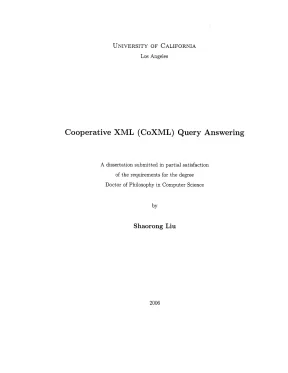
Tải xuống để đọc toàn bộUNIVERSITY OF CALIFORNIA Los Angeles Cooperative XML (CoXML) Query Answering A dissertation submitted in partial satisfaction of the requirements for the degree Doctor of Philosophy in Computer Science by Shaorong Liu 2006 UMI Number: 3240875 INFORMATION TO USERS The quality of this reproduction is dependent upon the quality of the copy submitted. Broken or indistinct print, colored or poor quality illustrations and photographs, print bleed-through, substandard margins, and improper alignment can adversely affect reproduction. In the unlikely event that the author did not send a complete manuscript and there are missing pages, these will be noted. Also, if unauthorized copyright material had to be removed, a note will indicate the deletion.
® UMI UMI Microform 3240875 Copyright 2007 by ProQuest Information and Learning Company. All rights reserved. This microform edition is protected against unauthorized copying under Title 17, United States Code. ProQuest Information and Learning Company 300 North Zeeb Road P.
Box 1346 Ann Arbor, MI 48106-1346 © Copyright by Shaorong Liu 2006 The dissertation of Shaorong Liu is approved. C2 TS Junghoo Cho Carlo Zaniolo LÒ, ce Yifgnian Wu A:— Wesley W. Chu, Committee Chair University of California, Los Angeles 2006 il To my family 1H TABLE OF CONTENTS 1 Introduction. 0000 2 gà kẻ va 1 11 The Problem.
cuc 1 12 CoXML Framework.3 Outline of the Dissertation. 6 2 Foundation of XML Relaxation.4 Query Relaxation Types .5 Query Relaxation Properties. eee 15 3 XML Query Relaxation Language. gà AT kia 19 3.2 Query Relaxation Language Syntax .3 Query Relaxation Language Examples.
ee 25 4 XML Relaxation Index Structure - XTAH. cv vn v v kg KV kg va 26 4.2 XML Type Abstraction Hierarchy- XTAH. eee ee eens 30 lv 4.4 Assigning Internal Representativesin XTAH .5 XTAH-Guided Query Relaxation Process.6 Relaxing Queries with Similar Structures. kg xa 45 XML Ranking .1 Weighted Term Frequency.2 Inverse Element FTequency.3 Extended Vector Space Model.3 Semantics-Oriented Structure Distance.
ee và va 57 5.1 The System ArchiteetUre.2 RLXQuery: A Relaxation-Enabled XQuery.2 Local Relaxation Control Operators.3 Global Relaxation Control Operators .3 Functionalities of System Components .4 The Relaxation Control Flow. ga 73 7 Evaluation Studies. eee ee ees 79 7.1 The INEX Test Collection.2 Query Sets & Tasks.2 Experimental Studies on the Content Similarity .1 Evaluation Studies on Different Node Weight Configurations 82 7.2 Evaluation Studies on Different Term Modifier Weight Con- figurations.3 Performance Studies with all the 30 CAS Topics in INEX 03 89 7.3 Evalation Studies on the CoXML Testbed .1 INEX 05 Query Sets .00 0c 2 cv Vy nt 101 References. AAaaaaaa 130 vi LIST OF FIGURES 11 The CoXML framework .1 A sample XML document.2 The tree representation of the sample XML document in Figure 2.3 Asample XML twig .4 Examples of structure relaxations for the twig in Figure2.1 A sample relaxation-enabled XML query.2 Topic 267 in the INEX 05 query set.3 Representing topic 267 in the INEX 05 query set with our query relaxation language.1 An example of re-using relaxed twigs for relaxing queries with the same tree structure .2 An example of XML relaxation index structure for the twig in Figure2.3 An example of using the upper and lower distance bounds in de- termining the search paths .4 The XTAH with some internal groups pruned based on the relax- ation controls !del($4) A gen(esis›) A !gen(esiss) A UseRT ype (node_delete, edge_generalization) in Figure3.5 A query with its twig structure similar to that in Figure2.1 An example of weighted term frequency.1 The CoXML testbed architecture .2 The CoXML testbed query relaxation control flow .3 The screen shot of a sample relaxation process: before relaxation .4 The screen shot of how a user edits the domain knowledge 73 6.ð The screen shot of a sample relaxation process: 1# relaxation.6 The screen shot of a sample relaxation process: 2” relaxation 76 6.7 The screen shot for a sample relaxation process: 3"? relaxation .1 The structure of a sample XML document in the INEX test collection 80 7.2 The structure summary of the INEX XML dataset .3 The precision/recall curves for topic 65 using the node weight con- figurations N,, N, & N, and the strict quantization function .4 The precision/recall curves for topic 65 using the node weight con- figurations N,, N, & N, and the generalized quantization function 85 7.5 The precision/recall curves for the 30 CAS topics in INEX 03 with the node weight configuration N, and the term modifer weight configuration M, 7.6 Comparisions of the number of returned results by our system vs.
the number of relevant results in the relevance assessment using the generalized quantization function .7 The precision/recall curves for the 30 CAS topics in INEX 03 with the node weight configuration Ny and term modifier weight con- figuration My using the AND-OR implmentation.8 The decay functiona®TM. ee vill LIST OF TABLES 2.1 Summary of notations related to the XML data model .2 Summary of notations related to the XML query model.3 Summary of notations related to XML query relaxation.1 Summary of notations related to XTAH internal nodes. 35 71 The meanings of the node labels used in Figure7.2 Three sets of node weight configurations used in experiments.3 The average precisions for topic 65 using the node weight configu- ration Nz, N, and Ng.4 Three sets of term modifier weight configurations used in experiments 87 7.5 The average precisions for topic 62 using the term modifier weights M,, Mp and Mz.6 The average precisions for all the 30 SCAS topics with the node weight configuration A and the term modifier weight configutation 7.7 The set of multi-branch queries in the INEX 05 CAS query set with their relevance assessment available .8 Comparisons of the performance evaluations (nxCG@10) for the results using the semantics-oriented vs. the uniform-cost distance functions.9 Comparisons of the performance evaluations (nxCG@25) for the results using semantics-oriented vs.
uniform-cost distance functions 98 1X 7.10 Comparisons of performance evaluations for the results with relax- ation controls vs. without relaxation controls (a =0.11 Comparisons of the performance evaluations for our results (a = 0. the official INEX 05 top-1 results in the VSCAS subtask 100 ACKNOWLEDGMENTS First, I would like to thank my advisor, Professor Wesley W. Chu, for being such a great advisor.
It is his profound knowledge and extreme patience that guided me through this dissertation. I am very grateful to Dr. Chu for the amount of effort he spent in helping me overcome various hurdles in research problems during the past four years. I also appreciate his extreme patience in advising me on how to write research papers and how to present research ideas.
I still recalled how Dr. Chu patiently helped me before I did my very first paper presentation at the SIGIR conference. Chu attended all four of my dry runs and gave me very constructive feedbacks in each dry run. I am fortunate to have not only a great research advisor but also a wonderful mentor in life.
During the past four years, Dr. Chu has kindly given me many invaluable advices, which alway inspire me and will be my lifelong assets. Second, I want to thank Professors Carlo Zaniolo and Junghoo Cho for helps during my Ph. I especially want to thank Professor Junghoo Cho for his advices on how to write research papers and how to do presentations.
I also want to thank Professors Junghoo Cho, Carlo Zaniolo and Yingnian Wu for participating in my Ph. committee and taking time to guide me through my dissertation. Third, I want to thank the two visiting professors, Arne and Ingeborg Solvberg, from Norwegian University of Science and Technology. They have given me many comments regarding my Ph.
research during their visit at UCLA. Professor Arne Solvberg has provided me with many constructive feedback on the various aspects of my defense slides, such as the organizations and logical connections. The research and development of CoXML has been a team effort. I would like Xi to thank our CoXML members, Tony Lee, Eric Sung, Anna Putnam, Christian Cardenas, Joseph Chen and Ruzan Shahinian, for their contributions in imple- mentation, testing and performance evaluation efforts.
I especially want to thank Ruzan, who has works with me during the past three years. Since Fall 2002, I have been actively participating in organizing dbUCLA sem- inars, which has been the most joyful extra-curriculum activity during my Ph. These seminars expose me to diverse state-of-the-art research topics and projects. I am grateful to all those students who were involved in organizing the seminars with me: Dr.
Zhenyu (Victor) Liu, Dr. Yi Xia, Alexandros Ntoulas, Ka Cheung Sia (Richard), Jianming He, Hetal Thakkar, Feng Qiu, Laura Yu Chen and many others. I am also indebted to all those volunteer seminar speakers, such as Raymond Pon, who has always been a great backup speaker. Further- more, special thanks goes to Professors Carlo Zaniolo and Junghoo Cho for their support in these activities.
I also want to thank our CoBase alumni, Dr. Wenlei Mao, Dr. Zhenyu (Victor) Liu and Dr. Wenlei gave me many suggestions during my first year working on XML relaxation.
Victor helped me a lot in both research and technical problems during the past few years. Qinghua was my first research collaborator and his hard work made the collaboration productive. I am also thankful to our current CoBase members, Jianming He and Laura Yu Chen, who are not only great colleagues but also good friends. Last but not least, I would like to thank my parents for their love, encour- agement and support over the years.
I also want to thank my fiance, Jiaxing, for his love, for always being very supportive and for sharing all the frustrating, sad, exciting and happy moments with me. His love and support greatly relieves me from all the stresses during my Ph. Summer 2005 Research Intern, Siemens Corporate Research(SCR). Fall 2005 Teaching Assistant, Computer Science Department, UCLA.
Fall 2004 Teaching Assistant, Computer Science Department, UCLA. 2002 - 2006 Research Assistant, Computer Science Department, UCLA. PUBLICATIONS Fusheng Wang, Shaorong Liu, Peiya Liu and Yijian Bai. Bridging Physical and Virtual Worlds: Complex Event Processing for RFID Data Streams.
In Proceedings of 10th International Conference on Extending Database Technology (EDBT 2006), Munich, Germany, March, 2006. Fusheng Wang, Shaorong Liu and Peiya Liu. Complex RFID Event Processing. Submitted for Journal Publication, 2006.
xii Shaorong Liu, Fusheng Wang and Peiya Liu. Integrated RFID Data Modeling: An Approach for Querying Physical Objects in Pervasive Computing. Submitted for Conference Publication, 2006. Yijian Bai, Fusheng Wang, Peiya Liu and Shaorong Liu.
RFID Data Processing with a Data Stream Query Language. Submitted for Conference Publication, 2006. Shaorong Liu and Wesley W. CoXML: A Cooperative XML Query An- swering System.
Submitted for Conference Publication, 2006. Chu and Shaorong Liu. Cooperative XML (CoXML) Query An- swering. Encyclopedia and Electronic Engineering, John Wiley & Son, Inc., 2006 Shaorong Liu, Wesley W.
Chu and Ruzan S. Vague Content and Structure (VCAS) Retrieval for Document-Centric XML Collections. In Proceed- ings of the 8th International Workshop on Web and Database (WebDB 2005), Baltimore, Maryland, USA, June, 2005. Shaorong Liu, Qinghua Zou, Wesley W.
Configurable Indexing and Rank- ing for XML Information Retrieval. In Proceedings of 27th Annual International ACM Special Interest Group on Information Retrieval (SIGIR 2004) Conference, Sheffield, UK, July, 2004. Qinghua Zou, Shaorong Liu, Wesley W. Using a Compact Tree to Index XIV and Query XML Data.
In Proceedings of Thirteenth Conference on Information and Knowledge Management (CIKM 2004), Washington D. Qinghua Zou, Shaorong Liu, Wesley W. CTree: A Compact Tree for Indexing XML Data. In Proceedings of 6th International Workshop on Web In- formation and Data Management (WIDM 2004), Washington D., USA, Novem- ber, 2004.
Shaorong Liu and Wesley W. Cooperative XML (CoXML) Query An- swering at INEX 2003. In Proceedings of the 2nd Initiative of the Evaluation of XML Retrieval (INEX 2003) Workshop, Schloss Dagstuhl, Germany, December, 2003. Xiaoyan Hong, Nam Nguyen, Shaorong Liu and Ying Teng.
Dynamic Group Support in LANMAR Routing Ad Hoc Networks.
Nội dung được bảo vệ bản quyền — Tải xuống đầy đủ
Trích dẫn luận án này
Shaorong Liu (2006). CoXML Query Answering - Luận án tiến sĩ Shaorong Liu UCLA [Luận án tiến sĩ, University of California, Los Angeles]. LuanAn.net. https://luanan.net/cong-nghe-thong-tin/khoa-hoc-may-tinh/coxml-query-answering-luan-an-tien-si-shaorong-liu-ucla
Câu hỏi thường gặp
Luận án "CoXML Query Answering - Luận án tiến sĩ Shaorong Liu UCLA" nghiên cứu về vấn đề gì?
Luận án tiến sĩ Cooperative XML Query Answering. Framework CoXML tối ưu hóa truy vấn XML qua kỹ thuật nới lỏng truy vấn và xếp hạng kết quả hiệu quả.
Luận án "CoXML Query Answering - Luận án tiến sĩ Shaorong Liu UCLA" được bảo vệ tại trường nào?
Luận án này được bảo vệ tại University of California, Los Angeles. Năm bảo vệ: 2006.
Luận án "CoXML Query Answering - Luận án tiến sĩ Shaorong Liu UCLA" thuộc chuyên ngành gì?
Luận án "CoXML Query Answering - Luận án tiến sĩ Shaorong Liu UCLA" thuộc chuyên ngành Computer Science. Danh mục: Khoa Học Máy Tính.
Luận án "CoXML Query Answering - Luận án tiến sĩ Shaorong Liu UCLA" có bao nhiêu trang?
Luận án "CoXML Query Answering - Luận án tiến sĩ Shaorong Liu UCLA" có 154 trang. Bạn có thể xem trước một phần tài liệu ngay trên trang web trước khi tải về.
Cách tải luận án "CoXML Query Answering - Luận án tiến sĩ Shaorong Liu UCLA" về máy như thế nào?
Để tải luận án về máy, bạn nhấn nút "Tải xuống ngay" trên trang này, sau đó hoàn tất thanh toán phí lưu trữ. File sẽ được tải xuống ngay sau khi thanh toán thành công. Hỗ trợ qua Zalo: 0559 297 239.