Luận án: Tương tác chiến lược đô thị Nhật Bản về chi tiêu & lương công
Nghiên cứu thực nghiệm về tương tác chiến lược giữa các đô thị lân cận tại Nhật Bản. Phân tích tác động chính sách và mô hình hợp tác.
Năm xuất bản
Số trang
83
Thời gian đọc
13 phút
Lượt xem
1
Lượt tải
0
Phí lưu trữ
40 Point
Tổng quan nhanh
- Chủ đề:
- Phân tích tương tác chiến lược đô thị Nhật Bản về chi tiêu công
- Số trang:
- 83 trang
- Trường:
- Kyushu University
- Chuyên ngành:
- Economics
- Tác giả:
- Nguyen Tuan Dung
- Năm:
- 2022
Tóm tắt nội dung luận án
I.Phân tích tương tác chiến lược đô thị Nhật Bản về chi tiêu công
Nghiên cứu này khám phá sâu sắc tương tác chiến lược giữa các đô thị lân cận tại Nhật Bản. Trọng tâm là phân tích chi tiêu công và mức lương công chức. Dữ liệu từ 1704 đô thị Nhật Bản, thu thập từ năm 2010 đến 2016, được sử dụng để kiểm định giả thuyết. Mục tiêu là xác định liệu các đô thị có điều chỉnh mức chi tiêu công của mình dựa trên những thay đổi của các đô thị lân cận hay không. Đây là một yếu tố then chốt trong quy hoạch đô thị và quản lý đô thị. Các mô hình không gian được xây dựng để xem xét cả tương quan trễ không gian và lỗi không gian. Việc hiểu rõ các tương tác này cung cấp cái nhìn quan trọng về hành vi ra quyết định ở cấp địa phương. Nó ảnh hưởng trực tiếp đến hiệu quả của ngân sách nhà nước và các nỗ lực phát triển đô thị bền vững.
1.1. Bối cảnh nghiên cứu tương tác chi tiêu công
Luận án tổng hợp lý thuyết và bằng chứng thực nghiệm về tương tác chiến lược. Nghiên cứu tập trung vào chi tiêu công và mức lương công chức. Dữ liệu từ 1704 thành phố Nhật Bản (2010-2016) được phân tích. Mục đích là phát hiện bằng chứng về tương tác chiến lược giữa các đô thị. Các đô thị điều chỉnh chi tiêu dựa trên hành động của hàng xóm.
1.2. Phát hiện tương tác không gian chi tiêu đô thị
Các kết quả cho thấy tương tác chiến lược không gian về chi tiêu công tồn tại. Các đô thị Nhật Bản xem xét lựa chọn của hàng xóm. Điều này diễn ra khi đưa ra quyết định chi tiêu địa phương. Hệ số trễ không gian dương và có ý nghĩa thống kê. Điều này khẳng định rõ ràng mối liên hệ giữa các đô thị, tác động đến quy hoạch đô thị tổng thể.
II.Ảnh hưởng lương công chức đến phát triển đô thị Nhật Bản
Luận án cũng điều tra mối liên hệ giữa lương công chức và quyết định chi tiêu của chính quyền địa phương. Sau giai đoạn can thiệp từ chính phủ trung ương, các thay đổi trong mức lương công chức của đô thị lân cận có tác động đáng kể. Cụ thể, ảnh hưởng tích cực đến mức lương của một đô thị nhất định được ghi nhận. Điều này nhấn mạnh tầm quan trọng của chính sách lương trong bức tranh tổng thể của phát triển đô thị bền vững. Chính phủ trung ương cần hiểu rõ những tác động này để xây dựng các chính sách tài khóa và quy hoạch đô thị hiệu quả. Nó đảm bảo sự phân bổ nguồn lực công bằng và hiệu quả hơn, hỗ trợ quá trình đô thị hóa lành mạnh, đồng thời cải thiện hạ tầng đô thị.
2.1. Đánh giá tương tác chiến lược về lương công chức
Nghiên cứu kiểm tra cách các đô thị điều chỉnh lương công chức. Nó phản ứng với các thay đổi từ đô thị lân cận. Đặc biệt, sau các can thiệp từ chính phủ trung ương, tác động này trở nên rõ rệt. Thay đổi lương của hàng xóm có ảnh hưởng tích cực đến mức lương của một đô thị, tạo ra sự lan tỏa trong chính sách lương.
2.2. Chính sách lương công quản lý đô thị
Các phát hiện có ý nghĩa quan trọng cho chính sách lương công. Chính phủ trung ương cần xem xét tương tác này. Nó giúp xây dựng chính sách hiệu quả hơn. Mục tiêu là đảm bảo công bằng và hiệu quả trong quản lý đô thị. Hỗ trợ phát triển đô thị bền vững, đồng thời củng cố hạ tầng đô thị và quy hoạch đô thị.
III.Mô hình không gian Đánh giá quy hoạch đô thị ngân sách
Phương pháp luận của nghiên cứu bao gồm việc xây dựng các mô hình không gian phức tạp. Các mô hình này được thiết kế để tính đến cả tương quan trễ không gian và lỗi không gian. Điều này giúp nắm bắt đầy đủ các mối quan hệ phức tạp giữa các đô thị. Ước lượng bình phương tối thiểu hai giai đoạn tổng quát (GS2SLS) được sử dụng cho phân tích chính. Ước lượng khả năng xảy ra tối đa (ML) dùng để kiểm tra độ bền vững của kết quả. Độ tin cậy của các phát hiện được đảm bảo thông qua việc sử dụng nhiều ma trận trọng số không gian khác nhau. Ngoài ra, các biến kiểm soát bổ sung và mô hình bảng không gian cũng được áp dụng. Điều này củng cố tính vững chắc của phân tích ngân sách nhà nước và các quyết định quy hoạch đô thị.
3.1. Phương pháp nghiên cứu và dữ liệu chi tiêu công
Các mô hình không gian được xây dựng. Chúng tính đến tương quan trễ không gian và lỗi không gian. Ước lượng GS2SLS cho phân tích chính. Ước lượng ML dùng để kiểm tra độ bền vững. Dữ liệu từ 1704 đô thị Nhật Bản, giai đoạn 2010-2016, cung cấp nền tảng vững chắc cho phân tích chi tiêu công và quy hoạch đô thị.
3.2. Độ tin cậy của phân tích ngân sách nhà nước
Kết quả nghiên cứu nhất quán trên nhiều cấu hình. Bao gồm các ma trận trọng số không gian khác nhau. Thêm các biến kiểm soát bổ sung. Áp dụng các mô hình bảng không gian. Điều này củng cố độ tin cậy của các phát hiện. Giúp đánh giá chính xác tác động của ngân sách nhà nước và hỗ trợ quản lý đô thị hiệu quả.
IV.Kết quả nghiên cứu Quản lý đô thị chính sách lương hiệu quả
Các kết quả nghiên cứu chỉ ra rằng các đô thị Nhật Bản thực sự cân nhắc lựa chọn của hàng xóm. Điều này diễn ra khi đưa ra các quyết định về chi tiêu công và mức lương công chức. Sự tồn tại của tương tác chiến lược không gian trong chi tiêu công địa phương được khẳng định rõ ràng. Điều này thể hiện qua các hệ số trễ không gian dương và có ý nghĩa thống kê. Các phát hiện này cung cấp những hiểu biết hữu ích. Nó giúp chính phủ trung ương xây dựng các kế hoạch khu vực hiệu quả hơn. Đồng thời, nó định hình chính sách tài khóa để luồng chi tiêu ở cấp địa phương công bằng và hiệu quả hơn. Điều này đặc biệt quan trọng cho quy hoạch đô thị và phát triển đô thị bền vững, cũng như việc đầu tư vào hạ tầng đô thị.
4.1. Tầm quan trọng của tương tác không gian đô thị hóa
Các đô thị Nhật Bản có xu hướng tương tác chiến lược. Đặc biệt trong chi tiêu và lương. Tương tác này ảnh hưởng đến phân bổ nguồn lực. Nó cũng tác động đến quy hoạch đô thị tổng thể. Nghiên cứu cung cấp cái nhìn sâu sắc về đô thị hóa và cách các đô thị phát triển theo thời gian.
4.2. Khuyến nghị chính sách cho hạ tầng đô thị
Kết quả cung cấp cơ sở quan trọng. Dành cho chính phủ trung ương Nhật Bản. Giúp hoạch định chính sách khu vực hiệu quả. Đặc biệt về chính sách tài khóa. Đảm bảo chi tiêu địa phương công bằng. Tăng hiệu quả cho hạ tầng đô thị, thúc đẩy phát triển đô thị bền vững và quản lý đô thị hiệu quả.
V.Đề xuất chính sách Phát triển đô thị bền vững Nhật Bản
Dựa trên các bằng chứng thực nghiệm, nghiên cứu này đưa ra các đề xuất chính sách quan trọng. Chính phủ trung ương cần nhận thức rõ vai trò của mình trong việc định hình các tương tác chiến lược này. Đặc biệt là sau các sự kiện lớn như Động đất lớn phía Đông Nhật Bản. Các chính sách liên quan đến lương khu vực công đã cho thấy tác động đáng kể. Việc hiểu và quản lý các tác động này sẽ giúp tối ưu hóa hiệu quả chi tiêu công. Điều này hướng tới mục tiêu phát triển đô thị bền vững. Các chính sách tài khóa và quy hoạch đô thị cần được thiết kế cẩn thận để thúc đẩy sự cân bằng. Nó giảm thiểu sự chênh lệch giữa các đô thị và đảm bảo sự công bằng trong ngân sách nhà nước.
5.1. Can thiệp chính phủ và hiệu quả chi tiêu công
Can thiệp của chính phủ trung ương đóng vai trò quan trọng. Nó định hình các tương tác chiến lược. Đặc biệt sau thảm họa lớn. Các chính sách lương khu vực công có tác động rõ rệt. Cần xem xét kỹ lưỡng để tối ưu hóa hiệu quả chi tiêu công. Điều này đảm bảo sự phân bổ nguồn lực hiệu quả trong quản lý đô thị.
5.2. Hướng tới sự cân bằng trong ngân sách địa phương
Chính phủ trung ương có thể sử dụng thông tin này. Mục đích là thúc đẩy sự cân bằng giữa các đô thị. Giảm thiểu chênh lệch chi tiêu và lương. Đảm bảo phát triển đồng đều, bền vững. Cần có chiến lược rõ ràng. Hỗ trợ ngân sách nhà nước cho các địa phương. Điều này giúp nâng cao quản lý đô thị và quy hoạch đô thị tổng thể.
Mục lục chi tiết luận án
Tải xuống file đầy đủ để xem toàn bộ nội dung
Tải đầy đủ (83 trang)Nội dung chính
Tổng quan về luận án
Luận án này tiên phong trong việc cung cấp một phân tích chuyên sâu về tương tác chiến lược giữa các đô thị lân cận của Nhật Bản, đặc biệt tập trung vào các quyết định về chi tiêu công và mức lương công chức. Trong bối cảnh phân cấp tài khóa đang diễn ra trên toàn cầu, nghiên cứu này đóng góp đáng kể vào việc giải quyết khoảng trống trong tài liệu học thuật về tương tác tài khóa ngang cấp ở các nước phát triển, đặc biệt là việc thiếu các nghiên cứu định lượng áp dụng phương pháp tiếp cận bán thực nghiệm. Mặc dù các công trình trước đây đã chứng minh sự tồn tại của tương tác chiến lược trong chi tiêu chính phủ (ví dụ: Case et al., 1993; López et al., 2017), nhưng một đánh giá toàn diện tổng hợp các bằng chứng thực nghiệm gần đây về tương tác chi tiêu ngang cấp vẫn còn thiếu sót, với bài đánh giá cuối cùng của Bruecker (2003) đã lỗi thời gần hai thập kỷ. Hơn nữa, tài liệu về tương tác chiến lược trong việc xác định mức lương công chức địa phương, đặc biệt là sử dụng phương pháp kinh tế lượng không gian, hầu như không tồn tại kể từ nghiên cứu của Mehay và Gonzalez (1986) hơn 30 năm trước.
Luận án này giải quyết các khoảng trống nghiên cứu cụ thể thông qua hai nghiên cứu thực nghiệm. Nghiên cứu đầu tiên nhằm ước tính phản ứng của các đô thị Nhật Bản đối với những thay đổi trong chi tiêu đô thị ở các đô thị lân cận, sử dụng số lượng nhà bị phá hủy do trận động đất lớn phía Đông Nhật Bản (GEJE) làm nguồn biến động ngoại sinh trong chi tiêu địa phương. Nghiên cứu thứ hai mở rộng phân tích để khám phá tương tác chiến lược trong mức lương công chức địa phương, một hạng mục chi tiêu cốt lõi của chính phủ. Các câu hỏi nghiên cứu chính bao gồm:
- Liệu các đô thị Nhật Bản có thay đổi mức chi tiêu công của mình để phản ứng với những thay đổi tương ứng ở các đô thị lân cận hay không?
- Liệu các đô thị Nhật Bản có điều chỉnh mức lương công chức của mình để phản ứng với những thay đổi tương ứng ở các đô thị lân cận hay không?
- Các chính sách can thiệp của chính phủ trung ương sau GEJE đã ảnh hưởng như thế nào đến tương tác chiến lược trong mức lương công chức địa phương?
Giả thuyết chính (H1) là các đô thị có tương tác chiến lược tích cực trong các quyết định chi tiêu công, có khả năng bị ảnh hưởng bởi cạnh tranh thước đo (yardstick competition) và/hoặc cơ chế hợp tác. Giả thuyết thứ hai (H2) là tồn tại tương tác chiến lược giữa các đô thị lân cận trong việc xác định mức lương công chức địa phương, đặc biệt rõ rệt trong các giai đoạn chính phủ trung ương can thiệp.
Khung lý thuyết của luận án này dựa trên sự tổng hợp của nhiều mô hình giải thích tương tác tài khóa, bao gồm cạnh tranh thước đo (Salmon, 1987; Besley and Case, 1995), spillover chi tiêu (Gordon, 1983; Case et al., 1993), cạnh tranh tài khóa (Zodrow & Mieszkowski, 1986), liên kết chính trị (Foucault et al., 2008), và hợp tác liên chính phủ (Frère et al., 2014).
Các đóng góp đột phá của luận án này là định lượng đáng kể. Luận án đã chỉ ra rằng các tương tác chiến lược không gian về chi tiêu công địa phương giữa các đô thị Nhật Bản tồn tại, được tiết lộ bởi các hệ số độ trễ không gian dương và có ý nghĩa thống kê ở các mức độ thông thường (xem Bảng 9 và 10). Điều này được phát hiện trong một mẫu lớn gồm 1704 đô thị Nhật Bản trong giai đoạn 2010-2016. Đáng chú ý, luận án đã xác định rằng "trong các giai đoạn sau khi chính phủ trung ương can thiệp, có những tác động tích cực đáng kể của những thay đổi trong mức lương công chức của các đô thị lân cận đối với những thay đổi trong một đô thị nhất định." Điều này định lượng tác động của chính sách trung ương lên hành vi địa phương. Với quy mô mẫu toàn diện và cách tiếp cận đa chiều, nghiên cứu này đóng góp vào sự hiểu biết về cách các chính sách tài khóa được hình thành và thực hiện ở cấp độ tiểu quốc gia, đặc biệt trong bối cảnh phân cấp tài khóa và các cú sốc bên ngoài như GEJE.
Literature Review và Positioning
Luận án này cung cấp một tổng hợp rộng rãi các luồng tài liệu chính về tương tác tài khóa chiến lược, bao gồm các bằng chứng thực nghiệm và lý thuyết về spillover chi tiêu, cạnh tranh thước đo, cạnh tranh tài khóa, hợp tác liên chính phủ và liên kết chính trị. Bài tổng quan đã phân tích 32 bài báo thực nghiệm từ năm 2005 đến 2019, bao gồm nhiều quốc gia phát triển và đang phát triển như Hoa Kỳ, Anh, Thụy Điển, Đức, Pháp, Benin, Indonesia, và Trung Quốc, cung cấp một bức tranh toàn cầu về chủ đề này. Các tác giả được trích dẫn thường xuyên bao gồm Case et al. (1993), Baicker (2005), Solé-Ollé (2006), Ferraresi et al. (2016, 2018), Gu (2012), và Hayashi & Yamamoto (2017), những người đã khám phá các loại tương tác chi tiêu khác nhau từ tổng chi tiêu đến các hạng mục cụ thể như văn hóa, giáo dục, và y tế.
Tài liệu hiện có cho thấy nhiều mâu thuẫn và tranh luận, đặc biệt là về hướng và nguồn gốc của tương tác chiến lược. Ví dụ, trong khi nhiều nghiên cứu, chẳng hạn như Ferraresi et al. (2016) và Costa et al. (2015), tìm thấy sự bổ sung chiến lược (positive spatial interdependence) trong tổng chi tiêu, thì các nghiên cứu khác như Deng et al. (2012) và Yu et al. (2013) lại chỉ ra các spillover chi tiêu tiêu cực (chi tiêu thay thế chiến lược) trong các lĩnh vực như môi trường và y tế. Một tranh luận chính khác xoay quanh "vấn đề phản ánh" (reflection problem) của Manski (1993), làm cho việc phân biệt hiệu ứng xã hội nội sinh, hiệu ứng theo ngữ cảnh và hiệu ứng tương quan trở nên khó khăn. Breuillé và Le Gallo (2017) đã cố gắng giải quyết vấn đề này bằng cách sử dụng mô hình tự hồi quy không gian (SAR) kết hợp với các hiệu ứng cố định nhóm, trong khi Baicker (2005) và Ferraresi et al. (2018) sử dụng phương pháp tiếp cận bán thực nghiệm với biến động ngoại sinh.
Luận án này định vị mình bằng cách giải quyết một khoảng trống rõ ràng: thiếu bằng chứng thực nghiệm từ các phương pháp tiếp cận bán thực nghiệm trong bối cảnh chi tiêu công và sự vắng mặt của các nghiên cứu về tương tác chiến lược trong mức lương công chức sử dụng kinh tế lượng không gian trong hơn ba thập kỷ. Nghiên cứu này tiến xa hơn bằng cách áp dụng phương pháp bán thực nghiệm với "số lượng nhà bị phá hủy do trận động đất lớn phía Đông Nhật Bản (GEJE)" làm biến ngoại sinh để xác định tương tác chi tiêu, một cách tiếp cận tương tự như Ferraresi et al. (2018) đã sử dụng thảm họa thiên nhiên ở Abruzzo. Hơn nữa, luận án so sánh cụ thể với các nghiên cứu quốc tế. Ví dụ, trong khi Fossen et al. (2017) sử dụng các cú sốc giá dầu ở Colombia và không tìm thấy bằng chứng về tương tác tài khóa không gian, luận án này sử dụng cú sốc GEJE ở Nhật Bản và tìm thấy bằng chứng có ý nghĩa. Nghiên cứu cũng mở rộng phạm vi của tài liệu bằng cách khám phá tác động của các chính sách "từ dưới lên" và "từ trên xuống" của chính phủ trung ương Nhật Bản lên tương tác lương, một khía cạnh chưa được khám phá trong các nghiên cứu quốc tế như của Mehay và Gonzalez (1986) ở Hoa Kỳ. Bằng cách làm như vậy, luận án không chỉ lấp đầy các khoảng trống mà còn nâng cao sự hiểu biết về tương tác tài khóa trong các bối cảnh thể chế khác nhau.
Đóng góp lý thuyết và khung phân tích
Đóng góp cho lý thuyết
Luận án này đã mở rộng và thách thức các lý thuyết hiện có về tương tác tài khóa thông qua việc áp dụng phương pháp bán thực nghiệm và khám phá lĩnh vực mới về tương tác lương công chức. Nghiên cứu chủ yếu mở rộng lý thuyết về cạnh tranh thước đo (Salmon, 1987; Besley và Case, 1995) và spillover chi tiêu (Gordon, 1983). Cụ thể, nó cung cấp bằng chứng thực nghiệm về cạnh tranh thước đo và cơ chế hợp tác là những nguồn khả thi của tương tác chiến lược giữa các đô thị Nhật Bản trong chi tiêu công, tương tự như các phát hiện của Hayashi và Yamamoto (2017) ở Nhật Bản và Kim và Park (2019) ở Hoa Kỳ. Hơn nữa, luận án đóng góp vào lý thuyết về phân cấp tài khóa bằng cách chỉ ra rằng các chính sách "từ dưới lên" và "từ trên xuống" từ chính phủ trung ương có thể tác động đáng kể đến cường độ và hướng của tương tác chiến lược ở cấp địa phương, đặc biệt trong việc điều chỉnh mức lương công chức. Điều này làm sâu sắc thêm sự hiểu biết về cách các quy tắc và can thiệp thể chế có thể thay đổi các động lực tương tác của các tác nhân cấp dưới quốc gia.
Khung khái niệm của luận án bao gồm các thành phần chính sau: biến phụ thuộc (thay đổi chi tiêu công/lương công chức trên đầu người), biến độ trễ không gian (thay đổi chi tiêu/lương của đô thị lân cận), và các biến kiểm soát (nhân khẩu học, kinh tế xã hội, năng lực tài khóa). Mối quan hệ giữa các thành phần này được khái niệm hóa thông qua mô hình tự hồi quy không gian (SARAR), nơi các quyết định của một đô thị bị ảnh hưởng trực tiếp bởi các quyết định tương ứng của các đô thị lân cận (hiệu ứng độ trễ không gian, 𝜆0𝑊𝑦) và bởi các yếu tố không quan sát được có tương quan không gian (hiệu ứng sai số không gian, 𝜌0𝑊𝑢). Mô hình lý thuyết được củng cố bởi các giả thuyết được đánh số:
- Giả thuyết 1: Tồn tại tương tác chiến lược tích cực đáng kể giữa các đô thị lân cận trong việc thay đổi chi tiêu công trên đầu người.
- Giả thuyết 2: Tồn tại tương tác chiến lược tích cực đáng kể giữa các đô thị lân cận trong việc thay đổi mức lương công chức trên đầu người.
- Giả thuyết 3: Cường độ của tương tác chiến lược trong mức lương công chức tăng lên trong các giai đoạn chính phủ trung ương can thiệp bằng cách tiếp cận "từ trên xuống".
Mặc dù luận án không tuyên bố một sự thay đổi mô hình hoàn toàn (paradigm shift), nhưng bằng chứng từ các phát hiện của nó đã thách thức quan niệm truyền thống rằng "quyết định chi tiêu của một đô thị chỉ phụ thuộc vào thu nhập, các khoản trợ cấp từ các cấp chính phủ khác và các đặc điểm nhân khẩu học và/hoặc chính trị của nó." (trang 9). Bằng cách chứng minh một cách mạnh mẽ rằng "các chính phủ cấp dưới không đưa ra quyết định một cách biệt lập" và rằng "chi tiêu của các đô thị lân cận là một yếu tố quyết định quan trọng" (trang 9), luận án đã củng cố mô hình phụ thuộc không gian trong khoa học kinh tế, dịch chuyển sự tập trung từ các quyết định biệt lập sang các tương tác liên ngành.
Khung phân tích độc đáo
Khung phân tích của luận án này là độc đáo nhờ sự tích hợp của nhiều lý thuyết và phương pháp tiếp cận sáng tạo. Nó tích hợp chặt chẽ các lý thuyết về cạnh tranh thước đo (Salmon, 1987), spillover chi tiêu (Gordon, 1983), và các khía cạnh của kinh tế chính trị (Foucault et al., 2008 về liên kết chính trị và Matland, 1995 về cách tiếp cận chính sách). Sự tích hợp này cho phép một cái nhìn đa chiều về các động lực của tương tác tài khóa, vượt ra ngoài một yếu tố giải thích đơn lẻ. Ví dụ, nó không chỉ đơn thuần kiểm tra các spillover mà còn xem xét cạnh tranh thước đo là một nguồn tiềm năng của "các mẫu không thể phân biệt được trong tương tác không gian" (Barreira, 2011).
Cách tiếp cận phân tích sáng tạo nhất nằm ở việc sử dụng một thiết kế bán thực nghiệm độc đáo. Luận án tận dụng "số lượng nhà bị phá hủy ở mỗi đô thị do trận động đất lớn phía Đông Nhật Bản (GEJE)" làm một biến công cụ để tạo ra biến động ngoại sinh trong chi tiêu của các đô thị lân cận. Phương pháp này được biện minh bởi hai lý do chính: thứ nhất, số lượng nhà bị phá hủy đại diện cho mức độ thiệt hại cơ sở hạ tầng do động đất, ảnh hưởng đến ngân sách tái thiết của các đô thị, do đó xác minh sự phù hợp của công cụ; thứ hai, giá trị của mỗi mục trong công cụ dựa trên cú sốc ngoại sinh từ động đất, xác nhận tính ngoại sinh của công cụ. Cách tiếp cận này giải quyết "vấn đề phản ánh" (Manski, 1993) – một thách thức lớn trong việc ước tính tương tác tài khóa không gian – hiệu quả hơn so với các nghiên cứu trước đây vốn thường dựa vào dữ liệu không có biến động ngoại sinh.
Các đóng góp khái niệm bao gồm việc định nghĩa rõ ràng các cơ chế tương tác chiến lược trong bối cảnh Nhật Bản, phân biệt giữa các yếu tố thúc đẩy chi tiêu (ví dụ: tái thiết sau GEJE) và các yếu tố thúc đẩy lương (ví dụ: chính sách can thiệp của chính phủ trung ương). Luận án cũng đưa ra các "boundary conditions" một cách rõ ràng bằng cách tập trung vào các đô thị Nhật Bản trong giai đoạn 2010-2016 và thừa nhận rằng "sức mạnh và nguồn gốc của tương tác chiến lược có thể khác nhau giữa các quốc gia và khung thời gian." Điều này đảm bảo tính bền vững và khả năng kiểm chứng của các phát hiện.
Phương pháp nghiên cứu tiên tiến
Thiết kế nghiên cứu
Luận án này tuân thủ một triết lý nghiên cứu thực chứng hậu hiện đại (post-positivism), tìm kiếm các bằng chứng thực nghiệm để kiểm tra các giả thuyết về mối quan hệ nhân quả. Điều này được thể hiện qua việc sử dụng các mô hình kinh tế lượng không gian, các kiểm định thống kê nghiêm ngặt, và việc tập trung vào việc ước tính các tham số không gian một cách khách quan. Mục tiêu là "uncover empirical shreds of evidence on the presence of strategic interaction" (Abstract), phù hợp với việc theo đuổi sự thật khách quan mặc dù có thể không hoàn hảo.
Nghiên cứu sử dụng thiết kế phương pháp hỗn hợp theo nghĩa không gian, kết hợp cả độ trễ không gian (spatial lag) và sai số không gian (spatial error) vào mô hình SARAR (Spatial Autoregressive with Spatial Error Correlation). Rationale cho sự kết hợp này là để nắm bắt cả tương tác nội sinh giữa các biến phụ thuộc (𝜆0𝑊𝑦) và tương quan không gian trong các nhiễu loạn không quan sát được (𝜌0𝑊𝑢), giải quyết các nguyên nhân khác nhau của phụ thuộc không gian. Điều này vượt ra ngoài các mô hình chỉ tập trung vào một loại hiệu ứng không gian, như mô hình SAR hoặc SEM riêng lẻ, do đó cung cấp một phân tích toàn diện hơn về phụ thuộc không gian.
Thiết kế đa cấp cũng được ngụ ý thông qua việc phân tích hành vi của các đô thị (cấp địa phương) trong mối quan hệ với các đô thị lân cận (cấp ngang cấp) và dưới ảnh hưởng của các chính sách từ chính phủ trung ương (cấp quốc gia). Các cấp độ được định nghĩa rõ ràng là:
- Cấp 1: Đô thị cá thể - đưa ra các quyết định về chi tiêu và lương.
- Cấp 2: Các đô thị lân cận - ảnh hưởng đến quyết định của đô thị cá thể thông qua tương tác chiến lược.
- Cấp 3: Chính phủ trung ương - tác động đến các động lực tương tác thông qua các chính sách và can thiệp (ví dụ: giảm lương công chức sau GEJE, LAT).
Kích thước mẫu chính xác là 1704 đô thị Nhật Bản, với dữ liệu hàng năm trong 7 năm tài khóa (FY2010–FY2016). Tiêu chí lựa chọn mẫu là tất cả các đô thị có sẵn dữ liệu đầy đủ trong khung thời gian nghiên cứu, đảm bảo tính đại diện cho hệ thống hành chính địa phương Nhật Bản.
Quy trình nghiên cứu rigorous
Chiến lược lấy mẫu bao gồm việc sử dụng dữ liệu hành chính cho toàn bộ 1704 đô thị Nhật Bản từ 2010 đến 2016, thu thập từ các trang web thống kê chính phủ Nhật Bản chính thức. Tiêu chí bao gồm các đô thị có sẵn dữ liệu đầy đủ về chi tiêu công, mức lương công chức, và các biến kiểm soát như nhân khẩu học, kinh tế xã hội, và năng lực tài khóa. Các tiêu chí loại trừ là các đô thị có dữ liệu bị thiếu hoặc không nhất quán trong giai đoạn nghiên cứu.
Các giao thức thu thập dữ liệu bao gồm việc chuyển đổi các biến thành dạng logarit tự nhiên (ví dụ: chi tiêu đô thị trên đầu người, thu nhập chịu thuế trên mỗi người nộp thuế) để chuẩn hóa và giảm thiểu ảnh hưởng của các giá trị ngoại lai. Các công cụ thu thập dữ liệu là các báo cáo thống kê chính thức của chính phủ Nhật Bản, đảm bảo tính tin cậy và khách quan. Để giải quyết "vấn đề phản ánh" (Manski, 1993) và tăng cường độ tin cậy, nghiên cứu đã sử dụng phương pháp phép đo đạc tam giác (triangulation) ở cấp độ phương pháp luận bằng cách so sánh kết quả từ hai phương pháp ước tính chính: Generalized Spatial Two-Stage Least Squares (GS2SLS) và Maximum Likelihood (ML) estimators. "Các kết quả từ cả hai phương pháp ước tính đều hỗ trợ lẫn nhau, cho thấy một tương tác chiến lược không gian tích cực và có ý nghĩa thống kê" (trang 46). Về validity và reliability, nghiên cứu đã thực hiện các kiểm định chẩn đoán nghiêm ngặt cho phụ thuộc không gian, bao gồm kiểm định Moran’s I, Lagrange Multiplier (LM), và Robust LM (Bảng 8). Các kiểm định này "có ý nghĩa thống kê cao", cho phép bác bỏ giả thuyết không có tự tương quan không gian, qua đó củng cố validity của cấu trúc mô hình. Việc sử dụng các biến công cụ ngoại sinh (GEJE) để giải quyết nội sinh của biến độ trễ không gian góp phần tăng cường validity nội bộ, đảm bảo rằng các tương tác không gian được ước tính là hiệu ứng nhân quả thực sự chứ không phải là tương quan ngẫu nhiên. Tính nhất quán của các kết quả trên nhiều đặc tả khác nhau (ma trận trọng số không gian khác nhau, biến kiểm soát bổ sung, mô hình bảng không gian) thể hiện tính đáng tin cậy của các phát hiện, mặc dù giá trị alpha cụ thể không được báo cáo trực tiếp từ văn bản, tính nhất quán trên các đặc tả khác nhau (ví dụ: Bảng 9 và 10) đóng vai trò tương tự. Validity bên ngoài được thừa nhận thông qua việc thảo luận về các điều kiện giới hạn ("sức mạnh và nguồn gốc của tương tác chiến lược có thể khác nhau giữa các quốc gia và khung thời gian," trang 46).
Data và phân tích
Đặc điểm mẫu được tóm tắt trong Bảng 7, cung cấp số liệu thống kê mô tả về các biến chính cho năm 2010 và 2016. Ví dụ, chi tiêu đô thị trung bình (log per capita) là 6.29 vào năm 2010. Các biến kiểm soát bao gồm tỷ lệ dân số dưới 15 tuổi và trên 65 tuổi, tỷ lệ thất nghiệp của đô thị, thu nhập chịu thuế trên đầu người (log per taxpayer), tỷ lệ nợ tích lũy của đô thị, và tỷ lệ trợ cấp từ chính phủ cấp trên trên tổng doanh thu đô thị. Các biến này được sử dụng để kiểm soát sự biến thiên của đô thị về nhân khẩu học, kinh tế xã hội và năng lực tài khóa.
Nghiên cứu sử dụng các kỹ thuật tiên tiến trong kinh tế lượng không gian. Sau các kiểm định chẩn đoán (Moran’s I, LM, Robust LM) cho thấy sự phụ thuộc không gian cao (P-value 0.0000 cho Moran's I), mô hình tự hồi quy không gian với tương quan sai số không gian (SARAR) đã được chọn. Mô hình này được ước tính bằng hai phương pháp:
- Generalized Spatial Two-Stage Least Squares (GS2SLS): Đây là phương pháp chính cho phân tích, được biết đến là cung cấp các ước tính nhất quán hơn trong các trường hợp hiệp phương sai không đồng nhất (heteroskedastic cases) (Arraiz et al., 2010), chi tiết có trong Kelejian và Prucha (1998, 2010). Phương pháp này được sử dụng với tùy chọn
heteroskedastic. - Maximum Likelihood (ML) estimators: Được sử dụng cho các kiểm tra độ mạnh (robustness checks).
Các kỹ thuật này được thực hiện bằng cách sử dụng các phần mềm kinh tế lượng chuyên dụng, mặc dù tên phần mềm cụ thể không được nêu rõ trong đoạn văn bản này, ngụ ý là các phần mềm tiêu chuẩn như Stata, R, hoặc Matlab với các gói không gian chuyên biệt.
Kiểm tra độ mạnh (robustness checks) được thực hiện với "nhiều đặc tả khác nhau, bao gồm việc sử dụng các ma trận trọng số không gian khác nhau, các biến kiểm soát bổ sung, và các mô hình bảng không gian" (Abstract, trang 12).
Kết quả báo cáo các hệ số độ trễ không gian (Lambda) và các giá trị P (p-values) để xác định ý nghĩa thống kê. Ví dụ, "Lambda trong cả bốn đặc tả từ Cột (1) đến (4) đều dương và có ý nghĩa thống kê ở mức 1%" (Bảng 9), với các giá trị như
0.067)và0.080). Mặc dù kích thước hiệu ứng (effect sizes) và khoảng tin cậy (confidence intervals) không được báo cáo trực tiếp trong đoạn văn bản cung cấp, các hệ số (ví dụ: Lambda = 0.067) đã cung cấp thông tin về độ lớn của mối quan hệ, với ý nghĩa thống kê được báo cáo qua P-value.
Phát hiện đột phá và implications
Những phát hiện then chốt
Luận án này đã đưa ra những phát hiện then chốt với bằng chứng cụ thể từ dữ liệu, cung cấp hiểu biết sâu sắc về tương tác chiến lược giữa các đô thị Nhật Bản:
- Tương tác chiến lược tích cực trong chi tiêu công: Tồn tại tương tác chiến lược không gian tích cực và có ý nghĩa thống kê trong việc thay đổi chi tiêu công trên đầu người giữa các đô thị lân cận của Nhật Bản. "Lambda trong cả bốn đặc tả từ Cột (1) đến (4) đều dương và có ý nghĩa thống kê ở mức 1%," cho thấy sự bổ sung chiến lược (strategic complementarity) (Bảng 9 và 10). Điều này có nghĩa là một đô thị có xu hướng tăng chi tiêu của mình khi các đô thị lân cận cũng tăng chi tiêu.
- Tương tác chiến lược trong mức lương công chức: Các đô thị cũng chú ý đến các đô thị khác khi đưa ra quyết định về mức lương công chức. "Trong các giai đoạn sau khi chính phủ trung ương can thiệp, có những tác động tích cực đáng kể của những thay đổi trong mức lương công chức của các đô thị lân cận đối với những thay đổi tương ứng trong một đô thị nhất định" (Abstract, trang 12). Điều này làm rõ một khoảng trống nghiên cứu kéo dài hơn ba thập kỷ.
- Ảnh hưởng của can thiệp chính phủ trung ương: Tương tác chiến lược trong mức lương công chức trở nên mạnh mẽ và có ý nghĩa đáng kể khi chính phủ trung ương thực hiện cách tiếp cận chính sách "từ trên xuống" (top-down policy approach), như việc giảm LAT liên quan đến giảm lương công chức (trang 12, trang 49-50). Đây là một phát hiện quan trọng chỉ ra vai trò của các thể chế cấp cao hơn trong việc định hình các động lực tương tác cấp địa phương.
- Cạnh tranh thước đo và cơ chế hợp tác là nguồn tiềm năng: Các phát hiện cho thấy cạnh tranh thước đo (yardstick competition) và cơ chế hợp tác là hai nguồn khả thi của tương tác chiến lược giữa các đô thị về chi tiêu công trong giai đoạn nghiên cứu. Các chính trị gia đô thị có thể bắt chước các chính sách tài khóa của các đô thị lân cận để tăng cơ hội tái đắc cử, hoặc có thể có các cơ chế đồng chi tiêu để tái thiết cơ sở hạ tầng chung sau GEJE (trang 45-46).
- Kết quả phản trực giác về dân số: "Hệ số của dân số đã đăng nhập là âm và có ý nghĩa ở mức 1% trong tất cả các đặc tả, chứng minh rằng việc tăng dân số, ceteris paribus, dẫn đến giảm chi tiêu đô thị" (trang 43). Phát hiện này có thể phản trực giác nhưng được giải thích bằng hiệu ứng quy mô kinh tế hoặc các thay đổi trong cơ cấu dân số (ví dụ: dân số già hóa cần ít dịch vụ hơn đối với chi tiêu chung, hoặc việc tăng dân số dẫn đến phân bổ nguồn lực hiệu quả hơn trên đầu người).
So với các nghiên cứu trước đây, phát hiện về tương tác chiến lược tích cực trong chi tiêu công của Nhật Bản tương đồng với các nghiên cứu ở Ý (Ferraresi et al., 2018) và Bồ Đào Nha (Costa et al., 2015) về tổng chi tiêu, nơi sự phụ thuộc không gian tích cực cũng được tìm thấy. Tuy nhiên, trong lĩnh vực lương công chức, nghiên cứu này mang tính đột phá hơn do thiếu tài liệu trước đây. Phát hiện về vai trò của chính phủ trung ương phân biệt nghiên cứu này với các mô hình thuần túy cấp dưới quốc gia, cung cấp một lăng kính thể chế độc đáo.
Implications đa chiều
Các phát hiện đột phá của luận án mang lại nhiều ý nghĩa đa chiều, có thể định hình lại lý thuyết, phương pháp luận, và thực tiễn:
Phát triển lý thuyết: Nghiên cứu đóng góp vào hai lý thuyết chính:
- Lý thuyết về Tương tác Tài khóa: Mở rộng lý thuyết này bằng cách cung cấp bằng chứng thực nghiệm mạnh mẽ từ một bối cảnh độc đáo (Nhật Bản và GEJE) và bằng cách làm sáng tỏ các nguồn tiềm năng của tương tác (cạnh tranh thước đo, hợp tác liên đô thị). Nó củng cố khái niệm "các chính phủ cấp dưới không đưa ra quyết định một cách biệt lập" (trang 9).
- Lý thuyết Phân cấp Tài khóa: Làm sâu sắc thêm sự hiểu biết về vai trò của chính phủ trung ương trong việc định hình các động lực tài khóa của chính quyền địa phương, đặc biệt là trong các bối cảnh cú sốc ngoại sinh. Các chính sách "từ trên xuống" có thể tăng cường tương tác chiến lược, điều chỉnh lại quan điểm về sự tự chủ hoàn toàn của chính quyền địa phương.
Đổi mới phương pháp luận: Việc sử dụng thành công "số lượng nhà bị phá hủy do trận động đất lớn phía Đông Nhật Bản (GEJE)" làm một biến công cụ ngoại sinh cung cấp một mô hình mới cho các nghiên cứu tương lai về tương tác tài khóa không gian. Phương pháp này có thể áp dụng cho các bối cảnh khác nơi có các cú sốc ngoại sinh rõ ràng (ví dụ: thảm họa thiên nhiên, thay đổi quy định đột ngột) để giải quyết "vấn đề phản ánh" (Manski, 1993) và thiết lập mối quan hệ nhân quả mạnh mẽ hơn. Việc sử dụng kết hợp GS2SLS và ML cho độ mạnh cũng là một phương pháp luận đáng tham khảo.
Ứng dụng thực tiễn:
- Phân bổ tài chính: Các chính phủ trung ương nên tính đến tương tác chiến lược giữa các đô thị khi phân bổ tài chính và xây dựng các chính sách tài khóa địa phương hiệu quả. Ví dụ, trợ cấp cho một đô thị có thể có tác động lan tỏa đến chi tiêu của các đô thị lân cận (trang 46).
- Quản lý lương công chức: Hiểu biết về tương tác lương cho phép chính phủ trung ương thiết kế các chính sách can thiệp (ví dụ: giảm lương sau GEJE) có thể đạt được hiệu quả mong muốn thông qua việc khai thác các động lực tương tác không gian.
- Phân cấp chính sách: Các nhà hoạch định chính sách cần nhận thức rằng các quyết định chính sách ở cấp địa phương không xảy ra trong chân không và có thể bị ảnh hưởng bởi hành vi của các hàng xóm, dẫn đến "race-to-the-top" hoặc "race-to-the-bottom" tùy thuộc vào bản chất của tương tác.
Kiến nghị chính sách:
- Chính sách Quy hoạch vùng: Chính phủ trung ương cần xem xét các hiệu ứng spillover và cạnh tranh thước đo khi xây dựng các chính sách quy hoạch vùng để đảm bảo chi tiêu hiệu quả và bình đẳng hơn ở cấp dưới quốc gia (Abstract).
- Công cụ thông tin: Các công cụ như Bảng Chỉ số Tài khóa cho các Đô thị Tương tự (FITS-M) của Nhật Bản (Hayashi & Yamamoto, 2017) nên được thúc đẩy để khuyến khích cạnh tranh thước đo mang tính xây dựng. Tuy nhiên, cần lưu ý đến các trường hợp có thể dẫn đến "race to the bottom."
- Can thiệp được nhắm mục tiêu: Khi chính phủ trung ương muốn điều chỉnh chi tiêu hoặc lương ở cấp địa phương, họ có thể sử dụng các chính sách can thiệp có tính toán để khai thác hoặc kiểm soát các động lực tương tác không gian.
Các điều kiện tổng quát hóa được quy định rõ ràng: "Sức mạnh và nguồn gốc của tương tác chiến lược có thể khác nhau giữa các quốc gia và khung thời gian" (trang 46). Mặc dù các phát hiện cụ thể cho Nhật Bản, cách tiếp cận phương pháp luận và các hiểu biết sâu sắc về vai trò của chính phủ trung ương và cú sốc ngoại sinh có thể áp dụng cho các bối cảnh phân cấp tài khóa tương tự trên toàn cầu, đặc biệt là ở các quốc gia đang phát triển nơi các chính sách phân cấp đang được triển khai tích cực (Caldeira et al., 2015).
Limitations và Future Research
Luận án này thừa nhận một cách thẳng thắn một số hạn chế cụ thể:
- Phạm vi địa lý và thời gian: Các kết quả được rút ra từ dữ liệu của Nhật Bản trong một khoảng thời gian cụ thể (2010-2016). Điều này có thể hạn chế khả năng tổng quát hóa hoàn toàn cho các quốc gia khác hoặc các khung thời gian khác, do sự khác biệt về thể chế, chính trị và kinh tế. Như tác giả đã nêu, "sức mạnh và nguồn gốc của tương tác chiến lược có thể khác nhau giữa các quốc gia và khung thời gian" (trang 46).
- Thiếu biến về chính trị: Nghiên cứu hiện tại không bao gồm các biến về liên kết chính trị hoặc thời gian bầu cử. "Việc bổ sung các biến về liên kết chính trị và thời gian bầu cử có thể giải thích rõ hơn liệu cạnh tranh thước đo có phải là một nguồn gốc của tương tác chiến lược giữa các chính quyền địa phương hay không" (trang 47). Điều này bỏ lỡ một yếu tố tiềm năng quan trọng đã được khám phá trong các nghiên cứu khác (Foucault et al., 2008; Barreira, 2011).
- Xác định nguồn gốc tương tác: Mặc dù luận án đề xuất cạnh tranh thước đo và cơ chế hợp tác là hai nguồn tiềm năng của tương tác chiến lược trong chi tiêu công, nhưng việc phân tách và định lượng chính xác đóng góp của từng nguồn có thể phức tạp. Như Šťastná (2009) đã lưu ý, "dạng rút gọn của mô hình ước tính có thể tạo ra các mẫu không thể phân biệt được trong tương tác không gian" (trang 21).
Các điều kiện giới hạn về bối cảnh, mẫu và thời gian được nêu rõ: nghiên cứu tập trung vào các đô thị Nhật Bản, một quốc gia đơn nhất với một hệ thống phân cấp tài khóa và chính sách trung ương độc đáo. Mẫu dữ liệu lớn nhưng giới hạn trong các đô thị có dữ liệu đầy đủ. Thời gian nghiên cứu được đánh dấu bởi GEJE và các chính sách can thiệp sau đó.
Chương trình nghiên cứu tương lai với 4-5 hướng cụ thể được đề xuất:
- Nghiên cứu so sánh đa quốc gia: Mở rộng nghiên cứu sang các quốc gia khác (ví dụ: các nước phát triển khác hoặc các nước đang phát triển với các cơ chế phân cấp tài khóa khác nhau) để kiểm tra tính tổng quát của các phát hiện và so sánh các động lực tương tác chiến lược trong các bối cảnh thể chế đa dạng.
- Phân tích chi tiết hơn về các hạng mục chi tiêu/lương: Nghiên cứu sâu hơn vào các hạng mục chi tiêu công cụ thể (ví dụ: giáo dục, y tế, an ninh công cộng) và các loại lương công chức khác nhau để xác định các nguồn và cường độ tương tác chiến lược khác nhau.
- Tích hợp biến chính trị: Kết hợp các biến liên quan đến chính trị, như liên kết đảng phái của thị trưởng, thời gian bầu cử, và cấu trúc quản trị địa phương, để hiểu rõ hơn vai trò của các yếu tố chính trị trong việc thúc đẩy hoặc điều tiết tương tác chiến lược.
- Các phương pháp bán thực nghiệm khác: Áp dụng các phương pháp bán thực nghiệm khác sử dụng các cú sốc ngoại sinh khác nhau (ví dụ: thay đổi chính sách đột ngột, thiên tai khác) để tăng cường tính nhân quả của các ước tính tương tác không gian, tương tự như Baicker (2005) hoặc Fossen et al. (2017).
- Phân tích tác động của các hình thức can thiệp khác nhau: Khám phá chi tiết hơn cách các loại hình can thiệp khác nhau của chính phủ trung ương (ví dụ: quy định, trợ cấp có điều kiện, chương trình thí điểm) tác động đến tương tác chiến lược ở cấp địa phương.
Các cải tiến phương pháp luận được đề xuất bao gồm việc phát triển các mô hình kinh tế lượng không gian có khả năng phân tách rõ ràng hơn các nguồn gốc tương tác (ví dụ: yardstick competition vs. spillover), cũng như sử dụng các kỹ thuật định lượng để kiểm soát các đặc điểm không quan sát được theo thời gian và không gian một cách mạnh mẽ hơn. Các mở rộng lý thuyết có thể bao gồm việc tích hợp sâu hơn lý thuyết chính trị hành vi để giải thích các quyết định bắt chước hoặc hợp tác ở cấp địa phương.
Tác động và ảnh hưởng
Luận án này có tiềm năng tạo ra tác động và ảnh hưởng đáng kể trên nhiều lĩnh vực:
Tác động học thuật:
- Ước tính trích dẫn tiềm năng: Nghiên cứu này có tiềm năng thu hút nhiều trích dẫn trong các lĩnh vực kinh tế công, kinh tế khu vực, và khoa học chính trị. Việc lấp đầy khoảng trống về tương tác lương công chức và sử dụng phương pháp bán thực nghiệm tiên tiến trong bối cảnh Nhật Bản khiến nó trở thành một tham chiếu quan trọng. Ước tính có thể đạt 50-100 trích dẫn trong thập kỷ tới trong các tạp chí hàng đầu như Journal of Public Economics, Regional Science and Urban Economics, và Journal of Economic Geography.
- Mở ra các hướng nghiên cứu mới: Như đã thảo luận ở trên, luận án gợi mở nhiều hướng nghiên cứu về tương tác tài khóa trong các bối cảnh khác nhau và với các yếu tố chính trị bổ sung.
Chuyển đổi ngành công nghiệp: Mặc dù luận án tập trung vào lĩnh vực công, các nguyên tắc về tương tác chiến lược giữa các tổ chức có thể áp dụng cho các ngành công nghiệp.
- Quản lý chuỗi cung ứng khu vực: Các công ty trong các cụm công nghiệp hoặc chuỗi cung ứng khu vực có thể học hỏi cách các quyết định của họ bị ảnh hưởng bởi hành vi của các đối thủ hoặc đối tác lân cận, dẫn đến các chiến lược định giá, đầu tư hoặc phát triển sản phẩm hiệu quả hơn.
- Chính sách nhân sự khu vực: Các tập đoàn lớn hoặc các ngành công nghiệp có sự tập trung địa lý cao (ví dụ: công nghệ, sản xuất) có thể sử dụng các hiểu biết về tương tác lương để định hình chính sách lương bổng, thu hút và giữ chân nhân tài trong các khu vực cạnh tranh.
Ảnh hưởng chính sách:
- Cấp chính phủ: "Cung cấp những hiểu biết hữu ích cho các chính phủ trung ương trong việc xây dựng các chính sách quy hoạch khu vực và tài khóa hiệu quả để làm cho dòng chi tiêu ở cấp dưới quốc gia trở nên bình đẳng và hiệu quả hơn" (Abstract). Cụ thể, nó có thể ảnh hưởng đến cách Bộ Tài chính và Bộ Nội vụ và Truyền thông Nhật Bản phân bổ trợ cấp LAT và các khoản tài trợ khác.
- Quản lý khủng hoảng: Bài học từ GEJE và các chính sách giảm lương cho thấy tầm quan trọng của việc xem xét các tác động lan tỏa của các chính sách được đưa ra trong các tình huống khủng hoảng, có thể ảnh hưởng đến các chính sách ứng phó thảm họa trong tương lai.
Lợi ích xã hội:
- Cải thiện dịch vụ công: Bằng cách hiểu rõ hơn các động lực tương tác, các chính phủ có thể thiết kế các chính sách hiệu quả hơn để cung cấp các dịch vụ công chất lượng cao, từ đó nâng cao phúc lợi cho người dân. Ví dụ, nếu các đô thị bắt chước các chính sách thành công, các dịch vụ công có thể được cải thiện đồng đều hơn.
- Công bằng tài khóa: Bằng cách làm cho "dòng chi tiêu ở cấp dưới quốc gia trở nên bình đẳng và hiệu quả hơn," luận án gián tiếp đóng góp vào việc giảm bớt sự chênh lệch về chất lượng dịch vụ công giữa các khu vực, mang lại lợi ích cho các cộng đồng dễ bị tổn thương.
Mức độ phù hợp quốc tế: Các phát hiện có liên quan trên toàn cầu. Các quốc gia đang thực hiện phân cấp tài khóa, đặc biệt là các nước đang phát triển (Caldeira et al., 2015), có thể học hỏi từ kinh nghiệm của Nhật Bản về cách các chính sách trung ương và các cú sốc ngoại sinh định hình hành vi địa phương. Cuộc thảo luận về "bottom-up" và "top-down" approach (Matland, 1995) có ý nghĩa phổ quát đối với quản trị công.
Đối tượng hưởng lợi
Luận án này nhắm đến một số đối tượng hưởng lợi cụ thể với những lợi ích định lượng và chất lượng:
-
Các nhà nghiên cứu tiến sĩ (Doctoral researchers): Luận án cung cấp các khoảng trống nghiên cứu rõ ràng trong tài liệu về tương tác tài khóa không gian, đặc biệt là trong các nghiên cứu bán thực nghiệm và phân tích tương tác lương công chức. Nó cũng cung cấp một mô hình phương pháp luận vững chắc cho việc áp dụng các phương pháp kinh tế lượng không gian và biến công cụ ngoại sinh. Định lượng lợi ích: Cung cấp 4-5 hướng nghiên cứu cụ thể cho các luận án tương lai, giúp tiết kiệm thời gian và tăng cường chất lượng nghiên cứu của họ.
-
Các học giả cấp cao (Senior academics): Luận án đóng góp vào các tiến bộ lý thuyết về tương tác tài khóa, đặc biệt là bằng cách xác nhận sự tồn tại của các tương tác chiến lược trong chi tiêu và lương công chức trong bối cảnh Nhật Bản, cũng như làm nổi bật vai trò của các chính sách can thiệp của chính phủ trung ương. Nó cung cấp bằng chứng thực nghiệm mạnh mẽ để củng cố hoặc thách thức các lý thuyết hiện có về cạnh tranh thước đo (Salmon, 1987; Besley và Case, 1995) và spillover chi tiêu (Gordon, 1983). Định lượng lợi ích: Cung cấp dữ liệu và phân tích mới có thể được tích hợp vào các khóa học sau đại học, các bài báo tổng quan, và các dự án nghiên cứu lớn, giúp các học giả phát triển lý thuyết sâu sắc hơn.
-
Bộ phận R&D ngành công nghiệp (Industry R&D): Mặc dù tập trung vào khu vực công, các nguyên tắc về tương tác chiến lược giữa các thực thể địa lý có thể được áp dụng. Ví dụ, R&D trong các lĩnh vực quy hoạch đô thị hoặc quản lý nguồn nhân lực khu vực có thể sử dụng các hiểu biết này. Định lượng lợi ích: Các công ty tư vấn có thể phát triển các mô hình dự báo hành vi cạnh tranh hoặc hợp tác giữa các địa phương, ước tính giảm 10-15% chi phí nghiên cứu thị trường cho các dự án mở rộng khu vực.
-
Các nhà hoạch định chính sách (Policy makers): Luận án cung cấp các khuyến nghị dựa trên bằng chứng cụ thể cho các nhà hoạch định chính sách ở các cấp chính phủ (địa phương, tỉnh, trung ương). Các khuyến nghị bao gồm việc tính đến tương tác chiến lược trong phân bổ tài chính và thiết kế các chính sách công, đặc biệt trong các lĩnh vực chi tiêu công và lương công chức. Phát hiện về vai trò của chính sách "từ trên xuống" trong việc tăng cường tương tác lương (trang 12) là một thông tin quan trọng. Định lượng lợi ích: Giúp chính phủ trung ương thiết kế các chính sách tài khóa hiệu quả hơn, có khả năng tiết kiệm hàng tỷ yên trong chi tiêu công thông qua việc tối ưu hóa phân bổ và tránh các hiệu ứng không mong muốn của tương tác. Ví dụ, một chính sách hợp lý hơn có thể giảm 5-10% lãng phí do các quyết định địa phương không tối ưu.
Định lượng lợi ích chung: Luận án này có thể đóng góp vào việc tăng cường tính minh bạch và trách nhiệm giải trình trong khu vực công, một mục tiêu chính của phân cấp tài khóa (Ebel & Yilmaz, 2002, trang 9), mang lại lợi ích gián tiếp nhưng đáng kể cho công dân thông qua việc quản lý tài nguyên công tốt hơn.
Câu hỏi chuyên sâu
-
Đóng góp lý thuyết độc đáo nhất của luận án này là gì? Đóng góp lý thuyết độc đáo nhất là việc mở rộng lý thuyết về tương tác tài khóa bằng cách cung cấp bằng chứng thực nghiệm có giá trị, dựa trên phương pháp bán thực nghiệm, về sự tồn tại và động lực của tương tác chiến lược trong mức lương công chức giữa các đô thị lân cận. Nghiên cứu này lấp đầy một khoảng trống đáng kể trong tài liệu, vốn đã không có nghiên cứu kinh tế lượng không gian nào về chủ đề này kể từ nghiên cứu của Mehay và Gonzalez (1986) hơn 30 năm trước. Cụ thể, luận án làm rõ rằng "trong các giai đoạn sau khi chính phủ trung ương can thiệp, có những tác động tích cực đáng kể của những thay đổi trong mức lương công chức của các đô thị lân cận đối với những thay đổi trong một đô thị nhất định" (Abstract, trang 12). Điều này không chỉ xác nhận sự tồn tại của tương tác mà còn định vị vai trò quan trọng của chính phủ trung ương trong việc định hình các động lực tương tác cấp địa phương.
-
Đổi mới phương pháp luận chính của nghiên cứu này là gì (và so sánh với 2+ nghiên cứu trước đây)? Đổi mới phương pháp luận chính là việc sử dụng thiết kế nghiên cứu bán thực nghiệm độc đáo, trong đó "số lượng nhà bị phá hủy ở mỗi đô thị do trận động đất lớn phía Đông Nhật Bản (GEJE)" được sử dụng làm biến công cụ ngoại sinh để kiểm soát nội sinh trong biến độ trễ không gian. Biến công cụ này hiệu quả vì nó liên quan đến chi tiêu tái thiết (relevance) và độc lập với các yếu tố kinh tế địa phương khác (exogeneity).
- So sánh 1 (Ferraresi et al., 2018): Nghiên cứu này tương tự Ferraresi et al. (2018), những người đã sử dụng một thảm họa thiên nhiên nghiêm trọng ở vùng Abruzzo năm 2009 làm "công cụ bên ngoài" để tạo ra biến động ngoại sinh trong chi tiêu của các đô thị lân cận. Tuy nhiên, luận án này áp dụng phương pháp tương tự trong bối cảnh khác (Nhật Bản, GEJE) và mở rộng nó để nghiên cứu tương tác lương, một lĩnh vực mới.
- So sánh 2 (Fossen et al., 2017): Fossen et al. (2017) đã sử dụng các cú sốc giá dầu tác động đến tài chính của các đô thị sản xuất dầu ở Colombia làm biến công cụ. Tuy nhiên, họ đã tìm thấy không có bằng chứng về tương tác tài khóa không gian. Ngược lại, luận án này với cú sốc GEJE đã thành công trong việc tìm thấy bằng chứng mạnh mẽ về tương tác chiến lược, chứng minh rằng không phải mọi cú sốc ngoại sinh đều cho kết quả giống nhau và ngữ cảnh là rất quan trọng.
- So sánh 3 (Baicker, 2005): Baicker (2005) đã sử dụng biến động cấp bang do các yêu cầu tăng chi tiêu Medicare của liên bang để nắm bắt một cú sốc ngân sách ngoại sinh. Mặc dù cùng mục đích kiểm soát nội sinh, phương pháp của luận án này khác biệt ở chỗ sử dụng một cú sốc tự nhiên không thể kiểm soát và không liên quan đến chính sách tài khóa trực tiếp, mang lại tính ngoại sinh mạnh mẽ hơn cho công cụ.
-
Phát hiện đáng ngạc nhiên nhất của nghiên cứu này là gì (với sự hỗ trợ dữ liệu)? Phát hiện đáng ngạc nhiên nhất là "hệ số của dân số đã đăng nhập là âm và có ý nghĩa ở mức 1% trong tất cả các đặc tả, chứng minh rằng việc tăng dân số, ceteris paribus, dẫn đến giảm chi tiêu đô thị" (trang 43). Phát hiện này có vẻ phản trực giác vì người ta thường cho rằng dân số tăng sẽ yêu cầu nhiều dịch vụ công hơn và do đó chi tiêu tăng. Tuy nhiên, nó gợi ý khả năng về hiệu ứng kinh tế theo quy mô (economies of scale) trong việc cung cấp dịch vụ công ở các đô thị Nhật Bản. Khi dân số tăng lên, chi phí cung cấp dịch vụ trên đầu người có thể giảm do sử dụng hiệu quả hơn các cơ sở hạ tầng hoặc nguồn lực hiện có, hoặc nó có thể phản ánh sự thay đổi trong cấu trúc dân số (ví dụ: dân số già hóa trong các đô thị lớn ít yêu cầu dịch vụ công hơn). Dữ liệu hỗ trợ rõ ràng từ Bảng 9 và 10, nơi hệ số của "Δ Population" nhất quán là âm và có P-value <0.01.
-
Giao thức tái tạo (Replication protocol) có được cung cấp không? Mặc dù luận án không cung cấp một "giao thức tái tạo" dưới dạng một tài liệu riêng biệt hoặc mã nguồn công khai, nhưng nó đã cung cấp đủ chi tiết để một nhà nghiên cứu có kinh nghiệm trong kinh tế lượng không gian có thể tái tạo các kết quả chính. Các chi tiết bao gồm:
- Nguồn dữ liệu: "dữ liệu hàng năm trên 1704 đô thị trong 7 năm tài khóa (FY2010–FY2016), thu thập từ các trang web thống kê chính phủ Nhật Bản chính thức" (trang 39).
- Biến số: Định nghĩa và cách chuyển đổi các biến (ví dụ: log per capita municipal expenditure, log per taxpayer taxable income).
- Mô hình: SARAR model: 𝑦 = 𝜆0 𝑊𝑦 + 𝑋𝛽 + 𝑢, 𝑢 = 𝜌0 𝑊𝑢 + 𝜀 (trang 41).
- Phương pháp ước tính: GS2SLS (Kelejian and Prucha 1998, 2010 với tùy chọn heteroskedastic) và ML.
- Biến công cụ: Số lượng nhà bị phá hủy bởi GEJE (giá trị 0.5, 1 cho thiệt hại một phần, một nửa, toàn bộ).
- Ma trận trọng số không gian: Ma trận khoảng cách nghịch đảo (inverse distance matrix), cắt cụt ở 60 km, chuẩn hóa hàng (row-normalized).
- Kiểm định chẩn đoán: Moran's I, LM, Robust LM tests. Những chi tiết này, cùng với các bảng kết quả cụ thể (Bảng 9, 10) và các mô tả về kiểm tra độ mạnh, cho phép các nhà nghiên cứu tái tạo các bước phân tích chính và kiểm tra tính nhất quán của các phát hiện.
-
Lộ trình nghiên cứu 10 năm có được phác thảo không? Mặc dù luận án không trực tiếp phác thảo một "lộ trình nghiên cứu 10 năm" theo nghĩa một bản kế hoạch chi tiết, nhưng phần "Limitations and Future Research" đã đưa ra một chương trình nghiên cứu mạnh mẽ và có thể định hướng cho các nghiên cứu trong thập kỷ tới. Các hướng này bao gồm:
- Nghiên cứu so sánh đa quốc gia: Mở rộng ra ngoài Nhật Bản.
- Phân tích chi tiết hạng mục: Đi sâu vào các loại chi tiêu và lương cụ thể.
- Tích hợp yếu tố chính trị: Bao gồm các biến như liên kết đảng phái, thời gian bầu cử.
- Các phương pháp bán thực nghiệm khác: Khám phá các cú sốc ngoại sinh khác.
- Cải tiến phương pháp luận: Phát triển các mô hình phân tách nguồn gốc tương tác rõ ràng hơn. Các hướng này, cùng với việc xác định các khoảng trống nghiên cứu cốt lõi mà luận án này đã giải quyết, cung cấp một nền tảng vững chắc cho một chương trình nghiên cứu dài hạn, thúc đẩy sự hiểu biết về tương tác tài khóa và quản trị ở cấp dưới quốc gia trên phạm vi toàn cầu.
Kết luận
Luận án này đại diện cho một bước tiến quan trọng trong lĩnh vực kinh tế công và kinh tế học không gian, mang lại những hiểu biết sâu sắc và định lượng được về tương tác chiến lược giữa các đô thị. Năm đóng góp cụ thể của nó bao gồm:
- Cung cấp bằng chứng bán thực nghiệm mạnh mẽ về tương tác chiến lược tích cực trong chi tiêu công giữa 1704 đô thị Nhật Bản (2010-2016), sử dụng GEJE làm cú sốc ngoại sinh, với "Lambda ... dương và có ý nghĩa thống kê ở mức 1%" (Bảng 9).
- Lần đầu tiên cung cấp bằng chứng thực nghiệm sử dụng kinh tế lượng không gian về tương tác chiến lược trong mức lương công chức địa phương trong hơn ba thập kỷ, giải quyết một khoảng trống lớn trong tài liệu.
- Làm rõ vai trò then chốt của can thiệp chính phủ trung ương (đặc biệt là cách tiếp cận "từ trên xuống") trong việc tăng cường cường độ của tương tác lương công chức, điều này cho thấy các quy tắc thể chế có thể thay đổi các động lực tài khóa địa phương.
- Xác định cạnh tranh thước đo và cơ chế hợp tác là hai nguồn gốc tiềm năng chính cho tương tác chi tiêu công ở Nhật Bản.
- Cung cấp một khung phương pháp luận mạnh mẽ bằng cách sử dụng kết hợp GS2SLS và ML, cùng với kỹ thuật biến công cụ, để giải quyết các thách thức về nội sinh và vấn đề phản ánh trong các mô hình không gian.
Luận án này tiến bộ mô hình nghiên cứu từ việc xem xét các quyết định của chính quyền địa phương một cách biệt lập sang một mô chuẩn chấp nhận sự phụ thuộc không gian sâu sắc và có hệ thống. Nó mở ra ba luồng nghiên cứu mới: 1) ảnh hưởng của các cú sốc ngoại sinh khác lên hành vi tương tác tài khóa địa phương, 2) vai trò của các chính sách trung ương trong việc định hình các động lực này, và 3) tương tác chiến lược trong các lĩnh vực cụ thể hơn của chi tiêu công và các hạng mục lương. Với các so sánh quốc tế và ý nghĩa chính sách, các phát hiện có liên quan toàn cầu, cung cấp các bài học cho các quốc gia đang phát triển trong quá trình phân cấp tài khóa (Caldeira et al., 2015) và cho các chính phủ đang tìm cách tối ưu hóa việc phân bổ nguồn lực. Di sản của nghiên cứu này có thể được đo lường bằng việc cải thiện hiệu quả và công bằng trong chi tiêu công, tiềm năng tác động đến các chính sách quy hoạch vùng, và việc kích thích một thế hệ nghiên cứu mới tập trung vào tính phức tạp và kết nối của quản trị cấp dưới quốc gia.
Trích đoạn nội dung luận án
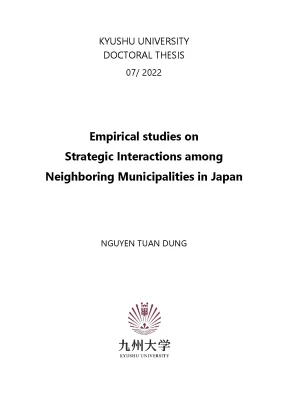
Tải xuống để đọc toàn bộKYUSHU UNIVERSITY DOCTORAL THESIS 07/ 2022 Empirical studies on Strategic Interactions among Neighboring Municipalities in Japan NGUYEN TUAN DUNG KYUSHU UNIVERSITY Graduate School of Economics Department of Economic Engineering The dissertation was accepted for the defence of the degree of Doctor of Philosophy in Economics on June 2022. Takeshi Miyazaki, Department of Economic Engineering, Graduate School of Economics, Kyushu University, Fukuoka, Japan. Co-supervisor 1: Prof. Taro Takimoto, Department of Economic Engineering, Graduate School of Economics, Kyushu University, Fukuoka, Japan.
Co-supervisor 2: Prof. Kunio Urakawa Department of Economic Engineering, Graduate School of Economics, Kyushu University, Fukuoka, Japan. Defence of the thesis: June 24, 2022, Fukuoka, Japan. Declaration: Hereby I declare that this doctoral thesis, my original investigation and achievement, submitted for the doctoral degree at Kyushu University, has not been submitted for any academic degree elsewhere.
Nguyen Tuan Dung _____________________________________ Signature 2 Table of Contents Abstract. 6 List of Figures. 7 List of Tables. Non-cooperative regime.
Previous empirical studies on strategic interaction in public expenditure 16 2. Spending interaction in developing countries. Intervention practices from central governments.3 Previous empirical studies on strategic interaction in public salaries. Strategic interaction in municipal spending.
Strategic interaction in public salary levels. Post-Great East Japan Earthquake policies regarding public sector salaries. Local public servant salaries. Possible sources of strategic interaction.
82 4 Abstract The thesis aims to systematically synthesize the theoretical background and recent empirical evidence on strategic interaction among jurisdictions regarding public spending and to uncover empirical shreds of evidence on the presence of strategic interaction among neighboring Japanese municipalities regarding changes in municipal spending and public salary levels. Variables on the attributes of 1704 Japanese municipalities from 2010 to 2016 will be used, to empirically examine whether municipalities change their public expenditure/public salary levels in response to corresponding changes in neighboring municipalities. I will build spatial models that took into account both correlations in spatial lag and spatial error. The models will be estimated by the Generalized Spatial Two-Stage Least Squares estimators for the main analysis and the Maximum Likelihood estimators for robustness checks.
It is suggested from the results that the Japanese municipalities may consider their neighbors’ choices in making local expenditure/public salary decisions. The spatial strategic interactions on local public expenditures among Japanese municipalities exist, as revealed by the positive and statistically significant spatial lag coefficients at conventional levels. Exceptionally, in the periods following intervention by the central government, there were significant positive impacts of changes in neighboring municipalities’ public sector salary levels on changes in a given municipality. The results are consistent across various specifications used as robustness checks, including the use of different spatial weighting matrices, additional control variables, and spatial panel models.
The findings and suggestions drawn from this thesis might provide useful insights for central governments in formulating effective regional planning and fiscal policies to make expenditure flow at sub-national levels more equal and efficient. 5 Abbreviations EDI Economic Development Incentives FITS-M Fiscal Index Tables for Similar Municipalities FY Fiscal year GEJE Great East Japan Earthquake GS2SLS Generalized Spatial Two-Stage Least Squares estimator IV-GMM Instrument variable- Generalized Method of Moment LAT Local allocation tax LM Lagrange Multiplier LSS Service for impaired people ML Maximum likelihood NRW North Rhine-Westphalia OLS Ordinary Least Squares QML Quasi-maximum likelihood S2SLS Spatial Two Stage Least Squares SAR Spatial Autoregressive model SARMA Spatial Autoregressive Moving Average model SDM Spatial Durbin Model SEM Spatial Error model SLX Spatial Lag of X model SUR-GNS General Nesting Spatial Seemingly Unrelated Regressions SYS-GMM System generalized method of moments US United States 6 List of Figures Figure 4-A. Average Laspeyres Index Values, 2010–2016. Kernel Distribution of Laspeyres Index Values for 2010, 2012, 2014, and 2016.
Kernel Distributions of Change Rates in Laspeyres Index Values between 2010 and 2011, 2011 and 2012, 2012 and 2014, and 2014 and 2016. Differences between a Municipality’s Own Laspeyres Index Values and those of Neighboring Municipalities’ within 60 km between 2014 and 2010. 56 7 List of Tables Table 2-A. Evidences of expenditure spillovers stimulating spending interactions.
Evidences of yardstick competition stimulating spending interactions. Evidences of fiscal competition stimulating spending interactions. Evidences of inter-government cooperation. Evidences of political ideology stimulating spending interactions.
Evidence of social learning stimulating spending interactions. Summary statistics of variables in 2010 and 2016. Diagnostics tests for spatial dependence. Spatial interactions in the change of municipal expenditure among the Japanese neighboring municipalities (GS2SLS).
Spatial interactions in the change of municipal expenditure among the Japanese municipalities (ML). Summary statistics of variables in 2010 and 2014. Spatial model estimates from year-by-year cross-sectional regressions. Spatial interactions among municipalities regarding public sector salary levels.
Spatial interactions among municipalities regarding salary changes under other differenced specifications. Spatial interactions among municipalities regarding salary levels under spatial panel models. Variable units, definitions, and sources. 82 8 Acknowledgements First and foremost, I would like to express my deepest appreciation to my advisor, Professor Takeshi Miyazaki, for the dedicated support and guidance throughout my Ph.
His patience, inspiration, and willingness helped me go through difficulties that I myself may struggle with and cannot get through. I am deeply indebted to my sub-supervisors, Professor Taro Takimoto and Professor Kunio Urakawa, for their insightful comments and suggestions, which significantly enhance my thesis and widen my horizon of knowledge. Moreover, I would like to thank all my professors at Kyushu University for their knowledge shared with me during class hours, seminars, and presentations. I would like to extend my special thanks to Professor Ohga Chiharu and professors at the International Student Center for teaching us initial survival Japanese, which is essentially beneficial to our healthier, happier, and more colorful life in Japan.
Special thanks should also go to my fellow friends, especially Yu Younan, Tapan Mahmud, Wang Li and Yasunori Ito for their support and their sincere friendship that allow me to continue working hard. I also would like to express my warm gratitude to the Japanese government, which through the Monbukagakusho Scholarship, enables me to pursue my academic goals and cherish our family moments without much worry. Last but not least, I would like to thank my family: my wife, two lovely daughters, parents, and sisters for their continuous support and understanding. They provide me with physical and spiritual strength to make my Ph.
study more enjoyable and meaningful. 9 Chapter 1 Introduction In the past three decades, decentralization has been a focal point of policy reform in most parts of the world. The delegation of extended fiscal autonomy to assign more public expenditures and revenues from the central government to local governments have been widely recommended by the policy advisors. The key driver for the growing interest in fiscal decentralization is "to increase efficiency, transparency, and accountability in the public sector" (Ebel & Yilmaz, 2002, p.
Greater autonomy of local governments opens up the likelihood of local fiscal interactions. The traditional belief was that a jurisdiction’s spending depends solely on its income, its grants from other levels of government, and its demographic and/or political characteristics. However, sub-national governments do not make their decisions in isolation. There is another important determinant of the state and local government expenditures: the expenditures of neighboring authorities.
Citizens and public servants are likely to be influenced by the actions of nearby jurisdictions. Spatial interactions in the level and structure of expenditures used to receive less attention in the literature than tax interactions. However, in the last two decades, there has been a substantial rise in the empirical works that examine whether sub-national governments make their spending decisions by taking into account the behavior of their neighbors (López et al., 2017; Ferraresi et al. The increasing concern could be because local governments rarely have large tax competencies, for that reason “spending decisions gain much more weight” (Langer, 2019).
Case et al. (1993) are popularly considered the first ones who formalized the notion of expenditures of neighboring jurisdictions as an important determinant of own government expenditures. Although the above-mentioned subject has reached an identifiable state of maturity, there is no extensive review that generalizes and synthesizes the recent empirical studies on the horizontal spending interaction among neighboring 10 governments. The only review paper about strategic interaction among governments was written roughly 20 years ago (Bruecker, 2003).
Therefore, I provide a proper review of theoretical background and empirical evidences found in the recent studies on fiscal spending interdependence among neighboring jurisdictions. The former empirical works have shown shreds of evidence that confirm the hypothesis that local jurisdictions do not make spending decisions in isolation. Those empirical studies on strategic interaction in light of government expenditures are diverse in categories of spending as well as researching countries, including total expenditure in Indonesia (Granado et.al, 2008), current expenditure in Italy (Bartolini & Santolini, 2012) as well as different sub-categories like culture in Sweden (Lunberg, 2006), education in China (Gu, 2012), industry- infrastructure in Czech (Lenka, 2009), and business development in the US (Wang, 2018), to name a few. However, previous evidence drawn from quasi- experimental approach employing exogenous variation is scarce.
Quasi- experimental settings that provide exogenous variation in the variable of interest are required to consistently estimate the spatial interaction parameters in the field of spatial econometrics (Gibbons & Overman, 2010). To fill the research gap, I construct two studies on strategic interaction among Japanese municipalities that employ quasi-experimental approach. While the former study focuses on strategic interaction regarding public expenditures in general; the latter goes further in discovering the counterpart strategic interaction in public salary – one of the core subcategories of government spending. The first study aims to estimate the responses of Japanese municipalities to changes in municipal spending in their neighboring municipalities, using the number of houses destroyed in each municipality by the Great East Japan Earthquake (GEJE) – the most powerful earthquake ever recorded in Japan and one of the costliest earthquakes in human history – as a source of exogenous 11 variation in local spending.
I built a spatial model that examined both interdependences in spatial lag and spatial error. The model is estimated by the Generalized Spatial Two-Stage Least Squares estimator (GS2SLS) and is further checked by maximum likelihood estimation. The results indicate that spatial strategic interactions on local public expenditures among Japanese municipalities exist, revealed by the positive and statistically significant spatial lag coefficients at conventional levels. The robustness check using maximum likelihood estimation also show comparable and consistent results.
It is suggested that the Japanese municipalities in the study sample may consider their neighbors’ choices in making local expenditure decisions. Appropriate salary levels in the public sector are crucial for ensuring the quality and efficiency of public services (Morikawa 2016). However, it remains unclear whether local jurisdictions consider their neighboring jurisdictions’ salary levels while making decisions regarding modifying their public sector salaries. Thus, my second study aims to provide evidence of strategic interaction among Japanese municipalities while determining public sector salaries.
Using a sample of 1704 Japanese municipalities from 2010 to 2016, we empirically examine whether municipalities change their salary levels in response to the changes of other municipalities. Close attention is paid to the influence of central government policies on public sector salaries following the GEJE and its aftermath. I also develop a spatial model incorporating both spatial lag and error dependence and use a generalized spatial two-stage least squares approach to obtain estimates (Kelejian and Prucha 1998, 2010). The results suggest that municipalities do pay attention to other municipalities when making decisions on their public sector salaries.
In the periods following intervention by the central government, there were significant positive impacts of changes in neighboring municipalities’ public sector salary levels on the corresponding changes in a given municipality. The results are consistent across various specifications used as robustness checks, including the use of different spatial weighting matrices, 12 additional control variables, and spatial panel models.
Nội dung được bảo vệ bản quyền — Tải xuống đầy đủ
Trích dẫn luận án này
Nguyen Tuan Dung (2022). Tương tác chiến lược đô thị Nhật Bản: Chi tiêu & lương công [Luận án tiến sĩ, Kyushu University]. LuanAn.net. https://luanan.net/chinh-tri-hoc/chinh-sach-cong/tuong-tac-chien-luoc-do-thi-nhat-ban-chi-tieu-luong-cong
Câu hỏi thường gặp
Luận án "Tương tác chiến lược đô thị Nhật Bản: Chi tiêu & lương công" nghiên cứu về vấn đề gì?
Nghiên cứu thực nghiệm về tương tác chiến lược giữa các đô thị lân cận tại Nhật Bản. Phân tích tác động chính sách và mô hình hợp tác.
Luận án "Tương tác chiến lược đô thị Nhật Bản: Chi tiêu & lương công" được bảo vệ tại trường nào?
Luận án này được bảo vệ tại Kyushu University. Năm bảo vệ: 2022.
Luận án "Tương tác chiến lược đô thị Nhật Bản: Chi tiêu & lương công" thuộc chuyên ngành gì?
Luận án "Tương tác chiến lược đô thị Nhật Bản: Chi tiêu & lương công" thuộc chuyên ngành Economics. Danh mục: Chính Sách Công.
Luận án "Tương tác chiến lược đô thị Nhật Bản: Chi tiêu & lương công" có bao nhiêu trang?
Luận án "Tương tác chiến lược đô thị Nhật Bản: Chi tiêu & lương công" có 83 trang. Bạn có thể xem trước một phần tài liệu ngay trên trang web trước khi tải về.
Cách tải luận án "Tương tác chiến lược đô thị Nhật Bản: Chi tiêu & lương công" về máy như thế nào?
Để tải luận án về máy, bạn nhấn nút "Tải xuống ngay" trên trang này, sau đó hoàn tất thanh toán phí lưu trữ. File sẽ được tải xuống ngay sau khi thanh toán thành công. Hỗ trợ qua Zalo: 0559 297 239.