Luận án: Tối ưu hóa ty thể tế bào ung thư làm chiến lược điều trị - Phân tích SAR
Tối ưu hóa ty thể tế bào ung thư là chiến lược điều trị tiềm năng, giúp tiêu diệt tế bào ung thư hiệu quả hơn.
University of Windsor
Chemistry and Biochemistry
Luan An
Luận án tiến sĩ
Năm xuất bản
Số trang
411
Thời gian đọc
1 giờ 2 phút
Lượt xem
0
Lượt tải
0
Phí lưu trữ
60 Point
Tổng quan nhanh
- Chủ đề:
- 1. Nhắm trúng đích ty thể trong điều trị ung thư ác tính
- Số trang:
- 411 trang
- Trường:
- University of Windsor
- Chuyên ngành:
- Chemistry and Biochemistry
- Tác giả:
- Dennis Ma
- Năm:
- 2016
Tóm tắt nội dung luận án
I. Nhắm trúng đích ty thể trong điều trị ung thư ác tính
Ty thể giữ vai trò trung tâm trong chuyển hóa và điều hòa sự sống tế bào. Bào quan này kiểm soát quá trình sinh năng lượng và chết theo chương trình. Tế bào ung thư thường biến đổi chức năng ty thể để thích nghi. Sự thay đổi này tạo ra khác biệt lớn so với mô lành bình thường. Điện thế màng ty thể ở khối u thường cao hơn. Mức độ tạo gốc tự do cũng có sự chênh lệch rõ rệt. Những đặc điểm này biến ty thể thành đích tác động tiềm năng. Can thiệp trực tiếp vào ty thể giúp tiêu diệt khối u hiệu quả. Liệu pháp nhắm đích ty thể hạn chế tối đa tổn thương mô lành. Khả năng kháng thuốc hóa trị truyền thống cũng được khắc phục đáng kể. Các nghiên cứu hiện đại tập trung khai thác điểm yếu sinh học này. Hướng đi này mở ra triển vọng lớn cho dược lý trị ung thư.
1.1. Tái lập trình chuyển hóa tế bào ung thư và ty thể
Khối u ác tính trải qua quá trình tái lập trình chuyển hóa tế bào ung thư sâu rộng. Quá trình này đáp ứng nhu cầu tăng sinh và phân chia nhanh. Tế bào thay đổi phương thức tạo ATP và sinh khối tế bào. Ty thể đóng vai trò trung tâm trong mạng lưới chuyển hóa mới. Bào quan này cung cấp tiền chất cho tổng hợp lipid và nucleotide. Đồng thời, chu trình TCA được biến đổi linh hoạt để tận dụng glutamine. Khả năng đệm áp lực oxy hóa của ty thể cũng gia tăng. Sự thích nghi này duy trì cân bằng nội môi cho khối u. Nhắm vào các điểm nút trao đổi chất làm suy yếu sức sống của tế bào. Tế bào u mất khả năng chống chịu và dễ bị tiêu diệt. Can thiệp chuyển hóa mang lại độ nhạy điều trị cao.
1.2. Vai trò của đột biến DNA ty thể mtDNA trong khối u
Hệ gen ty thể có cấu trúc vòng kín và không có histone bảo vệ. Tế bào ung thư tích lũy nhiều đột biến DNA ty thể (mtDNA). Những đột biến này làm thay đổi cấu trúc các phức hợp hô hấp. Sự sai hỏng dẫn đến rối loạn chuỗi chuyền điện tử. Lượng gốc tự do nội sinh rò rỉ gia tăng liên tục. Tình trạng này kích hoạt các con đường truyền tín hiệu sinh tồn bất thường. Đột biến mtDNA cũng thúc đẩy tính xâm lấn và di căn. Tuy nhiên, sự mất ổn định này tạo ra điểm yếu trí mạng. Tế bào ác tính trở nên cực kỳ nhạy cảm với các tác nhân gây độc ty thể. Tác động trúng đích sẽ kích hoạt quá trình tự hủy nhanh chóng. Đây là cơ sở then chốt để phát triển thuốc đặc hiệu.
II. Tái lập trình chuyển hóa năng lượng ở tế bào ác tính
Nghiên cứu ung thư hiện đại tập trung vào chuyển hóa năng lượng tế bào ung thư. Khối u duy trì nhu cầu năng lượng rất lớn để sinh trưởng. Phương thức sản xuất ATP ở tế bào u có tính linh hoạt cao. Khi một con đường bị chặn, tế bào nhanh chóng chuyển hướng thích nghi. Ty thể vẫn duy trì chức năng quan trọng dù đường phân tăng mạnh. Sự kết hợp giữa đường phân và hô hấp tế bào tạo ưu thế sinh tồn. Khóa chặt các nguồn cấp năng lượng khiến khối u sụp đổ. Liệu pháp chuyển hóa tạo ra tác động tiêu diệt kép. Khối u bị cạn kiệt cơ chất và mất khả năng bù trừ. Phương pháp này ngăn chặn khối u tái phát hoặc phát triển kháng thuốc.
2.1. Hiệu ứng Warburg và sự phụ thuộc năng lượng ty thể
Khối u tiêu thụ glucose mạnh ngay cả khi có đủ oxy. Hiện tượng này được biết đến với tên gọi hiệu ứng Warburg. Axit lactic tích tụ nhanh tạo môi trường vi mô thuận lợi cho u. Tuy nhiên, ty thể không hoàn toàn bị ức chế hay bất hoạt. Nghiên cứu chỉ ra nhiều dòng ung thư vẫn phụ thuộc vào ty thể. Bào quan này đảm nhận vai trò oxy hóa các cơ chất phi glucose. Ty thể cung cấp phần lớn năng lượng nền tảng cho tế bào gốc ung thư. Tế bào kháng thuốc cũng dựa chủ yếu vào nguồn ATP này. Hiểu rõ mối liên hệ giữa hai hệ thống giúp tối ưu phác đồ. Kết hợp chặn đường phân và ức chế ty thể đem lại hiệu quả vượt trội.
2.2. Chiến lược ức chế phosphoryl hóa oxy hóa OXPHOS
Nhiều loại khối u kháng thuốc duy trì hoạt động hô hấp mạnh mẽ. Áp dụng ức chế phosphoryl hóa oxy hóa (OXPHOS) là bước đi đột phá. Can thiệp vào OXPHOS làm suy giảm nhanh nồng độ ATP nội bào. Tế bào ung thư rơi vào khủng hoảng năng lượng nghiêm trọng. Khủng hoảng trao đổi chất dẫn đến ngừng chu kỳ tế bào. Sự sụt giảm ATP kích hoạt protein kinase AMPK cảm biến năng lượng. Quá trình sinh tổng hợp đại phân tử lập tức bị đình trệ. Tế bào u mất khả năng tự sửa chữa tổn thương. Đồng thời, OXPHOS bị ức chế làm tăng nhạy cảm với hóa trị chuẩn. Liệu pháp phối hợp này mở ra cơ hội điều trị ung thư kháng thuốc.
III. Kích hoạt apoptosis qua con đường ty thể chọn lọc cao
Mục tiêu cốt lõi của trị liệu ung thư là tiêu diệt tế bào ác tính. Kích hoạt apoptosis qua con đường ty thể mang lại độ chính xác cao. Ty thể là trung tâm chỉ huy các tín hiệu sống còn nội bào. Khi nhận kích thích gây độc, màng ty thể thay đổi cấu trúc. Các yếu tố thúc đẩy chết rò rỉ vào bào tương. Quá trình hoạt hóa enzyme caspase diễn ra theo dòng thác tín hiệu. Tế bào u bị phân rã mà không gây viêm nhiễm lan rộng. Tác động chọn lọc giúp bảo toàn nguyên vẹn các tế bào bình thường. Con đường nội sinh này vượt qua rào cản đề kháng của thụ thể bề mặt. Hiệu quả tiêu diệt tế bào ung thư đạt mức tối đa.
3.1. Tính thấm màng ngoài ty thể MOMP và giải phóng cyto C
Hiện tượng then chốt trong apoptosis nội sinh là tính thấm màng ngoài ty thể (MOMP). Quá trình này được điều hòa chặt chẽ bởi họ protein Bcl-2. Khi MOMP xảy ra, màng ngoài ty thể hình thành các lỗ thủng lớn. Cytochrome c lập tức thoát ra ngoài dịch bào tương. Yếu tố này kết hợp với Apaf-1 tạo thành phức hợp apoptosome. Phức hợp này hoạt hóa caspase-9 và kích hoạt chuỗi caspase thực thi. Quá trình phân hủy protein cấu trúc và phân mảnh DNA diễn ra nhanh. MOMP là điểm cam kết không thể đảo ngược của cái chết tế bào. Kích thích MOMP trúng đích tiêu diệt gọn khối u ác tính. Các mô lân cận không phải chịu tổn thương ngoài ý muốn.
3.2. Gia tăng stress oxy hóa và gốc tự do ROS tiêu diệt u
Tế bào ung thư thường hoạt động với mức nền oxy hóa cao. Sự gia tăng stress oxy hóa và gốc tự do ROS phá vỡ cân bằng mong manh. Các hợp chất nhắm ty thể thúc đẩy rò rỉ điện tử ồ ạt. Lượng ROS vượt ngưỡng gây độc kích hoạt quá trình oxy hóa lipid màng. Protein chức năng và axit nucleic bị tổn thương nghiêm trọng. Sự sụp đổ điện thế màng ty thể diễn ra ngay sau đó. Tế bào u cạn kiệt chất chống oxy hóa nội sinh như glutathione. Khối u không còn khả năng tự bảo vệ trước áp lực oxy hóa. Tế bào ác tính bước vào tiến trình chết tế bào không thể phục hồi. Phương thức này tạo ra hiệu ứng diệt u mạnh mẽ và dứt khoát.
IV. Ứng dụng mitocans thuốc nhắm trúng đích ty thể mới
Sự phát triển dược phẩm sinh học dẫn đến nhóm hợp chất mới. Khái niệm mitocans thuốc nhắm trúng đích ty thể được ứng dụng rộng rãi. Các phân tử này tấn công chuyên biệt vào cấu trúc hoặc enzyme ty thể. Cơ chế tác động không phụ thuộc vào tình trạng gen p53 của tế bào u. Điều này mang ý nghĩa lớn đối với các dạng ung thư đột biến kháng thuốc. Pancratistatin là một hợp chất tự nhiên tiêu biểu thuộc nhóm này. Dẫn xuất của nó cho thấy hoạt tính kháng u rất cao trong thực nghiệm. Hợp chất phân biệt chính xác giữa tế bào bệnh và tế bào lành. Tính chọn lọc cao giúp giảm thiểu tối đa tác dụng phụ độc hại. Đây là bước tiến lớn trong hóa dược điều trị ung thư.
4.1. Khảo sát chuỗi truyền điện tử ty thể ETC với Pancratistatin
Pancratistatin tác động trực tiếp lên chuỗi truyền điện tử ty thể (ETC). Hợp chất làm gián đoạn dòng vận chuyển electron qua phức hợp I và III. Sự ức chế này gây sụt giảm điện thế màng ty thể tức thì. Dòng electron bị nghẽn dẫn đến phóng thích ROS cục bộ ở mức cao. Chuỗi phản ứng nhanh chóng làm mở lỗ chuyển tiếp thấm ty thể. Cytochrome c thoát ra ngoài kích hoạt cái chết tế bào theo chương trình. Quá trình diễn ra độc lập với các thụ thể bề mặt màng tế bào. Mô lành không bị ảnh hưởng do có điện thế màng và trao đổi chất bình thường. Cơ chế tác động rõ ràng này củng cố tiềm năng lâm sàng của dẫn xuất.
4.2. Tối ưu cấu trúc hoạt tính nhằm hạn chế độc tính mô lành
Nghiên cứu quan hệ cấu trúc - hoạt tính (SAR) tạo bước đột phá trong tổng hợp thuốc. Các chất tương tự tổng hợp của pancratistatin được thiết kế tối ưu. Việc biến đổi vòng thơm và các nhóm thế tăng cường tính thân dầu. Cải tiến này giúp thuốc dễ dàng thâm nhập qua màng lipid kép ty thể. Hoạt tính diệt tế bào u tăng lên trong khi liều lượng sử dụng giảm xuống. Độc tính đối với mô bình thường được kiểm soát ở mức tối thiểu. Các dẫn xuất mới thể hiện độ ổn định hóa học và sinh khả dụng vượt trội. Thử nghiệm tiền lâm sàng ghi nhận khả năng dung nạp rất tốt trên mô hình sống. Tối ưu hóa cấu trúc là chìa khóa mở đường cho ứng dụng điều trị thực tế.
Mục lục chi tiết luận án
Tải xuống file đầy đủ để xem toàn bộ nội dung
Tải đầy đủ (411 trang)Trích đoạn nội dung luận án
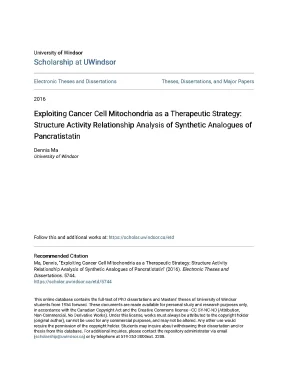
Tải xuống để đọc toàn bộUniversity of Windsor Scholarship at UWindsor Electronic Theses and Dissertations Theses, Dissertations, and Major Papers 2016 Exploiting Cancer Cell Mitochondria as a Therapeutic Strategy: Structure Activity Relationship Analysis of Synthetic Analogues of Pancratistatin Dennis Ma University of Windsor Follow this and additional works at: https://scholar.ca/etd Recommended Citation Ma, Dennis, "Exploiting Cancer Cell Mitochondria as a Therapeutic Strategy: Structure Activity Relationship Analysis of Synthetic Analogues of Pancratistatin" (2016). Electronic Theses and Dissertations.ca/etd/5744 This online database contains the full-text of PhD dissertations and Masters’ theses of University of Windsor students from 1954 forward. These documents are made available for personal study and research purposes only, in accordance with the Canadian Copyright Act and the Creative Commons license—CC BY-NC-ND (Attribution, Non-Commercial, No Derivative Works). Under this license, works must always be attributed to the copyright holder (original author), cannot be used for any commercial purposes, and may not be altered.
Any other use would require the permission of the copyright holder. Students may inquire about withdrawing their dissertation and/or thesis from this database. For additional inquiries, please contact the repository administrator via email (scholarship@uwindsor.ca) or by telephone at 519-253-3000ext. Exploiting Cancer Cell Mitochondria as a Therapeutic Strategy: Structure Activity Relationship Analysis of Synthetic Analogues of Pancratistatin Dennis Ma A Dissertation Submitted to the Faculty of Graduate Studies through the Department of Chemistry and Biochemistry in Partial Fulfillment of the Requirements for the Degree of Doctor of Philosophy at the University of Windsor Windsor, Ontario, Canada © 2016 Dennis Ma Exploiting Cancer Cell Mitochondria as a Therapeutic Strategy: Structure Activity Relationship Analysis of Synthetic Analogues of Pancratistatin By Dennis Ma APPROVED BY: ______________________________________________ S.
Ray, External Examiner Manchester University ___________________________________________ P. Vacratsis Department of Chemistry and Biochemistry ___________________________________________ M. Boffa Department of Chemistry and Biochemistry ___________________________________________ M. Crawford Department of Biological Sciences ___________________________________________ S.
Pandey, Advisor Department of Chemistry and Biochemistry May 25, 2016 Declaration of Co-authorship & Previous Publication I. Declaration of Co-Authorship I hereby declare that this dissertation incorporates material that is result of joint research as follows: This dissertation incorporates the outcome of joint research efforts undertaken in collaboration with Daniel Tarade, Tyler Gilbert, Christopher Pignanelli, Fadi Mansour, Scott Adams, Colin Curran, Alexander Dowhayko, Megan Noel, Melissa Cowell, Manika Gupta, Ian Tuffley, Sabrina Ma, Phillip Tremblay, Kevinjeet Mahngar, Pardis Akbari-Asl, Sergey Vshyvenko, Jonathan Collins, Tomas Hudlicky, and James McNulty under the supervision of Dr. In all cases, experimental design, execution, data analysis, interpretation, and manuscript preparation were performed by the author. All authors have read and approved the final manuscript prior to submission.
Collaboration with James McNulty is covered in Chapters 2 and 4 of this dissertation; this contribution was through provision of chemical compounds and write-up of synthesis details. Collaboration with Sergey Vshyvenko, Jonathan Collins, and Tomas Hudlicky is covered in Chapters 2-5 (and Appendices A and B) of this dissertation; this contribution was through synthesis and provision of chemical compounds and write-up of synthesis details. Collaboration with Phillip Tremblay, Kevinjeet Mahngar, and Pardis Akbari-Asl is covered in Chapters 2 and 3 (and Appendix A) of this dissertation; there was partial contribution to experimental execution and data interpretation. Collaboration with Daniel Tarade, Tyler Gilbert, Christopher Pignanelli, Fadi Mansour, Scott Adams, Colin Curran, Alexander Dowhayko, Megan Noel, Melissa Cowell, Manika Gupta, Ian Tuffley, and Sabrina Ma is covered in Chapters 4 and 5 of this dissertation; there was partial contribution to experimental execution and data interpretation.
I am aware of the University of Windsor Senate Policy on Authorship and I certify that I have properly acknowledged the contribution of other researchers to my dissertation, and have obtained written permission from each of the co-authors to include the above materials in my dissertation. I certify that, with the above qualification, this dissertation, and the research to which it refers, is the product of my own work. Declaration of Previous Publication This dissertation includes 4 original papers that have been previously published: CHAPTER 2 Ma D, Tremblay P, Mahngar K, Akbari-Asl P, Collins J, Hudlicky T, McNulty J, Pandey S. A Novel Synthetic C1 Analog of 7-deoxypancratistatin Induces Apoptosis in p53 Positive and Negative Human Colon Cancer Cells by Targeting the Mitochondria: Enhancement of Activity by Tamoxifen.
Investigational New Drugs 2012;30(3):1012-27. CHAPTER 3 Ma D, Tremblay P, Mahngar K, Collins J, Hudlicky T, Pandey S. Selective Cytotoxicity Against Human Osteosarcoma Cells by a Novel Synthetic C-1 Analogue of 7-deoxypancratistatin is Potentiated by Curcumin. APPENDIX A Ma D, Tremblay P, Mahngar K, Akbari-Asl P, Collins J, Hudlicky T, Pandey S.
Induction of Apoptosis and Autophagy in Human Pancreatic Cancer Cells by a Novel Synthetic C-1 Analogue of 7-deoxypancratistatin. APPENDIX B Ma D, Collins J, Hudlicky T, Pandey S. Enhancement of apoptotic and autophagic induction by a novel synthetic C-1 analogue of 7-deoxypancratistatin in human breast adenocarcinoma and neuroblastoma cells with tamoxifen. CHAPTERS 4 & 5 These chapters are manuscripts in preparation for submission.
Declaration of Previous Publication (Continued) I certify that I have obtained written permission from the copyright owners to include the above published materials in my dissertation. I certify that the above material describes work completed during my registration as graduate student at the University of Windsor. I declare that, to the best of my knowledge, my dissertation does not infringe upon anyone’s copyright nor violate any proprietary rights and that any ideas, techniques, quotations, or any other material from the work of other people included in my dissertation, published or otherwise, are fully acknowledged in accordance with the standard referencing practices. Furthermore, to the extent that I have included copyrighted material that surpasses the bounds of fair dealing within the meaning of the Canada Copyright Act, I certify that I have obtained a written permission from the copyright owners to include such materials in my dissertation.
I declare that this is a true copy of my dissertation, including any final revisions, as approved by my doctoral committee and the Graduate Studies office, and that this dissertation has not been submitted for a higher degree to any other University or Institution. v Abstract Distinct characteristics, including decreased dependence on mitochondrial respiration and high levels of oxygen radicals, provide opportunities for cancer targeting. We have shown the compound pancratistatin (PST) to selectively induce apoptosis in cancers by mitochondrial targeting. However, its low availability in nature was limiting its preclinical development.
Various PST analogues were synthesized to circumvent this limitation. In this dissertation, these analogues were screened and several had comparable or greater anti- cancer activity compared to PST. The analogue, SVTH-7, demonstrated the most potent anti-cancer activity, followed by SVTH-6 and -5 in vitro and in vivo. These compounds had greater efficacy than PST, 7-deoxyPST analogues, and multiple standard chemotherapeutics, and were found to induce apoptosis in cancer cells by acting on cancer cell mitochondria.
Furthermore, the anti-cancer effects of PST analogues were enhanced when used with agents known to target cancer cell mitochondria and oxidative vulnerabilities, including tamoxifen, curcumin, and piperlongumine. Interestingly, functional complex II and III of the electron transport chain were required for SVTH-7 to inflict its pro-apoptotic effects on cancer cells, suggesting exploitation of a mitochondrial vulnerability by SVTH-7. Therefore, these findings demonstrate a novel approach to treat cancer by exploiting cancer cell mitochondria with PST analogues alone or in combination with other compounds. These PST analogues have high therapeutic potential and this work will lay the groundwork for the identification and characterization of distinct mitochondrial features of cancer cells.
vi Acknowledgements I would like to thank my mentor and supervisor, Dr. Siyaram Pandey, for taking me into his lab in the summer of 2007 as an undergraduate student and giving me the opportunity to work in his lab for all these years to the completion of my undergraduate research project and this dissertation. He was the first to spark my interest in research and his guidance, expertise, patience and encouragement have been invaluable to my growth as a scientist. He is an example of having all the right intensions as a researcher to benefit others, and genuinely cares and advocates for his students.
Thank you to my doctoral committee, including Dr. Siyaram Pandey, Dr. Panayiotis Vacratsis, to Dr. Michael Boffa, Dr.
Michael Crawford, and Dr. Sidhartha Ray for their valuable input, critical evaluation of my work, and encouragement during my graduate studies. Thank you for the heartfelt local support to this work and our lab by the Knights of Columbus Chapter 9671 (Windsor, ON), the Pajama Angels, and the Couvillon Family, in memory of Kevin Couvillon. Your kindness, generosity, and encouragement have been extremely motivational to us and is greatly appreciated.
Thank you for believing in us. Thank you to the Lotte & John Hecht Memorial Foundation for funding the pancratistatin project and the Jesse & Julie Rasch Foundation for supporting the natural health products research in our laboratory. vii My graduate studies have been funded by a Vanier Canada Graduate Scholarship, a CIHR Frederick Banting and Charles Best Canada Graduate Scholarship, and an Ontario Graduate Scholarship. Thank you to our collaborators, Dr.
Tomas Hudlicky, Sergey Vshyvenko and Jonathan Collins of Brock University, for synthesizing and providing the synthetic derivatives of pancratistatin for this project. Thank you to Dr. James McNulty, for providing natural pancratistatin to our laboratory, as well as combretatstatin A4 (CA4) analogues for the synthetic CA4 project. Thank you to Dr.
Yi Wang at Wenzhou Medical University in China for providing synthetic analogues of curcumin for the synthetic curcumin project. Thank you to Dr. James Gauld in the capacity as both a mentor and collaborator. Having you next door was like having a second supervisor.
You have gone out of your way and have done so much for me and it is greatly appreciated; please also give my regards to Oscar and Frank. Thanks to Dan Simard and Mohamed Aboelnga for performing computation studies for my projects. Also, thanks to the rest of the Gauld Group, that I have gotten to know, for their support and friendship from across the hall: Phil De Luna, Bogdan Ion, Grant Fortowsky, Hisham Dokainish, Sameer Jafar, Wanlei Wei, Travis Dewolfe, Danielle, Rami Gherib, Eric Bushnel. Thank you to Dr.
Michael Boffa, Dr. Sirinart Ananvoranich, Dr. Bulent Mutus, Dr. Barbara Zielinski, and Dr.
Porter for the use of their lab equipment. Thank you to our secretaries in the Department of Chemistry and Biochemistry, Marlene Bezaire, Elizabeth Kickham, Cathy Wilson, and Michelle Miglietta for keeping our department running and for your support and encouragement. All of viii your work is much appreciated. Special thanks to Marlene for going out of her way to let me know about deadlines and scholarship opportunities; you are the reason why I am graduating as planned.
You have gone above and beyond, moving the whole world around for me, and your help throughout these years has been extremely valuable and greatly appreciated. Also thank you to Beth for addressing all my financial matters and concerns with general lab maintenance. Thank you to the Chemical Control Center crew, including Jerry Vriesacker, Alina Jaworska-Sobiesiak, Tina Lepine, Francis Arnaldo, and Sherri Menard, for all your assistance in obtaining lab supplies and materials. Special thanks to Jerry for dealing with all my extra ordering concerns in a very timely and efficient manner.
Special thanks to Janice Tubman, Elizabeth Fidalgo da Silva, Dorota Lubanska, Joe Lichaa, Bob Hodge, Elaine and Linda Sterling for their technical support.
Nội dung được bảo vệ bản quyền — Tải xuống đầy đủ
Trích dẫn luận án này
Dennis Ma (2016). Tối ưu hóa ty thể tế bào ung thư làm chiến lược điều trị [Luận án tiến sĩ, University of Windsor]. LuanAn.net. https://luanan.net/y-hoc/toi-uu-hoa-ty-the-te-bao-ung-thu-lam-chien-luoc-dieu-tri-phan-tich-sar
Câu hỏi thường gặp
Luận án "Tối ưu hóa ty thể tế bào ung thư làm chiến lược điều trị" nghiên cứu về vấn đề gì?
Tối ưu hóa ty thể tế bào ung thư là chiến lược điều trị tiềm năng, giúp tiêu diệt tế bào ung thư hiệu quả hơn.
Luận án "Tối ưu hóa ty thể tế bào ung thư làm chiến lược điều trị" được bảo vệ tại trường nào?
Luận án này được bảo vệ tại University of Windsor. Năm bảo vệ: 2016.
Luận án "Tối ưu hóa ty thể tế bào ung thư làm chiến lược điều trị" thuộc chuyên ngành gì?
Luận án "Tối ưu hóa ty thể tế bào ung thư làm chiến lược điều trị" thuộc chuyên ngành Chemistry and Biochemistry. Danh mục: Y Học.
Luận án "Tối ưu hóa ty thể tế bào ung thư làm chiến lược điều trị" có bao nhiêu trang?
Luận án "Tối ưu hóa ty thể tế bào ung thư làm chiến lược điều trị" có 411 trang. Bạn có thể xem trước một phần tài liệu ngay trên trang web trước khi tải về.
Cách tải luận án "Tối ưu hóa ty thể tế bào ung thư làm chiến lược điều trị" về máy như thế nào?
Để tải luận án về máy, bạn nhấn nút "Tải xuống ngay" trên trang này, sau đó hoàn tất thanh toán phí lưu trữ. File sẽ được tải xuống ngay sau khi thanh toán thành công. Hỗ trợ qua Zalo: 0559 297 239.