Mcmahon daithí 2019 the impact of facebook on the irish radio industry phd thesi
Mcmahon Daithí 2019: Nghiên cứu tác động của Facebook đến ngành phát thanh Ireland. Khám phá xu hướng và chiến lược số mới.
University of Derby
Luan An
Luận án tiến sĩ
Năm xuất bản
Số trang
318
Thời gian đọc
48 phút
Lượt xem
0
Lượt tải
0
Phí lưu trữ
60 Point
Tổng quan nhanh
- Chủ đề:
- Facebook's Economic & Social Impact on Irish Radio Industry
- Số trang:
- 318 trang
- Trường:
- University of Derby
- Tác giả:
- Daithí McMahon
- Năm:
- 2019
Tóm tắt nội dung luận án
I.Facebook s Economic Social Impact on Irish Radio Industry
Daithí McMahon's 2019 thesis deeply investigates Facebook's multifaceted impact on the Irish radio industry between 2011 and 2016. The study explores economic, social, and cultural transformations. Facebook emerged as a significant platform, altering traditional broadcasting models. Radio stations adapted to digital demands, facing new challenges and seizing fresh opportunities. This period witnessed a shift in media consumption Ireland. The traditional media landscape underwent profound changes. Understanding these dynamics is crucial for grasping the industry's evolution. The research meticulously analyzes how social media influence reshaped audience interactions and revenue streams. This analysis provides valuable insights for stakeholders within the Irish radio industry.
1.1. Context Irish Radio Landscape 2011 2016
The Irish radio industry faced a dynamic period from 2011 to 2016. Economic shifts, political changes, and social trends influenced its structure. Public service, independent commercial, and community radio sectors all navigated evolving environments. Radio listenership trends showed audience adaptation to new technologies. Digital broadcasting began to redefine content delivery. Stations sought new ways to connect with listeners. Facebook's rapid growth offered both potential and pressure. This context is vital for understanding the subsequent impact of social media influence on established media practices. The research situates Facebook's role within this complex industry backdrop.
1.2. Research Focus Facebook s Influence Scope
The core of the research investigates Facebook's specific influence on the Irish radio industry. It examines how Facebook transformed broadcasting operations and audience engagement radio. The study covers economic implications, such as advertising and revenue generation. It also delves into social aspects, including community building and listener interaction. Cultural shifts, like content creation and audience identity, are explored. The thesis scope encompasses the period 2011-2016, a crucial time for social media's integration. Facebook impact is analyzed through various lenses, offering a comprehensive view of its pervasive effects on traditional media challenges.
1.3. Methodologies for Impact Assessment
Assessing Facebook's impact required a multi-method approach. The research employed longitudinal content analysis to track digital trends. In-depth interviews provided qualitative insights from industry professionals. Audience surveys gathered quantitative data on listener behavior and preferences. Direct observation offered firsthand understanding of radio production changes. This triangulation of methods ensured robust findings regarding social media influence. The methodologies aimed to capture the nuances of audience engagement radio and the evolving role of online platforms broadcasting. McMahon’s rigorous approach strengthens the credibility of the findings on Facebook impact.
II.Audience Engagement Participation Facebook s Role
Facebook profoundly altered audience engagement and participation within the Irish radio industry. Listeners transitioned from passive consumers to active participants. The platform became a primary channel for interaction, feedback, and content sharing. Radio stations leveraged Facebook to foster stronger connections with their audience. This shift highlights the growing importance of online platforms broadcasting. Audience engagement radio is no longer confined to traditional phone calls or letters. Digital tools empower listeners, giving them a voice and a role in content creation. This transformation reflects broader changes in media consumption Ireland.
2.1. Radio Audience Participation Digital Evolution
Radio audience participation underwent a significant digital evolution. Social media influence, particularly from Facebook, transformed interaction models. Traditional radio relied on one-way communication or limited listener call-ins. Facebook introduced real-time, multi-directional engagement. Listeners could comment, share, and react to broadcasts instantly. This created a dynamic environment for audience engagement radio. The platform facilitated deeper connections between presenters and their audience. This digital shift reshaped expectations for listener involvement. It marked a new era for how radio content is consumed and produced.
2.2. Audience Motives Interacting with Radio on Facebook
Audience motives for interacting with radio on Facebook are diverse. Listeners sought entertainment, amusement, and participation in contests. The platform offered a sense of community and connection with like-minded individuals. Users preferred Facebook for its ease of use and familiarity. It provided a direct channel to their favorite shows and presenters. Facebook impact on audience behavior revealed a preference for engagement over mere feedback. This understanding of user gratification is crucial for stations optimizing their social media strategies. Radio listenership trends indicate a desire for active involvement.
2.3. From Listeners to Produsers New Media Consumption
The rise of social media transformed listeners into 'produsers.' This term describes audiences who actively participate in both consuming and producing content. Facebook facilitated this shift, allowing users to share opinions, create memes, and influence show topics. The active audience cycle involves tuning in and logging on, blurring traditional lines. This phenomenon represents a significant change in media consumption Ireland. Radio stations recognized the value of these engaged 'produsers.' Their contributions enhanced content and fostered a stronger sense of community. This dynamic interaction is a key aspect of Facebook impact.
III.Digital Transformation Capital Accumulation in Radio
The Irish radio industry experienced a profound digital transformation, heavily influenced by Facebook. Stations evolved into multimedia products, extending their reach beyond traditional airwaves. This shift brought new opportunities for capital accumulation, as audience engagement on social media could be monetized. Understanding this transformation is vital for comprehending the economic realities of modern broadcasting. Online platforms broadcasting became integral to business models. The study analyzes how radio adapted its production processes and revenue strategies in response to these digital imperatives. Traditional media challenges necessitated innovative solutions.
3.1. Radio s Multimedia Product Development on Facebook
Radio developed into a multimedia product, with Facebook playing a central role. Stations integrated audio with visual content, text, and interactive polls. Facebook became the 'face of radio 2.0,' complementing live broadcasts. This digital broadcasting approach enhanced listener experience and extended brand presence. The platform served as a hub for supplementary content and listener discussions. Radio and Facebook formed a 'perfect match' for a digital-first strategy. This evolution allowed stations to remain relevant in a fragmented media landscape. It underscored the profound social media influence on content delivery.
3.2. Accumulation of Capital Audience Commodification
Capital accumulation in the digital age involved the commodification of Facebook audiences. Engaged listeners became valuable assets, attracting advertisers. Radio stations leveraged their online presence to generate revenue through targeted ads and sponsored content. The study explored the line between exploitation and entertainment in this process. Audience engagement radio, when effectively measured, translated into economic value. This aspect highlights the significant Facebook impact on the financial models of broadcasters. The ability to monetize online interaction became a new frontier for the Irish radio industry.
3.3. Radio Station Owners Perspective on Digital Shift
Radio station owners offered key perspectives on the digital shift. Their views illuminated the strategic decisions behind adopting Facebook. Owners recognized the need to increase online presence and facilitate participation. They navigated the challenges of integrating digital platforms into existing operations. RTÉ, for instance, implemented significant digital changes to adapt. The shift required investment in new technologies and skillsets. Their insights are crucial for understanding the top-down adoption of social media influence. This perspective reveals the strategic importance of Facebook for the Irish radio industry's future.
IV.Online Communities Cultural Public Spheres on Facebook
Facebook transformed radio station pages into vibrant online communities and cultural public spheres. These digital spaces fostered shared connections and emotional bonds among listeners. The platform facilitated discussions, allowing audiences to express opinions on various topics. This aspect highlights the profound social and cultural Facebook impact. Radio stations effectively leveraged these online communities to strengthen listener loyalty and engagement. The study explores the characteristics that define these digital gatherings. It also examines their role in shaping public discourse and identity within the Irish radio industry.
4.1. Facebook Pages as Online Communities for Radio
Radio station Facebook pages functioned as thriving online communities. These communities shared common locations, emotional connections, and mutual influence. Listeners found shared resources and support, forming interpersonal relationships. A strong sense of belonging emerged among group members. These characteristics define the success of audience engagement radio on social media. The platform facilitated a space where listeners could connect beyond the broadcast. This community aspect is a critical outcome of social media influence on the Irish radio industry. It fosters a loyal and interactive listener base.
4.2. Cultural Public Spheres Free Speech Opinion
Facebook pages also acted as cultural public spheres, allowing for free speech and opinion sharing. These fora provided a space for discussing matters of art, culture, and emotion. The platform offered a measure of public opinion on various issues. Audience participation impacted policy and content decisions. This aspect highlights the democratic potential of online platforms broadcasting. The Facebook impact extended beyond entertainment, touching on societal discourse. These digital public spheres empowered listeners, giving them a collective voice within the Irish radio industry context.
4.3. Identity Community Case Study Radio Kerry
Radio Kerry serves as a prime case study for identity and community formation on Facebook. The station effectively used social media strategies to connect with its audience. Its Facebook page cultivated a strong sense of local identity and belonging. The platform became an extension of the station's community focus. Radio Kerry’s approach demonstrates how cultural public spheres operate at a local level. This case study illustrates the tangible benefits of Facebook impact in fostering deep audience connections. It provides a model for other stations in the Irish radio industry seeking to strengthen community ties.
V.Millennials Nostalgia Parasocial Interaction in Radio
The study delves into specific audience segments, particularly Millennials, and unique psychological dynamics like nostalgia and parasocial interaction. Facebook served as a powerful tool for radio stations to engage these groups. Millennials, often considered 'tech-savvy active audiences,' responded well to emotionally resonant content. Nostalgia-driven campaigns garnered significant attention. Parasocial interaction, a one-sided psychological bond between audience and media figures, deepened through Facebook. This section explores how these elements contribute to audience engagement radio and shape radio listenership trends. Understanding these psychological facets is key to maximizing social media influence.
5.1. Engaging Millennials Beat 102103 Case Study
Beat 102103 effectively engaged Millennials through its Facebook strategy. The station understood generational theory and adapted its content accordingly. Beat's Facebook page became a hub for trending topics and relatable content for younger audiences. This approach significantly contributed to its viral growth. The case study demonstrates the power of targeted social media influence. It shows how the Irish radio industry can capture and retain younger demographics. Facebook impact facilitated a strong connection between Beat and its core Millennial listeners, driving up audience engagement radio.
5.2. Affect Emotion Nostalgia on Facebook
Affect, emotion, and nostalgia proved powerful tools on Facebook. Beat 102103 capitalized on these elements through viral posts featuring nostalgic cultural references. Examples like Teletubbies and Betty Spaghetty content generated immense engagement. These posts triggered strong emotional responses, leading to widespread sharing. The use of nostalgia created a shared experience for Millennials. This strategy underscores the cultural Facebook impact on content creation. It highlights how emotional resonance drives audience engagement radio and expands reach, influencing media consumption Ireland.
5.3. Parasocial Interaction Radio Fandom Tubridy 2fm
Parasocial interaction and radio audience fandom were amplified by Facebook. The Tubridy 2fm (RTÉ) case study illustrates this phenomenon. Listeners developed a sense of intimacy and connection with presenters, even without direct personal contact. Facebook provided a platform for fans to express their adoration and engage with the personality. This deepened the one-sided relationship, fostering strong loyalty. This social media influence reinforces the power of personalities in radio. It demonstrates how Facebook impact supports and cultivates intense audience engagement radio, impacting listenership trends significantly.
VI.Future Challenges Opportunities for Irish Radio Online
The study concludes by examining ongoing challenges and emerging opportunities for the Irish radio industry online. Digital broadcasting continues to evolve, presenting both hurdles and pathways for growth. Sustaining innovation and adapting to new technologies remain critical. The landscape of media consumption Ireland is constantly shifting, requiring continuous audience understanding. Traditional media challenges persist, but online platforms broadcasting offer solutions. The future of radio hinges on its ability to integrate social media influence effectively, fostering dynamic audience engagement radio while exploring new revenue models. This forward-looking perspective offers strategic guidance for broadcasters.
6.1. Sustaining Digital Broadcasting Innovation
Sustaining digital broadcasting innovation is a continuous challenge for the Irish radio industry. The rapid pace of technological change demands constant adaptation. Stations must invest in new platforms and content formats to remain competitive. This includes exploring AI in content creation and personalized listening experiences. The Facebook impact demonstrates the necessity of integrating new digital tools. Innovation ensures continued relevance in a crowded media market. It prevents the industry from falling behind in evolving media consumption Ireland trends, maintaining robust audience engagement radio.
6.2. Evolving Media Consumption Ireland
Media consumption Ireland is in a constant state of evolution. Audiences increasingly consume content on multiple devices and platforms. Radio's challenge is to meet listeners where they are, whether on traditional sets, apps, or social media. Understanding these shifting habits is crucial for maintaining radio listenership trends. The Facebook impact has highlighted the importance of a multi-platform presence. Broadcasters must continuously analyze audience data to tailor their strategies. Adapting to these evolving behaviors ensures the long-term viability of the Irish radio industry.
6.3. Navigating Traditional Media Challenges
Navigating traditional media challenges requires strategic thinking and adaptability. Competition from streaming services and other digital content providers is intense. Radio must differentiate itself by emphasizing local relevance, community building, and unique personalities. The social media influence, particularly Facebook impact, offers tools to strengthen these core values. Traditional advertising models also face pressure, necessitating diversification of revenue streams. Addressing these challenges proactively ensures the continued resilience and growth of the Irish radio industry in the digital era.
Mục lục chi tiết luận án
Tải xuống file đầy đủ để xem toàn bộ nội dung
Tải đầy đủ (318 trang)Trích đoạn nội dung luận án
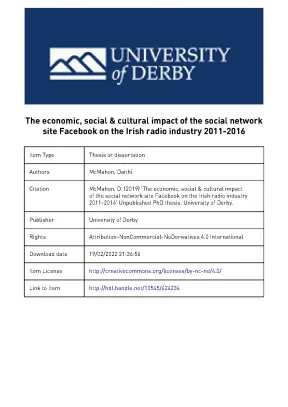
Tải xuống để đọc toàn bộThe economic, social & cultural impact of the social network site Facebook on the Irish radio industry 2011-2016 Item Type Thesis or dissertation Authors McMahon, Daithí Citation McMahon, D. (2019) 'The economic, social & cultural impact of the social network site Facebook on the Irish radio industry 2011-2016' Unpublished PhD thesis. University of Derby. Publisher University of Derby Rights Attribution-NonCommercial-NoDerivatives 4.0 International Download date 19/02/2022 21:36:56 Item License http://creativecommons.org/licenses/by-nc-nd/4.0/ Link to Item http://hdl.net/10545/624234 UNIVERSITY OF DERBY THE ECONOMIC, SOCIAL & CULTURAL IMPACT OF THE SOCIAL NETWORK SITE FACEBOOK ON THE IRISH RADIO INDUSTRY 2011-2016 Daithí McMahon Doctor of Philosophy 2019 Table of Contents List of Figures i Declaration ii Abstract iii Acknowledgements iv Chapter 1: Introduction and Context of Ireland and the Irish Radio Industry 2011-2016 p.2 Research Aims and Objectives p.3 Research Sub-Questions p.4 Thesis Scope, Outline and Structure p.5 Ireland 2011-2016: Political, Economic and Social Context p.6 The Irish Radio Industry p.14 Public Service Sector p.14 Independent Commercial Sector p.15 Community Radio Sector p.7 Radio Listenership in Ireland p.20 Chapter 2: Audience Participation – Radio at its Best p.2 Radio Audience Participation p.3 Audience Participation, Interaction and Engagement p.4 Radio and SNS ‘Followers’ p.30 Longitudinal Content Analysis p.35 Choice of Medium p.35 Choice of Radio Stations p.36 Facebook or Twitter? p.38 Multi-Method Approach p.41 In-Depth Interviews p.43 Audience Survey Questionnaire p.44 Chapter 3: The Development of Radio into a Multimedia Product p.2 Facebook: The Face of Radio p.0 and Social Media p.55 Radio and Facebook: The Perfect Match p.60 Radio’s Digital Transition p.63 Chapter 4: Audience Motives to Participate, Interact and Engage with Radio and Social Media p.2 Radio Uses and Gratifications p.3 Audience Survey Methodology p.71 Dissemination and Survey Sample p.73 Analysis of Findings p.4 Initial Survey Findings p.75 Tech-Savvy Active Audience p.75 Facebook is Preferred p.76 Audience Uses for Facebook p.78 (2) Seeking Entertainment/Amusement p.79 (3) Contests and Prizes p.5 Facebook not Feedback p.83 Chapter 5: Changes in Audience Media Consumption and the Role of the ‘Produsers’ p.2 Cultural Studies and the Active Audience p.3 Active User / Produser / Prosumer p.4 Active Audience Cycle p.90 Phase 1) Tune In p.92 Phase 2) Log On p.5 Audience Retention and Growth p.6 Commercial Radio vs RTÉ 2fm p.104 Chapter 6: Putting the ‘Social’ in Social Media: The Importance of Connecting with the Audience Through SNSs p.2 Research Methods: In-Depth Interviews p.3 Fundamental Functions of Facebook p.108 Increase Online Presence p.111 Increase Participation, Interaction and Engagement p.120 Chapter 7: Accumulation of Capital and the Commodification of Facebook Audiences p.123 Exploitation or Entertainment? p.125 Commodification of Audience Engagement p.3 Accumulation of Capital p.4 Habitus and Field p.0 – Radio’s Digital Coming of Age p.2 Research Methodology: Direct Observation p.3 Changes in Radio Production p.4 Radio Station Owners’ Perspective p.5 RTÉ Digital Changes p.148 Chapter 9: Understanding Radio Station Facebook Pages – Online Communities p.3 Online Communities – Audience Survey Findings p.155 Community Characteristic 1) Shared Common Location p.156 Community Characteristic 2) Emotional Connection with Others p.159 Community Characteristic 3) Community Influence p.160 Community Characteristic 4) Shared Connection p.162 Community Characteristic 5) Shared Resources and Support p.167 Community Characteristic 6) Shared Identities p.168 Community Characteristic 7) Interpersonal Relationships p.171 Community Characteristic 8) Sense of Belonging to a Group p.181 Chapter 10: Understanding Radio Station Facebook Pages – Cultural Public Spheres p.2 Public Spheres and Fora for Free Speech p.3 Impact on Audience/Participants p.4 Impact on Policy p.5 A Measure of Public Opinion p.6 Cultural Public Spheres – Matters of Art, Culture and Emotion p.7 Cultural Public Spheres on Facebook p.202 Chapter 11: Identity and Community – Beating the Tribal Drum: A Case Study of Radio Kerry p.2 Radio Kerry and its Audience p.3 Radio Kerry Production and Social Media Strategies p.4 Facebook and Cultural Public Spheres p.215 Chapter 12: Millennials, Nostalgia and Affective Communities: A Case Study of Beat 102103 p.2 Millennials and Generation Theory p.3 Affect and Emotion on SNSs p.220 Facebook and Nostalgia p.4 Beat’s Facebook Page p.224 Beat’s Connection with Millennials p.225 Beat’s Use of Nostalgia p.4 Beat’s Viral Posts p.227 Viral Post Example 1: Teletubbies p.227 Viral Post Example 2: Betty Spaghetty p.5 Beat’s Viral Growth p.232 Chapter 13: Radio Audiences and Parasocial Interaction: A Tubridy 2fm (RTÉ) Case Study p.2 Parasocial Interaction and Intimacy p.3 Radio Audience Fandom p.4 Tubridy 2fm Facebook Page p.244 Chapter 14: Radio in the Digital Age and Application of Research to Industry Policy and Strategy Development p.2 Revisit Research Questions p.3 Recommendations and Future Application of Research Findings p.261 Chapter 15: Critical Implications for the Research p.2 Change for Irish Radio p.3 The Future of Commercial Radio p.266 Radio’s Public Service Remit p.4 Visualisation of Radio p.271 Podcasts – Radio’s Aural Competition p.293 Appendix 1: Content Analysis Full Results Appendix 2: Informed Consent Form & Participant Information Sheet Appendix 3: Ethics Applications & Approvals Appendix 4: Radio Kerry Survey Results Appendix 5: Beat 102103 Survey Results Appendix 6: RTÉ 2fm Survey Results Appendix 7: Tubridy 2fm Survey Results Appendix 8: Radio Professional Interview Questions & Transcripts Appendix 9: Further Reading – Author’s Published Works & Presentations List of Figures Figure 1: Example of Beat Friday Post p.49 Figure 2: Example of survey post published on radio station Facebook pages p.73 Figure 3: The Active Audience Cycle p.92 Figure 4: Youth Radio Station Reach 2008-2014 p.100 Figure 5: Example of Beat meme on Irish weather p.138 Figure 6: Radio Kerry Facebook page on Sept.207 Figure 7: Terrace Talk post published July 2, 2016 p.214 Figure 8: Facebook’s emoji icons introduced in 2015 p.224 Figure 9: Beat Facebook page September 11, 2014 p.225 Figure 10: Beat Facebook page October 30, 2014 p.225 Figure 11: Teletubbies post on Beat’s Facebook page p.228 Figure 12: Betty Spaghetty post on Beat’s Facebook page p.230 Figure 13: Tubridy 2fm Facebook page September 11, 2014 p.235 Figure 14: RTÉ 2fm Facebook page September 11, 2014 p.237 Figure 15: RTÉ 2fm Facebook page July 13, 2018 p.237 Figure 16: An example of a ‘Behind the Scenes’ post March 4, 2014 p.241 Figure 17: ‘Celebrity Photo’ post Harry Shearer & Ryan Tubridy, March 7, 2014 p.242 Figure 18: ‘Ryan on Tour’ with the Irish Rugby Team, January 22, 2014 p.243 * Some images have been removed prior to publication for copyright reasons.
i Declaration I hereby certify that this material, which I now submit for assessment on the programme of study leading to the award of PhD is entirely my own work and has not been taken from the work of others save and to the extent that such work has been cited and acknowledged within the text of my work. Signed: ____________________ Daithí McMahon Date: ____________________ ii Abstract This thesis explores the relationship between radio and Facebook in Ireland during the period 2011-2016 and the ways in which radio production practices, audience participation and radio as a medium has changed over that time. From 2008, the Irish Radio Industry experienced a steep decline in advertising revenue which would continue for the next 8 years. Initially seen as a possible threat to the still largely analogue medium of radio, social media platforms such as Facebook were quickly adopted by radio stations and turned into tactical instruments to attract and engage audiences.
Again, radio proved its resilience and adaptability to change. Although producers for the most part used Facebook creatively and skilfully to gather their audience in online communities, Facebook has unfortunately been found to be presenting some significant issues for the Irish Radio Industry. This thesis employed a multimethod approach to explore the research problem from the perspective of the audience, the producer, and the media texts. This triangulation approach allowed for a comprehensive examination and analysis of the research question and an objective set of findings.
The research included interviews with Irish Radio Industry professionals (N=11) as well as direct observation of the presenters’/producers’ daily production routines. An extensive audience questionnaire was disseminated via Facebook and yielded a high response (N=416). Textual analysis of radio station Facebook pages offered insight into the bespoke nature of each station’s output including audience tastes and staff production strategies. A longitudinal content analysis allowed the researcher to measure the growth of radio station Facebook and Twitter followers over a two-and-a-half year period.
This research highlights the importance of Facebook for radio stations in Ireland as an audio- visual tool to reach new young audiences who have grown up in the digital age, although it does expand the producers’ remit. I argue that radio stations can accumulate social, cultural and symbolic capital through Facebook, and in some instances, economic capital. This thesis highlights the changes that are representative of convergence culture where the audience play a much more active role in media production and dissemination, but their ‘play labour’ is simultaneously being commodified and profited from by Facebook and Google. This research offers case studies which include some best practice in terms of social media management and will therefore inform radio production teaching in higher education.
Based on the research I propose that Irish radio needs to act fast while the industry is still afloat and engage in collaboration between commercial and public service radio, regulation of online advertisers and social network sites (SNSs) and innovation to engage further with digital media and find new revenue streams. Should action not be taken I predict the conglomeration of the commercial sector of the Irish Radio Industry and with it the loss of valuable and trusted public services from local communities. iii Acknowledgements This thesis would not have been possible without the help and support of Mary Immaculate College, University of Limerick and the staff of the Media & Communications Department. In particular I would like to thank my first thesis Director of Study Dr Rosemary Day who encouraged me to start this journey and supported me during our time working together.
I would also like to thank the rest of the staff in the department including Dr Marcus Free for his help and advice and his invaluable insight at a crucial stage of the research. Padraig Horgan was also extremely helpful as were the MIC library staff. Professor Jim Deegan and the staff of the MIC Research and Grad School were wonderfully supportive throughout my time at MIC and deserve my sincere thanks. PhD study takes time and money and so I must therefore also thank the MIC College of Arts for making my postgrad studies possible through an MIC Assistantship Award.
I transferred my studies to the University of Derby and I would like to thank Professor Chris White whose initiative and guidance in helping me transfer my studies was greatly welcomed, not to mention her expert guidance as my Director of Studies. I would also like to thank Professor Huw Davies whose support was invaluable in helping me bring this thesis over the line. I have learned a lot from all my supervisors which I will bring forward to my own PhD supervision in the future. I would also like to thank the College of Arts, Humanities & Education at the University of Derby for the financial and administrative support it provided to help me complete my studies, as well as the library staff at University of Derby and the post- grad support team who have been so helpful to me.
I also greatly appreciate all the participants who took part in the study, including the survey respondents, and the staff and management of the radio stations for their time, input and understanding of the importance of this research to radio studies. I would also thank the countless people who have helped along the way, too many to name individually or recall, but wherever you are please know that I appreciate your help and I thank you. My family have provided enormous support to me throughout the process of producing this thesis. I would like to thank my parents, siblings and their partners for everything they have done, big and small, to keep me moving forward.
Nội dung được bảo vệ bản quyền — Tải xuống đầy đủ
Trích dẫn luận án này
Daithí McMahon (2019). Mcmahon daithí 2019 the impact of facebook on the irish radi [Luận án tiến sĩ, University of Derby]. LuanAn.net. https://luanan.net/truyen-thong-bao-chi/truyen-thong-da-phuong-tien/mcmahon-daithi-2019-the-impact-of-facebook-on-the-irish-radio-industry-phd
Câu hỏi thường gặp
Luận án "Mcmahon daithí 2019 the impact of facebook on the irish radi" nghiên cứu về vấn đề gì?
Mcmahon Daithí 2019: Nghiên cứu tác động của Facebook đến ngành phát thanh Ireland. Khám phá xu hướng và chiến lược số mới.
Luận án "Mcmahon daithí 2019 the impact of facebook on the irish radi" được bảo vệ tại trường nào?
Luận án này được bảo vệ tại University of Derby. Năm bảo vệ: 2019.
Luận án "Mcmahon daithí 2019 the impact of facebook on the irish radi" có bao nhiêu trang?
Luận án "Mcmahon daithí 2019 the impact of facebook on the irish radi" có 318 trang. Bạn có thể xem trước một phần tài liệu ngay trên trang web trước khi tải về.
Cách tải luận án "Mcmahon daithí 2019 the impact of facebook on the irish radi" về máy như thế nào?
Để tải luận án về máy, bạn nhấn nút "Tải xuống ngay" trên trang này, sau đó hoàn tất thanh toán phí lưu trữ. File sẽ được tải xuống ngay sau khi thanh toán thành công. Hỗ trợ qua Zalo: 0559 297 239.