Hành vi mua sắm trực tuyến bất thường: Phân tích trung gian quan hệ & quyền dữ liệu
Phân tích hành vi mua sắm trực tuyến có vấn đề, xem xét vai trò trung gian của quan hệ tương tác trực tuyến và nhận thức quyền sở hữu dữ liệu.
National Pingtung University of Science and Technology
Tropical Agriculture and International Cooperation
Luan An
Luận án
Năm xuất bản
Số trang
177
Thời gian đọc
27 phút
Lượt xem
0
Lượt tải
0
Phí lưu trữ
50 Point
Mục lục chi tiết
Tóm tắt nội dung
I.Nghiên cứu hành vi mua sắm trực tuyến bất thường S O R
Nghiên cứu này khám phá hành vi mua sắm trực tuyến bất thường. Nó sử dụng khung Kích thích-Sinh vật-Phản ứng (S-O-R) từ tâm lý học hành vi. Mô hình S-O-R giải thích cách các yếu tố môi trường kích thích phản ứng mua sắm không bình thường. Nghiên cứu tích hợp nhận thức về lợi ích và rủi ro khi mua sắm online. Nó cũng xem xét phân tích dữ liệu lớn và công nghệ tập trung vào dữ liệu trong thương mại điện tử. Các yếu tố như quan hệ liên cá nhân online và ý thức sở hữu dữ liệu ảnh hưởng đến hành vi này. Mục tiêu là hiểu sâu hơn nguyên nhân gốc rễ của hành vi mua sắm trực tuyến bất thường. Nghiên cứu cung cấp một cái nhìn toàn diện, dựa trên dữ liệu. Điều này giúp giải thích các hành vi mua sắm phức tạp trên internet.
1.1. Khung lý thuyết S O R cho mua sắm trực tuyến
Mô hình S-O-R đóng vai trò trung tâm trong nghiên cứu này. Nó thiết lập một khung lý thuyết mạnh mẽ để phân tích hành vi mua sắm trực tuyến bất thường. Khung này cho phép giải thích các kích thích môi trường dẫn đến phản ứng mua sắm bất thường. Các kích thích bao gồm lợi ích và rủi ro được cảm nhận khi mua sắm online. Sự phát triển của internet và công nghệ điều khiển bởi dữ liệu cung cấp những hiểu biết sâu rộng về hành vi người tiêu dùng. Các nhà bán lẻ online thu thập lượng lớn hồ sơ khách hàng. Dữ liệu này được dùng để cải thiện dịch vụ cá nhân hóa. Tuy nhiên, việc khai thác thông tin người tiêu dùng cũng tiềm ẩn rủi ro. Nghiên cứu này đánh giá liệu những lợi ích và rủi ro này có giải thích được hành vi mua sắm trực tuyến có vấn đề hay không.
1.2. Phân tích hành vi người dùng dữ liệu lớn thương mại điện tử
Sự bùng nổ của internet và công nghệ dữ liệu tiên tiến tạo điều kiện cho việc thu thập và kiểm tra dữ liệu khách hàng. Các nhà bán lẻ trực tuyến có thể thu thập hồ sơ khách hàng khổng lồ. Điều này mang lại cái nhìn toàn diện về hành vi người tiêu dùng. Dữ liệu lớn thương mại điện tử là tài liệu thô cho các dịch vụ cá nhân hóa. Mặc dù thông tin khách hàng mang lại nhiều lợi ích và tiện lợi cho người tiêu dùng, mối lo ngại về các rủi ro tiềm ẩn ngày càng tăng. Nghiên cứu xem xét cách dữ liệu lớn trong thương mại điện tử ảnh hưởng đến nhận thức của người dùng. Nó đánh giá tác động của những yếu tố này đến hành vi mua sắm trực tuyến bất thường. Việc phân tích hành vi người dùng là chìa khóa để hiểu xu hướng và rủi ro tiềm ẩn.
II.Sở hữu dữ liệu người tiêu dùng Tác động lợi ích rủi ro
Nghiên cứu nhấn mạnh tầm quan trọng của ý thức sở hữu dữ liệu người tiêu dùng. Nhận thức này bị ảnh hưởng bởi lợi ích và rủi ro cảm nhận khi mua sắm online. Rủi ro cảm nhận có tác động đáng kể hơn lợi ích cảm nhận. Điều này gợi ý rằng lo ngại về rủi ro có thể tăng cường ý thức sở hữu dữ liệu. Ngược lại, lợi ích cảm nhận có thể làm giảm sự chú ý đến quyền sở hữu dữ liệu. Người tiêu dùng có thể bỏ qua tầm quan trọng của dữ liệu cá nhân khi được hưởng lợi ích. Việc hiểu rõ mối quan hệ này rất quan trọng để bảo vệ quyền riêng tư dữ liệu cá nhân. Nó cũng giúp các nhà cung cấp dịch vụ thiết kế chiến lược bảo vệ thông tin hiệu quả.
2.1. Nhận thức lợi ích rủi ro mua sắm online tác động sở hữu dữ liệu
Ý thức sở hữu dữ liệu của người tiêu dùng bị ảnh hưởng rõ rệt bởi nhận thức về lợi ích và rủi ro khi mua sắm trực tuyến. Mặc dù thương mại điện tử mang lại nhiều đổi mới và tiện lợi, những lo ngại về rủi ro tiềm ẩn cũng gia tăng. Kết quả phân tích chỉ ra rằng nhận thức về rủi ro có ảnh hưởng đáng kể hơn đến ý thức sở hữu dữ liệu so với nhận thức về lợi ích. Điều này hàm ý rằng cảm nhận rủi ro cao hơn có thể dẫn đến ý thức sở hữu dữ liệu cao hơn. Tuy nhiên, nhận thức về lợi ích có thể không có tác động tương tự, bởi vì nó có thể khiến người tiêu dùng bỏ qua tầm quan trọng của quyền sở hữu dữ liệu khi tiết lộ thông tin cá nhân của họ.
2.2. Quyền riêng tư dữ liệu cá nhân Nâng cao ý thức sở hữu
Việc nâng cao ý thức về quyền riêng tư dữ liệu cá nhân là một phát hiện quan trọng. Cảm nhận về rủi ro trực tuyến thúc đẩy người tiêu dùng nhận thức rõ hơn về quyền sở hữu dữ liệu của mình. Ngược lại, các lợi ích hấp dẫn của mua sắm online có thể làm lu mờ tầm quan trọng của việc bảo vệ dữ liệu. Khi người tiêu dùng quá tập trung vào các ưu đãi và tiện ích, họ dễ dàng bỏ qua việc bảo vệ thông tin cá nhân. Điều này đặt ra thách thức cho các nền tảng thương mại điện tử. Họ cần cân bằng giữa việc cung cấp dịch vụ cá nhân hóa và việc đảm bảo quyền riêng tư dữ liệu cá nhân, cũng như củng cố sở hữu dữ liệu người tiêu dùng. Việc này liên quan trực tiếp đến các quy định bảo vệ dữ liệu như GDPR và quyền sở hữu dữ liệu.
III.Quan hệ online quyền riêng tư dữ liệu ảnh hưởng mua sắm
Nghiên cứu đã khám phá vai trò trung gian của quan hệ liên cá nhân online và ý thức sở hữu dữ liệu. Ý thức sở hữu dữ liệu đóng vai trò trung gian quan trọng giữa lợi ích/rủi ro cảm nhận và hành vi mua sắm trực tuyến bất thường. Điều này có nghĩa là cách người tiêu dùng nhận thức về quyền sở hữu dữ liệu của mình ảnh hưởng đến việc họ có phát triển hành vi mua sắm có vấn đề hay không. Quan hệ liên cá nhân online cũng có tác động đáng kể đến hành vi này. Những cá nhân gặp khó khăn trong các mối quan hệ trực tuyến có xu hướng có hành vi mua sắm trực tuyến bất thường nhiều hơn.
3.1. Vai trò trung gian của sở hữu dữ liệu trong hành vi mua sắm
Ý thức sở hữu dữ liệu người tiêu dùng có hiệu ứng trung gian đáng kể. Nó kết nối lợi ích và rủi ro cảm nhận trong mua sắm trực tuyến với hành vi mua sắm bất thường. Điều này chỉ ra rằng nhận thức về việc ai sở hữu dữ liệu cá nhân đóng vai trò quan trọng. Nó định hình cách người tiêu dùng phản ứng với các kích thích mua sắm. Việc bảo vệ dữ liệu, quyền riêng tư trở nên thiết yếu. Các nền tảng cần xây dựng lòng tin, củng cố quyền riêng tư dữ liệu cá nhân. Một ý thức sở hữu dữ liệu mạnh mẽ giúp người tiêu dùng đưa ra quyết định mua sắm có trách nhiệm hơn, giảm nguy cơ phát triển hành vi mua sắm trực tuyến bất thường.
3.2. Mối quan hệ trực tuyến an ninh mạng trong mua sắm online
Mặc dù vai trò trung gian của quan hệ liên cá nhân online không đáng kể đối với lợi ích/rủi ro, nó có ảnh hưởng trực tiếp và tích cực đến hành vi mua sắm trực tuyến bất thường. Cụ thể, những người gặp khó khăn trong các mối quan hệ online có nhiều khả năng có hành vi mua sắm bất thường. Điều này cho thấy yếu tố xã hội trực tuyến đóng góp vào các vấn đề mua sắm. An ninh mạng trong mua sắm online và các vấn đề về tương tác xã hội cần được quan tâm. Sự cô lập hoặc căng thẳng trong các mối quan hệ trực tuyến có thể thúc đẩy hành vi tiêu dùng không lành mạnh. Các nền tảng cần phát triển môi trường an toàn, hỗ trợ người dùng, giảm thiểu rủi ro này.
IV.Phân tích hành vi mua sắm Dự đoán và phát hiện bất thường
Nghiên cứu đã xây dựng các mô hình khai phá dữ liệu để dự đoán hành vi mua sắm trực tuyến bất thường. Bốn mô hình đã được so sánh để đánh giá hiệu suất. Các mô hình như Mạng thần kinh nhân tạo, C5.0 và CHAID đã thể hiện khả năng dự đoán vượt trội. Chúng vượt trội hơn so với hồi quy Logistic. Việc phát hiện giao dịch gian lận và các hành vi bất thường là mục tiêu chính. Các yếu tố quan trọng như thời gian dành cho mua sắm online và hệ thống khuyến nghị ảnh hưởng mạnh mẽ. Kết quả này cung cấp công cụ hiệu quả cho các nhà bán lẻ. Nó giúp họ xác định và ngăn chặn các hành vi tiêu dùng có vấn đề.
4.1. Mô hình dự đoán hành vi mua sắm trực tuyến bất thường
Nghiên cứu đã xây dựng bốn mô hình khai phá dữ liệu. Mục tiêu là dự đoán và phân loại người tiêu dùng có hành vi mua sắm trực tuyến bất thường. Các mô hình này bao gồm Mạng thần kinh nhân tạo, C5.0, CHAID và hồi quy Logistic. Việc phát hiện giao dịch gian lận và các hành vi bất thường là rất quan trọng. Các mô hình này được đào tạo và kiểm tra trên dữ liệu thực tế. Hiệu suất của chúng được đánh giá thông qua các chỉ số thống kê. Mục tiêu là cung cấp một công cụ đáng tin cậy. Công cụ này giúp các nền tảng thương mại điện tử nhận diện sớm các rủi ro.
4.2. Hiệu suất thuật toán bảo mật thông tin thanh toán
Mạng thần kinh nhân tạo, C5.0 và CHAID đều vượt trội hơn hồi quy Logistic về hiệu suất dự đoán. Cụ thể, CHAID và C5.0 có khả năng dự đoán cao nhất. Hồi quy Logistic có khả năng dự đoán kém nhất. Phân tích độ nhạy cũng chỉ ra các yếu tố dự đoán quan trọng nhất. Thời gian dành cho mua sắm online hàng ngày, hệ thống bảo mật và hệ thống khuyến nghị là các yếu tố then chốt. Những yếu tố này giải thích hành vi mua sắm trực tuyến bất thường. Điều này nhấn mạnh tầm quan trọng của bảo mật thông tin thanh toán và các tính năng an toàn khác. Nó cũng giúp các nhà bán lẻ tối ưu hóa trải nghiệm người dùng, đồng thời giảm thiểu rủi ro.
V.Bảo vệ dữ liệu quy định bảo vệ dữ liệu thương mại điện tử
Nghiên cứu nhấn mạnh tầm quan trọng của ý thức sở hữu dữ liệu trong kỷ nguyên dữ liệu lớn. Khung nghiên cứu đã làm nổi bật vai trò của nhận thức người tiêu dùng. Nhận thức này ảnh hưởng đến ý thức sở hữu dữ liệu và hành vi mua sắm trực tuyến bất thường. Hiểu rõ hơn về lợi ích và rủi ro cảm nhận giúp các nhà điều hành nền tảng trực tuyến. Họ có thể thiết kế các chiến lược tốt để nâng cao sự hài lòng của khách hàng. Đồng thời, họ cần bảo vệ quyền riêng tư dữ liệu và nguyên tắc sở hữu dữ liệu. Điều này rất quan trọng để xây dựng lòng tin, tuân thủ các quy định bảo vệ dữ liệu như GDPR. Nó cũng giúp duy trì an ninh mạng trong mua sắm online.
5.1. Tăng cường nhận thức sở hữu dữ liệu người tiêu dùng
Nghiên cứu khẳng định tầm quan trọng của ý thức sở hữu dữ liệu. Nó đóng góp vào việc thảo luận sâu hơn về hành vi mua sắm trực tuyến bất thường trong kỷ nguyên dữ liệu lớn. Khung nghiên cứu đã nêu bật sự quan trọng của nhận thức người tiêu dùng đối với mua sắm online. Nhận thức này ảnh hưởng đến ý thức sở hữu dữ liệu và các hành vi mua sắm bất thường. Việc thúc đẩy sở hữu dữ liệu người tiêu dùng là cần thiết. Điều này giúp cá nhân có quyền kiểm soát thông tin của mình. Nó cũng giúp họ hiểu rõ hơn về các tác động của việc chia sẻ dữ liệu. Các quy định bảo vệ dữ liệu cần được tăng cường thực thi.
5.2. Chiến lược bảo vệ quyền riêng tư an ninh mạng thương mại điện tử
Việc hiểu sâu hơn về lợi ích và rủi ro cảm nhận của người tiêu dùng trực tuyến mang lại giá trị to lớn. Nó giúp các nhà khai thác nền tảng online thiết kế chiến lược hiệu quả. Các chiến lược này nhằm nâng cao sự hài lòng của người tiêu dùng. Đồng thời, họ phải bảo vệ quyền riêng tư dữ liệu cá nhân và nguyên tắc sở hữu dữ liệu. Điều này liên quan đến việc triển khai các biện pháp an ninh mạng trong mua sắm online mạnh mẽ. Nó bao gồm mã hóa dữ liệu, xác thực đa yếu tố. Việc tuân thủ GDPR và quyền sở hữu dữ liệu là bắt buộc. Các nền tảng cần minh bạch về cách dữ liệu được sử dụng. Điều này giúp xây dựng lòng tin, tạo ra một môi trường mua sắm trực tuyến an toàn hơn cho mọi người.
Tải xuống file đầy đủ để xem toàn bộ nội dung
Tải đầy đủ (177 trang)Trích đoạn nội dung luận án
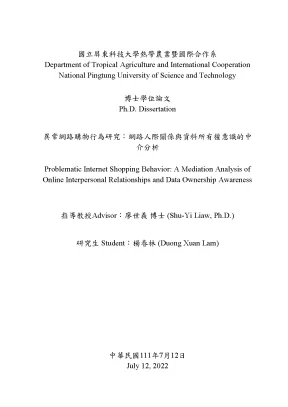
Tải xuống để đọc toàn bộ國立屏東科技大學熱帶農業暨國際合作系 Department of Tropical Agriculture and International Cooperation National Pingtung University of Science and Technology 博士學位論文 Ph. Dissertation 異常網路購物行為研究:網路人際關係與資料所有權意識的中 介分析 Problematic Internet Shopping Behavior: A Mediation Analysis of Online Interpersonal Relationships and Data Ownership Awareness 指導教授Advisor:廖世義 博士 (Shu-Yi Liaw, Ph.) 研究生 Student:楊春林 (Duong Xuan Lam) 中華民國111年7月12日 July 12, 2022 摘要 學號:P10722025 論文名稱:異常網路購物行為研究:網路人際關係與資料所有權意識的 中介分析 總頁數:163 頁 學校名稱:國立屏東科技大學 系(所)別:熱帶農業暨國際合作系 畢業時間及摘要別:110 學年度第 2 學期博士學位論文摘要 研究生:楊春林 指導教授:廖世義 博士 論文摘要內容: 互聯網的發展和資料驅動技術促使線上零售商能夠收集和檢查大量顧 客的資料,對消費者行為進行全面洞察,並將其用作改善顧客個人化服 務的參考。雖然在電子商務中常利用消費者信息為顧客提供許多創新的 服務和便利,但對與此類操縱相關的潛在風險的擔憂也在升級。然而, 這些好處和風險是否可以解釋消費者有問題的網上購物行為或異常的網 路購物行為尚未得到充分探索。因此,本研究旨在:(1) 建立一個基於環 境刺激-行為個體-趨避回應(S-O-R)的框架來研究異常的線上購物 行為; (2) 強調網路購物的感知利益和風險對消費者資料所有權意識及 對網路購物問題行為的影響; (3) 探討網路人際關係和資料所有權意識 對消費者的感知利益和風險對異常網路購物行為之間的關聯和中介效 用,(4) 構建基於分類演算法的異常網路購物行為的預測模型,並比較其 預測性能的相關分類器。透過使用社會科學統計軟體(SPSS)和結構方程 建模軟體 (PLS-SEM) 的 SmartPLS 分析 1,039 份有效回覆,獲得了以下幾 點結論。 重要的發現包括: I (1) 一個有效的行為心理學框架被用來解釋異常的網上購物行為, 並整合了消費者對線上購物的感知利益和風險,它是由電子商務中的大 數據分析和數據密集型技術驅動的,並透過消費者的人際關係和資料所 有權意識而影響異常的互聯網購物行為(響應)的刺激因素。S-O-R 模 型可讓本研究充分解釋了環境刺激如何導致實際反應異常的網路購物行 為。 (2) 分析結果說明,消費者的資料所有權意識受其對線上購物效益 和風險的認知的影響。發現感知風險對資料所有權意識的影響比感知效 益更顯著,這意味著風險感知可能導致更高的資料所有權意識。然而, 利益感知可能並非如此,因為它會引起消費者對自己消費及個資的信息 披露,從而導致他們忽略了資料所有權的重要。 (3) 進一步分析網路人際關係和資料所有權意識是否在本研究模式 內具中介效用。結果說明,資料所有權意識在網路購物的感知利益和網 路購物的感知風險及異常的網路購物間有顯著中介的效果。然而,本研 究發現使用者網路人際關係在網路購物的感知效益及感知風險在對異常 的網路購物之間的中介效應並不顯著。此外,網路人際關係對有異常的 網路購物有顯著正向影響,此也說明了網路人際關係越困難的人更容易 有異常的網路購物行為,這與之前的相關研究發現是一致的。 (4) 構建了四種資料探勘模型,並對異常網購行為的消費者進行預 測和分類。其中人工神經網路、C5.0 和 CHAID 在訓練或測試樣本的所 有性能評估中統計數據結果都優於羅吉斯迴歸。具體而言,CHAID 和 C5.0 的預測性能最高,而羅吉斯迴歸的預測能力最差。且敏感性分析也 說明了在本研究樣本中,每天花費在網上購物、安全和推薦系統上的時 間是解釋有異常網上購物行為的最關鍵預測因素。 本研究強調了資料所有權意識的重要性,並有助於在大數據時代 加強關於異常網路購物行為的深度探討。所提出的研究框架在強調消費 者對網路購物的感知對資料所有權意識和影響異常網購物行為的重要性。 相信對當代線上消費者感知利益和感知風險的進一步解,有助於線上平 II 台經營業者設計良好的策略來提升消費者滿意度,同時保護消費者的資 料隱私和資料所有權原則。 關鍵字:異常網購、資料所有權意識、網路人際關係、S-O-R 模型、資 料探勘、分類演算 III ABSTRACT Student ID: P10722025 Title of Dissertation: Problematic Internet Shopping Behavior: A Mediation Analysis of Online Interpersonal Relationships and Data Ownership Awareness Total Page: 163 Pages Name of Institute: Department of Tropical Agriculture and International Cooperation, National Pingtung University of Science and Technology Graduate Date: July 12, 2022 Degree Conferred: Doctoral Degree Name of Student: Duong Xuan Lam Advisor: Shu-Yi Liaw, Ph. The Contents of Abstract in This Dissertation:: The explosion of the internet and advanced data-driven technologies enable online retailers to gather and inspect enormous customers’ profiles, providing a thorough insight into consumer behavior and utilizing it as raw materials for improved personalization. While harnessing consumer information in e-commerce offers tremendous benefits and convenience to customers, concerns escalated over potential risks associated with such manipulation.
Nevertheless, whether such benefits and risks explain consumers’ problematic internet shopping behavior has been explored inadequately. Several theoretical models in behavioral psychology and consumer behavior literature have attempted to explain this association without concrete results. Therefore, the present study intends to: (1) establish a research framework grounded by Stimulus-Organism-Response (S-O-R) for studying problematic online shopping behavior; (2) accentuate the effect of perceived benefits and IV risks of internet shopping on consumers’ data ownership awareness and problematic online shopping behavior; (3) explore the mediating effect of online interpersonal relationships and data ownership awareness on the association between consumers’ perceived benefits and risks and problematic internet shopping behavior, and finally (4) construct models to predict problematic internet shopping behavior based on classification algorithms and compare the predictive performance of relevant classifiers. The results were obtained by analyzing 1,039 valid responses using standard statistical software.
The significant findings include: (1) The Stimulus-Organism-Response theory was employed to explain the problematic online shopping behavior. The present study integrates consumers’ perception of the benefits and risks of internet purchasing – presumably driven by big data analytics and data-intensive technologies in e- commerce as stimuli. These environmental stimuli affect problematic internet shopping behavior (response) through consumers’ interpersonal relationships and data ownership awareness (organism). The S-O-R paradigm adequately explains how the environmental stimuli result in an actual response.
(2) The analysis results suggest that consumers’ data ownership awareness greatly influences their benefit and risk perception. It is found that perceived risks manifest a more significant influence on data ownership awareness than perceived benefits, meaning that risk perception could lead to higher data ownership awareness. However, it might not be the case for the perception of benefits as it lures consumers into the information disclosure and consequently leads them to be unconscious of data ownership. (3) Further analyses were conducted to investigate whether online interpersonal relationships and data ownership awareness functioned as mediators within the research framework.
Results suggest that data ownership awareness mediates the relationship between perceived benefits, perceived V risks, and problematic internet shopping. Besides, online interpersonal relationships positively and significantly impact problematic internet shopping, indicating that those with inferior interpersonal relationships are more susceptible to problematic internet shopping. However, the study failed to support the proposed mediation effect of online interpersonal relationships on the association between perceived benefits, perceived risks, and problematic internet shopping. (4) Four data mining models were constructed to predict and classify consumers with problematic internet shopping behavior.0, and CHAID outperform logistic regression in all performance evaluation statistics in either training or testing samples.
Specifically, the CHAID and the C5.0 achieved the highest predictive performance, whereas the logistic regression showed the worst predictive capability. Besides, the sensitivity analysis indicates that daily time spent online shopping, security, and recommendation system were the most critical predictors explaining PIS in our study samples. Overall, the present research highlights the importance of data ownership awareness and enriches the scarcity of literature on the problematic internet shopping in the big data era. The proposed framework is the pioneer in emphasizing the significance of consumer perception regarding internet purchasing on data ownership awareness and problematic internet shopping behavior.
Also, a current understanding of perceived benefits and risks may help design good strategies to achieve consumer satisfaction while preserving consumers’ privacy and data ownership principles. Keywords: problematic internet shopping, data ownership awareness, online interpersonal relationships, S-O-R model, data mining, classification algorithms VI ACKNOWLEDGMENT The academic voyage to attain my doctoral degree has come to an end. Let us take this opportunity to acknowledge all those who followed along and supported me to reach this far. First and foremost, I would like to express my sincere gratitude to my esteemed research advisor – Dr.
Shu-Yi Liaw, for the continuous and constant support during my PhD program. I am indebted to him for his help in providing invaluable guidance, especially insights into the data and thesis structure. This endeavor would not have been possible without his considerable support from him during all the time of research and writing of this thesis. My wholehearted appreciation also goes to the member of my committee thesis, Dr.
Wen-Kai Hsu, Dr. Hsueh, Chao-Chih, Dr. Huang, Show-Hui, and Dr. Rong-Fan Chen, for their insightful comments and encouragement.
I sincerely thank the International Cooperation and Development Fund (TaiwanICDF) for providing me with financial support for my PhD research. In addition, I would also like to appreciate the kind support and assistance on various administrative matters to all DTAIC staff members, particularly Ms. Cor, and Ms. I am also grateful to Dr Jean Luc Pradel Mathurin Augustin, Emma, Joe, Liu Jia-Wei (Jeff), Ho Meng-Hua (Daniel), Hung Kai En (Kevin), Yang Ya-Chu, Lin Yi-Ru, and others in Computer Center for their fruitful discussion, counselling, and mental support during my study period.
Besides, completing this thesis would not have been accomplished without anonymous participants in Taiwan, Vietnam, and elsewhere who took the time to contribute helpful information to my research. Just as importantly, I am incredibly indebted to my parents, my wife, my son, and the others who have always trusted in me and given me continuous encouragement and support to finalize my study in Taiwan. VII TABLE OF CONTENT 摘要. VII TABLE OF CONTENT.
VIII LIST OF TABLES. XI LIST OF FIGURES. Background of the Study. Statement of the Problem.
Objectives of the Study. Contribution of the Study. Research Systematic Discussion. The Organization of the Dissertation.
Internet Use and Online Consumer Behavior. Big Data Analytics in Electronic Commerce. E-commerce and Cross-cultural Context: Taiwan and Vietnam. Stimulus-Organism-Response Model.
Perceived Benefits of Online Shopping. Perceived Risks of Online Shopping. Problematic Internet Shopping Behavior. Online Interpersonal Relationships.
Data Ownership Awareness. Conceptual Models and Hypotheses Development. Study I - Impact of Perceived Benefits and Risks of Online Shopping on Data Ownership Awareness. Study II - The Mediating Role of Online Interpersonal Relationships and Data Ownership Awareness.
Study III - Predicting Problematic Internet Shopping Using Data Mining Classification Algorithms. Data Sources and Procedure. Sample Size Determination. Data Cleaning and Data Pre-processing.
Exploratory Factor Analysis. Partial Least Squares Structural Equation Modeling. Big Data Analysis - Data Mining. RESULTS AND DISCUSSION.
Reliability and Validity of the Measurements. Study I – Impact of Perceived Benefits and Risks of Online Shopping on Data Ownership Awareness. Results and Discussion. Study II - The Mediating Role of Online Interpersonal Relationships and Data Ownership Awareness.
Results and Discussion. Study III – Predicting Problematic Internet Shopping using Data Mining Classification Algorithms. Results and Discussion. CONCLUSION AND RECOMMENDATIONS.
Theoretical and Practical Implications. Limitations and Future Research Recommendation. MICOM assessment for lower-order model (Study 1). Multigroup analysis test results (Study I).
MICOM assessment for higher-order model (Study I). Higher-order structural model assessment (Study 2). MICOM assessment of lower-order model (Study II). Multigroup analysis results (Study II).
160 X LIST OF TABLES Table 1. Constructs and measurements. Confusion matrix for a binary outcome. Construct reliability and validity of the lower-order model.
Discriminant validity of the lower-order model. PLS result- test of hypothesized relationships. Measurement invariance of composite models. Multigroup analysis results of the lower-order model.
Higher-order composite reliability and convergent validity. Higher-order composite discriminant validity. The assessment of predictive performance. Test of higher-order hypothesized relationships.
Results of IMPA (performance and total effects). Results of MICOM (higher-order model). Summary of multi-group analyses (Study I). Summary of Study I’s hypothesized relationships.
Lower-order construct reliability and validity (Study II). Discriminant validity assessment (Fornel & Larcker’s criterion). Assessment of discriminant validity – HTMT’s criterion. Higher-order construct reliability and validity (Study II).
Higher-order discriminant validity assessment (Study II). Out-of-sample predictive performance of indicators. Results of importance-performance matrix analysis (Study II). Evaluation of the structural model for indirect pathways.
Measurement invariance assessment of higher-order model. Results of multigroup analysis (Study II). 87 Table 27: Summary of Study II’s hypotheses relationships. Top 10 important input variables in four models.
94 XII LIST OF FIGURES Figure 1. Problematic buying-shopping continuum. Research model for Study I (lower-order construct). Research model for Study I (higher-order construct).
Research model of Study II. A conceptual diagram of the mediation model. The process of data mining. A typical example of a ROC curve.
Higher-order structural model (Study I). Results of the structural model (Study II). Predictive models building. ROC curve of four classification algorithms.
INTRODUCTION The introductory chapter focuses on the background, research motivation, and objectives. Furthermore, the organization of the study will also be presented, containing an overview of the whole thesis structure. The chapter closes with the definition terms, which give the reader a clear understanding of the study's critical terminologies. Background of the Study Over the last few decades, the e-commerce industry has evolved rapidly with the popularization of the internet.
The internet is generating profound changes in how retailing is operated. The burgeoning of digitization is generating opportunities for the extensive capture, storage, and analysis of business data, optimally used with big data analytics (BDA), which can release extraordinary business benefits. The organization has increasingly implemented the internet and computing technologies to assemble massive amounts of consumer data and provide effective and efficient marketing strategies. Companies were shown to consistently embrace technological artefacts to gather, analyze, and distribute personal information despite growing concern on whether individuals’ data is being compromised.
The internet offers an opportunity to be a "retail therapy," but shopping overuse could be problematic. There has been an upward trend in research exploring problematic buying-shopping behavior. Psychological literature commonly refers to this maladaptive consumption as compulsive buying or addictive buying-shopping. Many efforts have been made to characterize problematic shopping behavior, mainly focused on potential antecedents, possible comorbidity with other established disorders, or estimating the occurrence among the clinical and general population.
The crux of the issue is that psychiatrists have not agreed on defining or measuring it, and estimates of its prevalence vary widely. Thus, an individual's inability to regulate their 1 buying-shopping urges has attracted much research attention. It has been listed in the appendix of the most recent version of the Diagnostic and Statistical Manual of Mental Disorder (American Psychiatric Association, 2013).
Nội dung được bảo vệ bản quyền — Tải xuống đầy đủ
Câu hỏi thường gặp
Luận án "Hành vi mua sắm online bất thường: Quan hệ và sở hữu dữ liệu" nghiên cứu về vấn đề gì?
Phân tích hành vi mua sắm trực tuyến có vấn đề, xem xét vai trò trung gian của quan hệ tương tác trực tuyến và nhận thức quyền sở hữu dữ liệu.
Luận án "Hành vi mua sắm online bất thường: Quan hệ và sở hữu dữ liệu" được bảo vệ tại trường nào?
Luận án này được bảo vệ tại National Pingtung University of Science and Technology. Năm bảo vệ: 2022.
Luận án "Hành vi mua sắm online bất thường: Quan hệ và sở hữu dữ liệu" thuộc chuyên ngành gì?
Luận án "Hành vi mua sắm online bất thường: Quan hệ và sở hữu dữ liệu" thuộc chuyên ngành Tropical Agriculture and International Cooperation. Danh mục: Tâm Lý Học Xã Hội.
Luận án "Hành vi mua sắm online bất thường: Quan hệ và sở hữu dữ liệu" có bao nhiêu trang?
Luận án "Hành vi mua sắm online bất thường: Quan hệ và sở hữu dữ liệu" có 177 trang. Bạn có thể xem trước một phần tài liệu ngay trên trang web trước khi tải về.
Cách tải luận án "Hành vi mua sắm online bất thường: Quan hệ và sở hữu dữ liệu" về máy như thế nào?
Để tải luận án về máy, bạn nhấn nút "Tải xuống ngay" trên trang này, sau đó hoàn tất thanh toán phí lưu trữ. File sẽ được tải xuống ngay sau khi thanh toán thành công. Hỗ trợ qua Zalo: 0559 297 239.