Luận án: Quantum Repeaters, Coherent Control & Spin-Photon Entanglement trong InAs Quantum Dots
Tái lập bộ lặp lượng tử trạng thái rắn: điều khiển quang học kết hợp siêu nhanh & vướng víu spin-photon trong chấm lượng tử InAs tích điện.
Năm xuất bản
Số trang
159
Thời gian đọc
24 phút
Lượt xem
0
Lượt tải
0
Phí lưu trữ
50 Point
Tổng quan nhanh
- Chủ đề:
- Phát Triển Bộ Lặp Lượng Tử: InAs QD & Kiểm Soát Đồng Pha
- Số trang:
- 159 trang
- Trường:
- stanford university
- Chuyên ngành:
- Physics
- Tác giả:
- Kristiaan De Greve
- Năm:
- 2013
Tóm tắt nội dung luận án
I.Phát Triển Bộ Lặp Lượng Tử InAs QD Kiểm Soát Đồng Pha
Luận án này tiên phong trong việc phát triển bộ lặp lượng tử thể rắn. Nghiên cứu tập trung vào kiểm soát quang học đồng pha siêu nhanh và rối lượng tử spin-photon. Chấm lượng tử Indium Arsenide (InAs QD) đóng vai trò nền tảng chính. Công trình này đánh dấu bước tiến quan trọng trong lĩnh vực xử lý thông tin lượng tử. Nó cung cấp cái nhìn sâu sắc về việc xây dựng mạng lượng tử bền vững. Mục tiêu chính là vượt qua những thách thức về thời gian mất kết hợp qubit. Nghiên cứu mang lại tác động khoa học to lớn cho các nhà khoa học và nhà nghiên cứu mới.
1.1. Mục Tiêu Nghiên Cứu và Đóng Góp Khoa Học
Luận án hướng đến việc nâng cao khả năng điều khiển các qubit. Điều này bao gồm việc duy trì trạng thái lượng tử trong thời gian dài hơn. Nó cung cấp các kỹ thuật mới cho giao diện ánh sáng-vật chất hiệu quả. Công trình đóng góp nền tảng lý thuyết và thực nghiệm cho thế hệ bộ lặp lượng tử tiếp theo. Độ chính xác trong kiểm soát đồng pha được cải thiện đáng kể. Điều này mở ra nhiều ứng dụng tiềm năng.
1.2. Vai Trò Bộ Lặp Lượng Tử Trong Truyền Thông Lượng Tử
Bộ lặp lượng tử là yếu tố then chốt cho truyền thông lượng tử đường dài. Chúng giúp khắc phục sự suy giảm tín hiệu photon trong cáp quang. Điều này cho phép xây dựng các mạng lượng tử toàn cầu. Luận án khám phá cách InAs QD có thể hoạt động như các nút trung gian. Các nút này thực hiện việc làm mới rối lượng tử. Điều này đảm bảo tính bảo mật và hiệu quả của việc truyền dữ liệu lượng tử.
II.Kiểm Soát Lượng Tử Đồng Pha Cho Qubit Spin Trong InAs QD
Kiểm soát lượng tử đồng pha là yếu tố sống còn để thao tác qubit. Luận án trình bày các phương pháp điều khiển quang học siêu nhanh. Các phương pháp này tác động chính xác lên qubit spin trong InAs QD. Việc duy trì tính kết hợp là thử thách lớn. Công nghệ này đảm bảo các hoạt động lượng tử diễn ra mà không làm hỏng thông tin. Nó tạo nền tảng cho các phép tính và truyền dẫn lượng tử đáng tin cậy. Hiệu suất của các thiết bị lượng tử phụ thuộc vào kiểm soát đồng pha.
2.1. Kỹ Thuật Kiểm Soát Đồng Pha Nâng Cao Độ Chính Xác
Các kỹ thuật mới được phát triển để điều khiển trạng thái spin. Chúng sử dụng các xung laser cực ngắn và có kiểm soát. Điều này cho phép chuyển đổi trạng thái qubit nhanh chóng và hiệu quả. Độ chính xác của các thao tác này rất cao. Nó giảm thiểu lỗi do mất kết hợp. Đây là một bước tiến quan trọng trong việc xây dựng bộ xử lý lượng tử mạnh mẽ.
2.2. Qubit Spin Trong Chấm Lượng Tử Indium Arsenide InAs QD
Qubit spin trong InAs QD là một nền tảng đầy hứa hẹn. Spin điện tử trong chấm lượng tử có thời gian mất kết hợp tương đối dài. Điều này giúp lưu trữ thông tin lượng tử hiệu quả. InAs QD cũng cung cấp khả năng tương tác mạnh mẽ với ánh sáng. Đây là điều kiện lý tưởng cho giao diện ánh sáng-vật chất. Khả năng kiểm soát spin bằng quang học là một lợi thế lớn.
III.Rối Lượng Tử Spin Photon Nền Tảng Truyền Thông Lượng Tử
Rối lượng tử spin-photon là một yếu tố cốt lõi của truyền thông lượng tử. Luận án chi tiết cách tạo ra và duy trì mối liên kết này. Trạng thái spin của điện tử trong InAs QD được rối với trạng thái phân cực của photon. Photon rối sau đó có thể được truyền đi xa. Mối quan hệ này cho phép chuyển giao thông tin lượng tử an toàn. Đây là một viên gạch quan trọng trong kiến trúc mạng lượng tử. Nó đảm bảo tính bảo mật tuyệt đối cho dữ liệu.
3.1. Cơ Chế Rối Lượng Tử Giữa Spin và Photon Đơn
Việc tạo rối xảy ra thông qua quá trình phát xạ photon. Điện tử trong InAs QD chuyển trạng thái spin. Đồng thời, nó phát ra một photon. Trạng thái phân cực của photon phụ thuộc vào trạng thái spin cuối cùng của điện tử. Mối liên hệ này hình thành mối rối lượng tử. Đây là một nguồn photon đơn rối lượng tử hiệu quả. Nó thiết yếu cho nhiều giao thức lượng tử.
3.2. Ứng Dụng Rối Lượng Tử Trong Mạng Lượng Tử An Toàn
Rối lượng tử là nền tảng của phân phối khóa lượng tử (QKD). QKD cung cấp bảo mật không thể phá vỡ cho truyền thông. Mạng lượng tử sử dụng rối để tạo ra các kênh liên lạc an toàn. Sự có mặt của rối lượng tử cũng cho phép điện toán lượng tử phân tán. Nghiên cứu này mở đường cho việc xây dựng một internet lượng tử trong tương lai.
IV.Chấm Lượng Tử InAs Nền Tảng Vững Chắc Mạng Lượng Tử
Chấm lượng tử Indium Arsenide (InAs QD) là một vật liệu lý tưởng. Chúng cung cấp nền tảng thể rắn cho các ứng dụng lượng tử. Đặc tính của chúng bao gồm khả năng lưu trữ qubit spin ổn định. Chúng cũng là nguồn photon đơn hiệu quả. Cấu trúc chấm lượng tử cho phép điều khiển chính xác các trạng thái lượng tử. Luận án khám phá cách tối ưu hóa InAs QD. Điều này nhằm cải thiện hiệu suất của bộ lặp và bộ nhớ lượng tử. Tính linh hoạt và khả năng tích hợp của InAs QD rất cao.
4.1. Đặc Tính Nguồn Photon Đơn Từ Chấm Lượng Tử InAs
InAs QD hoạt động như các nguồn photon đơn theo yêu cầu. Mỗi lần kích thích, chúng phát ra một photon duy nhất. Điều này rất quan trọng cho truyền thông lượng tử an toàn. Chất lượng của photon đơn ảnh hưởng đến hiệu quả của các giao thức. InAs QD có thể tạo ra photon với độ tinh khiết cao. Chúng cũng có thể được điều chỉnh bước sóng để phù hợp với cáp quang.
4.2. InAs QD Là Bộ Nhớ Lượng Tử Tiềm Năng
Qubit spin trong InAs QD có tiềm năng làm bộ nhớ lượng tử. Chúng có thể lưu trữ thông tin lượng tử trong thời gian đáng kể. Điều này là cần thiết cho bộ lặp lượng tử và máy tính lượng tử. Khả năng đọc và ghi thông tin từ qubit spin cần được tối ưu hóa. Nghiên cứu này tìm cách cải thiện thời gian lưu trữ và hiệu quả truy cập.
V.Bộ Lặp Lượng Tử Tăng Cường Phạm Vi Truyền Thông Lượng Tử
Bộ lặp lượng tử là giải pháp cho khoảng cách xa trong truyền thông. Công trình này đóng góp vào thiết kế và triển khai các bộ lặp này. Chúng sử dụng khả năng kiểm soát đồng pha và rối lượng tử. InAs QD là thành phần trung tâm. Mục tiêu là mở rộng phạm vi của mạng lượng tử. Nó cho phép truyền thông lượng tử an toàn qua khoảng cách hàng nghìn km. Hiệu suất của bộ lặp ảnh hưởng trực tiếp đến quy mô mạng lượng tử. Đây là một bước tiến quan trọng cho tương lai công nghệ thông tin.
5.1. Kiến Trúc Bộ Lặp Lượng Tử Dựa Trên Qubit Spin
Kiến trúc bộ lặp lượng tử bao gồm nhiều nút. Mỗi nút chứa qubit spin và khả năng tạo rối. Các qubit spin lưu trữ thông tin tạm thời. Sau đó, chúng được sử dụng để làm mới rối lượng tử. Điều này giúp mở rộng khoảng cách truyền dẫn. Thiết kế này tập trung vào hiệu quả và khả năng mở rộng. Nó giải quyết vấn đề mất kết hợp và suy giảm tín hiệu.
5.2. Giao Diện Ánh Sáng Vật Chất Tối Ưu Cho Truyền Dẫn Hiệu Quả
Giao diện ánh sáng-vật chất hiệu quả là rất quan trọng. Nó cho phép chuyển đổi thông tin giữa photon và qubit vật chất. Giao diện này cần có độ chính xác và tốc độ cao. Các cải tiến trong InAs QD giúp tối ưu hóa giao diện này. Điều này đảm bảo rằng thông tin lượng tử không bị mất trong quá trình chuyển đổi. Đây là yếu tố then chốt cho bộ lặp lượng tử hoạt động.
VI.Tầm Quan Trọng Mở Rộng Tương Lai Mạng Lượng Tử Toàn Cầu
Nghiên cứu này có ý nghĩa sâu rộng cho tương lai khoa học và công nghệ. Nó cung cấp những hiểu biết cơ bản về cơ học lượng tử. Nó cũng thúc đẩy sự phát triển của các công nghệ lượng tử thực tế. Luận án củng cố vị thế của chấm lượng tử InAs. Chúng là một nền tảng mạnh mẽ cho hệ thống lượng tử. Những thành tựu này mở đường cho một kỷ nguyên mới của truyền thông an toàn. Chúng cũng tạo điều kiện cho điện toán lượng tử phân tán. Tầm nhìn về mạng lượng tử toàn cầu trở nên khả thi hơn bao giờ hết.
6.1. Đánh Giá Tác Động Khoa Học và Hướng Nghiên Cứu Tiếp Theo
Công trình này nhận được sự công nhận từ cộng đồng khoa học. Nó đặt nền móng cho các nghiên cứu trong tương lai. Các hướng tiếp theo có thể bao gồm việc mở rộng quy mô hệ thống. Việc cải thiện độ bền của qubit cũng là một trọng tâm. Khám phá các vật liệu và kiến trúc mới cũng rất quan trọng. Nghiên cứu tiếp theo sẽ xây dựng dựa trên những thành tựu này.
6.2. Vượt Qua Giới Hạn Thời Gian Mất Kết Hợp Qubit
Một trong những thách thức lớn nhất là thời gian mất kết hợp qubit ngắn. Luận án đã đóng góp vào việc kéo dài thời gian này. Điều khiển đồng pha chính xác giúp duy trì trạng thái lượng tử. Điều này cho phép thực hiện nhiều phép toán hơn. Việc kéo dài thời gian mất kết hợp là thiết yếu. Nó quyết định khả năng thực tế của máy tính và mạng lượng tử.
Tải xuống file đầy đủ để xem toàn bộ nội dung
Tải đầy đủ (159 trang)Trích đoạn nội dung luận án
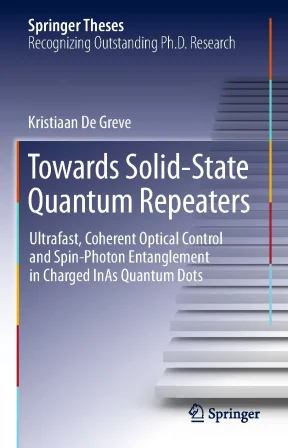
Tải xuống để đọc toàn bộSpringer Theses Recognizing Outstanding Ph. Research Kristiaan De Greve Towards Solid-State Quantum Repeaters Ultrafast, Coherent Optical Control and Spin-Photon Entanglement in Charged InAs Quantum Dots Springer Theses Recognizing Outstanding Ph. Research For further volumes: http://www.com/series/8790 www.com Aims and Scope The series “Springer Theses” brings together a selection of the very best Ph. theses from around the world and across the physical sciences.
Nominated and endorsed by two recognized specialists, each published volume has been selected for its scientific excellence and the high impact of its contents for the pertinent field of research. For greater accessibility to non-specialists, the published versions include an extended introduction, as well as a foreword by the student’s supervisor explaining the special relevance of the work for the field. As a whole, the series will provide a valuable resource both for newcomers to the research fields described, and for other scientists seeking detailed background information on special questions. Finally, it provides an accredited documentation of the valuable contributions made by todays younger generation of scientists.
Theses are accepted into the series by invited nomination only and must fulfill all of the following criteria • They must be written in good English. • The topic should fall within the confines of Chemistry, Physics, Earth Sciences, Engineering and related interdisciplinary fields such as Materials, Nanoscience, Chemical Engineering, Complex Systems and Biophysics. • The work reported in the thesis must represent a significant scientific advance. • If the thesis includes previously published material, permission to reproduce this must be gained from the respective copyright holder.
• They must have been examined and passed during the 12 months prior to nomination. • Each thesis should include a foreword by the supervisor outlining the significance of its content. • The theses should have a clearly defined structure including an introduction accessible to scientists not expert in that particular field.com Kristiaan De Greve Towards Solid-State Quantum Repeaters Ultrafast, Coherent Optical Control and Spin-Photon Entanglement in Charged InAs Quantum Dots Doctoral Thesis accepted by Stanford University, USA 123 www.com Kristiaan De Greve Supervisor Department of Physics Yoshihisa Yamamoto Harvard University Edward L. Ginzton Laboratory Cambridge, MA Stanford University USA Stanford, CA USA ISSN 2190-5053 ISSN 2190-5061 (electronic) ISBN 978-3-319-00073-2 ISBN 978-3-319-00074-9 (eBook) DOI 10.1007/978-3-319-00074-9 Springer New York Heidelberg Dordrecht London Library of Congress Control Number: 2013934550 © Springer International Publishing Switzerland 2013 This work is subject to copyright.
All rights are reserved by the Publisher, whether the whole or part of the material is concerned, specifically the rights of translation, reprinting, reuse of illustrations, recitation, broadcasting, reproduction on microfilms or in any other physical way, and transmission or information storage and retrieval, electronic adaptation, computer software, or by similar or dissimilar methodology now known or hereafter developed. Exempted from this legal reservation are brief excerpts in connection with reviews or scholarly analysis or material supplied specifically for the purpose of being entered and executed on a computer system, for exclusive use by the purchaser of the work. Duplication of this publication or parts thereof is permitted only under the provisions of the Copyright Law of the Publisher’s location, in its current version, and permission for use must always be obtained from Springer. Permissions for use may be obtained through RightsLink at the Copyright Clearance Center.
Violations are liable to prosecution under the respective Copyright Law. The use of general descriptive names, registered names, trademarks, service marks, etc. in this publication does not imply, even in the absence of a specific statement, that such names are exempt from the relevant protective laws and regulations and therefore free for general use. While the advice and information in this book are believed to be true and accurate at the date of publication, neither the authors nor the editors nor the publisher can accept any legal responsibility for any errors or omissions that may be made.
The publisher makes no warranty, express or implied, with respect to the material contained herein. Printed on acid-free paper Springer is part of Springer Science+Business Media (www.com Supervisor’s Foreword At the time of writing of this dissertation, the future of quantum information processing research, and in particular that of currently proposed quantum computing machines, is still elusive. The following is the summary of the current majority opinions in the scientific community (end of 2012). Any physical qubit has still a too short decoherence time compared to expected/required computational times for meaningful tasks, such as factoring of 1,024-bit integer numbers or quantum entan- glement distribution over 1,000 km distance.
Any current physical gate operation is faulty, and leads to computational errors, that need to be accounted for. The only existing solution for circumventing these two problems is the use of quantum error correcting codes, and fault-tolerant quantum computing architectures. A recent theoretical study on a layered quantum computing architecture with a topological surface code (N. Jones et al., Physical Review X, 2, 031007 (2012)) uncovers the prospective system size of such fault-tolerant quantum computers.
The required gate fidelity still exceeds 99.9 %, and the number of physical qubits is 108 –109, with an overall computational time as long as 1–10 days for factoring a relatively small (1,024-bit) integer number, or for quantum simulating a relatively small molecule with only 60 electrons and nuclei. How to physically implement such a huge quantum computer with numerous qubits? One is tempted to propose a distributed quantum information processing system connected by entangled memory qubits and quantum teleportation protocols. However, if we evaluate the resources required for high-fidelity entanglement distribution over non-local memory qubits, we can easily convince ourselves that a distributed quantum information processing network is not a practical solution. The overall computational time would be many years for factoring a 1,024-bit integer number instead of around 1 day.
We must integrate 108 –109 physical qubits into one chip in order to avoid this serious communication bottleneck and construct a useful quantum computer. Advanced molecular beam epitaxy and nanolithography techniques for optical semiconductors now allow us to grow InAs quantum dots (QDs) in GaAs host matrices or even in GaAs/AlAs microcavities in a square lattice geometry with v www.com vi Supervisor’s Foreword regular spacing of 100–1,000 nm (C. Schneider et al., Applied Physics Letters 92, 183101 (2008)). This means that 108 –109 QDs can be readily integrated into a reasonable 1 cm2 chip.
Such an optically active semiconductor QD can trap a single electron or hole as a matter (spin) qubit (M. Bayer et al., Physical Review B 65, 041308 (2002)), and simultaneously emit a single photon as a communication qubit (P. Michler et al. This particular system of an InAs QD embedded in a GaAs/AlAs microcavity is the platform on which Kristiaan De Greve has conducted various experiments in my research group while working toward his PhD thesis at Stanford University.
Before Kristiaan started his PhD thesis work in my group, we had accumulated some knowledge and techniques in this field. A Fourier-transform-limited single photon wavepacket, which is a quantum mechanically indistinguishable particle and an indispensible resource for quantum teleportation and quantum repeater systems, was generated from a single InAs QD in a micropost-microcavity (C. Santori et al. An entangled photon-pair can be produced by the collision of these two sequentially generated single photons at a 50–50 beam splitter, for which we demonstrated the violation of a Bell’s inequality.
Indistinguishable single photons can also be generated by two independent emitters using another optically active compound semiconductor, ZnSe. We had managed to manipulate a single electron spin in an InAs QD by off- resonant stimulated Raman scattering using single picosecond optical pulses, by which a general SU(2) operation for an electron spin can be implemented within tens of picoseconds (D. Press et al. Using Ramsey-interometry, the dephasing time (T2∗ ) of a donor bound electron had also been measured to be a few ns.
By virtue of a Hahn-spin-echo protocol, this noise source could be decoupled, resulting in a decoherence time (T2 ) of a few microcseconds. This is where Kristiaan’s research adventure started: with a project to implement an optical refocusing pulse technique to increase the decoherence time of a single quantum dot electron spin (D. De Greve et al. He then moved on to second project, in line with the former one, to demonstrate a quantum dot hole spin qubit which enjoys a suppressed hyperfine interaction with In and As nuclear spins (K.
De Greve et al., Nature Physics 7, 872 (2011)), to end with a third major project: a system-level experiment to generate and demonstrate an entangled state of a single photon and a single spin (K. De Greve et al. Stanford, CA, USA Yoshihisa Yamamoto www.com Summary of the Dissertation Single spins in optically active semiconductor host materials have emerged as leading candidates for quantum information processing (QIP). The quantum nature of the spin degree of freedom allows for encoding of stationary, memory quantum bits (qubits), and their relatively weak interaction with the host material preserves the coherence between the spin states that is at the very heart of QIP.
On the other hand, the optically active host material permits direct interfacing with light, which can be used both for all-optical manipulation of the quantum bits, and for efficiently mapping the matter qubits into flying, photonic qubits that are suited for long-distance communication. In particular, and over the past two decades or so, advances in materials science and processing technology have brought self-assembled, GaAs-embedded InAs quantum dots to the forefront, in view of their strong light-matter interaction, and good isolation from the environment. In addition, advanced and established microfabrication techniques allow for enhancing the light-matter interaction in photonic microstructures, and for scaling up to large- size systems. One of the (as of yet) most successful applications of QIP resides in the distribution of cryptographic keys, for use in one-time-pad cryptographic systems.
Here, the bizarre laws of quantum mechanics allow for clever schemes, where it is in principle impossible to copy or obtain the key (as opposed to practically, computationally hard schemes used in current, ‘classical’ schemes). Proof-of- principle schemes were demonstrated using transmission of single photons, though unavoidable photon losses and limited efficiency of the detectors used limit their use to distances of several hundred kilometers at most. Longer-range systems will need to rely on massively parallel, pre-established links consisting of quantum mechanically entangled memory qubits, with the information transfer occurring through quantum teleportation: the so-called quantum repeater. The establishment of such entangled qubit pairs relies on the possibility to efficiently map quantum information from memory qubits to flying, photonic qubits – the realm of charged, InAs quantum dots.
This work elaborates on previously established all-optical coherent control techniques of individual InAs quantum dot electron spins, and demonstrates vii www.com viii Summary of the Dissertation proof-of-principle experiments that should allow the utilization of such quantum dots for future, large-scale quantum repeaters. First, we show how more elaborate, multi-pulse spin control sequences can markedly increase the fidelity of the individual spin control operations, thereby allowing many more such operations to be concatenated before decoherence destroys the quantum memory. Furthermore, we implemented an ultrafast, gated version of a different type of control operation, the so-called geometric phase gate, which is at the basis of many proposals for scalable, multi-qubit gate operations. Next, we realized a new type of quantum memory, based on the optical control of a single hole (pseudo-)spin, that was shown to overcome some of the detrimental effects of nuclear spin hyperfine interactions, which are assumed to be the predominant sources of decoherence in electron spin- based quantum memories – at the expense, however, of a larger sensitivity to electric field-related noise sources.
Finally, we discuss a system-level experiment where the quantum dot electron spin is shown to be entangled with the polarization of a spontaneously emitted pho- ton after ultrafast, time-resolved (few picoseconds) downconversion to a wavelength (1,560 nm) that is compatible with low-loss optical fiber technology.
Nội dung được bảo vệ bản quyền — Tải xuống đầy đủ
Trích dẫn luận án này
Kristiaan De Greve (2013). Quantum Repeaters: Coherent Control & Entanglement in InAs QD [Luận án tiến sĩ, Stanford University]. LuanAn.net. https://luanan.net/tai-lieu-khac/towards-solid-state-quantum-repeaters-ultrafast-coherent-optical-control-and
Câu hỏi thường gặp
Luận án "Quantum Repeaters: Coherent Control & Entanglement in InAs QD" nghiên cứu về vấn đề gì?
Tái lập bộ lặp lượng tử trạng thái rắn: điều khiển quang học kết hợp siêu nhanh & vướng víu spin-photon trong chấm lượng tử InAs tích điện.
Luận án "Quantum Repeaters: Coherent Control & Entanglement in InAs QD" được bảo vệ tại trường nào?
Luận án này được bảo vệ tại Stanford University. Năm bảo vệ: 2013.
Luận án "Quantum Repeaters: Coherent Control & Entanglement in InAs QD" thuộc chuyên ngành gì?
Luận án "Quantum Repeaters: Coherent Control & Entanglement in InAs QD" thuộc chuyên ngành Physics. Danh mục: Tài liệu khác.
Luận án "Quantum Repeaters: Coherent Control & Entanglement in InAs QD" có bao nhiêu trang?
Luận án "Quantum Repeaters: Coherent Control & Entanglement in InAs QD" có 159 trang. Bạn có thể xem trước một phần tài liệu ngay trên trang web trước khi tải về.
Cách tải luận án "Quantum Repeaters: Coherent Control & Entanglement in InAs QD" về máy như thế nào?
Để tải luận án về máy, bạn nhấn nút "Tải xuống ngay" trên trang này, sau đó hoàn tất thanh toán phí lưu trữ. File sẽ được tải xuống ngay sau khi thanh toán thành công. Hỗ trợ qua Zalo: 0559 297 239.