Luận án: Tổng hợp & Vận chuyển Điện tử Nanotube Carbon Siêu sạch - Ngoc Viet Nguyen
Luận án: Synthesis and electrical transport of ultraclean carbon nanotubes. Xem tóm tắt và tải về tại LuanAn.net
Université de Grenoble
Physique des Materiaux
Luan An
Luận án tiến sĩ
Năm xuất bản
Số trang
77
Thời gian đọc
12 phút
Lượt xem
0
Lượt tải
0
Phí lưu trữ
40 Point
Tổng quan nhanh
- Chủ đề:
- 1. Tối ưu hóa Tổng hợp CNT Siêu sạch bằng CVD
- Số trang:
- 77 trang
- Trường:
- Université de Grenoble
- Chuyên ngành:
- Physique des Materiaux
- Tác giả:
- Ngoc Viet Nguyen
- Năm:
- 2012
Tóm tắt nội dung luận án
I. Tối ưu hóa Tổng hợp CNT Siêu sạch bằng CVD
Nghiên cứu tập trung vào việc cải thiện quá trình tổng hợp ống nano carbon (CNT) thành đơn (SWCNT) chất lượng cao. Phương pháp lắng đọng hơi hóa học (CVD) được sử dụng. Tối ưu hóa các thông số then chốt là cần thiết. Mục tiêu là tạo ra ống nano carbon siêu sạch. Độ tinh khiết ống nano quyết định hiệu suất ứng dụng. Việc kiểm soát chính xác các điều kiện CVD đảm bảo vật liệu tốt nhất.
1.1. Các thông số tổng hợp CNT chất lượng cao
Tổng hợp CNT đòi hỏi sự kiểm soát chặt chẽ các thông số. Tiền chất carbon ảnh hưởng đến nguồn cung cấp nguyên liệu. Lưu lượng khí điều chỉnh môi trường phản ứng. Nhiệt độ tổng hợp quyết định tốc độ và chất lượng tăng trưởng. Tất cả những yếu tố này được điều chỉnh để tối ưu hóa quá trình tổng hợp CNT. Mục tiêu là đạt được SWCNT có cấu trúc đồng nhất và ít khuyết tật. Phương pháp CVD được đánh giá cao về khả năng kiểm soát này. Việc tinh chỉnh các thông số giúp giảm thiểu tạp chất kim loại, tăng cường độ tinh khiết ống nano.
1.2. Vai trò xúc tác trong tổng hợp SWCNT chọn lọc
Thành phần xúc tác đóng vai trò quyết định trong tổng hợp SWCNT. Xúc tác ảnh hưởng trực tiếp đến sự tăng trưởng chọn lọc của ống nano carbon thành đơn. Một xúc tác tối ưu hóa giúp kiểm soát đường kính ống nano. Phân bố đường kính hẹp là mong muốn. Điều này đảm bảo tính nhất quán của vật liệu. Tạp chất kim loại từ xúc tác cần được giảm thiểu. Nghiên cứu tập trung vào việc tìm kiếm thành phần xúc tác lý tưởng. Điều này đảm bảo SWCNT có độ tinh khiết cao. Nó cũng góp phần vào việc đạt được ống nano carbon siêu sạch. Hiệu suất tổng hợp được cải thiện đáng kể.
II. Chế tạo Thiết bị CNT Ultra Clean Đo Vận Chuyển
Phần này tập trung vào việc tạo ra các thiết bị CNT siêu sạch. Đây là bước quan trọng để nghiên cứu đặc tính điện của chúng. Quá trình chế tạo phải đảm bảo loại bỏ mọi tạp chất. Mục tiêu là tạo ra các thiết bị CNT ultra-clean. Các phép đo vận chuyển điện tử được thực hiện sau đó. Việc này giúp hiểu rõ hơn về hành vi lượng tử của CNT. Độ sạch của thiết bị ảnh hưởng trực tiếp đến kết quả đo.
2.1. Quy trình chế tạo thiết bị CNT siêu sạch
Chế tạo thiết bị CNT siêu sạch đòi hỏi kỹ thuật nano tiên tiến. Các bước bao gồm lắng đọng CNT, tạo điện cực và cách ly. Mọi công đoạn phải giảm thiểu ô nhiễm. Mục tiêu là loại bỏ tạp chất kim loại và các hạt khác. Điều này đảm bảo độ tinh khiết ống nano. Thiết bị cuối cùng cần có bề mặt sạch. Chỉ khi đó, các phép đo vận chuyển điện tử mới chính xác. Sự sạch sẽ là yếu tố then chốt cho các ứng dụng lượng tử. Ống nano carbon siêu sạch được tích hợp vào cấu trúc chấm lượng tử.
2.2. Đo lường vận chuyển điện tử ở nhiệt độ thấp
Các phép đo vận chuyển điện tử được tiến hành ở nhiệt độ cực thấp. Nhiệt độ 40 mK thường được sử dụng. Điều này giúp quan sát các hiệu ứng lượng tử rõ ràng hơn. Các thiết bị CNT hoạt động như chấm lượng tử. Đặc tính điện của CNT được khám phá chi tiết. Dòng điện và điện áp được kiểm soát cẩn thận. Mục tiêu là ghi nhận phản ứng điện tử trong môi trường siêu lạnh. Độ chính xác cao là bắt buộc. Những dữ liệu này cung cấp thông tin quý giá về hành vi của electron trong ống nano carbon.
III. Khám phá Đặc tính Điện tử CNT Couplage Spin Orbit
Nghiên cứu sâu về các đặc tính điện tử của CNT là trọng tâm. Các phép đo vận chuyển điện tử cung cấp dữ liệu quan trọng. Chúng giúp phân tích phổ mức năng lượng điện tử. Đặc biệt, sự tương tác spin-quỹ đạo (spin-orbit coupling) được khám phá. Đây là yếu tố then chốt ảnh hưởng đến hành vi của điện tử. Việc hiểu rõ đặc tính điện này mở ra nhiều khả năng ứng dụng.
3.1. Phân tích phổ mức năng lượng điện tử CNT
Phổ mức năng lượng điện tử trong vỏ đầu tiên của CNT được điều tra. Kỹ thuật quang phổ cotunneling không đàn hồi được áp dụng. Phép đo này được thực hiện dưới tác dụng của từ trường trục. Mục tiêu là hiểu cách điện tử chiếm giữ các mức năng lượng. Dữ liệu thu được cung cấp cái nhìn sâu sắc. Nó cho thấy cấu trúc điện tử bên trong ống nano carbon siêu sạch. Sự phân bố năng lượng của điện tử được xác định chính xác. Điều này rất quan trọng để mô hình hóa hành vi lượng tử.
3.2. Ảnh hưởng của Couplage Spin Orbit đến lấp đầy điện tử
Phát hiện quan trọng là couplage spin-orbit âm mạnh. Điều này ảnh hưởng đến trình tự lấp đầy điện tử trong CNT. Nó khác biệt so với chế độ Kondo SU(4) thuần túy. Ở chế độ Kondo SU(4) thuần túy, couplage spin-orbit bằng không. Hiệu ứng Kondo quỹ đạo thuần túy được quan sát thấy. Nó xuất hiện tại N=2e ở một từ trường hữu hạn. Kết quả này làm sâu sắc thêm hiểu biết về đặc tính điện. Nó cũng chỉ ra sự phức tạp của tương tác điện tử trong SWCNT. Các nghiên cứu tiếp theo sẽ khám phá thêm.
IV. Tiềm năng Phát triển Thiết bị Lai CNT SMM
Phần cuối cùng tập trung vào các hướng phát triển tương lai. Nó mô tả việc thực hiện các thí nghiệm mới. Mục tiêu là tạo ra thiết bị lai. Các thiết bị này kết hợp ống nano carbon siêu sạch với các vật liệu khác. Sự tích hợp này hứa hẹn các chức năng mới. Nó mở ra cánh cửa cho các ứng dụng công nghệ tiên tiến.
4.1. Thực hiện bay hơi nhiệt cho nam châm phân tử đơn
Việc triển khai bay hơi nhiệt là một bước quan trọng. Nó dùng để lắng đọng các nam châm phân tử đơn (SMMs). Phương pháp này đảm bảo việc tích hợp SMMs một cách sạch sẽ. Mục tiêu là giữ vững độ tinh khiết ống nano. SMMs mang lại tính chất từ tính độc đáo. Chúng có thể tương tác với các đặc tính điện của CNT. Đây là nền tảng cho việc tạo ra các thiết bị lai phức tạp hơn.
4.2. Ứng dụng thiết bị lai CNT SMM ultra clean
Tương lai của thiết bị CNT-SMM ultra-clean rất hứa hẹn. Chúng có thể được ứng dụng trong điện tử spin (spintronics). Các thiết bị này có khả năng lưu trữ thông tin hiệu quả. Chúng cũng có thể dùng trong máy tính lượng tử. Sự kết hợp giữa ống nano carbon siêu sạch và SMMs mở ra nhiều khả năng. Nghiên cứu này đặt nền móng cho công nghệ nano thế hệ mới. Tiềm năng ứng dụng trong vật lý lượng tử là rất lớn.
Tải xuống file đầy đủ để xem toàn bộ nội dung
Tải đầy đủ (77 trang)Trích đoạn nội dung luận án
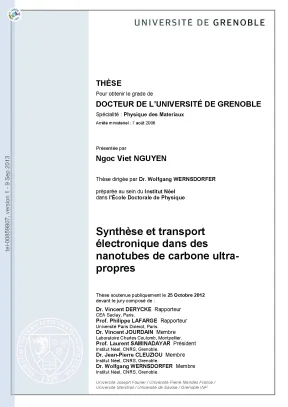
Tải xuống để đọc toàn bộTHÈSE Pour obtenir le grade de DOCTEUR DE L’UNIVERSITÉ DE GRENOBLE Spécialité : Physique des Materiaux Arrêté ministériel : 7 août 2006 Présentée par Ngoc Viet NGUYEN tel-00859807, version 1 - 9 Sep 2013 Thèse dirigée par Dr. Wolfgang WERNSDORFER préparée au sein du Institut Néel dans l'École Doctorale de Physique Synthèse et transport électronique dans des nanotubes de carbone ultra- propres Thèse soutenue publiquement le 25 Octobre 2012 devant le jury composé de : Dr. Vincent DERYCKE Rapporteur CEA Saclay, Paris. Philippe LAFARGE Rapporteur Université Paris Diderot, Paris.
Vincent JOURDAIN Membre Laboratoire Charles Coulomb, Montpellier. Laurent SAMINADAYAR Président Institut Néel, CNRS, Grenoble. Jean-Pierre CLEUZIOU Membre Institut Néel, CNRS, Grenoble. Wolfgang WERNSDORFER Membre Institut Néel, CNRS, Grenoble.
Université Joseph Fourier / Université Pierre Mendès France / Université Stendhal / Université de Savoie / Grenoble INP tel-00859807, version 1 - 9 Sep 2013 Université de Grenoble Synthèse et Transport électronique dans des nanotubes de carbone ultra-propres tel-00859807, version 1 - 9 Sep 2013 by Ngoc Viet NGUYEN A thesis submitted to obtain the degree of Doctor of Philosophy at the Institut Néel NANO department Octobre 2012 tel-00859807, version 1 - 9 Sep 2013 Abstract This thesis describes experiments on the synthesis of single wall carbon nanotubes (SWNTs), fabrication of ultraclean CNT devices, and study of electronic properties of CNTs with transport measurements. The first part of this work describes the optimization of the synthesis parameters (by chemical vapor deposition - CVD) such as carbon precursors, gas flows, temperature, catalyst for the growth of high quality SWNTs. In all these parameters, the catalyst composition plays a very important role on the high selective growth of SWNTs with a narrow diameter distribution. The second part deals with the nanofabrication of ultraclean CNT devices and the low temperature (40 mK) transport measurements of these CNT quantum dots.
The level spectra of the electrons in the first shell are investigated using tel-00859807, version 1 - 9 Sep 2013 inelastic cotunneling spectroscopy in an axial magnetic field, which show a strong negative spin-orbit coupling of electron. We find that the sequence of electron shell filling in our case (ǻSO < 0) is different from which would be obtained in the pure SU(4) Kondo regime (ǻSO = 0). Indeed, a pure orbital Kondo effect is observed in N=2e at a finite magnetic field. In the last part of this thesis, we describe the experimental implementation of the thermal evaporation of single molecule magnets (SMMs) for the future fabrication of ultraclean CNT- SMM hybrid devices.
Keywords: carbon nanotubes, CVD, ultraclean CNT devices, transport measurement, spin- orbit coupling, single molecule magnets. Résumé Cette thèse décrit des expériences sur la synthèse de nanotubes de carbone (CNT) mono-paroi, leur intégration dans des dispositifs ultra-propres, ainsi que l'étude de leurs propriétés électroniques par des mesures de transport à très basse température. La première partie de ce travail décrit l'optimisation des paramètres de synthèse par déposition chimique en phase vapeur (CVD) tels que les précurseurs de carbone, les flux de gaz, la température, ou le catalyseur pour la croissance de CNT de très bonne qualité. Parmis tous ces paramètres, la composition du catalyseur joue un rôle decisif pour permettre une croissance sélective en mono-paroi ansi qu’une distribution de faible diamètre.
Dans la deuxième partie nous tel-00859807, version 1 - 9 Sep 2013 développons la nanofabrication de boites quantiques ultra-propres à base de CNT ainsi que les mesures de transport de ces échantillons à basse température (40 mK). Le spectre de la première couche électronique du nanotube est mesuré par spectroscopie de cotunneling inélastique sous champ magnétique, montrant alors un fort couplage spin-orbite négatif, dans ce système. Nous montrons que la séquence de remplissage d'électrons dans notre cas (ǻSO < 0) est différente de celle que l’on obtiendrait en régime Kondo SU (4) (ǻSO = 0). En effet, un effet Kondo purement orbital est observé pour N = 2e à champ magnétique fini.
Dans la dernière partie de cette thèse, nous décrivons la mise en œuvre expérimentale d’un évaporateur thermique à aimants à molécule unique (SMMs) pour la fabrication future de dispositifs hybrides CNT-SMM ultra-propres. Mots-clés: nanotubes de carbone, CVD, ultra-propre dispositifs CNT, mesure de transport, couplage spin-orbite, aimants à une seule molécule. Acknowledgements This thesis would not have been possible without the help and company of many people in the Néel Institut/CNRS Grenoble through my three years of study here. First of all, I want to thank Dr.
Vincent Derycke and Prof. Philippe Lafarge for accepting to be the referees of my thesis, as well as Prof. Laurent Saminadayar and Dr. Vincent Jourdain for accepting to join the jury of this thesis.
Many thanks for their time devoted to the careful reading of the manuscript. I benefited a lot from their comments and suggestions on my thesis. I wish to express my sincere appreciation to my advisor, Dr. Wolfgang Wernsdorfer, for his scientific guidance and supports during the course of this research work.
Your tel-00859807, version 1 - 9 Sep 2013 assistance and suggestions were crucial in the realization of this work. Your passion for work, enthusiasm to young researchers, insight into physics, and scientific integrity has left me a deep impression and taught me how a good scientist should be. I am lucky to have been your student. The person with whom I have worked most is Dr.
Jean-Pierre Cleuziou. Actually he has introduced me most of the technical skills from CNT synthesis, characterizations, nanofabrications and measurements. I have learnt a lot from his exceptional skills and practical approach to things. His insight into physics and nanomaterials has been a constant source of inspiration, and his clear explanations have led me to the nanotubes world and greatly enhanced my understanding to the mesoscopic physics.
I owe a large debt of gratitude to Jean-Pierre for his always being supporting, understanding and suggestions. I was very fortunate to get helps from a lot of people in the Lab. First, I would like to thank the successive directors of the Institute, Alain Fontaine and Alain Schuhl, for their reception. I need also to thank particularly Joel Cibert and Hervé Courtois, the successive directors of the NANO department, for excellent working conditions and a friendly atmosphere that I benefited much within the department.
I would like to thank Véronique Fauvel and Sabine Gadal for their kind helps concerning many administrative questions. This thesis represents a large experimental effort, and I am extremely grateful to the staffs of CNRS and CEA. Special thanks to Richard Haettel, Eric Eyraud, Didier Dufeu and Julien Jarreau for their great helps and technical supports on the CVD setup, cryogenics, evaporators. Thanks to Nedjma Bendiab, Valérie Reita and Antoine Reserbat-Plantey for the introduction and discussions on the Raman spectroscopy of CNTs.
Thanks to Maria Bacia, Stéphanie Kodjikian and Sébastien Pairis for accepting me a right of intensive use of TEM and SEM. Thanks to Laetitia Marty for the AFM instruction and the Nanochimie working condition. Thanks to all the people in the NANOFAB and PTA for the best and opening working environment for the nanofabrication, specially to Thierry Fournier, Thierry Crozes, Bruno Fernandez, Thibault Haccart and Helge Haas. I would like to thank all the supports and valuable discussions during this work coming from Franck Balestro, Edgar Bonet-Orozco, Christophe Thirion, Vincent Bouchiat, Laurent Cagnon, Serge Florens.
Thanks to the PhD students: Matias Urdampilleta, Romain Vincent, Marc Ganzhorn, Stefan Thiele, Zheng Han, Zahid Ishaque for helps in my work and living in Grenoble. Thanks to the two post-docs of the group, Oksana Gaier and Jarno Jarvinen, for their time of reading my thesis and suggestions. tel-00859807, version 1 - 9 Sep 2013 I am grateful to the European Research Council (ERC) for the fellowship which assures me the financial support of this thesis. And finally, I want to thank my family and my Vietnamese friends for their always following and sparing advices when I needed most.
Special thanks to my wife and my little daughter, who had to bear my being away for such a long time, for their patient love and encouragement. Structures and synthesis methods of carbon nanotubes. SP2 Hybridized Based Carbon Allotropes. Carbon Nanotube Crystal Structure.
Single-Walled and Multi-Walled Carbon Nanotubes. From Graphene to Carbon Nanotubes. Electronic band structure of carbon nanotubes .9 tel-00859807, version 1 - 9 Sep 2013 2. Carbon nanotubes synthesis methods.
The physical synthesis methods. Catalytic Vapor Deposition Synthesis of SWNTs. Synthesis and characterization of single wall carbon nanotubes. Description of experiments.
Catalyst composition and preparation. Local deposition of the catalyst on a surface. Optimization the CVD synthesis conditions. Optimization of the catalyst composition.
Fe-Mo catalyst. Fe-Ru catalyst. Nanofabrication and Measurement Setup. Fabrication of ultraclean suspended CNT devices.
Fabrication of the electrodes. In situ CVD growth of the suspended CNTs. Fabrication of devices with local gate. Device characterizations at room temperature.
Room temperature conductance measurements. Conclusion and perspectives .81 tel-00859807, version 1 - 9 Sep 2013 5. Electronic properties of carbon nanotubes quantum dots. CNT four-fold energy level structure.
Spin-orbit coupling in CNTs. Ultraclean carbon nanotube quantum dot with a strong negative spin-orbit coupling in the Kondo regime. Kondo effect of ultraclean CNT quantum dot with SOI splitting. Conductance at zero magnetic field.
Evolution of Kondo ridges as a function of applied magnetic field. Evaporation of TbPc2 Single Molecule Magnets. Introduction to TbPc2 single molecule magnets and grafting methods. TbPc2 Single molecule magnets.
SMMs deposition methods. Results and discussions. The integrity of the SMMs after thermal evaporation. Effect of evaporation time on thickness and size of molecule clusters.
Evaporation of TbPc2 onto suspended CNTs. Conclusions and perspectives. Summary of the results .137 tel-00859807, version 1 - 9 Sep 2013 8. Binary phase diagrams of C-Mo and C-Ru.
Spin-orbit coupling in Kondo regime of ultra-clean CNT. III tel-00859807, version 1 - 9 Sep 2013 Chapter 1. General introduction Carbon nanotubes (CNTs) are one-atom thick cylinders formed of carbon atoms. Since their discovery, the CNTs have attracted tremendous interest in scientific community owing to their unique structural and electronic properties [1].
For example, carbon nanotubes can be metallic or semiconducting depending on the orientation of the atomic lattice with respect to the axial direction, despite the fact that there is no difference in the local chemical bonding between the carbon atoms. An interesting characteristic of these nanotubes, shared with graphene, is the four-fold degeneracy of the energy level spectrum resulting from spin and orbital degeneracy. When a short segment of a CNT is connected to metal electrodes, at low temperatures tel-00859807, version 1 - 9 Sep 2013 it behaves as a quantum dot (QD). The QDs are known as artificial atoms, with features close to those of real atoms.
Moreover, QDs have the advantage that the attractive potential of the nucleus in real atom is replaced by a confinement potential which can be controlled and tuned in the experiment. It is also possible to confine and control the number of electrons in the QD due to the Coulomb blockade effect. These properties make CNT QDs ideal objects for studies at molecular level. Our group “Nanospintronics and Molecular Transport” in the Néel Institute/CNRS Grenoble aims to fabricate, characterize and study molecular devices (molecular spin-valves and spin-filters, molecular spin-transistors, carbon nanotube junctions, nano-SQUIDs, molecular double-dot devices etc.) in order to read and manipulate spin states of a single molecule and to perform basic quantum operations [2].
In most of these devices, by utilizing the quantum transport measurement technique, carbon nanotubes are used as probes due to their high sensitivity to small changes in the electrostatic environment. At the time I joined the group, the nanotubes used for such a device fabrication were supplied by the collaborators in bulk form.
Nội dung được bảo vệ bản quyền — Tải xuống đầy đủ
Trích dẫn luận án này
Ngoc Viet Nguyen (2012). Tổng hợp & Vận chuyển Điện tử Nanotube Carbon Siêu sạch [Luận án tiến sĩ, Université de Grenoble]. LuanAn.net. https://luanan.net/tai-lieu-khac/tong-hop-van-chuyen-dien-tu-nanotube-carbon-sieu-sach
Câu hỏi thường gặp
Luận án "Tổng hợp & Vận chuyển Điện tử Nanotube Carbon Siêu sạch" nghiên cứu về vấn đề gì?
Luận án: Synthesis and electrical transport of ultraclean carbon nanotubes. Xem tóm tắt và tải về tại LuanAn.net
Luận án "Tổng hợp & Vận chuyển Điện tử Nanotube Carbon Siêu sạch" được bảo vệ tại trường nào?
Luận án này được bảo vệ tại Université de Grenoble. Năm bảo vệ: 2012.
Luận án "Tổng hợp & Vận chuyển Điện tử Nanotube Carbon Siêu sạch" thuộc chuyên ngành gì?
Luận án "Tổng hợp & Vận chuyển Điện tử Nanotube Carbon Siêu sạch" thuộc chuyên ngành Physique des Materiaux. Danh mục: Tài liệu khác.
Luận án "Tổng hợp & Vận chuyển Điện tử Nanotube Carbon Siêu sạch" có bao nhiêu trang?
Luận án "Tổng hợp & Vận chuyển Điện tử Nanotube Carbon Siêu sạch" có 77 trang. Bạn có thể xem trước một phần tài liệu ngay trên trang web trước khi tải về.
Cách tải luận án "Tổng hợp & Vận chuyển Điện tử Nanotube Carbon Siêu sạch" về máy như thế nào?
Để tải luận án về máy, bạn nhấn nút "Tải xuống ngay" trên trang này, sau đó hoàn tất thanh toán phí lưu trữ. File sẽ được tải xuống ngay sau khi thanh toán thành công. Hỗ trợ qua Zalo: 0559 297 239.