Luận án: Tiếng Anh Đại học Việt Nam đáp ứng yêu cầu công sở & Cải thiện bằng Action Research
Luận án: A study of the extent to which university english education fulfills workplace requirements for vietnamese graduates and of the extent to which action
University of Portsmouth
Languages and Area Studies
Luan An
Luận án tiến sĩ
Năm xuất bản
Số trang
262
Thời gian đọc
40 phút
Lượt xem
0
Lượt tải
0
Phí lưu trữ
50 Point
Tổng quan nhanh
- Chủ đề:
- 1. Tiếng Anh Đại học Việt Nam: Đáp ứng yêu cầu công sở
- Số trang:
- 262 trang
- Trường:
- University of Portsmouth
- Chuyên ngành:
- Languages and Area Studies
- Tác giả:
- Vo Thi Hong Le
- Năm:
- 2014
Tóm tắt nội dung luận án
I. Tiếng Anh Đại học Việt Nam Đáp ứng yêu cầu công sở
Nghiên cứu này đánh giá mức độ giáo dục tiếng Anh tại các trường đại học Việt Nam đáp ứng yêu cầu nơi làm việc. Sinh viên tốt nghiệp cần năng lực giao tiếp tiếng Anh hiệu quả. Tài liệu này khám phá những phương pháp tiếp cận để chuẩn bị cho sinh viên với kỹ năng cần thiết. Tiếng Anh chuyên nghiệp là yếu tố then chốt cho sự thành công của sinh viên trong môi trường công sở hiện đại. Chương trình tiếng Anh đại học cần được cập nhật để theo kịp nhu cầu thị trường lao động. Tiếng Anh cho công việc là một kỹ năng thiết yếu trong bối cảnh toàn cầu hóa.
1.1. Nhu cầu Tiếng Anh chuyên nghiệp tại nơi làm việc
Môi trường công sở đòi hỏi khả năng giao tiếp tiếng Anh thực tế. Sinh viên cần kỹ năng đàm thoại ý nghĩa. Các cuộc trò chuyện mang tính giao dịch và quan hệ xã hội đều quan trọng. Tiếng Anh cho công việc bao gồm nhiều khía cạnh diễn ngôn. Kỹ năng này vượt ra ngoài ngữ pháp và từ vựng cơ bản. Nhu cầu về Tiếng Anh chuyên nghiệp là một yêu cầu cấp thiết. Các doanh nghiệp tìm kiếm ứng viên có Kỹ năng tiếng Anh công sở vững vàng.
1.2. Khoảng cách giữa đào tạo và Kỹ năng tiếng Anh công sở
Thực tế giáo dục tiếng Anh đại học chưa đáp ứng đủ. Nhiều lớp học thiếu các cuộc đối thoại thực tế. Tài liệu giảng dạy cũng chưa phản ánh nhu cầu công việc. Sinh viên tốt nghiệp thường thiếu Kỹ năng tiếng Anh công sở. Khoảng cách này cần được thu hẹp thông qua cải thiện chương trình đào tạo. Điều này ảnh hưởng đến khả năng cạnh tranh của sinh viên trên thị trường lao động.
1.3. Tầm quan trọng của giao tiếp tiếng Anh cho công việc
Giao tiếp tiếng Anh hiệu quả là yêu cầu cơ bản. Khả năng này hỗ trợ sinh viên trong nhiều tình huống công việc. Giao tiếp không chỉ là truyền đạt thông tin. Nó còn bao gồm xây dựng mối quan hệ. Giáo dục tiếng Anh Việt Nam cần tập trung vào khía cạnh thực tế này. Việc phát triển Tiếng Anh chuyên nghiệp là cần thiết cho sự phát triển cá nhân và sự nghiệp.
II. Thực trạng giáo dục tiếng Anh đại học Việt Nam hiện nay
Giáo dục tiếng Anh tại các trường đại học Việt Nam đang đối mặt nhiều thách thức. Nghiên cứu quan sát thực trạng giảng dạy. Nơi đây chưa tạo ra môi trường tối ưu. Sinh viên thiếu năng lực giao tiếp tiếng Anh cần thiết. Chương trình tiếng Anh đại học cần được đánh giá lại. Các phương pháp giảng dạy cần đổi mới. Cải thiện chương trình đào tạo là trọng tâm để nâng cao chất lượng đầu ra.
2.1. Phương pháp giảng dạy truyền thống và hạn chế
Nhiều lớp học vẫn sử dụng phương pháp truyền thống. Giáo viên đóng vai trò trung tâm. Việc dạy tập trung vào ngữ pháp, cấu trúc. Tương tác giữa sinh viên còn hạn chế. Các hoạt động giao tiếp ít được kích thích. Điều này cản trở sự phát triển kỹ năng nói. Phương pháp này không phù hợp với yêu cầu về Kỹ năng tiếng Anh công sở.
2.2. Hạn chế về tài liệu và tương tác trong lớp học
Tài liệu giảng dạy thường thiếu tính xác thực. Chúng không mô phỏng các cuộc trò chuyện công sở. Tương tác trong lớp không đủ để phát triển kỹ năng giao tiếp. Sự cân bằng giữa đối thoại giao dịch và quan hệ còn thiếu. Cần có sự thay đổi trong thiết kế tài liệu. Điều này giúp nâng cao Tiếng Anh cho công việc của sinh viên.
2.3. Môi trường chưa tối ưu cho Tiếng Anh giao tiếp
Môi trường học tập chưa hỗ trợ hiệu quả. Giáo viên thiếu nhận thức ngữ cảnh. Cách đặt câu hỏi chưa khuyến khích giao tiếp. Các hoạt động CLT thường không hiệu quả. Môi trường cần được điều chỉnh. Mục tiêu là phát triển Kỹ năng tiếng Anh công sở. Giáo dục tiếng Anh Việt Nam cần tạo điều kiện cho sinh viên thực hành nhiều hơn.
III. Nghiên cứu hành động Action Research Cải thiện chương trình tiếng Anh
Nghiên cứu hành động là một phương pháp mạnh mẽ. Nó có thể cải thiện thực tiễn giảng dạy tiếng Anh. Phương pháp này tập trung vào các can thiệp nhỏ. Mục tiêu là mang lại thay đổi tích cực. Ứng dụng nghiên cứu hành động là chìa khóa. Nó giúp giải quyết các vấn đề thực tế trong giáo dục tiếng Anh Việt Nam. Nghiên cứu hành động thúc đẩy sự phát triển chuyên môn của giáo viên. Đây là công cụ hiệu quả để Cải thiện chương trình đào tạo.
3.1. Phương pháp luận định tính trong nghiên cứu hành động
Nghiên cứu sử dụng phương pháp định tính. Các phương pháp thu thập dữ liệu bao gồm quan sát, phỏng vấn và khảo sát. Phân tích diễn ngôn được áp dụng. Điều này giúp hiểu sâu hoạt động của người học và giáo viên. Nghiên cứu hành động cung cấp cơ sở đáng tin cậy. Nó giúp xác nhận tính chính xác của các phát hiện. Đây là cách tiếp cận toàn diện để đánh giá giáo dục tiếng Anh Việt Nam.
3.2. Can thiệp nhỏ mang lại thay đổi lớn trong giảng dạy
Các can thiệp nhỏ được thực hiện tại trường đại học. Chúng tập trung vào thực hành giảng dạy tiếng Anh. Ví dụ: điều chỉnh tài liệu hoặc tăng tương tác lớp học. Những thay đổi tích cực đáng kể được ghi nhận. Điều này chứng minh tiềm năng của Nghiên cứu hành động. Các can thiệp này góp phần nâng cao Kỹ năng tiếng Anh công sở cho sinh viên.
3.3. Tác động tích cực của Nghiên cứu hành động đến giáo viên
Giáo viên cho thấy sự thay đổi tích cực. Họ điều chỉnh tài liệu giảng dạy. Số lượng tương tác trong lớp học tăng lên. Giáo viên hiểu rõ hơn về các can thiệp. Họ thể hiện thái độ tích cực đối với thay đổi. Giáo viên vui mừng khi thu hút nhiều sinh viên hơn. Nghiên cứu hành động khuyến khích sự phát triển chuyên môn. Điều này là nền tảng để Đào tạo tiếng Anh cho doanh nghiệp hiệu quả hơn.
IV. Ứng dụng Nghiên cứu hành động nâng cao kỹ năng tiếng Anh công sở
Các phát hiện của nghiên cứu có ý nghĩa quan trọng. Chúng định hướng cho việc nâng cao chất lượng giáo dục. Ứng dụng nghiên cứu hành động giúp thu hẹp khoảng cách. Nó kết nối đào tạo tiếng Anh đại học với yêu cầu công sở. Cải thiện chương trình đào tạo là mục tiêu chính. Các đề xuất từ nghiên cứu giúp định hình tương lai của Giáo dục tiếng Anh Việt Nam. Việc này tạo ra lực lượng lao động có Tiếng Anh chuyên nghiệp.
4.1. Cải thiện tài liệu giảng dạy tiếng Anh đại học
Tài liệu cần được phát triển để phản ánh thực tế công sở. Chúng cần bao gồm các cuộc đối thoại ý nghĩa. Cần cân bằng giữa giao tiếp giao dịch và quan hệ. Tài liệu phải kích thích tương tác sinh viên-sinh viên. Điều này hỗ trợ phát triển Kỹ năng tiếng Anh công sở. Các tài liệu mới sẽ làm phong phú thêm Chương trình tiếng Anh đại học.
4.2. Phát triển năng lực giáo viên tiếng Anh Việt Nam
Giáo viên cần được đào tạo về phương pháp CLT hiệu quả. Họ cần hiểu rõ ngữ cảnh sử dụng tiếng Anh tại nơi làm việc. Cần khuyến khích giáo viên tham gia Nghiên cứu hành động. Điều này giúp cải thiện liên tục thực tiễn giảng dạy. Giáo dục tiếng Anh Việt Nam sẽ phát triển bền vững. Năng lực giáo viên là chìa khóa cho chất lượng Tiếng Anh cho công việc.
4.3. Đề xuất cho quản lý và chương trình đào tạo tiếng Anh
Các trường đại học cần thực hiện phân tích nhu cầu. Phân tích này nên dành cho các bên liên quan. Cần có sự điều chỉnh trong quản lý trường học. Mục tiêu là hỗ trợ phát triển tài liệu và giáo viên. Cải thiện chương trình đào tạo tiếng Anh là cấp thiết. Đào tạo tiếng Anh cho doanh nghiệp cần được tích hợp. Điều này đảm bảo sinh viên sẵn sàng cho môi trường làm việc toàn cầu.
Tải xuống file đầy đủ để xem toàn bộ nội dung
Tải đầy đủ (262 trang)Trích đoạn nội dung luận án
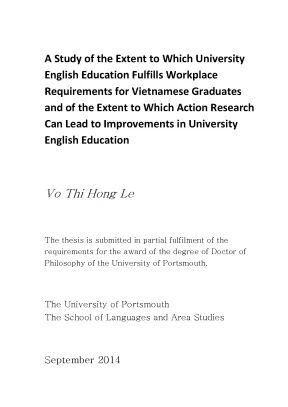
Tải xuống để đọc toàn bộA Study of the Extent to Which University English Education Fulfills Workplace Requirements for Vietnamese Graduates and of the Extent to Which Action Research Can Lead to Improvements in University English Education Vo Thi Hong Le The thesis is submitted in partial fulfilment of the requirements for the award of the degree of Doctor of Philosophy of the University of Portsmouth. The University of Portsmouth The School of Languages and Area Studies September 2014 Abstract This study focuses on possible approaches that can be undertaken at university to prepare undergraduate students with English language communicative competence required at the workplace. In exploring how English is taught at a university and whether English education met the needs of business, the main concern of this study is how materials design and teacher education can support learners to develop the skills to communicate effectively in the Vietnamese workplace. The purpose of the study was to (1) learn about the reality of English in the workplace to see what graduates’ needs at the workplace are, (2) undertake observational study at a university to see how needs were being met and (3) explore how minor interventions influence teachers and their English teaching practice.
The study employed a qualitative research methodology. The data collection methods employed were observations and interviews and a survey was undertaken. This is also to provide the basis for the reliability of studies and the validation of findings in terms of their accuracy, checking for bias in research methods and the development of research instruments. The data from these three resources was analysed through discourse analysis in order to address the analytic issues and the concern for an ‘in-depth’ focus on people’s activities of a qualitative research.
There were two main stages of research in the study. In the companies stage, the results reveal that meaningful conversations that required graduates at the workplace are often absent in language classroom and teaching materials. This raises the importance of achieving balance between transactional and relational talk in language teaching materials. It also raises the importance of communicative language teaching at university that can support in various aspects of discourse.
In the university stage of the research, the findings disclose that this was not an environment necessarily conducive to supplying the workplace with suitably communicatively competent graduates. There were various problems identified concerning teacher’s contextual realization, their questioning and their use of CLT activities that did not stimulate communication. By contrast, traditional teaching methods were noted, including the patterns of teacher fronted, form focused practice, with few student-student interactions. Importantly, the analyses of the results indicate that action research can help to bring improvement of teachers’ teaching practice.
Though limited in number, considerable positive changes made by ii the teachers were identified. These changes were primarily in terms of materials adaptation and the number of classroom interactions. The other significant finding was that teachers understanding of the study’s interventions had a positive impact on their practice. They also showed their positive attitude towards the changes and were pleased to engage more students through adopting these changes.
Based on the findings of the study, major issues are identified. The study’s findings have implications for materials development, teacher development and school management. The research also reveals the importance of conducting a needs analysis for stakeholders. Finally, the study’s limitations, together with recommendations for further research based on authentic transcripts/materials of workplace talk, or further interventions, observations and feedback in terms of teachers’ process in engaging action research, are discussed.
iii CONTENTS SECTION 1-INTRODUCTION .2 A Historical Overview of English Teaching in Vietnam .3 Statement of the problem .4 Inauthentic teaching materials.4 Innovations at the university of Information Technology (UIT) to which I contributed and preliminary evaluation .5 Research design and ethical issues .2 My roles as an insider and the consideration of ethical issues .6 Definitions of terms .7 The structure of the study. 15 SECTION 2 - UNDERSTANDING WHAT ENGLISH IS REQUIRED AT THE WORKPLACE. 16 Chapter 2: LITERATURE REVIEW - WORKPLACE DISCOURSE .1 The notion of genres.2 Transactional and relational aspects .3 Directives in transactional aspects .4 Politeness strategies in the workplace .5 Relational talk and humour .6 Gender and leadership talk at work. 30 Chapter 3: RESEARCH METHODS OF THE RESEARCH AT THE COMPANIES .1 Involving the companies in the research .3 The company participants.
37 Chapter 4: WHAT KIND OF ENGLISH IS REQUIRED AT THE WORKPLACE .1 What English is required at the workplace? .1 Less formal email .2 More formal email .4 Gender, leadership and the use of humour .2 What may cause the breakdowns of a conversation .1 Interviews with the employers .1 Communication strategies and linguistic skills .2 Cultural factors were concerned by the employers .2 Interviews with the employees .62 SECTION 3 - UNDERSTANDING ENGLISH EDUCATION AT UNIVERSITY .64 Chapter 5: LITERATURE REVIEW – ASPECTS OF COMMUNICATIVE LANGUAGE TEACHING .1 Popular English language teaching methodology .1 Traditional English instruction .2 Communicative based English instruction .1 Communicative language teaching (CLT) .2 Task-based language teaching (TBLT) .3 English for Specific purposes (ESP) .1 Elements constitute communicative competence for learners .1 Understanding of learners’ needs and principles of language learning .2 Opportunities to use the target language to achieve communicative purposes for learner .3 Aspects of CLT classroom methods .1 Group work and pair work .3 Observing the language classroom .4 Neglected aspects in CLT studies .5 Studies of teachers’ knowledge and beliefs, including about CLT .6 Studies on current CLT in Vietnam higher education .7 Pronunciation as Vietnamese learner need for communicative English use. 93 Chapter 6: RESEARCH METHODS OF THE RESEARCH AT THE UNIVERSITY .1 The teacher participants .4 Data collection and analysis. 100 Chapter 7: HOW ENGLISH WAS BEING TAUGHT AT UNIVERSITY .2 How do the teachers use communicative tasks .1 The teacher’s questioning/elicitation techniques .2 CLT use activities .3 Pairwork and groupwork .3 Teaching pronunciation and with supplementary Pronunciation Practice book. 121 SECTION 4 - INTERVENTING TO IMPROVE.
122 Chapter 8: LITERATURE REVIEW – TEACHER EDUCATION AND TEACHER’S COGNITIONS .1 The implications of studies on teacher’s knowledge for teacher education .2 The impact of teacher education on teacher’s cognitions .3 The implications of interventions for teacher education .1 Interventions encouraging the growth of teacher cognition.2 An insight to inform interventions .4 The considerations of the action researcher in the Vietnamese context .1 The implications of teachers as action researchers.2 Potential approach to teach pronunciation. 129 Chapter 9: RESEARCH METHODS – ACTION RESEARCH .1 Considerations of applying action research in my context .2 Procedure of action research .1 Observations and discussions (feedback) .4 Data collection and analysis. 136 Chapter 10: THE INTERVENTION-THE WORKSHOPS .1 The teachers’ use of supplementary materials compiled and designed by the department .2 Providing teachers examples of materials adaptation and data collected from the companies .1 An example of materials adaptation .2 Data collected from the companies .3 Responding to the follow-up questions on the conception of materials adaptation .1 Lesson planning and consideration of learners .2 Language teaching and learning .3 Classroom observations after workshops 1a and 1b .1 Watching the videos .1 The video of the teachers’ teaching .2 The videos of teaching pronunciation in the company’s training course. 154 Chapter 11: CLASSROOM OBSERVATIONS AFTER THE INTERVENTION – HAS THERE BEEN ANY CHANGE .1 The changes can be seen .1 More materials adaptation can be seen .2 Student-student interaction was little more focused by experienced teachers .3 Communicative activities were more employed by one novice teacher to teach grammar .2 The aspects that can be seen with not much change .1 The use of tasks .1 Little effective use of questioning skills .4 Pair work and group work.
169 SECTION 5 – DISCUSSION AND IMPLICATIONS .1 To what extent does English education at university fulfill the workplace requirements for Vietnamese graduates? .1 To what extent do graduates seem able to communicate in English to fulfill their work- related tasks? .1 English required of Vietnamese employees at the workplace .2 Graduates were unlikely to be able to communicate in English to fulfill the requirement.2 To what extent does English education at university provide the support graduates’ need? .1 Teachers’ understanding of CLT .3 Teacher’s practice was influenced by their experience and knowledge .4 Teachers’ practice was influenced by local cultural factors .2 To what extent was action research able to improve English education at UIT in some way? .1 How action research applied in the study .2 How effective was action research in my study .1 The teachers have positive attitudes toward opportunities for professional development .2 The interventions supporting the teachers’ changes .3 The interventions supporting the teachers’ reflection .1 Implications for materials development .2 Integrated pronunciation teaching .2 Strategies and language used at the workplace .2 Implications for teacher development .1 Workshops on material development .2 Workshops on communicative language teaching .3 Implications for school management. 208 Appendices Appendix 1: Invitation letters to participants including the guarantee of confidentiality. 226 Appendix 2: Question guide for company interviews. 228 Appendix 3: Classroom observation checklists.
233 Appendix 4: A lesson plan – English for waiters/waitresses. 234 Appendix 5: Questionnaire for teachers. 240 Research Ethics Review Checklist viii Whilst registered as a candidate for the above degree, I have not been registered for any other research award. The results and conclusions embodied in this thesis are the work of the named candidate and have not been submitted for any other academic award.032 words ix Lists of tables Table 3.1: Company participants in the study, including their participation in the two data collection strategies 36 Table 4.1 Participants’ ideas on factors that could cause the breakdown of a conversation from the interview data 58 Table 6.1: Teacher participants in the study 96 Table 9.1: The timeline for the action research 132 Table 10.1: The teachers’ responses to the reasons for their materials adaptation 143 Table 10.2: The teachers’ responses to what kinds of support that it should be for adapting/ designing materials 145 x Lists of figures Figure 13.1: Chan’s (2009) framework for developing checklist for evaluating materials 196 xi Abbreviations BA Bachelor of Arts CLT Communicative Language Teaching EAP English for Academic Purposes EFL English as a Foreign Language ELF English as a lingua franca ELT English language teaching ESL English as a Second Language ESP English for Specific Purposes FTA Face threatening acts HCMC Ho Chi Minh City IT Information Technology MA Master of Arts PhD Doctor of Philosophy TBLT Task-based language teaching TESOL Teaching English to Speakers of Other Languages VNU Vietnam National University UIT University of Information Technology UK United Kingdom xii Acknowledgements I would like first to give great thanks to my supervisors for their support and guidance throughout my pursuit of the Doctoral Degree.
My first supervisor, Dr. Mark Wyatt scheduled weekly meetings for data discussions and feedback from the very beginning. His invaluable expertise and interest in my work, his careful reading and concise comments gave me a significant support to work with the thesis. My second supervisor, Marie McCullagh provided me her professional advice and insightful feedback regarding my research.
I am grateful for her contributions to my intellectual growth during my study process. I would also like to thank John Naysmith, who worked as my third supervisor in the first year of my PhD programme. I am very grateful to Juliette Scott for not only her astute feedback but also her constant encouragement when I started my early work for my dissertation. Her words of helpful advice, including positive criticism, will be remembered.
Among all the people who have supported me through this long and sometimes lonesome journey, Mark Field deserves great and special thanks. I am really grateful to his proof-reading and comments on much of my work with his constant enthusiasm. Mark has meant a lot to me with his constructive comments and sustained support.
Nội dung được bảo vệ bản quyền — Tải xuống đầy đủ
Trích dẫn luận án này
Vo Thi Hong Le (2014). Tiếng Anh Đại học Việt Nam: Đáp ứng Yêu cầu Công sở & Vai trò của Action Research [Luận án tiến sĩ, University of Portsmouth]. LuanAn.net. https://luanan.net/tai-lieu-khac/tieng-anh-dai-hoc-viet-nam-yeu-cau-cong-so-action-research
Câu hỏi thường gặp
Luận án "Tiếng Anh Đại học Việt Nam: Đáp ứng Yêu cầu Công sở & Vai trò của Action Research" nghiên cứu về vấn đề gì?
Luận án: A study of the extent to which university english education fulfills workplace requirements for vietnamese graduates and of the extent to which action
Luận án "Tiếng Anh Đại học Việt Nam: Đáp ứng Yêu cầu Công sở & Vai trò của Action Research" được bảo vệ tại trường nào?
Luận án này được bảo vệ tại University of Portsmouth. Năm bảo vệ: 2014.
Luận án "Tiếng Anh Đại học Việt Nam: Đáp ứng Yêu cầu Công sở & Vai trò của Action Research" thuộc chuyên ngành gì?
Luận án "Tiếng Anh Đại học Việt Nam: Đáp ứng Yêu cầu Công sở & Vai trò của Action Research" thuộc chuyên ngành Languages and Area Studies. Danh mục: Tài liệu khác.
Luận án "Tiếng Anh Đại học Việt Nam: Đáp ứng Yêu cầu Công sở & Vai trò của Action Research" có bao nhiêu trang?
Luận án "Tiếng Anh Đại học Việt Nam: Đáp ứng Yêu cầu Công sở & Vai trò của Action Research" có 262 trang. Bạn có thể xem trước một phần tài liệu ngay trên trang web trước khi tải về.
Cách tải luận án "Tiếng Anh Đại học Việt Nam: Đáp ứng Yêu cầu Công sở & Vai trò của Action Research" về máy như thế nào?
Để tải luận án về máy, bạn nhấn nút "Tải xuống ngay" trên trang này, sau đó hoàn tất thanh toán phí lưu trữ. File sẽ được tải xuống ngay sau khi thanh toán thành công. Hỗ trợ qua Zalo: 0559 297 239.