Luận án Tiến sĩ: Ứng dụng Biochar và Sắn trong Chăn Nuôi Bò và Giảm Thải Khí Mê Tan tại Lào
Luận án: Luận án tiến sĩ sử dụng biochar và sắn trong chăn nuôi bò và việc giảm thải khí mê tan ở lào. Xem tóm tắt và tải về tại LuanAn.net
Đại học Nông Lâm - Đại học Huế (Hue University of Agriculture and Forestry)
Chăn nuôi (Animal Sciences)
Luan An
Luận án tiến sĩ
Năm xuất bản
Số trang
138
Thời gian đọc
21 phút
Lượt xem
0
Lượt tải
0
Phí lưu trữ
40 Point
Tổng quan nhanh
- Chủ đề:
- 1. Sử dụng Biochar
- Số trang:
- 138 trang
- Trường:
- Đại học Nông Lâm - Đại học Huế (Hue University of Agriculture and Forestry)
- Chuyên ngành:
- Chăn nuôi (Animal Sciences)
- Tác giả:
- Bounthavy Vongkhamchanh
- Năm:
- 2021
Tóm tắt nội dung luận án
I. Sử dụng Biochar
Biochar là một loại vật liệu có khả năng cải thiện chất lượng đất và giảm khí thải methane trong chăn nuôi bò. Việc sử dụng biochar trong chăn nuôi bò có thể giúp cải thiện sức khỏe đàn bò và tăng năng suất chăn nuôi.
1.1. Lợi ích của Biochar
Biochar có thể giúp giảm khí thải methane, cải thiện chất lượng đất và tăng cường sức khỏe đàn bò.
1.2. Cách sử dụng Biochar
Biochar có thể được sử dụng như một loại phụ gia trong thức ăn gia súc, giúp cải thiện chất lượng thức ăn và giảm khí thải methane.
II. Sử dụng Sắn
Sắn là một loại cây có khả năng cung cấp năng lượng và protein cho bò. Việc sử dụng sắn trong chăn nuôi bò có thể giúp cải thiện sức khỏe đàn bò và tăng năng suất chăn nuôi.
2.1. Lợi ích của Sắn
Sắn có thể cung cấp năng lượng và protein cho bò, giúp cải thiện sức khỏe đàn bò và tăng năng suất chăn nuôi.
2.2. Cách sử dụng Sắn
Sắn có thể được sử dụng như một loại thức ăn gia súc, giúp cung cấp năng lượng và protein cho bò.
III. Kết hợp Biochar và Sắn
Kết hợp biochar và sắn trong chăn nuôi bò có thể giúp cải thiện sức khỏe đàn bò và tăng năng suất chăn nuôi. Việc sử dụng biochar và sắn có thể giúp giảm khí thải methane và cải thiện chất lượng đất.
3.1. Lợi ích của kết hợp Biochar và Sắn
Kết hợp biochar và sắn có thể giúp giảm khí thải methane, cải thiện chất lượng đất và tăng cường sức khỏe đàn bò.
3.2. Cách kết hợp Biochar và Sắn
Biochar và sắn có thể được kết hợp như một loại phụ gia trong thức ăn gia súc, giúp cải thiện chất lượng thức ăn và giảm khí thải methane.
IV. Cải thiện Sức khỏe Đàn bò
Cải thiện sức khỏe đàn bò là một trong những mục tiêu chính của chăn nuôi bò. Việc sử dụng biochar và sắn có thể giúp cải thiện sức khỏe đàn bò và tăng năng suất chăn nuôi.
4.1. Lợi ích của cải thiện Sức khỏe Đàn bò
Cải thiện sức khỏe đàn bò có thể giúp tăng năng suất chăn nuôi và giảm thiểu rủi ro bệnh tật.
4.2. Cách cải thiện Sức khỏe Đàn bò
Cải thiện sức khỏe đàn bò có thể được thực hiện bằng cách sử dụng biochar và sắn như một loại phụ gia trong thức ăn gia súc.
V. Tăng Năng suất Chăn nuôi
Tăng năng suất chăn nuôi là một trong những mục tiêu chính của chăn nuôi bò. Việc sử dụng biochar và sắn có thể giúp tăng năng suất chăn nuôi và cải thiện sức khỏe đàn bò.
5.1. Lợi ích của tăng Năng suất Chăn nuôi
Tăng năng suất chăn nuôi có thể giúp tăng lợi nhuận và cải thiện đời sống của người chăn nuôi.
5.2. Cách tăng Năng suất Chăn nuôi
Tăng năng suất chăn nuôi có thể được thực hiện bằng cách sử dụng biochar và sắn như một loại phụ gia trong thức ăn gia súc.
VI. Kết luận
Kết luận, việc sử dụng biochar và sắn trong chăn nuôi bò có thể giúp cải thiện sức khỏe đàn bò, tăng năng suất chăn nuôi và giảm thiểu rủi ro bệnh tật. Việc kết hợp biochar và sắn có thể giúp giảm khí thải methane và cải thiện chất lượng đất.
6.1. Lợi ích của kết hợp Biochar và Sắn
Kết hợp biochar và sắn có thể giúp giảm khí thải methane, cải thiện chất lượng đất và tăng cường sức khỏe đàn bò.
6.2. Hướng phát triển tương lai
Hướng phát triển tương lai của chăn nuôi bò là sử dụng biochar và sắn như một loại phụ gia trong thức ăn gia súc để cải thiện sức khỏe đàn bò và tăng năng suất chăn nuôi.
Tải xuống file đầy đủ để xem toàn bộ nội dung
Tải đầy đủ (138 trang)Trích đoạn nội dung luận án
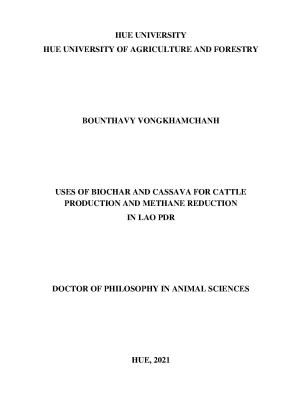
Tải xuống để đọc toàn bộHUE UNIVERSITY HUE UNIVERSITY OF AGRICULTURE AND FORESTRY BOUNTHAVY VONGKHAMCHANH USES OF BIOCHAR AND CASSAVA FOR CATTLE PRODUCTION AND METHANE REDUCTION IN LAO PDR DOCTOR OF PHILOSOPHY IN ANIMAL SCIENCES HUE, 2021 HUE UNIVERSITY HUE UNIVERSITY OF AGRICULTURE AND FORESTRY BOUNTHAVY VONGKHAMCHANH USES OF BIOCHAR AND CASSAVA FOR CATTLE PRODUCTION AND METHANE REDUCTION IN LAO PDR SPECIALIZATION: ANIMAL SCIENCES CODE: 9620105 DOCTOR OF PHILOSOPHY IN ANIMAL SCIENCES SUPERVISORS: 1: ASSOC. LE VAN AN 2: DR. DUONG THANH HAI HUE, 2021 GUARANTEE I hereby guarantee that scientific work in this thesis is mine. All results described in this thesis are righteous and objective.
They have been published in the journal of Champasak Province, Lao PDR, journal of Livestock Research for Rural Development (LRRD), JASTD, Lao PDR, and Journal of Animal Husbandry Sciences and Technics (JAHST), Vietnam. Hue University, 2020 Bounthavy, PhD student DEDICATION To my parents, my wife (Sangsavanh Niemthachit), daughter (Sangmany Vongkhamchanh) and son (Pharkdy Vongkhamchanh). i ACKNOWLEDGEMENTS I would like to express my sincere gratitude and appreciation to my major advisor, Assoc. Le Van An, Department of Animal Husbandry, Fuculty of Animal Husbandry and Veterinary Medicine, University of Agriculture and Forestry, Hue University for his precious advice, guidance on thesis, encouragement, and constructive comments.
My deeply grateful and sincere gratitude is extended to my co-advisor, Duong Thanh Hai, Ph., Department of Animal Husbandry, Fuculty of Animal Husbandry and Veterinary Medicine, University of Agriculture and Forestry, Hue University for his kindness in advising research proposal and experiment. I am grateful to all professors, teachers, and staff of the Faculty of Animal Husbandry and Veterinary Medicine for the suggestion, which enables me to complete my work. I would like to thanks MEKARN II project and Hue University of Agriculture and Forestry for providing the financial support for my study that enables me to complete this study. Finally, I am grateful to my family for their financial support, care, and love.
I would like to express my deep gratitude to Professor. Thomas Reg Preston, for guiding the experiments during the study and helping me to author my journal. I would also like to extend sincere thanks to several people who facilitate, encourage, and support the whole Ph. course such as Professor.
Ewadle, International Coordinator MEKARN II project; Dr. Vanthong Phengvichith, National Agriculture and Forestry Research Institute (NAFRI), Dr. Daovy Kongmanila, National Univerisity of Lao PDR; Dr. Kieu Borin, MEKARN II regional coordinator; Dr.
Ngo Tung Duc, the Head of Education Department, Hue University of Agriculture and Forestry. Warm thanks are extended to my Ph. classmates from the three countries: Laos, Vietnam, and Cambodia, for sharing the culture, friendship, and creating a warm atmosphere throughout the Ph. ii ABSTRACTS Cattle are regarded as one ruminant of livestock that is expressed the importance for smallholder and account are more than 50% of cash income in Laos.
However, barriers to cattle production are mainly limitation of feed qualities and quantities, and methane emission by enteric fermentation where consider as one source of greenhouse gases. Therefore, these studies aimed to evaluate the utilization of cassava supplied by biochar to mitigate methane production in an In vitro rumen incubation and incorporated with the diets for fattening local yellow cattle. Chapter 2 (experiment 1) The rice straw and cassava leaf meal were used as substrate. Urea was used as a source of NPN and protein.
Gas production and methane in the gas were measured over successive 6 h intervals for 24 h, after which the residual dry matter (DM) in the substrate was determined by filtration. During the fermentation intervals (18 – 24 h) there were significant differences in gas production between two substrates, rice straw (276.67 ml) and cassava leaf meal (515 ml) (p<0. The levels of biochar (0, 1 and 2%) were no effect in gas production of the substrates, in contrast, biochar can be reduced methane as well as 21.05) but between 1 and 2% of biochar were not shown any difference in decreasing the methane production. The cassava leaf meal (78.479%) was digested significantly higher than rice straw (70.
Biochar did not affect the proportion of DM mineralized and digestibility after 24 h but reduced the production of methane per unit DM mineralized. Chapter 3 (experiment 2) Dried, ensiled and fresh cassava roots were used as an energy substrate. Urea and cassava leaf meal were used as sources of NPN and protein. Gas production and methane in the gas were measured over successive 6 h intervals for 24 h, after which the residual dry matter (DM) in the substrate was determined by filtration.
There were no differences in gas production among the cassava root treatments during any of the fermentation intervals. By contrast, methane percent in the gas was lowest in the fresh root and highest in the dried root, with intermediate values for the ensiled root. The total DM mineralized after 24 h fermentation was not affected by root processing. Gas production tended to be reduced (p=0.07) by biochar for the 18-24 h interval but was not affected at the earlier intervals.
The methane concentration in the gas was reduced by biochar in the 18-24 h fermentation interval, but there was no effect for fermentation intervals of 0-6, 6-12 and 12-18 h. Biochar did not affect the proportion of DM mineralized after 24 h but reduced the production of methane per unit DM mineralized. iii Chapter 4 (experiment 3) Twelve local yellow cattle with an initial live weight of 90 – 105 kg were used to evaluate the efficacies of fresh cassava root incorporated with biochar. The experimental design was arranged in a completely randomized design (CRD) with three replications of each treatment.
The factors were different levels of fresh cassava root (CTL, 10, 20, and 30%) with 1% biochar in diet DM. The experiment was carried out for 84 days with an extra 14 days for adaptation to the pens and diets. Fresh cassava root (FC) was offered as a basal diet supplemented with urea, elephant grass, and rice straw. The addition of fresh cassava root by different levels was not shown any effects in feed intake but when increased the level of fresh cassava root as 30% incorporated with 1% biochar of diet DM found the cattle were displayed significant growth rate as high as 252.
Chapter 5 (experiment 4) In a 56-day experiment with 6 local yellow cattle fed ensiled cassava root-urea, brewers‘ grains and rice straw, there were indications (p=0.08) that after an initial 4- week adaptation to the diet, the cattle were growing faster when 1% of biochar (derived from rice husk) was incorporated in the diet was 0.635 of LW gain, kg/d. Chapter 6 (experiment 5) Ensiled cassava root incorporates different levels of dry cassava leaf that is used as a source of bypass protein for fattening local yellow cattle in Lao PDR, nine local yellow cattle with an initial live weight of 90 – 100 kg live weight (LW) were used in this study. The experimental design was arranged in a completely randomized design (CRD) with three replications of each treatment. The factors were different levels of dried cassava foliage (CTL, 25, and 50% of total diet DM).
The experiment was carried out for 14 days for adaptation to the pens and diets. Ensiled cassava root was offered as a basal diet supplemented with rice straw and mineral block, and adding dried cassava foliage by different levels. The results indicated that the increase of dried cassava foliage levels was displayed the effects in feed conversion rate (FCR) (p<0.05) and when increased the level of dried cassava foliage at 50% of total diet DM incorporated with the diet DM found the cattle were presented significant growth rate as high as 0.304 kg/d of ADG (p<0. From experimental results can conclude that 1% biochar incorporated with fresh or ensiled cassava root can be reduced methane emission in an In vitro rumen fermentation.
1% biochar (derived from rice husk) incorporated with ensiled cassava root, urea, brewers‘ grains and rice straw there were positive indications to increase the growth rate of cattle and by-product from cassava production (dried cassava foliage) was indicated the benefit of utilization for fattening cattle. Keywords: Greenhouse gases, HCN, fresh cassava root, cassava leaves, diets iv TABLE OF CONTENTS GUARANTEE. iii LIST OF FIGURES .xii LIST OF TABLES. xiii LIST OF ABBREVIATIONS, SYMBOLS AND EQUIVALENTS.
AIMS AND OBJECTIVES OF THE STUDY.1 AIMS OF THE STUDY. OBJECTIVES OF THE STUDY. SIGNIFICANT/INNOVATION OF THE DISSERTATION. CATTLE POPULATION AND PRODUCTION IN LAO PDR.
THE ROLE OF CATTLE. GENERAL CHARACTERISTIC OF HOUSEHOLD S‘ CATTLE RAISING. BREEDS AND BREEDING. Cattle meat consumption.
Cattle production system. INFECTIOUS DISEASES OF CATTLE. MARKET SYSTEM OF CATTLE. OPPORTUNITIES AND CONSTRAINS OF CATTLE PRODUCTION.
Potentials of cattle production. Constrains of cattle production. LOCAL FEED AND FEEDING. SITUATION OF FEED RESOURCES.
IMPORTANCE OF BY-PRODUCT. BY-PRODUCT FROM INDUSTRIES. Rice distillers‘ by-product. BY-PRODUCT FROM AGRICULTURE.
Agricultural by-product properties. Straw from cereal crop. By-product from cassava production. UTILIZATION OF BY-PRODUCT FOR RUMINANT.
FEEDING THE RUMEN MICROBES. Multi-nutrient blocks. GREENHOUSE GAS FROM AGRICULTURE AND MITIGATING WAYS. GREENHOUSE GAS FROM AGRICULTURE.
THE LIVESTOCK SECTOR. GREENHOUSE GAS MITIGATION FROM AGRICULTURE. LIVESTOCK AND MANURE MANAGEMENT. CONSEQUENCES OF GLOBAL WARMING.
CLIMATE AND NATURAL DISASTERS IN LAO PDR. GREENHOUSE GASES EMISSION FROM LIVESTOCK IN LAO PDR. PRODUCTION OF BIOCHAR. THE INFLUENCE OF BIOCHAR FOR MITIGATION OF GREENHOUSE GAS EFFECT.
MECHANISM OF BIOCHAR ON METHANE PRODUCTION IN THE RUMEN. YIELD AND AVAILABILITY. CONSTRAINTS OF USING CASSAVA. THE EFFECTS OF HCN FOR ANIMALS.
BARRIERS OF CASSAVA PRODUCTION IN LAOS. THE RELATED STUDIES ON USING BIOCHAR FOR GROWING CATTLE. 48 CHAPTER 2: EFFECT OF BIOCHAR LEVELS IN DRIED CASSAVA FOLIAGE AND RICE STRAW AS SUBSTRATES ON IN VITRO METHANE PRODUCTION. MATERIALS AND METHODS.
59 Location and duration. 59 Treatments and experimental design. 59 Source of biochar. 59 The In vitro incubation system.
61 Data collection and measurements. 62 Gas and methane (CH4) production. 67 CHAPTER 3: EFFECT OF PROCESSED CASSAVA ROOTS AND BIOCHAR ON IN VITRO METHANE PRODUCTION BY USING RUMEN FLUID OF LOCAL YELLOW CATTLE. MATERIALS AND METHODS.
73 Treatments and experimental design. 74 The In vitro incubation system. 75 Data collection and measurements. 77 Gas and methane (CH4) production.
81 CHAPTER 4: EFFECT OF DIFFERENT LEVELS OF FRESH CASSAVA ROOT ON GROWTH PERFORMANCE OF LOCAL YELLOW CATTLE IN LAO PDR. MATERIALS AND METHODS. 85 Location and duration. 85 Treatments and experimental design.
85 viii Feeds and feeding system. 88 Growth and feed conversion. 91 CHAPTER 5: EFFECT OF BIOCHAR IN ENSILED CASSAVA ROOTS, FRESH BREWERS' GRAINS AND RICE STRAW DIETS ON GROWTH PERFORMANCE OF LOCAL YELLOW CATTLE IN LAO PDR. MATERIALS AND METHODS.
96 Location and duration. 96 Treatments and experimental design. 96 Feeds and feeding system. 100 CHAPTER 6: EFFECT OF DIFFERENT LEVELS OF DRIED CASSAVA FOLIAGE INCORPORATED WITH ENSILED CASSAVA ROOT ON GROWTH PERFORMANCE OF LOCAL YELLOW CATTLE IN LAO PDR.
MATERIALS AND METHODS. 105 Location and duration. 105 Animals and housing. 106 Treatments and experimental design.
106 Feeding and management. 106 Data collection and measurements. 107 Chemical composition of feeds. 111 CHAPTER 7: GENERAL DISCUSSION AND CONCLUSIONS.
UTILIZATION OF BIOCHAR. 114 Mitigation of methane production. 114 Improving animal productions. UTILIZATION OF CASSAVA FOR MITIGATING METHANE EMISSION AND GROWTH PERFORMANCE OF CATTLE.
UTILIZATION OF BREWERS‘ GRAINS INCORPORATE WITH BIOCHAR FOR FATTENING CATTLE. IMPLICATION AND FURTHER RESEARCH. 125 xi LIST OF FIGURES Table 1. Number of Livestock and Density by Province and Region.
Cattle herd sizes or percentage of cattle holdings in the whole country. Statistics of meat consumption in the first six months 2017 .
Nội dung được bảo vệ bản quyền — Tải xuống đầy đủ
Trích dẫn luận án này
Bounthavy Vongkhamchanh (2021). Sử dụng Biochar và Sắn trong Chăn Nuôi Bò tại Lào [Luận án tiến sĩ, Đại học Nông Lâm - Đại học Huế (Hue University of Agriculture and Forestry)]. LuanAn.net. https://luanan.net/tai-lieu-khac/su-dung-biochar-va-san-trong-chan-nuoi-bo-tai-lao
Câu hỏi thường gặp
Luận án "Sử dụng Biochar và Sắn trong Chăn Nuôi Bò tại Lào" nghiên cứu về vấn đề gì?
Luận án: Luận án tiến sĩ sử dụng biochar và sắn trong chăn nuôi bò và việc giảm thải khí mê tan ở lào. Xem tóm tắt và tải về tại LuanAn.net
Luận án "Sử dụng Biochar và Sắn trong Chăn Nuôi Bò tại Lào" được bảo vệ tại trường nào?
Luận án này được bảo vệ tại Đại học Nông Lâm - Đại học Huế (Hue University of Agriculture and Forestry). Năm bảo vệ: 2021.
Luận án "Sử dụng Biochar và Sắn trong Chăn Nuôi Bò tại Lào" thuộc chuyên ngành gì?
Luận án "Sử dụng Biochar và Sắn trong Chăn Nuôi Bò tại Lào" thuộc chuyên ngành Chăn nuôi (Animal Sciences). Danh mục: Tài liệu khác.
Luận án "Sử dụng Biochar và Sắn trong Chăn Nuôi Bò tại Lào" có bao nhiêu trang?
Luận án "Sử dụng Biochar và Sắn trong Chăn Nuôi Bò tại Lào" có 138 trang. Bạn có thể xem trước một phần tài liệu ngay trên trang web trước khi tải về.
Cách tải luận án "Sử dụng Biochar và Sắn trong Chăn Nuôi Bò tại Lào" về máy như thế nào?
Để tải luận án về máy, bạn nhấn nút "Tải xuống ngay" trên trang này, sau đó hoàn tất thanh toán phí lưu trữ. File sẽ được tải xuống ngay sau khi thanh toán thành công. Hỗ trợ qua Zalo: 0559 297 239.