Luận án: Ẩn dụ về mùa trong bài hát Anh-Việt - Nghiên cứu nhận thức (ĐH Ngoại ngữ - ĐH Đà Nẵng)
Luận án: Luận án tiến sĩ ẩn dụ về mùa trong ca từ bài hát tiếng anh và tiếng việt nghiên cứu theo đướng hướng tri nhận. Xem tóm tắt và tải về tại LuanAn.net
University of Foreign Language Studies, The University of Danang
Luan An
Doctoral Thesis
Năm xuất bản
Số trang
242
Thời gian đọc
37 phút
Lượt xem
0
Lượt tải
0
Phí lưu trữ
50 Point
Tổng quan nhanh
- Chủ đề:
- 1. Khám phá ẩn dụ mùa: Nghiên cứu nhận thức đa văn hóa
- Số trang:
- 242 trang
- Trường:
- University of Foreign Language Studies, The University of Danang
- Chuyên ngành:
- English Linguistics
- Tác giả:
- Sỹ Thị Thơm
- Năm:
- 2021
Tóm tắt nội dung luận án
I. Khám phá ẩn dụ mùa Nghiên cứu nhận thức đa văn hóa
Nghiên cứu khám phá sự khái niệm hóa mùa trong lời bài hát tiếng Anh và tiếng Việt. Trọng tâm là phân tích ẩn dụ mùa. Công trình áp dụng thuyết ẩn dụ khái niệm (CMT) của Lakoff và Johnson (1980). Nó mở rộng hiểu biết về ngôn ngữ học nhận thức. CMT cung cấp khung lý thuyết vững chắc. Nó giải thích cách con người hiểu các khái niệm trừu tượng. Các khái niệm này thường thông qua trải nghiệm vật lý. Mục tiêu chính là xác định các ẩn dụ của MÙA trong cả hai ngôn ngữ.
1.1. Cơ sở lý thuyết Thuyết ẩn dụ khái niệm
Nghiên cứu dựa trên thuyết ẩn dụ khái niệm. Lý thuyết này coi ẩn dụ là một phần thiết yếu của tư duy. Nó không chỉ là một thiết bị tu từ. Thuyết này khẳng định các khái niệm trừu tượng được hiểu qua các khái niệm cụ thể. Ví dụ, MÙA có thể được dùng để hiểu về cuộc đời. Nó giúp làm rõ sự hiểu biết ẩn dụ. Lý thuyết cung cấp nền tảng cho việc phân tích.
1.2. Phương pháp nghiên cứu Phân tích so sánh dữ liệu
Phương pháp so sánh được sử dụng chủ yếu. Nó kết hợp với phương pháp mô tả. Các quy trình nhận diện ẩn dụ khái niệm được áp dụng. Cụ thể, nghiên cứu sử dụng thủ tục của Steen (2007) và nhóm Pragglejaz (2007). Hai phương pháp phân tích ẩn dụ khác cũng được dùng. Đó là Metaphor Pattern Analysis (MPA, Stefanowitsch 2006) và Metaphor Identification Procedure (MIPVU, Steen et al. 2011). Điều này đảm bảo tính khách quan trong phân tích.
1.3. Kho dữ liệu Lời bài hát Anh Việt
Dữ liệu thu thập từ lời bài hát tiếng Anh và tiếng Việt. Các bài hát được viết từ thế kỷ 20 đến nay. Đây là nguồn phong phú cho hình ảnh theo mùa và ngôn ngữ tượng hình trong các bài hát. Phân tích bao gồm cả phân tích lời bài hát tiếng Anh và phân tích lời bài hát tiếng Việt. Kho dữ liệu đa dạng này cho phép một cái nhìn toàn diện. Nó giúp thấy sự tương đồng và khác biệt ẩn dụ đa văn hóa.
II. Ẩn dụ mùa làm miền đích Sự khái niệm hóa trong nhạc
Nghiên cứu xem xét MÙA là miền đích của ánh xạ ẩn dụ. Miền đích là khái niệm được hiểu. Miền nguồn là khái niệm dùng để hiểu nó. Tổng cộng có 58 ẩn dụ được tìm thấy. Đây là một kết quả đáng chú ý. Nó cho thấy sự phong phú của ngôn ngữ tượng hình trong các bài hát. Phân tích này là cốt lõi của phân tích lời bài hát tiếng Anh và phân tích lời bài hát tiếng Việt.
2.1. Số lượng ẩn dụ chung và riêng biệt
40 ẩn dụ liên quan đến MÙA được tìm thấy ở cả tiếng Anh và tiếng Việt. Trong số đó, 28 ẩn dụ được chia sẻ chung. Điều này cho thấy một sự tương đồng mạnh mẽ. Ngoài ra, có 12 ẩn dụ là duy nhất cho một ngôn ngữ. Chúng không xuất hiện ở ngôn ngữ kia. Sự khác biệt này gợi ý các yếu tố văn hóa đặc thù. Nó cũng cho thấy cách mỗi ngôn ngữ xây dựng cảnh quan cảm xúc trong âm nhạc.
2.2. Sự tương đồng trong ẩn dụ mùa
Sự tương đồng về khái niệm hóa MÙA rất rõ ràng. Cả hai ngôn ngữ đều sử dụng MÙA để nói về những khía cạnh tương tự. Ví dụ, MÙA có thể đại diện cho các giai đoạn của cuộc đời. Nó cũng có thể biểu thị trạng thái cảm xúc. Hình ảnh theo mùa thường được dùng để mô tả sự thay đổi. Nó thể hiện chu kỳ sống, sự phát triển, và suy tàn. Điều này nhấn mạnh sự phổ quát của thuyết ẩn dụ khái niệm. Nó chứng minh sự kết nối giữa các nền văn hóa trong sự hiểu biết ẩn dụ.
III. Ẩn dụ mùa làm miền nguồn Hình tượng hóa cảm xúc
Nghiên cứu cũng xem xét MÙA là miền nguồn. Miền nguồn là khái niệm cụ thể dùng để hiểu một khái niệm trừu tượng. Ví dụ, Xuân, Hạ, Thu, Đông có thể dùng để miêu tả tình yêu, tuổi trẻ, hay nỗi buồn. Phân tích này cung cấp cái nhìn sâu sắc. Nó cho thấy cách các nền văn hóa sử dụng hình ảnh theo mùa để hình tượng hóa. Đặc biệt là những khái niệm trừu tượng như cảm xúc hay giai đoạn cuộc đời. Nó là một khía cạnh quan trọng của ngôn ngữ học nhận thức.
3.1. Phân tích ẩn dụ mùa ở miền nguồn
Có 10 ẩn dụ chung về MÙA làm miền nguồn. Chúng xuất hiện trong cả hai kho dữ liệu. Điều này một lần nữa khẳng định tính phổ quát. MÙA thường đại diện cho các giai đoạn của chu kỳ sống ẩn dụ. Ví dụ, mùa xuân là khởi đầu, mùa đông là kết thúc. Các ẩn dụ này giúp truyền tải cảm xúc. Chúng tạo nên cảnh quan cảm xúc trong âm nhạc. Phân tích sâu sắc này làm phong phú thêm sự hiểu biết ẩn dụ.
3.2. Sự khác biệt trong việc sử dụng ẩn dụ
Tuy nhiên, có những khác biệt đáng chú ý. 6 ẩn dụ MÙA làm miền nguồn chỉ tồn tại trong tiếng Việt. Chúng không có trong tiếng Anh. Điều này cho thấy những sắc thái văn hóa đặc trưng. Ngược lại, có 2 trường hợp chỉ được tìm thấy trong dữ liệu tiếng Anh. Những khác biệt này có thể do bối cảnh văn hóa. Chúng có thể do các trải nghiệm sống cụ thể. Việc này làm nổi bật khía cạnh ẩn dụ đa văn hóa. Nó chỉ ra cách các ngôn ngữ biểu đạt độc đáo.
IV. Phân tích xuyên văn hóa Ẩn dụ mùa trong lời nhạc
Phân tích so sánh cho thấy nhiều điều. Tiếng Anh và tiếng Việt có sự khái niệm hóa MÙA rất giống nhau. Điều này đúng cho các biểu thức liên quan đến MÙA. Ẩn dụ đa văn hóa thường có những điểm chung. Tuy nhiên, vẫn có những sắc thái riêng biệt. Nghiên cứu này đóng góp vào ngôn ngữ học nhận thức. Nó cung cấp cái nhìn sâu sắc về cách tư duy con người hoạt động.
4.1. Điểm tương đồng và khác biệt chính
Cả hai ngôn ngữ chia sẻ nhiều ẩn dụ. Chúng thể hiện một sự hiểu biết cốt lõi về MÙA. MÙA thường gắn liền với chu kỳ sống ẩn dụ. Nó đại diện cho các giai đoạn của tình yêu, tuổi trẻ, hay sự mất mát. Đây là một sự tương đồng phổ quát. Tuy nhiên, các ẩn dụ độc đáo cũng tồn tại. Chúng phản ánh các yếu tố văn hóa, địa lý, hoặc lịch sử. Những khác biệt này làm phong phú thêm nghiên cứu. Chúng cho thấy sự đa dạng trong cảnh quan cảm xúc trong âm nhạc.
4.2. Vai trò của ngôn ngữ trong hình ảnh mùa
Ngôn ngữ đóng vai trò quan trọng. Nó định hình cách MÙA được khái niệm hóa. Nó cũng ảnh hưởng cách MÙA được sử dụng trong lời bài hát. Hình ảnh theo mùa không chỉ là mô tả vật lý. Nó còn là một công cụ mạnh mẽ. Nó truyền tải cảm xúc, trạng thái tinh thần, và quan điểm về cuộc đời. Sự hiểu biết ẩn dụ giúp chúng ta giải mã. Nó giúp ta hiểu sâu sắc hơn về ý nghĩa văn hóa. Kết luận, có cả điểm tương đồng và khác biệt. Chúng tồn tại trong việc ẩn dụ hóa MÙA giữa tiếng Anh và tiếng Việt.
Tải xuống file đầy đủ để xem toàn bộ nội dung
Tải đầy đủ (242 trang)Trích đoạn nội dung luận án
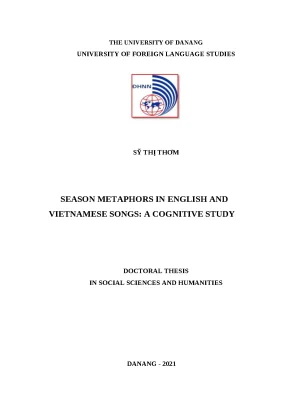
Tải xuống để đọc toàn bộTHE UNIVERSITY OF DANANG UNIVERSITY OF FOREIGN LANGUAGE STUDIES SỸ THỊ THƠM SEASON METAPHORS IN ENGLISH AND VIETNAMESE SONGS: A COGNITIVE STUDY DOCTORAL THESIS IN SOCIAL SCIENCES AND HUMANITIES DANANG - 2021 THE UNIVERSITY OF DANANG UNIVERSITY OF FOREIGN LANGUAGE STUDIES SEASON METAPHORS IN ENGLISH AND VIETNAMESE SONGS: A COGNITIVE STUDY DOCTORAL THESIS IN SOCIAL SCIENCES AND HUMANITIES Major: ENGLISH LINGUISTICS Code: 9220201 A dissertation submitted in partial fulfiHment of the requirements for the degree of Doctor of Philosophy in Linguistics SUPERVISORS: 1. Nguyễn Thị Minh Tâm DANANG - 2021 STATEMENT OF AUTHORSHIP Except where the reference is indicated, no other person’s work has been used without due acknowledgement in the text of the dissertation. This dissertation has not been submitted for the award of any degree of diploma in any other tertiary institution. Da Nang, December, 2021 i ACKNOWLEDGMENTS First and foremost, I am greatly indebted to my supervisors for their continuous support and conscientious supervision.
Namely, I wish to express my deep indebtedness to Assoc. Nguyễn Văn Long for his kindness of giving me useful feedback, advice, and his constant encouragement to help me to overcome obstacles. I am extremely thankful to Dr. Nguyễn Thị Minh Tâm for her enlightening comments and discussions with our several-hour meetings for this thesis.
Thus, my supervisors fire up my coníidence, determination in accomplishing my dissertation. I would like to express my great gratitude to Assoc. Trần Hữu Phúc, Assoc. Nguyễn Thị Quỳnh Hoa, Assoc.
Lưu Quý Khương, Dr. Ngũ Thiện Hùng, Dr. Lê Thị Giao Chi, Dr. Võ Thị Kim Anh for their precious comments and encouragement throughout my process of writing this dissertation.
I am also grateful to Assoc. Nguyễn Thị Thu Hiền, Assoc. Nguyễn Ngọc Vũ, and Assoc. Ngô Hữu Hoàng for their critical reviews, comments, advice in the version of manuscript at the faculty board of doctoral dissertation examiners, leading to the revision for this version of current manuscript.
Besides, I deeply thank Dr. Lý Ngọc Toàn for his help, especially for agreeing to code the subset of data as an intercoder to ensure the reliability of study. I would like to thank the personnel departments, administrators in the Arm of Special Forces in general, in Military University of Special Forces in particular for their generosity in creating all favorable conditions including time, financial supports, and permission for me to conduct the research. I also wish to express my sincere gratitude to the leaders of the Faculty of Fundamental Science, and colleagues who have encouraged me to finish this study.
Last but not least, I am very grateful to my family: my parents, my brothers and sisters, my two children, and my husband. Especially, this dissertation could not have been completed without the immense support of my husband, who kept on encouraging me to never quit, even when things seemed hopeless. 2 ABSTRACT In the light of the conceptual metaphor theory (CMT), initiated by Lakoff and Johnson (1980), this study aims at investigating the conceptualization of season in English and Vietnamese songs. Accordingly, the study is intended to identify the metaphors of SEASON in both languages.
It is the viewpoint of metaphors in pre-cognitive and cognitive periods that serves to build the theoretical framework for this study. Methodologically, the data are collected from English and Vietnamese song lyrics written from the 20th century to present. Comparative method was mainly employed in combination with descriptive method. Especially, the thesis employed the procedure of the identiíying of conceptual metaphors proposed by Steen (2007) and Pragglejaz Group (2007).
Thus, the two methods of metaphor analysis, namely Metaphor Pattern Analysis (MPA, Stefanowitsch 2006) and the version of the Metaphor Identification Procedure developed at Vrije Universiteit (MIPVU, Steen et al. 2011) were used to characterize how conceptual metaphor of season is expressed. This comparative analysis of the conceptual metaphors of season in English and Vietnamese revealed that the two languages show a very similar conceptualization of season-related expressions. In detail, the research findings disclose 58 metaphors in total.
Regarding SEASON as the target domain of a metaphorical mapping, 40 metaphors are found in both English and Vietnamese. The songs in two languages share 28 metaphors, and there are 12 metaphors which are unique to one language but not the other. In terms of SEASON considered as the source domain, 10 shared metaphors of SEASON are found in the both corpora. Simultaneously, 6 metaphors are existent in Vietnamese, but not present in English.
In contrast, there are 2 cases found in English data only. It can be concluded that there are both similarities and differences in metaphorizing the entity SEASON in between English and Vietnamese. The factors related to the phenomenon are given based on the physical and socio-cultural environment. The dissertation, as briefly described above, is hoped to make significant contribution to the teaching, learning and English-Vietnamese translating practice.
3 LIST OF ABBREVIATIONS CALD Cambridge Advanced Learner’s Dictionary CBA Corpus-based Approach CD Cambridge Dictionary CIC Context-Induced Creativity CL Cognitive Linguistics CMA Critical Metaphors Analysis CMT Conceptual Metaphor Theory CS Cognitive Semantics DM Domain Matrix FR Frames FSM Five-Step Method IS Image Schema LDE Longman Dictionary English MIP Metaphor Identification Procedures MS Mental Space MWD Merriam-Webster Collegiate Dictionary VD Vietnamese Dictionary 4 LIST OF FIGURES Figure 2. The traditional explanation of metaphor. Schematicity hierarchy for four conceptual structures. Schematicity as inclusion (Kốvecses, 2020, p.
Schematic model of a minimal conceptual integration network. Generalized Integration Network for the concept of Time as Space. The combined effect of factors on metaphor use (2010, p. Framework for metaphor explanation.
The procedure of SEASON conceptual metaphor identiíication. Analytical framework of conceptual metaphor of SEASON. Analysis procedure of conceptual metaphor of season. The distribution of animate and inanimate entities mapped onto SEASON in English and Vietnamese.
The distribution of the source domains in terms of object in space for SEASON in English and Vietnamese. SEASON as a temporal cycle. The distribution of source domains in terms of inanimate entities mapping onto season in English and Vietnamese. The distribution of animate entities as source domains mapping onto Season in English and Vietnamese.
The distribution of natural state domains mapped through SEASON in English and Vietnamese. The distribution of social domains mapped through SEASON in English and Vietnamese.141 5 LIST OF TABLES Table 2. Examples of conceptual structures in schematicity hierarchy. Conceptual metaphor TIME IS MOVING OBJECT by Evans (2005).
Frequently-occurring linguistic expressions which are associated with TIME IS MONEY, TIME IS A RESOURCE and TIME IS A COMMODITY in the BoE (Li, 2014, p. Frequently-occurring linguistic expressions which are associated with TIME IS MOTION in the BoE (Li, 2014, p. Conceptual metaphors of time in English and Vietnamese. The work can be done by Qualitative and Quantitative in the study.
Metaphor identiíication procedure of the Pragglejaz Group (2007). The procedure of linguistic metaphor identiíication of season. The lexemes of motion verbs used for conceptualization of SEASON as a moving object in English and Vietnamese. The lexemes of adverbs and adjectives used for conceptualization of SEASON as a moving object in English and Vietnamese.
Domains of physical entities used for SEASON in English and Vietnamese. The distribution of natural substance and phenomenon domains mapped onto SEASON in English and Vietnamese. The lexemes denoting coldness used to map onto SEASON in English and Vietnamese. The distribution of natural characteristic domains mapped onto SEASON in English and Vietnamese.
The lexemes used for conceptualization of SEASON as A PERSON. Conceptual Metaphors of SEASON in English and Vietnamese in terms of SEASON as target domain. Emotional domains mapped through SEASON in English and Vietnamese153 6 Table 5. LOVE AS SEASON (Ho, 2018, p.
Abstract domains mapped through SEASON in English and Vietnamese. Conceptual Metaphors of SEASON in English and Vietnamese in terms of SEASON as source domain. Map of domains SEASON mapping onto and mapped through. The distribution of some source domains mapping onto four seasons (spring, summer, autumn, winter) in English and Vietnamese.170 8 TABLE OF CONTENTS THE UNIVERSITY OF DANANG.
i THE UNIVERSITY OF DANANG. i STATEMENT OF AUTHORSHIP. iii LIST OF ABBREVIATIONS. iv LIST OF FIGURES.v LIST OF TABLES.
Aims and Objectives of the Study.Scope of the Study.Significance of the Study. Organization of the Study. THEORETICALBACKGROUND AND LITERATURE REVIEW. Traditional Metaphor Theories.
Metaphor in Cognitive Linguistics. Conceptual Metaphor Theory. Other Related Concepts. Review of Related Studies.
Research Questions Revisited. Data Collecting Procedure. Sources of Data. Conceptual Metaphor Identiíication.
Data Analysis Procedure. Reliability and Validity. THE ENTITY SEASON MAPPED THROUGH THE CONCRETE DOMAINS IN ENGLISH AND VIETNAMESE SONG LYRICS. Entity in Space.
Natural Substance and Phenomenon. Characteristic of Nature. Animal and Plant. THE ENTITY SEASON MAPPING ONTO THE ABSTRACT DOMAINS IN ENGLISH AND VIETNAMESE SONG LYRICS.
Natural State Domain. Victory, Freedom, Peace. CONCLUSION AND DISCUSSION. Degree of Four- SEASON Exploitation.
Degree of Conceptual Metaphor Type Exploitation. Bases for Metaphor Explanations. Limitation and Suggestions for Further Studies. 179 THESIS-RELATED PUBLICATIONS.
Rationale Cognitive linguistics (CL) is a modern school of linguistic thought and practice that originally emerged in the early 1970s and has been increasingly active since the 1980s out of dissatisfaction with formal approaches to language (Evans and Green 2006; Croft and Cruse, 2004). However, in the exploration of the relationship between in the relationship between language and thought, CL has been followed and developed by a variety of linguists, i., Evans and Green (2006), Fillmore (1988), Langacker (1990, 2008), Talmy (1983, 2000), Geeraerts (2006), Fauconnier (1997, 2007, 2009), etc. It is noticeable that Lakoff and John mark a revolution for CL by their grounding-breaking Metaphor We Live By (1980) when they present metaphor from the cognitive perspective. The idea that metaphor needs viewing as a conceptual phenomenon and not just as a linguistic one has been argued at length by Lakoff and his fellow researchers (notably Kốvecses, 2002, 2010; Lakoff, 1987; Lakoff & Johnson, 1980a, 1999; Lakoff & Turner, 1989).
Consequently, their theory has become a foundation for good research by other authors. In Vietnam, based on Lakoff and Johnson’s theory, a number of scholars have formulated a variety of reviews, overviews, research related to conceptual metaphor, for example, Khảo luận ẩn dụ tri nhận (Treatise of cognitive metaphor) (Trần Văn Cơ, 2009), Suy nghĩ về ẩn dụ khái niệm trong thế giới thi ca từ góc nhìn của ngôn ngữ học tri nhận (Thinking of conceptual metaphor in poetry in terms of cognitive linguistics) (Nguyễn Lai, 2009), Ẩn dụ ý niệm (Conceptual metaphor) (Phan Thế Hưng, 2007), Ân dụ dưới góc độ tri nhận (Metaphor from the perspective of cognition) (Phan Thế Hưng, 2009); Ẩn dụ trong thơ (metaphor in poetry) (Nguyễn Thị Quyết, 2012) and so on. In addition to works related to conceptual metaphor as mentioned above, a great number of studies have been conducted to examine conceptual metaphors of both concrete and abstract concepts around human beings all over the world, as well 1 as in Vietnam. Particularly, signiíicant attention has been paid to the abstract concepts as target domains in investigating conceptual metaphors, which can be easily understood because conceptual metaphor is a process of conceptualizing a more abstract domain in terms of more concrete domains (Lakoff and Johnson, 1980a).
Up to now, the abstract concepts which have been examined are various such as life (Lakoff, 1980; Kốvecses, 2010; Nguyễn Thị Quyết, 2012); emotion: love (Lakoff and Johnson, 1980a; Kốvecses, 1986, 1988, 2000; Schroder, 2009; Tissari 2001, 2005, 2006, 2010; Zitu and Zhang, 2012; Nguyễn Hòa, 2010; Phan Văn Hòa 2011; Ngũ Thiện Hùng and Trần Thị Thanh Thảo 2011; Hồ Trịnh Quỳnh Thư, 2018 etc.), sadness (Kốvecses, 2008, Csillag, 2017; Luo Luo, 2016; Nguyễn Văn Trào, 2009, 2014; Nguyễn Thị Quyết, 2014); poverty (Dodge, 2016) and so forth. Similarly, time, an abstract concept, is also widely investigated by both foreign and Vietnamese authors (Lakoff & Johnson, 1980; Goatly, 1997; Evans, 2004; Kốvecses, 2010; Shinohara & Pardeshi, 2011; Nguyễn Hòa, 2007; Nguyễn Văn Trào, 2007; Võ Thị Mai Hoa, 2016; Phan Văn Hòa et al, 2018).
Nội dung được bảo vệ bản quyền — Tải xuống đầy đủ
Trích dẫn luận án này
Sỹ Thị Thơm (2021). Ẩn dụ về mùa trong bài hát Anh-Việt: Nghiên cứu nhận thức [Luận án tiến sĩ, University of Foreign Language Studies, The University of Danang]. LuanAn.net. https://luanan.net/tai-lieu-khac/season-metaphors-english-vietnamese-songs-cognitive-study-doctoral-thesis
Câu hỏi thường gặp
Luận án "Ẩn dụ về mùa trong bài hát Anh-Việt: Nghiên cứu nhận thức" nghiên cứu về vấn đề gì?
Luận án: Luận án tiến sĩ ẩn dụ về mùa trong ca từ bài hát tiếng anh và tiếng việt nghiên cứu theo đướng hướng tri nhận. Xem tóm tắt và tải về tại LuanAn.net
Luận án "Ẩn dụ về mùa trong bài hát Anh-Việt: Nghiên cứu nhận thức" được bảo vệ tại trường nào?
Luận án này được bảo vệ tại University of Foreign Language Studies, The University of Danang. Năm bảo vệ: 2021.
Luận án "Ẩn dụ về mùa trong bài hát Anh-Việt: Nghiên cứu nhận thức" thuộc chuyên ngành gì?
Luận án "Ẩn dụ về mùa trong bài hát Anh-Việt: Nghiên cứu nhận thức" thuộc chuyên ngành English Linguistics. Danh mục: Tài liệu khác.
Luận án "Ẩn dụ về mùa trong bài hát Anh-Việt: Nghiên cứu nhận thức" có bao nhiêu trang?
Luận án "Ẩn dụ về mùa trong bài hát Anh-Việt: Nghiên cứu nhận thức" có 242 trang. Bạn có thể xem trước một phần tài liệu ngay trên trang web trước khi tải về.
Cách tải luận án "Ẩn dụ về mùa trong bài hát Anh-Việt: Nghiên cứu nhận thức" về máy như thế nào?
Để tải luận án về máy, bạn nhấn nút "Tải xuống ngay" trên trang này, sau đó hoàn tất thanh toán phí lưu trữ. File sẽ được tải xuống ngay sau khi thanh toán thành công. Hỗ trợ qua Zalo: 0559 297 239.