Nghiên cứu Quản lý Chất lượng Hiệu quả tại các Cơ sở Giáo dục Đại học Việt Nam
Quản lý chất lượng hiệu quả tại các trường đại học Việt Nam: Nâng cao tiêu chuẩn đào tạo, nghiên cứu và đáp ứng nhu cầu xã hội.
The University of Melbourne
Luan An
Luận án tiến sĩ
Năm xuất bản
Số trang
392
Thời gian đọc
59 phút
Lượt xem
0
Lượt tải
0
Phí lưu trữ
60 Point
Tổng quan nhanh
- Chủ đề:
- 1. Quản lý Chất lượng Giáo dục: Thách thức tại ĐH Việt Nam
- Số trang:
- 392 trang
- Trường:
- The University of Melbourne
- Chuyên ngành:
- Higher Education
- Tác giả:
- Phan Thi Kim Loan
- Năm:
- 2018
Tóm tắt nội dung luận án
I. Quản lý Chất lượng Giáo dục Thách thức tại ĐH Việt Nam
Các trường đại học Việt Nam đang nỗ lực nâng cao chất lượng giáo dục. Mục tiêu là bắt kịp các đại học hàng đầu thế giới. Việc này đòi hỏi nghiên cứu sâu về quản lý chất lượng (QM) trong bối cảnh văn hóa Việt Nam. Nghiên cứu hiện có về đảm bảo chất lượng (QA) còn hạn chế. Cần một phân tích toàn diện về QM tại các trường đại học công lập Việt Nam.
1.1. Nhu cầu nâng cao chất lượng giáo dục đại học
Chất lượng giáo dục đại học là ưu tiên hàng đầu. Các cơ sở giáo dục đối mặt áp lực cạnh tranh toàn cầu. Nâng cao tiêu chuẩn chất lượng giáo dục đại học là cần thiết. Điều này giúp các trường đại học Việt Nam hội nhập quốc tế. Đảm bảo chất lượng giáo dục tạo lợi thế phát triển bền vững. Nhu cầu này thúc đẩy cải cách trong hệ thống quản lý chất lượng giáo dục.
1.2. Những hạn chế trong đảm bảo chất lượng hiện hành
Các nghiên cứu trước đây về đảm bảo chất lượng tại Việt Nam còn rời rạc. Chưa có đánh giá hệ thống, toàn diện. Điều này cản trở việc hiểu rõ bản chất quản lý chất lượng. Việc thiếu dữ liệu và phân tích sâu sắc làm chậm quá trình cải tiến chất lượng đào tạo. Các trường đại học cần một khuôn khổ rõ ràng hơn để tự đánh giá chất lượng trường đại học và thực hiện đánh giá ngoài giáo dục đại học hiệu quả.
II. Phương pháp Nghiên cứu Hệ thống Quản lý Chất lượng
Nghiên cứu áp dụng phương pháp hỗn hợp tuần tự. Phương pháp này cung cấp phân tích có hệ thống, toàn diện. Nó bao gồm việc phát triển khuôn khổ QM, điều tra thực trạng, và đưa ra khuyến nghị. Nghiên cứu xem xét bối cảnh giáo dục đại học Việt Nam. Các khái niệm như chất lượng, QA, QM và chu trình Deming được khám phá. Thuyết văn hóa Hofstede cũng được dùng để hiểu ảnh hưởng văn hóa.
2.1. Phát triển khuôn khổ quản lý chất lượng toàn diện
Khuôn khổ quản lý chất lượng được xây dựng dựa trên cơ sở lý thuyết chặt chẽ. Việc này bao gồm rà soát các phân tích tổng hợp về QM trong giáo dục đại học toàn cầu. Các chiều cạnh thiết yếu của thực tiễn tốt nhất được xác định. Sau đó, khuôn khổ được điều chỉnh để phù hợp bối cảnh Việt Nam. Mục tiêu là tạo ra một hệ thống quản lý chất lượng giáo dục có thể ứng dụng hiệu quả. Khuôn khổ này sẽ định hướng cho việc cải tiến chất lượng đào tạo.
2.2. Kiểm định chất lượng đại học qua khảo sát chuyên gia
Khuôn khổ lý thuyết cần được kiểm định thực nghiệm. Một cuộc khảo sát hai vòng được thực hiện. Các chuyên gia quốc tế và trong nước về giáo dục đại học và quản lý chất lượng đã tham gia. Phản hồi từ họ giúp xác nhận tính hiệu lực của khuôn khổ. Quy trình này đảm bảo tính thực tiễn của hệ thống quản lý chất lượng giáo dục. Kết quả khảo sát củng cố niềm tin vào mô hình đề xuất. Đây là bước quan trọng để đảm bảo chất lượng giáo dục.
III. Đánh giá Thực trạng Quản lý Chất lượng Giáo dục Đại học
Dữ liệu thực nghiệm được thu thập từ tài liệu và phỏng vấn bán cấu trúc. Ba trường đại học công lập được chọn để nghiên cứu. Các bên liên quan đã cung cấp cái nhìn sâu sắc về triển khai QM. Kết quả cho thấy các trường đại học công lập Việt Nam đang ở giai đoạn đầu. Họ đang trong quá trình thực hiện quản lý chất lượng.
3.1. Giai đoạn đầu và những cải tiến chất lượng đào tạo
Các nỗ lực gần đây đã tập trung vào đảm bảo chất lượng. Việc đánh giá dựa trên hiệu suất đã giải quyết nhiều điểm yếu. Điều này đẩy các trường đại học lên một cấp độ cao hơn. Nhiều tiêu chuẩn chất lượng giáo dục đại học được áp dụng. Điều này giúp thúc đẩy các trường trong việc tự đánh giá chất lượng trường đại học. Tuy nhiên, sự phát triển vẫn còn ở giai đoạn sơ khai. Cần nhiều nỗ lực hơn để cải tiến chất lượng đào tạo bền vững.
3.2. Rào cản và thiếu sót trong tự đánh giá chất lượng
Các nỗ lực hiện tại chưa đáp ứng đủ yêu cầu đặc thù của từng trường. Chúng ít hỗ trợ cho việc cải tiến và nâng cao chất lượng thực sự. Một số khía cạnh thiết yếu còn kém phát triển. Ví dụ bao gồm quản lý thông tin và hoạt động đối sánh (benchmarking). Các biện pháp này cũng gặp phải một số sự kháng cự. Điều này cho thấy kiểm định chất lượng đại học phụ thuộc vào bối cảnh văn hóa. Cần một phương pháp tiếp cận linh hoạt hơn cho hệ thống quản lý chất lượng giáo dục.
IV. Khuôn khổ Quản lý Chất lượng Mới cho Đại học Việt Nam
Để hệ thống QA nhất quán và hỗ trợ cải tiến bền vững, nghiên cứu đề xuất một khuôn khổ QM. Khuôn khổ này gồm chín chiều cạnh quan trọng. Nó định hướng các hoạt động quản lý và cải tiến tại các trường đại học. Mục tiêu là tạo ra một môi trường thúc đẩy chất lượng toàn diện. Khuôn khổ này sẽ giúp đảm bảo chất lượng giáo dục một cách hiệu quả hơn.
4.1. Chín trụ cột cho hệ thống quản lý chất lượng giáo dục
Khuôn khổ đề xuất bao gồm: cải tiến liên tục, lãnh đạo và quản lý, quản lý thông tin. Các trụ cột khác là quản lý nguồn lực, quản lý giáo dục và nghiên cứu. Tập trung vào các bên liên quan và sự hài lòng cũng rất quan trọng. Phát triển và quản lý đối tác, đối sánh trong và ngoài trường cũng được nhấn mạnh. Cuối cùng là quản lý mối quan hệ lành mạnh. Các trụ cột này tạo nên một hệ thống quản lý chất lượng giáo dục toàn diện, thúc đẩy cải tiến chất lượng đào tạo.
4.2. Xây dựng văn hóa chất lượng đại học bền vững
Kết quả nghiên cứu ủng hộ ý tưởng QA phụ thuộc vào bối cảnh và văn hóa. Để có sự cam kết đầy đủ từ các bên liên quan, cần một văn hóa tuân thủ ban đầu. Đây là nền tảng vững chắc. Về lâu dài, lòng tin và sự minh bạch phải được thiết lập mạnh mẽ. Điều này thông qua các hoạt động chất lượng, tập trung vào văn hóa quốc gia. Xây dựng văn hóa chất lượng đại học là yếu tố then chốt cho sự thành công của hệ thống.
V. Khuyến nghị Chính sách Đảm bảo Chất lượng Bền vững
Nghiên cứu đưa ra các khuyến nghị quan trọng. Những khuyến nghị này dành cho chính sách quốc gia và thực tiễn của các trường đại học. Mục tiêu là giúp các trường quản lý chất lượng hiệu quả hơn. Chúng nhằm thúc đẩy cải tiến chất lượng đào tạo liên tục. Các đề xuất này dựa trên khuôn khổ QM đã được kiểm chứng.
5.1. Thúc đẩy văn hóa tuân thủ và cải tiến liên tục
Để đạt được cam kết toàn diện từ các bên liên quan, cần phát triển văn hóa tuân thủ. Đây là bước khởi đầu thiết yếu. Sau đó, tập trung vào việc tạo ra một môi trường khuyến khích cải tiến liên tục. Điều này đảm bảo rằng các tiêu chuẩn chất lượng giáo dục đại học luôn được nâng cao. Việc này giúp các trường đại học không ngừng phát triển, đáp ứng nhu cầu xã hội. Văn hóa chất lượng đại học phải được xây dựng từ gốc rễ.
5.2. Củng cố lòng tin minh bạch trong kiểm định chất lượng
Chiến lược dài hạn yêu cầu thiết lập lòng tin và minh bạch. Điều này thực hiện thông qua các thực hành chất lượng rõ ràng. Tập trung vào đặc điểm văn hóa quốc gia là điều cần thiết. Các quy trình kiểm định chất lượng đại học phải công bằng, khách quan. Điều này giúp loại bỏ sự kháng cự và tăng cường sự chấp nhận. Một hệ thống đảm bảo chất lượng giáo dục minh bạch sẽ tạo tiền đề cho sự phát triển bền vững.
Tải xuống file đầy đủ để xem toàn bộ nội dung
Tải đầy đủ (392 trang)Trích đoạn nội dung luận án
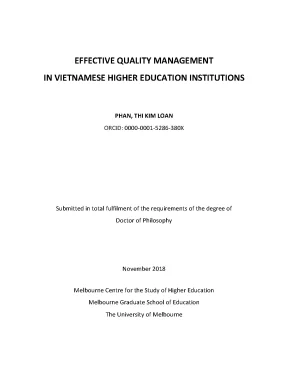
Tải xuống để đọc toàn bộEFFECTIVE QUALITY MANAGEMENT IN VIETNAMESE HIGHER EDUCATION INSTITUTIONS PHAN, THI KIM LOAN ORCID: 0000-0001-5286-380X Submitted in total fulfilment of the requirements of the degree of Doctor of Philosophy November 2018 Melbourne Centre for the Study of Higher Education Melbourne Graduate School of Education The University of Melbourne Abstract Given the current efforts of Vietnamese HEIs to increase quality and catch up with world-ranking universities, it is worthwhile to examine the nature of quality management (QM) implementation in the Vietnamese context and culture. In seeking to go beyond the previous scant research systematically examining the management of quality assurance (QA) in Vietnamese HEIs, this study aims to investigate the nature of QM in Vietnamese public HEIs. Using a sequential mixed methods approach, the study provides a comprehensive and systematic analysis of the topic by (i) developing a conceptually rigorous and empirically validated framework of QM for Vietnamese public HEIs; (ii) investigating the nature of QM in Vietnamese public universities; and (iii) examining implications for national policy and HEI practice based on the outcomes of the research. The study examines the context of Vietnamese higher education as a rationale for the research and higher education and HEI definitions and relevant characteristics as a background for the analysis.
To guide the design of a conceptual QM framework, it explores the major concepts of quality, QA, QM, and a modified Deming cycle. The potential influence of the Vietnamese national characteristics on QM implementation in HEIs is also explored via Hofstede cultural theory. This theoretical understanding helped with the review of the six meta-analyses on QM in higher education to establish essential dimensions representing good practices in world higher education which would potentially work in the Vietnamese context. For empirical validation, a review was administered to international and local experts in higher education and QM in higher education through a two-round survey.
The findings yielded an empirically validated conceptual framework. This framework, in turn, directed the location of the relevant documents and guided semi-structured interviews at three selected public HEIs to obtain stakeholders’ insights into QM implementation. The findings of this stage contributed to identifying the implications for national policy and institutional operations. Evidence from the study shows that Vietnamese public HEIs are still at an early stage in QM implementation.
The recent efforts to improve QA that emphasise performance-based assessment solved many weaknesses and pushed these HEIs to a higher level. However, they insufficiently accommodated unique institutional requirements, did little to support improvement and ultimately enhancement, and seemed to be underdeveloped in some essential dimensions such as information management and benchmarking. Not surprisingly, they met some resistance. The findings advocate the idea that QA is contextually and culturally dependent.
To help make the QA system more consistent and supportive of sustained improvement and innovation, the study suggests a QM framework consisting of nine dimensions, namely, continuous improvement, leadership and management, information management, resource management, education and research management, stakeholder focus and satisfaction, partnership development and management, benchmarking within the institution and beyond, and healthy relationship management. The thesis recommends a compliance culture for the initial stage to develop a full commitment to QA from all stakeholders. For long-term strategies, trust and transparency should be strongly established through quality practices with a focus on national culture. i Declaration This is to certify that: i.
The thesis comprises only my original work towards the PhD, ii. Due acknowledgment has been made in the text to all other material used, iii. The thesis is fewer than 100,000 words in length, exclusive of tables, bibliographies and appendices. Signature: Phan, Thi Kim Loan November 2018 ii Acknowledgments Imagining, researching and writing the doctoral dissertation is a difficult and often lonely process.
However, it is far from a solitary effort and I have been blessed with wonderful support from my supervisors, mentors, research participants, friends, and family members on this journey. It would take as many pages as the dissertation itself to list everyone who has helped and encouraged me and it is impossible to even list the people who have provided me with significant but confidential advice and insights. First thanks must go to my supervisors, Professor Leo Goedegebuure and Professor Hamish Coates for their patience, inspiration, support, and particularly, their incredibly kind graciousness when providing feedback and much needed critique. They made sure I felt respected and encouraged through every step of the dissertation.
They were always positive and instrumental in helping me shape the thesis, allowing me to struggle long enough to figure out the solutions on my own, and then had a masterful way of providing valuable feedback. I also extend thanks to my committee chair, Associate Professor Chi Baik for her guidance and insights. Her time, interest, and valuable suggestions helped me improve this research in countless ways and working alongside her has been a privilege beyond measure. Without the professional guidance and constant encouragement of these three, I could not have completed the thesis, and I am unable to adequately express the depth of my appreciation for their support.
I would like to express my gratitude to Dr. His immense knowledge and sound experience as a leader and as senior lecturer at Universiti Brunei Darussalam in South East Asia greatly contributed to the success of the thesis. I sincerely appreciate his dedicated work and his linguistics insights on improving the clarity throughout my thesis. Wood’s wisdom and willingness to help me as a guide and mentor made this experience rich and positive.
This thesis would not have been possible without the participation of a great many other experts and interviewees both from Vietnam and other countries around the world particularly from ASEAN countries. I am very grateful to the participants who contributed their precious time and insights to this study. Thank you all for your expertise and support. I am indebted to my lecturers, colleagues and students from the University of Humanities and Social Sciences, Vietnam National University, Ho Chi Minh City.
Especially, I wish to express my appreciation to Dr. Lê Hoàng Dũng, dean of my faculty. He encouraged me to consider graduate study, providing valuable suggestions in the initial phases of my iii research and helping prepare me for this journey. A special thank goes to Ms.
Trần Thị Nga, deputy head of the quality office, who was my first challenging reader of my chapters. My lecturers, colleagues and students’ love and support are a great source of encouragement even though they are thousands of miles away. I am very grateful to the academics and professional staff at the Melbourne Centre for the Study of Higher Education (MCSHE) where I have been based for four years. I especially offer my gratitude to Professor Peter McPhee for his extensive expertise and experience as a senior executive and his warm dedication to juniors.
He spent a lot of time discussing my topic, helping me with designing the questionnaire along with the interview questions, and constantly providing invaluable suggestions during my presentations at different seminars and conferences. Special thanks go to Professor Sophia Arkoudis, who has supported me since the first days of my journey with her kindness and her effort to engage me in the Centre experience. Thank you all for staying there to make the hard times more comfortable. I wish to express my deepest thanks to my fellow doctoral students at the Melbourne Graduate School of Education, especially those at MCSHE.
As a group, we are happy to provide support when needed, celebrate successes, and share experiences or simply listen to each other or enjoy lunch together. I especially thank Ms. Trần Thị Thanh Thuỷ for her companionship, for the articles, for late night talks, for countless discussions about the methodology, the context, the concepts, the ways of writing even very late at night…anytime and everywhere whether at our desks, on the plane, on the tram, or simply in the street. life together has made my learning experience even more worthwhile and formed a bond that I believe we will share forever.
I owe a huge debt of gratitude to my extended family, my husband, and my children for their unconditional and continuous love and devotion. They are the best examples of the extended family that I have ever known. My parents and siblings have always believed in me when I did not and could not believe in myself. Though extremely busy, they have not only helped me with my research but also been a constant source of support in my life.
Finally, I need to thank my two lovely children, Khue and Hoang, who are incredibly supportive, patient, and understanding. I especially thank my husband, Thanh, my soulmate and best friend, who is always with me and has never complained about the late nights, early mornings and weekends spent on the project, the tasks I neglected or the social events I missed. As the old African saying states: “If you want to go fast, go alone; if you want to go far go together" and to my beloved husband and children, I say we may not go fast, but we will go far! I love you all! iv Table of contents Chapter Page Abstract. iii Table of contents.
v List of tables. x List of figures. xi List of abbreviations. xiv 1 CHAPTER I: Introduction .3 Aim, objectives, and research questions .4 Summary of methodology .5 Significance of study .6 Scope of study .7 Structure of thesis.
13 2 Chapter 2: The Context .2 The current state of play .3 The non-public HEIs .3 Thirty years of change in Vietnamese higher education .2 Significant policies from 1986 onwards .3 Quality assurance development in Vietnamese higher education .1 Internal quality assurance (IQA) .3 Institutional quality culture .4 Quality management in Vietnamese higher education institutions. 40 v 3 Chapter 3: The Key Concepts .2 Higher education and higher education institution defined .3 Major quality concepts .1 Quality in higher education .2 Quality assurance in higher education .3 Quality management in higher education.4 The modified Deming Cycle in higher education .5 National cultural characteristics .1 Definitions of culture .2 Vietnamese national culture .3 Hofstede's six cultural dimensions .4 Vietnamese national culture from the lens of Hofstede's theory. 67 4 Chapter 4: The Core Quality Management Dimensions .2 The six comprehensive literature reviews on QM in Higher Education .3 Available quality management dimensions in higher education .4 The ‘ideal’ dimensions .5 Education and Research Management (ERM).6 Stakeholder Focus and Satisfaction (SFS) .7 Partnership Development and Management (PDM). 87 5 Chapter 5 Design and Method of Investigation .3 Stage One Design .2 Rationale of the method .4 Round One data collection .5 Round Two data collection .4 Stage Two Design.4 Data analysis and generalisation.
111 vi 6 Chapter 6: The Conceptual Framework .2 The essential dimensions for effective QM implementation .2 Leadership and Management (LM) .5 Education and Research Management (ERM).6 Stakeholder Focus and Satisfaction (SFS) .7 Partnership Development and Management (PDM) .8 Benchmarking within the institution and beyond (BM) .1 A unique approach for a unique context.2 The items constructing the dimensions .3 The QM dimensions for QM in Vietnamese public HEIs .4 The suggested QM framework. 141 7 Chapter 7: QM Implementation from Stakeholders’ Perspectives .1 Explicit commitment from top management .2 Quality Offices–the expected locomotive power.3 The backbone of continuous Improvement–Quality Culture .3 Leadership and Management (LM) .1 The importance of leadership and management .2 Leaders’ active participation in QM .3 Strategic planning and restructuring .4 Improving institutional performance management .1 The importance of information management .2 The implementation of information management .1 Human resource management .2 Finance, facilities, and materials management .6 Education and Research Management (ERM).7 Stakeholders’ Focus and Satisfaction (SFS) .2 Empowerment of internal and external stakeholders .8 Partnership Development and Management (PDM) .2 University commitment as a driver .5 Social engagement drivers .9 Benchmarking within the institution and beyond (BM) .1 Policies and university commitment .2 Benchmark against the HEI’s mission, vision, and objectives .
Nội dung được bảo vệ bản quyền — Tải xuống đầy đủ
Trích dẫn luận án này
Phan Thi Kim Loan (2018). Quản lý chất lượng tại các trường ĐH Việt Nam [Luận án tiến sĩ, The University of Melbourne]. LuanAn.net. https://luanan.net/tai-lieu-khac/quan-ly-chat-luong-hieu-qua-dai-hoc-viet-nam
Câu hỏi thường gặp
Luận án "Quản lý chất lượng tại các trường ĐH Việt Nam" nghiên cứu về vấn đề gì?
Quản lý chất lượng hiệu quả tại các trường đại học Việt Nam: Nâng cao tiêu chuẩn đào tạo, nghiên cứu và đáp ứng nhu cầu xã hội.
Luận án "Quản lý chất lượng tại các trường ĐH Việt Nam" được bảo vệ tại trường nào?
Luận án này được bảo vệ tại The University of Melbourne. Năm bảo vệ: 2018.
Luận án "Quản lý chất lượng tại các trường ĐH Việt Nam" thuộc chuyên ngành gì?
Luận án "Quản lý chất lượng tại các trường ĐH Việt Nam" thuộc chuyên ngành Higher Education. Danh mục: Tài liệu khác.
Luận án "Quản lý chất lượng tại các trường ĐH Việt Nam" có bao nhiêu trang?
Luận án "Quản lý chất lượng tại các trường ĐH Việt Nam" có 392 trang. Bạn có thể xem trước một phần tài liệu ngay trên trang web trước khi tải về.
Cách tải luận án "Quản lý chất lượng tại các trường ĐH Việt Nam" về máy như thế nào?
Để tải luận án về máy, bạn nhấn nút "Tải xuống ngay" trên trang này, sau đó hoàn tất thanh toán phí lưu trữ. File sẽ được tải xuống ngay sau khi thanh toán thành công. Hỗ trợ qua Zalo: 0559 297 239.