Khả năng ngữ pháp & ngôn từ sinh viên năm 3 ĐH Thái Nguyên: Cơ sở bài tập bổ trợ
Luận án đánh giá khả năng ngữ pháp, ngôn từ SV ĐH Thái Nguyên. Đề xuất bài tập bổ trợ, nâng cao năng lực ngôn ngữ hiệu quả.
Số trang
157
Thời gian đọc
24 phút
Lượt xem
0
Lượt tải
0
Phí lưu trữ
50 Point
Tổng quan nhanh
- Chủ đề:
- Nâng cao ngữ pháp tiếng Việt: Bài tập bổ trợ SV ĐH Thái Nguyên
- Số trang:
- 157 trang
- Trường:
- Batangas State University
- Chuyên ngành:
- English
- Tác giả:
- Nguyen Thi Hong Chuyen (Jenny)
Tóm tắt nội dung luận án
I.Nâng cao ngữ pháp tiếng Việt Bài tập bổ trợ SV ĐH Thái Nguyên
Tài liệu này tập trung vào việc nâng cao trình độ ngữ pháp tiếng Việt cho sinh viên. Ngữ pháp vững chắc là nền tảng cho mọi kỹ năng ngôn ngữ. Sinh viên Đại học Thái Nguyên thường đối mặt với thách thức trong việc sử dụng tiếng Việt chuẩn xác. Các bài tập bổ trợ tiếng Việt được thiết kế để khắc phục những điểm yếu này. Tài liệu cung cấp một hệ thống rèn luyện ngữ pháp có cấu trúc. Mục tiêu là giúp sinh viên nắm vững cấu trúc câu và các quy tắc. Việc thực hành đều đặn sẽ cải thiện đáng kể năng lực. Sinh viên sẽ tự tin hơn trong giao tiếp học thuật và đời sống hàng ngày. Đây là một công cụ thiết yếu cho quá trình học tập. Tài liệu này hỗ trợ việc tự học và ôn tập hiệu quả. Nó góp phần xây dựng nền tảng tiếng Việt vững chắc.
1.1. Tầm quan trọng của ngữ pháp tiếng Việt vững chắc
Ngữ pháp tiếng Việt chính xác là yếu tố then chốt. Nó đảm bảo thông điệp truyền tải rõ ràng. Sinh viên cần ngữ pháp tốt để viết báo cáo, làm bài luận. Giao tiếp hiệu quả cũng đòi hỏi sự chuẩn xác này. Một nền tảng ngữ pháp yếu sẽ gây hiểu lầm. Nó cũng ảnh hưởng đến uy tín trong học tập và công việc. Rèn luyện ngữ pháp tiếng Việt giúp phát triển tư duy logic. Nó tạo điều kiện thuận lợi cho việc học các môn khác. Kỹ năng tiếng Việt vững vàng mở ra nhiều cơ hội.
1.2. Các dạng bài tập bổ trợ ngữ pháp tiếng Việt
Tài liệu bao gồm nhiều dạng bài tập bổ trợ tiếng Việt. Các bài tập điền từ giúp củng cố từ vựng và cấu trúc. Bài tập chọn đáp án đúng rèn luyện khả năng nhận diện lỗi. Bài tập chuyển đổi câu phát triển sự linh hoạt. Bài tập sửa lỗi khuyến khích sự chú ý đến chi tiết. Mỗi dạng bài tập tập trung vào một khía cạnh ngữ pháp cụ thể. Các bài tập này được sắp xếp từ cơ bản đến nâng cao. Nó phù hợp với nhiều cấp độ năng lực của sinh viên Đại học Thái Nguyên. Thực hành đa dạng giúp sinh viên tiếp thu hiệu quả.
1.3. Áp dụng tài liệu vào việc học tập tiếng Việt
Sinh viên sử dụng tài liệu này để tự học và ôn tập. Cần lập kế hoạch học tập cụ thể. Nên hoàn thành các bài tập theo từng chuyên đề. Tự kiểm tra đáp án để đánh giá mức độ hiểu bài. Thảo luận với bạn bè về những phần khó. Điều này giúp củng cố kiến thức và phát hiện lỗi sai. Giáo trình tiếng Việt này là nguồn tài nguyên quý giá. Nó hỗ trợ sinh viên chủ động trong việc rèn luyện ngữ pháp. Việc áp dụng linh hoạt sẽ mang lại kết quả tốt.
II.Rèn luyện ngôn từ tiếng Việt Cải thiện giao tiếp hiệu quả
Việc rèn luyện ngôn từ tiếng Việt là thiết yếu. Nó giúp sinh viên phát triển khả năng giao tiếp toàn diện. Giao tiếp hiệu quả đòi hỏi sự phong phú trong vốn từ và cách diễn đạt. Tài liệu này cung cấp các phương pháp để cải thiện vốn từ tiếng Việt. Nó tập trung vào việc sử dụng ngôn từ một cách chính xác và tự nhiên. Kỹ năng tiếng Việt sẽ được nâng cao đáng kể. Sinh viên sẽ học cách lựa chọn từ ngữ phù hợp với ngữ cảnh. Điều này giúp truyền đạt ý tưởng rõ ràng hơn. Giáo trình tiếng Việt này là công cụ hữu ích cho việc tự học. Nó thúc đẩy sự tự tin trong mọi tình huống giao tiếp. Mục tiêu là phát triển khả năng diễn đạt lưu loát và thuyết phục.
2.1. Nâng cao vốn từ tiếng Việt qua thực hành
Vốn từ tiếng Việt phong phú là lợi thế. Sinh viên cần học từ mới trong ngữ cảnh. Các bài tập cung cấp nhiều văn bản mẫu và ví dụ. Điều này giúp hiểu sâu sắc ý nghĩa và cách dùng từ. Luyện tập đặt câu với từ mới. Sử dụng từ đồng nghĩa, trái nghĩa để mở rộng kiến thức. Ghi chú lại những từ khó nhớ. Việc thực hành thường xuyên giúp từ ngữ đi vào tiềm thức. Nó cũng củng cố khả năng sử dụng từ chính xác.
2.2. Phát triển kỹ năng viết tiếng Việt mạch lạc
Kỹ năng viết tiếng Việt mạch lạc rất quan trọng. Sinh viên cần sắp xếp ý tưởng logic. Cấu trúc câu phải rõ ràng, dễ hiểu. Tài liệu này cung cấp các bài tập viết có hướng dẫn. Các bài tập này bao gồm viết đoạn văn, tóm tắt, và phân tích. Việc rèn luyện giúp sinh viên diễn đạt ý tưởng một cách trôi chảy. Từ đó, tạo ra những bài viết có sức thuyết phục cao. Kỹ năng viết tốt là lợi thế trong học tập và công việc.
2.3. Luyện tập kỹ năng nói tiếng Việt tự tin
Tự tin khi nói tiếng Việt là mục tiêu quan trọng. Tài liệu này gián tiếp hỗ trợ kỹ năng nói. Việc nắm vững ngữ pháp và từ vựng là tiền đề. Sinh viên có thể sử dụng các bài tập để chuẩn bị cho các buổi thuyết trình. Luyện tập đọc to các đoạn văn mẫu. Ghi âm giọng nói để tự đánh giá. Việc xây dựng một nền tảng ngôn ngữ vững chắc giúp giảm lo lắng khi nói. Kỹ năng tiếng Việt tổng thể sẽ được cải thiện. Giao tiếp bằng lời nói sẽ tự nhiên hơn.
III.Tài liệu học tiếng Việt Cẩm nang cho sinh viên Đại học
Tài liệu học tiếng Việt này là một cẩm nang thiết yếu. Nó được thiết kế đặc biệt cho sinh viên Đại học Thái Nguyên. Tài liệu cung cấp một nguồn tài nguyên học tập phong phú. Mục tiêu là củng cố và phát triển kỹ năng tiếng Việt. Đây không chỉ là một giáo trình tiếng Việt thông thường. Nó là tập hợp các bài tập bổ trợ có hệ thống. Các bài tập giúp sinh viên ôn tập ngữ pháp tiếng Việt. Nó cũng cải thiện vốn từ tiếng Việt. Việc sử dụng tài liệu này giúp sinh viên tự tin hơn. Nó hỗ trợ họ trong việc đạt được mục tiêu học tập. Tài liệu được cấu trúc logic, dễ tiếp cận. Nó là một phần không thể thiếu trong hành trang học tập của sinh viên.
3.1. Cấu trúc giáo trình tiếng Việt bổ trợ
Giáo trình tiếng Việt này có cấu trúc rõ ràng. Nó được chia thành nhiều chương, mỗi chương tập trung vào một chủ đề ngữ pháp. Các chủ đề bao gồm từ loại, cấu trúc câu, và các quy tắc chính tả. Mỗi chương có phần lý thuyết tóm tắt. Sau đó là các bài tập thực hành đa dạng. Độ khó của bài tập tăng dần. Điều này giúp sinh viên tiếp thu kiến thức một cách có hệ thống. Cấu trúc này tối ưu hóa quá trình rèn luyện ngữ pháp.
3.2. Hướng dẫn sử dụng tài liệu học tiếng Việt hiệu quả
Việc sử dụng tài liệu học tiếng Việt cần có phương pháp. Sinh viên nên đọc kỹ phần lý thuyết trước. Sau đó, tiến hành làm các bài tập. Nên làm từng bài một cách cẩn thận. Kiểm tra đáp án để rút kinh nghiệm. Không nên bỏ qua những lỗi sai. Ghi chú lại những kiến thức cần nhớ. Tận dụng phần giải thích chi tiết nếu có. Sử dụng tài liệu này như một công cụ tự đánh giá. Việc học có mục tiêu rõ ràng sẽ mang lại hiệu quả cao.
3.3. Lợi ích của tài liệu bổ trợ tiếng Việt
Tài liệu bổ trợ tiếng Việt mang lại nhiều lợi ích. Nó giúp sinh viên củng cố kiến thức nền tảng. Nó cung cấp cơ hội rèn luyện ngữ pháp tiếng Việt chuyên sâu. Tài liệu giúp cải thiện vốn từ tiếng Việt. Nó nâng cao kỹ năng tiếng Việt tổng thể. Việc ôn tập ngữ pháp tiếng Việt trở nên dễ dàng hơn. Tài liệu này cũng là công cụ chuẩn bị cho các kỳ thi. Nó góp phần xây dựng sự tự tin trong giao tiếp học thuật. Đây là một khoản đầu tư xứng đáng cho tương lai.
IV.Ôn tập ngữ pháp tiếng Việt Chuẩn bị cho kỳ thi
Ôn tập ngữ pháp tiếng Việt là bước quan trọng. Nó giúp sinh viên chuẩn bị tốt nhất cho các kỳ thi. Tài liệu này đóng vai trò là một công cụ ôn tập hiệu quả. Nó cung cấp các bài tập được thiết kế để bao quát kiến thức. Sinh viên có thể rèn luyện ngữ pháp một cách có hệ thống. Mục tiêu là đạt được kết quả cao trong các bài kiểm tra. Việc nắm vững ngữ pháp giúp giảm áp lực thi cử. Nó cũng củng cố kỹ năng tiếng Việt tổng thể. Tài liệu này là người bạn đồng hành tin cậy. Nó giúp sinh viên tự tin đối mặt với thử thách. Việc ôn tập kỹ lưỡng sẽ mang lại thành công.
4.1. Chiến lược ôn tập ngữ pháp tiếng Việt hiệu quả
Một chiến lược ôn tập ngữ pháp tiếng Việt rõ ràng là cần thiết. Sinh viên nên xác định các điểm yếu của mình. Tập trung vào những phần ngữ pháp còn chưa vững. Sử dụng các bài tập bổ trợ tiếng Việt để thực hành chuyên sâu. Lập kế hoạch ôn tập theo thời gian biểu. Nên ôn tập thường xuyên, không dồn vào phút cuối. Làm các bài kiểm tra thử để làm quen với định dạng. Phân tích kết quả để điều chỉnh phương pháp học. Điều này giúp tối ưu hóa quá trình ôn tập.
4.2. Bài tập thực hành ngữ pháp tiếng Việt chuyên sâu
Tài liệu cung cấp các bài tập thực hành ngữ pháp tiếng Việt chuyên sâu. Các bài tập này bao gồm nhiều cấu trúc phức tạp. Nó đề cập đến những lỗi sai thường gặp. Việc giải quyết các bài tập này giúp củng cố kiến thức. Sinh viên sẽ phát triển khả năng phân tích và áp dụng quy tắc. Mỗi bài tập được thiết kế để rèn luyện một kỹ năng cụ thể. Thực hành chuyên sâu giúp nâng cao độ chính xác. Kỹ năng tiếng Việt sẽ được trau dồi toàn diện.
4.3. Đánh giá và cải thiện năng lực tiếng Việt
Đánh giá năng lực tiếng Việt định kỳ là cần thiết. Sinh viên sử dụng phần đáp án để tự chấm điểm. Xác định những lĩnh vực cần cải thiện thêm. Không ngần ngại xem lại các quy tắc ngữ pháp đã học. Luyện tập thêm với các bài tập tương tự. Việc theo dõi tiến độ giúp giữ động lực. Từ đó, năng lực tiếng Việt sẽ liên tục được nâng cao. Đây là một quá trình liên tục và cần sự kiên trì.
Tải xuống file đầy đủ để xem toàn bộ nội dung
Tải đầy đủ (157 trang)Trích đoạn nội dung luận án
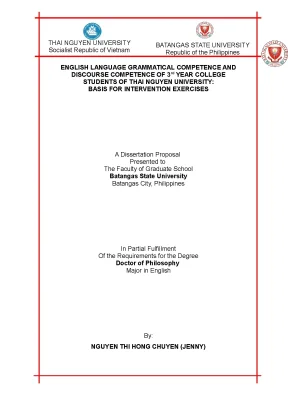
Tải xuống để đọc toàn bộTHAI NGUYEN UNIVERSITY BATANGAS STATE UNIVERSITY Socialist Republic of Vietnam Republic of the Philippines ENGLISH LANGUAGE GRAMMATICAL COMPETENCE AND DISCOURSE COMPETENCE OF 3rd YEAR COLLEGE STUDENTS OF THAI NGUYEN UNIVERSITY: BASIS FOR INTERVENTION EXERCISES A Dissertation Proposal Presented to The Faculty of Graduate School Batangas State University Batangas City, Philippines In Partial Fulfillment Of the Requirements for the Degree Doctor of Philosophy Major in English By: NGUYEN THI HONG CHUYEN (JENNY) i THAI NGUYEN UNIVERSITY BATANGAS STATE UNIVERSITY Socialist Republic of Vietnam Republic of the Philippines TABLE OF CONTENTS Page TITLE PAGE. TABLE OF CONTENTS.i LIST OF TABLES.1 Statement of the Problem.6 Scope, Delimitation and Limitation of the Study.8 Significance of the Study. REVIEW OF LITERATURE.51 Definition of Terms. RESEARCH METHOD AND PROCEDURE.60 ii THAI NGUYEN UNIVERSITY BATANGAS STATE UNIVERSITY Socialist Republic of Vietnam Republic of the Philippines Subjects of the Study.60 Data Gathering Instrument.62 Data Gathering Procedure.64 Statistical Treatment of Data.
PRESENTATION, ANALYSIS AND INTERPRETATION OF DATA. SUMMARY, CONCLUSION, AND RECOMMENDATION. Letter of Requests.154 iii THAI NGUYEN UNIVERSITY BATANGAS STATE UNIVERSITY Socialist Republic of Vietnam Republic of the Philippines LIST OF TABLES Table Title Page 1. Distribution of the Respondents of the Study.
Level of Grammatical Competence of Students in Parts of Speech. Level of Grammatical Competence of Students in Morphology. Level of Grammatical Competence of Students in Syntax. Level of Grammatical Competence of Students in Vocabulary Meaning.
Level of Discourse Competence of Students in Cohesive Devices. Level of Discourse Competence of Students in Transitional Phrases. Level of Discourse Competence of Students in Coherence. Level of Discourse Competence of Students in Connectors.
10 Level of Discourse Competence of Students in Choice of Words. Validated Students’ Skills Employed in Teaching the Basic English Course. Students’ Skills and their Frequency of Use. Students’ Skills and their Degree of Importance.
iv THAI NGUYEN UNIVERSITY BATANGAS STATE UNIVERSITY Socialist Republic of Vietnam Republic of the Philippines 14. Students’ Level of Grammatical and Discourse Competencies and their Performance as Assessed by English Teachers. Bases in the Design of Integrative Learning Exercises on Morpho-Syntactic Competencies. 1 THAI NGUYEN UNIVERSITY BATANGAS STATE UNIVERSITY Socialist Republic of Vietnam Republic of the Philippines CHAPTER I THE PROBLEM Introduction In Vietnam, students are required to learn English through compulsory programs and as a requirement in school and universities and in most countries in the world.
Many students take English course because of its utility value as lingua franca or a world language. Most of them fail to learn the language successfully. This situation also applies to students in other countries where learning a foreign language is also compulsory. Students enrolled in the English courses have either high dropped out rates or failed students at the end of the term.
This situation is true to countries like the United States and Australia where students literally drop out in their foreign language studies, while in countries like China, Japan and Vietnam students either mentally withdraw or look for strategies that will help them to learn the English language. In the last decade, the use of English as the main foreign language taught and employed in communication with foreigners, has dramatically increased in Vietnam. According to the Ministry of Education, the number of off-shore students exceeds 60,000 in Vietnam nowadays and Vietnamese students who want to work and study abroad are increasing. 2 THAI NGUYEN UNIVERSITY BATANGAS STATE UNIVERSITY Socialist Republic of Vietnam Republic of the Philippines However, English language teaching in Vietnam still utilizes the traditional teaching model where students are taught English just for passing examination purposes only and teachers just give lecture mainly to help students achieve this goal.
The result is that students do not have the ability to communicate effectively with others in English. This is referred to as dumb English or deaf English in Vietnam. Obviously students’ overall skills are not enhanced, especially for students at the college and university level. In order to improve the situation based on need analysis, Vietnam Ministry of Education states that the aims of Vietnam English Language Teaching (ELT) at general educational level expressed in the new curriculum are that at the end of the upper secondary level, students will be able to use English as means of communication at a certain level of proficiency in four macro skills: listening, speaking, reading and writing and to be able to read materials at the same level of their textbook, using a dictionary, to have a mastery of basic English phonetics and grammar, to have acquire the minimum of around 2,500 vocabulary items of English; to attain a certain level of understanding of English and American cultures, to become aware of cross cultural differences in order to become better communicators, to better inform the world of the Vietnamese people, their history and culture and to take pride in Vietnam, its language and culture (MOET 2007).
3 THAI NGUYEN UNIVERSITY BATANGAS STATE UNIVERSITY Socialist Republic of Vietnam Republic of the Philippines To promote the English language teaching and learning at tertiary level in recent years, Vietnamese government has encouraged the private tertiary institutions to carry out advanced programs in which English is required to be the medium of instruction. They have also encouraged tertiary institutions to teach in English in fundamental science subjects such as mathematics, physics, chemistry and some specialized subjects in the senior years. It is suggested that work start at the two national universities namely; Hanoi National University and Vietnam National University; three regional universities such as Thai Nguyen University, Hue University and Danang University and other pivotal universities in Vietnam with twenty percent of the students being involved in these advanced programs. This percentage will be increased and expanded so that finally all advanced programs will be applied throughout the tertiary educational system.
In Vietnam, English is the most important foreign language since the implementation of the reform and opening up policy. One of the major goals for English teaching is to develop communicative competencies of the learners. It is the initial and ultimate goal of English teaching. Communication on the other hand is considered the essence of English teaching.
4 THAI NGUYEN UNIVERSITY BATANGAS STATE UNIVERSITY Socialist Republic of Vietnam Republic of the Philippines In language teaching, the ability to communicate should be cultivated. Students should learn how to use a language in their daily communication in order to demonstrate their mastery of a language. Different language skills included under communicative competence are linguistic, socio-linguistic, discourse, strategic and pragmatic competencies. The expression, interpretation and negotiation of meaning between two interlocutors or between a text and its readers is referred to as language learning.
It is believed that one of the main goals of both English language teaching and communicative English teaching in Vietnam nowadays is to develop students’ communicative competence, as more students will regard English as a communicating tool after graduation. If students can use the English knowledge, skills and cultural aspects they have learned to communicate with people of different cultural backgrounds in real language contexts, they are then using English as a communication tool. The Ministry of Education and Training (MOET) has set a target of boosting foreign language teaching in high schools. At the start of Academic Year 2011-2012, students at specific schools will have to study mathematics and information technology in English.
Despite the significance of English language, majority of the Vietnamese students remain handicapped in the use of English. It was even reported by the 5 THAI NGUYEN UNIVERSITY BATANGAS STATE UNIVERSITY Socialist Republic of Vietnam Republic of the Philippines MOET in 2011 that English language competence of Vietnamese students was rapidly deteriorating. This implies that the government, in particular the education sector can hardly address such perceived deterioration of English. It was also reported by the MOET of Vietnam and the AETS or the American Educational Testing Service that fifty one point seven percent (51.7%) of Vietnamese students who graduated from college in 2009 had substandard English skills.
There are several reasons cited why English language teaching in Vietnam becomes a problem. Reasons include the deterioration in students’ English competence and less opportunities for students to practice English in the classroom. Most of the English classes are still adopting the traditional teaching in which teachers do the talking while students are merely listening and note taking so that the chance to speak diminished. Most college graduates in Vietnam have deteriorating English because during their college days, they spend only at least one and half year of English language studies.
So that when they embark on a more complex academic work which demands the use of English as well as the language skills, they fail because of lack of knowledge. 6 THAI NGUYEN UNIVERSITY BATANGAS STATE UNIVERSITY Socialist Republic of Vietnam Republic of the Philippines Another reason cited is the incompetency of Vietnamese students in the use of English. This problem leads to losing the most useful assets of Vietnamese people in contributing to national development and international communication. Many of the students in Thai Nguyen University (TNU) system struggle to keep up with the expectations of the school for them to communicate in good English.
For decades the university system in Thai Nguyen worked to address the need of all students. But somehow, the expected outcome has a very slow progress. With this scenario, as college teacher teaching English subject in this institution, the researcher is interested to determine the English language grammatical and discourse competence of the Third year college students of Thai Nguyen with the end view of proposing intervention exercises that will enhance further their knowledge along the said competencies. Statement of the Problem This study is focused on determining English language grammatical competence and discourse competence of 3rd year college students of Thai Nguyen system.
Specifically, it sought answers to the following questions. 7 THAI NGUYEN UNIVERSITY BATANGAS STATE UNIVERSITY Socialist Republic of Vietnam Republic of the Philippines 1. How may the grammatical competence of student respondents be described in terms of: 1.1 parts of speech; 1. What is the discourse competence of student respondents relative to: 2.5 choice of words? 3.
How do English teacher assess the grammatical and discourse competencies of 3rd year college students? 4. How do the respondents’ grammatical and discourse competencies compare with English teachers’ assessments? Are there significant relationships? 5. What innovative English language teaching intervention exercises may be proposed to enhance students’ grammatical and discourse competencies? 8 THAI NGUYEN UNIVERSITY BATANGAS STATE UNIVERSITY Socialist Republic of Vietnam Republic of the Philippines Scope, Delimitation and Limitation of the Study The study determines the English language grammatical competence and discourse competence of 3rd year college students of Thai Nguyen system. This includes the grammatical competence of student respondents in parts of speech, morphology and syntax, and vocabulary meaning.
Included also in the study is the discourse competence of student respondents relative to cohesive devices, transitional phrases, coherence, connectors and choice of words. Further, the study covers the assessment of the English teacher on the grammatical and discourse competencies of 3 rd year college students, the comparison of the respondents’ grammatical and discourse competencies and English teachers’ responses, the significant differences on students’ grammatical and discourse competencies and teachers’ responses with the end view of proposing an innovative English language teaching strategies to enhance students’ grammatical and discourse competencies. The study covered the three (3) Thai Nguyen Universities in Thai Nguyen City and made used of the 40 teachers teaching English and 300 3rd Year College students who were enrolled in the Academic Year 2013-2014. 9 THAI NGUYEN UNIVERSITY BATANGAS STATE UNIVERSITY Socialist Republic of Vietnam Republic of the Philippines This study is limited from the data gathered from the above mentioned respondents.
Third year college students and English teachers from other Thai Nguyen University systems are excluded in the study. Significance of the Study The study is deemed beneficial to the Administrators of Thai Nguyen University, English teachers, Third Year College students, Parents and Future researchers. Administrators of Thai Nguyen.
Nội dung được bảo vệ bản quyền — Tải xuống đầy đủ
Trích dẫn luận án này
Nguyen Thi Hong Chuyen (Jenny) (n.d.). Nghiên cứu ngữ pháp & ngôn từ SV ĐH Thái Nguyên: Bài tập bổ trợ [Luận án tiến sĩ, Batangas State University]. LuanAn.net. https://luanan.net/tai-lieu-khac/nghien-cuu-ngu-phap-ngon-tu-sinh-vien-dh-thai-nguyen-bai-tap-bo-tro
Câu hỏi thường gặp
Luận án "Nghiên cứu ngữ pháp & ngôn từ SV ĐH Thái Nguyên: Bài tập bổ trợ" nghiên cứu về vấn đề gì?
Luận án đánh giá khả năng ngữ pháp, ngôn từ SV ĐH Thái Nguyên. Đề xuất bài tập bổ trợ, nâng cao năng lực ngôn ngữ hiệu quả.
Luận án "Nghiên cứu ngữ pháp & ngôn từ SV ĐH Thái Nguyên: Bài tập bổ trợ" được bảo vệ tại trường nào?
Luận án này được bảo vệ tại Batangas State University.
Luận án "Nghiên cứu ngữ pháp & ngôn từ SV ĐH Thái Nguyên: Bài tập bổ trợ" thuộc chuyên ngành gì?
Luận án "Nghiên cứu ngữ pháp & ngôn từ SV ĐH Thái Nguyên: Bài tập bổ trợ" thuộc chuyên ngành English. Danh mục: Tài liệu khác.
Luận án "Nghiên cứu ngữ pháp & ngôn từ SV ĐH Thái Nguyên: Bài tập bổ trợ" có bao nhiêu trang?
Luận án "Nghiên cứu ngữ pháp & ngôn từ SV ĐH Thái Nguyên: Bài tập bổ trợ" có 157 trang. Bạn có thể xem trước một phần tài liệu ngay trên trang web trước khi tải về.
Cách tải luận án "Nghiên cứu ngữ pháp & ngôn từ SV ĐH Thái Nguyên: Bài tập bổ trợ" về máy như thế nào?
Để tải luận án về máy, bạn nhấn nút "Tải xuống ngay" trên trang này, sau đó hoàn tất thanh toán phí lưu trữ. File sẽ được tải xuống ngay sau khi thanh toán thành công. Hỗ trợ qua Zalo: 0559 297 239.