Nghiên cứu chế tạo vật liệu nano TiO2 ứng dụng trong lĩnh vực quang điện hóa
Luận án TS Vật lý: chế tạo vật liệu tổ hợp nano TiO2 dạng sợi ứng dụng quang điện hóa. Tiềm năng năng lượng sạch.
University of Sciences, Hue University
Solid State Physics
Luan An
Luận án tiến sĩ (Doctoral thesis / Summary of thesis Ph.D)
Năm xuất bản
Số trang
56
Thời gian đọc
9 phút
Lượt xem
0
Lượt tải
0
Phí lưu trữ
40 Point
Tổng quan nhanh
- Chủ đề:
- Vật liệu nano TiO2: Giải pháp năng lượng sạch
- Số trang:
- 56 trang
- Trường:
- University of Sciences, Hue University
- Chuyên ngành:
- Solid State Physics
- Tác giả:
- Nghia Van Nguyen
- Năm:
- 2021
Tóm tắt nội dung luận án
I.Vật liệu nano TiO2 Giải pháp năng lượng sạch
Nhu cầu năng lượng toàn cầu đang gia tăng mạnh mẽ. Nguồn nhiên liệu hóa thạch cạn kiệt nhanh chóng. Việc sử dụng chúng gây ra ô nhiễm môi trường nghiêm trọng. Đặc biệt, khí thải CO2 làm trầm trọng thêm biến đổi khí hậu. Cần tìm kiếm các nguồn năng lượng sạch, bền vững thay thế. Hydrogen nổi lên như một giải pháp năng lượng tiềm năng. Hydrogen phong phú trong tự nhiên, có mật độ năng lượng cao. Quá trình sử dụng hydrogen không tạo ra chất ô nhiễm. Hydrogen có thể sản xuất từ nhiều nguồn khác nhau. Phương pháp quang điện hóa hứa hẹn sản xuất hydrogen hiệu quả. TiO2 là vật liệu chủ chốt trong lĩnh vực này. Vật liệu nano TiO2 được nghiên cứu rộng rãi. Ứng dụng của chúng trong tế bào quang điện hóa (PEC) rất quan trọng. Mục tiêu là tối ưu hóa hiệu suất chuyển đổi năng lượng mặt trời.
1.1. Nhu cầu năng lượng và thách thức môi trường
Thế giới đối mặt với khủng hoảng năng lượng. Tiêu thụ nhiên liệu hóa thạch tăng cao. Điều này dẫn đến sự cạn kiệt tài nguyên. Ô nhiễm không khí và biến đổi khí hậu là hệ quả nghiêm trọng. Khí nhà kính, đặc biệt là CO2, gia tăng. Cần phát triển các công nghệ năng lượng tái tạo. Đây là vấn đề cấp bách toàn cầu.
1.2. Hydrogen Nguồn năng lượng của tương lai
Hydrogen được xem là nguồn năng lượng lý tưởng. Hydrogen là nguyên tố phong phú nhất tự nhiên. Nó tồn tại cả trong nước và khí sinh học. Hydrogen có mật độ năng lượng rất cao (140 kJ/g). Quá trình đốt cháy hydrogen chỉ tạo ra nước. Không có chất gây ô nhiễm nào phát sinh. Nó là phương tiện lưu trữ và vận chuyển năng lượng hiệu quả.
1.3. Vai trò của TiO2 trong quang điện hóa
TiO2 là vật liệu bán dẫn quan trọng. Nó có tính bền hóa học cao, không độc hại. Khoảng trống năng lượng phù hợp cho ứng dụng quang xúc tác. Vật liệu nano TiO2 cải thiện diện tích bề mặt. Nó tăng cường khả năng hấp thụ ánh sáng. TiO2 là lựa chọn hàng đầu cho điện cực quang trong PEC.
II.Chế tạo TiO2 ứng dụng quang điện hóa hiệu quả
Công nghệ quang điện hóa (PEC) được chú trọng. Nó chuyển đổi trực tiếp năng lượng mặt trời thành hydrogen. PEC tích hợp quá trình hấp thụ ánh sáng và điện hóa. Phản ứng oxy hóa và khử xảy ra trên các điện cực. Nước được phân tách thành hydrogen và oxy. Đây là công nghệ cân bằng giữa hiệu quả và chi phí. Điện cực quang đóng vai trò then chốt trong PEC. Vật liệu bán dẫn trên điện cực hấp thụ ánh sáng. Nó tạo ra các cặp electron-lỗ trống. TiO2 là vật liệu tiên phong cho điện cực quang. Lịch sử nghiên cứu TiO2 trong PEC bắt đầu từ năm 1972. Các nghiên cứu chế tạo TiO2 liên tục cải tiến. Mục tiêu là nâng cao hiệu suất và độ bền của điện cực.
2.1. Giới thiệu công nghệ PEC
Tế bào quang điện hóa (PEC) là hệ thống chuyển đổi năng lượng. Nó sử dụng năng lượng mặt trời để phân tách nước. Kết quả là tạo ra hydrogen sạch. PEC được đánh giá cao hơn PV-E và photocatalytic. Hiệu suất chuyển đổi năng lượng mặt trời thành hydrogen khá cao. Chi phí hoạt động của PEC tương đối hợp lý.
2.2. Vật liệu bán dẫn cho điện cực quang
Điện cực quang là thành phần cốt lõi của PEC. Vật liệu bán dẫn hấp thụ photon. Năng lượng photon phải lớn hơn khoảng trống năng lượng của vật liệu. Quá trình này tạo ra các cặp electron và lỗ trống. Các hạt tải điện sau đó tham gia vào phản ứng hóa học. TiO2 là vật liệu bán dẫn được nghiên cứu nhiều nhất cho mục đích này.
2.3. Lịch sử phát triển của TiO2 trong PEC
Năm 1972, Fujishima và Honda công bố nghiên cứu đột phá. Họ sử dụng điện cực TiO2 để phân tách nước bằng ánh sáng. Công trình này mở ra kỷ nguyên mới cho PEC. Kỹ thuật này cho phép trực tiếp tạo hydrogen từ năng lượng mặt trời. Từ đó, TiO2 trở thành trọng tâm của nhiều nghiên cứu chế tạo vật liệu. Các nhà khoa học không ngừng tối ưu hóa vật liệu này.
III.Tổng hợp TiO2 cấu trúc nano cho phản ứng PEC
Việc tổng hợp TiO2 cấu trúc nano là trọng tâm nghiên cứu. Nhiều phương pháp khác nhau đã được phát triển. Mỗi phương pháp có những ưu điểm riêng biệt. Chúng ảnh hưởng đến kích thước, hình dạng và tính chất vật liệu. Các phương pháp phổ biến bao gồm sol-gel, thủy nhiệt và anod hóa TiO2. Phương pháp sol-gel cho phép kiểm soát tốt kích thước hạt. Nó tạo ra vật liệu đồng nhất. Tổng hợp thủy nhiệt là phương pháp đơn giản. Nó tạo ra các cấu trúc nano với độ tinh thể cao. Anod hóa là kỹ thuật tạo màng ống nano TiO2. Cấu trúc tinh thể đóng vai trò quan trọng. Pha anatase và rutile có những đặc tính khác nhau. Pha anatase thường ưu tiên cho hoạt tính quang điện hóa. Pha rutile bền vững hơn. Việc kiểm soát các yếu tố này là cần thiết để tối ưu hóa hiệu suất PEC.
3.1. Các phương pháp tổng hợp phổ biến
Chế tạo TiO2 nano bao gồm nhiều kỹ thuật. Phương pháp sol-gel là kỹ thuật linh hoạt. Tổng hợp thủy nhiệt tạo ra vật liệu có độ tinh thể cao. Anod hóa là phương pháp tạo màng oxide xốp. Các kỹ thuật khác như lắng đọng hơi vật lý (PVD) cũng được sử dụng. Mỗi phương pháp tạo ra cấu trúc và đặc tính riêng biệt.
3.2. Ưu điểm của phương pháp sol gel và thủy nhiệt
Phương pháp sol-gel dễ kiểm soát kích thước và hình thái. Nó tạo ra vật liệu nano TiO2 đồng nhất. Tổng hợp thủy nhiệt là phương pháp kinh tế. Nó tạo ra cấu trúc nano dạng sợi hoặc ống. Cả hai phương pháp đều cho phép điều chỉnh pha tinh thể. Chúng tối ưu hóa hoạt tính quang xúc tác của vật liệu.
3.3. Tầm quan trọng của cấu trúc tinh thể
Cấu trúc tinh thể ảnh hưởng lớn đến hiệu suất. Pha anatase có hoạt tính quang xúc tác cao hơn. Nó có khả năng tách electron-lỗ trống hiệu quả. Pha rutile ổn định và có khoảng trống năng lượng nhỏ hơn. Pha hỗn hợp anatase-rutile thường cho hiệu suất tối ưu. Việc kiểm soát cấu trúc tinh thể là yếu tố then chốt.
IV.Cơ chế hoạt động quang điện hóa của TiO2 nano
Cơ chế hoạt động của tế bào PEC dựa trên nguyên lý điện phân nước. Một tế bào PEC bao gồm hai điện cực. Một điện cực bán dẫn (ví dụ TiO2) hấp thụ ánh sáng. Một điện cực kim loại đóng vai trò đối điện cực. Khi điện cực TiO2 được chiếu sáng, nó hấp thụ photon. Năng lượng photon phải lớn hơn khoảng trống năng lượng của TiO2. Quá trình này tạo ra các cặp electron-lỗ trống trong vật liệu. Electron di chuyển đến vùng dẫn, lỗ trống ở vùng hóa trị. Sau đó, electron di chuyển đến điện cực đối. Tại đó, electron tham gia vào phản ứng khử tạo ra khí hydrogen. Lỗ trống di chuyển đến bề mặt điện cực quang. Lỗ trống tham gia vào phản ứng oxy hóa, tạo ra khí oxy. Hiệu suất của quá trình phụ thuộc vào sự tách và vận chuyển hiệu quả của các hạt tải điện.
4.1. Nguyên lý phân tách nước bằng PEC
Nguyên lý cơ bản của PEC là chuyển đổi ánh sáng thành điện. Dòng điện này sau đó điện phân nước. Phản ứng diễn ra trên hai điện cực nhúng trong dung dịch điện ly. Một điện cực là bán dẫn, gọi là điện cực quang. Điện cực còn lại là kim loại, gọi là điện cực đối. Hydrogen được tạo ra ở cathode, oxy ở anode.
4.2. Quá trình tạo cặp electron lỗ trống
Khi điện cực TiO2 hấp thụ ánh sáng. Photon kích thích electron từ vùng hóa trị. Electron chuyển lên vùng dẫn. Đồng thời tạo ra một lỗ trống ở vùng hóa trị. Đây là quá trình tạo cặp electron-lỗ trống. Hiệu suất quá trình này phụ thuộc vào khoảng trống năng lượng. Nó cũng phụ thuộc vào khả năng hấp thụ ánh sáng của vật liệu.
4.3. Phản ứng oxy hóa khử trên điện cực
Electron di chuyển từ điện cực quang đến điện cực đối. Tại đây, chúng tham gia phản ứng khử H+ thành H2. Lỗ trống di chuyển đến bề mặt điện cực quang. Chúng tham gia phản ứng oxy hóa nước thành O2 và H+. Sự phân tách nhanh chóng của electron và lỗ trống là cần thiết. Nó ngăn chặn quá trình tái hợp và tăng hiệu suất.
V.Đặc trưng vật liệu nano TiO2 trong phân tách nước
Đặc trưng vật liệu nano TiO2 quyết định hiệu suất quang điện hóa. Khoảng trống năng lượng là yếu tố cốt lõi. TiO2 có khoảng trống năng lượng tương đối rộng. Nó chủ yếu hấp thụ tia UV. Cần điều chỉnh khoảng trống năng lượng để hấp thụ phổ ánh sáng rộng hơn. Cấu trúc tinh thể của TiO2 cũng rất quan trọng. Pha anatase và rutile có những đặc tính riêng biệt. Pha anatase thường có hoạt tính quang xúc tác cao hơn. Pha rutile bền vững hơn và có độ hấp thụ ánh sáng tốt ở một số bước sóng. Kích thước, hình dạng và độ xốp của hạt nano ảnh hưởng đến diện tích bề mặt. Diện tích bề mặt lớn tăng số vị trí phản ứng. Nghiên cứu tập trung vào việc tối ưu hóa các đặc tính này. Mục tiêu là đạt được hiệu suất chuyển đổi năng lượng cao nhất.
5.1. Ảnh hưởng của khoảng trống năng lượng
Khoảng trống năng lượng quyết định khả năng hấp thụ photon. TiO2 có khoảng trống năng lượng khoảng 3.0-3.2 eV (anatase). Nó chỉ hấp thụ phần tử tia cực tím của phổ mặt trời. Việc thu hẹp khoảng trống năng lượng là cần thiết. Nó giúp TiO2 hấp thụ ánh sáng khả kiến. Kỹ thuật pha tạp hoặc tạo khuyết tật có thể điều chỉnh khoảng trống năng lượng.
5.2. Cấu trúc anatase và rutile
TiO2 tồn tại chủ yếu ở hai pha tinh thể chính: anatase và rutile. Pha anatase có hoạt tính quang xúc tác vượt trội. Nó có khả năng tạo và tách electron-lỗ trống tốt. Pha rutile ổn định hơn và có chỉ số khúc xạ cao. Việc kiểm soát tỷ lệ pha là quan trọng. Pha hỗn hợp anatase-rutile thường cho hiệu suất cao hơn nhờ hiệu ứng dị thể.
5.3. Tối ưu hóa đặc tính vật liệu
Tối ưu hóa đặc tính vật liệu nano là rất quan trọng. Kích thước hạt nano ảnh hưởng đến diện tích bề mặt. Hình dạng vật liệu nano (sợi, ống, hạt) cũng tác động. Độ xốp của màng TiO2 ảnh hưởng đến khuếch tán chất điện ly. Diện tích bề mặt riêng lớn tăng số vị trí phản ứng. Các yếu tố này cần được điều chỉnh thông qua quá trình chế tạo TiO2.
Tải xuống file đầy đủ để xem toàn bộ nội dung
Tải đầy đủ (56 trang)Trích đoạn nội dung luận án
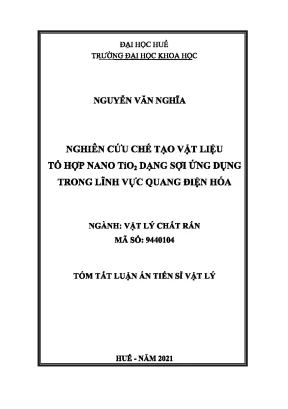
Tải xuống để đọc toàn bộHUE UNIVERSITY UNIVERSITY OF SCIENCES NGHIA VAN NGUYEN RESEARCH ON THE FABRICATION OF FIBER - LIKE TiO2 NANOCOMPOSITES FOR APPLICATION IN THE PHOTOELECTROCHEMICAL FIELD Major: Solid State Physics Code: 9440104 SUMMARY OF THESIS PH. PHYSICS HUE - 2021 The thesis has been completed at Faculty of Electricity, Electronics and Material Technology, University of Sciences, Hue University. Thuy Minh Doan 2. Son Manh Nguyen Reviewer 1:.
The thesis will be defended in front of Hue University’s Doctoral thesis committee at. The thesis will be accessible at: 1. National library of Vietnam. Library of University of Sciences, Hue University.
REASONS TO CHOOSE THE TOPIC The increase in population and the development of life in the world have led to an increase in energy demand globally. Currently, fossil fuels (coal, oil, gas) are still the main source of human energy (about 90%). In addition to the fact that fossil fuels will be depleted soon, fossil fuel consumption increases CO2 emissions, which has been exacerbating environmental pollution and gas change. According to a report by the Global Energy and Climate Outlook (GECO) in 2016, global energy demand and greenhouse gas emissions are expected to increase 37% and 30% respectively over the period to 2030.
The solution to this problem is to find and exploit clean, sustainable, and environmentally friendly energy sources. This is an urgent issue that attracts the attention of researchers around the world. Over the past decades, many renewable energy sources have been developed to replace fossil fuels such as wind, geothermal, hydroelectric and solar energy. These are relatively clean and sustainable energy sources.
However, each of those energy sources has several limitations that make development challenging. For example, electricity generated by wind turbines cannot be stored, hydroelectricity is limited in construction due to high costs and possible adverse environmental impacts. In this situation, hydrogen gas emerges as the ideal energy storage and transport means for the following reasons: First, it is the most abundant element in nature and exists both in water and in biological gas; Second, hydrogen is very light (0.8988 g/L) so it has a greater energy density (~ 140 kJ/g) than any other fuel, such as gasoline (~ 40 kJ/g); Third, it is environmentally friendly because its use does not generate pollutants or any negative impact on the environment. Like electricity, hydrogen can be produced from a variety of sources such as natural gas, coal, water, and other renewable energy sources.
Currently, the basic methods of hydrogen generation are the Converting hydrocarbons (fossil fuels, biomass) by heat (Reforming); the Electrolysis water method; The Biological method. However, these methods have a major limitation in consuming a lot of 2 energy from fossil fuel sources. In recent years, the photochemical method to generate hydrogen has been interested in research and development. Many scientists believe that the hydrogen energy is generated by photochemical water splitting is one of the most promising because it is based on the conversion of sunlight, an available energy source, and endless.
The photochemical system that produces hydrogen from solar water splitting can be divided into three main categories: (1) photoelectric – electrolytic (PV-E) cells, (2) photocatalytic ( PC), and (3) photoelectrochemical cell (PEC). PEC is a technology integrating light absorption on semiconductor materials and electrochemical process in photoelectric cells, oxidation and dehydration reactions take place on electrodes to separate water into hydrogen and oxygen. PEC technology is considered to be the middle ground between PV-E technology and PC technology, it has a relatively high efficiency of converting solar energy into hydrogen at a reasonable cost. Fujishima and Honda were the first to report the water separation PEC using a titanium dioxide (TiO2) electrode in 1972 in the Nature [26].
This technique allows the directly generation of hydrogen gas from solar energy. In the simplest case, the photoelectrochemical principle of water separation is based on the conversion of light energy into electric current in a cell consisting of two electrodes embedded in an electrolyte solution. This electric current is used to electrolyze water. One of the two electrodes is a semiconductor that can absorb light, called an working electrode (WE) or a photoelectrode, the other electrode is a metal, called a counting electrode (CE).
In which, the photoelectrode plays a very important role in the operation of PEC. The mechanism of this process is that, when the electrode WE are irradiated with an photon greater than the bandgap of TiO2, electron/hole pairs are formed in the conduction band (CB) and valence band (VB). Then electrons (e-) move toward the CE. The electrons involved in the reduction reaction produce H2 gas, while the holes (h+) oxidize to produce O2.
Theoretically, there are three ways of using electrode material in PEC, namely: WE is a semiconductor of type n and 3 CE is a metal; WE is n-type semiconductor and CE is a p-type semiconductor or WE is p-type semiconductor and CE is metal. In principle, the behavior of these three electrode layouts is the same. In PEC technology, the semiconductor material used as an photoelectrode must satisfy the following two basic conditions: First, the bandgap (Eg) must be greater than 1.23 eV, which is the energy needed to dissociate water molecules. Furthermore, for the reaction to occur without applying an external voltage, the conductor band bottom must be higher than the water oxidation level and the valence band peak must be higher than the hydrogen generation potential, that is, the two oxidation potentials.
- the reduction must be within the energy gap [37]; Second, since the electrodes are immersed in the electrolyte solution, they must be chemically stable to avoid electrochemical corrosion. It is also worth noting that, as mentioned above, for the water separation reaction to take place, Eg must be greater than 1.23 eV, but if Eg is too high (> 3 eV), the energy conversion efficiency is low. The reason is that it can only absorb ultraviolet (UV) light but cannot absorb visible light, while visible light contributes nearly half of the solar energy reaching the earth and light. Ultraviolet only accounts for about 4%.
After the report by Fujishima and Honda, a series of semiconductors used as photoelectrodes have been discovered and studied but finding a semiconductor that satisfies the above conditions remains a challenge. For example, semiconductor materials such as ZnO, SnO2 [48] have high chemical stability, but Eg are quite large so they cannot absorb most visible light, so the efficiency is quite low. The materials with low Eg such as Si, GaAs and InP [11] are susceptible to corrosion when in contact with electrolyte. Titanium, despite having a large Eg, is still one of the most attractive materials for PEC technology.
It has the conduction band bottom and valence band top position including both the oxidation-reduction potentials of H2O, thus satisfying the required for water splitting process. However, the optical conversion efficiency of this material system is still quite low 4 for practical application. Therefore, it was forgotten for a long time. Currently, in order to increase the sunlight absorption of the photoelectrodes, reasearch groups often combine TiO2 material and good optical absorbing material in the visible region.
In the most recent reports, the researchers have to combine TiO2 materials with low energy gap sizes such as CdS [18], CdSe [39], g-C3N4 [55]. The results showed that the efficiency of water splitting increased significantly under the radiation of sunlight. In these material systems, CdS is most interested in research because the small bandgap and the position of the conduction band bottom and the top of the valence band are consistent with the combination with TiO2. The publications of Jingshan et al.
[39]; Liu et al. [56]; Zhang et al. showed a significantly increased optical conversion efficiency of the CdS/TiO2 structure. Recently, metal nanoparticles are being developed to increase water separation efficiency.
The plasmonic effect from the nano- structured metals allows the broadening wavelength range of light absorption as well as the transport of "hot" electrons from the metal to the semiconductor. Fang Xu et al. [93]; Gong et al [78]; Wang et al [98] showed that when coated with the Au nanoparticles on the TiO2 surface, it was possible to shift the absorbance area of the photoelectrode towards the long wavelength. This is therefore increasing the optical current density.
In addition, the fabrication of electrodes with the nanocomposite structure of various layers has been published by some research groups showing the effectiveness of this structure in photoelectrochemistry such as N.Wu et al. [50]; Li et al. The optical conversion efficiency of the PEC is determined primarily by the photoelectrode material. An ideal photoelectrode for high efficiency and stability must satisfy the two following requirements: high light absorption and fast electron transportability.
These factors, not only depend on the crystal structure, but also depend on the structural morphology of the material. One-dimensional nanostructures such as nanowires, nanotubes, and nanorods are the most studied 5 because these structural types can improve carrier transportability. They reduce optical loss thanks to their constant path and anti-reflection resistance [35]. There are two main methods to fabricate one-dimensional nanostructured TiO2 used in the photoelectrochemical field: the electrochemical method and the hydrothermal method.
Many research results, as published by Grimes et al. showed that the nanotubes TiO2 with vertical order on the Ti substrate were fabricated by electrochemical method. In general, this method has the advantage of a simple fabrication tool that can control the diameter size. However, due to the anode of Ti, the number of photons absorbed into the material cannot be optimized.
Second, groups of Grimes et al [23]; Qin et al [66]; Leu et al. [85] successfully fabricated TiO2 with vertical order nanorod structure on transparent conductive FTO. Optical current density is relatively high, but the size of the nanorods is relatively large, so their surface area is not high. In addition to the above two methods, the electrospinning method has shown simplicity and efficiency in fabricating one- dimensional nanostructured materials with different materials.
This method is capable of controlling the porosity of the electrode film easily by controlling the nanofiber size. The electrospinning technique was invented in the US in 1902, but it was not until the late 20th century that scientists noticed this technique when making one-dimensional nanomaterials. By this method, Mali et al [59]; Li et al [52];. has successfully fabricated TiO2 photoelectrode with nanofiber structure.
Although there have been many reports on PEC technology, the study of the structure of the material on the photoelectrode to increase the conversion efficiency is still a research direction that has received great attention. On the other hand, the published works just stop at the level of investigating the materials, measuring the optical current and optical conversion efficiency. There are very few studies that directly absorb hydrogen gas generated in the reaction of the PEC. For the above reasons, we choose the thesis topic as: "Research on the fabrication of fiber-like TiO2 6 nanocomposites for application in the photoelectrochemical field".
THESIS TARGET The goal of the thesis is to fabricate nanomaterial nanostructured TiO2 composite nanomaterials, fabricated by the electrospinning method, used as a photoelectrode in the PEC model. The electrode has a high chemical, uniformity, good surface properties, good adhesion on ITO (Tin-doped indium oxide) electrode substrates, and gives high optical water separation performance in the visible light region. SUBJECTS AND SCOPE OF THE STUDY 3. Research subjects - TiO2 nanocomposites.
- Three-electrode electrochemical system. - The system captures hydrogen gas generated in the water separation reaction. Research scope - Investigating the fabrication conditions of a one- dimensional TiO2 nanostructured photoelectric electrode on ITO substrates by electrospinning method (controlling parameters affecting the size, thickness, and diameter of nanofibers). - Fabrication of CdS/Au/TiO2 composite nanomaterials on TiO2 fiber materials to ensure that the photoelectrode absorbs a large part of the sunlight spectrum.
- Measurement of the optical current characteristics of the photoelectrodes in the three-electrode system. - Design and obtain the amount of hydrogen generated by the reaction.
Nội dung được bảo vệ bản quyền — Tải xuống đầy đủ
Trích dẫn luận án này
Nghia Van Nguyen (2021). Nghiên cứu chế tạo vật liệu nano TiO2 ứng dụng quang điện hóa [Luận án tiến sĩ, University of Sciences, Hue University]. LuanAn.net. https://luanan.net/tai-lieu-khac/nghien-cuu-che-tao-vat-lieu-nano-tio2-ung-dung-quang-dien-hoa
Câu hỏi thường gặp
Luận án "Nghiên cứu chế tạo vật liệu nano TiO2 ứng dụng quang điện hóa" nghiên cứu về vấn đề gì?
Luận án TS Vật lý: chế tạo vật liệu tổ hợp nano TiO2 dạng sợi ứng dụng quang điện hóa. Tiềm năng năng lượng sạch.
Luận án "Nghiên cứu chế tạo vật liệu nano TiO2 ứng dụng quang điện hóa" được bảo vệ tại trường nào?
Luận án này được bảo vệ tại University of Sciences, Hue University. Năm bảo vệ: 2021.
Luận án "Nghiên cứu chế tạo vật liệu nano TiO2 ứng dụng quang điện hóa" thuộc chuyên ngành gì?
Luận án "Nghiên cứu chế tạo vật liệu nano TiO2 ứng dụng quang điện hóa" thuộc chuyên ngành Solid State Physics. Danh mục: Tài liệu khác.
Luận án "Nghiên cứu chế tạo vật liệu nano TiO2 ứng dụng quang điện hóa" có bao nhiêu trang?
Luận án "Nghiên cứu chế tạo vật liệu nano TiO2 ứng dụng quang điện hóa" có 56 trang. Bạn có thể xem trước một phần tài liệu ngay trên trang web trước khi tải về.
Cách tải luận án "Nghiên cứu chế tạo vật liệu nano TiO2 ứng dụng quang điện hóa" về máy như thế nào?
Để tải luận án về máy, bạn nhấn nút "Tải xuống ngay" trên trang này, sau đó hoàn tất thanh toán phí lưu trữ. File sẽ được tải xuống ngay sau khi thanh toán thành công. Hỗ trợ qua Zalo: 0559 297 239.