Assessing climate change impacts on surface water flow in Srepok River Basin, Việt Nam
Đánh giá tác động biến đổi khí hậu lên dòng chảy, khai thác bền vững tài nguyên nước lưu vực Srepok, Việt Nam.
Viet Nam National University, Hanoi
Climate Change and Development
Luan An
Master’s Thesis
Năm xuất bản
Số trang
112
Thời gian đọc
17 phút
Lượt xem
0
Lượt tải
0
Phí lưu trữ
40 Point
Tổng quan nhanh
- Chủ đề:
- 1. Biến đổi khí hậu Srepok: Mục tiêu và Phạm vi Nghiên cứu
- Số trang:
- 112 trang
- Trường:
- Viet Nam National University, Hanoi
- Chuyên ngành:
- Climate Change and Development
- Tác giả:
- Vu Thi Hai Ha
- Năm:
- 2021
Tóm tắt nội dung luận án
I. Biến đổi khí hậu Srepok Mục tiêu và Phạm vi Nghiên cứu
Nghiên cứu này đánh giá tác động biến đổi khí hậu lên dòng chảy lưu vực sông Srepok. Lưu vực sông Srepok đối mặt nhiều thách thức từ biến đổi khí hậu. Vùng này quan trọng với kinh tế, xã hội Việt Nam. Mục tiêu chính là phân tích sự thay đổi dòng chảy. Đồng thời, đề xuất giải pháp quản lý tài nguyên nước bền vững. Việc này giúp giảm thiểu tác động tiêu cực, bảo vệ sinh kế cộng đồng và môi trường. Tầm quan trọng của tài nguyên nước trong khu vực được nhấn mạnh.
1.1. Tổng quan lưu vực sông Srepok
Sông Srepok là một nhánh lớn của sông Mekong. Lưu vực trải dài qua nhiều tỉnh của Việt Nam. Đặc điểm địa lý, khí hậu đa dạng. Nguồn tài nguyên nước dồi dào, đóng vai trò sống còn. Hoạt động nông nghiệp bền vững, sinh kế cộng đồng phụ thuộc trực tiếp vào dòng sông. Tuy nhiên, vùng này ngày càng chịu ảnh hưởng của biến đổi khí hậu, gây ra các hiện tượng như hạn hán và lũ lụt. Hiểu rõ khu vực là nền tảng cho mọi phân tích.
1.2. Mục tiêu và câu hỏi nghiên cứu chính
Nghiên cứu xác định tác động biến đổi khí hậu lên thủy văn sông Srepok. Phân tích sự thay đổi dòng chảy bề mặt theo các kịch bản khí hậu. Đánh giá khả năng khai thác tài nguyên nước trong tương lai. Đề xuất chiến lược quản lý thích ứng. Câu hỏi nghiên cứu tập trung vào mức độ thay đổi dòng chảy, hậu quả đối với tài nguyên nước và các biện pháp ứng phó hiệu quả. Mục tiêu hướng đến quản lý bền vững, bảo vệ đa dạng sinh học và nâng cao khả năng thích ứng của cộng đồng.
II. Phương pháp và Mô hình phân tích Thủy văn Srepok
Việc đánh giá tác động biến đổi khí hậu đòi hỏi phương pháp khoa học và mô hình đáng tin cậy. Nghiên cứu sử dụng nhiều loại dữ liệu khác nhau. Các mô hình thủy văn tiên tiến được áp dụng. Điều này đảm bảo kết quả phân tích chính xác, cung cấp cơ sở vững chắc cho các đề xuất. Quy trình hiệu chỉnh và kiểm định mô hình được thực hiện kỹ lưỡng. Đây là bước quan trọng để đảm bảo độ tin cậy của các dự báo về thủy văn sông Srepok.
2.1. Nguồn dữ liệu thủy văn và khí tượng
Dữ liệu bao gồm thông tin khí tượng thủy văn, nhu cầu nước, thông tin hồ chứa và thủy điện. Dữ liệu khí tượng thu thập từ các trạm quan trắc. Bao gồm nhiệt độ, lượng mưa, bốc hơi. Dữ liệu dòng chảy từ các trạm thủy văn. Nhu cầu nước được tổng hợp từ các ngành như nông nghiệp, sinh hoạt, công nghiệp. Dữ liệu về hồ chứa và thủy điện cung cấp thông tin quan trọng cho mô hình. GIS và viễn thám hỗ trợ thu thập, xử lý dữ liệu không gian. Điều này tăng cường độ chính xác cho phân tích tài nguyên nước.
2.2. Ứng dụng mô hình thủy văn MIKE
Nghiên cứu sử dụng mô hình MIKE NAM và MIKE HYDRO BASIN. MIKE NAM mô hình hóa quá trình mưa-dòng chảy. Mô hình này giúp dự báo dòng chảy bề mặt. MIKE HYDRO BASIN mô phỏng cân bằng nước trong toàn lưu vực. Nó tích hợp các yếu tố như nhu cầu nước, hoạt động hồ chứa. Các mô hình này được hiệu chỉnh và kiểm định kỹ lưỡng. Dữ liệu lịch sử được sử dụng cho quá trình này. Kết quả mô hình cung cấp cái nhìn toàn diện về thủy văn sông Srepok. Chúng hỗ trợ đánh giá tác động biến đổi khí hậu.
III. Tác động Biến đổi khí hậu đến Dòng chảy sông Srepok
Phân tích kết quả mô hình cho thấy biến đổi khí hậu gây ra những thay đổi đáng kể về dòng chảy. Dòng chảy trung bình năm, mùa mưa và mùa khô đều chịu ảnh hưởng. Những thay đổi này trực tiếp tác động đến tài nguyên nước, gây ra các hiện tượng cực đoan. Hạn hán và lũ lụt trở nên thường xuyên hơn, khốc liệt hơn. Điều này ảnh hưởng nghiêm trọng đến nông nghiệp, sinh kế cộng đồng và đa dạng sinh học. Việc hiểu rõ các tác động này là cần thiết để đưa ra giải pháp ứng phó hiệu quả.
3.1. Phân tích sự thay đổi dòng chảy trung bình
Kết quả chỉ ra sự thay đổi rõ rệt trong dòng chảy trung bình năm. Dòng chảy có xu hướng giảm hoặc biến động mạnh. Điều này phụ thuộc vào kịch bản biến đổi khí hậu. Sự giảm dòng chảy có thể dẫn đến thiếu hụt tài nguyên nước. Điều này đặc biệt ảnh hưởng các khu vực hạ lưu. Ngược lại, những giai đoạn tăng đột biến dòng chảy gây ra lũ lụt. Phân tích này là cơ sở quan trọng cho quy hoạch sử dụng nước và ứng phó với hạn hán.
3.2. Ảnh hưởng đến dòng chảy mùa mưa và mùa khô
Dòng chảy mùa mưa và mùa khô chịu tác động khác biệt. Mùa mưa, lượng dòng chảy có thể tăng hoặc tập trung hơn. Điều này làm tăng nguy cơ lũ lụt. Mùa khô, dòng chảy có xu hướng giảm mạnh. Điều này gây ra tình trạng hạn hán kéo dài. Tình trạng này đe dọa nông nghiệp bền vững. Nó cũng ảnh hưởng nghiêm trọng đến sinh kế cộng đồng. Các biến động này đòi hỏi chiến lược quản lý tài nguyên nước linh hoạt, hiệu quả. Việc thích ứng với lũ lụt và hạn hán là ưu tiên hàng đầu.
IV. Quản lý Tài nguyên nước Srepok và Nhu cầu Sử dụng
Việc đánh giá nhu cầu nước và khả năng khai thác bền vững là then chốt. Biến đổi khí hậu làm phức tạp thêm công tác quản lý tài nguyên nước. Nghiên cứu phân tích nhu cầu nước của các ngành khác nhau. Đồng thời, đánh giá khả năng đáp ứng của lưu vực sông Srepok dưới tác động của biến đổi khí hậu. Điều này giúp xác định những khu vực dễ bị tổn thương. Từ đó, đưa ra giải pháp tối ưu hóa việc sử dụng nước, đảm bảo an ninh nguồn nước và hỗ trợ nông nghiệp bền vững.
4.1. Đánh giá nhu cầu nước tổng thể lưu vực
Nhu cầu nước tại lưu vực sông Srepok rất đa dạng. Nước được sử dụng cho nông nghiệp, sinh hoạt, công nghiệp và thủy điện. Ngành nông nghiệp chiếm tỷ lệ lớn nhất. Đặc biệt là các vùng sản xuất cây công nghiệp. Nhu cầu nước sẽ tăng theo sự phát triển kinh tế-xã hội. Biến đổi khí hậu làm thay đổi lượng nước sẵn có. Điều này tạo áp lực lớn lên tài nguyên nước. Đánh giá chi tiết giúp dự báo thiếu hụt. Nó cũng hỗ trợ phân bổ nước hợp lý, tránh lãng phí.
4.2. Khai thác bền vững tài nguyên nước Srepok
Nghiên cứu đánh giá khả năng khai thác bền vững tài nguyên nước. Các kịch bản biến đổi khí hậu được xem xét. Mục tiêu là đảm bảo đủ nước cho hiện tại và tương lai. Việc khai thác cần cân bằng giữa nhu cầu kinh tế và bảo vệ môi trường. Các giải pháp như tích trữ nước, tái sử dụng nước được đề xuất. Điều này giúp giảm thiểu tác động của hạn hán. Quản lý hiệu quả tài nguyên nước là yếu tố sống còn. Nó đảm bảo sinh kế cộng đồng và đa dạng sinh học khu vực.
V. Giải pháp thích ứng Biến đổi khí hậu cho Srepok
Đối mặt với những tác động của biến đổi khí hậu, các giải pháp thích ứng là cần thiết. Nghiên cứu đề xuất nhiều biện pháp. Bao gồm giải pháp phi công trình và công trình. Các giải pháp này nhằm tăng cường khả năng chống chịu của lưu vực. Mục tiêu là bảo vệ tài nguyên nước, phát triển nông nghiệp bền vững. Đồng thời, nâng cao sinh kế cộng đồng. Việc phối hợp giữa các bên liên quan là yếu tố then chốt cho sự thành công. Các đề xuất này hướng tới một tương lai ổn định hơn cho sông Srepok.
5.1. Đề xuất chính sách và quản lý tài nguyên nước
Cần đổi mới chính sách quản lý tài nguyên nước. Áp dụng quản lý tổng hợp tài nguyên nước (IWRM). Điều này đảm bảo sử dụng nước hiệu quả, công bằng. Tăng cường hợp tác liên tỉnh, liên ngành. Nâng cao năng lực dự báo, cảnh báo sớm hạn hán và lũ lụt. Phát triển cơ chế tài chính cho các dự án thích ứng. Thúc đẩy vai trò của cộng đồng trong quản lý nước. Các chính sách này hỗ trợ bảo vệ đa dạng sinh học, tối ưu hóa tài nguyên nước.
5.2. Các giải pháp công trình và nông nghiệp bền vững
Các giải pháp công trình bao gồm nâng cấp, xây dựng hồ chứa mới. Cải thiện hệ thống kênh mương thủy lợi. Tăng cường khả năng chống lũ, chống hạn. Về nông nghiệp, cần áp dụng các kỹ thuật canh tác bền vững. Phát triển cây trồng chịu hạn, chịu úng. Sử dụng công nghệ tưới tiết kiệm nước. Đa dạng hóa cây trồng, vật nuôi để giảm rủi ro. Các biện pháp này giúp đảm bảo an ninh lương thực. Chúng cũng bảo vệ sinh kế cộng đồng khỏi tác động biến đổi khí hậu.
Tải xuống file đầy đủ để xem toàn bộ nội dung
Tải đầy đủ (112 trang)Trích đoạn nội dung luận án
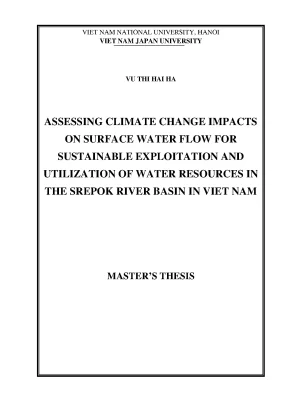
Tải xuống để đọc toàn bộVIET NAM NATIONAL UNIVERSITY, HANOI VIET NAM JAPAN UNIVERSITY VU THI HAI HA ASSESSING CLIMATE CHANGE IMPACTS ON SURFACE WATER FLOW FOR SUSTAINABLE EXPLOITATION AND UTILIZATION OF WATER RESOURCES IN THE SREPOK RIVER BASIN IN VIET NAM MASTER’S THESIS VIET NAM NATIONAL UNIVERSITY, HANOI VIET NAM JAPAN UNIVERSITY VU THI HAI HA ASSESSING CLIMATE CHANGE IMPACTS ON SURFACE WATER FLOW TOWARD SUSTAINABLE EXPLOITATION AND UTILIZATION OF WATER RESOURCES IN THE SREPOK RIVER BASIN IN VIET NAM MAJOR: CLIMATE CHANGE AND DEVELOPMENT CODE: 8900201.02QTD RESEARCH SUPERVISOR: Dr. Akihiko Kotera Prof. Koshi Yoshida Ha Noi, 2021 DECLARATION I hereby declare that this thesis is the result of my research and has not been published. The use of other research results and other documents must comply with the regulation.
The citations and references to documents, books, research, and websites must be listed as the thesis references. Author of the thesis Vu Thi Hai Ha ACKNOWLEDGEMENT First and foremost, my appreciation and gratitude go to excellent supervisors for their guidance during the thesis research, namely Prof. Dr Koshi Yoshida and Dr Akihiko Kotera. They have been great mentors and always being available and responding to my emails and questions.
I would like to thank the National Center for Water Resources Planning and Investigation and the Vietnam Meteorological and Hydrological Administration for their enthusiastic support in providing materials and guiding me in writing my thesis. I am also very grateful to the Danish Hydraulic Institute (DHI) offices in Ha Noi for the incredible internship assisting me in the modelling tutorial and MIKE license supply. My special thanks go to Mr Nguyen Ngoc Bach, who gave me so much meaningful advice in study MIKE models. I am very grateful for all the support, continuously encouragement, teaching and guidance from all the teachers of the MCCD program have extended to me during my time study here at Viet Nam Japan University, Hanoi National University.
Last but not least, I would like to express my indebtedness to my families and friends who have given me constant encouragement, great patience and utmost love to overcome all difficulties in the thesis completion. Thank you very much! TABLE OF CONTENTS DECLARATION ACKNOWLEDGEMENT TABLE OF CONTENTS LIST OF TABLES .i LIST OF FIGURES. ii LIST OF ABBREVIATIONS .2 The research question and hypothesis .3 Research objectives and tasks .4 Objects and scope of the research .5 Matrix of learning outcomes for the master's thesis .6 Contribution of the thesis .7 Framework of the Master’s thesis .9 Overview of the study area. Description of study area.
Socio-economic features .10 Overview climate change in Viet Nam and the Srepok river basin. MATERIALS AND METHODS. Hydro-meteorological data. Water demand data.
Reservoirs and hydropower plants data .2 Rainfall-runoff and water balance models. MIKE NAM model .2 The MIKE HYDRO BASIN model. RESULTS AND DISCUSSIONS .1 Calibration and validation of MIKE NAM model .2 Calibration and validation of MIKE HYDRO BASIN model .3 Impacts of climate change on flow. The average annual flow.
The average flow in the rainy season. The average flow in the dry season .4 Assessing the capacity of sustainable exploitation and using water resources under the context of climate change. Water demand assessment. Assessing the capacity of sustainable exploitation and using water resources under the context of climate change.
SOLUTION AND RECOMMENDATION. Solution and recommendation. Innovation of policy and management: IWRM (Solutions for water resource management). Agriculture and solutions.
Structural measures in the Srepok river basin. Recommendations to the government. CONCLUSIONS AND RECOMMENDATIONS. Recommendations for further study.
82 Appendix A: The MIKE NAM model results. 82 Appendix B: The water demand in the Srepok river basin. 86 Appendix C: The reservoirs and hydropower plants information. 86 Appendix D: The rainfall projection.
101 LIST OF TABLES Table 1.1: Research question and hypothesis .2: Objective and tasks.3: Relations between results of the Master's thesis and MCCD's Program Learning Outcomes (PLOs) .4: Characteristics of the main tributaries in the Srepok river basin in Viet Nam .5: Average monthly flow in 1980-2015 in the Srepok Basin (m³/s) .1: List of rainfall stations used in MIKE NAM .2: The variation of annual average rainfall compared to the baseline period in four provinces in the Srepok river basin.3: Changes in seasonal rainfall (%) compared with the baseline period in four provinces in the Srepok river basin .4: Water demand in the Srepok river basin (million m3) .5: Reservoirs and hydropower plans .6: MIKE NAM model parameter .7: The sub-basins in the Srepok river basin .8: The evaporation and rainfall stations in the area of Duc Xuyen station .9: The evaporation and rainfall stations in the area of Cau14 station .10: The evaporation and rainfall stations in the area of Giang Son station .11: The calibration and validation period of MIKE NAM.12: The average monthly flow for the 1986-2015 period (m3/s) in the Srepok river basin .13: Hydropower plants information in Srepok river basin .14: The calibration and validation period of MIKE HYDRO BASIN .1: The parameter of calibration and validation model .2: Results of calibration and validation of MIKE– NAM model at three hydrological stations Giang Son, Duc Xuyen and Cau 14 in the study basin .3: Criteria evaluation result of calibration and validation of MIKE HYDRO BASIN model at 2 hydrological stations Giang Son and Cau 14 .4: Water demand deficit in 2017 (million m3) .5: Water demand deficit in 2017 by sector (million m3) .6: Water demand deficit in 2030 with P=85% (million m3) .7: Water demand deficit in 2030 with P=85% by sector (million m3) .8: Water demand deficit in 2030 with P=50% (million m3) .9: Water demand deficit in 2030 with P=50% by sector (million m3) .10: The percentage reduces to meet the 85% water supply in agriculture. 65 i LIST OF FIGURES Figure 1.1: Framework of the thesis .2: The Srepok river basin .3: The Srepok River system .4: Average monthly water level at Cau 14 station in 1980–2018 .5: Average monthly water level at Duc Xuyen station in 1980–2018 .6: Average monthly water level at Giang Son station in 1980–2018 .7: The percentage of annual average surface water resources of sub-basins in the Srepok river basin in 1980-2015 .8: Temperature in some stations in the Srepok river basin (oC) .9: Rainfall in some stations in the Srepok river basin (mm) .1: The hydro-meteorological stations, reservoirs and hydropower plants network.2: The process and concept for the MIKE NAM and MIKE HYDRO BASIN models. Structure of NAM model .4: Sub-basin in MIKE NAM model .5: Thiessen polygon calculates the average rainfall of the basin to the Duc Xuyen hydrological station.6: Thiessen polygon calculates the average rainfall of the basin to the Cau 14 hydrological station.7: Thiessen polygon calculates the average rainfall of the basin to the Cau 14 hydrological station.8: Thesis’s MIKE HYDRO BASIN model setting .9: Water users connected to the river network in thesis .10: Reservoir information in the thesis .11: The position of Reservoir and Hydropower plant in thesis’s model .1: Calibration and validation in Giang Son station .2: Calibration and validation in Duc Xuyen station.3: Calibration and validation in Cau 14 station .5: Frequency curve and respective flow values calculation by computer program FFC 2008 .6: Observed and simulated flow at Giang Son station and Cau 14 station .7: Average annual flow in 1986–2005 and 2016–2035 periods .8: The average annual flow change in 1986–2005 and 2017–2035 periods .9: The average flow years in the rainy season .10: The average flow years change in the rainy season .11: The average annual flow in the dry season .12: The average annual flow years in the dry season .13: The water demand in 2017 .14: The water demand in 2030 .15: The water demand by sector in 2017 .16: The water demand by sector in 2030. 61 iii LIST OF ABBREVIATIONS CC Climate change CMIP5 Coupled Model Inter comparison Project Phase 5 DHI Danish Hydraulic Institute DWRPIS Division for Water Resources Planning and Investigation for the South of Viet Nam IPCC Intergovernmental Panel on Climate Change GCM General Circulation Model HPP Hydropower plant NAWAPI National Center for Water Resources Planning and Investigation MONRE Ministry of Natural Resources and Environment MARD Ministry of Agriculture and Rural Development RCPs Representative Concentration Pathways R-R Rainfall-Runoff SWAT Soil and Water Assessment Tool UNICEF United Nations International Children's Emergency Fund VMHA Vietnam Meteorological and Hydrological Administration WMO World Meteorological Organization iv CHAPTER 1.1 Background Given the impacts of global warming and sea-level rise, climate change is one of the biggest challenges to humanity in the 21st century, especially for the island and coastal states.
Climate change has been making the impacts of natural disasters more severe, exacerbated the harmful effects of floods and droughts in many places, exacerbating water scarcity and contaminating water supplies (UNICEF, 2021). According to the Inter-governmental Panel on Climate Change (IPCC) report on climate change, Viet Nam is one of the most affected countries by those impacts (IPCC, 2007). Furthermore, Viet Nam also faces many challenges, especially in water resource management and use - one of the fields directly and severely affected by climate change. Climate change increases temperature and changes the seasonal distribution of rainfall, causing changes in inflows, floods frequency and drought characteristics.
Meanwhile, due to socio-economic development and population growth, water demand increases, leading to the imbalance of supply and demand, which consequently leads to competition and crisis in water use. These factors directly affect not only economic development but also social security. Therefore, it is necessary to have synchronous and specific solutions with a long-term strategic vision to solve sustainable water use in the context of climate change. For this purpose, the thesis "Assessing Climate Change Impacts on Surface Water Flow toward Sustainable Exploitation and Utilization of Water Resources in the Srepok river basin in Viet Nam" is developed to provide a partial overview of climate change impacts on water resources.
Besides, the problems of using water resources will be thoroughly analyzed. Finally, the thesis will provide specific solutions to solve the problem. However, within the framework of a master's thesis, it will be challenging to consider the above problem on a national scale due to time constraints and other factors. Hence, the author has selected the Srepok basin to study and solve the above issues.
1 The Srepok river basin, a sub-basin in the Lower Mekong, was selected as the study area. Located within Viet Nam, the river basin area spans an area of 18.264km2 and covers the administrative boundaries of four provinces: Gia Lai, DakLak, DakNong, and Lam Dong (MONRE, 2017). Recent studies have shown that climate change in the Srepok basin is indicated in the increasing trend of rainfall reduction and temperature (Dao, 2013). The results of projecting climate change scenarios based on the Statistical downscaling model (SDSM) determined that annual rainfall and annual temperature will increase in the future, but rainfall will decrease in the dry season (Dao et al.
The study based on three-climate change scenarios has been detailed from the IPCC’s CMIP5 program indicates that in the Srepok river basin, the flow tends to decrease sharply in several months. The transfer between the two seasons and the dry season, especially at Duc Xuyen station, reduces by nearly 80% in June. This has increased the risk of a prolonged drought in the basin (Nguyen et al. Therefore, it can be seen that climate change is implicit in extreme weather events with increasing intensity and unpredictability.
In addition, significant problems exist in the management of water resources in the Srepok river basin, including floods, droughts leading to environmental degradation (such as water pollution), erosion, and sedimentation of reservoirs, over-exploitation of groundwater, conflict of water use for different purposes, conflict of river boundaries (between provinces and districts). In 2016, over 70% of dams and over 80% of dug wells went dry due to prolonged drought.
Nội dung được bảo vệ bản quyền — Tải xuống đầy đủ
Trích dẫn luận án này
Vu Thi Hai Ha (2021). Nghiên cứu biến đổi khí hậu trên lưu vực sông Srepok [Luận án tiến sĩ, Viet Nam National University, Hanoi]. LuanAn.net. https://luanan.net/tai-lieu-khac/nghien-cuu-bien-doi-khi-hau-tren-luu-vuc-song-srepok
Câu hỏi thường gặp
Luận án "Nghiên cứu biến đổi khí hậu trên lưu vực sông Srepok" nghiên cứu về vấn đề gì?
Đánh giá tác động biến đổi khí hậu lên dòng chảy, khai thác bền vững tài nguyên nước lưu vực Srepok, Việt Nam.
Luận án "Nghiên cứu biến đổi khí hậu trên lưu vực sông Srepok" được bảo vệ tại trường nào?
Luận án này được bảo vệ tại Viet Nam National University, Hanoi. Năm bảo vệ: 2021.
Luận án "Nghiên cứu biến đổi khí hậu trên lưu vực sông Srepok" thuộc chuyên ngành gì?
Luận án "Nghiên cứu biến đổi khí hậu trên lưu vực sông Srepok" thuộc chuyên ngành Climate Change and Development. Danh mục: Tài liệu khác.
Luận án "Nghiên cứu biến đổi khí hậu trên lưu vực sông Srepok" có bao nhiêu trang?
Luận án "Nghiên cứu biến đổi khí hậu trên lưu vực sông Srepok" có 112 trang. Bạn có thể xem trước một phần tài liệu ngay trên trang web trước khi tải về.
Cách tải luận án "Nghiên cứu biến đổi khí hậu trên lưu vực sông Srepok" về máy như thế nào?
Để tải luận án về máy, bạn nhấn nút "Tải xuống ngay" trên trang này, sau đó hoàn tất thanh toán phí lưu trữ. File sẽ được tải xuống ngay sau khi thanh toán thành công. Hỗ trợ qua Zalo: 0559 297 239.