Msc dissertation the feasibility of dubb
Luận án: Msc dissertation the feasibility of dubb. Xem tóm tắt và tải về tại LuanAn.net
University of Manchester and Institute of Science and Technology
Translation Studies
Luan An
dissertation
Năm xuất bản
Số trang
110
Thời gian đọc
17 phút
Lượt xem
0
Lượt tải
0
Phí lưu trữ
40 Point
Tổng quan nhanh
- Chủ đề:
- 1. Assessing Dubbing Feasibility for Humour in Audiovisual Media
- Số trang:
- 110 trang
- Trường:
- University of Manchester and Institute of Science and Technology
- Chuyên ngành:
- Translation Studies
- Tác giả:
- Margherita Dore
- Năm:
- 2002
Tóm tắt nội dung luận án
I. Assessing Dubbing Feasibility for Humour in Audiovisual Media
A comprehensive dubbing feasibility study analyzes the complexities of transferring comedic content across languages. Audiovisual media presents unique challenges, particularly when humour relies on linguistic nuances or cultural contexts. The primary objective is to evaluate the operational challenges in dubbing, ensuring the comedic intent remains intact for the target audience. Technical feasibility for dubbing involves intricate synchronization requirements, including lip-sync synchronization and vocal performance matching. Media translation services constantly navigate these constraints, aiming for a balance between fidelity and audience reception. This research delves into the procedural mixture of constraints and advantages inherent in the dubbing process, providing insights into successful audio localization strategies. Understanding these foundational aspects is crucial for producing high-quality dubbed content that resonates culturally and humorously. The study also examines how the established practices in video localization impact the translation of complex elements like humour, offering a detailed perspective on the practicalities involved in adapting comedic dialogues and performances.
1.1. Constraints and Advantages of Dubbing Processes
Dubbing presents a complex process for audiovisual media. Technical feasibility for dubbing involves intricate synchronization requirements. Operational challenges in dubbing include lip-sync, timing, and vocal performance matching. However, dubbing offers significant advantages. It expands market reach for content, making it accessible to non-native speakers. Media translation services utilize dubbing to overcome language barriers. The recreation of verbal text demands team collaboration. This ensures cultural relevance and comedic timing are preserved. Maintaining the original humour's impact becomes a primary goal. The study explores these dual aspects, weighing the benefits against the difficulties encountered in audio localization projects. It considers how various production elements interact during the dubbing phase, from script adaptation to voice-over production. The constant interplay of linguistic and technical demands shapes the final output, influencing how humour is perceived and appreciated by the target audience.
1.2. The Italian Dubbing Tradition and Its Context
Italy boasts a rich and long-standing dubbing tradition. This history significantly influences the local consumption of foreign audiovisual content. Audiences are accustomed to dubbed versions of films and television series. This deeply ingrained preference creates a robust market demand for dubbed content. The tradition has refined specific practices and methodologies for audio localization and video localization. These practices aim to maintain narrative integrity while adapting cultural nuances. The Italian context provides a unique case study. It illustrates how a nation’s established dubbing culture impacts translation choices. Understanding this tradition is crucial for evaluating the feasibility of dubbing complex elements like humour. The study acknowledges Italy's proficiency in media translation services. It examines how this tradition shapes approaches to character voice, dialogue adaptation, and comedic timing, highlighting both strengths and potential limitations when transferring specific types of humour.
II. Theoretical Framework for Humour Translation in Dubbing
A robust theoretical framework underpins any successful dubbing feasibility study concerning humour. The intricate nature of humour requires a deep understanding of its linguistic and contextual origins. Scholars have long explored humour from various academic disciplines, but its translation, especially in audiovisual media, remains less studied. This research bridges that gap, building upon established theories of humour to inform audiovisual translation practices. Understanding how humour is constructed linguistically provides critical insights for media translation services. The theoretical exploration addresses the inherent difficulties in transferring humour across linguistic and cultural boundaries. It poses fundamental questions about the ultimate (un)translatability of humour, particularly when constrained by the technical requirements of voice-over production and lip-sync synchronization. This section establishes the conceptual foundation necessary to analyze the strategies employed in audio localization and video localization of comedic content.
2.1. Understanding Linguistic and Contextual Humour Theories
Humour remains a complex human phenomenon, studied across diverse fields. Linguistic theories offer a structured approach to understanding humour. Scholars like Greimas, Raskin, and Attardo have analyzed the mechanisms creating linguistic humour. Their work provides foundational insights for media translation services. Contextual humour theories explore the situational and cultural factors. These factors contribute to an utterance's comedic effect. A thorough dubbing feasibility study requires understanding these theoretical underpinnings. The dissertation explores various perspectives. These include semiotic and text theories, alongside script-based approaches. This theoretical grounding helps identify the elements making jokes funny. It informs decisions regarding their transfer across languages. Such understanding is crucial for effective audio localization and video localization, ensuring comedic impact endures despite linguistic and cultural shifts, and recognizing the multiple layers from which humour can emerge.
2.2. The Un Translatability of Humour Across Cultures
Translating humour presents significant challenges. Certain forms of humour, especially wordplay, rely heavily on source language specifics. Culture-specific jokes often lose their meaning or impact in translation. This raises questions about the complete translatability of humour. The study investigates this critical debate. It considers various theories, including Grice's Maxims of communication. Violations of these maxims often create humour. Replicating these violations in a target language requires careful adaptation. Operational challenges in dubbing arise from these linguistic and cultural gaps. Achieving equivalent comedic effect demands creative solutions. The discussion explores whether humour can truly be translated or if adaptation becomes the only viable path. This aspect is vital for any dubbing feasibility study addressing comedic content. Successful audio localization and video localization depend on navigating these complexities, acknowledging that direct equivalence is frequently elusive and creative problem-solving is paramount.
III. Strategies for Translating Humour in Dubbed Content
Effective translation of humour in dubbed content necessitates a strategic approach. Given the inherent challenges of transferring cultural and linguistic jokes, specific methodologies must be employed. This section outlines various strategies developed to tackle different forms of humour within audiovisual media. Media translation services must adapt not only the words but also the underlying comedic mechanisms. Voice-over production and lip-sync synchronization add technical layers of complexity, demanding creative solutions that maintain timing and visual consistency. The research categorizes humour types, from wordplay to parody, and proposes tailored translation approaches. These strategies aim to preserve the perlocutionary effect of humour – its intended impact on the audience – across linguistic boundaries. A nuanced understanding of humour categories informs the best practices for audio localization and video localization, ensuring the comedic essence is not lost in translation, but rather skillfully adapted for new audiences.
3.1. Categorizing Humour Types and Translation Approaches
Effective humour translation requires systematic categorization of comedic forms. The study identifies different types of humour, including culture-specific wordplay, parody, satire, and irony. Each category demands specific translation approaches. A mini-theory of humour translation is developed to guide these strategies. This framework helps media translation services address diverse comedic scenarios. Voice-over production and lip-sync synchronization play crucial roles in delivering translated humour. The chosen strategy must align with the technical constraints of dubbing. Maintaining the original comedic intent while adapting to the target culture is paramount. This section outlines various techniques. These techniques ensure humour resonates with the new audience. It explores how different humour types necessitate distinct localization efforts, emphasizing that a one-size-fits-all approach is ineffective for complex comedic content.
3.2. Adapting Culture Specific Humour for Dubbing
Culture-specific humour poses the greatest challenge in audiovisual translation. Jokes rooted in specific cultural contexts or linguistic quirks often do not have direct equivalents. The study examines strategies for adapting such humour in dubbed content. Solutions include substitution, generalization, or even omission where necessary. The goal remains to translate the perlocutionary nature of humour—its intended effect on the audience. Achieving this requires more than literal translation. It involves cultural adaptation and creative rewriting. Audio localization teams must balance fidelity to the original with audience comprehension. This ensures the humour lands effectively. The analysis highlights methods for managing culture-bound references. It explores how successful video localization overcomes these particular hurdles, maintaining comedic value despite inherent differences, and ensuring the audience still finds the content amusing and relevant.
IV. Case Study Humour Dubbing of The Simpsons English Italian
To thoroughly assess the dubbing feasibility of humour, a practical case study is indispensable. This research focuses on a contrastive analysis of "The Simpsons," First Season, comparing the English original with its Italian dubbed version. "The Simpsons" offers a rich tapestry of verbal and non-verbal humour, making it an ideal candidate for detailed examination. This empirical approach provides concrete examples of translation strategies in action, highlighting both successes and operational challenges in dubbing. The study scrutinizes how specific jokes, wordplay, and cultural references are adapted for the Italian audience, considering the constraints of lip-sync synchronization and the nuances of voice-over production. The findings from this video localization analysis contribute significantly to understanding the practical application of humour translation theories in media translation services, offering tangible insights into the complexities of maintaining comedic impact across languages.
4.1. Methodological Approach for Data Analysis
The dissertation employs a contrastive analysis methodology. It compares the English original and the Italian dubbed version of "The Simpsons," First Season. This approach allows for a detailed examination of translation choices. Data analysis focuses on specific instances of humour. It evaluates how these instances were rendered into Italian. The methodological framework provides a robust basis for assessing dubbing feasibility study aspects related to humour. It explores both successful adaptations and areas of difficulty. The study uses specific examples to illustrate the theoretical concepts discussed earlier. This practical application demonstrates the complexities faced by media translation services. It provides empirical evidence regarding the effectiveness of various translation strategies in real-world scenarios, identifying patterns and deviations in humour transfer.
4.2. Analysis of Verbal and Non Verbal Humour in Dubbing
"The Simpsons" provides rich material for analyzing both verbal and non-verbal humour. The study scrutinizes how visual gags and vocal inflections combine with dialogue to create comedic effect. It investigates how these elements are handled during the video localization process. Humour often arises from violations of Grice's maxims of communication. The analysis examines how these violations are preserved or altered in the dubbed version. Instances of humorous register in dubbing are explored. This includes unexpected rhymes and wordplay adaptations. The study uses "Disparagement Theory" to further understand comedic intent. Operational challenges in dubbing become evident through this detailed comparison. The analysis reveals specific tactics used by Italian dubbing artists and scriptwriters, showcasing their creative solutions to maintain the original comedic spirit while adapting to linguistic and cultural differences.
V. Key Findings on Dubbing Humour Future Translation Needs
The research culminates in key findings regarding the dubbing feasibility study of humour in audiovisual content. This section synthesizes the observations and analyses, offering conclusive insights into the effectiveness of various translation strategies. The outcomes highlight both the potential and the limitations of media translation services in transferring comedic effect. Implications for the broader audiovisual translation industry are discussed, addressing the ongoing market demand for dubbed content and the need for specialized expertise. The findings contribute to a deeper understanding of operational challenges in dubbing, particularly those unique to humour. The study also offers recommendations for future research, including areas such as cost-benefit analysis dubbing for complex comedic series. Ultimately, this research provides valuable guidance for practitioners involved in audio localization and video localization, aiming to enhance the quality and cultural resonance of dubbed comedic productions.
5.1. Major Outcomes of the Dubbing Feasibility Study
The research yields significant insights into the feasibility of dubbing humour. It confirms that translating humour is possible, but demands highly skilled adaptation. Direct translation often proves insufficient. Successful dubbing relies on creative localization strategies. These strategies ensure cultural relevance and comedic impact. The study identifies specific patterns of adaptation for different humour types. It highlights the challenges posed by culture-specific jokes and wordplay. Findings provide a comprehensive understanding of the operational complexities involved. This contributes to the broader knowledge base for dubbing feasibility study in audiovisual translation. The results offer practical guidance for media translation services. They indicate where specific expertise is most required for successful audio localization of comedic content, demonstrating that a nuanced approach yields superior results.
5.2. Implications for Audiovisual Translation and Localization
The findings hold important implications for the entire audiovisual translation industry. They underscore the necessity for specialized approaches to humour localization. The market demand for dubbed content continues to grow globally. This increases the need for high-quality, culturally resonant translations. The study suggests areas for further research. This includes exploring cost-benefit analysis dubbing for complex comedic series. It emphasizes the importance of understanding target audience expectations. Successful video localization projects depend on balancing linguistic fidelity with cultural adaptation. The dissertation provides a foundation for enhancing practices in media translation services. It advocates for ongoing development of theoretical frameworks and practical strategies for translating challenging content like humour, ensuring that the comedic value of international productions is preserved and enjoyed worldwide.
Tải xuống file đầy đủ để xem toàn bộ nội dung
Tải đầy đủ (110 trang)Trích đoạn nội dung luận án
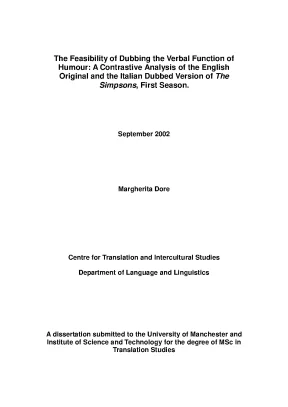
Tải xuống để đọc toàn bộThe Feasibility of Dubbing the Verbal Function of Humour: A Contrastive Analysis of the English Original and the Italian Dubbed Version of The Simpsons, First Season. September 2002 Margherita Dore Centre for Translation and Intercultural Studies Department of Language and Linguistics A dissertation submitted to the University of Manchester and Institute of Science and Technology for the degree of MSc in Translation Studies Declaration No portion of the work referred to in this dissertation has been submitted in support of an application for another degree or qualification of this or any other university or other institution of learning. Acknowledgements I am grateful to my supervisor, Peter Fawcett, for his continuous help and guidance throughout this endeavour. I would like to thank my parents, my sister, my brothers and all my friends for their moral support.
I am also indebted to the government of my region (Sardinia) without whose economic support this experience would not have been possible. Last but not least, special thanks are due to John Robinson whose love and patience (and proof-reading) will never be forgotten. Abstract As a component of human behaviour, humour has received a large amount of interest throughout the centuries from theorists of many different fields of study. In the recent past have theorists in the field of humour research analysed this phenomenon strictly from a linguistic viewpoint (e.: Greimas, Raskin, Attardo) in order to understand the mechanism which creates linguistic humour.
Far less interest has been shown in translation of humour itself. Similarly, given that the audiovisual medium is a relatively recent creation, theorists in its earlier past paid little attention to the role played by translation in this medium. Nevertheless, scholars in the field of translation studies have demonstrated a growing interest in this complex branch of language transfer which, as in translation in general, contributes to the communication between cultures across linguistic boundaries. In this light, this study seeks to highlight the way in which humour can be translated in the audiovisual domain by virtue of the dubbing mode.
In order to do so, it will consider the case of the Italian translation of an American television series: The Simpsons. 1 Chapter I Constraints and Advantages in Dubbing with Particular Reference to the Italian Situation. 2 Dubbing: A Procedural Mixture of Constraints and Advantages. 3 Italy: A Case of Dubbing Tradition.
17 Chapter II Difficult Issues: Theories of Humour and its (Un)Translatability. 3 Semiotic and Text Theories. 4 Script-Based Theory. 5 Theories of Contextual Humour.
6 Violation of Grice's Maxims. 7 Humour and Translation: Possible or Impossible?. 35 Chapter III Humour Categorisation and Translation Strategies. 1 Culture-specific wordplay.
2 A mini-theory of humour translation. 3 Parody, Satire and Irony in Translation. 4 Humour in the Audio-visual Domain. 5 Translating the Perlocutionary Nature of Humour.
54 Chapter IV Data Analysis: The Simpsons, First Season. 4 Combining Verbal and Non-verbal Text. 5 Humour and Grice's maxims of communication. 6 Humorous Register in Dubbing (and Disparagement Theory).
7 Unexpected but Humorous Rhymes. 94 Findings and Concluding Remarks .104 ii Introduction Introduction As a component of human behaviour, humour has received a large amount of interest throughout the centuries from theorists of many different fields of study. Cicero, Freud and Bergson, to name only a few, have tried to explain the reasons for the existence of humour. Their explanations often focused on the psychological reasons which lead humans to produce humorous utterances.
Only in the recent past have scholars in the field of humour research analysed this phenomenon strictly from a linguistic viewpoint. Their studies have shed new light on the mechanism which creates linguistic humour (e.: Greimas, Raskin, Attardo). Far less interest has been shown in translation of humour itself. Similarly, given that the audiovisual medium is a relatively recent creation, theorists in its earlier past paid little attention to role played by translation in this medium.
Nevertheless, scholars in the field of translation studies, which is itself in its infancy, have demonstrated a growing interest in this complex branch of language transfer which, as in translation in general, contributes to the communication between cultures across linguistic boundaries. In this light, this study seeks to highlight the way in which humour can be translated in the audiovisual domain by virtue of the dubbing mode. In order to do so, it will consider the case of the Italian translation of an American television series: The Simpsons. The first chapter presents a survey on the dubbing mode, which starts with an insight into its technical production process.
This underlies the need for team collaboration during the recreation of the verbal text that has to be adjusted in order to match adequately the non-verbal one present in the original audiovisual material, be it a film, a television programme and so on. The process is complex and the result often depends on the level of technical expertise of the whole team. In particular, the ability and creativity of translators and dialogists in the preliminary phases may greatly help the dubbing director and actors to deliver a satisfying performance. The role of the translator should then not be underestimated, as it often is, because it is a fundamental 1 Introduction element in the dubbing process.
In this light, the chapter proceeds to focus on dubbing in Italy, where a long and established tradition has developed its peculiarities such as a tolerant attitude towards lip synchronisation and a tendency to localise the source text during translation, especially when dealing with entertainment material. The second chapter concentrates on humour and the feasibility of its translation. It first discusses some of the recent linguistic theories which mainly agree with the idea that humour is the result of incongruities or oppositions between items present in a text. Then, a discussion on the (un)translatability of humour follows.
This analysis takes into account the opposite orientations of scholars in the field of translation studies and gives ground to the following discussion on the translation methods recently suggested in order to overcome the problems that humour poses in translation. The third chapter outlines the evaluation of the translatability of humorous texts according to the language and culture-specific features which characterise them, be they wordplays, parodies, satirical or ironic remarks. The focus of this chapter then shifts to the particular case of audiovisual translation of humour. In this, other elements come into play and the translator/dialogist has to take them into account.
For example the connection of verbal and visual humour or the references to culture- specific humour or the presence of a live audience and the time pressure under which translators usually work are important factors influencing the final result. The solutions adopted in the case of humour translation are demonstrated to depend on the type of approach adopted. To be sure, the pragmatic functional approach seems to ensure adequate results in humour translation. This means that, in order to allow the text to produce its perlocutionary effect (amusement), the translated text partially overlooks the literary, and sometimes semantic, fidelity to the source text.
The fourth chapter demonstrates the efficacy of the pragmatic functional approach through the analysis of the data collected regarding the first season of the television cartoon comedy The Simpons. The choice of this text depends on both personal and objective reasons. Personal because we are aware of the fact that the enjoyment of The Simpsons and its humour in Italian (I Simpson) overtly depends on the high level of localisation applied to it. Objective reasons are given by this programme world- 2 Introduction wide success and the fact that it has revolutionised the concept of animation.
In fact it combines animation with comedy aimed at an adult audience thus becoming a landmark in this new type of television entertainment. The contrastive analysis carried out on the English original and the Italian dubbed version clearly shows that the Italian dubbing team opted for a high level of source-text manipulation for the sake of its primary function, that is its humour. This has been possible mainly because of the transfer medium used. In fact, dubbing allows the complete removal of the original verbal text, substituting it with a new target one.
It goes without saying that this is impossible in subtitling where the original is retained and its translation is presented written at the bottom of the screen. Finally, we propose a few avenues of future research. 3 Chapter I Constraints and Advantages in Dubbing with Particular Reference to the Italian Situation Chapter I Constraints and Advantages in Dubbing with Particular Reference to the Italian Situation. ‘Language Transfer can be an important means of access to the life-styles, thoughts and creative productions of people from other regions in Europe and elsewhere.
High quality Language Transfer is, therefore, a vital key to better understanding between countries and people in Europe’ (Luyken et al 1991: 28) 1. 1 Introduction Recently, multimedia translation in the field of translation studies has seen a relatively large amount of interest in the translation of films and television programmes. Scholars of translation, such as Marleau (1982) and Delabastita (1989, 1990), discuss a variety of problems associated with audio-visual translation. In particular, they analyse a possible range of constraints related to the most popular ways in which the aforementioned media are transposed from the source language (SL) into the target language (TL): dubbing and subtitling.
The choice of one mode of translation over the other often depends on factors such as the cost of production, the traditions developed by individual countries and the relevance of the source text (ST) within the receiving culture. Similarly, Luyken et al. His empirical investigation reveals that a preference for dubbing increases with age while subtitling is preferred among highly educated audiences (ibid. However, Luyken et al.
point out that the term Language Transfer has to be intended as inclusive of the different types of strategies applied, whether these include subtitling, voice-overs, commentary or dubbing. Each of these processes employs particular techniques aiming to overcome the linguistic barriers posed by the medium itself. Indeed, he crucially points out that: “Any method of Language Transfer will inevitably interfere with the original film or programme. But it should attempt to be as unobtrusive as 4 Chapter I Constraints and Advantages in Dubbing with Particular Reference to the Italian Situation possible so that, ideally, the new viewer's experience of the programme will differ as little as possible from that of the original audience.
Highly professional and competent application of the various methods of Language Transfer, be it subtitling, voice-over or lip-sync dubbing, is therefore essential in order to preserve the original artistic identity of the audiovisual production to the widest possible extent. For whether emotionally supported or rejected, Language Transfer will play an increasingly significant role in the future direction of the television industry and the development of European identity.29) The emphasis on the word ‘ideally’ derives from the fact that the situation portrayed by Luyken et al. can only be described as ideal. More often that not, in fact, the process of Language Transfer faces a large number of constraints forcing translators and dialogists (or scriptwriters in subtitling) to manipulate texts in such a way that they differ greatly from the originals.
However, if the aim of Language Transfer is to allow the target audience to participate in an experience as close as possible to the original, then the means applied might be justified by the scope. Moreover, the translator's high level of expertise will help to overcome the difficulties posed by each audio-visual text. If, on the one hand, translation modes in this field have to cope with specific constraints, on the other, they are able to rely upon peculiar advantages. This multiplicity of constraints and advantages is in fact the result of the very nature of mass communication, which develops through a multi-semiotic channel.
Nội dung được bảo vệ bản quyền — Tải xuống đầy đủ
Trích dẫn luận án này
Margherita Dore (2002). Msc dissertation the feasibility of dubb [Luận án tiến sĩ, University of Manchester and Institute of Science and Technology]. LuanAn.net. https://luanan.net/tai-lieu-khac/msc-dissertation-the-feasibility-of-dubb
Câu hỏi thường gặp
Luận án "Msc dissertation the feasibility of dubb" nghiên cứu về vấn đề gì?
Luận án: Msc dissertation the feasibility of dubb. Xem tóm tắt và tải về tại LuanAn.net
Luận án "Msc dissertation the feasibility of dubb" được bảo vệ tại trường nào?
Luận án này được bảo vệ tại University of Manchester and Institute of Science and Technology. Năm bảo vệ: 2002.
Luận án "Msc dissertation the feasibility of dubb" thuộc chuyên ngành gì?
Luận án "Msc dissertation the feasibility of dubb" thuộc chuyên ngành Translation Studies. Danh mục: Tài liệu khác.
Luận án "Msc dissertation the feasibility of dubb" có bao nhiêu trang?
Luận án "Msc dissertation the feasibility of dubb" có 110 trang. Bạn có thể xem trước một phần tài liệu ngay trên trang web trước khi tải về.
Cách tải luận án "Msc dissertation the feasibility of dubb" về máy như thế nào?
Để tải luận án về máy, bạn nhấn nút "Tải xuống ngay" trên trang này, sau đó hoàn tất thanh toán phí lưu trữ. File sẽ được tải xuống ngay sau khi thanh toán thành công. Hỗ trợ qua Zalo: 0559 297 239.