Modelling of Cement Hydration in Concrete Structures with Hybrid Finite Elements - Pham Tien Cuong
Luận án: Modelling of cement hydration in concrete structures with hybrid finite elements. Xem tóm tắt và tải về tại LuanAn.net
Universidade de Lisboa - Instituto Superior Técnico
Luan An
Luận án tiến sĩ
Năm xuất bản
Số trang
192
Thời gian đọc
29 phút
Lượt xem
0
Lượt tải
0
Phí lưu trữ
50 Point
Tổng quan nhanh
- Chủ đề:
- Phát triển mô hình phần tử hữu hạn lai hydrat hóa
- Số trang:
- 192 trang
- Trường:
- Universidade de Lisboa - Instituto Superior Técnico
- Chuyên ngành:
- Civil Engineering
- Tác giả:
- Pham Tien Cuong
- Năm:
- 2014
Tóm tắt nội dung luận án
I.Phát triển mô hình phần tử hữu hạn lai hydrat hóa
Nghiên cứu tập trung phát triển một công thức phần tử hữu hạn lai. Mục tiêu chính là mô hình hóa quá trình hydrat hóa xi măng trong cấu trúc bê tông. Công thức này dựa trên cách tiếp cận tiên tiến. Nó tạo ra các mô hình toán học của hydrat hóa xi măng một cách hiệu quả. Phương pháp phần tử hữu hạn (FEA) lai cho phép xấp xỉ độc lập các trường vật lý quan trọng. Đây là một bước tiến quan trọng trong lĩnh vực computational models. Nó cung cấp một công cụ chính xác để phân tích cấu trúc bê tông từ giai đoạn đầu. Mô hình được đánh giá kỹ lưỡng về độ hội tụ và tính ổn định. Các thử nghiệm chứng minh hiệu quả của nó với nhiều bài toán chuyển nhiệt. Kết quả cho thấy tính chính xác và độ tin cậy cao của các mathematical models of hydration. Sự độc lập trong xấp xỉ trường giúp tăng cường hiệu suất tính toán. Điều này quan trọng cho các ứng dụng thực tế, đặc biệt khi dự đoán early-age concrete properties. Nó đảm bảo mô hình có thể xử lý hiệu quả các dữ liệu phức tạp.
1.1. Mục tiêu và phương pháp phần tử hữu hạn lai
Nghiên cứu tập trung phát triển một công thức phần tử hữu hạn lai. Mục tiêu chính là mô hình hóa quá trình hydrat hóa xi măng trong cấu trúc bê tông. Công thức này dựa trên cách tiếp cận tiên tiến. Nó tạo ra các mô hình toán học của hydrat hóa xi măng một cách hiệu quả. Phương pháp phần tử hữu hạn (FEA) lai cho phép xấp xỉ độc lập các trường vật lý quan trọng. Đây là một bước tiến quan trọng trong lĩnh vực computational models. Nó cung cấp một công cụ chính xác để phân tích cấu trúc bê tông từ giai đoạn đầu.
1.2. Giải pháp chuyển nhiệt độc lập và mạnh mẽ
Bước đầu tiên phát triển công thức lai cho các bài toán chuyển nhiệt. Nhiệt độ và trường dòng nhiệt được xấp xỉ độc lập trong miền và trên biên của phần tử. Phương pháp này đảm bảo tính mạnh mẽ và hội tụ cao. Nó được kiểm chứng qua các bài toán ổn định và không ổn định, tuyến tính và phi tuyến. Việc này xác nhận khả năng của mô hình giải quyết các thách thức phức tạp. Nó tạo nền tảng vững chắc cho việc hiểu hydration kinetics và sự phát triển microstructure development trong bê tông.
1.3. Đánh giá độ tin cậy mô hình toán học ban đầu
Mô hình được đánh giá kỹ lưỡng về độ hội tụ và tính ổn định. Các thử nghiệm chứng minh hiệu quả của nó với nhiều bài toán chuyển nhiệt. Kết quả cho thấy tính chính xác và độ tin cậy cao của các mathematical models of hydration. Sự độc lập trong xấp xỉ trường giúp tăng cường hiệu suất tính toán. Điều này quan trọng cho các ứng dụng thực tế, đặc biệt khi dự đoán early-age concrete properties. Nó đảm bảo mô hình có thể xử lý hiệu quả các dữ liệu phức tạp.
II.Phân tích nhiệt hóa và truyền ẩm trong bê tông
Mô hình lai được sử dụng để mô phỏng đáp ứng nhiệt-hóa của bê tông xi măng Portland thông thường. Khái niệm mức độ hydrat hóa được áp dụng. Công thức được mở rộng để bao gồm ảnh hưởng của nguồn nhiệt. Nó trực tiếp xấp xỉ trường mức độ hydrat hóa. Điều này cho phép phân tích sâu hơn về hydration kinetics. Nó cung cấp cái nhìn chi tiết về sự phát triển microstructure development. Việc mô phỏng chính xác rất quan trọng cho việc đánh giá early-age concrete properties. Mô hình lai tiếp tục được mở rộng để mô phỏng các quá trình truyền nhiệt và truyền ẩm kết hợp. Hai trường được xấp xỉ trong miền của phần tử: nhiệt độ và độ ẩm tương đối. Hai trường khác được xấp xỉ trên biên: dòng nhiệt và dòng ẩm. Cách tiếp cận này giúp dự đoán thermal stress hiệu quả. Nó hỗ trợ hiểu rõ hơn về shrinkage cracking. Sự kết hợp này là cần thiết để đánh giá toàn diện trạng thái của bê tông. Mô hình này có thể mô phỏng đáp ứng hygro-thermo-hóa của cả bê tông đang cứng và đã cứng. Nó áp dụng cho bê tông cường độ thường và bê tông hiệu năng cao. Việc này cung cấp một công cụ mạnh mẽ để nghiên cứu microstructure development trong suốt vòng đời của bê tông. Nó cũng hỗ trợ các nghiên cứu về early-age concrete properties. Khả năng này rất quan trọng cho durability prediction.
2.1. Mô phỏng đáp ứng nhiệt hóa và mức độ hydrat hóa
Mô hình lai được sử dụng để mô phỏng đáp ứng nhiệt-hóa của bê tông xi măng Portland thông thường. Khái niệm mức độ hydrat hóa được áp dụng. Công thức được mở rộng để bao gồm ảnh hưởng của nguồn nhiệt. Nó trực tiếp xấp xỉ trường mức độ hydrat hóa. Điều này cho phép phân tích sâu hơn về hydration kinetics. Nó cung cấp cái nhìn chi tiết về sự phát triển microstructure development. Việc mô phỏng chính xác rất quan trọng cho việc đánh giá early-age concrete properties.
2.2. Phân tích truyền nhiệt và ẩm song song trong bê tông
Mô hình lai tiếp tục được mở rộng để mô phỏng các quá trình truyền nhiệt và truyền ẩm kết hợp. Hai trường được xấp xỉ trong miền của phần tử: nhiệt độ và độ ẩm tương đối. Hai trường khác được xấp xỉ trên biên: dòng nhiệt và dòng ẩm. Cách tiếp cận này giúp dự đoán thermal stress hiệu quả. Nó hỗ trợ hiểu rõ hơn về shrinkage cracking. Sự kết hợp này là cần thiết để đánh giá toàn diện trạng thái của bê tông.
2.3. Ứng xử hygro thermo hóa bê tông sớm và đã cứng
Mô hình này có thể mô phỏng đáp ứng hygro-thermo-hóa của cả bê tông đang cứng và đã cứng. Nó áp dụng cho bê tông cường độ thường và bê tông hiệu năng cao (HPC). Việc này cung cấp một công cụ mạnh mẽ để nghiên cứu microstructure development trong suốt vòng đời của bê tông. Nó cũng hỗ trợ các nghiên cứu về early-age concrete properties. Khả năng này rất quan trọng cho durability prediction.
III.Mở rộng mô hình cho các phản ứng hóa học phức tạp
Mô hình toán học cơ sở được mở rộng. Nó mô phỏng ảnh hưởng của phản ứng tro xỉ và trùng hợp silicat. Các phản ứng này góp phần vào việc sinh nhiệt và tiêu thụ ẩm. Đây là bước quan trọng để nâng cao độ chính xác của mô hình. Đặc biệt, nó hữu ích cho các loại bê tông hiện đại. Degrees of reactions tương ứng cũng được xấp xỉ trong mô hình phần tử hữu hạn lai. Việc này đảm bảo một cái nhìn toàn diện về material characterization của bê tông. Việc tích hợp các phản ứng bổ sung cho phép mô hình dự đoán chính xác hơn quá trình sinh nhiệt. Nó cũng xác định mức độ tiêu thụ ẩm trong bê tông. Điều này rất quan trọng để quản lý nhiệt độ nội bộ. Nhiệt độ ảnh hưởng trực tiếp đến thermal stress và shrinkage cracking. Hiểu rõ các yếu tố này giúp cải thiện durability prediction. Mô hình cung cấp dữ liệu quan trọng cho thiết kế và thi công. Mô hình mở rộng được thiết kế để áp dụng cho cả bê tông cường độ thường và bê tông hiệu năng cao (HPC). Điều này làm tăng tính linh hoạt của nó. Khả năng mô hình hóa HPC rất quan trọng. HPC thường chứa các vật liệu phụ gia phản ứng cao. Mô hình hỗ trợ nghiên cứu microstructure development trong các loại vật liệu tiên tiến này. Nó giúp dự đoán early-age concrete properties và hành vi lâu dài.
3.1. Tích hợp phản ứng phụ gia tro xỉ và trùng hợp silicat
Mô hình toán học cơ sở được mở rộng. Nó mô phỏng ảnh hưởng của phản ứng tro xỉ và trùng hợp silicat. Các phản ứng này góp phần vào việc sinh nhiệt và tiêu thụ ẩm. Đây là bước quan trọng để nâng cao độ chính xác của mô hình. Đặc biệt, nó hữu ích cho các loại bê tông hiện đại. Degrees of reactions tương ứng cũng được xấp xỉ trong mô hình phần tử hữu hạn lai. Việc này đảm bảo một cái nhìn toàn diện về material characterization của bê tông.
3.2. Ảnh hưởng đến sinh nhiệt và tiêu thụ ẩm bê tông
Việc tích hợp các phản ứng bổ sung cho phép mô hình dự đoán chính xác hơn quá trình sinh nhiệt. Nó cũng xác định mức độ tiêu thụ ẩm trong bê tông. Điều này rất quan trọng để quản lý nhiệt độ nội bộ. Nhiệt độ ảnh hưởng trực tiếp đến thermal stress và shrinkage cracking. Hiểu rõ các yếu tố này giúp cải thiện durability prediction. Mô hình cung cấp dữ liệu quan trọng cho thiết kế và thi công.
3.3. Áp dụng cho bê tông cường độ cao và hiệu năng
Mô hình mở rộng được thiết kế để áp dụng cho cả bê tông cường độ thường và bê tông hiệu năng cao (HPC). Điều này làm tăng tính linh hoạt của nó. Khả năng mô hình hóa HPC rất quan trọng. HPC thường chứa các vật liệu phụ gia phản ứng cao. Mô hình hỗ trợ nghiên cứu microstructure development trong các loại vật liệu tiên tiến này. Nó giúp dự đoán early-age concrete properties và hành vi lâu dài.
IV.Tối ưu hóa tính toán hiệu suất mô hình lai FE
Mô hình duy trì các ưu điểm tính toán của công thức phần tử hữu hạn lai. Cơ sở xấp xỉ là trực giao và phân cấp tự nhiên. Điều này tạo ra chỉ số thưa thớt cao trong hệ thống. Nó cho phép p-refinement thích ứng một cách hiệu quả. Việc này tối ưu hóa tài nguyên tính toán. Nó cải thiện tốc độ và hiệu quả của các computational models. Cấu trúc này cũng hỗ trợ việc phân tích chi tiết microstructure development. Hệ thống giải không được cô đọng ở cấp độ phần tử. Điều này tăng cường khả năng xử lý song song. Việc xấp xỉ các biến trạng thái và hình học không bị ghép nối. Nó cho phép sử dụng lưới không cấu trúc, thô với các phần tử bậc cao. Cách tiếp cận này giúp giảm thời gian tính toán. Nó đồng thời duy trì độ chính xác cao trong finite element analysis (FEA). Xấp xỉ các biến trạng thái cũng được tách biệt theo hướng trong không gian. Điều này giúp triển khai các phần tử có tỉ lệ khung hình cao. Các phần tử này thường cần thiết trong mô phỏng thi công theo giai đoạn của cấu trúc bê tông. Đặc điểm này hỗ trợ giải quyết các vấn đề phức tạp. Nó cải thiện khả năng mô hình hóa thermal stress và shrinkage cracking trong các cấu trúc lớn.
4.1. Cấu trúc cơ sở xấp xỉ phân cấp thưa thớt
Mô hình duy trì các ưu điểm tính toán của công thức phần tử hữu hạn lai. Cơ sở xấp xỉ là trực giao và phân cấp tự nhiên. Điều này tạo ra chỉ số thưa thớt cao trong hệ thống. Nó cho phép p-refinement thích ứng một cách hiệu quả. Việc này tối ưu hóa tài nguyên tính toán. Nó cải thiện tốc độ và hiệu quả của các computational models. Cấu trúc này cũng hỗ trợ việc phân tích chi tiết microstructure development.
4.2. Tăng cường xử lý song song lưới phần tử không cấu trúc
Hệ thống giải không được cô đọng ở cấp độ phần tử. Điều này tăng cường khả năng xử lý song song. Việc xấp xỉ các biến trạng thái và hình học không bị ghép nối. Nó cho phép sử dụng lưới không cấu trúc, thô với các phần tử bậc cao. Cách tiếp cận này giúp giảm thời gian tính toán. Nó đồng thời duy trì độ chính xác cao trong finite element analysis (FEA).
4.3. Xấp xỉ biến trạng thái độc lập tỉ lệ khung hình cao
Xấp xỉ các biến trạng thái cũng được tách biệt theo hướng trong không gian. Điều này giúp triển khai các phần tử có tỉ lệ khung hình cao. Các phần tử này thường cần thiết trong mô phỏng thi công theo giai đoạn của cấu trúc bê tông. Đặc điểm này hỗ trợ giải quyết các vấn đề phức tạp. Nó cải thiện khả năng mô hình hóa thermal stress và shrinkage cracking trong các cấu trúc lớn.
V.Xác thực ứng dụng thực tế mô hình hydrat hóa xi măng
Đặc biệt chú ý đến mô phỏng các điều kiện biên. Các điều kiện này thường xuất hiện trong ứng dụng thực tế. Chúng thường phi tuyến và thay đổi theo thời gian, không gian. Việc xử lý chính xác các điều kiện này là rất quan trọng. Nó đảm bảo tính chân thực của computational models. Điều này cần thiết để dự đoán chính xác early-age concrete properties. Hiệu suất của công thức được đánh giá kỹ lưỡng. Nó dựa trên các thí nghiệm trong phòng thí nghiệm và thử nghiệm tại chỗ. Các thí nghiệm này được báo cáo trong tài liệu. Các thử nghiệm bao gồm các vấn đề một và hai chiều. Nó cũng bao gồm các ứng dụng đối xứng trục và ba chiều. Điều này xác nhận độ tin cậy của mathematical models of hydration. Nó cũng đảm bảo khả năng của mô hình trong durability prediction. Mô hình có thể được sử dụng để dự đoán nhiều tính chất của bê tông. Bao gồm early-age concrete properties như nhiệt độ và độ ẩm. Nó cũng hữu ích trong việc đánh giá thermal stress và shrinkage cracking. Điều này có ý nghĩa quan trọng trong thiết kế. Nó giúp tối ưu hóa thi công các cấu trúc bê tông. Mô hình đóng góp vào việc hiểu rõ hơn về material characterization.
5.1. Xử lý điều kiện biên phi tuyến trong thực tế
Đặc biệt chú ý đến mô phỏng các điều kiện biên. Các điều kiện này thường xuất hiện trong ứng dụng thực tế. Chúng thường phi tuyến và thay đổi theo thời gian, không gian. Việc xử lý chính xác các điều kiện này là rất quan trọng. Nó đảm bảo tính chân thực của computational models. Điều này cần thiết để dự đoán chính xác early-age concrete properties.
5.2. Đánh giá hiệu năng bằng thí nghiệm thực địa và phòng lab
Hiệu suất của công thức được đánh giá kỹ lưỡng. Nó dựa trên các thí nghiệm trong phòng thí nghiệm và thử nghiệm tại chỗ. Các thí nghiệm này được báo cáo trong tài liệu. Các thử nghiệm bao gồm các vấn đề một và hai chiều. Nó cũng bao gồm các ứng dụng đối xứng trục và ba chiều. Điều này xác nhận độ tin cậy của mathematical models of hydration. Nó cũng đảm bảo khả năng của mô hình trong durability prediction.
5.3. Ứng dụng dự đoán tính chất sớm và lâu dài bê tông
Mô hình có thể được sử dụng để dự đoán nhiều tính chất của bê tông. Bao gồm early-age concrete properties như nhiệt độ và độ ẩm. Nó cũng hữu ích trong việc đánh giá thermal stress và shrinkage cracking. Điều này có ý nghĩa quan trọng trong thiết kế. Nó giúp tối ưu hóa thi công các cấu trúc bê tông. Mô hình đóng góp vào việc hiểu rõ hơn về material characterization.
Tải xuống file đầy đủ để xem toàn bộ nội dung
Tải đầy đủ (192 trang)Trích đoạn nội dung luận án
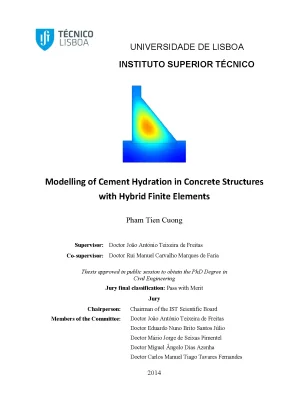
Tải xuống để đọc toàn bộUNIVERSIDADE DE LISBOA INSTITUTO SUPERIOR TÉCNICO Modelling of Cement Hydration in Concrete Structures with Hybrid Finite Elements Pham Tien Cuong Supervisor: Doctor João António Teixeira de Freitas Co-supervisor: Doctor Rui Manuel Carvalho Marques de Faria Thesis approved in public session to obtain the PhD Degree in Civil Engineering Jury final classification: Pass with Merit Jury Chairperson: Chairman of the IST Scientific Board Members of the Committee: Doctor João António Teixeira de Freitas Doctor Eduardo Nuno Brito Santos Júlio Doctor Mário Jorge de Seixas Pimentel Doctor Miguel Ângelo Dias Azenha Doctor Carlos Manuel Tiago Tavares Fernandes 2014 UNIVERSIDADE DE LISBOA INSTITUTO SUPERIOR TÉCNICO Modelling of Cement Hydration in Concrete Structures with Hybrid Finite Elements Pham Tien Cuong Supervisor: Doctor João António Teixeira de Freitas Co-supervisor: Doctor Rui Manuel Carvalho Marques de Faria Thesis approved in public session to obtain the PhD Degree in Civil Engineering Jury final classification: Pass with Merit Jury Chairperson: Chairman of the IST Scientific Board Members of the Committee: Doctor João António Teixeira de Freitas Professor Catedrático do Instituto Superior Técnico, da Universidade de Lisboa Doctor Eduardo Nuno Brito Santos Júlio Professor Catedrático do Instituto Superior Técnico, da Universidade de Lisboa Doctor Mário Jorge de Seixas Pimentel Professor Auxiliar da Faculdade de Engenharia, da Universidade do Porto Doctor Miguel Ângelo Dias Azenha Professor Auxiliar da Escola de Engenharia, da Universidade do Minho Doctor Carlos Manuel Tiago Tavares Fernandes Professor Auxiliar do Instituto Superior Técnico, da Universidade de Lisboa Funding institutions Fundação para a Ciência e a Tecnologia (FCT), Grant reference number: SFRH/BD/76632/2011 2014 Abstract The main objective of this work is to develop a hybrid finite element formulation to model cement hydration in concrete structures. First, a hybrid formulation of the finite element method is developed for the solution of heat transfer problems. It is based on the independent approximation of the temperature and heat flux fields in the domain and on the boundary of the element, respectively. The formulation is assessed in terms of convergence and robustness, and is validated using linear and nonlinear steady-state and transient test problems.
Second, the hybrid model is used to simulate the thermo-chemical response of ordinary Portland cement concrete using the hydration degree concept. The hybrid formulation is extended to include the simulation of the effect of the heat source and to approximate directly the hydration degree field. Third, the hybrid model is extended to simulate the coupled processes of heat transfer and moisture transport in concrete. Two fields are approximated in the domain of the element (temperature and relative humidity) and on the boundaries (heat and moisture fluxes).
The model can be used to simulate the hygro-thermo-chemical response of both hardening and hardened concrete and is valid for normal strength concrete and high-performance concrete. Therefore, and besides the hydration reaction, the supporting mathematical model is extended to simulate the effects of the silica fume reaction and silicate polymerization in heat generation and in moisture consumption. The corresponding degrees of reactions are also approximated in the hybrid finite element model. Particular attention is paid to the simulation of the boundary conditions that occur in practical applications, which are typically nonlinear and vary in time and in space.
This is essential to assess the performance of the formulation using laboratory experiments and in situ tests reported in the literature. These tests include one- and two-dimensional problems, as well as axisymmetric and three-dimensional applications. Special attention is also paid to preserving the computational advantages offered by hybrid finite element formulations. The approximation bases are orthogonal and naturally hierarchical, to induce high sparsity indices and enable adaptive p-refinement.
The solving system is not condensed at element level to enhance parallel processing. The approximations of the state variables and of the geometry are uncoupled to enable the use of unstructured, coarse meshes of high-degree elements. Approximation of the state variables is also uncoupled directionally in space to implement elements with high aspect ratios, frequently needed in the simulation of staged construction of concrete structures. Keywords: Cement hydration; Heat transfer; Moisture transport; Normal strength concrete; High-performance concrete; Hybrid finite elements.
iii Resumo O objectivo central deste trabalho é desenvolver uma formulação híbrida do método dos elementos finitos para simular a hidratação do cimento em estruturas de betão. Começa-se por desenvolver uma formulação híbrida para problemas de transferência de calor, a qual é baseada na aproximação independente da temperatura no domínio do elemento e do fluxo de calor nas fronteiras. O desempenho da formulação é avaliado em termos de convergência e robustez, sendo validado recorrendo a problemas em regime estacionário e transitório, lineares e não-lineares. A formulação é depois aplicada à simulação da hidratação do cimento Portland em betões de resistência normal.
A reacção e a fonte de calor associada ao processo termo-químico são descritas usando o conceito de grau de hidratação, sendo esse campo também directamente aproximado na formulação por elementos finitos híbridos. Seguidamente procede-se à generalização da formulação para simular o acoplamento dos processos de transferência de calor e de transporte de humidade. O modelo utilizado pode ser usado para simular o comportamento higro-termo-químico do betão nas diferentes fases de hidratação e de endurecimento, e é também válido para betões de alto desempenho, pois a formulação desenvolvida contempla as reacções de fumo de sílica e de polimerização dos silicatos. Os correspondentes graus de reacção são também directamente aproximados na formulação híbrida desenvolvida.
A formulação é validada recorrendo aos resultados publicados sobre testes laboratoriais e ensaios in situ de provetes e estruturas de betão. Dá-se, por isso, particular atenção à adequada simulação das condições de fronteira que ocorrem nos ensaios simulados numericamente, as quais são frequentemente não-lineares e variáveis no espaço e no tempo. Os testes de validação cobrem problemas unidimensionais, planos, axi-simétricos e tridimensionais. Procura-se, também, conceber e implementar a formulação preservando as vantagens computacionais inerentes às variantes híbridas do método dos elementos finitos.
As bases de aproximação são ortogonais e naturalmente hierárquicas, por forma a obter sistemas resolventes com elevados índices de esparsidade e facilitar a aplicação de processos de refinamento adaptativos. O sistema resolvente não é condensado a nível do elemento, a fim de potenciar a solução em processamento paralelo. A aproximação das variáveis de estado é desacoplada da aproximação da geometria, para permitir o uso de malhas não estruturadas envolvendo relativamente poucos elementos mas com elevado grau de aproximação. A aproximação das variáveis de estado é também desacoplada direccionalmente, para permitir a utilização de elementos com relações de dimensões características muito elevadas, cuja utilização é muito útil na simulação do processo construtivo de estruturas de betão.
Palavras-chave: Hidratação do cimento; Transferência de calor; Transporte de humidade; Betão de resistência normal; Betão de alto desempenho; Elementos finitos híbridos. v Acknowledgements The work done in this thesis would not have been possible without the help and contribution of many people. I would like to express my deep gratitude to all of them. First, I would like to express my deepest gratitude to my supervisor, Prof.
João António Teixeira de Freitas for giving me the opportunity to do a PhD at Departamento de Engenharia Civil, Arquitectura e Georecursos (DECivil) with his great scientific guidance, advice, and invaluable support throughout my PhD period. He did his best to clarify my understanding of the non-conventional formulations of finite elements which were new to me. His scientific knowledge contributed to this thesis in many ways. He was always to help me solve not only problems in my work but also any difficulties during my stay in Portugal.
Furthermore, he always received me with sympathy for the long period of my stay. I admire him for his profound knowledge, experience and his passion for research. I will always be grateful for the lessons that I learned from our discussions. Finally, I would like to thank him for the friendship that we have developed.
I express my sincerest gratitude to my co-supervisor Prof. Rui Manuel Carvalho Marques de Faria from the University of Porto for all his advice, support, guidance and special contribution for this thesis. He always received me warmly whenever we had meetings in Porto and he suggested many good ideas in our discussions. I would like to express my thanks to the Departamento de Engenharia Civil, Arquitectura e Georecursos where I pursued my doctoral degree and to the Portuguese Foundation for Science and Technology (FCT) for their financial support through R&D project PTDC/ECM/70781/2006 launched at IST and research contract SFRH/BD/76632/2011.
My thanks are also extended to “O Núcleo de Pós-Graduação e Formação Contínua” for their kind help for my PhD’s procedure at IST. I would like to thank all the staff and professors of the Structural Mechanics and Structures Section, especially Maria da Conceição Melo, Paula Cristina, Prof. Moitinho de Almeida, Prof. Luís Castro, Prof.
Orlando Pereira and Prof. Eduardo Júlio for all their assistance and support. My special thanks are conveyed to Prof. Carlos Manuel Tiago Tavares Fernandes, from whom I received great help, support and encouragement as well as for the many daily talks about many aspects of life that we had, in particular, cycling and football discussions.
I sincerely wish to thank Prof. João José Rio Tinto de Azevedo and his aunt, Ms. Maria Tinto for letting me stay in her apartment without paying during my last year of my PhD. I want to take this opportunity to thank Prof.
Miguel Ângelo Dias Azenha from the School of Engineering of the University of Minho. He never hesitated to share his scientific expertise, particularly in early-age concrete behaviour. Additionally, he gave me many good comments and suggestions, as well as many test data used in this work. vii Acknowledgements viii I would also like to thank Prof.
Giovanni Di Luzio at Department of Structural Engineering, Politecnico di Milano, Italy, for his kind help with many discussions about the mathematical model of moisture as well as the data used in this thesis. I gratefully acknowledge Maria Cristina (my supervisor’s wife) for her kindness, encouragement as well as her regular and kind regards to my family in Vietnam. I would like to thank her for the close friendship that we have built. My thanks also go to my colleagues at DECivil: Cristina Lopez, Vasco Mano, Júlio Pargana and Maria José.
I will always remember the fun moments we had together. My particular gratitude to Luís Mendes, my office mate, who helped me a lot, namely with Matlab programing, and we also had a lot of fun during the first two years of my PhD. I express many thanks to another office mate, Vladimir Ivannikov, a Russian PhD student who shared with me many types of fun for almost three years and half, such as watching together many games of European football cups, going to watch the games in Estádio da Luz, the home of the Benfica team, and travelling. I have also spent many great moments with Vietnamese friends, who were studying and working in Lisbon: Hoàng Văn Xiêm, Trần Nguyễn Nguyên Khôi, Lê Hồng Trang, Hàn Thế Anh, Đinh Thanh Giang, Trần Thế Hùng, Nguyễn Thành Trung, Nguyễn Hà Anh Tuấn, Nguyễn Hoàng Sơn and Prof.
Phan Thành An. Thank you all for sharing a good time with me during my stay in Lisbon. My thanks also go to other friends: Diego Felix de Souza, Sanchit Singh, Mauricio Ramalho, Suresh, Dhiraj K. Shah, Berner Panti and João Matos Cardoso for the great times of relaxing and travelling during my stay in Portugal, especially with all the funny things they did that I cannot forget.
Furthermore, I am particularly grateful to my close friend, Cao Đức Toàn, without whose help I may not have been to Lisbon. I would like to thank my mother, mother-in-law, sisters, brothers, sisters-in-law and brothers- in-law, who encouraged, motivated and supported me throughout my years of study. They admire me and I deeply love them. Finally, my most special words are for my wife, Lê Thị Tuyết Chinh and my son, Phạm Gia Hoàng, for having me in their hearts.
Nothing could have been possible without their love, encouragement and patience.
Nội dung được bảo vệ bản quyền — Tải xuống đầy đủ
Trích dẫn luận án này
Pham Tien Cuong (2014). Modelling Cement Hydration in Concrete Structures [Luận án tiến sĩ, Universidade de Lisboa - Instituto Superior Técnico]. LuanAn.net. https://luanan.net/tai-lieu-khac/modelling-cement-hydration-in-concrete-structures
Câu hỏi thường gặp
Luận án "Modelling Cement Hydration in Concrete Structures" nghiên cứu về vấn đề gì?
Luận án: Modelling of cement hydration in concrete structures with hybrid finite elements. Xem tóm tắt và tải về tại LuanAn.net
Luận án "Modelling Cement Hydration in Concrete Structures" được bảo vệ tại trường nào?
Luận án này được bảo vệ tại Universidade de Lisboa - Instituto Superior Técnico. Năm bảo vệ: 2014.
Luận án "Modelling Cement Hydration in Concrete Structures" thuộc chuyên ngành gì?
Luận án "Modelling Cement Hydration in Concrete Structures" thuộc chuyên ngành Civil Engineering. Danh mục: Tài liệu khác.
Luận án "Modelling Cement Hydration in Concrete Structures" có bao nhiêu trang?
Luận án "Modelling Cement Hydration in Concrete Structures" có 192 trang. Bạn có thể xem trước một phần tài liệu ngay trên trang web trước khi tải về.
Cách tải luận án "Modelling Cement Hydration in Concrete Structures" về máy như thế nào?
Để tải luận án về máy, bạn nhấn nút "Tải xuống ngay" trên trang này, sau đó hoàn tất thanh toán phí lưu trữ. File sẽ được tải xuống ngay sau khi thanh toán thành công. Hỗ trợ qua Zalo: 0559 297 239.