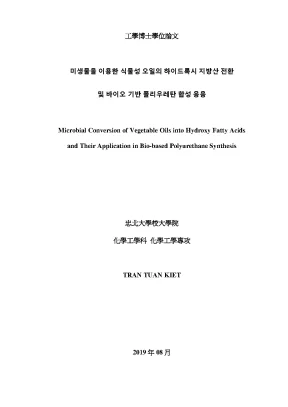
PhD Thesis on Microbial Conversion of Vegetable Oils to Hydroxy Fatty Acids and Bio-based Polyurethanes by Tran Tuan Kiet, Chungbuk National University
Nghiên cứu chuyển đổi dầu thực vật thành axit béo hydroxy bằng vi khuẩn và ứng dụng trong tổng hợp polyurethane sinh học.
Chungbuk National University
Luan An
Luận án tiến sĩ
Năm xuất bản
Số trang
146
Thời gian đọc
22 phút
Lượt xem
0
Lượt tải
0
Phí lưu trữ
40 Point
Tổng quan nhanh
- Chủ đề:
- 1. Microbial Conversion of Vegetable Oils for HFAs
- Số trang:
- 146 trang
- Trường:
- Chungbuk National University
- Chuyên ngành:
- Chemical Engineering
- Tác giả:
- Tran Tuan Kiet
- Năm:
- 2019
Tóm tắt nội dung luận án
I. Microbial Conversion of Vegetable Oils for HFAs
Sản xuất axit béo hydroxy (HFAs) từ dầu thực vật thông qua chuyển đổi vi sinh vật mang lại giải pháp bền vững. Phương pháp này tránh hóa chất khắc nghiệt. HFAs là các hợp chất oleochemicals giá trị. Chúng đóng vai trò quan trọng trong ngành công nghiệp hóa học xanh. Nghiên cứu này tập trung vào việc chuyển đổi dầu olive và dầu thầu dầu. Mục tiêu là tạo ra các loại HFAs cụ thể. Công nghệ sinh học cung cấp con đường thân thiện với môi trường. Nó thay thế các quy trình hóa học truyền thống. Sự lựa chọn vi sinh vật và tối ưu hóa điều kiện là rất quan trọng. Điều này đảm bảo hiệu quả và sản lượng cao. Các HFA thu được có tiềm năng ứng dụng rộng lớn. Chúng đặc biệt hữu ích trong tổng hợp polyme sinh học.
1.1. Bioconversion Processes for Hydroxy Fatty Acids
Chuyển đổi sinh học sử dụng vi sinh vật để đưa nhóm hydroxyl vào chuỗi axit béo. Quá trình này được gọi là hydroxylation axit béo. Nó mang lại hiệu suất chọn lọc cao. Vi sinh vật như Pseudomonas aeruginosa đã được chứng minh là hiệu quả. Chúng xúc tác phản ứng hydroxyl hóa một cách tự nhiên. Phương pháp sinh học giúp giảm thiểu chất thải độc hại. Nó hỗ trợ các nguyên tắc hóa học xanh. Việc hiểu cơ chế chuyển đổi sinh học là thiết yếu. Điều này giúp tối ưu hóa sản xuất HFAs. Đây là một bước tiến quan trọng trong việc tạo ra biopolyols bền vững.
1.2. Olive Oil Transformation to Dihydroxy Fatty Acid
Nghiên cứu chuyển đổi dầu olive thành 7,10-dihydroxy-8(E)-octadecenoic acid (DOD). Đây là một HFA có giá trị. Quá trình sử dụng vi sinh vật được tối ưu hóa. Sản lượng DOD cao được mong đợi. DOD là tiền chất quan trọng cho polyurethanes sinh học. Nó có hai nhóm hydroxyl. Các nhóm này cung cấp điểm phản ứng cho quá trình trùng hợp. Việc sản xuất DOD từ nguồn tài nguyên tái tạo như dầu olive góp phần vào nền kinh tế sinh học tuần hoàn. Phương pháp này thể hiện tiềm năng của bioconversion trong việc tạo ra hóa chất đặc biệt.
1.3. Castor Oil Conversion to Trihydroxy Fatty Acid
Dầu thầu dầu là một nguồn tài nguyên tự nhiên giàu axit ricinoleic. Nghiên cứu này khám phá sự chuyển đổi dầu thầu dầu thành 7,10,12-trihydroxy-8(E)-octadecenoic acid (TOD). TOD là một HFA với ba nhóm hydroxyl. Số lượng nhóm hydroxyl tăng cường tính đa chức năng. Điều này làm cho TOD trở thành biopolyol lý tưởng hơn. Nó có thể tạo ra polyurethanes có tính chất vượt trội. Quá trình bioconversion được kiểm soát cẩn thận. Mục tiêu là tối đa hóa hiệu quả chuyển đổi và độ tinh khiết sản phẩm. Việc sản xuất TOD mở rộng phạm vi ứng dụng của HFAs.
II. Hydroxy Fatty Acids Building Blocks for Polymers
Hydroxy fatty acids (HFAs) là thành phần cơ bản trong việc phát triển polyme bền vững. Cấu trúc độc đáo của chúng bao gồm một hoặc nhiều nhóm hydroxyl. Các nhóm này là vị trí phản ứng chủ yếu. Chúng cho phép HFAs hoạt động như biopolyols. Các biopolyols này có thể thay thế polyols có nguồn gốc hóa dầu. Chúng thúc đẩy green chemistry. HFAs cung cấp các đặc tính mong muốn cho vật liệu mới. Điều này bao gồm khả năng phân hủy sinh học và tính tương thích sinh học. Vai trò của chúng vượt ra ngoài polyurethanes. Nghiên cứu tập trung vào DOD và TOD. Chúng đại diện cho các oleochemicals có tiềm năng lớn.
2.1. Importance of HFAs in Sustainable Chemistry
HFAs đóng vai trò quan trọng trong việc chuyển đổi sang hóa học bền vững. Chúng là các hợp chất có thể tái tạo. Việc sử dụng chúng giúp giảm sự phụ thuộc vào nguyên liệu hóa thạch. HFAs cung cấp nền tảng cho biopolyols. Các biopolyols này là thành phần chính của các polyme sinh học. Hóa học xanh được thúc đẩy thông qua các quy trình sản xuất thân thiện với môi trường. Các quy trình này tạo ra HFAs. Nhu cầu về vật liệu bền vững đang tăng lên. HFAs là giải pháp hấp dẫn. Chúng góp phần vào một tương lai ít carbon.
2.2. Structural Characteristics of Novel HFAs
DOD và TOD là hai HFA mới được nghiên cứu. DOD có hai nhóm hydroxyl. TOD có ba nhóm hydroxyl. Các nhóm hydroxyl này là chìa khóa cho phản ứng trùng hợp. Chúng tạo liên kết với các isocyanate. Vị trí và số lượng nhóm hydroxyl ảnh hưởng đến tính chất của polyme cuối cùng. Cấu trúc chưa bão hòa của chúng cũng có thể được tận dụng. Điều này cho phép các phản ứng hóa học khác. Hiểu rõ cấu trúc là cần thiết. Nó giúp thiết kế các vật liệu polymer với hiệu suất tùy chỉnh.
2.3. Applications of HFAs Beyond Polyurethanes
Mặc dù polyurethanes là trọng tâm chính, HFAs có nhiều ứng dụng khác. Chúng có thể được sử dụng trong chất bôi trơn sinh học. Chúng cũng là thành phần trong mỹ phẩm. HFAs có tiềm năng trong sản xuất chất hoạt động bề mặt. Chúng được dùng trong chất tẩy rửa. Tính đa năng này đến từ tính chất lưỡng cực của HFAs. Chúng có đầu ưa nước và kỵ nước. Các ứng dụng này nhấn mạnh giá trị của HFAs. Chúng là các oleochemicals sinh học đa chức năng. Việc khám phá các ứng dụng mới tiếp tục mở rộng thị trường cho các vật liệu này.
III. Bio based Polyurethanes from Sustainable Biopolyols
Polyurethane sinh học là một loại polymer bền vững. Chúng được tổng hợp từ HFAs có nguồn gốc vi sinh vật. Nghiên cứu này chứng minh tính khả thi của việc sử dụng DOD và TOD làm biopolyols chính. Chúng thay thế các polyols từ hóa dầu. Quá trình tổng hợp bao gồm phản ứng giữa HFAs và diisocyanates. Các vật liệu kết quả thể hiện các tính chất cơ học và nhiệt mong muốn. Điều này mở đường cho các ứng dụng đa dạng. Phát triển polyurethanes sinh học là một bước quan trọng. Nó hướng tới ngành công nghiệp polyme thân thiện với môi trường. Các biopolyols này cung cấp một lựa chọn bền vững.
3.1. Synthesis of Polyurethanes with Microbially Derived HFAs
Polyurethanes được tổng hợp bằng cách sử dụng DOD và TOD. Các HFA này hoạt động như các biopolyols. Phản ứng chính là giữa nhóm hydroxyl của HFA và nhóm isocyanate. Các liên kết urethane được hình thành. Quá trình này được thực hiện trong điều kiện được kiểm soát. Mục tiêu là đạt được trọng lượng phân tử và cấu trúc mong muốn. Polyurethanes gốc DOD (PU-DOD) và gốc TOD (PU-TOD) được tạo ra. Khả năng phản ứng của các nhóm hydroxyl là rất quan trọng. Nó ảnh hưởng đến động học trùng hợp và tính chất sản phẩm cuối cùng.
3.2. Enhancing PU Properties with HFA Blends
Để cải thiện tính chất của polyurethanes, HFAs được pha trộn. Các chất pha trộn như PEG (polyethylene glycol) hoặc PCLDO (polycaprolactone diol) được sử dụng. Việc pha trộn cho phép điều chỉnh các đặc tính. Điều này bao gồm độ cứng, độ bền kéo và khả năng chịu nhiệt. Polyurethanes pha trộn (PU-DOD/PEG, PU-TOD/PCLDO) thể hiện các tính chất cơ học đa dạng. Chúng có thể tạo ra bọt polyurethane cứng hoặc mềm. Việc kiểm soát thành phần pha trộn là rất quan trọng. Điều này giúp tùy chỉnh vật liệu cho các ứng dụng cụ thể.
3.3. Thermal and Mechanical Characterization of Biopolymers
Các polyurethanes sinh học mới được tổng hợp được đặc trưng kỹ lưỡng. Các kỹ thuật bao gồm DSC (nhiệt lượng kế quét vi sai) và TGA (phân tích nhiệt trọng lượng) được sử dụng. Chúng đánh giá tính chất nhiệt. NMR (cộng hưởng từ hạt nhân) và FTIR (quang phổ hồng ngoại biến đổi Fourier) xác nhận cấu trúc hóa học. Các thử nghiệm cơ học đo độ bền và độ cứng. Kết quả cung cấp cái nhìn sâu sắc về hiệu suất của polyme. Dữ liệu này rất quan trọng để xác nhận DOD và TOD là biopolyols khả thi. Chúng có thể thay thế polyols hóa dầu trong các ứng dụng công nghiệp.
IV. Optimizing HFA Production via Bioconversion Methods
Nghiên cứu tập trung vào việc tối ưu hóa sản xuất HFA. Đặc biệt là DOD từ axit oleic. Phương pháp cell-free synthesis (tổng hợp không tế bào) được khám phá. Kỹ thuật này nâng cao hiệu quả và kiểm soát quá trình. Tối ưu hóa các điều kiện nuôi cấy và phản ứng là cần thiết. Điều này nhằm đạt được sản lượng cao và độ tinh khiết sản phẩm. Các yếu tố như nguồn carbon, nguồn nitơ, nồng độ axit oleic, pH và nhiệt độ được đánh giá. Mục tiêu là phát triển một quy trình bền vững. Quy trình này có thể áp dụng cho sản xuất quy mô lớn các oleochemicals có giá trị.
4.1. Cell free Synthesis for Enhanced HFA Yields
Phương pháp cell-free synthesis là một cách tiếp cận tiên tiến. Nó cho phép sản xuất DOD bên ngoài tế bào sống. Phương pháp này loại bỏ các hạn chế của chuyển hóa tế bào. Nó có thể đạt được hiệu suất cao hơn và thời gian phản ứng nhanh hơn. Điều này giảm thiểu sự hình thành sản phẩm phụ. Quá trình kiểm soát được tăng cường. Tổng hợp không tế bào mang lại tiềm năng đáng kể. Nó giúp sản xuất HFAs và các oleochemicals khác một cách hiệu quả và bền vững.
4.2. Factors Influencing Oleic Acid Conversion to DOD
Nhiều yếu tố ảnh hưởng đến quá trình chuyển đổi axit oleic thành DOD. Thời gian tiền nuôi cấy của tế bào vi sinh vật ảnh hưởng đến hoạt động của enzyme. Các nguồn carbon và nitơ tối ưu hóa sự phát triển và biểu hiện enzyme. Nồng độ axit oleic ảnh hưởng đến động học phản ứng. Giá trị pH và nhiệt độ ủ kiểm soát hoạt động của enzyme. Việc xác định các điều kiện tối ưu là rất quan trọng. Nó giúp tối đa hóa sản lượng DOD và hiệu quả quy trình trong hệ thống không tế bào.
4.3. Advancing Fatty Acid Hydroxylation Efficiency
Việc tối ưu hóa quá trình hydroxylation axit béo là cần thiết. Nó giúp đạt được hiệu quả cao hơn. Điều này bao gồm cả phương pháp dựa trên tế bào và không tế bào. Các cải tiến trong hoạt động của enzyme được mong đợi. Việc tìm kiếm các enzyme mới hoặc kỹ thuật protein engineering cũng có thể hữu ích. Nâng cao hiệu quả là chìa khóa. Nó giúp giảm chi phí sản xuất. Đồng thời, nó tăng khả năng cạnh tranh của HFAs sinh học. Mục tiêu là thúc đẩy việc áp dụng các oleochemicals bền vững trong công nghiệp.
V. Future Prospects in Green Chemistry and Biopolymers
Nghiên cứu này mở ra nhiều triển vọng cho hóa học xanh và polyme sinh học. Việc sản xuất HFAs từ dầu thực vật là một bước tiến đáng kể. Nó hướng tới các vật liệu bền vững. Tiềm năng ứng dụng của các biopolyols này là rất lớn. Chúng có thể thay thế các vật liệu hóa dầu truyền thống. Tuy nhiên, vẫn còn những thách thức về quy mô và thương mại hóa. Phát triển các kỹ thuật chuyển đổi sinh học tiên tiến là cần thiết. Điều này sẽ củng cố tương lai của các oleochemicals và biopolyme. Nghiên cứu tiếp theo sẽ tập trung vào việc mở rộng danh mục dầu thực vật được sử dụng.
5.1. Impact on Sustainable Polymer Development
Phát triển HFAs từ nguồn gốc sinh học có tác động lớn. Nó thúc đẩy các polyme bền vững. Việc thay thế polyols hóa dầu bằng biopolyols giúp giảm lượng khí thải carbon. Nó cũng giảm chất thải môi trường. Các polyurethanes sinh học thể hiện tiềm năng giảm thiểu ô nhiễm. Chúng hỗ trợ nền kinh tế tuần hoàn. Việc đầu tư vào nghiên cứu và phát triển này là cần thiết. Nó giúp tạo ra một tương lai xanh hơn cho ngành công nghiệp polyme.
5.2. Scalability and Commercialization Challenges for HFAs
Mặc dù có nhiều hứa hẹn, việc mở rộng sản xuất HFA đối mặt với thách thức. Sản xuất quy mô lớn đòi hỏi các quy trình hiệu quả và kinh tế. Chi phí sản xuất hiện tại có thể cao hơn hóa dầu. Cần có các cải tiến trong kỹ thuật bioconversion. Việc tối ưu hóa hiệu suất và chi phí là rất quan trọng. Điều này sẽ giúp HFAs cạnh tranh trên thị trường. Việc hợp tác giữa các nhà nghiên cứu và công nghiệp là cần thiết. Nó giúp đưa các sản phẩm này ra thị trường rộng rãi.
5.3. Expanding the Scope of Bio based Oleochemicals
Phạm vi các oleochemicals sinh học có thể được mở rộng. Điều này bao gồm khám phá các loại dầu thực vật khác. Nó cũng bao gồm phát triển các HFAs mới với các cấu trúc khác nhau. Việc tận dụng sự đa dạng của sinh khối là tiềm năng lớn. Nó có thể tạo ra nhiều sản phẩm hóa học có giá trị hơn. Việc tiếp tục nghiên cứu các enzyme mới và chủng vi sinh vật là quan trọng. Điều này sẽ mở khóa các con đường tổng hợp mới. Nó giúp thúc đẩy sự phát triển của một ngành công nghiệp hóa chất bền vững và dựa trên sinh học.
Tải xuống file đầy đủ để xem toàn bộ nội dung
Tải đầy đủ (146 trang)Trích đoạn nội dung luận án
Tải xuống để đọc toàn bộ工學博士學位論文 미생물을 이용한 식물성 오일의 하이드록시 지방산 전환 및 바이오 기반 폴리우레탄 합성 응용 Microbial Conversion of Vegetable Oils into Hydroxy Fatty Acids and Their Application in Bio-based Polyurethane Synthesis 忠北大學校大學院 化學工學科 化學工學專攻 TRAN TUAN KIET 2019 年 08 月 工學博士學位論文 미생물을 이용한 식물성 오일의 하이드록시 지방산 전환 및 바이오 기반 폴리우레탄 합성 응용 Microbial Conversion of Vegetable Oils into Hydroxy Fatty Acids and Their Application in Bio-based Polyurethane Synthesis 指導敎授 金 範 洙 化學工學科 化學工學專攻 TRAN TUAN KIET 이 論文을 工學博士學位論文으로 提出함 2019 年 08 月 A Dissertation for the Degree of Doctor of Philosophy Microbial Conversion of Vegetable Oils into Hydroxy Fatty Acids and Their Application in Bio-based Polyurethane Synthesis Department of Chemical Engineering Chungbuk National University TRAN TUAN KIET August 2019 Microbial Conversion of Vegetable Oils into Hydroxy Fatty Acids and Their Application in Bio-based Polyurethane Synthesis Advisor: Professor Kim, Beom Soo By Tran Tuan Kiet, Department of Chemical Engineering, Chungbuk National University, Cheongju, South of Korea A thesis submitted to the Chungbuk National University in partial fulfillment of the requirements for the degree of Doctor of Philosophy in the department of Chemical Engineering August 2019 本 論文을 TRAN TUAN KIET 의 工學博士學位 論文으로 認定함. 위 원 장 김대수 ㊞ 부위원장 김범수 ㊞ 위 원 신채호 ㊞ 위 원 나병기 ㊞ 위 원 문종호 ㊞ 忠 北 大 學 校 大 學 院 2019 年 08 月 Contents Contents. VII List of Figures. X List of Tables.
XIV Chapter 1: Introduction. Hydroxy fatty acids (HFAs). Synthesis of HFAs. Types of HFAs.
α-HFA and β-HFA. Applications of HFAs. Pseudomonas aeruginosa PR3 and Pseudomonas aeruginosa KNU-2B. Synthesis of Polyurethanes.
Rigid polyurethane foams. Flexible polyurethane foams. Cell-free synthetic biology. Cell-free protein engineering.
Cell-free metabolic engineering. Artificial cell engineering. Aims and objectives of this study. 22 Chapter 2: Microbial Conversion of Vegetable Oil to 7,10-dihydroxy- 8(E)-octadecenoic acid and Its Application to Bio-Based Polyurethane Synthesis.
Materials and Methods. Media and Cultivation Conditions. Production of DOD from Olive Oil. Preparation of PUs Based on DOD.
Preparation of PUs Based on DOD and PEG or PCLDO. DSC and TGA. Results and Discussion. Production of DOD from Olive Oil.
Synthesis of PUs from DOD (PU-DOD). Synthesis of PUs from DOD and PEG or PCLDO (PU‐DOD/PEG or PU-DOD/PCLDO). 49 Chapter 3: Microbial Conversion of Castor Oil to 7,10,12-trihydroxy- 8(E)-octadecenoic acid and Its Application to Bio-Based Polyurethane Synthesis. Materials and Methods.
Media and cultivation conditions. Production of TOD from castor oil. Preparation of PUs from TOD. Preparation of blended PUs: PU-TOD/PEG and PU-TOD/PCLDO.
NMR and FTIR. DSC and TGA. Results and discussion. Production of TOD from castor oil.
Synthesis of PUs from TOD (PU-TOD). Synthesis of PUs from TOD and its blend (PU-TOD/PEG or PU- TOD/PCLDO). 84 Chapter 4: Production of 7,10-dihydroxy-8(E)-octadecenoic acid from Oleic Acid by Using Cell-free Synthesis Method. Materials and methods.
Media and cultivation conditions. DOD production by cell-free method. Analysis of products. Results and Discussion.
Identify the structure of product. DOD production by cell-free method. Optimum condition for DOD production from oleic acid by cell-free method. Effect of pre-culture time.
Effect of carbon sources. Effect of nitrogen sources. Effect of oleic acid concentration. Effect of initial pH and incubation temperature.
109 Chapter 5: Conclusions and Future Prospects. 113 V Acknowledgements I would like to express my sincere thanks and deepest respect to my supervisor Prof. Kim Beom Soo. Thank you for your instruction, guidance, support and encouragement throughout the duration of this study.
Without your help, I would not be able to complete my research. I would like to thank Dr. Prasun Kumar and all the members of the Biochemical Engineering Lab for helping me a lot in my research and making my time in the lab more interesting. I would also like to thank my friends at Chungbuk National University for sharing unforgettable memories during my time in Korea.
Finally, I would like to express my sincere thanks to my family. Thanks for always loving, caring, supporting and cheering for me. The love of family is a great motivation to help me overcome all difficulties in life. Thank you very much.
VI Microbial Conversion of Vegetable Oils into Hydroxy Fatty Acids and Their Application in Bio-based Polyurethane Synthesis Tran Tuan Kiet Department of Chemical Engineering Chungbuk National University Cheongju, South of Korea Supervised by: Professor Kim, Beom Soo Abstract New polyurethanes were synthesized based on dihydroxy fatty acid obtained by the microbial conversion of olive oil. Monounsaturated 7,10‐ dihydroxy‐8(E)‐octadecenoic acid (DOD) was produced from olive oil by Pseudomonas aeruginosa KNU-2B and reacted with hexamethylene diisocyanate (HMDI) at different ratios to form polyurethanes. Fourier transform infrared spectroscopy and gas chromatography/mass spectrometry confirmed the synthesis of DOD. The thermal and tensile properties of the polyurethanes were investigated by differential scanning calorimetry, thermogravimetric analysis, and a universal testing machine.
At an isocyanate/hydroxyl ratio of 1.4, the polyurethane exhibited an elongation at break of 59.2% and a high tensile strength of 37. DOD was also mixed VII with polycaprolactone diol or polyethylene glycol at different weight ratios and then reacted with HMDI to produce new polyurethanes of various properties. These polyurethanes displayed higher elongation at break and good thermal stability. This is the first report on the synthesis of polyurethanes based on DOD produced by the microbial conversion of vegetable oil.
Castor oil is a vegetable oil containing 85-95% ricinoleic acid, a substrate for tri-hydroxy fatty acids production. In this study, castor oil was used as a raw material to synthesize 7,10,12-trihydroxy-8(E)-octadecenoic acid (TOD) by the strain Pseudomonas aeruginosa KNU-2B. Subsequently, HMDI was used in different ratios and reacted with TOD to produce new polyurethanes. Fourier transform-infrared spectroscopy, nuclear magnetic resonance spectroscopy, and gas chromatography/mass spectrometry were used to confirm the identity of TOD.
Differential scanning calorimetry, thermo-gravimetric analysis, and tensile property testing were used to investigate the thermal and mechanical properties of polyurethanes. Polyurethanes synthesized based on TOD had a tensile strength of 45.4 MPa with low elongation at break of 8.16% at an isocyanate/hydroxyl ratio of 2. To modify properties of polyurethane, TOD was blended separately with polyethylene glycol or polycaprolactone diol at different weight ratios before reacting with HMDI. The modified polymer showed improved thermal stability and comparatively higher elongation at break.
This is the first study VIII demonstrating the conversion of castor oil into TOD that can be used stand alone or as a blend for polyurethane synthesis. Pseudomonas aeruginosa KNU-2B is a new strain isolated from Pseudomonas aeruginosa PR3. This new strain was also capable of producing 7,10‐dihydroxy‐8(E)‐octadecenoic acid (DOD) from oleic acid but the production yield was lower than by PR3. Cell-free synthesis method is known for many advantages such as fast production rate, high product content.
In this study, for the first time, cell-free synthesis method was applied to DOD production from oleic acid by strain KNU-2B to improve this process. The results showed faster production time and higher product concentration than conventional method. The production of DOD from oleic acid reached the highest of 6.41 g/L of DOD in 36 hours. Various factors were changed to find the optimal conditions for production.
Among the carbon sources tested, galactose was most effective for DOD production. Sodium glutamate and diammonium phosphate were most effective for DOD production as using for sole nitrogen source. The optimal pH and incubation temperature were 8 and 27oC, respectively. IX List of Figures Figure 1.
Biosynthetic pathway of oleic acid to 7,10-dihydroxy-8(E)- octadecenoic acid. Application of Polyurethanes. The chemical reaction of Polyurethanes (A) and their classification (B). Types of polyol.
Engineering protein, metabolism and artificial cell in the open cell-free system. FTIR spectra of the product produced from olive oil by P. EI mass spectra of the major product produced from olive oil by P. FTIR spectra of polyurethane‐7,10‐dihydroxy‐8(E)‐octadecenoic acid (PU-DOD) with different NCO/OH ratios.
Differential scanning calorimetry (DSC) analysis of PU‐DOD with different NCO/OH ratios. (a) TGA and (b) derivative thermogravimetry (DTG) thermograms of PU-DOD with different NCO/OH ratios. Stress-strain curves of PU‐DOD with different NCO/OH ratios. Reaction schemes for the synthesis of PU‐DOD/PCLDO and PU‐ DOD/PEG.
FTIR spectra of (a) PU-DOD/PEG200, (b) PU-DOD/PEG20K, and (c) PU-DOD/PCLDO. TGA and derivative thermogravimetry (DTG) thermograms of (a) PU-DOD/PEG200, (b) PU-DOD/PEG20K, and (c) PU-DOD/PCLDO. Tensile properties of (a) PU-DOD/PEG200, (b) PU- DOD/PEG20K, and (c) PU-DOD/PCLDO. Bio-conversion of castor oil to TOD by P.
FTIR spectra of the major product produced from castor oil by P. GC/MS of the major product produced from castor oil by P. 1H-NMR spectra of product produced from castor oil by P. FTIR spectra of PU-TOD with different NCO/OH ratios and PU- CO.
DSC analysis of PU-TOD with different NCO/OH ratios. (a) TGA and (b) derivative thermogravimetry (DTG) thermograms of PU-TOD with different NCO/OH ratios. Tensile properties of PU-TOD with different NCO/OH ratios and PU-CO. Reaction scheme for the synthesis of PU-TOD, PU-TOD/PCLDO and PU-TOD/PEG.
FTIR spectra of PU-TOD/PEG200, PU-TOD/PEG20K, and PU- TOD/PCLDO. TGA and derivative thermogravimetry (DTG) thermograms of (a) PU-TOD/PEG200, (b) PU-TOD/PEG20K, and (c) PU-TOD/PCLDO. Tensile properties of (a) PU-TOD/PEG200, (b) PU- TOD/PEG20K, and (c) PU-TOD/PCLDO. EI mass spectra of the major product produced from oleic acid by cell-free method.
1H-NMR spectra of product produced from oleic acid by cell-free method. Comparison of DOD production from oleic acid between conventional method and cell-free method. Effect of pre-culture time on DOD production from oleic acid. Effect of carbon source on DOD production from oleic acid.
Effect of organic nitrogen source on DOD production from oleic acid. Effect of inorganic nitrogen source on DOD production from oleic acid. Effect of substrate concentration on DOD production from oleic acid. Effect of initial pH on DOD production from oleic acid.
Effect of incubation temperature on DOD production from oleic acid. 107 XIII List of Tables Table 1. Production of DOD and TOD from fatty acid and vegetable oil by P. Thermal and mechanical properties of PU‐DOD.
Thermal and mechanical properties of PUs from DOD with PEG or PCLDO. Gel content of PU-TOD, PU-TOD/PEG and PU-TOD/PCLDO. Thermal and mechanical properties of PU-TOD. Thermal and mechanical properties of PU-TOD/PEG and PU- TOD/PCLDO.
86 XIV Chapter 1: Introduction 1. Hydroxy fatty acids (HFAs) HFAs are saturated or unsaturated fatty acids with a branchless long carbon chain containing one or more hydroxyl (-OH) groups and a carbonyl (- COOH) group at the end of the circuit. In nature, HFAs are found in waxes, cerebellum, and lipids of animals, plants and microorganisms. Compared with normal fatty acids, HFAs have higher stability, viscosity, reactivity and solubility with solvents.
Synthesis of HFAs Although possessing outstanding properties, HFAs are not commercially available because of their high cost and their synthetic pathways are not environmentally friendly. The chemical synthesis pathway of HFAs has many limitations: multiple steps, poor selectivity, harsh reaction conditions, toxic chemicals and low product diversity [1]. These factors have created barriers to the potential of commercialization of HFAs. However, the emergence of microorganisms capable of synthesizing HFAs has created a new step in improving the value of these fatty acids.
These strains are reported to synthesize HFAs through the conversion of fatty acids or vegetable oils with a variety of different enzymes. In general, there are four enzymes involved in the conversion of fatty acids into HFAs: hydratase, cytochrome P450 1 monooxygenase, lipoxygenase, and hydroxylase [2]. Many studies have shown that different enzymes metabolize different HFAs such as 13- hydroxyoctadecadienoic acid (HODE), 10-hydroxystearic acid and ω-hydroxy fatty acid produced by lipoxygenase [3], hydratase [4] and cytochrome P450 monooxygenase (P450) [5], respectively. Compared to chemical synthesis, the production of HFAs through microbial processes is easier, does not affect the environment, and reduces production costs.
Nội dung được bảo vệ bản quyền — Tải xuống đầy đủ
Trích dẫn luận án này
Tran Tuan Kiet (2019). Microbial Conversion of Vegetable Oils to Hydroxy Fatty Acids for Bio-based Polyurethanes [Luận án tiến sĩ, Chungbuk National University]. LuanAn.net. https://luanan.net/tai-lieu-khac/microbial-conversion-of-vegetable-oils-into-hydroxy-fatty-acids-and-their
Câu hỏi thường gặp
Luận án "Microbial Conversion of Vegetable Oils to Hydroxy Fatty Acids for Bio-based Polyurethanes" nghiên cứu về vấn đề gì?
Nghiên cứu chuyển đổi dầu thực vật thành axit béo hydroxy bằng vi khuẩn và ứng dụng trong tổng hợp polyurethane sinh học.
Luận án "Microbial Conversion of Vegetable Oils to Hydroxy Fatty Acids for Bio-based Polyurethanes" được bảo vệ tại trường nào?
Luận án này được bảo vệ tại Chungbuk National University. Năm bảo vệ: 2019.
Luận án "Microbial Conversion of Vegetable Oils to Hydroxy Fatty Acids for Bio-based Polyurethanes" thuộc chuyên ngành gì?
Luận án "Microbial Conversion of Vegetable Oils to Hydroxy Fatty Acids for Bio-based Polyurethanes" thuộc chuyên ngành Chemical Engineering. Danh mục: Tài liệu khác.
Luận án "Microbial Conversion of Vegetable Oils to Hydroxy Fatty Acids for Bio-based Polyurethanes" có bao nhiêu trang?
Luận án "Microbial Conversion of Vegetable Oils to Hydroxy Fatty Acids for Bio-based Polyurethanes" có 146 trang. Bạn có thể xem trước một phần tài liệu ngay trên trang web trước khi tải về.
Cách tải luận án "Microbial Conversion of Vegetable Oils to Hydroxy Fatty Acids for Bio-based Polyurethanes" về máy như thế nào?
Để tải luận án về máy, bạn nhấn nút "Tải xuống ngay" trên trang này, sau đó hoàn tất thanh toán phí lưu trữ. File sẽ được tải xuống ngay sau khi thanh toán thành công. Hỗ trợ qua Zalo: 0559 297 239.