Luận án ts y học patient satisfaction a strategic tool for health services manag
Luận án tiến sĩ y học phân tích sự hài lòng của bệnh nhân, xem đây là công cụ chiến lược then chốt giúp nâng cao chất lượng và hiệu quả dịch vụ y tế.
Scuola Superiore Sant’Anna
Management, competitiveness and development
Luan An
Luận án
Số trang
98
Thời gian đọc
15 phút
Lượt xem
0
Lượt tải
0
Phí lưu trữ
40 Point
Tổng quan nhanh
- Chủ đề:
- 1. Patient Satisfaction: Strategic Healthcare Tool
- Số trang:
- 98 trang
- Trường:
- Scuola Superiore Sant’Anna
- Chuyên ngành:
- Management, competitiveness and development
- Tác giả:
- Anna Maria Murante
Tóm tắt nội dung luận án
I. Patient Satisfaction Strategic Healthcare Tool
Patient satisfaction serves as a critical strategic tool in health services management. This thesis emphasizes its role as a key performance indicator for health organizations. The concept's complexity is explored, detailing its definition and measurement. A shift from basic satisfaction surveys to a comprehensive patient experience perspective is highlighted. This evolution is vital for effective strategic management healthcare and continuous improvements in healthcare quality. The patient's role transforms from passive recipient to active participant. Patient feedback directly influences hospital performance and fosters the development of patient-centered care. Rigorous measurement practices are essential for informing robust healthcare strategy development, particularly within public, non-profit healthcare systems seeking optimal service delivery and patient outcomes.
1.1. The Patient s Central Role in Healthcare
The patient's position within the healthcare ecosystem has evolved significantly. No longer a passive recipient, the patient actively contributes feedback. This feedback drives improvements in service delivery and shapes healthcare quality. Understanding the patient perspective is foundational for effective strategic management healthcare. The patient's journey and perceptions are central to modern healthcare models. Recognizing this role enhances patient engagement and promotes better health outcomes.
1.2. Patient Satisfaction A Complex Concept
Patient satisfaction is a multifaceted construct. It encompasses various dimensions of care, extending beyond clinical outcomes. Perceptions of empathy, communication, and facility comfort all contribute. Measuring this concept accurately requires instruments reflecting the patient's viewpoint, not solely the provider's. Its strategic importance lies in its ability to predict patient loyalty healthcare and engagement, influencing overall hospital performance.
1.3. Evolution to Patient Experience Focus
The field has progressed from merely measuring patient satisfaction to understanding the broader patient experience. This shift offers a more holistic view of interactions with the healthcare system. Patient experience surveys provide deeper insights into service quality in healthcare. They identify critical touchpoints for intervention. This perspective directly informs hospital performance evaluation and patient-centered care initiatives, guiding healthcare strategy development.
II. Measuring Patient Experience for Quality Performance
This section delves into methodologies for assessing patient experience. It discusses various tools and approaches used to capture patient feedback, moving beyond basic questionnaires. Focus is placed on how these measurements integrate into multidimensional performance evaluation systems within the health sector. The section explores techniques like inter-correlation analysis to understand relationships between different aspects of care and overall patient satisfaction. Accurate measurement is crucial for identifying areas of improvement, enhancing service quality in healthcare, and fostering patient engagement. Data from systematic surveys, like those in the Tuscany Region, provide valuable insights for improving patient health and overall hospital performance. Effective measurement supports evidence-based healthcare strategy development.
2.1. Methodologies for Patient Experience Measurement
Robust methodologies are essential for capturing patient experience. Questionnaires are designed to reflect the patient's perspective, not just the provider's. These instruments gather data on various care dimensions. The goal is to obtain accurate and meaningful information. This data then supports quality of care measurement and strategic management healthcare decisions. Valid and reliable tools ensure actionable insights.
2.2. Analyzing Inter Correlations for Performance
Inter-correlation analysis reveals complex relationships within patient feedback data. This method identifies how different aspects of care influence overall patient satisfaction. Understanding these links is vital for targeted interventions. It helps in optimizing service quality in healthcare and improving hospital performance. Such analysis strengthens the multidimensional performance evaluation systems in use.
2.3. Multidimensional Performance Evaluation
Patient experience metrics are integrated into multidimensional performance evaluation systems. This provides a comprehensive view of healthcare quality. The systems monitor results achieved by health authorities. Indicators on patient satisfaction are key components. This strategic approach ensures continuous improvement in patient-centered care and supports effective healthcare strategy development for public health systems.
III. Institutional Impact on Patient Satisfaction Quality
This part examines how organizational characteristics influence inpatient satisfaction. It outlines the data sources and research methodology employed, including the identification of explanatory variables at both patient and hospital levels. Multilevel models are utilized to analyze these complex relationships, discerning the impact of institutional policies, resources, and operational structures on patient perceptions. Understanding these effects is essential for healthcare strategy development. Findings help healthcare managers tailor interventions to improve patient satisfaction and optimize healthcare quality, ensuring patient-centered care is effectively delivered across different hospital settings. This research directly impacts hospital performance and strategic management healthcare.
3.1. Data Collection Research Methodology
Rigorous data collection forms the foundation of this research. Information is gathered through comprehensive patient surveys. A robust methodology ensures data quality and relevance. This includes careful selection of participants and survey administration. The aim is to capture a representative view of patient experience and perceptions of healthcare quality, crucial for accurate analysis.
3.2. Variables Affecting Inpatient Satisfaction
Various variables influence inpatient satisfaction. These include patient-level characteristics and hospital-level factors. Patient demographics, health status, and prior experiences are considered. Hospital characteristics, such as staff-to-patient ratios, facility features, and organizational culture, also play a role. Analyzing these variables informs targeted improvements in patient-centered care and enhances hospital performance.
3.3. Multilevel Model Outcomes Insights
Multilevel models reveal significant insights into the determinants of inpatient satisfaction. These models account for hierarchical data structures. They identify how institutional characteristics interact with individual patient experiences. The results offer actionable intelligence for healthcare managers. This knowledge guides healthcare strategy development to enhance service quality in healthcare and overall patient loyalty healthcare.
IV. Marketing Strategies for Patient Oriented Healthcare
This section introduces a marketing-centric approach to designing patient-oriented pathways within hospital services. It details the objectives of shifting from a provider-centric to a patient-centered care model. The discussion covers how marketing principles can be applied to enhance service quality in healthcare, focusing on patient needs and preferences throughout the care journey. Multivariate linear regression models are applied to analyze factors contributing to patient loyalty healthcare and engagement. The section also acknowledges limitations of current research and proposes avenues for further investigation to continually improve patient experience and healthcare quality. This strategic application of marketing concepts aims to optimize hospital performance.
4.1. Objectives of Patient Oriented Pathways
The primary objective is to create healthcare pathways centered around the patient. This involves understanding patient expectations and integrating their feedback. The aim is to improve the overall patient experience and satisfaction. Such an approach transforms traditional service delivery. It prioritizes patient-centered care, fostering greater patient engagement and contributing to superior healthcare quality.
4.2. Developing Patient Centric Healthcare Services
Developing patient-centric healthcare services requires a deep understanding of the patient journey. Marketing principles inform the design of these services. Emphasis is placed on communication, accessibility, and continuity of care. This approach enhances service quality in healthcare. It also builds patient loyalty healthcare, directly impacting hospital performance and strategic management healthcare effectiveness.
4.3. Insights from Multivariate Regression
Multivariate linear regression models provide valuable insights. These models identify key factors influencing patient satisfaction and loyalty. They help quantify the impact of various service attributes. This analytical approach supports evidence-based decision-making. It enables healthcare organizations to refine their healthcare strategy development and optimize resource allocation for improved patient experience and healthcare quality.
V. Strategic Implications Future Healthcare Research
This concluding section synthesizes key findings from the thesis, underscoring the strategic importance of patient satisfaction in health services management. It discusses how integrating patient feedback can drive significant improvements in healthcare quality and hospital performance. The analysis highlights the need for continuous quality of care measurement and robust healthcare strategy development. Practical recommendations for healthcare managers are presented, emphasizing patient engagement and the cultivation of patient loyalty healthcare. The section also outlines current research limitations and suggests future directions for studies, particularly focusing on evolving patient experience metrics and innovative approaches to patient-centered care. This work contributes to enhancing strategic management healthcare practices.
5.1. Strategic Imperatives for Healthcare Management
Patient satisfaction is a strategic imperative for modern healthcare management. It directly impacts hospital performance and long-term sustainability. Organizations must integrate patient feedback into their core operations. This ensures continuous improvements in healthcare quality and service delivery. A strong focus on patient-centered care drives competitive advantage and enhances public trust, solidifying strategic management healthcare.
5.2. Addressing Research Limitations
Research limitations are acknowledged to provide context for the findings. These may include data scope, specific regional focus, or methodological constraints. Addressing these limitations informs more comprehensive future studies. It ensures the ongoing refinement of quality of care measurement techniques. This transparency promotes further robust healthcare strategy development and enhances academic rigor.
5.3. Future Directions for Healthcare Innovation
Future research should explore emerging trends in patient experience and technology. Personalized patient engagement strategies warrant further investigation. The long-term impact of patient loyalty healthcare initiatives also needs deeper analysis. These avenues promise new insights for healthcare quality improvement. Continued focus on patient-centered care and innovative strategic management healthcare approaches will benefit the entire sector.
Tải xuống file đầy đủ để xem toàn bộ nội dung
Tải đầy đủ (98 trang)Trích đoạn nội dung luận án
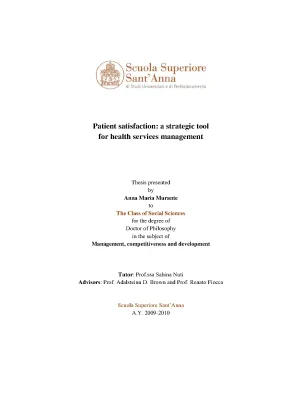
Tải xuống để đọc toàn bộPatient satisfaction: a strategic tool for health services management Thesis presented by Anna Maria Murante to The Class of Social Sciences for the degree of Doctor of Philosophy in the subject of Management, competitiveness and development Tutor: Prof.ssa Sabina Nuti Advisors: Prof. Brown and Prof. Renato Fiocca Scuola Superiore Sant’Anna A. 7 CHAPTER 1 – The theoretical framework .1 The patient role .2 Patient satisfaction: a complex concept .3 The patient satisfaction measurement .4 Patient experience: a new perspective for performance evaluation systems in health sector.
21 CHAPTER 2 - Tools and methods to measure patient experience for the multidimensional performance evaluation systems in the health sector.2 – The theoretical framework. 43 C) Inter-correlation analysis. 43 D) Overall evaluation and its dimensions. 49 CHAPTER 3 - The effects of institutional characteristics on inpatient satisfaction.3 – Data and Methodology.
59 Explanatory variables, patient level. 61 Explanatory variables, hospital level. 64 Multilevel model results .6 – Discussion and Conclusion. 72 CHAPTHER 4 - A marketing approach for creating patient oriented pathways in hospital services.1 – Introduction and Objectives.
77 Health care services. 83 Multivariate linear regression model .7 - Limitations and further research. 95 4 Acknowledgements This thesis is the result of the research work carried out in cooperation and with the support of the whole team of Laboratorio Management e Sanità of Scuola Superiore Sant’Anna in Pisa. In particular, I would like to thank: my supervisor, Professor Sabina Nuti, a “volcano of ideas”, for continuously stimulating me and posing challenging questions in our research activities; Chiara Seghieri for patiently guiding me through the fundamentals of statistics; and all my colleagues for facing everyday challenges together.
I wish to thank Professor Adalsteinn Brown for his precious suggestions and for the opportunity he gave me to carry out a part of the analyses described in this work in the Health System Strategy Division of the Ministry of Health and Long-Term Care in Ontario. A sincere thank to Professor Renato Fiocca, for taking care of the students education and their future. I am grateful to him for devoting his valuable time to read my thesis and for his careful and wise advice. Furthermore, I am indebted to all citizens who accepted to be interviewed and provided us with a wealth of information on the quality of health services and to all professionals of Health Authorities who made the surveys possible.
This thesis would not have been possible without the support of all my family, and in particular without the precious example of my mum and dad who taught me to work hardly in order to achieve important goals. The greatest thanks are for Luigi, for his love and warm encouragements in any situation! 5 6 INTRODUCTION This doctoral thesis focuses on the role of patient satisfaction in health services management as a strategic measure of health organizations’ performance. Most of the literature contributions on patient satisfaction were developed in US and UK; however, in the last years also Italian researchers and health managers have increased the interest and attention for the patient perspective. In detail, this work mostly refers to the patient experience surveys systematically conducted in Tuscany Region and used to create indicators included in the Tuscan Performance Evaluation System.
Since 2004 this system, developed by Laboratorio Management e Sanità of Scuola Superiore Sant’Anna, has been monitoring the results achieved by Tuscan Health Authorities considering also indicators on patient satisfaction. In this no profit – based scenario, the patient satisfaction surveys are valuable data sources to improve patient health and service quality. To better meet the patients’ needs and to achieve the main goals of a public health care system, the determinants of patient satisfaction and their changes across organizations have to be investigated. Research questions Based on these premises, the three articles that constitute the main body of this thesis aim to respond to the three research questions (RQs) hereafter presented.
Which are the dimensions that can explain patient satisfaction’s concept? The complex nature of patient satisfaction’s concept implies that dimensions to be investigated are well identified considering the patient perspective. In fact, a critical aspect in the patient satisfaction’s measurement is that models and instruments sometimes reflect the providers’ perspective rather than the patients’ one (Calnan, 1988). Thus, in order to monitor patient satisfaction with a health service by using questionnaires it is not enough to identify the main aspects of care and to define questions related to them. On the opposite side, it is important to use appropriate and scientifically rigorous means to measure patient experience so that accurate and meaningful information is produced.
A common objection to patient satisfaction research is related to technical and methodological issues (Rubin, 1990; McDaniel and Nash,1990). In 1990s, when 7 patient satisfaction measures were increasingly used to monitor the performance of health services, Sitzia (1999) pointed out the poor attention to the validity and reliability properties of questionnaires adopted in previous studies. These properties explain the extent to which a questionnaire is really able to capture the construct it is supposed to measure (Streiner et al, 2008). When the questionnaire properties are not evaluated and methodological weaknesses exist, misleading results may be generated and erroneous signals may be sent out.
Thus, a rigorous methodology has to be ensured. On the basis of the above considerations, the first paper (Murante A., Strumenti e metodi per misurare la patient satisfaction nei sistemi multidimensionali di valutazione della performance in sanità, presented at AIES Conference, Bergamo, 2009) aims at analyzing the validity and reliability properties of a questionnaire used by the Regional Health Care Service (RHCS) of Liguria and then by the RHCS of Tuscany, Umbria, Val d’Aosta and Trento to measure citizens experience with primary care services. The validation process of the questionnaire allowed to identify the main dimensions that can explain the overall patient satisfaction with primary care. Which are the personal and organizational characteristics that better explain the variability of patient satisfaction? A large number of studies analyzed how the patients’ perception of health services’ quality is influenced by their expectations, socio-demographic characteristics and clinical needs (Westaway, 2003; Bruster et al., 1994; Sitzia and Wood, 1997).
Moreover, in recent years, the characteristics of the external environment have been also considered as additional factors influencing individual evaluation. Researchers mainly observed whether variations exist across different organizations (e. A combined analysis of both individual and contextual characteristics allows to take into account the main aspects influencing overall satisfaction. Furthermore, adjusting for these aspects, patients’ ratings can also be compared across organizations.
The second paper (Murante A., The effects of institutional characteristics on inpatient satisfaction. A multilevel analysis, proceeding) focuses on the multidimensionality of the health quality concept. As 8 pointed out by Donabedian (Donabedian, 1988) structural and organizational aspects, healthcare process and patient satisfaction have to be considered together according to a comprehensive approach. The paper describes the results obtained using a multilevel model in order to investigate: (i) which are the personal (level 1) and organizational (level 2) characteristics that more affect patients’ experience with Tuscan hospitals and (ii) how much of the overall variability is explained at each level.
Investigating the variation of satisfaction within and between hospitals and its origins provides valuable information for planning effective policies of quality improvement. In fact, depending on whether patient experience is more influenced by patient or hospital characteristics, different actions have to be defined and implemented. Which are the elements to be considered in order to create patient - oriented services? In the last years health systems changed the way of thinking and delivering care: patient became the centre of the overall care process and new organizational models were applied in order to provide patient-centered services. The publication Seeing the person in the patient (Goodrich and Cornwell, 2008) provides several definitions of the “patient-centered care” concept, of which the most complete and clear one identifies the following dimensions: “(i) compassion, empathy and responsiveness to needs, values and expressed preferences; (ii) co-ordination and integration; (iii) information, communication and education; (iv) physical comfort; (v) emotional support, relieving fear and anxiety; (vi) involvement of family and friends” (Institute of Medicine, 2001).
This definition is consistent with the responsiveness’s goal assigned to the international health systems by the World Health Organization. In fact, health services have to meet the clinical needs of population as well as to ensure respect for persons, prompt attention, quality of amenities, access to social support networks and choice of the provider. Based on these premises, the third paper (Murante A., A marketing approach for creating patient oriented pathways in hospital services, accepted at the 10th International Marketing Trends Conference, Paris, January 2011) aims at promoting marketing’s approaches and methods in order to orient health policies towards the actual needs of citizens. The study focuses on the elements that most affect the patient’s overall experience and the factors to be improved in order to create patient-centered hospital service.
The analysis highlights also the differences 9 existing among patients hospitalized in three different wards (medical, surgical and obstetrical, gynecological and pediatric). 10 REFERENCES – Introduction Brown A. (2008), Comparing patient reports about hospital care across a Canadian – US border, International Journal for quality in Health Care; Vol. Bruster S, Jarman B, Bosanquet N, Weston D, Erens R, Delblanco T.
(1994), National survey of hospital patients., Towards a conceptual framework of lay evaluation of health care. Soc Sci Med 1988;27:927–33. (1988), Quality assessment and assurance: unity of purpose, diversity of means., Van den Berg B. (2009), Patient satisfaction revisited: a multilevel approach.
Social Science & Medicine; 69:68-75. Institute of Medicine (2001). Crossing the Quality Chasm: A new health system for the 21st century. Washington DC: National Academy Press.
(2010), Patients’experiences with continuum of care across hospitals. A multilevel analysis of Consumer Quality Index Continuum of Care. Patient Educ Couns 2010, doi: 10., Compendium of instrument measuring patient satisfaction with nursing care. Qual Rev Bull 1990: 16: 182 – 188., Can Patient evaluate the quality of hospital care? Med Care Rev 1990: 47: 267 – 326.
(2010), Patients’ experience and satisfaction in primary care: secondary analysis using multilevel modeling., How valid and reliable are patient satisfaction data? An analysis of 195 studies. International Journal for Quality in Health Care 1999: 11 (4): 319-328. (1997), Patient satisfaction: a review of issues and concept, Soc Sci Med; Vol. (2008), Health Measurement Scales: a Practical Guide to their Development and Use, 4th edition.
Oxford: Oxford University Press. (2007), Patients’ experiences with quality of hospital care: the Consumer Quality Index Cataract Questionnaire. BMC Ophthalmology, 7:14, doi: 10. (2010), Organizational determinants of patient-centered fertility care: a multilevel analysis.
Fertility and Sterility. (2003), Patient experience with information in a Hospital setting. Medical Care; Vol. (2003), Interpersonal and organizational dimensions of patient satisfaction: the moderating effects of health status.
International Journal for Quality in Health, Vol. 12 CHAPTER 1 The theoretical framework Before proceeding with the complete presentation of the three research’s papers, this first chapter introduces an overview of patient satisfaction literature with a focus on: (i) the patient role; (ii) the patient satisfaction’s concept, its subjective nature and its determinants; (iii) the use of patient satisfaction measures as outcome and process indicators; (iv) the introduction of patient perspective in multidimensional systems for evaluating the performance of health organizations. All these issues are the basis of the patient experience and satisfaction research field and constitute the framework of this PhD thesis. The patient role Usually, words as patient, user and consumer are indistinctly used as synonyms, even though they differ for the nature of relationships between health professionals and citizens.
While the patient is a person who has an illness and comes to doctors and nurses asking for advice and treatment, the user may identify people who used, use or could use health care services. Instead, the consumer reminds us of a person who purchases goods and services for his needs or a person who consumes something (Herxheimer and Goodare, 1999).
Nội dung được bảo vệ bản quyền — Tải xuống đầy đủ
Trích dẫn luận án này
Anna Maria Murante (n.d.). Luận án ts y học patient satisfaction a strategic tool for h [Luận án tiến sĩ, Scuola Superiore Sant’Anna]. LuanAn.net. https://luanan.net/tai-lieu-khac/luan-an-ts-y-hoc-patient-satisfaction-a-strategic-tool-for-health-services
Câu hỏi thường gặp
Luận án "Luận án ts y học patient satisfaction a strategic tool for h" nghiên cứu về vấn đề gì?
Luận án tiến sĩ y học phân tích sự hài lòng của bệnh nhân, xem đây là công cụ chiến lược then chốt giúp nâng cao chất lượng và hiệu quả dịch vụ y tế.
Luận án "Luận án ts y học patient satisfaction a strategic tool for h" được bảo vệ tại trường nào?
Luận án này được bảo vệ tại Scuola Superiore Sant’Anna.
Luận án "Luận án ts y học patient satisfaction a strategic tool for h" thuộc chuyên ngành gì?
Luận án "Luận án ts y học patient satisfaction a strategic tool for h" thuộc chuyên ngành Management, competitiveness and development. Danh mục: Tài liệu khác.
Luận án "Luận án ts y học patient satisfaction a strategic tool for h" có bao nhiêu trang?
Luận án "Luận án ts y học patient satisfaction a strategic tool for h" có 98 trang. Bạn có thể xem trước một phần tài liệu ngay trên trang web trước khi tải về.
Cách tải luận án "Luận án ts y học patient satisfaction a strategic tool for h" về máy như thế nào?
Để tải luận án về máy, bạn nhấn nút "Tải xuống ngay" trên trang này, sau đó hoàn tất thanh toán phí lưu trữ. File sẽ được tải xuống ngay sau khi thanh toán thành công. Hỗ trợ qua Zalo: 0559 297 239.