Luận án nghiên cứu quá trình tổng hợp vật liệu nano silic để chế tạo anode định
Luận án nghiên cứu quá trình tổng hợp vật liệu nano silic, khám phá các phương pháp tối ưu và ứng dụng tiềm năng trong pin lithium, cảm biến.
Theoretical chemistry and Physical chemistry
Luan An
Luận án tiến sĩ
Năm xuất bản
Số trang
134
Thời gian đọc
21 phút
Lượt xem
0
Lượt tải
0
Phí lưu trữ
40 Point
Tổng quan nhanh
- Chủ đề:
- Tổng hợp vật liệu nano silic: Bước tiến mới cho pin
- Số trang:
- 134 trang
- Trường:
- academy of military science and technology
- Chuyên ngành:
- Theoretical chemistry and Physical chemistry
- Tác giả:
- Nguyen Van Thang
- Năm:
- 2019
Tóm tắt nội dung luận án
I.Tổng hợp vật liệu nano silic Bước tiến mới cho pin
Nghiên cứu này tập trung vào quá trình tổng hợp vật liệu nano silic. Đây là vật liệu anode tiềm năng cho pin Li-ion. Việc sử dụng vật liệu nano silic hứa hẹn tăng cường đáng kể mật độ năng lượng pin. Các phương pháp tổng hợp được khảo sát kỹ lưỡng. Mục tiêu là phát triển vật liệu có hiệu suất cao và bền vững.
1.1. Tầm quan trọng của vật liệu nano silic
Vật liệu nano silic mang lại dung lượng lý thuyết cao cho pin Li-ion. Chúng là vật liệu anode đầy hứa hẹn. Năng lượng pin được tăng cường đáng kể. Anode graphite truyền thống có giới hạn. Vật liệu nano silic khắc phục các hạn chế này. Chúng mở ra tiềm năng cho thế hệ pin hiệu suất cao. Sự phát triển này thúc đẩy công nghệ năng lượng.
1.2. Mục tiêu nghiên cứu tổng hợp vật liệu nano silic
Nghiên cứu tập trung vào quá trình tổng hợp vật liệu nano silic. Mục tiêu là chế tạo vật liệu anode hiệu suất cao. Quá trình này tối ưu hóa từ tiền chất vỏ trấu. Các phương pháp tổng hợp được khảo sát kỹ lưỡng. Điều này đảm bảo tính bền vững và hiệu quả chi phí. Nghiên cứu cũng phân tích cơ chế hình thành để cải thiện quy trình.
II.Phương pháp tổng hợp hạt nano silic hiệu quả
Luận án đi sâu vào các phương pháp tổng hợp hạt nano silic, đặc biệt từ vỏ trấu. Vỏ trấu được xem là tiền chất thân thiện môi trường. Các kỹ thuật tiên tiến được áp dụng. Mục tiêu là đạt được cấu trúc vật liệu nano silic mong muốn. Điều này đảm bảo tính ứng dụng cao cho pin Li-ion.
2.1. Tổng hợp nano silic từ vỏ trấu Tiền chất tiềm năng
Vỏ trấu là nguồn tiền chất dồi dào, chi phí thấp. Nó chứa hàm lượng silica cao. Silica từ vỏ trấu được chuyển đổi thành hạt nano silic. Quá trình bao gồm xử lý axit và nung. Sau đó, khử silica thành silic. Đây là một phương pháp tổng hợp bền vững và thân thiện môi trường. Nghiên cứu tập trung vào việc tối ưu hóa các điều kiện tổng hợp này.
2.2. Các phương pháp tổng hợp hạt nano silic khác
Nhiều kỹ thuật tổng hợp hạt nano silic tồn tại. Phương pháp lắng đọng hơi hóa học (CVD) phổ biến. Khắc điện hóa cũng tạo ra cấu trúc vật liệu nano. Mục tiêu là kiểm soát kích thước và hình thái vật liệu. Điều này ảnh hưởng lớn đến hiệu suất. Chấm lượng tử silic và dây nano silic cũng được nghiên cứu qua các phương pháp khác nhau. Sự đa dạng này mở rộng lựa chọn.
2.3. Quy trình tổng hợp vật liệu nano Si rGO
Vật liệu tổng hợp Si@rGO được phát triển. Nó kết hợp hạt nano silic với graphene khử (rGO). Graphene cải thiện độ dẫn điện và ổn định cấu trúc. Quy trình này bao gồm tổng hợp rGO từ than chì. Sau đó, hạt nano silic được phân tán và kết hợp. Tạo ra một vật liệu composite tiên tiến cho anode pin Li-ion. Đây là giải pháp để khắc phục nhược điểm của silic nguyên chất.
III.Cơ chế hình thành vật liệu nano silic và điều kiện
Hiểu rõ cơ chế hình thành vật liệu nano silic là trọng tâm nghiên cứu. Các phản ứng hóa học chi tiết được phân tích. Điều kiện tổng hợp ảnh hưởng trực tiếp đến cấu trúc và tính chất vật liệu. Việc tối ưu hóa các điều kiện này là cần thiết. Nó đảm bảo sản phẩm cuối cùng đạt hiệu suất cao nhất cho ứng dụng anode pin Li-ion.
3.1. Phản ứng hóa học trong tổng hợp vật liệu nano silic
Quá trình tổng hợp bao gồm nhiều phản ứng hóa học phức tạp. Silica từ vỏ trấu được tinh chế ban đầu. Sau đó, nó trải qua phản ứng khử thành silic. Phản ứng cacbothermic thường được sử dụng. Các giai đoạn phản ứng được theo dõi cẩn thận. Hiểu rõ phản ứng giúp kiểm soát sản phẩm cuối cùng. Điều này đảm bảo chất lượng vật liệu nano silic.
3.2. Điều kiện tổng hợp ảnh hưởng cấu trúc vật liệu nano
Các yếu tố như nhiệt độ nung, thời gian phản ứng, nồng độ axit. Chúng ảnh hưởng đến kích thước và hình thái hạt nano silic. Kiểm soát chặt chẽ điều kiện này là cần thiết. Mục tiêu là tạo ra vật liệu nano silic có cấu trúc mong muốn. Ví dụ như silic xốp, để tối ưu hóa hiệu suất anode. Các điều kiện cụ thể quyết định tính chất cuối cùng.
3.3. Động học và nhiệt động học của quá trình tổng hợp
Nghiên cứu động học và nhiệt động học cung cấp hiểu biết sâu sắc. Nó giúp tối ưu hóa quá trình tổng hợp vật liệu nano silic. Các thông số như năng lượng hoạt hóa được xác định. Điều này cho phép kiểm soát hiệu quả quá trình chuyển hóa. Phân tích nhiệt là công cụ quan trọng để xác định các đặc trưng này. Việc này đảm bảo hiệu quả sản xuất vật liệu nano.
IV.Ứng dụng hạt nano silic làm anode pin Li ion
Hạt nano silic thể hiện tiềm năng vượt trội khi ứng dụng làm vật liệu anode. Quy trình chế tạo anode được mô tả chi tiết. Đặc tính điện hóa của anode nano silic được đánh giá. Các thử nghiệm pin Li-ion cho thấy hiệu suất của vật liệu. Kết quả này khẳng định khả năng ứng dụng thực tế của vật liệu nano silic.
4.1. Chế tạo vật liệu anode từ hạt nano silic
Hạt nano silic được sử dụng làm vật liệu anode chính. Quy trình chế tạo anode bao gồm trộn vật liệu. Nó trộn với chất kết dính và chất dẫn điện. Hỗn hợp được phủ lên lá thu dòng. Sau đó, sấy khô và nén. Tạo ra điện cực anode hoàn chỉnh cho pin Li-ion. Mỗi bước đều quan trọng để đảm bảo chất lượng điện cực.
4.2. Đặc tính điện hóa của anode nano silic
Anode nano silic thể hiện dung lượng cao vượt trội. Tuy nhiên, nó đối mặt với sự giãn nở thể tích lớn. Điều này gây suy giảm chu kỳ sạc-xả. Vật liệu composite như Si@rGO giúp khắc phục. Chúng cải thiện ổn định chu kỳ và độ dẫn điện. Các đặc tính này rất quan trọng để đánh giá tiềm năng thương mại của vật liệu.
4.3. Đánh giá hiệu suất pin Li ion sử dụng anode nano silic
Pin Li-ion được lắp ráp với anode nano silic. Các thử nghiệm điện hóa được thực hiện chi tiết. Chúng bao gồm chu kỳ sạc-xả liên tục và đường cong thế. Mục tiêu là đánh giá dung lượng, hiệu suất Coulomb và độ bền chu kỳ. Kết quả này xác định tiềm năng ứng dụng thực tế của vật liệu. Các chỉ số này là căn cứ cho phát triển tiếp theo.
V.Thách thức và triển vọng vật liệu nano silic pin Li ion
Mặc dù có nhiều ưu điểm, vật liệu nano silic vẫn đối mặt với thách thức. Đặc biệt là vấn đề giãn nở thể tích. Nghiên cứu đề xuất các hướng phát triển vật liệu nano silic tương lai. Các cấu trúc như silic xốp, dây nano silic được xem xét. Tiềm năng thương mại hóa và ứng dụng rộng rãi được thảo luận. Đây là bước đệm cho thế hệ pin tiếp theo.
5.1. Các vấn đề cần giải quyết với vật liệu nano silic
Giãn nở thể tích là thách thức lớn đối với vật liệu nano silic. Nó gây phá hủy cấu trúc điện cực. Tạo thành lớp rắn điện phân (SEI) không ổn định. Điều này dẫn đến mất dung lượng nhanh chóng. Các vấn đề này cần được giải quyết triệt để để thương mại hóa vật liệu nano. Việc kiểm soát cấu trúc là then chốt.
5.2. Hướng nghiên cứu phát triển vật liệu nano silic tương lai
Phát triển cấu trúc vật liệu nano mới là ưu tiên hàng đầu. Silic xốp, dây nano silic, chấm lượng tử silic đang được nghiên cứu. Các cấu trúc này giúp giảm ứng suất. Chúng cải thiện khả năng lưu trữ Li+. Kết hợp với các vật liệu khác cũng là một hướng đi triển vọng. Việc này nhằm tối đa hóa hiệu quả sử dụng.
5.3. Tiềm năng thương mại hóa và ứng dụng rộng rãi
Vật liệu nano silic có tiềm năng rất lớn. Nó có thể thay thế anode graphite truyền thống. Đem lại năng lượng cao hơn cho thiết bị di động, xe điện. Nghiên cứu tiếp theo sẽ thúc đẩy ứng dụng thực tế. Phát triển công nghệ tổng hợp quy mô lớn là cần thiết để đưa sản phẩm ra thị trường. Điều này sẽ mở ra kỷ nguyên mới cho pin Li-ion.
Mục lục chi tiết luận án
Tải xuống file đầy đủ để xem toàn bộ nội dung
Tải đầy đủ (134 trang)Trích đoạn nội dung luận án
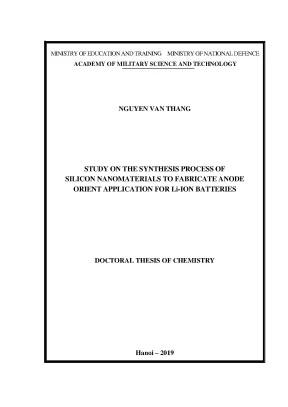
Tải xuống để đọc toàn bộMINISTRY OF EDUCATION AND TRAINING MINISTRY OF NATIONAL DEFENCE ACADEMY OF MILITARY SCIENCE AND TECHNOLOGY NGUYEN VAN THANG STUDY ON THE SYNTHESIS PROCESS OF SILICON NANOMATERIALS TO FABRICATE ANODE ORIENT APPLICATION FOR Li-ION BATTERIES DOCTORAL THESIS OF CHEMISTRY Hanoi – 2019 MINISTRY OF EDUCATION AND TRAINING MINISTRY OF NATIONAL DEFENCE ACADEMY OF MILITARY SCIENCE AND TECHNOLOGY NGUYEN VAN THANG STUDY ON THE SYNTHESIS PROCESS OF SILICON NANOMATERIALS TO FABRICATE ANODE ORIENT APPLICATION FOR Li-ION BATTERIES Specialization: Theoretical chemistry and Physical chemistry Code: 9 44 01 19 DOCTORAL THESIS OF CHEMISTRY Scientific supervisors: Dr. Nguyen Tran Hung Assoc. Nguyen Manh Tuong Hanoi – 2019 i STATEMENT OF AUTHORSHIP I assure that the thesis is my own research work. The data and results presented in the dissertation are honest and have not been unpublished in other work.
The reference is fully cited. Hanoi, date: Ph.D student Nguyen Van Thang ii ACKNOWLEDGMENTS First of all, I would like to express their deep gratitude to my supervisors Dr. Nguyen Tran Hung and Assoc. Nguyen Manh Tuong for their direct instruction guidance and support throughout my thesis implementation process.
I am grateful for the help of the Training Department, Academy of Military Science and Technology throughout the complete process of the thesis. I sincerely express my deepest thanks to the head of the Institute of Materials - Chemistry, the head of the Nanomaterials Department, the colleagues and my friends for their encouragement.D student Nguyen Van Thang iii TABLE OF CONTENTS Page LIST OF FIGURES .vi LIST OF TABLES .x LIST OF SYMBOLS AND ABBREVIATIONS. Overview of LIB. The new generation of electrochemical sources.
Domestic and foreign research situation on LIB. Anode materials of LIB. Ion storage material. Anode from silicon material, silicon nanoparticles/graphene.
Methods of synthesis silicon nanoparticles and current progress of thermodynamics, the kinetics of synthesis of silicon nanoparticles from rice husk. Overview of silicon. Introduction about rice husk and current status of rice husk use in our country. The synthesis nano Si from rice husk.
Synthesis methods of graphene. Overview of graphene. Synthesis methods of graphene. Kinetics and thermodynamics.
Thermal analysis and reaction kinetics study by thermal analysis.39 CHAPTER 2: SUBJECTS AND METHODS OF RESEARCH. The synthesis method of nano Si from rice husk. Kinetic, thermodynamic characteristics of synthesis nano Si from rice husk. Synthesis of rGO from graphite.
Synthesis of nano Si@rGO material for LIB's anode. Fabrication of LIB to test electrochemical properties of anode materials. The fabrication process of LIB’s anode. LIB fabrication process.
Methods of studying the composition and material structure. Scanning electron microscope (SEM) method. Energy-dispersive X-ray spectroscopy (EDX) method. Transmission electron microscopy (TEM) method.
Fourier-transform infrared spectroscopy method (FT-IR). X-ray diffraction method (XRD). Isothermal method adsorbed gas nitrogen. Methods of surveying electrochemical properties of electrodes.
Galvanostatic charge-discharge (GC) .55 CHAPTER 3: RESULTS AND DISCUSSION. Synthesis silica nanoparticles from rice husk. Investigate the effects of acid treatment. Investigate the effects of calcination mode.
Thermodynamics, the kinetics of the process of synthesis silica nanoparticles from rice husk. Synthesis of silicon nanoparticles from silica nanoparticles. Investigation of factors affecting silicon nanoparticles synthesis process. Kinetics of the process of synthesis silicon nanoparticles from silica nanoparticles.
Synthesis nano rGO and nano Si@rGO. Synthesis nano rGO. Investigate the structure and composition of nano Si@rGO materials. Application of rGO, nano Si and nano Si@rGO materials for fabrication LIB’s anode.
Experimental fabrication anode material combination. The electrochemical characteristics of LIB. Conclusion of chapter 3. 107 LIST OF PUBLICATIONS RELATING TO THESIS.
109 LIST OF REFERENCES. 110 vi LIST OF FIGURES Pages Figure 1. Comparison of energy densities and specific energy of different rechargeable batteries. Some Li-ion batteries on the white background.
Schematic of the electrochemical process in LIB. Structures of common cathode materials:. The model illustrates the formation of host-guest compound. Schematic picture of the failure mechanism of silicon nanoparticles during cycling.
Schematic process for fabricating the silicon nanoparticles/graphene nanocomposite. Schematic of silicon synthesis silicon nanoparticles by chemical vapor deposition of silanes. Schematic of silicon synthesis by electrochemical etching method. Graphene is the basic structure of other carbon nanostructures.
The bonds of carbon atoms in the graphene. Image illustrating graphene oxide film. The thermal reducing reaction of hydroxyl groups. The thermal reducing reaction of carbonyl groups.
Process of synthesizing silica nanoparticles from rice husk. Process of synthesizing silicon nano from silica nano. Schematic diagram of the reduction facility for silicon nanoparticles synthesis process. rGO synthesis process from graphite.
The thermal reduction process of GO in the furnace. The synthesis process of nano Si@rGO. The fabrication process of LIB’s anode. LIB with the two-electrode structure and glove box.
Cyclic voltammetry waveform. LIB with the two-electrode structure to measure electrochemical characterizations. TG/DTA curve of rice husk at the heating rate of 3 oC/min. SiO2 content in rice husk ash dependence on acid treatment time.
SiO2 content in rice husk ash dependence on acid treatment temperature. SiO2 content in rice husk ash dependence on ratio rice husk/HCl acid. Influence of calcination temperature on SiO2 content in rice husk ash. Influence of calcination time on SiO2 content in rice husk ash.
SEM images of rice husk ash samples after calcination at the temperature of 650 oC at the heating rates of 3, 6, 9, 12, 15 oC/min, respective. SEM and EDX images of nano SiO2. Particle size distribution of nano SiO2. XRD pattern of nano SiO2.
SEM image of nano SiO2 sample in high-resolution.12: TEM image of nano SiO2. DSC curves of rice husk pyrolysis process with heating rates of 3, 6, 9, 12, 15 oC/min. Plots of lg and 1/Tp of RHs of the F-W-O model. Plots of ln(β/Tp2) and 1/Tp of RHs of the Kissinger model.
DTA curves of rice husk pyrolysis process with heating rates of 3, 6, 9, 12, 15 oC/min. Plots of lg and 1/Tp of RHs of the F-W-O model. Plots of ln(β/Tp2) and 1/Tp of RHs of the Kissinger model. Si content dependence on mol ratio Mg/SiO2.
Si content dependence on calcination temperature. SEM images of nano Si samples obtained by magnesiothermic reduction of nano SiO2 with heating rates of 5 °C/min and 15 °C/min. N2 adsorption-desorption isotherms and the pore size distribution of nano Si RH-5. DSC curves of the reaction between nano SiO2 and Mg with different ramp rates.
XRD pattern of nano Si RH-5. Particle size distribution of nano Si RH-5. TEM image of nano Si RH-5. DSC curves of nano SiO2 reduction process with Mg with heating rates of 5, 9, 12, 15 oC/min.
Plots of lg and 1/Tp in the reduction of SiO2 by Mg of the F-W-O model. Plots of ln(β/Tp2) and 1/Tp in the reduction of SiO2 by Mg of Kissinger model. GO gel after acid washing. GO gel after freeze-drying.
Graphite particle size distribution. GO particle size distribution. FT-IR spectra of graphite. FT-IR spectra of GO.
TG/DTA curve of GO at the heating rate of 10 oC/min. XRD pattern of graphite. XRD pattern of GO. SEM image of graphite.
SEM image of GO. TEM image of GO. Image of rGO sheets. FTIR spectra of rGO.
TG/DTA curve of GO at the heating rate of 10 oC/min. SEM images of rGO at different resolutions. XRD pattern of rGO. EDX pattern of rGO (M1.
EDX pattern of rGO (M2. EDX pattern of nano composite Si@rGO. XRD pattern of nano composite Si@rGO. SEM, TEM images of nano composite Si@rGO.54: Schematic for synthesis process of nano composite Si@rGO.
Compound slurry of nano composite Si@rGO/cacbon/PVDF + NMP. LIB’s anode with a 11 mm diameter. Material structure of anode/cacbon/PVDF.58: SEM image and EDX pattern of carbon superP. SEM image of the anode/cacbon/PVDF material.
Cyclic voltammetry curves of LIB with anode fabricated on rGO basis of the first two cycles at a scan rate of 0.1 mV/s in the voltage range of 0. Cycling performance of LIB with anode fabricated on rGO basis under the current rate 0.2 mA/g) in the voltage range of 0. The rate capability of LIB with anode fabricated on rGO basis at the current rates from 37. Cyclic voltammetry curves of LIB with anode fabricated on nano Si basis of the first two cycles at a scan rate of 0.1 mV/s in the voltage range of 0.
Galvanostatic discharge-charge profiles of LIB with anode fabricated on nano Si basis at the current rate of 0.05C in the voltage range of 0. Cycling performance of LIB with anode fabricated on nano Si basis under the current rate 0.1C in the voltage range of 0. Cyclic voltammetry curves of LIB with anode fabricated on nano Si@rGO basis of the first two cycles at a scan rate of 0.1 mV/s in the voltage range of 0. Galvanostatic discharge-charge profiles of LIB with anode fabricated on nano Si@rGO basis at the current rate of 0.05C in the voltage range of 0.
Cycling performance of LIB with anode fabricated on nano Si@rGO basis under the current rate 1.5C in the voltage range of 0. The rate capability of LIB with anode fabricated on Si@rGO basis at the different current rates in the voltage range of 0. 104 x LIST OF TABLES Pages Table 1. Characteristics of cathode materials.
Advantages and disadvantages of LIB. Characteristics of cathode materials. Properties of graphene. Typical analysis of rice husk.
Typical analysis of Mg powder. Samples of materials after grinding in the process of synthesis rGO. Properties of copper foil. Properties of lithium foil.
SiO2 content in rice husk ash dependence on. Basic kinematic parameters according to the FWO model and Kissinger model in rice husk pyrolysis process. Basic kinetic parameters according to the FWO model and Kissinger model in rice husk pyrolysis process. Thermodynamic parameters of the synthesis of silica nanoparticles from rice husk.
Si content dependence on molar ratio Mg/SiO2. Basic kinetic parameters according to the FWO model and Kissinger model in the reduction of SiO2 by Mg. The electrochemical characteristics of LIB with anode fabricated on rGO, nano Si and nano Si@rGO basis and previous publications. 104 xi LIST OF SYMBOLS AND ABBREVIATIONS Ah Ampere-hour Anode An electrode of the battery C Capacity Cathode An electrode of the battery CE Counter Electrode CMC Carboxymethyl cellulose CNF Carbon nanofiber CNT Carbon nanotube CV Cyclic voltammetry CVD Chemical Vapor Deposition DMC Dimethyl carbonate DoD Depth of discharge DSC Differential scanning calorimetry DTA Differential Thermal Analysis e Electron EC Ethylen cacbonate EDX/EDS Energy–dispersive X-ray spectroscopy EMC Ethyl methyl carbonate FE-SEM Field Emission Scanning Electron Microscopy FT-IR Fourier transform infrared spectroscopy FWO Flynn-Wall-Ozawa model GC Galvanostatic Cycling GO Graphene oxide LIB Li-ion battery Li-ion Lithium ion MA Methyl acetate xii mAh Milliampere-hour mAh/g Milliampere-hour/gram MCMB MesoCarbon MicroBeads NiCd Nickel cadmium NiMH Nickel metal hydride NMP N-methylpyrrolidinone PC Propylene cacbonate PDDA Poly (diallyl dimethyl ammonium) PTC Positive thermal coefficient PTFE Poly (tetrafluoroethylene) PVA Poly (vinyl alcohol) PVDF Poly (vinylidene fluoride) Wh/kg Watt-hour/kilogram Wh/l Watt-hour/litre R Resistance RE Reference Electrode rGO Reduced Graphene Oxide SEI Solid Electrolyte Interphase SEM Scanning Electron Microscopy TGA Thermal Gravicmetric Analysis SUP-P Super-P, Carbon black WE Working Electrode XRD X-ray Diffraction 1 INTRODUCTION 1.
The urgency of the thesis topic The phenomenon of global warming, energy shortage worldwide, the increasing of pollution in cities are serious challenges that promote the replacement of fossil fuels that cannot be renewed by green energy sources such as solar energy, wind energy and nuclear energy,.Compared to the traditional fossil fuels, most green energy sources often depend on the geographical location of each region, weather and season, so that the energy conversion devices cannot be operated continuously, the efficiency is not high. For nuclear energy, there are many potential risks of radiation damage to human health and the environment.
Nội dung được bảo vệ bản quyền — Tải xuống đầy đủ
Trích dẫn luận án này
Nguyen Van Thang (2019). Luận án nghiên cứu quá trình tổng hợp vật liệu nano silic để [Luận án tiến sĩ, Academy of Military Science and Technology]. LuanAn.net. https://luanan.net/tai-lieu-khac/luan-an-nghien-cuu-qua-trinh-tong-hop-vat-lieu-nano-silic-de-che-tao-anode-dinh
Câu hỏi thường gặp
Luận án "Luận án nghiên cứu quá trình tổng hợp vật liệu nano silic để" nghiên cứu về vấn đề gì?
Luận án nghiên cứu quá trình tổng hợp vật liệu nano silic, khám phá các phương pháp tối ưu và ứng dụng tiềm năng trong pin lithium, cảm biến.
Luận án "Luận án nghiên cứu quá trình tổng hợp vật liệu nano silic để" được bảo vệ tại trường nào?
Luận án này được bảo vệ tại Academy of Military Science and Technology. Năm bảo vệ: 2019.
Luận án "Luận án nghiên cứu quá trình tổng hợp vật liệu nano silic để" thuộc chuyên ngành gì?
Luận án "Luận án nghiên cứu quá trình tổng hợp vật liệu nano silic để" thuộc chuyên ngành Theoretical chemistry and Physical chemistry. Danh mục: Tài liệu khác.
Luận án "Luận án nghiên cứu quá trình tổng hợp vật liệu nano silic để" có bao nhiêu trang?
Luận án "Luận án nghiên cứu quá trình tổng hợp vật liệu nano silic để" có 134 trang. Bạn có thể xem trước một phần tài liệu ngay trên trang web trước khi tải về.
Cách tải luận án "Luận án nghiên cứu quá trình tổng hợp vật liệu nano silic để" về máy như thế nào?
Để tải luận án về máy, bạn nhấn nút "Tải xuống ngay" trên trang này, sau đó hoàn tất thanh toán phí lưu trữ. File sẽ được tải xuống ngay sau khi thanh toán thành công. Hỗ trợ qua Zalo: 0559 297 239.