Luận án: Lan tỏa tri thức, đổi mới ngành và TFP doanh nghiệp chế tạo Việt Nam
Luận án TS: lan tỏa tri thức, cải tiến năng suất TFP ngành chế tạo VN. Nghiên cứu đổi mới, nâng cao hiệu quả doanh nghiệp.
Năm xuất bản
Số trang
197
Thời gian đọc
30 phút
Lượt xem
0
Lượt tải
0
Phí lưu trữ
50 Point
Tổng quan nhanh
- Chủ đề:
- 1. Lan tỏa tri thức, đổi mới ngành: Tầm quan trọng
- Số trang:
- 197 trang
- Trường:
- Trường Đại học Kinh tế Thành phố Hồ Chí Minh
- Chuyên ngành:
- Development Economics
- Tác giả:
- Nguyen Thi Hoang Oanh
- Năm:
- 2021
Tóm tắt nội dung luận án
I. Lan tỏa tri thức đổi mới ngành Tầm quan trọng
Nghiên cứu này làm rõ vai trò then chốt của việc lan tỏa tri thức trong ngành sản xuất Việt Nam. Sự chuyển giao tri thức thúc đẩy mạnh mẽ đổi mới sáng tạo ngành. Điều này tác động trực tiếp đến hiệu quả sản xuất kinh doanh của các doanh nghiệp. Tầm quan trọng của năng suất yếu tố tổng hợp (TFP) doanh nghiệp cũng được nhấn mạnh. TFP chịu ảnh hưởng từ đặc điểm riêng của doanh nghiệp và hiệu ứng lan tỏa từ ngành, khu vực. Hiểu rõ các yếu tố này giúp tối ưu hóa đầu tư R&D doanh nghiệp và phát triển nguồn nhân lực chất lượng cao cho ngành sản xuất Việt Nam, vốn là xương sống của nền kinh tế.
1.1. Vai trò chuyển giao tri thức ngành sản xuất
Giới thiệu tầm quan trọng của chuyển giao tri thức trong sự phát triển kinh tế, đặc biệt là ngành sản xuất tại Việt Nam. Tri thức lan tỏa thúc đẩy đổi mới sáng tạo ngành. Điều này tác động trực tiếp đến hiệu quả sản xuất kinh doanh của các doanh nghiệp. Nghiên cứu này làm rõ vai trò then chốt của việc phổ biến tri thức.
1.2. Tác động đến năng suất yếu tố tổng hợp TFP
Phân tích tầm quan trọng của nghiên cứu về sự đa dạng trong năng suất yếu tố tổng hợp (TFP) của doanh nghiệp. TFP chịu ảnh hưởng bởi đặc điểm riêng của doanh nghiệp. Nó cũng chịu tác động từ hiệu ứng lan tỏa của ngành và khu vực. Đây là yếu tố quyết định năng lực cạnh tranh doanh nghiệp trong dài hạn.
1.3. Ngành sản xuất Việt Nam và tiềm năng
Nhấn mạnh tầm quan trọng của việc nghiên cứu chuyển giao tri thức và đổi mới sáng tạo ngành trong bối cảnh ngành sản xuất Việt Nam. Ngành này đóng vai trò xương sống cho nền kinh tế. Hiểu rõ các yếu tố này giúp tối ưu hóa đầu tư R&D doanh nghiệp và phát triển nguồn nhân lực chất lượng cao.
II. Nâng cao TFP doanh nghiệp Việt Nam Phân tích sâu
Nghiên cứu đi sâu vào định nghĩa và phương pháp đo lường năng suất yếu tố tổng hợp (TFP). TFP là thước đo hiệu quả sử dụng tổng hợp các yếu tố đầu vào. Thảo luận các thách thức trong đo lường TFP, sử dụng phương pháp bán tham số để đảm bảo độ tin cậy. Hệ sinh thái đổi mới sáng tạo ngành (SIS) cũng được phân tích. SIS bao gồm các mối liên kết giữa doanh nghiệp, viện nghiên cứu và chính phủ, tạo điều kiện cho chuyển giao tri thức và thúc đẩy đổi mới sáng tạo ngành, góp phần vào năng lực cạnh tranh doanh nghiệp. Chức năng sản xuất tri thức được giải thích, với các yếu tố đầu vào như đầu tư R&D doanh nghiệp và phát triển nguồn nhân lực chất lượng cao là quan trọng, nhằm tăng hiệu quả sản xuất kinh doanh.
2.1. Khái niệm và đo lường TFP
Định nghĩa rõ ràng về năng suất yếu tố tổng hợp (TFP). Đây là thước đo hiệu quả sử dụng tổng hợp các yếu tố đầu vào. Thảo luận các phương pháp đo lường TFP, bao gồm phương pháp bán tham số. Việc đo lường chính xác TFP đối mặt với nhiều thách thức. Nghiên cứu sử dụng dữ liệu cụ thể để đảm bảo độ tin cậy.
2.2. Hệ sinh thái đổi mới sáng tạo ngành
Giới thiệu khái niệm Hệ sinh thái đổi mới sáng tạo ngành (SIS). SIS và các yếu tố quyết định được phân tích. Nó bao gồm các mối liên kết giữa doanh nghiệp, viện nghiên cứu và chính phủ. SIS tạo điều kiện cho chuyển giao tri thức và thúc đẩy đổi mới sáng tạo ngành. Một SIS mạnh mẽ hỗ trợ năng lực cạnh tranh doanh nghiệp.
2.3. Chức năng sản xuất tri thức và đổi mới
Giải thích chức năng sản xuất tri thức. Chức năng này xác định đổi mới sáng tạo trong nghiên cứu. Các yếu tố đầu vào như đầu tư R&D doanh nghiệp và phát triển nguồn nhân lực chất lượng cao là quan trọng. Sản phẩm là bằng sáng chế hoặc các cải tiến công nghệ. Điều này góp phần vào hiệu quả sản xuất kinh doanh chung.
III. Phương pháp nghiên cứu TFP và đổi mới sáng tạo
Nghiên cứu sử dụng các phương pháp tiên tiến để phân tích chuyển giao tri thức và năng suất yếu tố tổng hợp (TFP). Mô hình lan tỏa tri thức cấp ngành được xây dựng, tập trung vào hiệu ứng lan tỏa trong nội bộ ngành và ngoại tác vốn con người từ cấp tỉnh. Điều này giúp hiểu rõ cách tri thức ảnh hưởng đến đổi mới sáng tạo ngành. Phân tích TFP doanh nghiệp được thực hiện bằng mô hình đa cấp, xem xét đặc điểm doanh nghiệp và hiệu ứng lan tỏa từ ngành, khu vực, giải quyết sự không đồng nhất trong TFP và cung cấp cái nhìn sâu sắc về năng lực cạnh tranh doanh nghiệp. Việc ứng dụng mô hình kinh tế lượng không gian và mô hình đa cấp lồng ghép cho phép đo lường hiệu ứng trực tiếp và gián tiếp của chuyển giao tri thức.
3.1. Mô hình lan tỏa tri thức cấp ngành
Mô tả các kênh chuyển giao tri thức. Các giả thuyết nghiên cứu về sự lan tỏa tri thức được hình thành. Mô hình này tập trung vào hiệu ứng lan tỏa trong nội bộ ngành đến các doanh nghiệp. Nó cũng xem xét ngoại tác vốn con người từ cấp tỉnh đến doanh nghiệp. Mô hình giúp hiểu rõ cách tri thức ảnh hưởng đến đổi mới sáng tạo ngành.
3.2. Phân tích TFP doanh nghiệp đa cấp
Trình bày mô hình đa cấp về năng suất yếu tố tổng hợp (TFP) của doanh nghiệp. Mô hình xem xét cả đặc điểm doanh nghiệp và hiệu ứng lan tỏa từ ngành, khu vực. Phương pháp này giải quyết sự không đồng nhất trong TFP. Nó cung cấp cái nhìn sâu sắc về các yếu tố ảnh hưởng đến năng lực cạnh tranh doanh nghiệp.
3.3. Ứng dụng mô hình không gian và đa cấp
Nêu bật việc sử dụng mô hình kinh tế lượng không gian và mô hình đa cấp lồng ghép. Các mô hình này được áp dụng để phân tích đổi mới sáng tạo ngành và năng suất yếu tố tổng hợp (TFP). Phương pháp này cho phép đo lường hiệu ứng trực tiếp và gián tiếp của chuyển giao tri thức. Dữ liệu được thu thập và xử lý cẩn thận cho các mô hình này.
IV. R D bằng sáng chế Đổi mới sáng tạo ngành Việt Nam
Tổng quan về hoạt động R&D tại Việt Nam cho thấy bức tranh tổng thể về đầu tư R&D doanh nghiệp và cường độ R&D. Phân tích các nguồn tài trợ và hiệu suất của R&D, cùng với nguồn nhân lực, là nền tảng cho đổi mới sáng tạo ngành. Tình hình đăng ký và cấp bằng sáng chế được thống kê, phản ánh kết quả của đầu tư R&D doanh nghiệp và góp phần nâng cao năng lực cạnh tranh doanh nghiệp. Các kênh chuyển giao tri thức và công nghệ trong ngành sản xuất Việt Nam cũng được khảo sát, bao gồm đầu tư trực tiếp nước ngoài, liên kết hợp tác và mua bán công nghệ. Sự hiệu quả của các kênh này ảnh hưởng trực tiếp đến đổi mới sáng tạo ngành và hiệu quả sản xuất kinh doanh.
4.1. Tổng quan hoạt động R D tại Việt Nam
Cung cấp bức tranh tổng thể về đầu tư R&D doanh nghiệp và cường độ R&D ở Việt Nam. Phân tích các nguồn tài trợ và hiệu suất của hoạt động R&D. Nguồn nhân lực trong R&D cũng được đề cập. Những yếu tố này đóng vai trò nền tảng cho đổi mới sáng tạo ngành.
4.2. Tình hình đăng ký và cấp bằng sáng chế
Thống kê và đánh giá tình hình đăng ký và cấp bằng sáng chế tại Việt Nam. Bằng sáng chế là chỉ số quan trọng của đổi mới sáng tạo. Nó phản ánh kết quả của đầu tư R&D doanh nghiệp. Việc tăng cường bằng sáng chế góp phần nâng cao năng lực cạnh tranh doanh nghiệp.
4.3. Kênh chuyển giao công nghệ và đổi mới
Tổng quan về các kênh chuyển giao tri thức và công nghệ trong ngành sản xuất Việt Nam. Các kênh này bao gồm đầu tư trực tiếp nước ngoài, liên kết hợp tác và mua bán công nghệ. Sự hiệu quả của các kênh này ảnh hưởng trực tiếp đến đổi mới sáng tạo ngành và hiệu quả sản xuất kinh doanh.
V. Đa dạng TFP doanh nghiệp Yếu tố ảnh hưởng và tác động
Nghiên cứu nhấn mạnh vai trò then chốt của các ngành sản xuất Việt Nam, đóng góp đáng kể vào tổng giá trị gia tăng kinh tế. Phân tích đóng góp của vốn, lao động và năng suất yếu tố tổng hợp (TFP) vào tăng trưởng kinh tế. Sự tăng trưởng ổn định của ngành sản xuất là nền tảng cho phát triển bền vững. Kết quả cho thấy sự không đồng nhất trong TFP giữa các doanh nghiệp sản xuất Việt Nam. Các yếu tố như quy mô, tuổi đời và sở hữu doanh nghiệp giải thích sự khác biệt này. Hiểu rõ sự đa dạng giúp chính sách hỗ trợ doanh nghiệp hiệu quả hơn. Chuyển giao tri thức và đổi mới sáng tạo ngành ảnh hưởng đến TFP, với hiệu ứng lan tỏa thúc đẩy năng lực cạnh tranh doanh nghiệp và hiệu quả sản xuất kinh doanh.
5.1. Vai trò ngành sản xuất trong tăng trưởng
Nhấn mạnh vai trò then chốt của các ngành sản xuất tại Việt Nam. Ngành này đóng góp đáng kể vào tổng giá trị gia tăng kinh tế. Phân tích đóng góp của vốn, lao động và năng suất yếu tố tổng hợp (TFP) vào tăng trưởng kinh tế. Sự tăng trưởng ổn định của ngành sản xuất là nền tảng cho phát triển bền vững.
5.2. Sự khác biệt TFP giữa các doanh nghiệp
Trình bày kết quả về sự không đồng nhất trong năng suất yếu tố tổng hợp (TFP) giữa các doanh nghiệp sản xuất Việt Nam. Các yếu tố như quy mô doanh nghiệp, tuổi đời, và sở hữu có thể giải thích sự khác biệt này. Hiểu rõ sự đa dạng giúp chính sách hỗ trợ doanh nghiệp hiệu quả hơn.
5.3. Tác động của lan tỏa tri thức và đổi mới
Phân tích cách chuyển giao tri thức và đổi mới sáng tạo ngành ảnh hưởng đến TFP của doanh nghiệp. Hiệu ứng lan tỏa từ các ngành khác hoặc từ đối tác có thể thúc đẩy TFP. Điều này có ý nghĩa quan trọng đối với năng lực cạnh tranh doanh nghiệp và hiệu quả sản xuất kinh doanh.
VI. Chính sách hỗ trợ Tăng trưởng doanh nghiệp bền vững
Nghiên cứu đề xuất các chính sách hỗ trợ doanh nghiệp nhằm khuyến khích đầu tư R&D doanh nghiệp. Cần có các ưu đãi thuế và quỹ hỗ trợ để thúc đẩy đổi mới sáng tạo ngành, giúp doanh nghiệp nâng cao năng lực cạnh tranh và khả năng thích ứng. Việc phát triển nguồn nhân lực chất lượng cao là tối quan trọng, với các chương trình đào tạo và nâng cao kỹ năng hỗ trợ chuyển giao tri thức hiệu quả và chuyển đổi số doanh nghiệp Việt Nam. Cuối cùng, nghiên cứu đề xuất xây dựng một hệ sinh thái đổi mới sáng tạo toàn diện và vững mạnh, liên kết chặt chẽ giữa các doanh nghiệp, viện nghiên cứu và cơ quan chính phủ, thúc đẩy chuyển giao tri thức và tối ưu hóa hiệu quả sản xuất kinh doanh.
6.1. Khuyến khích đầu tư R D và đổi mới
Đề xuất các chính sách hỗ trợ doanh nghiệp nhằm khuyến khích đầu tư R&D doanh nghiệp. Cần có các ưu đãi thuế và quỹ hỗ trợ để thúc đẩy đổi mới sáng tạo ngành. Điều này giúp doanh nghiệp nâng cao năng lực cạnh tranh và khả năng thích ứng.
6.2. Phát triển nguồn nhân lực chất lượng cao
Nhấn mạnh tầm quan trọng của việc phát triển nguồn nhân lực chất lượng cao. Các chương trình đào tạo và nâng cao kỹ năng là cần thiết. Nguồn nhân lực có trình độ cao là yếu tố then chốt cho chuyển giao tri thức hiệu quả. Điều này cũng hỗ trợ chuyển đổi số doanh nghiệp Việt Nam.
6.3. Xây dựng hệ sinh thái đổi mới vững mạnh
Đề xuất xây dựng một hệ sinh thái đổi mới sáng tạo toàn diện và vững mạnh. Hệ sinh thái này cần liên kết chặt chẽ giữa các doanh nghiệp, viện nghiên cứu và cơ quan chính phủ. Việc này thúc đẩy chuyển giao tri thức và tối ưu hóa hiệu quả sản xuất kinh doanh.
Mục lục chi tiết luận án
Tải xuống file đầy đủ để xem toàn bộ nội dung
Tải đầy đủ (197 trang)Trích đoạn nội dung luận án
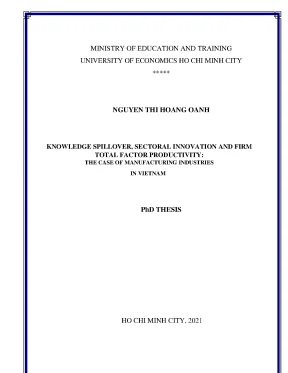
Tải xuống để đọc toàn bộMINISTRY OF EDUCATION AND TRAINING UNIVERSITY OF ECONOMICS HO CHI MINH CITY ***** NGUYEN THI HOANG OANH KNOWLEDGE SPILLOVER, SECTORAL INNOVATION AND FIRM TOTAL FACTOR PRODUCTIVITY: THE CASE OF MANUFACTURING INDUSTRIES IN VIETNAM PhD THESIS HO CHI MINH CITY, 2021 MINISTRY OF EDUCATION AND TRAINING UNIVERSITY OF ECONOMICS HO CHI MINH CITY ***** NGUYEN THI HOANG OANH KNOWLEDGE SPILLOVER, SECTORAL INNOVATION AND FIRM TOTAL FACTOR PRODUCTIVITY: THE CASE OF MANUFACTURING INDUSTRIES IN VIETNAM Major: Development Economics Code: 9310105 PhD Thesis ACADEMIC ADVISORS 1. Pham Khanh Nam 2. Pham Hoang Van HO CHI MINH CITY, 2021 i COMMITMENTS I hereby declare that this dissertation is my own work and it has not been previously submitted for a degree elsewhere. All the references from works done by other authors have been explicitly cited.
To the best of my knowledge, I would like to certify that the above statements are true. Ho Chi Minh City, January 2021 Nguyen Thi Hoang Oanh ii ACKNOWLEDGEMENT First of all, I would like to express my deepest gratitude to my academic advisers Dr. Pham Khanh Nam and Dr. Pham Hoang Van for their valuable advices and continuous support during my study.
They have given me autonomy on doing my research while continuing to provide me valuable feedbacks and encouragement. Second, I would like to thank the School of Economics and University of Economics Ho Chi Minh City for providing me the best environment for my study and doing my research. I also would like to thank the board of professors and independent external reviewers on giving me a lot of useful comments on my research. All their comments enable me to improve and complete this version of my thesis.
Last but not least, I am extremely grateful to my family for their love, support and sacrifice. Without them, the completion of my dissertation would not have been possible. Ho Chi Minh City, January 2021 Nguyen Thi Hoang Oanh iii Table of Contents COMMITMENTS. vii LIST OF TABLES.
viii LIST OF FIGURES. The significance of the research’s topic. The importance of the research the role of knowledge spillovers on innovation at sector level 3 1. The importance of the research on heterogeneity of firms’ TFP in considering both firms’ characteristics and spillover effects from sectors and regions.
The importance of research on the role of knowledge spillovers on sectoral innovation and firms’ TFP in the manufacturing industries in Vietnam. The gaps and the new aspects in this thesis. The new aspects in theoretical framework. The new aspects of the methodology.
The new aspects of the context. RESEARCH OBJECTIVES AND QUESTIONS. RESEARCH METHODOLOGY and RESEARCH SCOPE. STRUCTURE OF THIS STUDY.
DEFINITION AND CONCEPTS. Knowledge production function and the determination of innovation in this study. Sectoral Innovation System (SIS) and its determinants. Total Factor Productivity (TFP).
Definition of Total Factor Productivity. TFP measurement and its issue. TFP measurement methods. Developing model on Knowledge Spillovers at sector-level.
Channels of knowledge spillovers and the research hypothesis of the first objective 33 2. Theoretical framework of knowledge spillovers to firms. Debates on knowledge spillover of intra- sector to firms. Human capital externalities from the province to firms.
Multilevel modeling on firms’ total factor productivity and the research hypothesis of the second objective. Empirical Studies on determinants of sectoral innovation. Empirical Studies on channels of knowledge spillover and applications of Spatial Regression Model. Empirical Studies on TFP.
THE RESEARCH MODEL ON SECTORAL INNOVATION. The spatial econometrics and test for model specification. Estimation Strategy of the Model. Measuring Direct and Indirect effects in the Model.
The research model of Cross-Classified Model. Measurement of Total Factor Productivity: Semi- parametric Approach. Data for measuring TFP. Application of Cross-Classified Multilevel Model on the study.
The Research Model of Cross-classified Model on Firm Productivity. SECTORAL INNOVATION AND SPILLOVER EFFECTS: RESULTS FROM SPATIAL REGRESSION MODELS AND DISCUSSIONS. OVERVIEW OF RESEARCH AND DEVELOPMENT (R&D) ACTIVITIES AND PATENTS IN VIETNAM. R&D expenditure and R&D intensity in Vietnam.
Funding sources and performance of R&D activities. The human resources in R&D activities. The overview of the registration and approval of patents in Vietnam. Overview of transfer channel of technology and innovation in Vietnamese manufacturing industries.
RESULTS OF THE MODEL ESTIMATION. DISCUSSION ON THE RESULTS. HETEROGENEITY IN TFP OF VIETNAMESE MANUFACTURING FIRMS: RESULTS FROM CROSS-CLASSIFIED MODELS AND DISCUSSIONS. THE MANUFACTURING INDUSTRIES AND FIRMS’ PRODUCTIVITY.
The importance of manufacturing industries in Vietnam. The value added and contribution of capital, labor and TFP to economic growth by economic activities in Vietnam. Overview of capital, labor and total factor productivity (TFP) in manufacturing sectors in Vietnam. Summary on characteristics of Vietnamese manufacturing enterprises in the research data 126 5.
THE RESULTS OF MODEL ESTIMATION. The Cross classified model with no predictors (Empty Model). The Fixed effect models. The multilevel models: fixed region and random sector.
The multilevel model: fixed sector and random province. The multilevel model with sector random effects and region random effects. The multilevel model with sector random effects and province random effects. SUMMARY ON RESULTS AND DISCUSSION.
CONCLUSION AND POLICY IMPLICATIONS. CONCLUSIONS ON IMPORTANT FINDINGS. SOME POLICY IMPLICATIONS. LIMITATIONS AND FUTHER RESEARCH.
Description of Sectors. The distribution of provinces by regions. Test on SDM versus SEM and SAR. Spatial Regression Model in analysis on Knowledge Spillover among Sectors.
General idea of Spatial Regression Model. Knowledge Spillover among Sectors under Spatial Regression Model approach. Robust Hausman Test. xxxii vii ABBREVIATIONS Words Meanings APO Asian Productivity Organization ASEAN Associate East Asia Nation CCMM Cross-Classified Multilevel Model CIEM Central Institute for Economic Management DERG Development Economics Research Group FDI Foreign Direct Investment FE Fixed Effects GDP Gross Domestic Product GERD Gross expenditure on R&D GSO General Statistics Office GTFP Green Total Factor Productivity IO Input Output LBE Learning by Exporting LP Levinsohn and Petrin NIS National Innovation System NISTPASS National Institute for S&T Policy and Strategy Studies OECD Organization for Economic Co-operation and Development OP Olley-Pakes Ph.
Philosophy Doctor QML Quasi-Maximum Likelihood R&D Research and Development RE Random Effects RIS Regional Innovation System S&T Science and Technology SAC Spatial Autoregressive Model with Auto Regressive SAR Spatial Autoregressive Model SDM Spatial Durbin Model SEM Spatial Error Model SIC Standard Industrial Classification SIS Sectoral Innovation System SME Small and Medium Enterprise TCS Technology and Competitiveness Survey TFP Total Factor Productivity VAT Value Added Tax VES Vietnam Enterprise Survey VPC Variance Partitioning Coefficient VSIC Vietnam Standard Industrial Classification viii LIST OF TABLES Table 3. Description of variables in the models. Description of variables in the model of the second objective. Gross expenditure on R&D (GERD) and intensity of GERD.
Investment on Science &Technology and Research & Development in 2013. Registration for patents by nationality of applicants. Number of approved patents by nationality of the holders. Descriptive Statistics of variables in the model of the first objective.
Correlation matrix of variables in the model. Estimation results of the model by fixed and random effects. Estimation results of the model by Spatial Regression with fixed year effects 106 Table 4. Estimation results of the model by Spatial Regression with random sector effects.
Estimation results of the model by Spatial Regression with fixed year effects. Estimation results of the model by Spatial Regression with random sector effects. The number of sectors per province. The number of provinces that firms in a sector has located.
The descriptive statistics of variables in the model. The correlation matrix between variables in the model. The descriptive statistics of the logarithm of TFP in the data sample. The result of Cross classified model with no predictors.
The result of firm fixed effect model. The result of region Fixed effect and sector Random effect model. The result of sector Fixed effect and province Random effect model. The results of sector Random effect and region Random effect model.
The results of sector Random effect and province Random effect model. 143 x LIST OF FIGURES Figure 2. The framework of knowledge production function. The equilibrium between wage and rent in two types of city.
Theoretical framework of the study. Example on 12 firms at Level 1 nested within an Industry and Province Cross- Classified Multilevel Model at Level 2. Comparison on GERD of some countries. Average expenditure on R&D per researcher (FTE) (USD PPP).
GERD and R&D investment from enterprises in 2013. GERD of nations by funding sources. GERD by implementing parties in 2011. GERD by implementing parties in some ASEAN countries.
The average number of researchers per ten thousand people in 2013. The R&D human resources by economic types in 2014. The R&D human resources by implementing parties in 2014. The qualification of researchers by economic types.
The qualification of researchers by types of organizations. The percentage of registration for patents to be approved. Main Supplier of Technology. The technology transfer from Customers.
The main export markets of Vietnamese firms. Sources of Imported Inputs of Vietnamese firms. Originality of Research Output. Share of firms doing research and adaptation.
Percentage of number of firms had R&D activities by sectors. Percentage of number of firms had innovation activities by sectors. Percentage of number of firms had modification activities by sectors. The decomposition of GDP in Vietnam from 2010 to 2016.
Labor participation by economic sector from 2010 to 2016. The Average output growth by Industry, 2000-2014. The contribution share to output growth by industry, 2000-2014. Labor productivity growth by Industry in the period 2000-2014.
Growth rate in value added and labor productivity by economic sectors. Contribution to economic growth by Capital, Labor and TFP. Growth rate in Labor Productivity with Capital, Labor and TFP by economic sectors. Labor Productivity in 2015 and average labor productivity (2011-2015).
Growth rate in capital per worker and TFP (2011-2015). Contribution of Capital, Labor and TFP to growth of value added (2011-2015). 125 1 KNOWLEDGE SPILLOVER, SECTORAL INNOVATION AND FIRM TOTAL FACTOR PRODUCTIVITY: THE CASE OF MANUFACTURING INDUSTRIES IN VIETNAM Abstract This study developed the framework of knowledge spillovers at sector level and investigated these spillover effects of research and development (R&D), foreign direct investment (FDI) and trade activities on sectoral innovation by Spatial Regression Models. Besides, the study examined the spillover effects of sectoral innovation and provincial human resources on firms’ TFP with 7,236 enterprises in 38 sectors of Vietnamese manufacturing industries, located in 62 provinces by Cross-Classified Models.
By Spatial Regression Models with 38 manufacturing sectors in correspondence to Input/Output table from 2010 to 2014, the intra-industry rather than inter-industry spillover effects was found to be significant; that approved the hypothesis of Marshall rather than Jacobs externalities. In particular, only R&D and export activities were found to have significantly positive effects on innovation activities at the sector level. In contrast, FDI and import activities seem to have negative impact on innovation activities. In cross-classified models, firms’ characteristics in comparison with characteristics of sectors and provinces may have the highest explanation on the heterogeneity in firms’ TFP.
The firm size, capital intensive and export orientation were found to have stably significantly positive impacts on firms’ TFP. The sectoral innovation might turn to have positive impacts on the productivity of firms in that sector after one year. Besides, the externalities of human resources in provinces on firms’ productivity were found to be positive.
Nội dung được bảo vệ bản quyền — Tải xuống đầy đủ
Trích dẫn luận án này
Nguyen Thi Hoang Oanh (2021). Lan tỏa tri thức, đổi mới ngành và TFP doanh nghiệp Việt Nam [Luận án tiến sĩ, University of Economics Ho Chi Minh City]. LuanAn.net. https://luanan.net/tai-lieu-khac/luan-an-lan-toa-tri-thuc-doi-moi-nganh-tfp-doanh-nghiep-viet-nam
Câu hỏi thường gặp
Luận án "Lan tỏa tri thức, đổi mới ngành và TFP doanh nghiệp Việt Nam" nghiên cứu về vấn đề gì?
Luận án TS: lan tỏa tri thức, cải tiến năng suất TFP ngành chế tạo VN. Nghiên cứu đổi mới, nâng cao hiệu quả doanh nghiệp.
Luận án "Lan tỏa tri thức, đổi mới ngành và TFP doanh nghiệp Việt Nam" được bảo vệ tại trường nào?
Luận án này được bảo vệ tại University of Economics Ho Chi Minh City. Năm bảo vệ: 2021.
Luận án "Lan tỏa tri thức, đổi mới ngành và TFP doanh nghiệp Việt Nam" thuộc chuyên ngành gì?
Luận án "Lan tỏa tri thức, đổi mới ngành và TFP doanh nghiệp Việt Nam" thuộc chuyên ngành Development Economics. Danh mục: Tài liệu khác.
Luận án "Lan tỏa tri thức, đổi mới ngành và TFP doanh nghiệp Việt Nam" có bao nhiêu trang?
Luận án "Lan tỏa tri thức, đổi mới ngành và TFP doanh nghiệp Việt Nam" có 197 trang. Bạn có thể xem trước một phần tài liệu ngay trên trang web trước khi tải về.
Cách tải luận án "Lan tỏa tri thức, đổi mới ngành và TFP doanh nghiệp Việt Nam" về máy như thế nào?
Để tải luận án về máy, bạn nhấn nút "Tải xuống ngay" trên trang này, sau đó hoàn tất thanh toán phí lưu trữ. File sẽ được tải xuống ngay sau khi thanh toán thành công. Hỗ trợ qua Zalo: 0559 297 239.