Luận án: Lịch sử Công giáo Nguyễn và Sự hình thành Bản sắc Dân tộc Công giáo Việt Nam
Ngo Georgetown 0076d 13171: tìm thông tin chi tiết, đánh giá, giá bán, địa chỉ uy tín. Cập nhật mới nhất 2023.
Năm xuất bản
Số trang
340
Thời gian đọc
51 phút
Lượt xem
0
Lượt tải
0
Phí lưu trữ
60 Point
Tổng quan nhanh
- Chủ đề:
- 1. Bản sắc Công giáo Việt Nam: Giai đoạn 1770s-1890s
- Số trang:
- 340 trang
- Trường:
- Georgetown University
- Chuyên ngành:
- History
- Tác giả:
- Lan Anh Ngo
- Năm:
- 2016
Tóm tắt nội dung luận án
I. Bản sắc Công giáo Việt Nam Giai đoạn 1770s 1890s
Tài liệu này khám phá lịch sử Công giáo Việt Nam. Giai đoạn 1770s đến 1890s là trọng tâm. Nghiên cứu tập trung vào sự hình thành bản sắc Công giáo Việt Nam. Nó cũng xem xét mối quan hệ giữa Công giáo và triều Nguyễn.
1.1. Luận điểm mới về Công giáo Việt Nam thế kỷ 18 19
Lịch sử Công giáo Việt Nam thường bị thiên lệch. Các nhà sử học Pháp thường tập trung vào vai trò truyền giáo. Họ ít chú ý đến người Công giáo bản địa. Sử liệu triều Nguyễn mô tả Công giáo như tà giáo. Các nhà nghiên cứu khác lại nhấn mạnh sự hợp tác với thực dân. Tuy nhiên, quan điểm mới đang thay đổi. Nó không còn nhìn Công giáo như một thế lực bên ngoài. Thay vào đó, Công giáo được xem là một phần của quá trình xây dựng bản sắc dân tộc Việt Nam.
1.2. Nguồn tài liệu Từ hồ sơ triều Nguyễn đến giáo dân
Nghiên cứu hiện tại sử dụng nhiều nguồn. Hồ sơ chính thức của triều Nguyễn được tham khảo. Các báo cáo của thừa sai cũng được dùng. Đặc biệt, giọng nói của người Công giáo bản địa được chú trọng. Những tư liệu từ các tín hữu địa phương rất quan trọng. Điều này giúp hiểu sâu hơn về trải nghiệm của họ. Nó cũng làm rõ vai trò của họ trong lịch sử.
II. Công giáo Việt Nam dưới góc nhìn lịch sử mới
Tài liệu phân tích cách nhìn lịch sử về Công giáo. Các quan điểm cũ thường mang tính đối kháng. Nghiên cứu hiện tại hướng tới cái nhìn đa chiều. Nó đặt Công giáo vào bối cảnh xã hội rộng lớn hơn.
2.1. Phá bỏ quan điểm cũ về Công giáo Việt Nam
Trước đây, lịch sử Công giáo thường được nhìn theo hai cực. Một bên là những người theo đạo là kẻ nổi loạn. Bên kia là những người hợp tác với ngoại bang. Quan điểm này đơn giản hóa phức tạp của lịch sử. Nó bỏ qua những sắc thái đa dạng. Cách tiếp cận mới tránh sự phân cực. Nghiên cứu xem xét Công giáo trong bối cảnh khu vực. Điều này tạo ra một cái nhìn khách quan hơn. Nó cũng công nhận vai trò thực sự của giáo dân bản địa.
2.2. Công giáo như một phần không thể thiếu của dân tộc
Quan điểm hiện đại không coi Công giáo là một thế lực ngoại lai. Nó là một yếu tố nội tại trong quá trình hình thành dân tộc. Công giáo được đặt trong bối cảnh văn hóa xã hội Việt Nam. Nó không phải là một thực thể tách biệt. Thay vào đó, Công giáo tương tác với các yếu tố bản địa. Sự tương tác này góp phần định hình bản sắc dân tộc. Công giáo Việt Nam thế kỷ 18 và thế kỷ 19 là minh chứng rõ rệt.
III. Chính sách cấm đạo triều Nguyễn và Công giáo Việt Nam
Triều Nguyễn đã có nhiều chính sách với Công giáo. Giai đoạn này chứng kiến sự thay đổi lớn. Từ tương đối khoan dung đến cấm đoán nghiêm ngặt. Chính sách cấm đạo triều Nguyễn có ảnh hưởng sâu sắc.
3.1. Các triều vua Nguyễn và thái độ với Công giáo
Mối quan hệ giữa Triều Nguyễn và Công giáo phức tạp. Vua Gia Long ban đầu khá khoan dung. Sự giúp đỡ từ một số người Công giáo đã hỗ trợ ông lên ngôi. Tuy nhiên, các vị vua sau đó có chính sách khác. Vua Minh Mạng là người đầu tiên ban hành lệnh cấm đạo nghiêm khắc. Vua Thiệu Trị và Vua Tự Đức tiếp tục các chính sách này. Họ coi Công giáo là mối đe dọa. Công giáo bị xem là dị giáo, phá hoại thuần phong mỹ tục. Các lệnh cấm đạo gây ra nhiều cuộc đàn áp. Điều này tạo ra sự căng thẳng lớn trong xã hội Việt Nam.
3.2. Ảnh hưởng của Tây Sơn lên sự phát triển Công giáo
Giai đoạn Tây Sơn và Công giáo cũng đáng chú ý. Phong trào Tây Sơn đã tạo ra biến động. Một số giáo sĩ và giáo dân đã hỗ trợ Nguyễn Ánh. Điều này ảnh hưởng đến sự phát triển ban đầu của Công giáo. Nó cũng góp phần định hình mối quan hệ sau này. Những sự kiện này cho thấy Công giáo không tách rời khỏi bối cảnh chính trị. Công giáo Việt Nam thế kỷ 18 đã chứng kiến những liên minh phức tạp này.
IV. Mối tương tác Công giáo Triều Nguyễn Định hình Việt Nam
Mối quan hệ giữa triều Nguyễn và Công giáo không chỉ là đối kháng. Nó là một yếu tố then chốt định hình Bản sắc dân tộc Việt Nam. Những tương tác này đã tạo ra sự biến đổi sâu rộng.
4.1. Tương tác Nguyễn Công giáo Yếu tố then chốt thế kỷ 19
Các tương tác giữa Triều Nguyễn và Công giáo rất quan trọng. Chúng định hình dòng chảy lịch sử Việt Nam hiện đại. Sự căng thẳng và đàn áp không phải là câu chuyện duy nhất. Những sự kiện này buộc các cộng đồng Công giáo phải tự củng cố. Họ phát triển mạng lưới liên kết chặt chẽ hơn. Công giáo Việt Nam thế kỷ 19 chứng kiến sự phát triển này. Các giáo dân đã tìm cách thích nghi, tồn tại.
4.2. Từ cộng đồng phân tán đến thực thể chính trị quốc gia
Ban đầu, các cộng đồng Công giáo khá rời rạc. Chúng thường mang tính chất địa phương. Tuy nhiên, các tương tác với triều Nguyễn đã thay đổi điều này. Đặc biệt là qua các cuộc cấm đạo. Những cuộc đàn áp đã tạo ra sự đoàn kết. Các cộng đồng Công giáo dần biến thành một thực thể chính trị. Đây không phải là ngẫu nhiên. Nó là kết quả trực tiếp của các tương tác đó. Bản sắc dân tộc Việt Nam của người Công giáo dần hình thành.
V. Phát triển bản sắc Công giáo Việt Nam qua các biến động
Lịch sử Công giáo Việt Nam là hành trình thích nghi. Nó trải qua nhiều biến động chính trị xã hội. Bản sắc dân tộc Việt Nam của người Công giáo được tôi luyện. Sự phát triển này rất phức tạp và đa chiều.
5.1. Vai trò của giáo dân bản địa trong lịch sử Công giáo
Các tiếng nói của người Công giáo bản địa thường bị bỏ qua. Nghiên cứu này đặt họ vào vị trí trung tâm. Giáo dân không phải là những người thụ động. Họ là tác nhân tích cực trong lịch sử. Họ đã tự tổ chức, bảo vệ đức tin. Họ duy trì cộng đồng trong thời kỳ khó khăn. Sự đóng góp của họ định hình Bản sắc dân tộc Việt Nam độc đáo. Điều này thách thức những quan điểm cũ.
5.2. Công giáo Việt Nam Kết nối xã hội và văn hóa
Công giáo không chỉ là một tôn giáo. Nó là một phần của tổng thể xã hội và văn hóa. Công giáo Việt Nam thế kỷ 18 và thế kỷ 19 đã chứng minh điều này. Nó tương tác với các phong tục, tập quán địa phương. Nó không tách rời khỏi bối cảnh bản địa. Việc hiểu rõ bối cảnh này quan trọng. Nó giúp nhận ra Công giáo là một phần của kiến tạo quốc gia.
Tải xuống file đầy đủ để xem toàn bộ nội dung
Tải đầy đủ (340 trang)Trích đoạn nội dung luận án
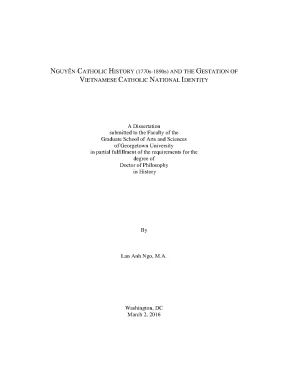
Tải xuống để đọc toàn bộNGUYỄN-CATHOLIC HISTORY (1770s-1890s) AND THE GESTATION OF VIETNAMESE CATHOLIC NATIONAL IDENTITY A Dissertation submitted to the Faculty of the Graduate School of Arts and Sciences of Georgetown University in partial fulfillment of the requirements for the degree of Doctor of Philosophy in History By Lan Anh Ngo, M. Washington, DC March 2, 2016 Copyright 2016 by Lan Anh Ngo All Rights Reserved ii NGUYỄN-CATHOLIC HISTORY (1770s-1890s) AND THE GESTATION OF VIETNAMESE CATHOLIC NATIONAL IDENTITY Lan Anh Ngo, M. Thesis Advisors: Peter C. ABSTRACT The historiography of Vietnamese Catholicism has tended not only towards a polemical French-centric narrative but also one in which the local converts rarely have a voice.
Nguyễn’s dynastic chroniclers, in the first wave of scholarship, portrayed Catholics as instigators of rebellions and followers of a so-called heterodox cult. In the late nineteenth century, French missionary historians often patronizingly cast Vietnamese Catholics as passive recipients of the Catholic faith in an internally united and supportive community created by the sacrifices of missionaries in a hostile external world. Subsequently, mainstream scholars, journalists and popular writers of the Cold War era, along with Vietnamese state-sponsored researchers after 1975, were interested in proving the collaborative role of Catholicism in the period of European expansionism. Current historiography, spearheaded by scholars trained at Australian National University in the 1980s, has gradually moved from a binary polemic to a more nuanced view of the past through the perspective of regionalism.
And the research from this local-centered angle no longer views Catholicism as a separate, external force but as an integral part of nation-building. This direction toward regionalism contextualizes and situates Catholicism within its larger social and cultural milieu rather than continuing with the conventional binary of revolutionaries and collaborators. But to do this, it is important to bring forth the missing voices of local Catholics. iii My dissertation, while including much information from Nguyễn official records and missionary reports, pays greater attention to the sources produced by indigenous Catholic converts and local historians.
Moreover, despite the turbulent Nguyễn-Catholic relationship and their history of mutual recrimination, my research demonstrates that the Nguyễn-Catholic interactions, more than any other factors in the nineteenth century, shaped the course of modern Vietnam. The transformation from disconnected Catholic communities into a national political entity was not coincidental with the rise and fall of the Nguyễn dynasty, but very much the result of their interactions. iv ACKNOWLEDGEMENTS This dissertation could not have been complete without the support and encouragement of many people. To the following people, I express my deepest gratitude: First, to the Jesuits of the Society of Jesus of California Province, who have been so generous and accommodating for the past twenty-two years.
To the Georgetown Jesuit Community, to St. Ignace Jesuit Community of la rue Sala in Lyon, to the Leonard Neale House Jesuit Community, to the Most Holy Trinity Jesuit Community in San Jose of California, who have made my studies in Washington, D., my research in France, and then the completion of the dissertation possible. To Georgetown University and to the History Department at Georgetown University, who provided scholarships under the Jesuit Tuition Deferment Program during my first two years and then the department tuition support for the last five years. Second, to the late Father John Witek, S., who believed the importance of my interest in the pursuit of the historical development of Vietnamese Catholicism.
To the faculty and administrative staff of the History Department at Georgetown University, who have gone above and beyond of the call of duty providing me invaluable guidance following the untimely death of Father Witek. Above all, I would like to thank Professor James Millward, Professor Sandra Horvath-Peterson, Professor Aparna Vaidik, Reverend Professor Peter Phan, and Reverend Professor John W. Third, to the members of my dissertation committee, whom I am especially indebted— besides the aforementioned Professor James Millward, Professor Sandra Horvath-Peterson, and Reverend Professor Peter Phan—Professor Carol Benedict also from Georgetown University, and Professor Nhung-Tuyet Tran from the History Department, University of Toronto, Canada. This dissertation simply would not have been possible without the careful feedback from v Professor Benedict, Professor Horvath-Peterson, Professor Millward, and Professor Phan.
I would also like to thank Reverend Professor Michael Sheeran, S., who had corrected, edited, as well as offered challenging and valuable suggestions in my first draft. Fourth, I am grateful for Cardinal Phêrô Nguyễn Văn Nhơn of Hanoi, Bishop Nguyễn Văn Yến of Phát Diệm Diocese, and Father Provincial Nguyễn Văn Liêm of the Society of Jesus of Vietnam Province who assisted me in my research in Vietnam. I also owe a great deal to the late Reverend Đỗ Quang Chính, S. of Vietnam, Professor Nguyễn Đăng Trúc at University of Strasbourg, Professor Trần Văn Cảnh at ECOTEC, Paris, Reverend Professor Phạm Hưng, S., Reverend Professor Trần Quốc Anh, S.
Ngô Anh Tuấn, who spent time to guide me through the sources of Vietnamese Church history. Several other faculty members of the Asian Theological Summer Institute of the Lutheran Theological Seminary at Philadelphia have been sources of inspiration during my proposal stage. I would like especially to thank Professor J. Paul Rajashekar and Professor Kwok Pui Lan.
I am also indebted to many wonderful directors and staff of various archives and libraries: Madame Odile Lolom, Madame Laurence Brodly, and Madame Bernadette Truchet of Œuvres Pontificales Missionnaires in Lyon; Madame Lucie Perrault of Missions Étrangères de Paris; Ms. Rosa Chow of Holy Spirit Study Center in Hong Kong; Ms. Nguyễn Quỳnh-Trâm of Nhóm Hán Nôm Công Giáo in Hồ Chí Minh City; Reverend Doctor Leon Hooper, S. Amy Phillips of Woodstock Theological Library; and Doctor Lenore Rouse of the Rare Books and Special Collections at the Catholic University of America in Washington, D.
Finally, I want to thank my family, especially my parents—Gioan Ngô Văn Phong and Maria Nguyễn Phước Huyền Tôn Nữ Thị Hạnh. I am also grateful for the constant support of my friends, including Father Robert Ballecer, S., Father Nguyễn Công Chánh, S., the Christian vi Life Community of the Diocese of Arlington in Virginia, and friends from the Most Holy Trinity Parish in San Jose of California. vii To the memory of Reverend Professor John Witek, S. viii TABLE OF CONTENTS Introduction: If Tombstones Could Tell Their Stories………………………….
A Brief History of Vietnamese Catholicism. General Outline of the Dissertation…….…………22 Chapter 1: Cultural Purity, Doctrinal Purity, and Spiritual Purity—Three Foundational Facets in the History of Vietnamese Clergy Formation as Reflected in the Công Đồng Tứ Xuyên. Correcting the Monolithic Representation of Catholicism. From Toledo in 1449 to Tonkin in 1873………………………………………….
The 1873 Công Đồng Tứ Xuyên (CĐTX)…………………………. Iberian Cultural Purity Found in the 1873 Công Đồng Tứ Xuyên ………………. Post-Tridentine Doctrinal Purity Found in the 1873 Công Đồng Tứ Xuyên…. French Dévot Spiritual Purity Found in the 1873 Công Đồng Tứ Xuyên………….
Conclusion to Chapter One.66 Chapter 2: Nguyễn-Catholic Alliance in the Late Eighteenth Century…. Eurocentric Perspective in Nguyễn-Catholic Histories……………. From the Fall of the Phú Xuân Court to the Rise of the Gia Định Regime (1788-1802). Dynastic Records of the Nguyễn-Catholic Encounter and Its Lacunae………….
Convergence of the Two Groups on the Fringe………………………………………. The Military Advantage of the Nguyễn-Catholic Alliance……. Prominent Đàng Trong Catholic Personages…. Beginning of the Conflict………………………………………………………….
Conclusion to Chapter Two.115 ix Chapter 3: Tension during the Early Years of the Nguyễn Dynasty………. The Confessional Interpretation and Its Influence on Nguyễn-Catholic Histories……. From the Gia Định Regime (1788-1802) to the 1832 Nhâm Thìn Edict……………. The 1832 Nhâm Thìn Edict…………………………………………….
The Beginning of Prickly Relations under Gia Long………………………. Boiling Tension in the Early Minh Mạng Reign toward Missionaries……………. Three Important Local Cases before the 1832 Nhâm Thìn Edict………………………152 VII. Conclusion to Chapter Three…………………………….158 Chapter 4: Catholicism—an Affront to the Nguyễn Imperial State-Building.
The Marxist Eurocentric Interpretation on Modern Vietnam. Four Stages that Transformed the Catholic Issue from Domestic Tensions to International Affairs……………………………………. Entanglement between Catholics and Lê Văn Duyệt’s Legacy………………………. Nguyễn Centralization in an Absolutist Direction…………….
Minh Mạng’s Ten Moral Maxims—Thập Điều…………. Catholicism—a Direct Affront to Nguyễn’s Fuller Absolutism………………………. Transition from a Domestic Problem to a Foreign Threat………………….1848-1883)—the Last Enforcer of Nguyễn Absolutism…………………. Disintegration of Absolutism…….
Catholic Response to the Nguyễn Anti-Catholic Policy……………………. Conclusion to Chapter Four.216 Chapter 5: Phêrô Trần Lục (1825-1899)—the Embodiment of Nguyễn-Catholic History. A Biographical Sketch of Phêrô Trần Lục…………………………………………. Thirty Years from Childhood to Adulthood.
Trần Lục as a Potential Leader in Training. Problems as the Results of the Disintegration of the Nguyễn Administration in the Second-half of the Nineteenth Century………………………………………………. Trần Lục as a New Pastor of Phát-Diệm and the Imperial Legate…………………. Conclusion to Chapter Five…………………………….……………………………………………………263 Appendix A: Vietnamese Dynasties…………………………………….269 Appendix B: Catholic-Nguyễn Chronology……………………………………………………271 Appendix C: Notable Converts in Catholic-Nguyễn History…….272 Appendix D: Notable Missionaries in Catholic-Nguyễn History……………….273 Appendix E: Tờ Tâu Cho Cụ Trần Làm Quan…………………………………………….275 Appendix F: Yết Thị Quan Khâm Sai Ra Cho Tĩnh Thanh….…………………280 Appendix G: Tờ Cụ Lớn Tấu Về Các Việc Tỉnh Thanh…………………………………….284 Appendix H: Vietnamese Catholic Colonies in Southeast Asia in the Nineteenth Century….295 Appendix I: Indochina Missions (1670s-1840s)………………….296 Appendix J: Indochina Missions in the Early Twentieth Century………….297 Appendix K: Phát-Diệm Vicariate in 1924…………………………………….302 xi LIST OF ILLUSTRATIONS Figure Page 1.
Reflection pool in front of Phương Đình Bell Tower at Phát-Diệm, 2004. The Phương Đình Bell Tower, 2005. The bas-relief depicting the battle between Archangel Michael and the Devil on the left side of Phát-Diệm Cathedral’s main entrance, 2005. The bas-relief depicting an angel on the right side of Phát-Diệm Cathedral’s main entrance, 2005…………………………….
Trần Lục’s tomb in the courtyard between the Phương Đình Bell Tower and Phát-Diệm Cathedral, 2015. The stone lattice of phoenix in the Chapel of Immaculate Heart of Mary, undated…………224 7. The stone bamboo lattice, 2005. Nguyễn Hữu Độ, undated.279 xii Introduction: If Tombstones Could Tell Their Stories On 2 March 1983, a 183-year-old tomb was razed to the ground by an order of the municipal government of the Hồ Chí Minh City.
The French bulletin, L’Association nationale des anciens et amis de l’Indochine et du souvenir Indochinois, describes the complete mayhem between the soldiers protecting the workers and a crowd of several thousand spectators: Two different waves were forced against each other. The crowd pushed in towards the grave, and the security pushed out. Soldiers held the people back with rifle butts. In a cloud of dust and human commotion, the crowd of spectators tried to reach the sarcophagus in the hope that they could take a piece of its wood.
It was a true fit of hysteria. Young and old had only one goal: to lay claim to a memento from the one who had been entombed for so many years. In the pandemonium, and in spite of several interruptions by the waves of onlookers, the exhumation continued to completion.1 Five years later, on 18 January 1988, the Ministry of Culture of the Socialist Republic of Vietnam decreed, Quyết Định 28 VH/QĐ, as a National Heritage Monument, a tomb built in 1899, along with its attached religious complex at Phát-Diệm of Ninh-Bình.2 The Ho Chi Minh city branch of the Hùng Vương Cultural Heritage Association declared the Phát-Diệm Cathedral as “the most grandiose stone church in the country…. Along with the ancient capital Hoa-Lư, Tràng-An Landscape Complex, Bái Đính Pagoda, Tam Cốc Cave and Bích Động Grotto, and 1 “Deux mouvements contradictoires se heurtèrent.
La foule se précipita vers la fosse alors que les autorités reculaient. Les soldats presents durent les dégager à coups de crosse. Au milieu de la poussière et des cris de vieilles vietnamiennes essayant d’atteindre le sarcophagi pour s’emparer d’un morceau de bois, une veritable hystérie avait saisi l’assistance, jeunes et vieux n’ayant qu’un but, emporter un vestige de ce qui venait d’être, après tant d’annés, remis au jour. C’est dans cette atmosphere de pandemonium que s’est poursuivie l’exhumation avec plusieurs interruptions dues aux poussées de la foule,” [Guy Simon, ed.], “Obseques et exhumation de l’Eveque D’Adran,” Bulletin de l’ANAI, avril-mai-juin 1999, 6.
2 Tòa giám mục Phát-Diệm, Nhà thờ lớn Phát-Diệm (Hà Nội: Nhà Xuất Bản Hà Nội, 1999), 5.
Nội dung được bảo vệ bản quyền — Tải xuống đầy đủ
Trích dẫn luận án này
Lan Anh Ngo (2016). Lịch sử Công giáo Việt Nam & Bản sắc Dân tộc (1770s-1890s) [Luận án tiến sĩ, Georgetown University]. LuanAn.net. https://luanan.net/tai-lieu-khac/lich-su-cong-giao-viet-nam-va-ban-sac-dan-toc-nguyen-lan-anh-ngo
Câu hỏi thường gặp
Luận án "Lịch sử Công giáo Việt Nam & Bản sắc Dân tộc (1770s-1890s)" nghiên cứu về vấn đề gì?
Ngo Georgetown 0076d 13171: tìm thông tin chi tiết, đánh giá, giá bán, địa chỉ uy tín. Cập nhật mới nhất 2023.
Luận án "Lịch sử Công giáo Việt Nam & Bản sắc Dân tộc (1770s-1890s)" được bảo vệ tại trường nào?
Luận án này được bảo vệ tại Georgetown University. Năm bảo vệ: 2016.
Luận án "Lịch sử Công giáo Việt Nam & Bản sắc Dân tộc (1770s-1890s)" thuộc chuyên ngành gì?
Luận án "Lịch sử Công giáo Việt Nam & Bản sắc Dân tộc (1770s-1890s)" thuộc chuyên ngành History. Danh mục: Tài liệu khác.
Luận án "Lịch sử Công giáo Việt Nam & Bản sắc Dân tộc (1770s-1890s)" có bao nhiêu trang?
Luận án "Lịch sử Công giáo Việt Nam & Bản sắc Dân tộc (1770s-1890s)" có 340 trang. Bạn có thể xem trước một phần tài liệu ngay trên trang web trước khi tải về.
Cách tải luận án "Lịch sử Công giáo Việt Nam & Bản sắc Dân tộc (1770s-1890s)" về máy như thế nào?
Để tải luận án về máy, bạn nhấn nút "Tải xuống ngay" trên trang này, sau đó hoàn tất thanh toán phí lưu trữ. File sẽ được tải xuống ngay sau khi thanh toán thành công. Hỗ trợ qua Zalo: 0559 297 239.