Chứng minh Định lý Fermat cuối cùng của Andrew Wiles trên Annals of Mathematics
"Giải thích định lý Fermat, một trong những vấn đề nổi tiếng nhất trong lịch sử toán học, liên quan đến số nguyên tố và hình học số."
Toán học (Lý thuyết số)
Luan An
Bài báo khoa học
Năm xuất bản
Số trang
109
Thời gian đọc
17 phút
Lượt xem
1
Lượt tải
0
Phí lưu trữ
40 Point
Tổng quan nhanh
- Chủ đề:
- Giải quyết Định lý Fermat cuối cùng của Andrew Wiles
- Số trang:
- 109 trang
- Chuyên ngành:
- Toán học (Lý thuyết số)
- Tác giả:
- Andrew John Wiles
- Năm:
- 1995
Tóm tắt nội dung luận án
I.Giải quyết Định lý Fermat cuối cùng của Andrew Wiles
Bài báo chuyên sâu của Andrew Wiles trình bày một chứng minh hoàn chỉnh cho Định lý Fermat cuối cùng. Thành tựu vĩ đại này đã giải quyết một bí ẩn toán học kéo dài hơn ba thế kỷ. Công trình của Wiles tập trung vào việc chứng minh tính modularity của các đường cong elliptic bán ổn định trên trường số hữu tỉ. Định lý sau đó được suy ra như một hệ quả trực tiếp. Chứng minh đột phá này tổng hợp các khái niệm tiên tiến từ lý thuyết số và hình học đại số. Nó đại diện cho một đỉnh cao của tư duy toán học hiện đại. Giải pháp này cho thấy sức mạnh của các cách tiếp cận liên ngành.
1.1. Nguồn cảm hứng của Andrew Wiles
Ở tuổi mười, Andrew Wiles đã đọc cuốn sách "The Last Problem" của Eric Temple Bell. Cuốn sách này đã gây ấn tượng sâu sắc với ông. Nó khơi dậy tham vọng suốt đời là chứng minh Định lý Fermat cuối cùng. Sự say mê ban đầu đó đã thúc đẩy nhiều thập kỷ nghiên cứu chuyên sâu. Nó cung cấp một mục tiêu rõ ràng, duy nhất cho hành trình toán học của ông.
1.2. Mục tiêu chứng minh Định lý Fermat
Định lý Fermat cuối cùng tuyên bố không tồn tại các số nguyên khác không a, b, c và số nguyên n > 2 sao cho a^n + b^n = c^n. Định lý này đơn giản trong cách phát biểu nhưng cực kỳ phức tạp trong việc chứng minh. Nó thách thức nhiều thế hệ nhà toán học. Việc giải quyết Định lý Fermat đã trở thành một biểu tượng cho những giới hạn của lý thuyết số.
1.3. Kết nối với Định lý Modularity
Chứng minh của Wiles là đỉnh cao của một chuỗi các kết nối. Nó dựa trên công trình của Frey, Serre và Ribet. Các nhà toán học này đã thiết lập một mối liên hệ trực tiếp giữa Định lý Fermat cuối cùng và Định lý Modularity (trước đây là giả thuyết Taniyama-Shimura). Công trình của Wiles hoàn thiện mảnh ghép cuối cùng, chứng minh Định lý Modularity cho một loại đường cong elliptic cụ thể.
II.Nguồn gốc và thách thức của Định lý Fermat
Pierre de Fermat, một nhà toán học Pháp thế kỷ 17, đã để lại một ghi chú nổi tiếng. Ông viết bên lề một bản sao cuốn "Arithmetica" của Diophantus. Ghi chú này khẳng định: "Tôi đã tìm thấy một chứng minh thực sự kỳ diệu cho định lý này, nhưng lề giấy này quá hẹp để chứa nó." Phát biểu đó đã trở thành khởi nguồn cho Định lý Fermat cuối cùng. Sự thiếu vắng chứng minh của Fermat đã làm say mê các nhà toán học. Nó thách thức họ trong nhiều thế kỷ.
2.1. Phát biểu của Pierre de Fermat
Phát biểu của Pierre de Fermat là một tuyên bố đơn giản. Nó nói rằng không có ba số nguyên dương a, b, c nào có thể thỏa mãn phương trình a^n + b^n = c^n với mọi số nguyên n lớn hơn 2. Đây là một khái quát hóa của Định lý Pytago (trường hợp n = 2). Định lý Pytago có vô số nghiệm.
2.2. Vấn đề toán học lâu đời
Trong hơn 350 năm, Định lý Fermat cuối cùng vẫn là một trong những bài toán chưa được giải quyết nổi tiếng nhất trong toán học. Nó đã thu hút sự chú ý của rất nhiều nhà toán học lỗi lạc. Nhiều nỗ lực chứng minh đã được thực hiện nhưng đều thất bại. Những nỗ lực này đã thúc đẩy sự phát triển của nhiều lĩnh vực toán học mới.
2.3. Sự phức tạp của Định lý
Thách thức của Định lý Fermat không nằm ở sự phức tạp của phát biểu. Sự khó khăn nằm ở việc không tìm thấy một phương pháp giải quyết rõ ràng. Các trường hợp n nhỏ như n=3, n=4 đã được chứng minh riêng lẻ bởi Euler và Fermat. Tuy nhiên, một chứng minh tổng quát cho mọi n > 2 vẫn còn là ẩn số. Nó đòi hỏi những công cụ toán học chưa từng có.
III.Mối liên hệ giữa Đường cong Elliptic và Định lý Modularity
Mối liên hệ then chốt trong chứng minh Định lý Fermat cuối cùng là thông qua Giả thuyết Taniyama-Shimura. Giả thuyết này, sau này được gọi là Định lý Modularity, tuyên bố rằng mọi Đường cong Elliptic trên trường số hữu tỉ đều là dạng modular. Một đường cong elliptic được coi là modular nếu có một ánh xạ phủ hữu hạn từ một đường cong modular dạng X0(N). Wiles đã chứng minh Định lý Modularity cho các đường cong elliptic bán ổn định. Đây là một bước đột phá quan trọng.
3.1. Giả thuyết Taniyama Shimura
Giả thuyết Taniyama-Shimura được hình thành vào những năm 1950 và 1960. Nó trở nên phổ biến hơn sau khi được Weil xuất bản vào năm 1967. Giả thuyết này đã dự đoán một mối liên hệ sâu sắc giữa các đường cong elliptic và dạng modular. Nó gợi ý một sự tương ứng chặt chẽ giữa hai lĩnh vực toán học dường như khác biệt. Giả thuyết này đã được kiểm tra bằng số trong nhiều trường hợp.
3.2. Đường cong Elliptic và dạng Modular
Đường cong Elliptic là các đối tượng hình học quan trọng trong lý thuyết số. Dạng modular là các hàm phức có tính đối xứng đặc biệt. Mối liên hệ giữa chúng là trung tâm của Định lý Modularity. Chứng minh của Wiles đã thiết lập sự tương đương này cho một lớp quan trọng của đường cong elliptic. Nó mở ra những hiểu biết mới về cấu trúc của các số nguyên.
3.3. Quan sát đột phá của Frey
Năm 1985, Gerhard Frey đưa ra một quan sát đáng kinh ngạc. Ông đề xuất rằng nếu Định lý Fermat cuối cùng là sai (tức là tồn tại a^n + b^n = c^n), thì một đường cong elliptic đặc biệt, đường cong Frey, có thể được xây dựng. Đường cong Frey này sẽ không phải là dạng modular. Quan sát này tạo ra một cầu nối rõ ràng. Nó biến Định lý Fermat cuối cùng thành một hệ quả của Định lý Modularity. Điều này được Serre cụ thể hóa thành giả thuyết epsilon và được Ribet chứng minh vào năm 1986.
IV.Chiến lược chứng minh Định lý Fermat cuối cùng của Wiles
Chiến lược của Andrew Wiles để chứng minh Định lý Fermat cuối cùng dựa trên việc nghiên cứu biểu diễn Galois. Đặc biệt, Wiles tập trung vào biểu diễn Galois ρ3 trên các điểm chia 3 của một đường cong elliptic. Mục tiêu là chứng minh rằng tất cả các nâng cấp phù hợp của ρ3 đều là modular, dưới các điều kiện nhất định. Phương pháp này liên kết một cách khéo léo lý thuyết số đại số với lý thuyết dạng modular.
4.1. Tiếp cận qua biểu diễn Galois
Cách tiếp cận của Wiles liên quan đến việc phân tích các biểu diễn Galois. Những biểu diễn này mô tả cách nhóm Galois của số hữu tỉ tác động lên các điểm chia của đường cong elliptic. Việc này cho phép chuyển đổi bài toán hình học về đường cong elliptic thành một bài toán đại số. Nó tạo ra một ngôn ngữ chung để kết nối với dạng modular.
4.2. Định lý Langlands Tunnell
Một định lý quan trọng của Langlands và Tunnell đóng vai trò cốt lõi. Định lý này cho thấy rằng nếu biểu diễn Galois ρ3 là bất khả quy, thì nó cũng là modular. Đây là một bước đệm cực kỳ quan trọng. Nó giúp Wiles thu hẹp phạm vi chứng minh cần thiết. Điều này cung cấp một điểm khởi đầu vững chắc cho luận điểm của ông.
4.3. Liên kết với lý thuyết số đại số
Wiles đã liên kết vấn đề chứng minh modularity với một lớp bài toán số học lớp. Ông sử dụng các lập luận mới từ đại số giao hoán. Sau đó, vấn đề này được giải quyết với sự trợ giúp của một công trình khác (TW). Sự kết hợp này là chìa khóa. Nó chứng minh rằng một đường cong elliptic là modular nếu và chỉ nếu biểu diễn 3-adic liên quan của nó là modular.
V.Vai trò của Biểu diễn Galois và Dạng Modular
Chứng minh của Wiles tạo ra một mối liên hệ mới giữa hai truyền thống mạnh mẽ nhưng riêng biệt trong lý thuyết số. Một truyền thống tập trung vào mối quan hệ giữa biểu diễn Galois và dạng modular. Truyền thống này phát triển mạnh mẽ từ những năm 1950. Nó đã chứng kiến sự đóng góp của nhiều nhà toán học lỗi lạc.
5.1. Hai truyền thống lý thuyết số
Mối liên hệ giữa biểu diễn Galois và dạng modular là một phần trung tâm của lý thuyết số hiện đại. Biểu diễn Galois cung cấp thông tin về cấu trúc đại số của các mở rộng trường. Dạng modular là các hàm phức với tính chất đối xứng phong phú. Wiles đã tạo ra một cầu nối sâu sắc giữa hai đối tượng này.
5.2. Phát triển từ Eichler đến Langlands
Các công trình ban đầu của Eichler và Shimura trong những năm 1950 và 1960 đã đặt nền móng. Sau đó, Deligne, Serre và Langlands đã chứng minh các định lý chính khác. Công việc này bao gồm việc xây dựng biểu diễn Galois liên kết với dạng modular. Nó cũng bao gồm các cải tiến của Langlands và Deligne, cùng với ứng dụng quan trọng của phương pháp thay đổi cơ sở của Langlands.
5.3. Các giả thuyết của Serre
Từ giữa những năm 1980, các giả thuyết của Serre đã tạo động lực chính cho lĩnh vực này. Chúng mở rộng giả thuyết epsilon trước đó. Ngoài công trình của Ribet và những người khác, chứng minh của Wiles còn dựa trên những phát triển chuyên biệt hơn của những năm 1980. Những phát triển này bao gồm các kết quả của Hida và Mazur, cung cấp các công cụ thiết yếu cho việc chứng minh.
VI.Đóng góp từ Lý thuyết số và Hình học Đại số
Chứng minh Định lý Fermat cuối cùng của Wiles là một minh chứng hùng hồn cho sự giao thoa sâu sắc giữa Lý thuyết số và Hình học Đại số. Nó không chỉ giải quyết một bài toán cổ điển mà còn mở ra những con đường mới trong nghiên cứu. Công trình này kết hợp các ý tưởng từ hai truyền thống toán học khác nhau. Nó cho thấy sức mạnh của việc tích hợp các lĩnh vực tưởng chừng như riêng biệt.
6.1. Giá trị đặc biệt của hàm L
Truyền thống thứ hai mà Wiles dựa vào là lý thuyết về giá trị đặc biệt của hàm L. Nền tảng của truyền thống này bắt nguồn từ công thức số lớp giải tích nổi tiếng của Dirichlet. Sự hồi sinh hiện đại của nó nhờ vào giả thuyết Birch và Swinnerton-Dyer. Giả thuyết này đã kết nối hành vi của hàm L của đường cong elliptic với các tính chất số học của chúng.
6.2. Nguồn gốc từ Dirichlet và Iwasawa
Trong thực tế, Wiles đã khai thác các ý tưởng của Iwasawa trong lĩnh vực này. Những ý tưởng này cung cấp các công cụ mạnh mẽ để nghiên cứu các đối tượng số học trên các tháp mở rộng trường. Mặc dù Wiles phải thay thế một phần đáng kể các nguyên lý của Iwasawa, nhưng các khái niệm cơ bản vẫn là nền tảng.
6.3. Sáng tạo mới trong lý thuyết số
Công trình của Wiles đã đưa ra một sự liên kết mới và bất ngờ. Nó kết nối biểu diễn Galois và dạng modular với cách diễn giải các giá trị đặc biệt của hàm L. Sự tổng hợp này đã thúc đẩy sự phát triển của cả lý thuyết số và hình học đại số. Nó cung cấp những hiểu biết sâu sắc hơn về các cấu trúc toán học cơ bản.
Tải xuống file đầy đủ để xem toàn bộ nội dung
Tải đầy đủ (109 trang)Trích đoạn nội dung luận án
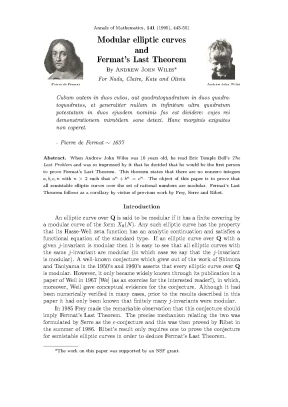
Tải xuống để đọc toàn bộAnnals of Mathematics, 141 (1995), 443-551 Modular elliptic curves and Fermat’s Last Theorem By Andrew John Wiles* For Nada, Claire, Kate and Olivia Pierre de Fermat Andrew John Wiles Cubum autem in duos cubos, aut quadratoquadratum in duos quadra- toquadratos, et generaliter nullam in infinitum ultra quadratum potestatum in duos ejusdem nominis fas est dividere: cujes rei demonstrationem mirabilem sane detexi. Hanc marginis exiguitas non caperet. - Pierre de Fermat ∼ 1637 Abstract. When Andrew John Wiles was 10 years old, he read Eric Temple Bell’s The Last Problem and was so impressed by it that he decided that he would be the first person to prove Fermat’s Last Theorem.
This theorem states that there are no nonzero integers a, b, c, n with n > 2 such that an + bn = cn. The object of this paper is to prove that all semistable elliptic curves over the set of rational numbers are modular. Fermat’s Last Theorem follows as a corollary by virtue of previous work by Frey, Serre and Ribet. Introduction An elliptic curve over Q is said to be modular if it has a finite covering by a modular curve of the form X0 (N ).
Any such elliptic curve has the property that its Hasse-Weil zeta function has an analytic continuation and satisfies a functional equation of the standard type. If an elliptic curve over Q with a given j-invariant is modular then it is easy to see that all elliptic curves with the same j-invariant are modular (in which case we say that the j-invariant is modular). A well-known conjecture which grew out of the work of Shimura and Taniyama in the 1950’s and 1960’s asserts that every elliptic curve over Q is modular. However, it only became widely known through its publication in a paper of Weil in 1967 [We] (as an exercise for the interested reader!), in which, moreover, Weil gave conceptual evidence for the conjecture.
Although it had been numerically verified in many cases, prior to the results described in this paper it had only been known that finitely many j-invariants were modular. In 1985 Frey made the remarkable observation that this conjecture should imply Fermat’s Last Theorem. The precise mechanism relating the two was formulated by Serre as the ε-conjecture and this was then proved by Ribet in the summer of 1986. Ribet’s result only requires one to prove the conjecture for semistable elliptic curves in order to deduce Fermat’s Last Theorem.
*The work on this paper was supported by an NSF grant. 444 ANDREW JOHN WILES Our approach to the study of elliptic curves is via their associated Galois representations. Suppose that ρp is the representation of Gal(Q̄/Q) on the p-division points of an elliptic curve over Q, and suppose for the moment that ρ3 is irreducible. The choice of 3 is critical because a crucial theorem of Lang- lands and Tunnell shows that if ρ3 is irreducible then it is also modular.
We then proceed by showing that under the hypothesis that ρ3 is semistable at 3, together with some milder restrictions on the ramification of ρ3 at the other primes, every suitable lifting of ρ3 is modular. To do this we link the problem, via some novel arguments from commutative algebra, to a class number prob- lem of a well-known type. This we then solve with the help of the paper [TW]. This suffices to prove the modularity of E as it is known that E is modular if and only if the associated 3-adic representation is modular.
The key development in the proof is a new and surprising link between two strong but distinct traditions in number theory, the relationship between Galois representations and modular forms on the one hand and the interpretation of special values of L-functions on the other. The former tradition is of course more recent. Following the original results of Eichler and Shimura in the 1950’s and 1960’s the other main theorems were proved by Deligne, Serre and Langlands in the period up to 1980. This included the construction of Galois representations associated to modular forms, the refinements of Langlands and Deligne (later completed by Carayol), and the crucial application by Langlands of base change methods to give converse results in weight one.
However with the exception of the rather special weight one case, including the extension by Tunnell of Langlands’ original theorem, there was no progress in the direction of associating modular forms to Galois representations. From the mid 1980’s the main impetus to the field was given by the conjectures of Serre which elaborated on the ε-conjecture alluded to before. Besides the work of Ribet and others on this problem we draw on some of the more specialized developments of the 1980’s, notably those of Hida and Mazur. The second tradition goes back to the famous analytic class number for- mula of Dirichlet, but owes its modern revival to the conjecture of Birch and Swinnerton-Dyer.
In practice however, it is the ideas of Iwasawa in this field on which we attempt to draw, and which to a large extent we have to replace. The principles of Galois cohomology, and in particular the fundamental theorems of Poitou and Tate, also play an important role here. The restriction that ρ3 be irreducible at 3 is bypassed by means of an intriguing argument with families of elliptic curves which share a common ρ5. Using this, we complete the proof that all semistable elliptic curves are modular.
In particular, this finally yields a proof of Fermat’s Last Theorem. In addition, this method seems well suited to establishing that all elliptic curves over Q are modular and to generalization to other totally real number fields. Now we present our methods and results in more detail. MODULAR ELLIPTIC CURVES AND FERMAT’S LAST THEOREM 445 Let f be an eigenform associated to the congruence subgroup Γ1 (N ) of SL2 (Z) of weight k ≥ 2 and character χ.
Thus if Tn is the Hecke operator associated to an integer n there is an algebraic integer c(n, f ) such that Tn f = c(n, f )f for each n. We let Kf be the number field generated over Q by the {c(n, f )} together with the values of χ and let Of be its ring of integers. For any prime λ of Of let Of,λ be the completion of Of at λ. The following theorem is due to Eichler and Shimura (for k = 2) and Deligne (for k > 2).
The analogous result when k = 1 is a celebrated theorem of Serre and Deligne but is more naturally stated in terms of complex representations. The image in that case is finite and a converse is known in many cases. For each prime p ∈ Z and each prime λ|p of Of there is a continuous representation ρf,λ : Gal(Q̄/Q) −→ GL2 (Of,λ ) which is unramified outside the primes dividing N p and such that for all primes q - N p, trace ρf,λ (Frob q) = c(q, f ), det ρf,λ (Frob q) = χ(q)q k−1. We will be concerned with trying to prove results in the opposite direction, that is to say, with establishing criteria under which a λ-adic representation arises in this way from a modular form.
We have not found any advantage in assuming that the representation is part of a compatible system of λ-adic representations except that the proof may be easier for some λ than for others. Assume ρ0 : Gal(Q̄/Q) −→ GL2 (F̄p ) is a continuous representation with values in the algebraic closure of a finite field of characteristic p and that det ρ0 is odd. We say that ρ0 is modular if ρ0 and ρf,λ mod λ are isomorphic over F̄p for some f and λ and some embedding of Of /λ in F̄p. Serre has conjectured that every irreducible ρ0 of odd determinant is modular.
Very little is known about this conjecture except when the image of ρ0 in PGL2 (F̄p ) is dihedral, A4 or S4. In the dihedral case it is true and due (essentially) to Hecke, and in the A4 and S4 cases it is again true and due primarily to Langlands, with one important case due to Tunnell (see Theorem 5. More precisely these theorems actually associate a form of weight one to the corresponding complex representation but the versions we need are straightforward deductions from the complex case. Even in the reducible case not much is known about the problem in the form we have described it, and in that case it should be observed that one must also choose the lattice carefully as only the semisimplification of 2 ρf,λ = ρf,λ mod λ is independent of the choice of lattice in Kf,λ.
446 ANDREW JOHN WILES If O is the ring of integers of a local field (containing Qp ) we will say that ρ : Gal(Q̄/Q) −→ GL2 (O) is a lifting of ρ0 if, for a specified embedding of the residue field of O in F̄p , ρ̄ and ρ0 are isomorphic over F̄p. Our point of view will be to assume that ρ0 is modular and then to attempt to give conditions under which a representation ρ lifting ρ0 comes from a modular form in the sense that ρ ≃ ρf,λ over Kf,λ for some f, λ. We will restrict our attention to two cases: (I) ρ0 is ordinary (at p) by which we mean that there is a one-dimensional subspace of F̄2p , stable under a decomposition group at p and such that the action on the quotient space is unramified and distinct from the action on the subspace. (II) ρ0 is flat (at p), meaning that as a representation of a decomposition group at p, ρ0 is equivalent to one that arises from a finite flat group scheme over Zp , and det ρ0 restricted to an inertia group at p is the cyclotomic character.
We say similarly that ρ is ordinary (at p), if viewed as a representation to Q̄2p , there is a one-dimensional subspace of Q̄2p stable under a decomposition group at p and such that the action on the quotient space is unramified. Let ε : Gal(Q̄/Q) −→ Z× p denote the cyclotomic character. Conjectural converses to Theorem 0.1 have been part of the folklore for many years but have hitherto lacked any evidence. The critical idea that one might dispense with compatible systems was already observed by Drinfield in the function field case [Dr].
The idea that one only needs to make a geometric condition on the restriction to the decomposition group at p was first suggested by Fontaine and Mazur. The following version is a natural extension of Serre’s conjecture which is convenient for stating our results and is, in a slightly modified form, the one proposed by Fontaine and Mazur. (In the form stated this incorporates Serre’s conjecture. We could instead have made the hypothesis that ρ0 is modular.
Suppose that ρ : Gal(Q̄/Q) −→ GL2 (O) is an irreducible lifting of ρ0 and that ρ is unramified outside of a finite set of primes. There are two cases: (i) Assume that ρ0 is ordinary. Then if ρ is ordinary and det ρ = εk−1 χ for some integer k ≥ 2 and some χ of finite order, ρ comes from a modular form. (ii) Assume that ρ0 is flat and that p is odd.
Then if ρ restricted to a de- composition group at p is equivalent to a representation on a p-divisible group, again ρ comes from a modular form. MODULAR ELLIPTIC CURVES AND FERMAT’S LAST THEOREM 447 In case (ii) it is not hard to see that if the form exists it has to be of weight 2; in (i) of course it would have weight k.
Nội dung được bảo vệ bản quyền — Tải xuống đầy đủ
Trích dẫn luận án này
Andrew John Wiles (1995). Giải Định lý Fermat cuối cùng của Andrew Wiles [Luận án tiến sĩ]. LuanAn.net. https://luanan.net/tai-lieu-khac/giai-dinh-ly-fermat-andrew-wiles
Câu hỏi thường gặp
Luận án "Giải Định lý Fermat cuối cùng của Andrew Wiles" nghiên cứu về vấn đề gì?
"Giải thích định lý Fermat, một trong những vấn đề nổi tiếng nhất trong lịch sử toán học, liên quan đến số nguyên tố và hình học số."
Luận án "Giải Định lý Fermat cuối cùng của Andrew Wiles" thuộc chuyên ngành gì?
Luận án "Giải Định lý Fermat cuối cùng của Andrew Wiles" thuộc chuyên ngành Toán học (Lý thuyết số). Danh mục: Tài liệu khác.
Luận án "Giải Định lý Fermat cuối cùng của Andrew Wiles" có bao nhiêu trang?
Luận án "Giải Định lý Fermat cuối cùng của Andrew Wiles" có 109 trang. Bạn có thể xem trước một phần tài liệu ngay trên trang web trước khi tải về.
Cách tải luận án "Giải Định lý Fermat cuối cùng của Andrew Wiles" về máy như thế nào?
Để tải luận án về máy, bạn nhấn nút "Tải xuống ngay" trên trang này, sau đó hoàn tất thanh toán phí lưu trữ. File sẽ được tải xuống ngay sau khi thanh toán thành công. Hỗ trợ qua Zalo: 0559 297 239.