Farnia dissertation 2017
Nghiên cứu của Farnia năm 2017 trình bày phân tích toàn diện, phương pháp luận chặt chẽ và kết quả đóng góp mới cho lĩnh vực khoa học.
Texas A&M University
Educational Human Resource Development
Luan An
Luận án tiến sĩ
Năm xuất bản
Số trang
149
Thời gian đọc
23 phút
Lượt xem
0
Lượt tải
0
Phí lưu trữ
40 Point
Tổng quan nhanh
- Chủ đề:
- 1. Tổng quan Luận án Tiến sĩ: Trí tuệ cảm xúc & Nghề nghiệp
- Số trang:
- 149 trang
- Trường:
- Texas A&M University
- Chuyên ngành:
- Educational Human Resource Development
- Tác giả:
- Forouzan Farnia
- Năm:
- 2017
Tóm tắt nội dung luận án
I. Tổng quan Luận án Tiến sĩ Trí tuệ cảm xúc Nghề nghiệp
Luận án tiến sĩ này khám phá vai trò của trí tuệ cảm xúc trong việc dự đoán sự thiếu quyết đoán nghề nghiệp ở sinh viên đại học. Đề tài nghiên cứu được thực hiện bởi Forouzan Farnia. Luận án được đệ trình lên Đại học Texas A&M vào tháng 12 năm 2017, hoàn thành yêu cầu cho bằng Tiến sĩ. Nghiên cứu xác định các yếu tố liên quan đến sự thiếu chắc chắn trong lựa chọn nghề nghiệp. Trọng tâm chính là liệu trí tuệ cảm xúc có thể giải thích thêm một phần đáng kể sự thay đổi trong sự thiếu quyết đoán nghề nghiệp hay không. Phần này vượt xa các yếu tố nhân cách và cảm xúc tích cực, tiêu cực đã được biết đến. Đây là một khóa luận quan trọng, cung cấp cái nhìn sâu sắc về tâm lý phát triển nghề nghiệp.
1.1. Giới thiệu đề tài nghiên cứu
Nghiên cứu học thuật này tập trung vào mối liên hệ giữa trí tuệ cảm xúc (EI), đặc điểm tính cách, và cảm xúc với sự thiếu quyết đoán nghề nghiệp. Đối tượng là sinh viên đại học. Mục đích là làm rõ cơ chế tâm lý đằng sau những khó khăn trong việc đưa ra quyết định nghề nghiệp. Tài liệu chỉ ra rằng việc hiểu rõ các yếu tố này giúp cải thiện công tác tư vấn hướng nghiệp. Nó cũng hỗ trợ phát triển các chương trình can thiệp hiệu quả. Luận án tiến sĩ này đóng góp vào lĩnh vực phát triển nguồn nhân lực giáo dục. Nó cung cấp nền tảng vững chắc cho các nghiên cứu tiếp theo.
1.2. Mục tiêu chính của khóa luận
Mục tiêu hàng đầu của khóa luận là kiểm tra khả năng dự đoán của trí tuệ cảm xúc. Cụ thể, nghiên cứu tìm hiểu liệu trí tuệ cảm xúc có thể dự đoán một tỷ lệ biến thiên gia tăng đáng kể trong sự thiếu quyết đoán nghề nghiệp hay không. Điều này được xem xét ngoài những biến thiên đã được giải thích bởi các đặc điểm tính cách và cảm xúc tích cực, tiêu cực. Nghiên cứu được thực hiện trên sinh viên nam và nữ. Các sinh viên này thuộc các trường Cao đẳng Kỹ thuật và Giáo dục tại một trường đại học nghiên cứu hàng đầu ở Tây Nam Hoa Kỳ. Đề tài nghiên cứu này đặt ra một câu hỏi quan trọng về vai trò của trí tuệ cảm xúc trong việc định hình các quyết định nghề nghiệp của sinh viên.
II. Phương pháp luận Nghiên cứu Học thuật về Trí tuệ Cảm xúc
Phần này chi tiết hóa phương pháp luận đã được áp dụng trong luận án tiến sĩ. Nó mô tả cách thức dữ liệu được thu thập, đối tượng nghiên cứu và các công cụ được sử dụng. Một cách tiếp cận nghiên cứu định lượng đã được sử dụng. Phân tích dữ liệu được thực hiện một cách chặt chẽ. Đề tài nghiên cứu này đảm bảo tính khoa học và độ tin cậy. Nghiên cứu học thuật đòi hỏi sự chính xác cao trong từng bước thực hiện. Các bước này bao gồm từ thiết kế nghiên cứu đến báo cáo kết quả. Phương pháp luận cung cấp một khuôn khổ rõ ràng. Nó cho phép các nhà nghiên cứu khác tái tạo hoặc mở rộng nghiên cứu này. Đây là một yếu tố quan trọng trong việc xây dựng kiến thức khoa học.
2.1. Đối tượng và Dữ liệu thu thập
Dữ liệu được thu thập từ 582 người tham gia. Đây là sinh viên đại học. Các sinh viên này hoàn thành bốn bảng câu hỏi khảo sát. Các công cụ bao gồm: Bảng câu hỏi trí tuệ cảm xúc tính cách – Dạng ngắn (TEIQue-Short Form), Thang đo khó khăn trong đưa ra quyết định nghề nghiệp liên quan đến cảm xúc và tính cách – Dạng ngắn (EPCD), Thang đo cảm xúc tích cực và tiêu cực (PANAS), và Bảng kiểm kê Big Five (BFI). Quá trình thu thập dữ liệu được thực hiện cẩn thận. Nó đảm bảo tính toàn vẹn và đại diện của mẫu. Dữ liệu này là nền tảng cho phân tích dữ liệu sau này, cung cấp cơ sở vững chắc cho các kết luận khoa học.
2.2. Công cụ phân tích và Mô hình thống kê
Các phân tích hồi quy đa cấp bậc đã được thực hiện. Phương pháp luận này cho phép kiểm tra mối quan hệ phức tạp giữa các biến số. Nó cũng giúp xác định khả năng dự đoán của trí tuệ cảm xúc đối với sự thiếu quyết đoán nghề nghiệp. Công cụ phân tích thống kê giúp kiểm soát các yếu tố nhiễu. Điều này tăng cường độ tin cậy của kết quả. Mô hình thống kê được chọn phù hợp với mục tiêu nghiên cứu. Nó cũng giúp trả lời các câu hỏi chính của đề tài nghiên cứu. Phân tích dữ liệu được thực hiện bởi các chuyên gia. Điều này đảm bảo tính chính xác và khách quan của kết quả.
III. Kết quả Nghiên cứu Chính Trí tuệ Cảm xúc Thiếu quyết đoán
Các kết quả nghiên cứu học thuật của luận án tiến sĩ này cung cấp cái nhìn sâu sắc mới. Nó liên quan đến vai trò của trí tuệ cảm xúc trong sự thiếu quyết đoán nghề nghiệp. Phân tích dữ liệu đã đưa ra những phát hiện quan trọng. Những phát hiện này có ý nghĩa đáng kể cho cả lý thuyết và thực tiễn. Nghiên cứu đã chứng minh rằng trí tuệ cảm xúc không chỉ là một yếu tố bổ sung. Nó còn là một yếu tố dự đoán mạnh mẽ. Việc hiểu rõ những kết quả này giúp các nhà giáo dục và tư vấn phát triển các chiến lược hiệu quả hơn. Nó cũng giúp hỗ trợ sinh viên trong quá trình định hướng nghề nghiệp. Các kết quả nghiên cứu cũng mở ra những hướng mới cho các đề tài nghiên cứu trong tương lai.
3.1. Vai trò dự đoán của trí tuệ cảm xúc
Các phân tích hồi quy đa cấp bậc đã tiết lộ rằng trí tuệ cảm xúc bổ sung một tỷ lệ phần trăm đáng kể biến thiên gia tăng. Biến thiên này liên quan đến sự thiếu quyết đoán nghề nghiệp. Điều này là so với các biến thiên được giải thích bởi các đặc điểm tính cách và cảm xúc. Phát hiện này nhấn mạnh tầm quan trọng của trí tuệ cảm xúc. Nó không chỉ là một đặc điểm phụ. Trí tuệ cảm xúc có khả năng định hình các quyết định quan trọng trong cuộc sống. Đặc biệt là trong bối cảnh lựa chọn nghề nghiệp. Kết quả nghiên cứu này củng cố các lý thuyết hiện có về trí tuệ cảm xúc. Nó cũng mở rộng hiểu biết về ứng dụng của trí tuệ cảm xúc trong định hướng nghề nghiệp.
3.2. Tác động tương hỗ của giới tính và chuyên ngành
Nghiên cứu cũng tìm cách điều tra hiệu ứng điều tiết. Hiệu ứng này của giới tính và chuyên ngành học đối với sự dự đoán sự thiếu quyết đoán nghề nghiệp bởi trí tuệ cảm xúc. Một phân tích điều tiết điều tiết đã tiết lộ một hiệu ứng tương tác ba chiều đáng kể. Hiệu ứng này bao gồm giới tính, chuyên ngành học và một trong các khía cạnh của trí tuệ cảm xúc: khả năng tự kiểm soát. Tự kiểm soát dự đoán một tỷ lệ đáng kể biến thiên trong sự thiếu quyết đoán nghề nghiệp đối với nam giới trong kỹ thuật, nam giới trong giáo dục và nữ giới trong giáo dục. Tuy nhiên, đối với nữ giới trong kỹ thuật, tự kiểm soát không thể dự đoán đáng kể sự thiếu quyết đoán nghề nghiệp. Kết quả này chỉ ra sự phức tạp của các yếu tố ảnh hưởng đến quyết định nghề nghiệp.
IV. Đóng góp Khoa học và Ứng dụng Thực tiễn từ Đề tài
Đề tài nghiên cứu của Farnia mang lại những đóng góp khoa học quan trọng cho lĩnh vực phát triển nguồn nhân lực và tâm lý học nghề nghiệp. Luận án tiến sĩ này không chỉ mở rộng kiến thức lý thuyết mà còn cung cấp những hàm ý thực tiễn giá trị. Các phát hiện có thể được ứng dụng trong việc xây dựng các chương trình tư vấn nghề nghiệp hiệu quả hơn. Chúng cũng giúp hỗ trợ sinh viên đối mặt với sự thiếu quyết đoán. Nghiên cứu học thuật này tạo tiền đề cho các dự án nghiên cứu tương lai, khuyến khích khám phá sâu hơn các biến số phức tạp. Phân tích dữ liệu kỹ lưỡng và các kết quả nghiên cứu rõ ràng làm tăng giá trị thực tiễn của công trình.
4.1. Hàm ý thực tiễn cho định hướng nghề nghiệp
Các kết quả nghiên cứu được thảo luận kỹ lưỡng. Hàm ý cho thực tiễn đã được giải thích chi tiết. Các nhà tư vấn nghề nghiệp, giáo viên và nhà hoạch định chính sách có thể sử dụng những hiểu biết này. Mục đích là phát triển các chiến lược can thiệp phù hợp. Điều này giúp hỗ trợ sinh viên đưa ra quyết định nghề nghiệp tự tin hơn. Ví dụ, việc tập trung vào phát triển kỹ năng tự kiểm soát có thể đặc biệt hữu ích cho một số nhóm sinh viên. Hiểu rõ sự khác biệt giữa các nhóm giới tính và chuyên ngành cũng là điều cần thiết. Điều này cho phép các chương trình hỗ trợ được cá nhân hóa và hiệu quả hơn. Đóng góp khoa học này có giá trị thực tiễn cao.
4.2. Gợi ý hướng nghiên cứu tương lai
Luận án tiến sĩ này cũng đưa ra các ý tưởng nghiên cứu tương lai. Điều này bao gồm việc khám phá sâu hơn các khía cạnh khác của trí tuệ cảm xúc. Nó cũng có thể điều tra các nhóm dân số khác nhau hoặc các yếu tố văn hóa. Nghiên cứu có thể kiểm tra hiệu quả của các chương trình can thiệp cụ thể. Các chương trình này nhằm nâng cao trí tuệ cảm xúc và giảm sự thiếu quyết đoán nghề nghiệp. Các nghiên cứu định tính có thể cung cấp cái nhìn sâu sắc hơn. Nó liên quan đến trải nghiệm cá nhân của sinh viên. Đề tài nghiên cứu này mở ra nhiều con đường mới. Nó hướng tới việc hiểu biết toàn diện hơn về quá trình ra quyết định nghề nghiệp.
V. Thông tin Luận án Tiến sĩ Tác giả và Ban cố vấn
Phần này cung cấp thông tin chi tiết về tác giả của luận án tiến sĩ và những người đã hỗ trợ quá trình nghiên cứu. Công trình này là kết quả của sự cống hiến và nỗ lực đáng kể của Forouzan Farnia. Vai trò của giáo sư hướng dẫn và các thành viên hội đồng cũng được nhấn mạnh. Họ đã cung cấp sự hướng dẫn và chuyên môn quý giá. Nghiên cứu học thuật chất lượng cao đòi hỏi sự hợp tác chặt chẽ. Nó cần sự hỗ trợ từ một đội ngũ cố vấn có kinh nghiệm. Luận án này đại diện cho một cột mốc quan trọng trong sự nghiệp học thuật của tác giả. Nó cũng đóng góp vào cộng đồng khoa học.
5.1. Tác giả và Học vị
Luận án tiến sĩ này được thực hiện bởi Forouzan Farnia. Công trình được đệ trình để hoàn thành các yêu cầu cho bằng DOCTOR OF PHILOSOPHY. Chuyên ngành chính là Phát triển nguồn nhân lực giáo dục. Việc hoàn thành khóa luận là minh chứng cho năng lực nghiên cứu. Nó cũng thể hiện khả năng phân tích dữ liệu và tư duy phản biện của tác giả. Bằng tiến sĩ này đánh dấu một bước tiến quan trọng. Nó đánh dấu trong sự nghiệp học thuật của Forouzan Farnia. Các kết quả nghiên cứu đã được công bố. Chúng có sẵn cho cộng đồng học thuật toàn cầu.
5.2. Giáo sư hướng dẫn và Ban hội đồng
Giáo sư Fredrick M. Nafukho là Chủ tịch ủy ban. Các thành viên ủy ban bao gồm Helen M. Paetzold và Ben Zoghi. Họ là những người đã cung cấp sự hỗ trợ và hướng dẫn chuyên môn xuyên suốt quá trình thực hiện đề tài nghiên cứu. Vai trò của giáo sư hướng dẫn là vô cùng quan trọng. Họ định hình phương pháp luận và phân tích dữ liệu. Sự đóng góp của các giáo sư đã đảm bảo tính khoa học và độ tin cậy của luận án. Trưởng phòng ban là Mario Torres. Đây là một yếu tố quan trọng trong thành công của một khóa luận học thuật. Sự hỗ trợ từ các chuyên gia là điều kiện tiên quyết cho một công trình chất lượng.
Mục lục chi tiết luận án
Tải xuống file đầy đủ để xem toàn bộ nội dung
Tải đầy đủ (149 trang)Trích đoạn nội dung luận án
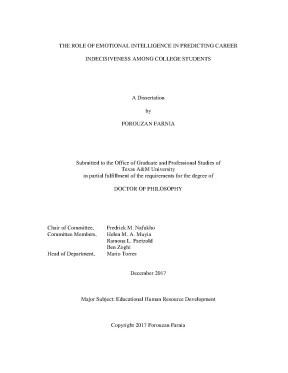
Tải xuống để đọc toàn bộTHE ROLE OF EMOTIONAL INTELLIGENCE IN PREDICTING CAREER INDECISIVENESS AMONG COLLEGE STUDENTS A Dissertation by FOROUZAN FARNIA Submitted to the Office of Graduate and Professional Studies of Texas A&M University in partial fulfillment of the requirements for the degree of DOCTOR OF PHILOSOPHY Chair of Committee, Fredrick M. Nafukho Committee Members, Helen M. Paetzold Ben Zoghi Head of Department, Mario Torres December 2017 Major Subject: Educational Human Resource Development Copyright 2017 Forouzan Farnia ABSTRACT The study examined the role of emotional intelligence, personality traits and positive and negative affect in relation to career indecisiveness. The primary purpose was to investigate whether emotional intelligence could predict a significant proportion of incremental variance in career indecisiveness beyond the variance accounted for by the personality traits and positive and negative affect among male and female undergraduate university students across Colleges of Engineering and Education at a research one university in Southwest, USA.
Data were collected from 582 participants who completed four survey questionnaires including the Trait Emotional Intelligence Questionnaire-Short Form (TEIQue), Emotional and Personality-Related Career Decision-Making Difficulties Scale-Short Form (EPCD), Positive and Negative Affect Scale (PANAS) and the Big Five Inventory (BFI). Hierarchical multiple regression analyses were conducted and the results revealed that emotional intelligence added a significant percentage of incremental variance in career indecisiveness compared to the variances explained by the personality traits and affectivity. The study also sought to investigate the moderation effect of gender and academic major on the prediction of career indecisiveness by emotional intelligence. A moderated moderation analysis revealed a significant three-way interaction effect of gender and academic major on the prediction of career indecisiveness by one of the emotional intelligence dimensions, self-control.
According ii to the results, significant proportions of variance in career indecisiveness were predicted by self-control for men in engineering, men in education, and women in education. However, for women in engineering, self-control could not significantly predict career indecisiveness. The results were thoroughly discussed, implications for practice were explained and future research ideas were suggested. iii DEDICATION Dedicated to the lovely people of College Station who made me feel at home during my five years of stay in the USA.
iv ACKNOWLEDGMENTS First and foremost, I would like to thank the members of my dissertation committee, Fredrick Nafukho, Ramona Paetzold, Helen Muyia and Ben Zoghi. To my adviser, Fredrick Nafukho, you are the true example of mentorship, leadership and scholarship. Thank you for guiding me throughout this path, believing in me from the very first day, empowering me in every step I took, and offering your help any time I needed it. To Ramona Paetzold, thank you so much for all your scholarly input, critical insights and invaluable feedback, which developed this research beyond my expectations.
Learning advanced statistics began in your classes and continued afterwards in our countless meetings. Thank you for helping me become a better researcher and for being such an awesome person, scholar, and teacher. To Helen Muyia, you were a true mentor to me during the PhD program, not only in terms of research but also in teaching and above all, in life. Thank you for spending so many hours reviewing my work and for supporting me in every aspect.
I had my best moments of life when I was working under your supervision. Thanks for everything! To Ben Zoghi, collecting data from the College of Engineering made this research a lot more interesting and meaningful. Although it would have been absolutely impossible without your help, your support of me went well beyond data collection. Every time I came to your office, I left with a brighter mind and stronger motivations to move forward.
Thanks for being such an inspiring professor! v CONTRIBUTORS AND FUNDING SOURCES Contributors This work was supervised by a dissertation committee consisting of Professor Fredrick M. Nafukho and Professor Helen Muyia of the Department of Educational Administration and Human Resource Development, Professor Ramona Paetzold of the Management Department and Professor Ben Zoghi of the Engineering Technology and Industrial Distribution Department All work for the dissertation was completed independently by the student. Funding Sources Graduate study was supported by a dissertation fellowship from Texas A&M University and Graduate Assistantship from the Department of Educational Administration and Human Resource Development. vi NOMENCLATURE EI Emotional Intelligence EPCD Emotional and Personality-related Career Decision-Making Difficulties BFI Big Five Inventory PANAS Positive and Negative Affect Scale TEIQue Trait Emotional Intelligence Questionnaire vii TABLE OF CONTENTS Page ABSTRACT.
v CONTRIBUTORS AND FUNDING SOURCES.vii TABLE OF CONTENTS. viii LIST OF FIGURES. xi LIST OF TABLES .xii CHAPTER I INTRODUCTION. 1 The Role of Emotions, Affects and Personality Traits in Predicting Career Decision-Making Difficulties.
3 Statement of the Problem. 6 Purpose of the Study. 10 Operational Definitions of the Key Terms. 12 CHAPTER II REVIEW OF LITERATURE.
16 Career Decision-Making. 16 Emergence of Developmental Theories. 17 Career Decision-Making as a Process. 20 Conceptualization of Individual Differences in Career Decision-Making.
20 The Assessment of Career Decision-Making. 22 Measuring Career Indecision. 24 Measuring Career Indecisiveness. 25 Emotions and Career Decision-Making.
31 viii Leading Models of Emotional Intelligence. 32 Categorization of EI Models. 35 The Fallacy of Ability EI. 37 Theory of Trait EI.
37 Big Five Personality Factors. 40 Positive and Negative Affect. 41 Empirical Evidence on the link between EI and Career Decision – Making Difficulties. 50 CHAPTER III METHOD.
53 Purpose of the Study. 54 The Sample and the Population. 59 Data Collection Procedures. 64 CHAPTER IV RESULTS.
68 Assumptions for Interpretation of OLS Regression. 68 Variance Inflation Factors (VIFs). 71 Results for Research Question One. 74 Results for Research Question Two.
78 Results for Research Question Five. 84 Results for Research Question Three. 85 Results for Research Question Four. 86 Further Exploration on the Moderation Effect.
91 Summary of the Study. 101 Implications for Practice. 103 Research Limitations and Delimitations. 105 Suggestions for Future Research.
136 x LIST OF FIGURES Page Figure 1. Histogram for the Normality Assumption. Normal P-P Plot for the Linearity Assumption. Scatterplot for the Homogeneity and Homoscedasticity Assumptions.
Visual Representation of the Conditional Effect of Self-Control on Career Indecisiveness Total (TCareer) as a Function of Gender and Academic Major. 89 xi LIST OF TABLES Page Table 1. TEIQue Factors and Facets. Major*Gender Cross Tabulation….
Data Analysis Procedures Broken by Research Questions…. Variance Inflation Factors …. Simple Correlation Matrix of the Variables in the Study……………………. Summary of the Hierarchical Regression Analysis of Variables Relating to Career Indecisiveness Total ………….
Summary of the Hierarchical Regression Analysis of Variables Relating to Anxiety………. Summary of the Hierarchical Regression Analysis of Variables Relating to Self-Concept and Identity…. Summary of the Hierarchical Regression Analysis of Variables Relating to Pessimistic Views. 83 xii CHAPTER I INTRODUCTION Career decision-making is one of the most challenging stages of life for the young adults who are preparing to join the workforce as they often “struggle to plan their professional future in the face of practically endless possibilities they can realize” (Gati & Levin, 2014, p.
Such difficulties are experienced by a wide range of individuals, including college students, who have already made a choice on their major (Gati & Tal, 2008; Super 1980). The research into college students’ career decision-making suggests that even senior students do not necessarily believe that their “undergraduate degree binds them to a related career” (Lichtenstein, et al. As Lichtenstein, et al. (2009) further explained: Throughout the undergraduate years, students continue to struggle with career decisions—not merely job decisions— often contemplating professional options with no direct relationship to their undergraduate major.
For example, a student with a pre-med degree might choose a graduate program in law while a student with an engineering degree might choose a job in investment banking. Students can wrestle with job and career decisions late into their senior year—and beyond (p. As a well-researched topic in career psychology, career decision making difficulties are defined as “the difficulties encountered by individuals while making career related decisions. (They) refer(s) to all problems and challenges that need to be 1 addressed prior to, during, or after the decision-making process” (Saka, Gati & Kelly, 2008, p.
In a broad sense, career decision-making difficulties are categorized as either temporary and developmental, or chronic, long lasting and pervasive. Temporary and developmental difficulties, which are often called career indecision, are experienced by many college students and are part of the normal development process. Career indecision is not a sign of personality problems and is usually resolved easily by the individuals themselves or with the help of career counselors. The second category, which is often referred to as career indecisiveness, is an aspect of “more chronic and pervasive difficulties, mainly stemming from emotional problems or personality-related characteristics” (Gati et.
Indecisive individuals may have identity conflicts, anxiety about decision-making and dependence on other’s approval when making decisions. According to Salomoneh (1982), these individuals are unable to “make a vocational choice no matter how carefully they are led through a decision-making process” (p. Given the fact that the sources of career decision-making difficulties are diverse, several assessment tools have been created to diagnose the type of career decision- making difficulties among individuals. For instance, Gati et al.
2 Career indecisiveness is the focus of one of the CDDQ dimensions (under Readiness category), but the dimension “does not indicate the specific issues that contribute to its prevalence” (Gati &Levin, 2014, p. To identify these issues, Saka et al., 2008 introduced a taxonomy of the possible sources of career indecisiveness that “integrat(ed) previously identified prominent emotional and personality-related factors underlying indecisiveness” (Gati & Levin, 2014, p. It is referred to as the Emotional and Personality –related Career Decision-Making Difficulties (EPCD) and includes 11 categories grouped into three major clusters (Pessimistic Views, Anxiety, and Self-Concept and Identity). The Role of Emotions Affects and Personality Traits in Predicting Career Decision- Making Difficulties Individual characteristics could predict career decision-making difficulties.
According to Walsh and Osipow (1988), traits make people act differently in “the manner in which decisions are approached, responded to, and engaged in” (p. According to a recent meta-analysis study, there is a statistically significant relationship between the five-factor traits (Neuroticism, Agreeableness, Conscientiousness, Extraversion, and Openness) and career decision-making difficulties, with neuroticism having the highest positive correlation and consciousness having the highest negative correlation with career decision-making difficulties (Martincin & Stead, 2015). People’s emotions affect the process of career decision-making as well. Emotions work in close cooperation with the cognitive system involved in the decision-making 3 process, and their adaptive use can lead to decisions that would bring more satisfying results (Emmerling & Cherniss, 2003).
As Emmerling and Cherniss (2003) noted: Emotions experienced during the career decision-making process may influence the number of career options under consideration, tolerance for risky career decisions, the amount and kind of self-exploration individuals will engage in during the choice process, how much effort to invest in the process, and how information related to career choice is processed” (p. The adaptive use of emotions, or being aware of one’s emotions and being able to express them appropriately and regulate them constructively to assist the thought process, is generally referred to as emotional intelligence (Mayer & Salovey, 1997). Although there are several EI models in the literature, two mainstream approaches to EI are recognized depending on the type of measurement used in a model (Petrides & Furnham, 2000, 2003). The ability EI is conceptualized as cognitive-emotional abilities in the domain of intelligence, measured through performance-based tests like IQ.
Trait EI “concerns emotion related dispositions and self-perceptions measured via self-report” assessment tools (Petrides, Pita, & Kokkinaki, 2007, p. Theory of trait EI (Petrides & Furnham, (2001)“posits that individuals differ in the extent to which they attend to, process, and utilize affect-laden information of an intrapersonal (e., managing one’s own emotions) or interpersonal (e.
Nội dung được bảo vệ bản quyền — Tải xuống đầy đủ
Trích dẫn luận án này
Forouzan Farnia (2017). Farnia dissertation 2017 [Luận án tiến sĩ, Texas A&M University]. LuanAn.net. https://luanan.net/tai-lieu-khac/farnia-dissertation-2017
Câu hỏi thường gặp
Luận án "Farnia dissertation 2017" nghiên cứu về vấn đề gì?
Nghiên cứu của Farnia năm 2017 trình bày phân tích toàn diện, phương pháp luận chặt chẽ và kết quả đóng góp mới cho lĩnh vực khoa học.
Luận án "Farnia dissertation 2017" được bảo vệ tại trường nào?
Luận án này được bảo vệ tại Texas A&M University. Năm bảo vệ: 2017.
Luận án "Farnia dissertation 2017" thuộc chuyên ngành gì?
Luận án "Farnia dissertation 2017" thuộc chuyên ngành Educational Human Resource Development. Danh mục: Tài liệu khác.
Luận án "Farnia dissertation 2017" có bao nhiêu trang?
Luận án "Farnia dissertation 2017" có 149 trang. Bạn có thể xem trước một phần tài liệu ngay trên trang web trước khi tải về.
Cách tải luận án "Farnia dissertation 2017" về máy như thế nào?
Để tải luận án về máy, bạn nhấn nút "Tải xuống ngay" trên trang này, sau đó hoàn tất thanh toán phí lưu trữ. File sẽ được tải xuống ngay sau khi thanh toán thành công. Hỗ trợ qua Zalo: 0559 297 239.