Nghiên cứu Detritivory ở Cua Sesarmid Parasesarma erythodactyla - Luận án Tiến sĩ
"Nghiên cứu về quá trình tiêu thụ detritus của cua sesarmid Parasesarma erythodactyla trong rừng ngập mặn, vai trò của loài trong chu trình dinh dưỡng."
Griffith University
Environment
Luan An
Luận án tiến sĩ
Năm xuất bản
Số trang
156
Thời gian đọc
24 phút
Lượt xem
0
Lượt tải
0
Phí lưu trữ
50 Point
Tổng quan nhanh
- Chủ đề:
- 1. Vai trò sinh thái cua Sesarmid ở hệ sinh thái rừng ngập mặn
- Số trang:
- 156 trang
- Trường:
- Griffith University
- Chuyên ngành:
- Environment
- Tác giả:
- Thi Hong Hanh Bui
- Năm:
- 2014
Tóm tắt nội dung luận án
I. Vai trò sinh thái cua Sesarmid ở hệ sinh thái rừng ngập mặn
Cua Sesarmid giữ vai trò sinh thái quan trọng trong các khu rừng ngập mặn thuộc vùng địa lý sinh vật Ấn Độ-Tây Thái Bình Dương. Những loài cua này xử lý lượng lớn mùn bã lá cây, góp phần giữ lại chất hữu cơ trong rừng ngập mặn. Chúng cũng tăng tốc độ khoáng hóa và cung cấp liên kết dinh dưỡng bổ sung thông qua vật liệu đã qua xử lý. Nghiên cứu này đặt mục tiêu làm rõ các lỗ hổng kiến thức về hoạt động ăn mùn bã của cua Sesarmid. Cua Parasesarma erythodactyla, loài phá hoại lá cây chủ đạo ở rừng ngập mặn cận nhiệt đới Úc, được chọn làm mô hình động vật để nghiên cứu sâu. Việc hiểu rõ vai trò của chúng giúp đánh giá chính xác hơn động lực học chất hữu cơ trong hệ sinh thái quan trọng này. Sinh thái học cua là một lĩnh vực phức tạp, đặc biệt khi xem xét chu trình dinh dưỡng.
1.1. Tầm quan trọng của cua trong rừng ngập mặn
Cua Sesarmid là những động vật ăn mùn bã chính trong hệ sinh thái rừng ngập mặn. Hoạt động của chúng tác động trực tiếp đến sự phân hủy lá cây. Cua góp phần đáng kể vào việc tái chế chất dinh dưỡng. Chúng duy trì sự ổn định của hệ sinh thái ven biển. Quá trình này giữ lại chất hữu cơ, hỗ trợ các loài khác. Các nghiên cứu về cua Sesarmid khẳng định vai trò then chốt trong việc duy trì sức khỏe rừng ngập mặn.
1.2. Mâu thuẫn về thành phần chế độ ăn cua
Thành phần chế độ ăn của cua Sesarmid vẫn còn nhiều tranh cãi. Phân tích thành phần ruột cho thấy lá cây ngập mặn chiếm ưu thế trong khẩu phần ăn. Tuy nhiên, dữ liệu đồng vị ổn định lại ủng hộ việc hấp thụ chất hữu cơ từ vi thực vật đáy. Chúng không phải từ lá cây ngập mặn. Sự khác biệt này đặt ra câu hỏi về nguồn dinh dưỡng thực sự. Cần có nghiên cứu sâu hơn để giải quyết mâu thuẫn này trong sinh thái học cua.
1.3. Nhu cầu nghiên cứu về dinh dưỡng detritivory
Khả năng cua Sesarmid hấp thụ đủ dinh dưỡng từ lá cây ngập mặn là một vấn đề. Lá cây này giàu carbon cấu trúc (cellulose) nhưng nghèo các chất dinh dưỡng khác như nitơ. Nghiên cứu này nhằm lấp đầy những khoảng trống kiến thức. Mục tiêu là làm sáng tỏ cách cua có thể khai thác nguồn thức ăn chất lượng thấp này. Hiểu biết về detritivory là rất cần thiết.
II. Đánh giá vai trò lá cây ngập mặn trong chế độ ăn cua
Một loạt thí nghiệm cho ăn đã đánh giá vai trò của lá cây ngập mặn trong chế độ ăn của P. erythodactyla. Cua được cho ăn bằng lá cây ngập mặn có nguồn gốc tự nhiên và được đánh dấu kép (13C và 15N). Kết quả cho thấy cua có thể sống tốt chỉ với chế độ ăn lá cây trong thời gian dài (9 tuần). Chúng đồng hóa carbon và nitơ từ lá cây với hiệu suất đáng kể. Hiệu suất hấp thụ carbon là 36%, nitơ là 56%. Điều này chứng minh lá cây ngập mặn là một nguồn thức ăn chính. Chu trình dinh dưỡng trong hệ sinh thái rừng ngập mặn phụ thuộc vào khả năng này của cua. Hiểu biết về cách động vật ăn mùn bã này xử lý chất hữu cơ giúp xác định vai trò của chúng trong chuỗi thức ăn.
2.1. Thí nghiệm với lá cây ngập mặn được đánh dấu
Cua Parasesarma erythodactyla được theo dõi khi ăn lá cây ngập mặn. Lá cây được đánh dấu bằng các đồng vị ổn định 13C và 15N. Điều này cho phép theo dõi quá trình đồng hóa chất dinh dưỡng. Thí nghiệm kéo dài 9 tuần, chứng minh khả năng sống sót của cua. Cua duy trì sức khỏe tốt chỉ với lá cây. Điều này củng cố quan điểm về vai trò của lá cây trong thức ăn của cua.
2.2. Xác định giá trị phân biệt đồng vị dinh dưỡng
Các giá trị phân biệt đồng vị carbon (Δδ13C) và nitơ (Δδ15N) được xác định thực nghiệm. Những giá trị này khác biệt đáng kể so với các giá trị trung bình toàn cầu thường dùng. Giá trị Δδ13C (cua-ngập mặn) là +5.45‰. Giá trị này gần với sự khác biệt δ13C giữa cua Sesarmid và lá ngập mặn trong các tài liệu (+5.8‰). Điều này gợi ý một giá trị Δδ13C tương tự có thể áp dụng cho các loài cua Sesarmid khác ăn lá ngập mặn. Nó quan trọng cho việc giải thích dữ liệu chuỗi thức ăn. Chúng giúp làm rõ vai trò của cua Sesarmid trong chu trình dinh dưỡng vùng triều.
2.3. Mô hình IsoConc và đóng góp thức ăn chính
Mô hình pha trộn IsoConc đã được sử dụng để tính toán thành phần chế độ ăn. Dựa trên các giá trị phân biệt đồng vị được xác định, mô hình này hỗ trợ. Nó cho thấy lá cây ngập mặn đóng góp chính. Lá cây chiếm 89% sinh khối trong chế độ ăn của cua. Kết quả này củng cố quan điểm cua Sesarmid là loài xử lý ban đầu quan trọng. Chúng xử lý năng suất sơ cấp của rừng ngập mặn. Đặc biệt ở vùng Ấn Độ-Tây Thái Bình Dương. Nơi đây cua Sesarmid đa dạng và phong phú nhất.
III. Khám phá enzyme cellulase nội sinh ở cua detritivory
Cua detritivory rừng ngập mặn đã phát triển các thích nghi sinh lý. Chúng có khả năng sử dụng mùn bã ngập mặn giàu cellulose, nguồn carbon phong phú nhất hệ sinh thái. Nghiên cứu sử dụng phương pháp phân tử để chứng minh điều này. Cua sở hữu các enzyme thủy phân cellulose nội sinh. Enzyme cellulase nội sinh này là chìa khóa cho việc tiêu hóa cellulose. Đây là bằng chứng trực tiếp về khả năng xử lý thức ăn chất lượng thấp. Điều này làm sáng tỏ cơ chế sinh thái học cua trong vùng triều. Nó cũng giải thích khả năng của động vật ăn mùn bã này trong chu trình dinh dưỡng.
3.1. Thích nghi sinh lý với chất mùn giàu cellulose
Mặc dù lá cây ngập mặn là thức ăn chất lượng thấp, cua Sesarmid vẫn khai thác được. Cua có thể đồng hóa lá cây tươi trước khi phân hủy vi sinh vật đáng kể. Lá cây già thường được ưu tiên hơn. Cơ chế này vẫn chưa rõ ràng. Nghiên cứu đã tìm hiểu về thích nghi sinh lý. Nó tập trung vào khả năng tiêu hóa cellulose. Enzyme cellulase nội sinh là một phần quan trọng của sự thích nghi này.
3.2. Bằng chứng về sản xuất cellulase nội sinh
Nghiên cứu cung cấp bằng chứng trực tiếp về sản xuất cellulase nội sinh. Không chỉ ở P. erythodactyla, mà còn ở các loài cua khác. Các họ cua bao gồm Sesarmidae, Varunidae, Macrophthalmidae, Heloeciidae và Ocypodidae. Phát hiện này rất quan trọng. Nó khẳng định khả năng tự sản xuất enzyme tiêu hóa cellulose. Điều này khác biệt với nhiều loài động vật ăn cỏ dựa vào vi khuẩn ruột. Đây là một khám phá quan trọng về động vật ăn mùn bã.
3.3. Giải trình tự gen cellulase ở cua
Các trình tự cDNA mã hóa endo-β-1,4-glucanase đã được xác định. Đây là một trong những enzyme chính cần thiết cho quá trình tiêu hóa cellulose hoàn chỉnh. Các trình tự này được tìm thấy ở những loài cua được nghiên cứu. Đây là những trình tự gen cellulase nội sinh đầu tiên được báo cáo ở cua Brachyuran. Điều này mở ra hướng nghiên cứu mới về khả năng tiêu hóa của động vật ăn mùn bã. Nó củng cố vai trò của cua Sesarmid trong hệ sinh thái rừng ngập mặn.
IV. Tổng hợp dinh dưỡng nội sinh và vai trò vi khuẩn ruột
Cua P. erythodactyla có khả năng tự tổng hợp các chất dinh dưỡng quan trọng. Các axit amin thiết yếu như Threonine, Isoleucine và Phenylalanine được tổng hợp de novo. Axit béo không bão hòa đa chuỗi dài, docosahexaenoic acid (DHA), cũng có thể được tổng hợp. Quá trình này có thể được hỗ trợ bởi hệ vi khuẩn đường ruột của cua. Những chất dinh dưỡng tự tổng hợp này bổ sung cho chế độ ăn lá cây ngập mặn. Lá cây này thường thiếu nitơ và axit béo không bão hòa chuỗi dài (LC-PUFA). Điều này giúp cua vượt qua hạn chế về chất lượng thức ăn. Nó là một chiến lược quan trọng để duy trì chu trình dinh dưỡng trong hệ sinh thái rừng ngập mặn. Sự tương tác giữa cua và vi khuẩn đường ruột là một khía cạnh quan trọng của sinh thái học cua.
4.1. Tổng hợp axit amin thiết yếu trong cua
Cua Parasesarma erythodactyla không chỉ dựa vào nguồn thức ăn bên ngoài. Cua có thể tự tổng hợp các axit amin thiết yếu. Các axit amin bao gồm Threonine, Isoleucine và Phenylalanine. Điều này đảm bảo cua có đủ các khối xây dựng protein cần thiết. Đặc biệt khi chế độ ăn chính (lá cây ngập mặn) có thể không cung cấp đầy đủ. Đây là một chiến lược dinh dưỡng quan trọng của động vật ăn mùn bã.
4.2. Sản xuất axit béo không bão hòa chuỗi dài DHA
Ngoài axit amin, cua cũng có thể tổng hợp DHA. DHA là một axit béo không bão hòa đa chuỗi dài thiết yếu. DHA đóng vai trò quan trọng trong sự phát triển và chức năng sinh lý của cua. Khả năng tự sản xuất DHA giúp cua bù đắp sự thiếu hụt trong chế độ ăn lá cây ngập mặn. Điều này nhấn mạnh sự thích nghi cao của P. erythodactyla với môi trường sống.
4.3. Hỗ trợ từ hệ vi khuẩn đường ruột của cua
Quá trình tổng hợp de novo các chất dinh dưỡng này có thể có sự hỗ trợ. Hệ vi khuẩn đường ruột của cua có thể đóng vai trò quan trọng. Các vi khuẩn cộng sinh giúp phân giải vật liệu thức ăn. Chúng cũng có thể tham gia vào chu trình tổng hợp chất dinh dưỡng. Mối quan hệ này là một ví dụ về tương tác sinh học phức tạp. Nó góp phần vào khả năng sống sót của cua Sesarmid trong hệ sinh thái rừng ngập mặn.
V. Đóng góp cua Sesarmid vào chu trình dinh dưỡng rừng ngập mặn
Những phát hiện của nghiên cứu này tái khẳng định vai trò quan trọng của cua Sesarmid. Chúng đóng góp vào động lực học chất hữu cơ trong rừng ngập mặn. Thông qua mối liên kết Sesarmid, lá cây ngập mặn khó tiêu hóa được chuyển đổi. Chúng có thể trở thành sản phẩm thứ cấp của cua. Hoặc chúng trở thành vật liệu phân có giá trị dinh dưỡng được cải thiện. Điều này hỗ trợ dinh dưỡng cho các loài động vật trong rừng ngập mặn. Nó cũng hỗ trợ các môi trường sống kết nối. Cua Sesarmid là loài xử lý ban đầu chủ chốt của năng suất sơ cấp rừng ngập mặn. Đặc biệt ở khu vực Ấn Độ-Tây Thái Bình Dương. Nơi đây cua Sesarmid đa dạng và phong phú nhất. Vai trò này là không thể thiếu trong việc duy trì sức khỏe của hệ sinh thái rừng ngập mặn và chu trình dinh dưỡng tổng thể. Chúng giúp bảo toàn chất hữu cơ và năng lượng trong vùng triều.
5.1. Biến đổi mùn bã lá cây thành sản phẩm thứ cấp
Cua Sesarmid biến lá cây ngập mặn thành sản phẩm thứ cấp của chính chúng. Đây là một bước quan trọng trong chuỗi thức ăn. Chúng chuyển đổi vật liệu thực vật khó tiêu hóa thành sinh khối động vật. Sinh khối này sau đó có thể được các loài săn mồi khác sử dụng. Quá trình này làm tăng tính khả dụng của năng lượng trong hệ sinh thái rừng ngập mặn.
5.2. Cải thiện giá trị dinh dưỡng của vật liệu thải
Ngoài ra, vật liệu thải từ cua (phân) có giá trị dinh dưỡng cao hơn. Chúng giàu chất dinh dưỡng hơn so với lá cây ban đầu. Phân cua là nguồn thức ăn quan trọng cho các loài động vật ăn mùn bã nhỏ hơn. Chúng cũng là nguồn dinh dưỡng cho vi sinh vật. Điều này thúc đẩy chu trình dinh dưỡng và tái chế chất hữu cơ hiệu quả hơn. Nó duy trì sự phong phú của hệ sinh thái vùng triều.
5.3. Duy trì động lực chất hữu cơ trong hệ sinh thái
Tổng thể, cua Sesarmid đóng vai trò không thể thiếu. Chúng duy trì động lực chất hữu cơ trong rừng ngập mặn. Chúng là cầu nối quan trọng giữa thực vật sơ cấp và các cấp độ dinh dưỡng khác. Hoạt động của cua đảm bảo năng lượng và chất dinh dưỡng được luân chuyển. Điều này hỗ trợ đa dạng sinh học và năng suất của hệ sinh thái. Việc bảo tồn các loài cua Sesarmid là cần thiết cho sức khỏe của rừng ngập mặn.
Tải xuống file đầy đủ để xem toàn bộ nội dung
Tải đầy đủ (156 trang)Trích đoạn nội dung luận án
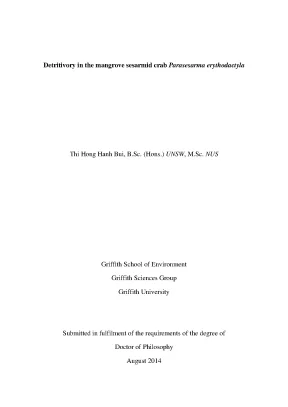
Tải xuống để đọc toàn bộDetritivory in the mangrove sesarmid crab Parasesarma erythodactyla Thi Hong Hanh Bui, B. NUS Griffith School of Environment Griffith Sciences Group Griffith University Submitted in fulfilment of the requirements of the degree of Doctor of Philosophy August 2014 ABSTRACT Sesarmid crabs have important ecological roles in the mangroves of the Indo-west-Pacific biogeographic region. By processing large amount of leaf litter, these crabs retain organic matter in the mangroves, increase the rate of mineralisation, and fuel additional trophic links with the processed material. However, the dietary composition of the mangrove sesarmids is still a controversy.
Gut content analyses suggest a dominant contribution of mangrove leaf litter in the crab diet but stable isotope data seem to support the assimilation of organic matter derived from the microphytobenthos but not mangrove litter. In addition, ability of the sesarmid crabs to obtain sufficient nutrition from mangrove litter, which is rich in structural carbon (cellulose) but poor in other nutrients such as nitrogen, has been questioned. The over- arching goal of this thesis was to fill these gaps of knowledge in detritivory of the mangrove sesarmids, using Parasesarma erythodactyla (Hess, 1865), the dominant shredder in sub- tropical Australian mangroves, as an animal model. The role of mangrove leaf litter in the diet of P.
erythodactyla was evaluated though a series of feeding experiments. Using natural abundance and dual-labelled (13C and 15N) mangrove leaf litter as feed, I showed that the crabs were well sustained on the leaf litter only diet for an extended period (9 weeks), and assimilated mangrove carbon and nitrogen at the efficiency of 36% and 56. Experimentally determined carbon and nitrogen trophic discrimination values (Δδ13C and Δδ15N) between P. erythodactyla and its three potential food sources, namely mangrove leaf litter, microphytobenthos and prawn muscle, were significantly different from the global mean values (~+1 ‰ for Δδ13C and +3 ‰ for Δδ15N) commonly used for interpretation of stable isotope data on mangrove food webs.
The close proximity between Δδ13C(crab-mangrove) determined by this study (+5.45‰ ) and the difference ii in δ13C values of the sesarmid-mangrove litter pairs reported in the liturature (mean = +5.8‰ ) suggests that the same Δδ13C(crab-mangrove) values may apply to other mangrove sesarmids feeding on mangrove litter. Dietary composition calculated by the IsoConc mixing model based on trophic discrimination values determined in this study supports a dominant contribution of mangrove leaf litter to the crab’s diet (89% in terms of biomass). Together, these results reinforce the notion that sesarmid crabs are the key initial processor of mangrove primary production, particularly in the Indo-west-Pacific, where mangrove sesarmids are most diverse and abundant. Unlike other detritivores, sesarmid crabs are capable of assimilating fresh mangrove leaf litter before significant microbial decomposition can occur, although aged litter is usually preferred.
Mechanisms by which these animals could exploit this low-quality food source, however, remains unclear. Using a molecular approach, I showed that mangrove detritivorous crabs are physiologically adapted to utilizing cellulose-rich mangrove detritus, the most abundant carbon source in this ecosystem, by possessing endogenous cellulose hydrolysis enzymes. Direct evidence of endogenous cellulase production not only in P. erythodactyla but also in other crabs of Sesarmidae, Varunidae, Macrophthalmidae, Heloeciidae, and Ocypodidae families is presented.
The cDNA sequences encoding endo-β-1,4-glucanase, one of the key enzymes required for complete digestion of cellulose, identified in these crabs are the first endogenous cellulase gene sequences reported for brachyuran crabs. I also demonstrated that the essential amino acid Threonine, Isoleucine, and Phenylalanine and the long-chain polyunsaturated fatty acid, docosahexaenoic acid (DHA), could be de novo synthesized in P. erythodactyla, possibly with assistance from its gut microflora. In addition to nutrients derived from animal and microphytobenthos food, these de novo synthesised iii nutrients represent a subsidy for the nitrogen and LC-PUFA deficient mangrove litter diet of the crab.
Findings of this study re-affirm the important role of the sesarmid crabs in mangrove organic matter dynamics. Through the sesarmid link, the unpalatable and hard-to-digest mangrove leaf litter is converted to either crab secondary production or faecal materials of improved nutritive values, supporting the nutrition of fauna in the mangrove and connected habitats. iv STATEMENT OF ORIGINALITY This work has not previously been submitted for a degree or diploma in any university. To the best of my knowledge and belief, the thesis contains no material previously published or written by another person except where due reference is made in the thesis itself.
Thi Hong Hanh Bui v TABLE OF CONTENTS ABSTRACT .ii STATEMENT OF ORIGINALITY. v LIST OF FIGURES. viii LIST OF TABLES. ix LIST OF ABBREVIATIONS .2 Role of sesarmid crabs in tropical mangrove ecosystems .3 Feeding ecology of grapsoid crabs .4 Parasesarma erythodactyla – the dominant sesarmid crab in the eastern Australian subtropical mangroves.5 Rationale of this thesis .5 Aims and objectives the thesis .6 Structure of the thesis.
DOES ‘YOU ARE WHAT YOU EAT’ APPLY TO MANGROVE GRAPSID CRABS? .3 Materials and Methods. ENDOGENOUS CELLULASE PRODUCTION IN THE LEAF LITTER FORAGING MANGROVE CRAB PARASESARMA ERYTHODACTYLA .2 Materials and Methods .4 Results and Discussion. POTENTIAL CONTRIBUTIONS OF GUT MICROFLORA TO THE NUTRITION OF THE DETRITIVOROUS SESARMID CRAB PARASESARMA ERYTHODACTYLA .3 Materials and Methods .2 Implications for the trophic role of detritivorous crabs in tropical mangrove ecosystems .3 Implications for the dynamics of mangrove primary production in estuarine food webs .4 Future research directions. 140 vii LIST OF FIGURES Figure 2.
Influence of available organic matter on the fitness of P. Temporal changes in δ13C and δ15N values of P. erythodactyla fed enriched mangrove leaves. δ13C and δ15N profiles of crabs on the mangrove leaf, MPB, and prawn diet.
Estimation of the diet composition of P. erythodactyla by the IsoConc mixing model. Effect of (A) pH (n = 8) and (B) temperature (n = 10) on total cellulase activity in the stomach juice of P. Full-length cDNA and the deduced amino acid sequence of PeEG.
Phylogenetic analysis of PeEG and GHF9 EGs from other animals. Expression of endo-β-1,4-glucanase genes in the hepatopancreas of the mangrove crabs. Effect of antibiotic treatment on number of gut microflora in crabs on the 13C- enriched glucose (GNE & GAE) and palmitic acid (PNE and PAE) supplemented diets. δ13C values of non-essential and essential (in boldface) amino acids of crabs fed 13 C-enriched glucose (GNE, GAE); non-enriched glucose diet (GNN); and the field crabs (F).
Relative enrichment in 13C of amino acids in muscle tissues of crabs fed on 13C- enriched glucose with (GAE) and without (GNE) antibiotic treatment. δ13C values of crabs fed glucose (A - C) and palmitic acid (D - F) supplements. Effect of antibiotic treatment on 13C compositions of FAs synthesised by crabs fed 13C-enriched glucose (A) and palmitic acid (B). Trophic transfer and transformation of mangrove primary production through the coastal food webs via the grapsoid link.
135 viii LIST OF TABLES Table 1. Reported rates of litter removal by sesarmid crabs recorded from mangroves throughout the world. C/N ratios of fresh mangrove leaf litter. Data used in the estimation of relative contributions of mangrove leaf, MPB and animal tissue in the diet of P.
erythodactyla using the IsoConc mixing model. Difference in δ13C (‰) values of the mangrove grapsid and their associated mangrove leaf litter from the literature. Oligonucleotide primers used for molecular work. Mangrove crabs used for the endo-β-1,4-glucanase gene expression study and the GenBank accession numbers of the 204 bp endo-β-1,4-endoglucanase cDNA fragments amplified from them.
Cellulase activities in the digestive juice of P. Summary of experimental set-up. 103 ix LIST OF ABBREVIATIONS AA Arachidonic acid CBM Carbohydrate binding module CMC Carboxymethyl cellulose CSIA Compound-specific isotope analysis DHA Docosahexaenoic acid EAA Essential amino acid EG Endo-β-1,4-glucanase EPA Eicosapentaenoic acid FA Fatty acid FAME Fatty acid methyl ester GC-IRMS Gas chromatography - isotope ratio mass spectrometry GHF9 Glycosyl hydrolase family 9 HSI Hepatosomatic index HUFA Highly unsaturated fatty acid IWP Indo-west Pacific LA Linoleic acid LC-PUFA Long-chain polyunsaturated fatty acid LNA Linolenic acid MPB Microphytobenthos MUFA Monounsaturated fatty acid ORF Open reading frame PBS Phosphate buffer saline PKS Polyketide synthase PUFA Polyunsaturated fatty acid RT-PCR Reverse transcription polymerase chain reaction SAFA Saturated fatty acid UTR Untranslated region x ACKNOWLEDGEMENTS First and formost, I would like to express my deep gratitude to my supervisor, Prof. Shing Yip (Joe) Lee, for his encouragement, continuous support, and great guidance.
From this enthusiastic, thoughtful and dedicated scientist, I have learned a great deal about doing research. I especially appreciate how he always encourages me to think independently and be confident in what I am doing. I sincerely thank the financial support from the Endeavour Postgraduate Scholarship scheme of the Australian Government, without which I would not have had the opportunity to conduct this work. I would also like to offer my special thanks to Prof.
Brian Fry (Griffith University), Dr Wenqing Wang (Xiamen University, China), and Ben Matthews (Smart Water Research Centre) for constructive feedback and useful advice on the stable istope and molecular work. Technical assistance in analysis of stable isotope and fatty acid samples provided by Daniel Tonzing, Rene Diocares, and Radoslaw Bak is greatly appreciated. I also wish to acknowledge Alan Richards, Dr Tish Pankhurst, Assoc. Dave Welsh, Dr Helen Stratton, Prof.
Jane Hughes, Shimony Mohanty, and Dr Marxim Sheludchenko for sharing resources for my experimental work. Also, thanks to Hee Lee for helpful assistance in administrative matters throughout my candidature. Many thanks to my friends, Anh, Patricia, Augustina, Yibing, Jason, Maizah, Liana, James, Ariella, Jean, Xiaolu, Dona, Shafagh, and Robert for general discussion on the project, providing good feedback for the pratice talks, and making life fun. Finally, I would like to thanks my family, especially my husband and daughter, and my best friend, Loan Le.
Their unconditional love, patience, and support meant so much to me.1 General overview Grapsoid crabs are some of the most abundant brachyurans in mangroves (Jones, 1984). The majority of mangrove grapsoids belongs to family Sesarmidae (previously Sesarminae (Lee, 1998) but see (Ng et al. The highest species diversity of grapsoids is recorded in the mangroves of the Indo-Pacific region (Lee, 1998), with up to 51 species (44 sesarmid species) described in Singapore-Malaysia (Tan and Ng, 1994) and 61 species (48 sesarmid species) in Australia (Davie, 2002). Being the initial processors of mangrove leaf litter, the grapsoids have an important role in cycling of organic matter in the mangroves.
By ingesting high percentages of leaf litter, these crabs retain a significant amount of autochthonous primary production in the mangroves (Cannicci et al. Crab litter processing also generates faecal material, which, upon microbial enrichment, has improved nutritive values and smaller fragment sizes than mangrove litter, potentially valuable to the nearshore consumers (Lee, 1997; Werry and Lee, 2005). In addition, mangrove grapsoids themselves are source of food for higher trophic levels. Remnants of grapsoids are prominent items in the diet of fishes in the mangroves of Malaysia (Leh et al., 2012; Sasekumar et al.
Despite the reported significant trophic role of the sesarmid crabs, their actual diet remains controversial. The high rates of litter removal (Table 1.1) and the high abundance of leaf litter relative to other food items found in the stomach of these crabs (Malley, 1978; Poovachiranon and Tantichodok, 1991) suggest a dominant contribution of mangrove leaf litter to their diet. Large deviations (~5‰) of carbon isotopic values (δ13C) of the grapsoid crabs from those of mangrove leaf litter, however, question a leading dietary role of this food source (Bouillon et al., 2002; Guest and Connolly, 1 2004; Mazumder and Saintilan, 2010). It must be noted, however, that past interpretations of mangrove crab stable isotope data were based on the means of the highly variable (among pairs of consumer and food source) trophic discrimination values reported in the literature rather than the true trophic discrimination values between the grapsoids and their potential food sources.
Nội dung được bảo vệ bản quyền — Tải xuống đầy đủ
Trích dẫn luận án này
Thi Hong Hanh Bui (2014). Detritivory ở cua Sesarmid: Nghiên cứu về Parasesarma erythodactyla [Luận án tiến sĩ, Griffith University]. LuanAn.net. https://luanan.net/tai-lieu-khac/detritivory-cua-sesarmid-parasesarma-erythodactyla
Câu hỏi thường gặp
Luận án "Detritivory ở cua Sesarmid: Nghiên cứu về Parasesarma erythodactyla" nghiên cứu về vấn đề gì?
"Nghiên cứu về quá trình tiêu thụ detritus của cua sesarmid Parasesarma erythodactyla trong rừng ngập mặn, vai trò của loài trong chu trình dinh dưỡng."
Luận án "Detritivory ở cua Sesarmid: Nghiên cứu về Parasesarma erythodactyla" được bảo vệ tại trường nào?
Luận án này được bảo vệ tại Griffith University. Năm bảo vệ: 2014.
Luận án "Detritivory ở cua Sesarmid: Nghiên cứu về Parasesarma erythodactyla" thuộc chuyên ngành gì?
Luận án "Detritivory ở cua Sesarmid: Nghiên cứu về Parasesarma erythodactyla" thuộc chuyên ngành Environment. Danh mục: Tài liệu khác.
Luận án "Detritivory ở cua Sesarmid: Nghiên cứu về Parasesarma erythodactyla" có bao nhiêu trang?
Luận án "Detritivory ở cua Sesarmid: Nghiên cứu về Parasesarma erythodactyla" có 156 trang. Bạn có thể xem trước một phần tài liệu ngay trên trang web trước khi tải về.
Cách tải luận án "Detritivory ở cua Sesarmid: Nghiên cứu về Parasesarma erythodactyla" về máy như thế nào?
Để tải luận án về máy, bạn nhấn nút "Tải xuống ngay" trên trang này, sau đó hoàn tất thanh toán phí lưu trữ. File sẽ được tải xuống ngay sau khi thanh toán thành công. Hỗ trợ qua Zalo: 0559 297 239.