Clay turner dissertation
Luận văn của Clay Turner trình bày nghiên cứu sâu rộng, phân tích các vấn đề học thuật phức tạp. Đóng góp kiến thức mới, mở ra hướng nghiên cứu tiềm năng.
Carnegie Mellon University
Economics and Public Policy
Luan An
Luận án tiến sĩ
Năm xuất bản
Số trang
144
Thời gian đọc
22 phút
Lượt xem
0
Lượt tải
0
Phí lưu trữ
40 Point
Tổng quan nhanh
- Chủ đề:
- 1. Introduction to Clay Turner Dissertation Research
- Số trang:
- 144 trang
- Trường:
- Carnegie Mellon University
- Chuyên ngành:
- Economics and Public Policy
- Tác giả:
- Abby Clay Turner
- Năm:
- 2013
Tóm tắt nội dung luận án
I. Introduction to Clay Turner Dissertation Research
This summary provides a concise overview of the Clay Turner doctoral dissertation, a significant scholarly publication in the field of education economics. The PhD thesis, titled "Three Essays on the Economics of Education," represents the culmination of extensive academic research and graduate studies at Carnegie Mellon University. It explores critical issues impacting student performance, educational policy, and the economic returns of various educational pathways. The dissertation full text offers in-depth analysis of these complex research topics. This foundational work contributes valuable empirical evidence to university archives and the broader academic community.
1.1. Core Focus of This Doctoral Dissertation
The Clay Turner doctoral dissertation, titled "Three Essays on the Economics of Education," constitutes a significant scholarly publication. This PhD thesis investigates critical issues within the field of education economics. The academic research explores various facets impacting student outcomes, educational policy, and the labor market returns to different educational pathways. The work represents a culmination of graduate studies at Carnegie Mellon University. This foundational research topic sets the stage for detailed empirical analyses across three distinct chapters. The dissertation full text provides comprehensive insights into these complex areas.
1.2. Academic Context and Committee Oversight
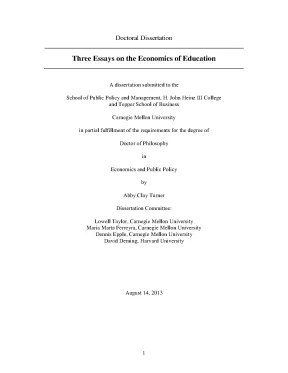
This extensive Clay Turner academic research was submitted to the School of Public Policy and Management, H. John Heinz III College, and Tepper School of Business at Carnegie Mellon University. It fulfills requirements for the degree of Doctor of Philosophy in Economics and Public Policy. A distinguished dissertation committee oversaw the PhD thesis. Committee members included Lowell Taylor, Maria Marta Ferreyra, Dennis Epple from Carnegie Mellon University, and David Deming from Harvard University. This oversight ensures the rigor and quality of the scholarly publication. The dissertation's submission date was August 14, 2013, marking a milestone in graduate studies.
1.3. Importance of Scholarly Publication
The Clay Turner doctoral dissertation serves as a vital scholarly publication. It contributes new empirical evidence to ongoing debates in education policy. The research topic encompasses timely and relevant issues for policymakers and educators. This PhD thesis offers data-driven insights. Such academic research informs future policy decisions. The complete dissertation full text is an essential resource for those studying the economics of education. This work from graduate studies enriches university archives and provides a basis for further academic inquiry. The insights derived from this dissertation abstract inform educational stakeholders.
II. Analyzing Formative Assessments 4Sight Impact
The first essay of the Clay Turner doctoral dissertation meticulously examines the effectiveness of formative assessments. This academic research, part of the comprehensive PhD thesis, focuses on 4Sight, an assessment battery designed to provide teacher feedback and improve student test scores. Methodologies drawn from program evaluation literature were applied, yielding surprising and critical insights. The findings, detailed in this scholarly publication, highlight the need for careful evaluation of educational interventions. This research topic provides crucial information for educational policymakers regarding assessment implementation and the unforeseen effects of publicly-funded programs.
2.1. Evaluating 4Sight s Effectiveness on Test Scores
The first essay in the Clay Turner doctoral dissertation examines the efficacy of 4Sight, a formative assessment system. This academic research investigates whether 4Sight provides teachers with useful feedback. The goal of this feedback is to improve student test scores throughout the year. Methodologies from program evaluation literature were employed. These included individual and school-level OLS, quartile regressions, probit regressions, and school-level matching. The study focused on Pennsylvania's first year of 4Sight implementation. Empirical results showed no discernible effect on math scores. A small negative effect was observed on reading scores. This finding represents a key part of the Clay Turner PhD thesis.
2.2. Unexpected Findings on NCLB Tutoring Programs
A surprising discovery emerged from this Clay Turner academic research. Students receiving publicly-funded tutoring under NCLB were significantly less likely to pass exams. This negative effect ranged between four and nine percent. These results held true even after controlling for various covariates, including eligibility for tutoring. This finding implies that NCLB tutoring programs might disadvantage participating students. The policy implications are substantial. This part of the doctoral dissertation advises caution for policymakers selecting interventions. The scholarly publication highlights potential unintended consequences in education.
2.3. Policy Recommendations for Assessment Implementation
III. Teacher Strikes Productivity in Public Schools
The second essay of the Clay Turner doctoral dissertation delves into the impact of teacher strikes and labor disputes on public school productivity. This academic research, a vital component of the Clay Turner PhD thesis, addresses a frequently debated topic with limited empirical data. The study utilizes regression analysis to quantify the effects of labor unrest on student test scores and graduation rates in Pennsylvania. This scholarly publication distinguishes between different forms of labor strife, offering nuanced insights for administrators and policymakers. The findings from this research topic provide a strong basis for informed decision-making in collective bargaining and education management.
3.1. Quantifying Labor Strife s Effect on Student Outcomes
The second essay in the Clay Turner doctoral dissertation addresses teacher strikes and collective bargaining. This academic research fills a gap in literature regarding labor unrest in public schools. The study explores whether a measurable relationship exists between labor strife and productivity. Data includes teacher strikes and expired contracts over seven years in Pennsylvania. Regression analysis was used to investigate this research topic. The Clay Turner PhD thesis provides empirical evidence.
3.2. Differentiating Strike vs. Contract Dispute Impacts
Findings from this Clay Turner academic research reveal distinct impacts. District-level math test pass rates decreased by 1-2% during a strike year. Pass rates also decreased by about 0.5% when teachers worked under an expired contract. Furthermore, cohorts experiencing a strike in their 11th-grade year saw a 2% decrease in graduation rates. This part of the doctoral dissertation distinguishes between productivity loss from strikes and from ongoing labor disputes. This refined analysis enhances the understanding of labor relations' effects on education. The scholarly publication offers unique insights.
3.3. Implications for Educational Policy Making
This Clay Turner doctoral dissertation chapter offers significant policy implications. Administrators need awareness of a strike's possible effect on graduation rates. The research highlights the need for better data collection on collective bargaining by state agencies. These insights contribute to informed decision-making regarding labor disputes in education. The academic research provides concrete evidence for policymakers. The thesis abstract conveys these critical findings.
IV. For Profit Higher Education Earnings Degrees
The final essay of the Clay Turner doctoral dissertation meticulously examines the economics of for-profit higher education. This academic research leverages rich datasets to analyze the labor market returns of two-year degrees, a key research topic within graduate studies. The Clay Turner PhD thesis identifies significant selection biases that complicate the accurate estimation of earnings gains. This scholarly publication provides critical insights into how institutional sector and major area of study influence post-graduation earnings, offering valuable information for prospective students and policymakers. The dissertation full text provides comprehensive empirical analysis of this rapidly growing sector.
4.1. Economic Returns of Two Year Degrees Explored
The third essay in the Clay Turner doctoral dissertation analyzes the for-profit higher education industry. This academic research uses data from NLSY97 Geocode merged with IPEDS institutional data. The study empirically analyzes individuals with two-year degrees. It estimates the average marginal earnings gain from these degrees. OLS regressions were employed with extensive controls for family background and demographics. This scholarly publication provides a first look into the differential inputs and outputs of for-profit and public two-year degree programs.
4.2. Selection Biases in Higher Education Choices
The Clay Turner PhD thesis identifies evidence of selection at multiple levels. Selection occurs into college itself, into the type of college (e.g., for-profit vs. public), and into a specific major area of study. These selection mechanisms introduce bias into estimates of labor market returns. Future academic research must model and unravel these processes for unbiased estimates. This highlights a critical methodological challenge in assessing educational outcomes. The doctoral dissertation emphasizes the complexity of analyzing earnings gains.
4.3. Sectoral and Major Area Influences on Earnings
This Clay Turner academic research finds a two-year degree results in an 8.1 percent average marginal earnings gain over a high-school diploma. The sector of the degree-granting institution alone affects this gain. Earnings gains also vary greatly by major. Individuals with “academic” degrees often experience different outcomes. This part of the doctoral dissertation provides crucial insights into how institutional type and field of study impact post-graduation earnings. The thesis abstract encapsulates these valuable findings for policy and individual decision-making. The dissertation full text offers comprehensive details.
Tải xuống file đầy đủ để xem toàn bộ nội dung
Tải đầy đủ (144 trang)Trích đoạn nội dung luận án
Tải xuống để đọc toàn bộDoctoral Dissertation Three Essays on the Economics of Education A dissertation submitted to the School of Public Policy and Management, H. John Heinz III College and Tepper School of Business Carnegie Mellon University in partial fulfillment of the requirements for the degree of Doctor of Philosophy in Economics and Public Policy by Abby Clay Turner Dissertation Committee: Lowell Taylor, Carnegie Mellon University Maria Marta Ferreyra, Carnegie Mellon University Dennis Epple, Carnegie Mellon University David Deming, Harvard University August 14, 2013 1 Introduction This thesis is composed of three essays on the economics of education. Chapter 1 analyzes the effectiveness of a battery of formative assessments, 4Sight, which are broadly aligned with annual assessments required by NCLB. These formative assessments are designed to provide teachers with feedback on student performance throughout the year in order to raise end of year student test scores.
Methodologies for evaluating the effect of using 4Sight on test score outcomes are drawn from the program evaluation literature, and include individual and school- level OLS, quartile regressions, and probit regressions, as well as matching at the school-level. Micro-econometric results show that 4Sight had no discernible effect on math scores and a small negative effect on reading scores in its first year in Pennsylvania. Policy recommendations include continuing a smaller-scale trial period of 4Sight for several more years in conjunction with careful, improved alignment between 4Sight and PSSA, ongoing empirical analysis of its effects, and incorporating more opportunity for feedback to teachers and students to improve 4Sight as a formative assessment. Perhaps the most surprising finding of this paper is that while 4Sight has a very small effect on student outcomes, students receiving tutoring under NCLB are significantly and between four and nine percent less likely to pass their exams, even after controlling for all covariates, including eligibility for tutoring.
This implies that the publicly- funded tutoring is actually disadvantaging those students who receive it. These results should serve as a cautionary example to school, district, and state-level policy-makers when choosing interventions designed to improve student performance on tests tied to NCLB. Teacher strikes and the right of public employees to collectively bargain are topics of frequent and heated debate in the public sphere, with little research available to inform the debate. In firms, the negative relationship between labor unrest and reduced productivity is well- documented; the purpose of this study is to explore whether there exists a similar, measurable relationship between labor strife and productivity in public schools.
In Chapter 2, I use regression analysis to analyze data that includes teacher strikes and expired contracts over a seven-year period in Pennsylvania, and I find that the pass rates on a district-level cohort’s math tests decrease by about 1-2% in the year of a strike and by about 0.5% during a year that teachers work under an expired contract. Additionally, cohorts experiencing a strike during their 11th- grade year realize about a 2% decrease in their graduation rate. In addition to improving upon 2 the methodologies of previous teacher strike papers, this paper distinguishes between productivity loss due to strikes and that due to lengthy ongoing labor disputes that do not necessarily end in strike. Policy implications include making administrators aware of the possible effect of a strike on graduation rates and the need for better collection of data on collective bargaining by state agencies.
The past decade has seen enormous growth in the for-profit higher education industry, and along with it, enormous debate over the relative costs and benefits of such an education. Utilizing the rich data from the NLSY97 Geocode merged with institutional data from IPEDS, in Chapter 3 I empirically analyze data on individuals with two-year degrees, estimate the average marginal earnings gain from a two-year degree, and compare the effects of degrees across institutional sector and across major area of study using OLS with family background and extensive demographic controls. I find evidence of selection at three levels: selection into college, selection into type of college, and selection into major area of study. Any estimates of labor market returns to these degrees will be biased until future research unravels and models these selection mechanisms and processes.
This chapter provides a first look into the differential inputs and outputs of for-profit and public two-year degree programs. I find that a two-year degree results in an 8.1 percent average marginal earnings gain over a high-school diploma, and that the sector of the degree-granting institution alone does affect this gain. I also find that earnings gains vary greatly by major; individuals with “academic” degrees experience no significant earnings gains while individuals with “vocational/technical” degrees on average experience a 32.7 percent earnings gain. I find statistical differences in the marginal earnings gains across institutional sector within major fields of study, suggesting that attending a for- profit does matter when major field of study is taken into account.
Policy-makers should take note that this preliminary analysis of the returns (which can be thought of as the private benefits) to public and for-profit degrees does not provide unambiguous evidence in favor of one sector over another, but rather a first look into the “black box” in which students, institutions, and major areas of study come together and jointly determine labor market outcomes. 3 Acknowledgements Chapter 1 utilizes confidential student achievement information obtained under a signed confidentiality agreement with the Pennsylvania Department of Education. The authors wish to thank Jinxiang Liu for programming and database support. The authors benefited from discussions with Maria Ferreyra, Margaret McMacken, John Garrow, Dave Davare, Brian Junker, participants at the October 3, 2008 seminar on applied microeconomics at the Tepper School, participants at the May 23, 2009 seminar at Heinz College, and comments received at the 2009 Annual Meeting of the American Economic Finance Association and the 2009 Summer Meeting of the North American Econometric Society.
Financial support from the Heinz Endowments and the William Penn Foundation is gratefully acknowledged. Responsibility for the findings and interpretation of this paper rests solely with the authors. Regarding Chapter 2, I would like to thank Lowell Taylor, Maria Marta Ferrerya, and Mel Stephens, Heinz and Tepper seminar participants, Melanie Zilora, Billie Morrow Davis, John Gardner, and Abby Linn. I also thank Dave Davare, Anne Herald, and the staff of the PSBA.
Chapter 3 has benefited from the advice of Lowell Taylor, Melanie Zilora, Billie Morrow Davis, Aaron Turner, my committee, and comments received at my dissertation proposal. I also thank Stephanie Cellini and Latika Chaudhary for their help in replicating their paper. I gratefully invite the comments and feedback of any readers of this version. This research was conducted with restricted access to Bureau of Labor Statistics (BLS) data.
The views expressed here do not necessarily reflect the views of the BLS. 4 Table of Contents Three Essays on the Economics of Education .4 Table of Contents .5 List of Tables .6 List of Figures .8 Chapter 1: With the Best of Intentions: School-Level Interventions and the Pursuit of Proficiency .1 Introduction and Research Questions .2 Some Background on Student Achievement Testing and Testing in Pennsylvania .3 Overview of 4Sight and its Use in Pennsylvania .4 Evaluation Methodology and Data Requirements .6 Conclusions, Implications, and Future Research .8 Tables and Figures. 59 Chapter 2: Labor Strife in Public Schools: Does it Affect Education Production?.7 Conclusions and Policy Implications .9 Tables and Figures. 99 Chapter 3: Selection Bias and For-Profit Associate Degrees: Evidence from the NLSY Geocode .6 Replication of Cellini and Chaudhary (2012) .9 Tables and Figures.
128 5 List of Tables Table 1.1: Student-Level Descriptive Statistics by 4Sight Math Use .2: Mean Student-Level 2005-06 PSSA Scaled Scores by 4Sight Math Use .3: Student Descriptive Statistics by 4Sight Reading Use .4: Mean Student-Level 2005-06 PSSA Scaled Scores by 4Sight Reading Use .5: School-Level Descriptive Statistics by 4Sight Math Use .6: Mean School--Level 2005-06 PSSA Scaled Scores by 4Sight Math Use .7: School-Level Descriptive Statistics by 4Sight Reading Use .8: Mean School-Level 2005-06 PSSA Scaled Scores by 4Sight Reading Use .10: Individual-Level OLS Results: Math.11: Individual-Level OLS Results: Reading .12: Individual-Level Quartile Regressions: Math .13: Individual-Level Quartile Regressions: Reading.14: Individual-Level Probit Results: Math .15: Individual-Level Probit Results: Reading .16: Individual-Levle Tobit Regression Results: .17: Individual-Level Tobit Regression Results: .18: Individual-Level Tobit Regression Results: Math Reporting Category with Controls .19: Individual-Level Tobit Regression Results: .20: School-Level OLS Results: Math .21: School-Level OLS Results: Reading .22: School-Level Nearest-Neighbor Matching Model Results: ATT of Math 4Sight on Mean Math PSSA Scaled Scores .23: School-Level Nearest-Neighbor Matching Model Results: ATT of Reading 4Sight on Mean Reading PSSA Scaled Scores .1: District-Level Math PSSA Pass Rate Descriptive Statistics.2: District-Level Reading PSSA Pass Rate Descriptive Statistics .3: Descriptive Statistics: Striking vs. Non-Striking Districts .4: Percent of Districts with Expired Contracts or Striking Each Year .5: Cohort Regression Results: 8th-11th Grade‡ .6: Regression Results: Graduation Rate† .7: Cohort Regression for One-Year First Differences, 4th-8th Grades† .2: Descriptive Statistics for Two-Year Completers, by Institutional Status .3: Outcome Descriptive Statistics, Age 25+ .4: Outcome Descriptive Statistics for Two-Year Completers, by Institution Type, Age 25+ .5: Area of Major for Two-Year Completers, by Institution Type .6: Selected Descriptive Statistics for Two-Year Completers, by Major and Institution Type .7: OLS Regression Results: Effects on Log Weekly Earnings .8: OLS Regression Results: Effects on Other Outcomes .9: Two-Year Completers: Industry Working In At Age 26, by Major and Institution Type.10: Descriptive Statistics for Fixed-Effects Analysis .11: Pre- and Post-Education Summary Statistics .12: Fixed-Effects Analysis: Returns to College Attendance, Log Weekly Earningsa .13: Fixed-Effects Analysis: Returns to College Attendance and Completion, Log Weekly Earningsa .14: Fixed-Effects Analysis: Effects of College Attendance on Other Labor Market Outcomesa .15: Fixed-Effects Analysis: Effects of College Attendance and Completion on Other Labor Market Outcomesa .16: Fixed-Effects Analysis: Returns to College Attendance by Major, Log Weekly Earnings .17: Fixed-Effects Analysis: Returns to College Attendance and Completion by Major, Log Weekly Earnings .144 7 List of Figures Figure 1.1: Propensity Scores for Math 4Sight Use† .2: Propensity Scores for Reading 4Sight Use† .1: Time-Trend in Math PSSA Pass Rates.2: Time Trend in Reading PSSA Pass Rates .3: Map of Striking Districts .4: Test Score Data Available, By Cohort. 95 8 Chapter 1: With the Best of Intentions: School-Level Interventions and the Pursuit of Proficiency with Robert P. Strauss Abstract This paper analyzes the effectiveness of a battery of formative assessments, 4Sight, which are broadly aligned with annual assessments required by NCLB.
These formative assessments are designed to provide teachers with feedback on student performance throughout the year in order to raise end of year student test scores. Methodologies for evaluating the effect of using 4Sight on test score outcomes are drawn from the program evaluation literature, and include individual and school-level OLS, quartile regressions, and probit regressions, as well as matching at the school-level. Micro-econometric results show that 4Sight had no discernible effect on math scores and a small negative effect on reading scores in its first year in Pennsylvania. Policy recommendations include continuing a smaller-scale trial period of 4Sight for several more years in conjunction with careful, improved alignment between 4Sight and PSSA, ongoing empirical analysis of its effects, and incorporating more opportunity for feedback to teachers and students to improve 4Sight as a formative assessment.
Perhaps the most surprising finding of this paper is that while 4Sight has a very small effect on student outcomes, students receiving tutoring under NCLB are significantly and between four and nine percent less likely to pass their exams, even after controlling for all covariates, including eligibility for tutoring. This implies that the publicly-funded tutoring is actually disadvantaging those students who receive it. These results should serve as a cautionary example to school, district, and state- level policy-makers when choosing interventions designed to improve student performance on tests tied to NCLB.1 Introduction and Research Questions The enactment of the No Child Left Behind (NCLB) Act in 2002 has hastened the spread of a culture of testing in the K – 12 public schools of our nation.
Nội dung được bảo vệ bản quyền — Tải xuống đầy đủ
Trích dẫn luận án này
Abby Clay Turner (2013). Clay turner dissertation [Luận án tiến sĩ, Carnegie Mellon University]. LuanAn.net. https://luanan.net/tai-lieu-khac/clay-turner-dissertation
Câu hỏi thường gặp
Luận án "Clay turner dissertation" nghiên cứu về vấn đề gì?
Luận văn của Clay Turner trình bày nghiên cứu sâu rộng, phân tích các vấn đề học thuật phức tạp. Đóng góp kiến thức mới, mở ra hướng nghiên cứu tiềm năng.
Luận án "Clay turner dissertation" được bảo vệ tại trường nào?
Luận án này được bảo vệ tại Carnegie Mellon University. Năm bảo vệ: 2013.
Luận án "Clay turner dissertation" thuộc chuyên ngành gì?
Luận án "Clay turner dissertation" thuộc chuyên ngành Economics and Public Policy. Danh mục: Tài liệu khác.
Luận án "Clay turner dissertation" có bao nhiêu trang?
Luận án "Clay turner dissertation" có 144 trang. Bạn có thể xem trước một phần tài liệu ngay trên trang web trước khi tải về.
Cách tải luận án "Clay turner dissertation" về máy như thế nào?
Để tải luận án về máy, bạn nhấn nút "Tải xuống ngay" trên trang này, sau đó hoàn tất thanh toán phí lưu trữ. File sẽ được tải xuống ngay sau khi thanh toán thành công. Hỗ trợ qua Zalo: 0559 297 239.