Luận án: Chiến lược Đa dạng hóa, Rủi ro và Hiệu quả Ngân hàng tại Việt Nam (2021)
Luận án tiến sĩ: Chiến lược đa dạng hóa ngân hàng Việt Nam. Phân tích hiệu quả & rủi ro bằng chứng thực nghiệm. Tối ưu hóa tăng trưởng bền vững.
Năm xuất bản
Số trang
186
Thời gian đọc
28 phút
Lượt xem
0
Lượt tải
0
Phí lưu trữ
50 Point
Tổng quan nhanh
- Chủ đề:
- 1. Chiến lược Đa dạng hóa Ngân hàng
- Số trang:
- 186 trang
- Trường:
- Trường Đại học Kinh tế Thành phố Hồ Chí Minh
- Chuyên ngành:
- Finance and Banking
- Tác giả:
- Pham Khanh Duy
- Năm:
- 2021
Tóm tắt nội dung luận án
I. Chiến lược Đa dạng hóa Ngân hàng
Đa dạng hóa ngân hàng là quá trình mở rộng dịch vụ và hoạt động của ngân hàng để giảm thiểu rủi ro và tăng cường hiệu quả. Chiến lược này giúp ngân hàng tăng trưởng bền vững và quản trị rủi ro hiệu quả.
1.1. Hiệu quả của Đa dạng hóa Ngân hàng
Đa dạng hóa ngân hàng giúp tăng cường hiệu quả hoạt động của ngân hàng bằng cách giảm thiểu rủi ro và tăng cường doanh thu.
1.2. Rủi ro của Đa dạng hóa Ngân hàng
Đa dạng hóa ngân hàng cũng có thể dẫn đến rủi ro nếu không được quản lý hiệu quả, bao gồm rủi ro tín dụng, rủi ro thị trường và rủi ro hoạt động.
II. Quản lý Rủi ro trong Đa dạng hóa Ngân hàng
Quản lý rủi ro là một phần quan trọng của đa dạng hóa ngân hàng. Ngân hàng cần phải xác định và quản lý rủi ro một cách hiệu quả để đảm bảo sự an toàn và ổn định của hệ thống tài chính.
2.1. Xác định Rủi ro
Ngân hàng cần phải xác định rủi ro một cách chính xác và đầy đủ để có thể quản lý rủi ro hiệu quả.
2.2. Quản lý Rủi ro
Ngân hàng cần phải có chiến lược quản lý rủi ro hiệu quả, bao gồm việc phân tích rủi ro, đánh giá rủi ro và thực hiện biện pháp giảm thiểu rủi ro.
III. Tái cấu trúc Ngân hàng
Tái cấu trúc ngân hàng là quá trình thay đổi cơ cấu và hoạt động của ngân hàng để tăng cường hiệu quả và giảm thiểu rủi ro. Tái cấu trúc ngân hàng giúp ngân hàng tăng trưởng bền vững và quản trị rủi ro hiệu quả.
3.1. Mở rộng Dịch vụ
Mở rộng dịch vụ là một phần quan trọng của tái cấu trúc ngân hàng. Ngân hàng cần phải mở rộng dịch vụ để tăng cường doanh thu và giảm thiểu rủi ro.
3.2. Tăng cường Quản trị
Tăng cường quản trị là một phần quan trọng của tái cấu trúc ngân hàng. Ngân hàng cần phải tăng cường quản trị để đảm bảo sự an toàn và ổn định của hệ thống tài chính.
IV. Kết quả và Thảo luận
Kết quả nghiên cứu cho thấy rằng đa dạng hóa ngân hàng có thể giúp tăng cường hiệu quả hoạt động của ngân hàng và giảm thiểu rủi ro. Tuy nhiên, quản lý rủi ro và tái cấu trúc ngân hàng là những yếu tố quan trọng để đảm bảo sự an toàn và ổn định của hệ thống tài chính.
4.1. Kết quả Nghiên cứu
Kết quả nghiên cứu cho thấy rằng đa dạng hóa ngân hàng có thể giúp tăng cường hiệu quả hoạt động của ngân hàng và giảm thiểu rủi ro.
4.2. Thảo luận
Thảo luận về kết quả nghiên cứu và ý nghĩa của nó đối với ngành ngân hàng và hệ thống tài chính.
V. Kết luận và Khuyến nghị
Kết luận và khuyến nghị về đa dạng hóa ngân hàng và quản lý rủi ro. Khuyến nghị về việc áp dụng chiến lược đa dạng hóa ngân hàng và quản lý rủi ro hiệu quả để tăng cường hiệu quả hoạt động của ngân hàng và giảm thiểu rủi ro.
5.1. Kết luận
Kết luận về đa dạng hóa ngân hàng và quản lý rủi ro.
5.2. Khuyến nghị
Khuyến nghị về việc áp dụng chiến lược đa dạng hóa ngân hàng và quản lý rủi ro hiệu quả.
Tải xuống file đầy đủ để xem toàn bộ nội dung
Tải đầy đủ (186 trang)Trích đoạn nội dung luận án
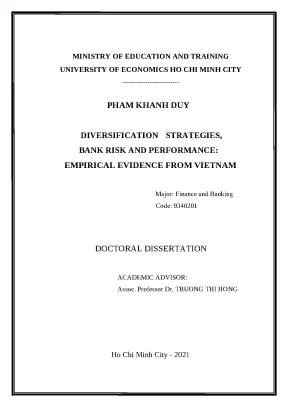
Tải xuống để đọc toàn bộMINISTRY OF EDUCATION AND TRAINING UNIVERSITY OF ECONOMICS HO CHI MINH CITY --------------------------- PHAM KHANH DUY DIVERSIFICATION STRATEGIES, BANK RISK AND PERFORMANCE: EMPIRICAL EVIDENCE FROM VIETNAM Major: Finance and Banking Code: 9340201 DOCTORAL DISSERTATION ACADEMIC ADVISOR: Assoc. TRUONG THI HONG Ho Chi Minh City - 2021 ii ACKNOWLEDGEMENT In completing this dissertation, I would like to express my gratitude to the University of Economics Ho Chi Minh City (UEH), which provides an ideal environment and financial support for my research journey. At UEH, I have gained valuable academic knowledge and research skills as a lecturer and as a Ph. My utmost appreciation is to my academic supervisor, Assoc.
Truong Thi Hong, for dedicated, whole-heartedly coaching and guidance throughout the completion of my thesis. My gratitude also goes to my dearest colleagues at the School of Banking and the School of UEH Graduate for their continuously dedicated support, contributions, and guidance, for me in writing this dissertation. I want to thank Prof. Vo Xuan Vinh for the preliminary research ideas and suggestions.
My special thanks to Dr. Nguyen Huu Huan, Dr. Ngo Minh Vu, Dr. Phan Chung Thuy, Dr.
Hoang Hai Yen, and Dr. Ngo Minh Hai for their best efforts in helping me with various challenges during my Ph. Saying thank you is just simply not enough for what they have offered me. Finally and most importantly, my beloved family and best friends have always been by my sides, with unconditional love, encouragement, and endless support.
Without them, this dissertation would have never been written. Thank you all for the most profound appreciation. Ho Chi Minh City, October 2021 Pham Khanh Duy iii TABLE OF CONTENTS STATEMENT OF AUTHENTICATION. ii TABLE OF CONTENTS.
iii ABBREVIATION LIST. vii LIST OF TABLES. viii LIST OF FIGURES. xi CHAPTER 1 INTRODUCTION.
Research gap identification. The scope of research. Research procedure and methodology. Structure of the dissertation.
19 CHAPTER 2 LITERATURE REVIEW AND HYPOTHESES DEVELOPMENT. Bank diversification definition. Classification of bank diversification strategies. Asset diversification in the banking sector.
Income diversification in the banking sector. Funding diversification in the banking sector. Theories of bank diversification. Theories of diversification.
Theories of bank diversification. Concept and measurement of bank risk and performance. Concept and measurement of bank risk. Concept and measurement of bank performance.
Theoretical overview of banking crisis. The impact of diversification on bank risk and performance. 50 Although the concern on the impact of diversification on banks' risks and performance is discussed in various articles, the conclusion of this topic is still unclear. Asset diversification, bank risk, and performance.
Income diversification, bank risk, and performance. Funding diversification, bank risk, and performance. Combinations of diversification strategies. Bank diversification, risk and performance in the financial crisis.
Role of ownership structure in the nexus between diversification, risk and performance. 67 v CHAPTER 3 DATA AND METHODOLOGY. Construction of variables. Dependent variables – Bank risk and performance.
Key explanatory variables - Bank diversification measures. The role of financial distress and bank ownership. 86 CHAPTER 4 EMPIRICAL RESULTS AND DISCUSSION. Diversification strategies, bank’s risk and performance.
Diversification strategy combination, bank risk and performance. Diversification, bank risk and performance during the crisis. The role of bank ownership structure. Robustness check results.
Summary of research findings. 122 LIST OF PUBLICATION. xv x ABSTRACT Purpose – This dissertation investigates the impacts of asset, funding, and income diversification strategies and their combinations on the banking system’s performance and risk in Vietnam, especially during the financial crisis. The research also evaluates the role of ownership structure upon diversification-risk and performance nexus.
Methodology – Using panel data collected from 34 Vietnamese commercial banks from 2005 to 2019, with modern econometrics technique – two-step system GMM estimator method described by Arellano and Bover (1995), are employed to achieve research objectives. The data was collected manually from the bank's audited financial statements, obtained from reliable sources. Findings – The empirical results indicate that, in general, diversification practices in banking sectors are effective in improving banks’ risk-return profile, especially during the financial crisis. However, using them in combinations is only effective for income and funding diversifications.
These results are robust regarding the use of alternative measures of diversification level. The results also indicate that this impact varies across different types of bank ownership: State- owned banks, domestic private banks, and foreign banks. Contribution – This dissertation fills the gap in empirical literature by systematically examining the nexus between diversification strategies, bank risk, and performance, conditioned upon financial crisis and ownership structure. In this sense, the findings of this dissertation provide bank managers and regulators important information about the diversification strategy effectiveness to maintain the stability of the banking system and financial market.
Keywords: Diversification strategies, bank performance, bank risk, ownership structure, financial crisis, emerging market. xi TÓM TẮT Mục đích - Mục đích của luận án này là nghiên cứu tác động của các chiến lược đa dạng hóa tài sản, nguồn vốn, thu nhập và sự kết hợp của chúng đối với rủi ro và hiệu quả hoạt động của các ngân hàng thương mại Việt Nam, đặc biệt trong thời kỳ khủng hoảng ngân hàng Việt Nam. Nghiên cứu cũng đánh giá vai trò của cấu trúc sở hữu dựa trên mối quan hệ giữa đa dạng hóa-rủi ro và hiệu suất. Phương pháp luận - Sử dụng dữ liệu bảng thu thập từ 34 ngân hàng thương mại Việt Nam từ năm 2005 đến năm 2019, với kỹ thuật kinh tế lượng hiện đại - phương pháp ước lượng GMM hệ thống hai bước được mô tả bởi Arellano và Bover (1995), được sử dụng để đạt được các mục tiêu nghiên cứu.
Dữ liệu được thu thập theo cách thủ công từ báo cáo tài chính hàng năm của ngân hàng, lấy từ Bankscope. Kết quả - Kết quả thực nghiệm cho thấy, nhìn chung, thực tiễn đa dạng hóa trong các lĩnh vực ngân hàng có hiệu quả trong việc cải thiện hiệu quả và rủi ro của các ngân hàng, đặc biệt là trong cuộc khủng hoảng ngân hàng Việt Nam từ năm 2011 đến năm 2014. Tuy nhiên, sử dụng kết hợp các chiến lược chỉ có hiệu quả đối với đa dạng hóa thu nhập và đa dạng hóa nguồn vốn. Những kết quả này rất rõ ràng khi sử dụng các phương pháp đo lường mức độ đa dạng hóa khác nhau.
Kết quả cũng chỉ ra rằng tác động này khác nhau giữa các loại hình sở hữu ngân hàng: ngân hàng quốc doanh, ngân hàng tư nhân trong nước và ngân hàng nước ngoài. Đóng góp - Luận án này đóng góp thêm vào các nghiên cứu thực nghiệm bằng cách xem xét một cách có hệ thống mối quan hệ giữa đa dạng hóa, rủi ro và hiệu quả hoạt động ngân hàng, tùy thuộc vào cấu trúc sở hữu và trong từng thời kỳ. Kết quả nghiên cứu của luận án cung cấp cho các nhà quản lý ngân hàng những thông tin quan trọng về hiệu quả của chiến lược đa dạng hóa nhằm duy trì sự ổn định của hệ thống ngân hàng và thị trường tài chính. Research motivation “In 1952, Nobel Laureate Harry Markowitz demonstrated mathematically why putting all your eggs in one basket is an unacceptably risky strategy and why diversification is the nearest an investor or business manager can ever come to a free lunch.
That revelation touched off the intellectual movement that revolutionized Wall Street, corporate finance and business decisions around the world; its effects are still being felt today” Bernstein and Bernstein (1996) The practice of diversification has created conflicting arguments about its impact on the banking sector’s risk and performance. On the one hand, a diversification strategy is motivated by certain advantages that focused banks cannot have: (1) gaining from exploiting managerial skills and abilities across products and geographical areas (Iskandar-Datta & McLaughlin, 2007), (2) taking advantage of economies of scale by sharing fixed costs across various products and markets (Drucker & Puri, 2009), and (3) offering a wide range of financial services to clients who require multiple products. On the other hand, the ones that prefer the concentration strategy claim that diversified banks can reduce their comparative management advantage when investing in many areas they are not experts (Klein & Saidenberg, 1998). Furthermore, diversification increases competition (Winton, 1999) and creates higher agency costs resulting from diminishing value activities when managers reduce their risk (L.
The empirical literature on banking diversification first addresses developed markets, where banks have been fully mature, such as the US market and other 2 developed countries in Europe (Baele, De Jonghe, & Vander Vennet, 2007; Curi, Lozano-Vivas, & Zelenyuk, 2015; Elsas, Hackethal, & Holzhäuser, 2010; Mercieca, Schaeck, & Wolfe, 2007; Stiroh & Rumble, 2006). The research and discussion on this topic in emerging and transition economies are explored (N. Chen, Liang, & Yu, 2018; Moudud-Ul-Huq, Ashraf, Gupta, & Zheng, 2018). However, the literature provides different results for different countries and regions (T.
According to Doumpos, Gaganis, and Pasiouras (2016), diversification can be more beneficial for banks operating in less developed countries compared to banks in advanced and major advanced countries. Vietnam is one of the fastest-growing emerging markets with significant reforms in both politics and the economy. Nevertheless, Vietnam is still considered a special case study as the country still set itself as a market-driven economy under a socialist regime (Doan, Lin, & Doong, 2018). State-owned enterprises play an exclusive role in the economy, particularly the banking and financial system.
The banking sector is always one of the most important factors of all economic systems. In Vietnam, the role of banks is more critical. The Vietnamese financial system has been bank- based, in which the banking industry is considered the bloodstream of the economy (Luu, Nguyen, & Vu, 2019; Vo & Nguyen, 2018). Banks are the main source of short and long-term funding for almost all firms, especially private firms (Tran, Ong, & Weldon, 2015).
Typically, the banking system in Vietnam is primarily 1 dominated by State-owned commercial banks , of which the majority shareholder is the State bank of Vietnam, with over 70% of owner equity. Besides, State-owned commercial banks account for approximately 50% of the market shares, possessing a large customer base, make them less motivated to improve their profitability or efficiency. The core business of 1 There are four biggest State-owned commercial banks, including Vietnam Bank for Agriculture and Rural Development, Joint Stock Commercial Bank for Investment and Development of Vietnam, Vietnam Joint Stock Commercial Bank of Industry and Trade, and Joint Stock Commercial Bank for Foreign Trade of Vietnam. 3 Vietnamese banks was concentrated in traditional interest-bearing activities and interbank lending.
During the integration phase, especially in 2007, the participation of Vietnam in the World Trade Organization (WTO) and the penetration of 5 foreign banks’ wholly-owned subsidiaries resulted in fierce competition in lending and deposit markets. Consequently, Vietnamese banks are forced to step out of their traditional business models and gradually diversify towards non-traditional activities (Le, 2015; P. When the real estate bubble burst in the United States in 2008, the Global economy witnessed a subprime mortgage crisis followed by the global financial crisis (Y. Chen, Wei, Zhang, & Shi, 2013; Demyanyk & Van Hemert, 2009).
The world economic growth slowed down while inflationary pressure still increased considerably, challenging central banks' monetary policy. The degree of impact was different depending on the level of integration into the economy. Many economies, especially large economies like the US, Europe, and Japan, suffer severe consequences such as negative economic growth, production and business recall, bankruptcy, and unemployment. The financial market has continuously shown negative signals in this condition, creating negative sentiment for the market and the economy.
The underlying cause of this economic catastrophe lies in the credit crunch and the concentration risk in the bank’s credit portfolio. Vietnam was not out of this negative trend.
Nội dung được bảo vệ bản quyền — Tải xuống đầy đủ
Trích dẫn luận án này
Pham Khanh Duy (2021). Chiến lược Đa dạng hóa Ngân hàng: Hiệu quả và Rủi ro tại Việt Nam [Luận án tiến sĩ, University of Economics Ho Chi Minh City]. LuanAn.net. https://luanan.net/tai-lieu-khac/chien-luoc-da-dang-hoa-ngan-hang-hieu-qua-ruoi-ro-viet-nam
Câu hỏi thường gặp
Luận án "Chiến lược Đa dạng hóa Ngân hàng: Hiệu quả và Rủi ro tại Việt Nam" nghiên cứu về vấn đề gì?
Luận án tiến sĩ: Chiến lược đa dạng hóa ngân hàng Việt Nam. Phân tích hiệu quả & rủi ro bằng chứng thực nghiệm. Tối ưu hóa tăng trưởng bền vững.
Luận án "Chiến lược Đa dạng hóa Ngân hàng: Hiệu quả và Rủi ro tại Việt Nam" được bảo vệ tại trường nào?
Luận án này được bảo vệ tại University of Economics Ho Chi Minh City. Năm bảo vệ: 2021.
Luận án "Chiến lược Đa dạng hóa Ngân hàng: Hiệu quả và Rủi ro tại Việt Nam" thuộc chuyên ngành gì?
Luận án "Chiến lược Đa dạng hóa Ngân hàng: Hiệu quả và Rủi ro tại Việt Nam" thuộc chuyên ngành Finance and Banking. Danh mục: Tài liệu khác.
Luận án "Chiến lược Đa dạng hóa Ngân hàng: Hiệu quả và Rủi ro tại Việt Nam" có bao nhiêu trang?
Luận án "Chiến lược Đa dạng hóa Ngân hàng: Hiệu quả và Rủi ro tại Việt Nam" có 186 trang. Bạn có thể xem trước một phần tài liệu ngay trên trang web trước khi tải về.
Cách tải luận án "Chiến lược Đa dạng hóa Ngân hàng: Hiệu quả và Rủi ro tại Việt Nam" về máy như thế nào?
Để tải luận án về máy, bạn nhấn nút "Tải xuống ngay" trên trang này, sau đó hoàn tất thanh toán phí lưu trữ. File sẽ được tải xuống ngay sau khi thanh toán thành công. Hỗ trợ qua Zalo: 0559 297 239.