Luận án: Cách các chính trị gia Mỹ hình dung về tương lai - Đại học Hawaii
Luận án: A dissertation submitted to the graduate division of the university of hawaii at mānoa in partial fulfillment of the requirments for the degree of. Xem
University of Hawai‘i at Mānoa
Luan An
Luận án
Năm xuất bản
Số trang
340
Thời gian đọc
51 phút
Lượt xem
0
Lượt tải
0
Phí lưu trữ
60 Point
Tổng quan nhanh
- Chủ đề:
- Tầm nhìn chính trị Mỹ: Vượt qua nhiệm kỳ bầu cử
- Số trang:
- 340 trang
- Trường:
- University of Hawai‘i at Mānoa
- Chuyên ngành:
- Political Science
- Tác giả:
- David J. Brier
- Năm:
- 2011
Tóm tắt nội dung luận án
I.Tầm nhìn chính trị Mỹ Vượt qua nhiệm kỳ bầu cử
Nghiên cứu này thách thức quan niệm phổ biến về tư duy chính trị. Chính trị gia Mỹ không chỉ tập trung vào nhiệm kỳ tiếp theo. Họ thường xuyên hình dung và thảo luận về các viễn cảnh dài hạn. Các diễn văn và lời khai quốc hội cung cấp bằng chứng rõ ràng. Tài liệu cho thấy sự cân nhắc về tác động của chính sách lên các thế hệ tương lai. Điều này góp phần mở rộng hiểu biết về tầm nhìn chính trị Mỹ. Nó chỉ ra một sự phức tạp hơn trong quá trình hoạch định chính sách.
1.1. Khám phá tư duy dài hạn của chính khách.
Chính khách Mỹ thể hiện khả năng tư duy chiến lược. Họ xem xét những hậu quả vượt ra ngoài chu kỳ bầu cử. Các chủ đề như phát triển bền vững, an ninh quốc gia Mỹ, và cải cách hệ thống được đưa ra. Điều này cho thấy cam kết với tương lai lâu dài của đất nước. Tầm nhìn chính trị Mỹ không bị giới hạn bởi thời gian ngắn.
1.2. Phân tích diễn văn và lời khai Quốc hội.
Các diễn văn tình hình thành phố và bang từ năm 2000-2010 được phân tích. Lời khai trước Quốc hội cũng là nguồn dữ liệu quan trọng. Nội dung liên quan đến tương lai được định lượng và phân loại. Phương pháp này giúp nhận diện chính sách tương lai Mỹ. Nó cung cấp cái nhìn sâu sắc về cách các nhà lãnh đạo diễn đạt kỳ vọng.
II.Phương pháp mới phân tích chính sách tương lai Mỹ
Luận án giới thiệu một phương pháp phân loại hình ảnh tương lai mới. Phương pháp này xem xét tương lai như một quá trình chính trị. Nó không đơn thuần là một trạng thái sẽ xảy ra. Cách tiếp cận này giúp phân tích vai trò của chủ thể con người. Nó chỉ ra cách các chính trị gia hình thành và kiểm soát tương lai. Đây là bước đột phá giúp các nhà phân tích thoát khỏi các khuôn khổ cũ. Nó tăng cường khả năng nhận diện các chính sách dài hạn.
2.1. Tương lai là quá trình Vai trò chủ động.
Con người có khả năng định hình tương lai. Chính trị là một quá trình liên tục. Các cuộc đấu tranh và thỏa hiệp tạo ra các hướng đi khác nhau. Khái niệm này nhấn mạnh sự năng động trong hoạch định chính sách. Nó cho thấy chính sách tương lai Mỹ là kết quả của các hành động hiện tại.
2.2. Thoát khỏi khung tranh luận truyền thống.
Cách nhìn cũ thường đối lập phát triển kinh tế ngắn hạn và bảo tồn môi trường dài hạn. Phương pháp mới phá vỡ sự nhị nguyên này. Nó cho phép một cách hiểu phức tạp hơn về công lý liên thế hệ. Nó giúp phân tích chính sách mà không bị giới hạn.
III.Thế hệ tương lai và thách thức toàn cầu của Mỹ
Các chính trị gia Mỹ thường đề cập đến "thế hệ tương lai". Tuy nhiên, việc sử dụng khái niệm này có sự phức tạp. Nghiên cứu chỉ ra rằng các thế hệ tương lai không có một bản sắc thống nhất. Họ không chia sẻ một tiếng nói chung. Điều này đặt ra thách thức trong việc xây dựng các chính sách. Đặc biệt đối với các vấn đề như biến đổi khí hậu. Việc bảo vệ lợi ích của họ đòi hỏi sự hiểu biết sâu sắc hơn.
3.1. Ngôn ngữ về công lý liên thế hệ.
Các diễn văn chính trị thường chứa đựng thông điệp này. Chính trị gia nói về việc để lại di sản tốt đẹp. Họ cam kết đảm bảo tương lai bền vững cho con cháu. Khái niệm công lý liên thế hệ được đề cập. Nó thể hiện sự quan tâm đến các hậu quả dài hạn.
3.2. Không có bản sắc chung cho thế hệ sau.
“Thế hệ tương lai” là một khái niệm trừu tượng. Nó bao gồm nhiều nhóm lợi ích khác nhau. Các nhóm này có thể có nhu cầu và ưu tiên khác biệt. Sự thiếu vắng một bản sắc chung làm phức tạp chính sách. Điều này yêu cầu chính phủ phải linh hoạt.
3.3. Biến đổi khí hậu và chính sách tương lai Mỹ.
Biến đổi khí hậu là một thách thức toàn cầu. Nó đòi hỏi các giải pháp dài hạn. Các chính sách về môi trường, năng lượng cần được xem xét cẩn trọng. Điều này liên quan trực tiếp đến phúc lợi của thế hệ tương lai. Phát triển công nghệ xanh cũng là một phần của giải pháp.
IV.Tranh cãi ANWR Định hình an ninh quốc gia Mỹ
Cuộc tranh luận về Khu bảo tồn Động vật Hoang dã Quốc gia Bắc Cực (ANWR) minh họa rõ ràng. Tương lai là một quá trình liên tục đấu tranh. Các phe phái chính trị đối lập nhau. Họ tranh giành quyền kiểm soát định hình chính sách. ANWR trở thành biểu tượng cho sự xung đột tầm nhìn. Nó phản ánh sự khác biệt giữa Đường lối Đảng Dân chủ và Đường lối Đảng Cộng hòa. Cuộc tranh luận này có ý nghĩa quan trọng đối với an ninh quốc gia Mỹ. Nó liên quan đến nguồn năng lượng và bảo vệ môi trường.
4.1. ANWR Cuộc chiến định hình tương lai.
Khu vực ANWR là điểm nóng về chính sách. Tương lai của nó gắn liền với các quyết định hiện tại. Khai thác tài nguyên hay bảo tồn sinh thái là câu hỏi cốt lõi. Đây là một cuộc chiến không ngừng nghỉ giữa các lợi ích.
4.2. Xung đột tầm nhìn Đường lối Đảng Dân chủ và Cộng hòa.
Đảng Dân chủ thường ủng hộ bảo vệ môi trường. Họ ưu tiên bảo tồn ANWR. Đảng Cộng hòa thường ủng hộ khai thác tài nguyên. Họ nhấn mạnh an ninh năng lượng và phát triển kinh tế. Các đường lối này đối lập nhau. Chúng định hình các chính sách về năng lượng và môi trường của Mỹ.
V.Tác động chính sách Hướng tới tương lai bền vững
Nghiên cứu này cung cấp cái nhìn sâu sắc về khả năng của chính phủ. Chính phủ có thể hướng tới một tương lai bền vững hơn. Nó gợi ý một cấu trúc chính trị có tầm nhìn xa. Các hình ảnh về tương lai ảnh hưởng đến tư duy chính trị. Công trình này tích hợp các ý tưởng của James Dator và Michel Foucault. Nó phân tích mối quan hệ giữa quyền lực và kiến thức. Điều này có ý nghĩa quan trọng cho việc tạo ra những tương lai công bằng. Nó cũng ảnh hưởng đến Kinh tế Mỹ 2030 và định hướng phát triển công nghệ.
5.1. Khả năng quản trị hướng tới tương lai.
Chính phủ có tiềm năng thực hiện các chính sách dài hạn. Việc này đòi hỏi sự thay đổi trong cách tư duy. Chính sách tương lai Mỹ cần được xây dựng cẩn trọng. Nó phải xem xét các hậu quả đa chiều. Điều này thúc đẩy sự bền vững cho quốc gia.
5.2. Ảnh hưởng của quyền lực và kiến thức.
Quyền lực định hình cách chúng ta nói về tương lai. Kiến thức ảnh hưởng đến cách chúng ta hình dung nó. Các hình ảnh chung về tương lai có thể bị thao túng. Việc nhận thức điều này giúp tạo ra chính sách công bằng hơn.
5.3. Phát triển công nghệ và Kinh tế Mỹ 2030.
Phát triển công nghệ là động lực chính của tương lai. Chính sách cần hỗ trợ đổi mới sáng tạo. Kinh tế Mỹ 2030 sẽ chịu tác động lớn từ các quyết định hiện tại. Đầu tư vào công nghệ xanh, AI, và các lĩnh vực chiến lược là cần thiết. Điều này đảm bảo Mỹ duy trì vị thế cạnh tranh toàn cầu và trong quan hệ quốc tế.
Tải xuống file đầy đủ để xem toàn bộ nội dung
Tải đầy đủ (340 trang)Trích đoạn nội dung luận án
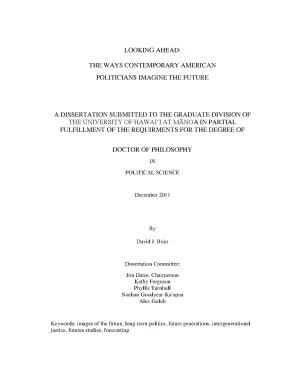
Tải xuống để đọc toàn bộLOOKING AHEAD: THE WAYS CONTEMPORARY AMERICAN POLITICIANS IMAGINE THE FUTURE A DISSERTATION SUBMITTED TO THE GRADUATE DIVISION OF THE UNIVERSITY OF HAWAI‘I AT MĀNOA IN PARTIAL FULFILLMENT OF THE REQUIRMENTS FOR THE DEGREE OF DOCTOR OF PHILOSOPHY IN POLITICAL SCIENCE December 2011 By David J. Brier Dissertation Committee: Jim Dator, Chairperson Kathy Ferguson Phyllis Turnbull Noelani Goodyear-Ka'opua Alex Golub Keywords: images of the future, long-term politics, future generations, intergenerational justice, futures studies, forecasting ©2011 by David J. Brier ii DEDICATION To my children Jade and Rory iii ACKNOWLEDGMENTS I am grateful to all the members of my committee who have inspired and helped me. Kathy Ferguson’s and Phyllis Turnbull’s work and comments helped sharpen my eye for the practices of political power within images of the future.
Noelani Goodyear-Ka’opua’s work inside and outside of the classroom helped me imagine new worlds and enriched my ideas in this project. Alex Golub’s entry into the project made an arduous process easier and more bearable. I am especially thankful to James Dator, my chair and mentor, who guided me through this process. Over the years, he has invested much time, energy, and attention teaching and coaching me.
His work inspired me and speaks from these pages. I am grateful to my dad, the late Robert J. Brier, who never failed to offer me his analytic energies reading and unraveling politics. My dad’s interest in politics (and daily critiques on political corruption and inefficiencies) rubbed off on me and inspired my interest in studying government.
My mother, Maria Brier, offered regular encouragement that I would finish this project. Thanks go to my children. My daughter, Jade, politely sat through numerous out loud readings of paragraphs of this dissertation (and then ran when it looked like I would read more). Jade has not yet known a time when her dad was not “working on his dissertation.” The completion of this project will open a new chapter in her life with me.
My now two year old son, Rory, acted as my unofficial editor. He sat on my lap as I typed portions of the dissertation offering creative commentary (an odd mix of babble and interesting linkages among chocolate milk, cookies, cheese, and the future) and encouragement. Above all, I am grateful to my wife, Vickery, who remains an invaluable support. She took the children out of the house on countless weekend mornings so I could write.
She gave me pep talks when I needed it and provided a sounding board when trying to form and sharpen my arguments. Without her intellectual and emotional support, I would have been unable to complete this dissertation. iv ABSTRACT This dissertation examines the ways in which contemporary American politicians imagine the future. Analysis of the futures-related content of political speeches and congressional testimony reveals that, contrary to conventional wisdom, politicians do think beyond the next election and, at times, consider the plight of future generations.
Chapter 2 analyzes images of the future and futures-related discourse found in State of the City and State of the State addresses delivered between 2000 and 2010. The dissertation provides a new methodology to classify images of the future to improve the ability of analysts to identify long-term politics. Typically, categorization schemes such as Dator’s generic images of the future encourage the analyst to conceptualize the future as a noun, the thing it becomes. This dissertation offers a new classification scheme that invites scholars to conceptualize the future as a verb, a political process and contest.
By exploring the ways politicians speak about the extent of human agency in shaping the future, this dissertation develops a technique to help scholars escape the short-term economic development versus long-term environmental preservation frame that dominates our thinking about long-term politics and intergenerational justice. Chapter 3 investigates the use of future generations-related language and themes in these speeches. Chapter 4 studies the struggle to control the future of the Arctic National Wildlife Refuge (ANWR). The ANWR debate shows that the future is a process (a contest) as much as it a thing (what emerges).
The ANWR debate also suggests that one cannot speak about the plight of future generations in any universal or common way because future generations do not share a unified identity. Drawing on an array of sources including James Dator’s generic images of the future and Michel Foucault’s ideas on power/knowledge, I study v how these generic images of the future and power shape the way politicians do (and do not) speak and think about the future and the implications for creating just futures. This dissertation complicates an overly simplistic view of long-term politics and contributes to a discussion about the possibilities of more future-oriented government in the current political structure. vi TABLE OF CONTENTS ACKNOWLEDGEMENTS iv ABSTRACT v LIST OF FIGURES x CHAPTER 1.
INTRODUCTION 1 Politicians Don’t Take the Future Seriously 1 Short-Term Assumptions and Starting Points 3 Individuals and Groups have Exclusively Short-Term Interests 4 Events Contain One Time Horizon 10 Future Generations are a Single Entity 11 Long-Term Thinking is Altruistic 11 Long-Term Action Will be Punished by the Electorate 12 Short-Term Action is Required by the Structure of Democratic Institution 13 Politicians Have No Long-Term Interests of their Own 14 Future-Oriented Behavior is Counted by Winning Acts of Legislation 15 Long-Term Thinking is Primarily a Struggle between Short-Term Development Needs and Long-Term Environmental Issues 16 A More Complicated Story 30 Agency without Autonomy 31 The Remaining Chapters 32 The Justification for This Dissertation 33 CHAPTER 2. IMAGINING THE AMERICAN FUTURE: VISIONS OF WHAT IS TO COME IN POLITICAL SPEECHES 36 Why Rhetoric and Discourse? 36 State of the State and State of the City Speeches 43 Images of the Future 44 Economic Growth Image 51 vii Technology Driven Future 53 Economic Growth versus Environmental Protection Equals Green Jobs 59 Feasibility 63 Education – Preparing Today’s Labor Force for Tomorrow’s Jobs 75 Using the Future – The Future as a Strategic Asset 79 Hauntingly Familiar 82 Education in 2100 85 Social Continuity 86 Phoenix in 2034 87 The Emergence of the Creative Class 89 Social Justice & the Uncreative Class 95 Technological Fixes 97 The Future Hawaiian Style 106 There Can Only be One 107 Using the Long-Term 108 Smart Growth 110 Shrinkage (Smart Decline) 116 Who to Shrink? 118 Image Complexity (Images within Images) 121 The Many Challenges to Futures Thinking 123 Agency Images 142 Conclusion 152 CHAPTER 3. IMAGINING FUTURE GENERATIONS 155 Generativity 158 Who Benefits? 162 Open Space 167 Time Horizon 170 Scope of Interest 172 The Gendered Nature of the Future 173 Conclusion 178 viii CHAPTER 4. ANWR: A CASE STUDY IN POLITICAL FUTURES 179 Why ANWR? 180 Background 181 Structural Prohibiters or Enablers 184 Whose Long-Term? 186 Cost Benefit Analysis 188 Growth Future 191 Thinking About Future Generations 194 National Environmentalism versus Global Environmentalism 204 National Security 210 Indigenous Futures 217 Alaska Land Claims Settlement Act 228 Introducing the Gwich’in 231 Who Decides? The Genuine Native 233 The Timeless Indian 241 Conclusion 247 CHAPTER 5: CONCLUSION 249 REFERENCES 272 APPENDIX.
FUTURE EXCERPTS 295 Dean, Howard. Vermont State of the State Address 295 Gordon, Phil. 2004 Phoenix State of the City Address 298 Hoeven, John. 2005 North Dakota State of the State Address.
2009 Hawaii State of the State Address 314 Nickels, Greg. 2007 Seattle State of the City Address 324 Shaheen, Jeanne. 2001 New Hampshire State of the State Address 326 ix LIST OF FIGURES Figure 1: ANWR Map 182 Figure 2: ANWR Land Use 182 x CHAPTER 1 INTRODUCTION Politicians Don’t Take the Future Seriously A popular belief in futures research, political science, and public administration is that elected members of government do not think long-term (20 years or more into the future) or beyond the next election cycle when preparing or considering legislation and providing plans and visions to their constituencies. For example, public administration scholars Keiner, Rejeski and Wobig described it this way: Ask high level public officials how much time they are able to spend thinking about long-term issues, and the answers often range from “none” to “a few moments in the shower this morning.” The future is simply too distant to command much attention given the day-to-day imperatives of government.
(Keiner, Rejeski, & Wobig 2002, 26) This assumption that government focuses on the present and does not think long-term is shared by numerous futurists. In the words of political scientist and futurist James Dator: “it is impossible for a legislator to be future-oriented” (Griffith 2005, 8) and “… the future can and MUST be ignored by elected officials (Dator 1998). This is echoed by futurist Alvin Toffler when blaming government policy makers for failing to anticipate the future: “Our political decision makers swing widely back and forth between doing nothing about a problem until it explodes into crisis, and alternatively, racing in with ill- equipped, poorly assessed crash programs” (Toffler 1978, xvii). And reechoed by futurist Richard Slaughter when writing “governments around the world still maintain their short- term time horizons up to the next election, with little or no thought for the longer-term” (Slaughter 1996).
This conventional assumption is not limited to political scientists, public administration scholars, or futurists. To illustrate, an editorial appearing in Australian newspaper represented the belief this way: Government must begin thinking ahead with the unacceptable rate of unemployment in this country, one would expect the Federal Government to be doing everything possible to remedy defects in our education and training system. Unfortunately, as with business here, Australian governments do not understand the necessity to set long-term goals… Surely, somewhere in the ranks of our 1 leaders there is someone who has the vision to anticipate what Australian society will be like in 20 years time. (Northern Times 1998) Even some government officials share this belief.
According to the former General Accounting Office Comptroller David Walker “One of the biggest problems in Washington today is the continued unwillingness of public officials to look at the future, recognize reality and make difficult policy choices” (McFetters 2005). Although not a futurist, Walker’s responsibility for supervising the US federal budget from 1998 to 2008 led him to conclude that the United States suffers from temporal myopia and an inability to engage and solve long-term problems. The belief that government focuses on the present and does not think long-term is widespread. Yet politicians do speak about the future and act on behalf of future generations.
In the course of my graduate studies in public administration and political science, I read and could not help but notice that many contemporary American political speeches contained beliefs of and desires for the future well beyond the next election and, indeed, beyond the politician’s term limit in office. When, during a course in political futures in my doctoral program, I began to review legislation and public policy for language and provisions to promote and protect future generations, what I read did not always concur with the mainstream view that politicians ignore the future. It appeared as if academics making such assertions avoided the wealth of political language on the future and the examples of legislation and policy proposed on behalf of future generations. It is easier not to see a concern for the plight of future generations if one remains committed to the prejudice that politicians don’t care about the future.
However, if one begins to read political language and public policy closely and with a habit of finding the future, instances of it become apparent. In my job as a librarian, I noticed that numerous academics spoke and wrote about topics in a way that allowed them to ignore long-term organization and action inherent in political movements. To illustrate, a review of academic literature indicates there is little published on the subject or keywords long-term politics (or short-term politics for that matter).
Nội dung được bảo vệ bản quyền — Tải xuống đầy đủ
Trích dẫn luận án này
David J. Brier (2011). Cách chính trị gia Mỹ hình dung tương lai [Luận án tiến sĩ, University of Hawai‘i at Mānoa]. LuanAn.net. https://luanan.net/tai-lieu-khac/cach-chinh-tri-gia-my-hinh-dung-tuong-lai
Câu hỏi thường gặp
Luận án "Cách chính trị gia Mỹ hình dung tương lai" nghiên cứu về vấn đề gì?
Luận án: A dissertation submitted to the graduate division of the university of hawaii at mānoa in partial fulfillment of the requirments for the degree of. Xem
Luận án "Cách chính trị gia Mỹ hình dung tương lai" được bảo vệ tại trường nào?
Luận án này được bảo vệ tại University of Hawai‘i at Mānoa. Năm bảo vệ: 2011.
Luận án "Cách chính trị gia Mỹ hình dung tương lai" thuộc chuyên ngành gì?
Luận án "Cách chính trị gia Mỹ hình dung tương lai" thuộc chuyên ngành Political Science. Danh mục: Tài liệu khác.
Luận án "Cách chính trị gia Mỹ hình dung tương lai" có bao nhiêu trang?
Luận án "Cách chính trị gia Mỹ hình dung tương lai" có 340 trang. Bạn có thể xem trước một phần tài liệu ngay trên trang web trước khi tải về.
Cách tải luận án "Cách chính trị gia Mỹ hình dung tương lai" về máy như thế nào?
Để tải luận án về máy, bạn nhấn nút "Tải xuống ngay" trên trang này, sau đó hoàn tất thanh toán phí lưu trữ. File sẽ được tải xuống ngay sau khi thanh toán thành công. Hỗ trợ qua Zalo: 0559 297 239.