Luận án: Ảnh hưởng gradient nhiệt lên hành vi tế bào bằng mảng dây vi của Truong Ka My Dang
Dùng mảng vi dây nghiên cứu ảnh hưởng gradient nhiệt độ lên hành vi tế bào. Khám phá ứng dụng đột phá trong sinh học tế bào.
Technische Universität München
Elektrotechnik und Informationstechnik / Neuroelektronik
Luan An
Luận án tiến sĩ
Năm xuất bản
Số trang
144
Thời gian đọc
22 phút
Lượt xem
0
Lượt tải
0
Phí lưu trữ
40 Point
Tổng quan nhanh
- Chủ đề:
- Nghiên cứu Ảnh hưởng Gradient Nhiệt lên Hành vi Tế Bào
- Số trang:
- 144 trang
- Trường:
- Technische Universität München
- Chuyên ngành:
- Elektrotechnik und Informationstechnik / Neuroelektronik
- Tác giả:
- Truong Ka My Dang
- Năm:
- 2018
Tóm tắt nội dung luận án
I.Nghiên cứu Ảnh hưởng Gradient Nhiệt lên Hành vi Tế Bào
Nhiệt độ đóng vai trò thiết yếu trong việc điều hòa chức năng sinh học và sự phát triển của tế bào. Những thập kỷ gần đây, công nghệ vi chế tạo đã phát triển mạnh mẽ. Công nghệ này cho phép điều khiển nhiệt độ cục bộ ở quy mô vài micron. Điều này mở ra cơ hội nghiên cứu ảnh hưởng gradient nhiệt lên vi hệ thống sinh học. Luận án này khám phá những thay đổi trong hành vi tế bào tùy thuộc vào gradient nhiệt bằng cách sử dụng mảng dây vi. Ngoài ra, luận án giới thiệu phương pháp lớp hy sinh để chế tạo vi kênh dẫn hướng neuron. Việc tích hợp mảng dây vi vào các vi kênh này mang lại phương pháp mới. Phương pháp này giúp điều khiển mạng lưới thần kinh dưới ảnh hưởng gradient nhiệt. Nghiên cứu tập trung vào việc làm sáng tỏ cơ chế tế bào phản ứng với sự thay đổi nhiệt độ. Công trình này cung cấp cái nhìn sâu sắc về đáp ứng tế bào với nhiệt độ, mở đường cho các ứng dụng y sinh.
1.1. Tầm quan trọng của gradient nhiệt và vi hệ thống
Nhiệt độ ảnh hưởng sâu sắc đến mọi hoạt động sinh học. Sự biến đổi nhiệt độ cục bộ tạo ra gradient nhiệt có thể kích thích hoặc ức chế các quá trình tế bào. Nghiên cứu trên vi hệ thống cho phép kiểm soát chính xác môi trường vi mô. Điều này giúp theo dõi hành vi tế bào trong điều kiện được xác định.
1.2. Mảng dây vi và điều khiển nhiệt độ cục bộ
Mảng dây vi là công cụ chủ chốt trong nghiên cứu này. Chúng tạo ra nhiệt độ tại các điểm siêu nhỏ. Kết nối mảng dây vi với nguồn điện cung cấp khả năng điều khiển nhiệt độ cục bộ hiệu quả. Kỹ thuật này tái tạo các điều kiện gradient nhiệt phức tạp trong phòng thí nghiệm.
1.3. Phương pháp nghiên cứu hành vi tế bào
Luận án sử dụng các phương pháp tiên tiến để quan sát hành vi tế bào. Kỹ thuật chụp ảnh canxi tốc độ cao giúp đánh giá lan truyền tín hiệu. Phương pháp chụp ảnh theo thời gian (time-lapse) theo dõi tăng sinh tế bào và hướng phát triển. Phân tích hình ảnh cung cấp dữ liệu định lượng về đáp ứng tế bào với nhiệt độ.
II.Mảng Dây Vi Điều Khiển Nhiệt Độ Cục Bộ Tế Bào Tim
Phần này trình bày ứng dụng mảng dây vi để nghiên cứu ảnh hưởng gradient nhiệt lên sự lan truyền tín hiệu trong mạng lưới tế bào tim. Một lớp tế bào cơ tim (cardiomyocytes) được nuôi cấy trực tiếp trên chip có chứa mảng dây vi. Điều khiển nhiệt độ cục bộ được tạo ra bằng cách cấp điện cho các mảng dây vi. Nhiệt độ tác động trực tiếp lên các tế bào. Phương pháp chụp ảnh canxi được thực hiện để đánh giá những thay đổi trong sự lan truyền tín hiệu. Việc này diễn ra dưới sự kích thích nhiệt cục bộ. Tín hiệu canxi được ghi lại bằng camera tốc độ cao, độ nhạy sáng thấp. Kết quả cho thấy tốc độ lan truyền tín hiệu canxi trong mạng lưới tế bào tăng lên đáng kể khi có kích thích nhiệt. Điều này minh chứng cho đáp ứng tế bào với nhiệt độ một cách nhanh chóng. Nghiên cứu cũng ghi nhận sự thay đổi vị trí của tế bào chủ nhịp (pacemaker cell). Ngoài ra, sự biến dạng của sóng canxi cũng được quan sát khi nhiệt độ cục bộ tăng. Những phát hiện này làm nổi bật vai trò của nhiệt độ trong việc điều hòa chức năng sinh lý của tế bào tim.
2.1. Đặt tế bào tim lên mảng dây vi
Một lớp tế bào cơ tim được nuôi cấy trên bề mặt chip. Chip này tích hợp mảng dây vi siêu nhỏ. Tế bào bám dính vào bề mặt chip. Việc này tạo ra một mạng lưới tế bào liên kết. Chuẩn bị này cho phép tạo ra gradient nhiệt chính xác trên các vùng tế bào cụ thể.
2.2. Đánh giá tín hiệu calcium dưới stress nhiệt cục bộ
Kỹ thuật chụp ảnh canxi giúp quan sát phản ứng của tế bào. Tín hiệu canxi được theo dõi khi tế bào chịu stress nhiệt tế bào cục bộ. Dữ liệu hình ảnh được thu thập liên tục. Phân tích cho thấy sự thay đổi động học trong việc giải phóng canxi.
2.3. Thay đổi lan truyền tín hiệu và di chuyển tế bào
Tốc độ lan truyền tín hiệu canxi tăng rõ rệt khi có kích thích nhiệt. Điều này cho thấy sự điều hòa chức năng điện sinh lý. Sự tái định vị của tế bào chủ nhịp cũng được quan sát. Sóng canxi cũng biến dạng. Đây là bằng chứng về di chuyển tế bào và sự thay đổi hình thái dưới tác động nhiệt.
III.Ảnh Hưởng Gradient Nhiệt Đến Tăng Trưởng Tế Bào Thần Kinh
Phần thứ hai của luận án tập trung vào nghiên cứu sự phát triển của neuron dưới ảnh hưởng gradient nhiệt. Các tế bào giống neuron PC12 được nuôi cấy trên chip mảng dây vi. Ảnh hưởng gradient nhiệt lên neuron được kiểm tra. Trọng tâm là tốc độ và hướng phát triển của sợi trục (neurite outgrowth). Sự phát triển của sợi trục dưới kích thích nhiệt cục bộ được ghi lại bằng phương pháp chụp ảnh theo thời gian (time-lapse imaging). Các hình ảnh sau đó được phân tích để ước tính sự phát triển của neuron trong gradient nhiệt. Kết quả cho thấy tốc độ phát triển của neuron tăng lên khi có kích thích nhiệt. Điều này tương ứng với tăng sinh tế bào. Hơn nữa, bằng chứng cho thấy gradient nhiệt ảnh hưởng đến hướng phát triển của sợi trục cũng được quan sát. Quan sát này thực hiện trong thí nghiệm dài hạn (24 giờ sau khi làm nóng). Phát hiện này cung cấp hiểu biết mới về cơ chế di chuyển tế bào và phát triển neuron.
3.1. Nuôi cấy tế bào thần kinh trên chip
Tế bào PC12, một mô hình neuron, được nuôi cấy trên chip mảng dây vi. Tế bào được đặt trong môi trường nuôi cấy kiểm soát. Việc này giúp đảm bảo sự bám dính tế bào và phát triển ổn định. Thiết lập này cho phép áp dụng gradient nhiệt chính xác lên từng tế bào.
3.2. Quan sát tốc độ tăng sinh tế bào thần kinh
Tốc độ phát triển của sợi trục neuron là chỉ số chính. Phương pháp chụp ảnh theo thời gian ghi lại sự thay đổi hình thái. Dữ liệu cho thấy tốc độ tăng sinh tế bào neuron tăng đáng kể dưới tác động nhiệt. Đây là bằng chứng về đáp ứng tế bào với nhiệt độ thông qua tăng trưởng.
3.3. Ảnh hưởng đến hướng di chuyển tế bào thần kinh
Gradient nhiệt không chỉ ảnh hưởng tốc độ mà còn định hướng sự phát triển. Thí nghiệm dài hạn chỉ ra rằng sợi trục có xu hướng phát triển về phía nguồn nhiệt. Điều này gợi ý một cơ chế di chuyển tế bào định hướng bởi nhiệt. Hiện tượng này mở ra hướng nghiên cứu mới về điều khiển mạng lưới thần kinh.
IV.Chế Tạo Vi Kênh Kết Hợp Mảng Dây Vi Để Điều Khiển Tế Bào
Phần cuối của luận án trình bày một phương pháp chế tạo đầy hứa hẹn. Phương pháp này dựa trên kỹ thuật chế tạo phòng sạch tiêu chuẩn và ăn mòn lớp hy sinh. Mục tiêu là kết hợp mảng dây vi với một bộ vi kênh dẫn hướng sợi trục vuông góc. Cách tiếp cận này cho phép định vị sợi trục cũng như kiểm soát phân cực của chúng. Cụ thể, một mảng vi kênh bất đối xứng được chế tạo. Các kênh này có đầu vào rộng và đầu ra hẹp. Điều này giúp sợi trục phát triển theo một hướng duy nhất. Thí nghiệm với sợi trục từ tế bào PC12 chứng minh khả năng sợi trục phát triển từ đầu vào đến đầu ra của vi kênh. Hơn nữa, việc chế tạo các vi kênh này, tích hợp với mảng dây vi, cho phép nghiên cứu ảnh hưởng gradient nhiệt lên sự hình thành mạng lưới neuron chức năng. Kỹ thuật này mở ra tiềm năng lớn cho việc thiết kế các vi hệ thống phức tạp. Các vi hệ thống này có thể điều khiển chính xác hành vi tế bào trong không gian ba chiều.
4.1. Kỹ thuật chế tạo vi kênh dẫn hướng tế bào
Phương pháp chế tạo sử dụng lớp hy sinh giúp đơn giản hóa quy trình. Nó tạo ra các vi kênh có hình dạng và kích thước chính xác. Vi kênh này đóng vai trò như đường dẫn cho sợi trục. Kỹ thuật này giảm số bước chế tạo. Nó cũng cải thiện độ bám dính giữa vi kênh và bề mặt chip.
4.2. Mảng dây vi kết hợp vi kênh định hướng di chuyển tế bào
Sự tích hợp giữa mảng dây vi và vi kênh là điểm nhấn. Mảng dây vi cung cấp khả năng điều khiển nhiệt độ cục bộ. Vi kênh định hướng di chuyển tế bào và sự phát triển của sợi trục. Sự kết hợp này tạo ra một nền tảng mạnh mẽ. Nền tảng này kiểm soát và nghiên cứu mạng lưới thần kinh.
4.3. Ứng dụng điều khiển mạng lưới thần kinh
Nền tảng tích hợp này có tiềm năng lớn. Nó giúp nghiên cứu ảnh hưởng gradient nhiệt lên sự hình thành và chức năng của mạng lưới neuron. Nó cung cấp công cụ để điều khiển hướng và tốc độ tăng sinh tế bào. Điều này hữu ích trong kỹ thuật mô và điều trị bệnh thần kinh.
V.Kết Luận Về Đáp Ứng Tế Bào Với Nhiệt Độ và Vi Hệ Thống
Tổng thể, luận án này tập trung điều tra ảnh hưởng gradient nhiệt lên hành vi tế bào. Việc này được thực hiện bằng cách sử dụng nhiệt cục bộ tạo ra bởi mảng dây vi. Công trình này chứng minh vai trò quan trọng của việc làm nóng vi mô. Nó điều hòa sự lan truyền tín hiệu. Nó cũng ảnh hưởng đến các đặc tính phát triển của mạng lưới tế bào. Cụ thể, nhiệt độ được giới hạn chặt chẽ trong một khu vực nhỏ. Nhiệt độ này chi phối sự lan truyền tín hiệu canxi của tế bào cơ tim. Nó cũng điều khiển sự phát triển của sợi trục hướng về phía nguồn nhiệt. Đây là một ví dụ rõ ràng về đáp ứng tế bào với nhiệt độ. Về mặt kỹ thuật, việc chế tạo mảng dây vi mỏng cho phép kiểm soát nhiệt độ cao trong một khu vực siêu nhỏ. Hơn nữa, việc chế tạo vi kênh hy sinh mang lại nhiều lợi ích cho việc dẫn hướng neuron. Ví dụ, nó giúp giảm số bước chế tạo và cải thiện độ bám dính tế bào giữa vi kênh và bề mặt chip. Công trình này mở ra triển vọng mới. Nó giúp hiểu sâu hơn về tương tác giữa nhiệt độ và sinh học tế bào trong các vi hệ thống.
5.1. Vai trò của gradient nhiệt trong hành vi tế bào
Nhiệt độ cục bộ tạo ra gradient nhiệt có khả năng điều hòa nhiều quá trình tế bào. Nó ảnh hưởng đến lan truyền tín hiệu. Nó cũng chi phối tốc độ và hướng tăng sinh tế bào. Sự hiểu biết này là nền tảng cho việc can thiệp sinh học.
5.2. Điều khiển nhiệt độ cục bộ ảnh hưởng bám dính tế bào
Kỹ thuật điều khiển nhiệt độ cục bộ bằng mảng dây vi rất hiệu quả. Nó ảnh hưởng đến các đặc tính vật lý của tế bào. Nó có thể tác động đến sự bám dính tế bào với bề mặt. Điều này quan trọng trong kỹ thuật mô.
5.3. Tiềm năng của vi hệ thống trong nghiên cứu y sinh
Các vi hệ thống tích hợp mảng dây vi và vi kênh có tiềm năng to lớn. Chúng cung cấp nền tảng để nghiên cứu phức tạp hơn. Nó hỗ trợ phát triển các phương pháp điều trị mới. Nó bao gồm kỹ thuật tái tạo thần kinh và điều trị bệnh tim mạch.
Tải xuống file đầy đủ để xem toàn bộ nội dung
Tải đầy đủ (144 trang)Trích đoạn nội dung luận án
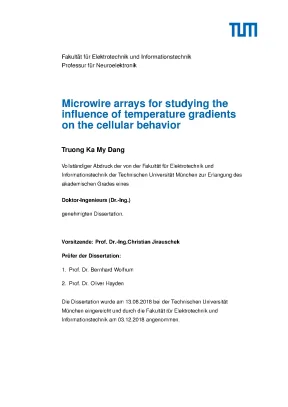
Tải xuống để đọc toàn bộFakultät für Elektrotechnik und Informationstechnik Professur für Neuroelektronik Microwire arrays for studying the influence of temperature gradients on the cellular behavior Truong Ka My Dang Vollständiger Abdruck der von der Fakultät für Elektrotechnik und Informationstechnik der Technischen Universität München zur Erlangung des akademischen Grades eines Doktor-Ingenieurs (Dr.Christian Jirauschek Prüfer der Dissertation: 1. Oliver Hayden Die Dissertation wurde am 13.2018 bei der Technischen Universität München eingereicht und durch die Fakultät für Elektrotechnik und Informationstechnik am 03. A BSTRACT Temperature plays an important role in regulating the biological function of cellular development. Over the past few decades, the development of microfabrication technology has enabled highly localized temperature control at the scale of a few microns.
This allows the study of thermal influences on biological microsystems. In this context, the present thesis investigates the changes of cellular behavior depending on temperature gradients using microwire arrays. In addition, the thesis also introduces a sacrificial layer approach to fabricate microchannels for studying neu- ronal guidance. The integration of the microwire array into microchan- nels presented in this thesis proposes a novel method for governing neu- ronal networks under the influences of temperature gradients.
The first part of this thesis presents the application of microwire arrays to study the effects of localized temperature gradients on signal propaga- tion in cardiac cell networks. In order to investigate the effects of temper- ature on cellular networks, a monolayer of cardiomyocytes is cultured onto the chip. The localized temperature is induced by using a power supply connected to microwire arrays. A calcium imaging method is performed to evaluate changes in signal propagation under local heat stimulation.
Calcium signals are recorded using a high speed and low light camera. Also in this part, the velocity of the calcium signal prop- agation in cellular networks is locally increased upon heat stimulation. Additionally, this part presents a relocation of the pacemaker cell and a deformation of the calcium wavefront caused by an increase of the local temperature. In the second part, the growth of neurons is investigated under the in- fluence of temperature gradients.
In this study, the PC12 neuron-like cells are cultured on the microwire array chip. The effects of temperature gra- dients on neurons are examined, focusing on the speed and direction of neurite outgrowth. The growth of neurites under local heat stimulation is recorded using a time-lapse imaging method. The images are then ana- lyzed to estimate the development of neurons within temperature gradi- ents.
The result indicates that the growth speed of neurons increases with heat stimulation. Moreover, the evidence that temperature gradients af- fect the growth direction of neurites is observed in a long-term period experiment (24 h after heating). The last part of the thesis presents a promising fabrication approach, based on standard clean room fabrication and sacrificial layer etching, for combining microwire arrays with a set of perpendicular axon-guiding mi- crochannels. This approach enables the positioning of neurites, as well as control over their polarity.
In particular, an array of asymmetrical mi- crochannels with wide inlets and narrow outlets is fabricated to allow neurites to grow in one direction. The experiment with neurites from PC12 cells demonstrates that neurites can grow from the entrance to the exit of the microchannels. Furthermore, the fabrication of microchannels, integrated with microwire arrays, allows the study of temperature gradi- ents effects on the formation of functional neuronal networks. Overall, this thesis focuses on investigating thermal impacts on cellu- lar behavior using the localized heating generated by microwire arrays.
This work demonstrates the important role of microscopic heating in reg- ulating signal propagation, as well as the growing properties of cellu- lar networks. Specifically, the temperature highly confined in a small area governs the calcium signal propagation of cardiomyocytes and the growth of neurites towards the heat source. Other than that, concerning the technical aspects, the fabrication of thin microwire enables us to con- trol high temperature in a microscopic area. Furthermore, the fabrication of sacrificial microchannels contributes benefits for neuronal guidance, ii such as reducing a number of fabrication steps and improving the adhe- sion between microchannels and the chip’s surface.
iii iv C ONTENTS 1 Introduction 1 2 Fundamentals & Theory 5 2.1 The cell structure .3 Action potentials and signal propagation .4 Signal propagation in cardiac cells .5 TRPV channels as temperature sensors .1 HL-1 cells: A cardiomyocyte cell line .2 PC12 cells as a model for neurons .3 Devices and fabrication techniques .2 Microfluidic channels for cell culture .3 Fabrication technologies for microfluidic channels .2 Fluorescence lifetime imaging (FLIM). 35 3 Heat stimulation for modulating signal propagation in HL-1 cell networks 37 C ONTENTS 3.3 Materials and methods .1 Fabrication of microwire array chips .2 Culture of HL-1 cells on the microwire array chip .3 Thermal stimulation and Ca imaging .4 Cross-correlation analysis .4 Results and discussions .1 Effect of localized heat stimulation on Ca2+ signal propagation .2 Effect of localized heat stimulation on the pacemaker position .5 Conclusions and outlook. 51 4 Heat activation and guidance of neurite outgrowth 55 4.3 Materials and methods .1 PC12 cell culture on chips .2 Heat stimulation Setup .3 Thermal stimulation and imaging .4 Image processing using the optical flow method .4 Results and discussion .1 Effect of temperature gradients on cellular growth .2 Influence of temperature gradients on the direction of cellular growth .3 Temperature distribution on microwire .5 Conclusions and outlook. 70 5 Fabrication of microchannel structures for neuronal guidance to- wards heat activation 73 5.3 Materials and Methods .1 Fabrication of PDMS microchannels .2 Fabrication of aligned SU-8 microchannel .4 Fluorescence imaging of the neurite length in mi- crochannels .4 Results and discussion .1 PDMS microchannels and its drawbacks .2 Microwire array and SU-8 microchannel structures 82 5.3 Neurite outgrowth into SU-8 microchannels .5 Conclusion and Outlook.
87 6 Conclusions and outlook 89 6.1 Summary of the Thesis. 91 Appendix 95 A Geometry and parameters for temperature simulation 95 B Protocol for bonding PDMS to a polyimide surface 97 C Protocol for HL-1 cell culture 99 D Protocol for PC12 cell culture 103 E Protocol for preparing dyes 107 E.2 Calcein-AM/Ethidium Homodimer(EthD). 107 Author’s list of publications 127 Conference presentations 129 Acknowledgment 131 vii C ONTENTS viii C HAPTER 1 I NTRODUCTION Temperature is an important physical parameter affecting every life pro- cess. In mammals, temperature is well known as an essential vital sign that indicates sickness or health.
Additionally, temperature plays a cru- cial role in regulating a variety of mechanisms in biological systems. It has been demonstrated that cells decrease their growth rate under low temperature conditions [1, 2]. Conversely, the proliferation rate of cells rises in response to an increase of ambient temperature [3]. In line with this, the previous study of Kang et al.
[4] shows that temperature has a comprehensive influence on intracellular calcium dynamics, which ma- nipulates most biochemical processes such as neural transmission, mus- cle contraction, and heart beat. In fact, many studies have demonstrated that temperature has a profound effect on living systems such as birth length [5], life span [6] and aging-associated diseases [7]. Together with temperature itself, temperature gradients also play a sig- nificant role in regulating the living systems. Spatial and temporal vari- ation of temperature induces changes in the nature of chemical reactions and alters the configuration of atoms that build up nucleic acids, pro- teins, lipids and other biomolecules [8].
A spatial temperature gradient has been demonstrated to be a guidance cue for the migration of organ- isms. Many studies indicate that thermotaxis can cause an organism to move up or down according to a gradient temperature [9–11]. I NTRODUCTION iment with Caenorhabditis elegans, a transparent nematode (roundworm), has shown that Caenorhabditis elegans migrates to a certain temperature when subjected to a spatial temperature gradient [12]. While the temper- ature sensitivity of organisms is well known, it has been not well under- stood how individual cells respond to different temperatures.
The study of temperature sensitivity at a cellular level has been a challenging engi- neering problem, possibly due to the lack of microscopic systems which can produce temperature at microscales. Over the past few decades, microtechnology has been developed as a new approach for studies in biophysics and physical chemistry [13–15]. Microtechnology employs fabrication methods (e. photolithography) to create microsystems on chips, such as lab-on-a-chip or micro-total- analysis-systems.
As a result of the development of microelectromechan- ical systems (MEMS) and microfluidic devices, scientists are now able to investigate and manipulate biological systems at a cellular level [16– 19]. MEMS offer the ability to precisely manipulate cells on microscales, which makes it possible to study cellular interactions with physical and chemical microenvironments surrounding them [17, 20]. These interac- tions offer deep insights into the fundamental behaviors of biological mi- crosystems, such as pacemaker cells, calcium concentrations, neuronal outgrowth, cellular viability, and cellular locomotion. This thesis aims to study cellular networks regulating and responding to local heating generated by microwire array chips.
Particularly, the in- fluence of localized temperature gradients on calcium signal propagation in cardiomyocytes will be investigated. A rise of local temperature will cause an increase in the propagation speed of these signals. This results in a deformation of the calcium wave in the cardiac networks. Addition- ally, the local temperature will be used to stimulate cells in the heated zone.
This stimulation causes the cells to become more active. This re- sults in the relocation of pacemaker cells to the heated area. Moreover, the effects of temperature gradients on neuron-like cells will be exam- ined in this work. Temperature gradients could accelerate the speed of neurite outgrowth and be a guidance cue for neurites.
To access cellular 2 behavior in response to localized heating, a fabrication approach which combines microheaters and microfluidic channels for neurite guidance will be introduced in this thesis. The local heating with high spatial accuracy induced from microwire array chips provides an effective approach to study heat effects at cellu- lar levels. Studying the influence of heat on living cells at a microscale creates a pathway to understanding how cells are sensed by the adja- cent cells and communicate with each other in response to temperature changes. The thesis contains six chapters.
In the introduction, the motivation for the research is presented. The second chapter takes up the fundamentals and methods. This chapter describes the basic concepts of biology and physics which are used in the following experiments and studies. The third chapter presents the study of local heat stimulation for modulating signal propagation in cardiomyocyte-like cell (HL-1 cells) networks.
The study of the effect of heat activation on the guidance of neurite outgrowth will be conducted in the fourth chapter. The next chapter describes the fabrication of microchannels perpendicular to microwire arrays for study- ing the effects of thermal gradients on neurite outgrowth and neuronal guidance. The last chapter presents the conclusions and outlook, which suggests possible applications of microwire arrays in studies of neuronal regeneration, cell migration, and dopamine releases. I NTRODUCTION 4 C HAPTER 2 F UNDAMENTALS & T HEORY 2.1 T HE CELL STRUCTURE The cell is the basic unit of biological activity.
The name “cell” was suggested by Robert Hooke in 1665. The meaning is derived from the Latin cella which means storeroom or chamber [21]. There are two dif- ferent types of cells, prokaryotic cells and eukaryotic cells. The structure of prokaryotic cells is very simple, whereas the structure of eukaryotic cells is more complex.
The cells from plants and animals are all eukary- otic cells. Since the cells used in this work are cardiomyocyte-like cells and neuron-like cells, only the structure of eukaryotic cells is described in detail. The size of eukaryotic cells is between 1 and 100 µm. The structure of eukaryotes is shown in Figure 2.
Surrounding the cell is the plasma membrane, which protects and separates the cell from the external envi- ronment. The cell membrane contains many biomolecules such as pro- teins.
Nội dung được bảo vệ bản quyền — Tải xuống đầy đủ
Trích dẫn luận án này
Truong Ka My Dang (2018). Ảnh hưởng gradient nhiệt lên hành vi tế bào với mảng dây vi [Luận án tiến sĩ, Technische Universität München]. LuanAn.net. https://luanan.net/tai-lieu-khac/anh-huong-gradient-nhiet-len-hanh-vi-te-bao-voi-mang-day-vi
Câu hỏi thường gặp
Luận án "Ảnh hưởng gradient nhiệt lên hành vi tế bào với mảng dây vi" nghiên cứu về vấn đề gì?
Dùng mảng vi dây nghiên cứu ảnh hưởng gradient nhiệt độ lên hành vi tế bào. Khám phá ứng dụng đột phá trong sinh học tế bào.
Luận án "Ảnh hưởng gradient nhiệt lên hành vi tế bào với mảng dây vi" được bảo vệ tại trường nào?
Luận án này được bảo vệ tại Technische Universität München. Năm bảo vệ: 2018.
Luận án "Ảnh hưởng gradient nhiệt lên hành vi tế bào với mảng dây vi" thuộc chuyên ngành gì?
Luận án "Ảnh hưởng gradient nhiệt lên hành vi tế bào với mảng dây vi" thuộc chuyên ngành Elektrotechnik und Informationstechnik / Neuroelektronik. Danh mục: Tài liệu khác.
Luận án "Ảnh hưởng gradient nhiệt lên hành vi tế bào với mảng dây vi" có bao nhiêu trang?
Luận án "Ảnh hưởng gradient nhiệt lên hành vi tế bào với mảng dây vi" có 144 trang. Bạn có thể xem trước một phần tài liệu ngay trên trang web trước khi tải về.
Cách tải luận án "Ảnh hưởng gradient nhiệt lên hành vi tế bào với mảng dây vi" về máy như thế nào?
Để tải luận án về máy, bạn nhấn nút "Tải xuống ngay" trên trang này, sau đó hoàn tất thanh toán phí lưu trữ. File sẽ được tải xuống ngay sau khi thanh toán thành công. Hỗ trợ qua Zalo: 0559 297 239.