A dissertation submitted to the doctoral school of economics and management in p
Luận án: A dissertation submitted to the doctoral school of economics and management in partial fulfillment of the requirements for the doctoral degree in econo
University of Trento
Economics and Management
Luan An
Luận án tiến sĩ
Năm xuất bản
Số trang
172
Thời gian đọc
26 phút
Lượt xem
0
Lượt tải
0
Phí lưu trữ
50 Point
Tổng quan nhanh
- Chủ đề:
- Luận Án Tiến Sĩ Kinh Tế: Phương Pháp Nghiên Cứu Mới
- Số trang:
- 172 trang
- Trường:
- University of Trento
- Chuyên ngành:
- Economics and Management
- Tác giả:
- Giulia Canzian
- Năm:
- 2009
Tóm tắt nội dung luận án
I.Luận Án Tiến Sĩ Kinh Tế Phương Pháp Nghiên Cứu Mới
Đây là một luận án tiến sĩ được trình bày tại trường đào tạo tiến sĩ Kinh tế. Nghiên cứu này đóng góp vào chương trình tiến sĩ. Nó khám phá sâu sắc lĩnh vực kinh tế vĩ mô dựa trên tác nhân (Agent-Based Macroeconomics). Luận án là một phần của yêu cầu để đạt được bằng Tiến sĩ về Kinh tế. Công trình này do Giulia Canzian thực hiện vào tháng 11 năm 2009. Luận án tập trung vào việc áp dụng các phương pháp nghiên cứu tiên tiến để giải quyết các vấn đề kinh tế phức tạp. Nó mở ra một hướng tiếp cận mới cho kinh tế học hiện đại.
1.1. Mục Tiêu Tổng Quát Của Nghiên Cứu Tiến Sĩ
Nghiên cứu tiến sĩ này hướng đến mục tiêu chính. Nó cung cấp cái nhìn sâu sắc về phương pháp luận dựa trên tác nhân. Phương pháp này được áp dụng vào phân tích kinh tế vĩ mô. Công trình giải quyết các vấn đề về tính không đồng nhất của tác nhân, tính hợp lý hạn chế và sự tương tác. Nó cung cấp một khung phân tích toàn diện cho các hệ thống kinh tế phức tạp.
1.2. Giới Thiệu Phương Pháp Agent Based Economics
Chương đầu tiên mô tả các đặc điểm của kinh tế học dựa trên tác nhân. Nó nêu bật những ưu điểm và nhược điểm của phương pháp này. Việc hiểu rõ phương pháp này là nền tảng cho toàn bộ nghiên cứu. Nó giúp định hình cách tiếp cận cho các vấn đề kinh tế vĩ mô phức tạp. Phương pháp này nhấn mạnh vào tương tác và hành vi của các tác nhân cá thể.
II.Phân Tích Thị Trường Tín Dụng Nghiên Cứu Tiến Sĩ
Chương hai của luận án tiến sĩ kinh tế này tập trung vào thị trường tín dụng. Nó trình bày một khung thị trường cụ thể. Khung này giúp hiểu rõ hơn về các tương tác kinh tế. Luận án nghiên cứu các tình huống có thông tin bất đối xứng. Nó xem xét các tác động của yếu tố này lên hệ thống tài chính. Đây là một phần quan trọng của nghiên cứu tiến sĩ, cung cấp cái nhìn mới mẻ.
2.1. Khung Thị Trường Tín Dụng Với Thông Tin Bất Đối Xứng
Luận án đề xuất một khung thị trường tín dụng. Khung này đặc trưng bởi sự hiện diện của thông tin bất đối xứng. Thông tin này tồn tại giữa ngân hàng và các doanh nhân. Điều này phản ánh thực tế của thị trường tài chính. Nó là một yếu tố then chốt ảnh hưởng đến quyết định và kết quả kinh tế.
2.2. Tác Động Của Quan Hệ Ngân Hàng Đến Kinh Tế Vĩ Mô
Nghiên cứu phân tích tính không đồng nhất của doanh nhân. Nó xem xét ảnh hưởng của Relationship Banking. Các yếu tố này tác động đến các thuộc tính vĩ mô của hệ thống. Nó cung cấp cái nhìn sâu sắc về cách các yếu tố vi mô ảnh hưởng đến kết quả vĩ mô. Kết quả nghiên cứu có ý nghĩa quan trọng cho chính sách kinh tế.
III.Mô Hình Kinh Tế Học Keynes Cách Tiếp Cận Hiện Đại
Chương ba tiến hành một thí nghiệm đặc biệt. Nó tái tạo các khái niệm cốt lõi của kinh tế học Keynes. Việc này được thực hiện trong môi trường phòng thí nghiệm máy tính. Nghiên cứu này là một phần quan trọng của luận án tiến sĩ. Nó cung cấp một cách tiếp cận mới để hiểu sâu hơn về lý thuyết kinh tế vĩ mô truyền thống. Luận án thách thức những giả định cũ.
3.1. Chuyển Thể Kinh Tế Học Keynes Vào Phòng Thí Nghiệm
Luận án nỗ lực chuyển đổi lý thuyết kinh tế vĩ mô của Keynes. Nó đưa các nguyên tắc này vào môi trường tính toán. Nghiên cứu thực hiện điều này theo tinh thần lịch sử tư tưởng kinh tế phản thực tế. Điều này cho phép kiểm tra các kịch bản và giả thuyết khác nhau một cách linh hoạt.
3.2. Đặc Trưng Hành Vi và Hạn Chế Tính Hợp Lý Hoàn Hảo
Công trình tập trung vào đặc trưng hành vi của ba trụ cột Keynes. Các trụ cột này là MEC, MPC và LP. Nó dựa trên sự từ chối rõ ràng về tính hợp lý hoàn hảo trong quá trình ra quyết định. Việc này cung cấp một cái nhìn mới về các khái niệm kinh tế học truyền thống, nhấn mạnh vai trò của tính phi lý trí và cảm xúc.
IV.Chính Sách Tiền Tệ Kỳ Vọng Lạm Phát Trong Kinh Tế Vĩ Mô
Chương cuối của nghiên cứu tiến sĩ này mở rộng văn học về tác động của chính sách tiền tệ. Nó đặc biệt xem xét dưới giả thuyết về tính hợp lý hạn chế của tác nhân. Luận án phân tích sâu rộng các yếu tố ảnh hưởng đến kỳ vọng lạm phát. Đây là một phần quan trọng trong việc hoàn thành chương trình tiến sĩ. Nó cung cấp những phân tích thực nghiệm và lý thuyết giá trị.
4.1. Tác Động Của Chính Sách Tiền Tệ Với Hạn Chế Hợp Lý
Luận án thiết kế một quy trình hợp lý bán phần. Quy trình này mô tả cách các kỳ vọng lạm phát được cập nhật. Điều này là một đóng góp quan trọng cho phương pháp nghiên cứu. Nó giúp hiểu rõ hơn về cách các tác nhân điều chỉnh dự đoán của mình trước thông tin mới.
4.2. Hiệu Quả Của Các Chế Độ Chính Sách Tiền Tệ Khác Nhau
Nghiên cứu sau đó phân tích sự tương tác. Giả thuyết về tính hợp lý hạn chế này tương tác với hiệu quả. Nó kiểm tra các chế độ chính sách tiền tệ khác nhau. Kết quả cung cấp thông tin quý giá cho các nhà hoạch định chính sách kinh tế vĩ mô. Việc này giúp họ thiết kế các chính sách hiệu quả hơn trong thực tế.
Tải xuống file đầy đủ để xem toàn bộ nội dung
Tải đầy đủ (172 trang)Trích đoạn nội dung luận án
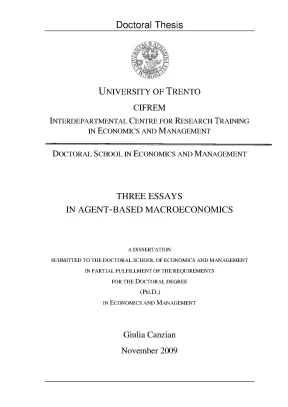
Tải xuống để đọc toàn bộDoctoral Thesis UNIVERSITY OF TRENTO CIFREM INTERDEPARTMENTAL CENTRE FOR RESEARCH TRAINING IN ECONOMICS AND MANAGEMENT DOCTORAL SCHOOL IN ECONOMICS AND MANAGEMENT THREE ESSAYS IN AGENT-BASED MACROECONOMICS A DISSERTATION SUBMITTED TO THE DOCTORAL SCHOOL OF ECONOMICS AND MANAGEMENT IN PARTIAL FULFILLMENT OF THE REQUIREMENTS FOR THE DOCTORAL DEGREE (PH.) IN ECONOMICS AND MANAGEMENT Giulia Canzian November 2009 ADVISORS DOCTORAL COMMITTEE Dott. Edoardo Gaffeo Prof. Richard Pomfret Università degli Studi di Trento University of Adelaide Prof. Roberto Tamborini Prof.ssa Roberta Raffaelli Università degli Studi di Trento Università degli Studi di Trento Dott.ssa Laura Magazzini Università degli Studi di Verona Prof.
Raffaele Corrado Università degli Studi di Bologna Per chi viaggia in direzione ostinata e contraria Col suo marchio speciale di speciale disperazione E fra il vomito dei respinti muove gli ultimi passi Per consegnare alla morte una goccia di splendore, di umanità, di verità. DeAndrè To Bruno and Celide To my Family Abstract The dissertation is aimed at offering an insight into the agent-based methodology and its possible application to the macroeconomic analysis. Relying on this method- ology, I deal with three different issues concerning heterogeneity of economic agents, bounded rationality and interaction. Specifically, the first chapter is devoted to describe the distinctive characteristics of agent-based economics and its advantages-disadvantages.
In the second chapter I propose a credit market framework characterized by the presence of asymmetric in- formation between the banks and the entrepreneurs. I analyze how entrepreneurs’ heterogeneity and the presence of Relationship Banking influences the macro prop- erties of the designed system. In the third chapter I work to take the core of Keynes’s macroeconomics into the computer laboratory, in the spirit of a counterfactual his- tory of economic thought. In particular, I devote much effort in the behavioural characterization of the three pillars of Keynes’s economics – namely the MEC, MPC and LP – relying on his clear refusal of perfect rationality in the decision making process.
The last chapter adds to the literature that assesses the impact of monetary policy under the hypothesis of agent’s bounded rationality. Indeed, I design a quasi rational process through which inflation expectations are updated, and then I ana- lyze how this hypothesis interacts with the efficacy of different monetary policy re- gimes. Keywords Macroeconomics, Agent-based economics, Complex Adaptive System 6 Contents INTRODUCTION. 1 AN INSIGHT INTO AGENT-BASED ECONOMICS.
WHAT ARE AGENT BASED MODELS?. WHY AGENT BASED MODELS AND NOT DSGE FOR A MODERN MACROECONOMICS?. THE AGENT–BASED NATURE OF THIS DISSERTATION. 17 FIRM-BANK RELATIONSHIP AND THE MACROECONOMY: SOME COMPUTATIONAL EXPERIMENTS.
FINANCE AND THE ECONOMY. AN OVERVIEW ABOUT RELATIONSHIP BANKING .1 Basic framework: the Symmetric Information case. Bank-firm interactions .2 Pure Asymmetric Information treatment .3 Relationship Banking treatment. Pure Asymmetric treatment versus Relationship Banking treatment.
48 KEYNES IN THE COMPUTER LABORATORY.AN AGENT-BASED MODEL WITH MEC, MPC, LP. UNCERTAINTY, ANIMAL SPIRITS AND MARKET SENTIMENT. PROTAGONISTS ON STAGE: MEC, MPC AND LP. The Marginal Efficiency of Capital.
The Marginal Propensity to Consume. The Liquidity Preference. ANIMAL SPIRITS AND MARKET SENTIMENT AFTER KEYNES. AN ABM OF A KEYNESIAN ECONOMY .2 The Marginal Efficiency of Capital.
The Marginal Propensity to Consume. The Liquidity Preference .5 Modelling Market Sentiment. Market Sentiment in motion .3 Implementing the model with Unconditional Market Sentiment .4 Implementing the model with Endogenous Market Sentiment .5 Reproducing under-production and under-investment. 92 INFLATION EXPECTATIONS AND MARKET SENTIMENT: SOME COMPUTATIONAL EXPERIMENTS.
A GENERAL OVERVIEW OF NEO CLASSICAL MONETARY POLICY THEORY. QUESTIONING RATIONAL EXPECTATIONS: THE LEARNING LITERATURE AND DEVELOPMENTS. INFLATION EXPECTATIONS AND MARKET SENTIMENT. The Old Regime versus the Modern regime.2 Flexible money supply rule .3 Changing the importance attached to inflation expectations.
137 CHAPTER 2 – FLOW DIAGRAM. 141 ii iii Introduction Introduction “The economy is an evolving, complex, adaptive dynamic system. Much progress has been made in the study of such systems in a wide variety of fields, such as medicine an brain research, ecology and biology, in recent years. To people from one of these fields who come to take an interest in ours, economists must seem in the grips of an entirely alien and certainly unpromising methodology.
In these other fields, computer modelling and experimentation is accepted without much question as valuable tools. It was possible, already 15 years ago, to hope that economists would find them valuable as well [Leijonhufvud, 1993]. But the inter- vening years have not witnessed a stampede into agent-based economics.” (Leijon- hufvud, 2006, pag.1627) This dissertation is my personal first tentative to work towards what Leijonhufvud called “Agent Based Macroeconomics”. It is a tentative in the sense that the agent based methodology is both in its “technical infancy” (Lejionhufvud, 2006) and it is still considered controversial by the majority of the profession.
Nonetheless, I found particularly inspiring the previously cited Lejionhufvud’s article, and I decided to go deeper into the understanding of how agent-based modelling can help us in disentangling the inner characteristics of complex economic systems. Which are the reasons to consider real economies as complex systems? If I was to put it very briefly, I would highlight three interrelated points. First, real people are heterogeneous. Probably we can bring back their economic behav- iour to some reasonable and homogeneous macro behaviour, but this cannot overcome the fact that they are inherently different.
The inner diversity makes them behave in a variety of manners at the very micro level. Second, people are not unbounded rational. Real economic agents are neither able to per- fectly forecast the future, nor they are able to perform very complex computation, so that it is quite controversial assuming them to choose through the resolution of optimizing processes. In- Introduction deed, bounded rational people are not necessarily irrational, in the sense that most people follow reasonable economic patterns, and most of the times they do not degenerate in some crazy con- duct.
Their bounded rationality can be traced back to the incapability of processing all the infor- mation they would need to take rational economic decisions. Third, the former characteristics imply interaction. People interact because of their het- erogeneity, and therefore because interacting they can overcome their lack of knowledge and their incapability of processing information. Interaction becomes a way through which coping with bounded rationality.
The three features taken together render any economic system complex, adaptive and dy- namic. Indeed, the chapters of this thesis try to assess the study of the economy as a complex system taking as reference point the latter issues. Since traditional DSGE models perform poorly in tackling these problems, I am working in the spirit of Leijonhufuvd’s words, that is, I aim at showing that agent based economics en- dows economists with the possibility of building models that better assess such complex systems. These models then present us with a better understanding of the macroeconomic dynamics result- ing from micro behaviour characterization.
Chapter 1 offers an overview about what agent based models are and why they can be considered good alternatives to general equilibrium optimizing models, highlighting the differ- ences between ABM and assumption-based economics. In particular, they will be presented both the advantages of this new methodology and the disadvantages of it. Finally, I will show why the older Classical Economics can be considered as a precursor of the principles on which agent based economic is built on. The three subsequent chapters deal in different ways with the issues characterizing com- plex economies.
Chapter 2 tries to shed light on the implications of having heterogeneous entrepreneurs in an asymmetric information framework regulated by Relationship Banking. On one hand, the Fi- nancial Fragility literature points at demonstrating that economic fluctuations can be traced back to the presence of asymmetric information in the credit market although neither considering het- erogeneous entrepreneurs, nor differentiating the possible contractual arrangements that regulate bank-firm interactions. On the other hand, both the theoretical and the empirical literature about Relationship Banking do not consider heterogeneous agents and do not study the macroeconomic impact of such credit relationship. Aiming at overcoming these limitations, I build a model in which the economy is populated by entrepreneurs who are heterogeneous both in their productive capacity and in their opportunistic attitude.
In order to produce they have to ask for credit to a 2 Introduction bank, which is not able to distinguish good entrepreneurs ex-ante. Then, I envision two treat- ments. In the first one, the bank faces asymmetric information by charging each entrepreneur with the same interest rate since it is not able to discriminate among them. In the second one, the bank has the possibility of discriminating entrepreneurs ex-post upon their being good long term clients or not: in the former case, the bank charge entrepreneurs with a lower interest rate.
The two situations will be separately analyzed in order to assess which situation is better in terms of aggregate efficiency and macro dynamics. Chapter 3 offers an interpretation of Keynes’s intuitions in the spirit of conducting a counterfactual history of economic thought. In particular, the agent based model deals with one of the most controversial and neglected issues of the General Theory, namely, agents’ bounded rationality in the form of limited information processing. The economy is designed such that all economic decisions are mediated by the Market Sentiment, that is, they are taken not through op- timization processes but through heuristics based on personal feelings and common sense.
The three pillars of the General Theory are modelled in light of this assumption: the Marginal Effi- ciency of Capital, the Marginal Propensity to Consume and the Liquidity Preference change along with the Market Sentiment and in turn impact over the economy. Simulations are con- ducted in order to study whether the framework is able to produce a coherent aggregate dynamics resembling the principal characteristics that Keynes highlighted. Chapter 4 wants to analyze the implications of assuming bounded rational agents for the design of monetary policy. Indeed, the theoretical framework upon which monetary policy has been designed in the last years still results unsatisfactory in considering agents’ bounded rational- ity.
The learning literature has offered some developments with respect to traditional DSGE models, but its principle of cognitive consistency remains controversial; not only, a part from ex- pectations formation, the learning literature assumes the rest of economic decisions to be regu- lated by optimization processes. My contribution goes in the direction of taking seriously into account bounded rationality in the design of a framework over which monetary policies are to be tested. Indeed, I stay with the model developed in the previous chapter, and complement it with the additional hypothesis that agents form inflation expectations basing upon Market Sentiment; therefore, I let the Market Sentiment to be in turn influenced by inflation dynamics. In this way the system envisions a mechanism for the macro regularities to feed back into the micro behav- iour.
3 Introduction References Leijonhufvud A. (2006), “Agent-Based Macro”., Handbook of Computational Economics, vol. 4 Chapter 1 An insight into Agent-Based Economics In the following I will offer a brief and general overview about agent-based economics. In particular, in section 1, I will introduce what an agent-based model is describing its prin- cipal characteristics as a tool through which many different issues in different fields can be tack- led.
The second section is twofold: first I present the principal features and the main drawbacks that have characterized macroeconomics in the last 40 years, and second I will show how it ap- pears natural to use ABM to overcome these inconsistencies. Finally, in the last section, the validity of the complexity approach in using agent-based techniques is reinforced by looking back to Classical economics: it will result how the seed of it was already present in the pioneer works of the British School, and in particular in Keynes’ and Marshall’s way of thinking about economics. What are Agent Based Models?
Nội dung được bảo vệ bản quyền — Tải xuống đầy đủ
Trích dẫn luận án này
Giulia Canzian (2009). A dissertation submitted to the doctoral school of economics [Luận án tiến sĩ, University of Trento]. LuanAn.net. https://luanan.net/tai-lieu-khac/a-dissertation-submitted-to-the-doctoral-school-of-economics-and-management-in
Câu hỏi thường gặp
Luận án "A dissertation submitted to the doctoral school of economics" nghiên cứu về vấn đề gì?
Luận án: A dissertation submitted to the doctoral school of economics and management in partial fulfillment of the requirements for the doctoral degree in econo
Luận án "A dissertation submitted to the doctoral school of economics" được bảo vệ tại trường nào?
Luận án này được bảo vệ tại University of Trento. Năm bảo vệ: 2009.
Luận án "A dissertation submitted to the doctoral school of economics" thuộc chuyên ngành gì?
Luận án "A dissertation submitted to the doctoral school of economics" thuộc chuyên ngành Economics and Management. Danh mục: Tài liệu khác.
Luận án "A dissertation submitted to the doctoral school of economics" có bao nhiêu trang?
Luận án "A dissertation submitted to the doctoral school of economics" có 172 trang. Bạn có thể xem trước một phần tài liệu ngay trên trang web trước khi tải về.
Cách tải luận án "A dissertation submitted to the doctoral school of economics" về máy như thế nào?
Để tải luận án về máy, bạn nhấn nút "Tải xuống ngay" trên trang này, sau đó hoàn tất thanh toán phí lưu trữ. File sẽ được tải xuống ngay sau khi thanh toán thành công. Hỗ trợ qua Zalo: 0559 297 239.