A dissertation attachment report submitted in partial fulfilment for degree of m
Luận án: A dissertation attachment report submitted in partial fulfilment for degree of master of business administration of the open university of tanzania. Xe
Open University of Tanzania
Luan An
Luận văn thạc sĩ
Năm xuất bản
Số trang
62
Thời gian đọc
10 phút
Lượt xem
0
Lượt tải
0
Phí lưu trữ
40 Point
Tổng quan nhanh
- Chủ đề:
- 1. Nghiên cứu Chính sách Chính phủ và Hiệu suất Khởi nghiệp
- Số trang:
- 62 trang
- Trường:
- Open University of Tanzania
- Chuyên ngành:
- Business Administration
- Tác giả:
- Haroun Mtebene
- Năm:
- 2011
Tóm tắt nội dung luận án
I. Nghiên cứu Chính sách Chính phủ và Hiệu suất Khởi nghiệp
Tài liệu này là một báo cáo đính kèm luận văn thạc sĩ. Báo cáo được nộp để hoàn thành một phần yêu cầu bằng cấp. Bằng Thạc sĩ Quản trị Kinh doanh được cấp bởi Đại học Mở Tanzania. Năm hoàn thành báo cáo là 2011. Nghiên cứu tập trung vào ảnh hưởng của chính sách chính phủ. Nó điều tra hiệu suất khởi nghiệp tại Tanzania. Trường hợp cụ thể là Thành phố Kinondoni. Đây là một tài liệu hỗ trợ luận văn quan trọng. Nó đóng góp vào nghiên cứu sau đại học về kinh tế. Mục tiêu chính là làm rõ mối quan hệ giữa chính sách và phát triển doanh nghiệp. Nghiên cứu đáp ứng các tiêu chuẩn học thuật cao. Nó cung cấp phân tích sâu sắc về môi trường kinh doanh. Báo cáo này là một phần không thể thiếu của luận văn thạc sĩ. Nó trình bày những phát hiện và phân tích chi tiết. Báo cáo là minh chứng cho việc hoàn thành một phần yêu cầu bằng cấp. Việc nộp đề tài nghiên cứu này hỗ trợ cho việc bảo vệ luận văn.
1.1. Tổng quan Luận văn Thạc sĩ về Chính sách Khởi nghiệp
Báo cáo này là tài liệu đính kèm cho một luận văn thạc sĩ. Luận văn được nộp để hoàn thành một phần yêu cầu bằng cấp Thạc sĩ Quản trị Kinh doanh. Đại học Mở Tanzania đã cấp bằng vào năm 2011. Nghiên cứu này điều tra tác động của chính sách chính phủ. Trọng tâm là hiệu suất khởi nghiệp ở Tanzania. Một nghiên cứu điển hình được thực hiện tại Thành phố Kinondoni. Tài liệu này đóng vai trò là tài liệu hỗ trợ luận văn. Nó tuân thủ nghiêm ngặt các tiêu chuẩn học thuật. Đây là một phần quan trọng trong nghiên cứu sau đại học. Nó cung cấp cái nhìn tổng thể về chủ đề nghiên cứu.
1.2. Mục tiêu Nghiên cứu và Phạm vi Báo cáo Đính kèm
Mục tiêu chính của nghiên cứu là phân tích tác động. Nó đánh giá tác động của chính sách chính phủ đối với hiệu suất khởi nghiệp. Phạm vi nghiên cứu giới hạn ở Thành phố Kinondoni, Tanzania. Báo cáo này là một báo cáo dự án học thuật chi tiết. Nó là một phần của yêu cầu bằng cấp thạc sĩ. Nội dung bao gồm các yếu tố ảnh hưởng đến doanh nghiệp. Đây là một phần quan trọng của việc nộp đề tài nghiên cứu. Nó cung cấp dữ liệu và phân tích chuyên sâu. Nghiên cứu này giúp hiểu rõ hơn về bối cảnh khởi nghiệp tại Tanzania.
II. Đánh giá Ảnh hưởng Chính sách lên Doanh nghiệp Tanzania
Nghiên cứu này làm nổi bật các thách thức. Nhiều yếu tố cản trở sự phát triển của khu vực Doanh nghiệp Nhỏ và Vừa (SME). Tài liệu chỉ ra rằng chính sách phát triển SME đã được xây dựng. Mục đích là giải quyết những hạn chế này. Chính sách này nhằm khai thác đầy đủ tiềm năng của ngành. Báo cáo này là một tài liệu hỗ trợ luận văn giá trị. Nó cung cấp cái nhìn sâu sắc về chính sách. Các chính sách có thể thúc đẩy sự tăng trưởng và cạnh tranh. Đây là một phần của yêu cầu bằng cấp thạc sĩ. Nó đóng góp vào nghiên cứu sau đại học. Chính sách SME được xem xét kỹ lưỡng. Mục tiêu là kích thích các doanh nghiệp mới thành lập. Đồng thời, nó giúp các doanh nghiệp hiện có phát triển mạnh mẽ hơn. Việc hoàn thành một phần báo cáo này chứng minh sự hiểu biết sâu sắc. Nó phân tích các rào cản và cơ hội phát triển. Báo cáo này là một luận án tiến sĩ tiềm năng về chính sách kinh tế.
2.1. Phân tích các Yếu tố Cản trở Hiệu suất Khởi nghiệp
Nghiên cứu đã xác định nhiều yếu tố hạn chế. Các yếu tố này làm chậm sự phát triển của khu vực SME. Một chính sách Phát triển SME đã được xây dựng. Mục đích là giải quyết các hạn chế này. Chính sách cũng nhằm khai thác tiềm năng đầy đủ của ngành. Báo cáo dự án học thuật này cung cấp phân tích sâu sắc. Nó giúp các nhà hoạch định chính sách hiểu rõ hơn. Đây là một tài liệu hỗ trợ luận văn quan trọng.
2.2. Chính sách SME tại Tanzania Đánh giá và Đề xuất
Chính sách Phát triển Doanh nghiệp Nhỏ và Vừa (SME) đã được đánh giá. Mục tiêu chính là cung cấp hướng dẫn cho tất cả các bên liên quan. Chính sách này được kỳ vọng sẽ kích thích thành lập doanh nghiệp mới. Nó cũng giúp các doanh nghiệp hiện có phát triển. Các doanh nghiệp sẽ trở nên cạnh tranh hơn. Luận văn thạc sĩ này phân tích hiệu quả của chính sách. Nó đưa ra các đề xuất cụ thể để cải thiện. Nghiên cứu này đáp ứng các tiêu chuẩn học thuật cao.
III. Báo cáo Đính kèm Luận văn Thạc sĩ Phương pháp Nghiên cứu
Phương pháp nghiên cứu được sử dụng là nghiên cứu tình huống. Cách tiếp cận này cho phép khám phá sâu sắc. Dữ liệu được thu thập từ nhiều nguồn khác nhau. Dữ liệu sơ cấp được thu thập trực tiếp từ các doanh nhân. Dữ liệu thứ cấp được tổng hợp từ các tài liệu liên quan. Phương pháp luận này đảm bảo tính toàn diện của kết quả. Nghiên cứu sau đại học này xem xét các đặc điểm dân số học. Các yếu tố bao gồm tuổi, giới tính, trình độ học vấn. Các chỉ số tâm lý cũng được xem xét. Đây là một báo cáo đính kèm luận văn thạc sĩ chi tiết. Nó cung cấp cơ sở vững chắc cho phân tích. Việc hoàn thành một phần báo cáo này là quan trọng. Nó đáp ứng yêu cầu bằng cấp của chương trình. Việc nộp đề tài nghiên cứu này bao gồm một phần về phương pháp luận rõ ràng. Nó chứng minh kỹ năng nghiên cứu của tác giả. Các tiêu chuẩn học thuật được tuân thủ nghiêm ngặt.
3.1. Thiết kế Nghiên cứu Điển hình và Thu thập Dữ liệu Chính
Nghiên cứu áp dụng phương pháp nghiên cứu tình huống. Dữ liệu sơ cấp được thu thập từ các doanh nhân. Dữ liệu thứ cấp được tổng hợp từ các tài liệu hiện có. Phương pháp này đảm bảo tính toàn diện. Dữ liệu bao gồm các đặc điểm như tuổi, giới tính và trình độ học vấn. Các chỉ số tâm lý cũng được xem xét. Đây là một tài liệu hỗ trợ luận văn quan trọng. Nó trình bày chi tiết cách thu thập thông tin.
3.2. Lấy mẫu Nghiên cứu và Phân tích Dữ liệu Thực tế
Tổng cộng 30 người trả lời đã được khảo sát. Họ là những doanh nhân đang điều hành các doanh nghiệp nhỏ. Kỹ thuật lấy mẫu phân tầng đã được sử dụng. Phân tầng dựa trên giới tính và loại hình kinh doanh. Dữ liệu thu thập sau đó được phân tích. Các bảng và biểu đồ được sử dụng để trình bày kết quả. Việc nộp đề tài nghiên cứu này bao gồm phân tích dữ liệu chi tiết. Nó là một báo cáo đính kèm minh bạch. Nghiên cứu này góp phần vào luận văn thạc sĩ.
IV. Kết quả Thảo luận Chính sách Kinh doanh và SME Tanzania
Nghiên cứu này trình bày các phát hiện chính. Các phát hiện tập trung vào tác động của chính sách chính phủ. Chúng ảnh hưởng đến hiệu suất khởi nghiệp. Các chính sách được xem xét bao gồm quy trình cấp phép. Hệ thống thuế và luật bản quyền. Ngoài ra, nghiên cứu cũng phân tích các chính sách. Chúng liên quan đến mặt bằng cho SME. Các tòa nhà được phân bổ và giáo dục công cộng. Báo cáo dự án học thuật này làm rõ nhiều vấn đề. Nó cung cấp bằng chứng thực nghiệm về hiệu quả chính sách. Việc hoàn thành một phần luận văn thạc sĩ này. Nó đưa ra cái nhìn sâu sắc về môi trường kinh doanh. Nghiên cứu cũng xem xét chính sách tài chính. Nó đánh giá các hiệp hội và nhà cung cấp dịch vụ. Các tiêu chuẩn học thuật cao được áp dụng cho toàn bộ phân tích này. Nó là một tài liệu hỗ trợ luận văn quan trọng.
4.1. Các Phát hiện Chính về Chính sách và Hiệu suất Doanh nghiệp
Nghiên cứu đã trình bày các phát hiện chính. Các phát hiện này liên quan đến ảnh hưởng của chính sách. Chính sách ảnh hưởng đến hiệu suất khởi nghiệp. Các chính sách bao gồm quy trình cấp phép và hệ thống thuế. Pháp luật bản quyền cũng được xem xét. Các chính sách về mặt bằng và giáo dục công cộng cũng là một phần quan trọng. Báo cáo dự án học thuật này cung cấp bằng chứng rõ ràng.
4.2. Tác động của Chính sách đến Doanh nghiệp Phụ nữ và Yếu thế
Các phát hiện cũng xem xét các chính sách tài chính. Các chính sách về hiệp hội và nhà cung cấp dịch vụ. Một phần quan trọng của nghiên cứu đánh giá các chính sách. Nó giải quyết các vấn đề của phụ nữ và các nhóm yếu thế. Đây là một phần thiết yếu của luận văn thạc sĩ. Nó nhấn mạnh sự cần thiết của chính sách bao trùm. Nghiên cứu sau đại học này cung cấp cái nhìn công bằng.
V. Ý nghĩa và Đề xuất từ Tài liệu Hỗ trợ Luận văn
Nghiên cứu này đóng góp đáng kể vào sự hiểu biết. Nó làm rõ về vai trò của khởi nghiệp. Nó cung cấp bằng chứng về ảnh hưởng của chính phủ. Các chính sách có thể thúc đẩy tăng trưởng kinh tế. Đặc biệt là ở các khu vực đô thị như Kinondoni. Đây là một tài liệu hỗ trợ luận văn giá trị. Nó cung cấp các hướng dẫn cụ thể. Các hướng dẫn này nhằm cải thiện chính sách hiện hành. Mục tiêu là khai thác đầy đủ tiềm năng của khu vực SME. Việc hoàn thành một phần báo cáo này. Nó mang lại cái nhìn thực tế và sâu sắc. Nó là một phần thiết yếu của yêu cầu bằng cấp. Nghiên cứu sau đại học này rất quan trọng. Nó định hình các chiến lược phát triển trong tương lai. Các tiêu chuẩn học thuật cao được duy trì trong suốt báo cáo. Báo cáo là một phần của việc nộp đề tài nghiên cứu. Nó có thể là nền tảng cho luận án tiến sĩ tiếp theo.
5.1. Đóng góp của Nghiên cứu cho Phát triển Doanh nghiệp Nhỏ
Nghiên cứu đóng góp vào sự hiểu biết về khởi nghiệp. Nó cung cấp bằng chứng về vai trò của chính phủ. Các chính sách có thể thúc đẩy tăng trưởng kinh tế. Đặc biệt ở các khu vực đô thị. Đây là một tài liệu hỗ trợ luận văn giá trị. Nghiên cứu sau đại học này rất quan trọng. Nó chỉ ra con đường phát triển bền vững. Luận văn thạc sĩ này là một công trình nghiên cứu toàn diện.
5.2. Hướng dẫn Chính sách Tương lai cho Hệ sinh thái Khởi nghiệp
Báo cáo cung cấp các đề xuất cụ thể. Các đề xuất nhằm cải thiện chính sách hiện hành. Mục tiêu là khai thác đầy đủ tiềm năng SME. Đề xuất bao gồm giám sát chính sách. Quản lý môi trường và chất thải. Việc hoàn thành một phần báo cáo này. Nó cung cấp cái nhìn thực tế cho các nhà hoạch định chính sách. Đây là một phần quan trọng của yêu cầu bằng cấp. Nó đáp ứng các tiêu chuẩn học thuật cao.
Tải xuống file đầy đủ để xem toàn bộ nội dung
Tải đầy đủ (62 trang)Trích đoạn nội dung luận án
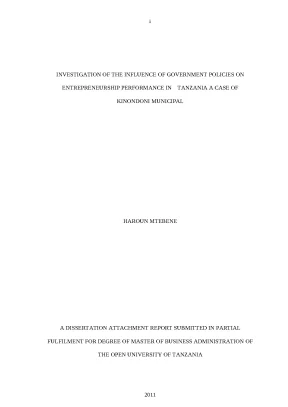
Tải xuống để đọc toàn bội INVESTIGATION OF THE INFLUENCE OF GOVERNMENT POLICIES ON ENTREPRENEURSHIP PERFORMANCE IN TANZANIA A CASE OF KINONDONI MUNICIPAL HAROUN MTEBENE A DISSERTATION ATTACHMENT REPORT SUBMITTED IN PARTIAL FULFILMENT FOR DEGREE OF MASTER OF BUSINESS ADMINISTRATION OF THE OPEN UNIVERSITY OF TANZANIA 2011 ii CERTIFICATION I, the undersigned certify that I have read the dissertation entitled “Challenges and success of entrepreneurship performance in Tanzania: A case study of Kinondoni Municipal” and found it to be in a form acceptable for examination. Mutagwaba SUPERVISOR Date: ……………………………………. iii COPYRIGHT © All rights reserved. No part of this thesis/dissertation may be reproduced, stored in any retrieval system, or transmitted in any form by any means, electronic, mechanical, photocopying, recording or otherwise without prior written permission of the author or the Open University of Tanzania in that behalf.
iv DECLARATION I, Mtebene Haroun, declare that this proposal is my original work and it has not been submitted for a similar degree in any other institution or university. Where the work of other authors has been used, relevant quotations have been made. Date: …………………………………………………… v DEDICATION I dedicate this work to my late Father who during his life time encouraged me to work harder till I will be honored a higher degree level. vi TABLE OF CONTENTS CERTIFICATION.
v TABLE OF CONTENTS.vi LIST OF TABLES. xii CHAPTER ONE.1 Statement of the Problem.4 Significance of the Study.0 Definition of key Terms.1 Meaning of Entrepreneurship.1 Meaning of Intrapreneurship. Theoretical basis of the Research. Entrepreneurship in Tanzania.
Small Business Enterprises. Role of Small Business Firms in Society.4 Issues and Barriers for Realizing Entrepreneurial Potentials.5 Strategies for Pro-Poor Business Development.2 Survey Population/unit of Inquiry.1 Primary Data Collection.4 Secondary Data Collection.5 Data Presentation Technique. DATA ANALYSIS, PRESENTATION AND DISCUSSION. Factors Inhibiting Entrepreneurship Performance.
Assessment of Entrepreneurship and SMEs Policy in Tanzania.46 ix LIST OF TABLES Table 1: Respondents Age and Entrepreneurship Experience.23 Table 2: Correlation: Respondents Age and Entrepreneurship Experience.24 Table 3: Respondents Gender and Type of SMEs Owned.25 Table 4: Policy Strategies: Licensing Procedures, Tax System and Copyright Law.27 Table 5: Policy Strategies: Premises for SMEs, Allocating Buildings and Public Education.28 Table 6: Policy Strategies: Education, Information Centers and ICT Training.29 Table 7: Policy Strategies: SMEs Census, Networking and Joint Ventures Facilitation. Policy Strategies: Small-Large Business Linkages, Marketing Agencies and Facilitation30 Table 9: Policy Strategies: Exhibition Centers, Meeting Standards and Trade Issues.30 Table 10: Policy Strategies: Financial Institutions, Products and Access for SMEs.31 Table 11: Policy Strategies: Financing, Associations and Service Providers.32 Table 12: Policy Strategies: Policy Monitory, Environmental and Waste Management Issues.32 Table 13: Policy Strategies: Addressing Woman and Disadvantaged Groups Issues.33 Table 14: SMEs Policy Inhibits Entrepreneurial Performance.34 Table 15: SMEs Policy Facilitates Entrepreneurial Performance.34 x LIST OF APPENDICES Appendix 1: Respondents Gender and Educational Level.37 Appendix 2: Respondents Gender and Type of SMEs Owned.38 Appendix 3: SMEs Policy Inhibits Entrepreneurial Performance.39 Appendix 4: Cross Tabulation: Type of SMEs owned and Views that SMEs Policy Inhibits Entrepreneurial Performance. 40 Appendix 5: SMEs Policy Facilitates Entrepreneurial Performance.41 Appendix 6: Cross Tabulation: Type of SMEs owned and Views that SMEs Policy Facilitates Entrepreneurial Performance. 42 xi ABSTRACT Entrepreneurship has been seen as a hub in generating income for the majority of urban dwellers with no formal paid employment.
The full potential of the SME sector has yet to be tapped due to the existence of a number of constraints hampering the development of the sector. It is for this reason that SME Development Policy was formulated so as to address the constraints and to tap the full potential of the sector. This policy will serve as guidelines to all stakeholders and thus stimulate new enterprises to be established and existing ones to grow and become more competitive. In view of the importance of entrepreneurship this study is trying to investigate the influence of Government policies in entrepreneurship performance in Tanzania cited Kinondoni Municipality.
The methodology used was case study. The population of the study was exhibited on different characteristics based on age, gender, educational level, and psychological indices. Total of 30 respondents were drawn from different entrepreneurs who deal with small businesses. The stratified sampling technique was employed in selecting respondents.
The population was stratified according to gender and type of business owned, data was analyzed through SPSS. Based on study findings factors which inhibit entrepreneurial performance are marketing, capital and premises problems. These needed to be re-addressed in government policy and improved in order to facilitate entrepreneurial performance. For the case of Government policies, both ways the policy has been viewed by respondents as both facilitating and inhibiting entrepreneurial performance.
Recommendations that are advanced by the researcher are workable policy on ensuring a sustainable and reliable market is to be put in place; direct market and marketing instruments need to be addressed in the policy so that the strategies implementation can have direct effects on the specific problems at hand. Efforts to address the problems of financing needs, education and training, capital needs, simplification of business working environment and registration processes to be addressed clearly and more realistically in the policy statement and strategies as the current policy xii did not seem to be completely effective. ACKNOWLEDGEMENTS My first acknowledgements goes to Dr. Mutagwaba for his kindness to accept my proposal and to take part as my supervisor after the sudden death of my former supervisor Dr.
Katunzi may almighty God rest his soul in peace. My second acknowledgement again goes to Dr. Mutagwaba for spending his valuable time as my supervisor in advising me tirelessly from the development of the proposal up to this stage and his relentless efforts made this work to conform to the standards required by the Open University of Tanzania. Thirdly, I would like to express my gratitude to both all entrepreneurs working at Mwenge, Ubungo bus Terminal and Tegeta market place for their immeasurable support granted during the whole period of data collection.
I assertively say that without their support this dissertation would never have been a success. Lastly, I would like to express my gratitude, in a very special way, to my family which during my absence suffered in one way or another but prayed for my success. 1 CHAPTER ONE INTRODUCTION This chapter describes the background information, statement of the problem, research objectives, research questions and significance of the study in which the research is based on.0 Background Information Historical perspectives of the state of entrepreneurship in Tanzania have thoroughly been presented by Rutashobya (1998). The general view is that for many years since independence, African public policies (including Tanzania) were not conducive to entrepreneurship development.
This lack of good policies has generally been in the low levels of entrepreneurship, which has further resulted in Africans underdevelopment (Rutashobya, 1998). Most Tanzanians make their living on subsistence agriculture and small medium enterprise (SMEs) activities. It is estimated that SMEs contribute 35% to GDP and 20% of the total labour force (Wangwe, 1999). Small Medium Enterprise Entrepreneurs in Tanzania are considered to be potential in creating jobs and contributing towards the economic growth.
The SME sector contains businesspersons from different entrepreneurial background and skills. In recognition of the SME and small business the government formulated small and medium enterprise Development policy in 2003 to support the development of this sector. Also the government emphasized the importance of informal sector as part of SMEs in achieving the war against poverty (Kato, 1996). It is a recognized fact that the natural habitat of entrepreneurship is in the small businesses.
Therefore entrepreneurship has a lot to do with development of small business. As is the case with entrepreneurship, small enterprises can not be defined with unanimity. The SME sector is an area where the poor may not only make out a living, but also get most of their 2 goods and services at prices they can afford. Over 90 per cent of operators get credit, training, information, water and sanitation from the sector.
In Dar es Salaam, the capital city of Tanzania, over 90 per cent of poor communities get water and sanitation services from the SME sector (URT, 1995). So any positive or negative developments in the sector will have a direct corresponding effect on the livelihoods of the community. Different researchers tried to focus on problems facing entrepreneurship development in Tanzania. Mfaume; Wilhelm Leonard (2004) focus on Small business entrepreneurship in Dar es salaam – Tanzania exploring problems and prospects for future development.
They focused on crime and entrepreneurship in Tanzania urban areas, tried to unfold various issues that cluster and affect the development of small business entrepreneurship in Tanzania. Kuzilwa (2005), point out the role of credits for small business success. It clearly examines the role of credit in generating entrepreneurial activities. Olomi (2006) on his policy dialogue seminar paper points the opportunities and challenges for Rural SME’s development in Tanzania.
From above studies it clearly shown that still there is a need to research more on SME’s police on entrepreneurship development in Tanzania because many researchers concentrate on the challenges of entrepreneurship performance but they have not focus on the possible solution especially on the SME police, is it worth to entrepreneurs?, does the existing policies enhance entrepreneurship performance as the business environment is uncontrollable. In this study the researcher makes an attempt to conduct an investigation of the influence of Government policies on entrepreneurship performance cited Kinondoni Municipal. This study was therefore concentrated on different small businesses that are conducted in Dar es salaam Kinondoni municipality due to time and fund constrains. Inference was drawn from the results.
Businesses, which were studied range from small shops, agro-processing, saloons, cafeteria, guesthouses, stationary services and bars. The study helped to stimulated economic growth since 3 there is no way the country will develop without passing through small business or informal sector. Also the study contributed in understanding different methods of acquiring entrepreneurial skills in Tanzania. The purpose of this paper therefore is to present some empirical evidence of investigation of the influence of Government policies on entrepreneurship performance especially on small business based on the findings of the case study unity of enquiry conducted at Kinondoni Municipal.
The study is divided in five main parts. This introduction is the first chapter. The second one is literature review recently from 2008 to date. The intention here is to try to give some insights briefly on what the literature says on challenges and success so far and the views of other researchers on entrepreneurship development.
The third chapter is the context methodology that underpinned the main study. The fourth chapter presents various empirical evidences and discusses data analysis, presentation and discussions on examining the inhibiting factors for low level of entrepreneurship performance and whether the existing government policies enhance entrepreneurship in Tanzania as cited Kinondoni municipality. Chapter five which is last focus on conclusions and Policy recommendations based on related research objectives. The study was therefore intended to investigate the influence of Government policies on entrepreneurship performance in Tanzania cited Kinondoni Municipal.1 Statement of the Problem.
The research on the determinants of the entrepreneurship success is extensive. However the results are far from being conclusive. This is partially due to the lack of theoretical grounding as well as differences in the unit of analyses, growth indicators and research time frame. Consequently, Davidsson and Wiklund (1999) correctly point out that the knowledge about what facilitates and hinders entrepreneurship is still scattered and limited despite an extensive research.
In addition, a large number of empirical studies have not given a very high yield of generalizable knowledge, 4 Davidsson et al, (2006). Although the environmental factors play an important role in the small business growth and development, other factors should not be neglected either. Surely, a significant potential for SME growth is located internally within the firm. Previous studies have explored the characteristics of the entrepreneur as important factors influencing the growth of the firm.
Human capital and intentions for growth are among most frequently mentioned entrepreneur related factors, influencing firm growth.
Nội dung được bảo vệ bản quyền — Tải xuống đầy đủ
Trích dẫn luận án này
Haroun Mtebene (2011). A dissertation attachment report submitted in partial fulfil [Luận án tiến sĩ, Open University of Tanzania]. LuanAn.net. https://luanan.net/tai-lieu-khac/a-dissertation-attachment-report-submitted-in-partial-fulfilment-for-degree-of
Câu hỏi thường gặp
Luận án "A dissertation attachment report submitted in partial fulfil" nghiên cứu về vấn đề gì?
Luận án: A dissertation attachment report submitted in partial fulfilment for degree of master of business administration of the open university of tanzania. Xe
Luận án "A dissertation attachment report submitted in partial fulfil" được bảo vệ tại trường nào?
Luận án này được bảo vệ tại Open University of Tanzania. Năm bảo vệ: 2011.
Luận án "A dissertation attachment report submitted in partial fulfil" thuộc chuyên ngành gì?
Luận án "A dissertation attachment report submitted in partial fulfil" thuộc chuyên ngành Business Administration. Danh mục: Tài liệu khác.
Luận án "A dissertation attachment report submitted in partial fulfil" có bao nhiêu trang?
Luận án "A dissertation attachment report submitted in partial fulfil" có 62 trang. Bạn có thể xem trước một phần tài liệu ngay trên trang web trước khi tải về.
Cách tải luận án "A dissertation attachment report submitted in partial fulfil" về máy như thế nào?
Để tải luận án về máy, bạn nhấn nút "Tải xuống ngay" trên trang này, sau đó hoàn tất thanh toán phí lưu trữ. File sẽ được tải xuống ngay sau khi thanh toán thành công. Hỗ trợ qua Zalo: 0559 297 239.