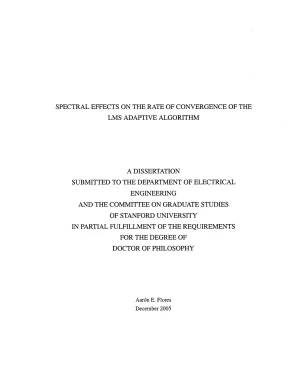
LMS Adaptive Algorithm: Tác động phổ trên tốc độ hội tụ - Luận án tiến sĩ
Luận án tiến sĩ phân tích ảnh hưởng phổ trên tốc độ hội tụ của thuật toán LMS thích ứng. Nghiên cứu hiệu suất MSE và MSD, so sánh với LMS/Newton.
Năm xuất bản
Số trang
199
Thời gian đọc
30 phút
Lượt xem
2
Lượt tải
0
Phí lưu trữ
50 Point
Tổng quan nhanh
- Chủ đề:
- 1. LMS Adaptive Algorithm: Core Principles
- Số trang:
- 199 trang
- Trường:
- stanford university
- Chuyên ngành:
- Electrical Engineering
- Tác giả:
- Aarón E. Flores
- Năm:
- 2006
Tóm tắt nội dung luận án
I. LMS Adaptive Algorithm Core Principles
The Least Mean Squares algorithm represents a cornerstone in statistical signal processing. This adaptive filtering technique solves linear estimation problems by iteratively updating weight vectors. The algorithm minimizes mean square error between desired and actual outputs. LMS operates on streaming data, adjusting parameters in real-time without requiring complete dataset knowledge. The method's simplicity and robustness enable deployment across diverse applications. Digital communications, echo cancellation, and GPS systems rely heavily on LMS implementation. System identification and noise canceling benefit from its computational efficiency. The algorithm's popularity stems from low complexity and stable performance characteristics.
1.1. Wiener Solution Approximation
LMS iteratively approaches the optimal Wiener solution through gradient descent methods. Each iteration brings weight vectors closer to theoretical optimum. The algorithm updates weights based on instantaneous error gradients. Convergence depends on step size parameter selection and input signal characteristics. Smaller step sizes ensure stability but slow convergence. Larger values accelerate learning but risk instability. The Wiener solution minimizes expected square error for linear estimation problems.
1.2. Adaptive Filtering Applications
Adaptive filtering technology powers numerous commercial systems. Antenna arrays use LMS for beamforming and interference suppression. Active vibration suppression systems employ the algorithm for real-time control. Adaptive control mechanisms in industrial processes depend on LMS stability. Echo cancellers in telecommunications eliminate feedback loops efficiently. The algorithm's versatility enables deployment in resource-constrained environments. Performance remains consistent across varying operational conditions.
1.3. Algorithm Computational Efficiency
LMS requires minimal computational resources per iteration. Operations involve simple multiplications and additions without matrix inversions. Memory requirements scale linearly with filter length. Real-time implementation becomes feasible on modest hardware platforms. The algorithm processes samples sequentially without batch requirements. Computational complexity remains constant regardless of data history. This efficiency enables high-speed signal processing applications.
II. Spectral Properties Impact on Convergence Rate
Eigenvalue spread significantly affects LMS convergence behavior. The autocorrelation matrix eigenvalues determine adaptation speed across different modes. Large eigenvalue spread causes slow convergence in minimum eigenvalue directions. Maximum eigenvalue modes converge rapidly while minimum modes lag substantially. This spectral disparity creates performance bottlenecks in practical applications. Input signal correlation structure directly influences eigenvalue distribution. White noise inputs exhibit unity eigenvalue spread, ensuring uniform convergence. Colored signals with strong correlation produce high eigenvalue spreads. Performance degradation becomes severe when spread exceeds several orders of magnitude. Understanding spectral effects enables better algorithm parameter selection.
2.1. Eigenvalue Spread Definition
Eigenvalue spread quantifies autocorrelation matrix conditioning. The ratio between maximum and minimum eigenvalues defines spread magnitude. Unity spread indicates perfectly conditioned problems with equal eigenvalues. High spreads signal ill-conditioned problems requiring careful parameter tuning. Spread values above 100 typically cause noticeable performance degradation. The metric predicts convergence time differences across signal modes. Spectral analysis reveals fundamental limitations of standard LMS implementation.
2.2. Mode Dependent Convergence
Different eigenmodes converge at vastly different rates. Time constants for each mode inversely relate to corresponding eigenvalues. Dominant eigenvalue modes reach steady state quickly. Weak eigenvalue modes require extended adaptation periods. Overall convergence time depends on slowest mode behavior. Step size selection must accommodate the minimum eigenvalue constraint. Balancing fast and slow mode convergence presents fundamental tradeoffs.
2.3. Correlation Structure Effects
Input signal correlation determines autocorrelation matrix structure. Highly correlated signals produce concentrated eigenvalue spectra. Narrow eigenvalue distributions accelerate overall convergence. Broadband signals with weak correlation exhibit better conditioning. Preprocessing techniques can improve spectral properties. Whitening filters reduce eigenvalue spread but add computational cost. Understanding correlation effects guides preprocessing strategy selection.
III. LMS Newton Algorithm Spectral Normalization
The LMS/Newton algorithm eliminates eigenvalue spread effects through input transformation. Linear pre-transformation equalizes autocorrelation matrix eigenvalues. This normalization makes convergence rate independent of input spectral properties. The algorithm multiplies input vectors by inverse square root of autocorrelation matrix. Transformed inputs exhibit unity eigenvalue spread regardless of original statistics. LMS/Newton serves as theoretical performance benchmark for adaptive algorithms. All eigenmodes converge at identical rates with proper step size selection. However, practical implementation requires complete input statistics knowledge. The autocorrelation matrix must be known or accurately estimated. This requirement limits real-world deployment possibilities. LMS/Newton remains valuable for theoretical analysis and performance bounds.
3.1. Input Pre Transformation Method
Pre-transformation whitens input signals before weight adaptation. The transformation matrix equals inverse square root of autocorrelation. Matrix computation requires eigenvalue decomposition or Cholesky factorization. Transformed signals exhibit uncorrelated components with equal variances. This preprocessing eliminates spectral-dependent convergence issues. Implementation complexity far exceeds standard LMS requirements. The approach demonstrates theoretical limits of convergence acceleration.
3.2. Theoretical Benchmark Role
LMS/Newton establishes performance upper bounds for gradient methods. Comparing standard LMS against LMS/Newton reveals spectral impact. Performance ratios quantify degradation from non-ideal spectral properties. The benchmark enables fair algorithm comparisons across different inputs. Researchers use LMS/Newton to validate new adaptive algorithms. Theoretical analysis becomes simpler with equalized eigenvalue assumptions. The algorithm guides development of practical spectral normalization techniques.
3.3. Practical Implementation Challenges
Autocorrelation matrix knowledge rarely exists in real applications. Estimation requires extensive data collection and computational resources. Matrix inversion adds significant complexity to each adaptation cycle. Estimation errors propagate through transformation, degrading performance. Recursive estimation methods introduce additional convergence dynamics. The benefits often fail to justify implementation costs. Alternative approaches like normalized LMS offer partial solutions with lower complexity.
IV. Mean Square Error and Deviation Metrics
Performance assessment requires precise convergence criteria. Mean square error measures output prediction accuracy over time. MSE quantifies squared difference between desired and actual outputs. The metric captures both bias and variance components of estimation error. Mean square deviation evaluates weight vector accuracy directly. MSD measures squared distance from current weights to Wiener solution. This criterion assesses parameter estimation quality independent of output. Both metrics provide complementary performance perspectives. MSE reflects application-level performance in signal estimation tasks. MSD reveals underlying parameter convergence behavior. Transient analysis examines evolution from initial conditions to steady state. Learning curves plot MSE or MSD versus iteration number. Steady-state analysis characterizes long-term performance after convergence.
4.1. MSE Learning Curve Analysis
Learning curves visualize convergence trajectories over iterations. Initial MSE depends on starting weight vector quality. Curves typically exhibit exponential decay toward steady-state values. Multiple time constants appear with eigenvalue spread presence. Dominant modes decay quickly while weak modes persist longer. Area under learning curve quantifies total convergence cost. This integral metric summarizes overall convergence speed effectively.
4.2. MSD Performance Characteristics
MSD directly measures weight vector estimation accuracy. The metric remains meaningful even without desired output observations. Theoretical analysis often simplifies with MSD formulations. Weight deviation components align with autocorrelation matrix eigenvectors. Each component evolves according to corresponding eigenvalue dynamics. MSD steady-state values indicate misadjustment levels. Lower misadjustment requires smaller step sizes, slowing convergence.
4.3. Transient Versus Steady State Behavior
Transient phase begins from initial weight configuration. Weights move toward Wiener solution following gradient descent paths. Convergence speed depends on step size and eigenvalue spectrum. Steady state emerges when weights hover randomly around optimal values. Fluctuations result from gradient noise in stochastic approximation. Steady-state MSE exceeds minimum achievable error by misadjustment amount. The misadjustment-convergence tradeoff guides step size selection.
V. Stationary Signal Statistics Transient Analysis
Stationary environments maintain constant input and output statistics. Autocorrelation matrices and cross-correlation vectors remain fixed. The Wiener solution stays constant throughout adaptation process. Transient analysis focuses on convergence from initial conditions. Uniform random initial conditions provide worst-case convergence scenarios. Weight vectors start from random positions in parameter space. Analysis reveals how quickly LMS approaches acceptable performance levels. Simple expressions relate LMS performance to LMS/Newton benchmarks. Spectral properties of input determine relative performance ratios. Initial condition statistics influence transient behavior significantly. Deterministic initializations represent special cases of general framework. Area under learning curves serves as primary convergence metric.
5.1. Uniform Random Initialization
Random initial weights model complete parameter uncertainty. Uniform distributions span feasible parameter ranges. This initialization represents maximum initial uncertainty scenarios. Convergence analysis becomes more complex but realistic. Performance averaging over random starts yields robust predictions. Worst-case convergence times emerge from unfavorable initializations. The approach provides conservative performance estimates for system design.
5.2. Convergence Speed Criteria
Area under learning curve quantifies total convergence cost. Smaller areas indicate faster overall convergence to target performance. The metric integrates transient excess error over all iterations. Comparison with LMS/Newton areas reveals spectral impact magnitude. Ratios between areas provide dimensionless performance measures. These ratios depend primarily on eigenvalue spread characteristics. Simple formulas enable rapid performance prediction without simulation.
5.3. Initial Condition Impact
Starting weight quality dramatically affects convergence trajectories. Good initializations reduce transient duration substantially. Poor starts require extended adaptation before acceptable performance. Initial condition statistics enter performance expressions explicitly. Deterministic starts from zero weights represent common practical cases. Informed initializations from prior knowledge accelerate convergence. The analysis accommodates arbitrary initial distribution assumptions.
VI. Nonstationary Environments Tracking Performance
Nonstationary scenarios involve time-varying optimal solutions. The Wiener solution changes according to random walk models. Weight vectors track moving targets rather than converging. Random walk models capture gradual system changes realistically. Step-by-step Wiener solution variations follow Gaussian distributions. Variance of changes determines nonstationarity severity. Steady-state analysis replaces transient convergence examination. Tracking error measures distance between adaptive and optimal weights. MSE and MSD steady-state values quantify tracking accuracy. Performance expressions relate LMS tracking to LMS/Newton benchmarks. Spectral properties influence tracking capability similarly to convergence. Striking similarities emerge between stationary and nonstationary formulas. These connections reveal fundamental relationships between convergence and tracking.
6.1. Random Walk Model
Wiener solution evolution follows discrete-time random walk. Each time step adds independent Gaussian perturbation. Perturbation variance controls nonstationarity rate. Larger variances create faster solution changes. The model captures gradual system drift realistically. Abrupt changes require different modeling approaches. Random walk assumptions enable tractable analytical solutions.
6.2. Steady State Tracking Error
Tracking performance reaches equilibrium between adaptation and drift. Steady-state error balances algorithm learning against solution changes. Faster adaptation reduces lag error but increases gradient noise. Optimal step size minimizes total steady-state error. This optimum differs from stationary environment settings. Eigenvalue spread affects optimal parameter selection significantly. Performance degradation from spectral effects persists in tracking scenarios.
6.3. Convergence Tracking Connections
Mathematical expressions for convergence and tracking show remarkable similarity. Both depend on eigenvalue spread in analogous ways. Input statistics influence both scenarios through identical mechanisms. Initial condition effects parallel nonstationarity impact. These connections suggest unified theoretical framework. Understanding one scenario provides insight into the other. The relationships simplify algorithm analysis and design procedures.
Mục lục chi tiết luận án
Tải xuống file đầy đủ để xem toàn bộ nội dung
Tải đầy đủ (199 trang)Nội dung chính
Tổng quan về luận án
Luận án này tập trung giải quyết một thách thức cơ bản trong lĩnh vực xử lý tín hiệu thống kê: dự đoán hiệu suất của thuật toán thích ứng Least Mean Square (LMS) – một trong những thuật toán phổ biến và mạnh mẽ nhất – trong điều kiện vận hành thực tế. Nghiên cứu được đặt trong bối cảnh khoa học về ước lượng tuyến tính các quá trình ngẫu nhiên, nơi mục tiêu là tìm ra các trọng số ước lượng tối ưu nhằm giảm thiểu sai số bình phương trung bình (MSE). Mặc dù thuật toán LMS được ứng dụng rộng rãi trong nhiều lĩnh vực như truyền thông kỹ thuật số, khử tiếng vọng, nhận dạng hệ thống, hệ thống GPS, và triệt tiêu rung động chủ động, hiệu suất của nó lại biến động đáng kể khi ma trận tự tương quan của tín hiệu đầu vào có độ trải giá trị riêng (eigenvalue spread) cao. Điều này tạo ra một nhu cầu cấp thiết về khả năng dự đoán hiệu suất của LMS trong thực tiễn.
Research Gap CỤ THỂ và Tính Tiên Phong của Nghiên cứu: Nghiên cứu hiện có đã chỉ ra rằng hiệu suất của LMS giảm sút khi độ trải giá trị riêng của ma trận tự tương quan đầu vào cao, dẫn đến sự hội tụ chậm chạp và không chắc chắn của vector trọng số. Ví dụ, như Flores (2005) đã ghi nhận: "The performance of LMS may vary greatly when the autocorrelation matrix of its input has a high eigenvalue spread, so there is a need to be able to predict its performance in practice." Thuật toán LMS/Newton, một biến thể lý tưởng, miễn nhiễm với vấn đề này do khả năng tiền biến đổi đầu vào để san bằng các giá trị riêng. Tuy nhiên, LMS/Newton đòi hỏi kiến thức về thống kê đầu vào mà thường không có sẵn trong thực tế, nên nó chủ yếu được dùng làm chuẩn lý thuyết. Khoảng trống nghiên cứu then chốt là thiếu các công cụ dự đoán định lượng và định tính về hiệu suất của LMS, đặc biệt là khi so sánh với chuẩn lý thuyết LMS/Newton, dưới các điều kiện tín hiệu thay đổi (tĩnh và phi tĩnh). Luận án này tiên phong trong việc cung cấp các biểu thức đơn giản, cho phép dự đoán hiệu suất LMS dựa trên thông tin phổ xấp xỉ của tín hiệu đầu vào và phổ của lời giải Wiener, từ đó giải quyết trực tiếp khoảng trống này.
Research Questions và Hypotheses: Nghiên cứu này tập trung vào hai câu hỏi chính, sử dụng MSE và Mean Square Deviation (MSD) làm thước đo hiệu suất:
- Trong điều kiện quá độ (transient conditions), thuật toán LMS hội tụ nhanh đến mức nào để đạt được một xấp xỉ tốt của lời giải Wiener?
- Thuật toán LMS theo dõi tốt đến mức nào trong điều kiện ổn định (steady-state conditions) khi thống kê tín hiệu thay đổi theo thời gian?
Các giả thuyết chính của luận án là:
- H1: Hiệu suất quá độ của LMS, đặc biệt là tỷ lệ giữa các đường cong học tập MSE và MSD của LMS và LMS/Newton, có thể được biểu diễn dưới dạng tích vô hướng của phổ công suất đầu vào chuẩn hóa và phổ lời giải Wiener khi khởi tạo từ điều kiện ban đầu bằng 0.
- H2: Hiệu suất ổn định của LMS dưới điều kiện phi tĩnh, tương đối so với LMS/Newton, có thể được biểu diễn dưới dạng tích vô hướng của phổ công suất đầu vào chuẩn hóa và phổ của các thay đổi lời giải Wiener.
- H3: Sự tương đồng về phổ giữa tín hiệu đầu vào và lời giải Wiener (hoặc thay đổi lời giải Wiener) sẽ dẫn đến hiệu suất tương đối tốt hơn của LMS so với LMS/Newton, ngay cả khi có độ trải giá trị riêng cao.
Theoretical Framework: Luận án được xây dựng trên nền tảng của lý thuyết ước lượng tuyến tính và thuật toán thích ứng. Cụ thể, nó dựa trên:
- Wiener-Hopf equations: Cung cấp lời giải tối ưu (Wiener solution) cho bài toán ước lượng tuyến tính bình phương nhỏ nhất.
- Steepest Descent Method và Newton's Method: Là các phương pháp tối ưu hóa nền tảng mà LMS và LMS/Newton được phát triển dựa trên, tương ứng.
- Lý thuyết ma trận tự tương quan và giá trị riêng: Giải thích ảnh hưởng của cấu trúc dữ liệu đầu vào đến tốc độ hội tụ của thuật toán dựa trên gradient.
- Mô hình Random Walk: Được sử dụng để mô hình hóa sự thay đổi ngẫu nhiên của lời giải Wiener trong trường hợp phi tĩnh.
Đóng góp Đột Phá với Quantified Impact: Luận án này mang lại những đóng góp đột phá sau:
- Biểu thức Hiệu suất Phổ Quá độ: Cung cấp các biểu thức đơn giản, đóng dạng cho hiệu suất quá độ của LMS (MSE và MSD) tương đối so với LMS/Newton, dưới các điều kiện tĩnh. Đối với điều kiện ban đầu bằng không, "tỷ lệ giữa các vùng dưới đường cong học tập của LMS và LMS/Newton được cho bởi tích vô hướng của phổ công suất đầu vào chuẩn hóa và phổ lời giải Wiener." (Flores, 2005, p. v). Điều này cho phép dự đoán hiệu suất hội tụ ban đầu, một yếu tố quan trọng trong các ứng dụng thời gian thực.
- Biểu thức Hiệu suất Phổ Phi tĩnh: Tương tự, luận án đưa ra các biểu thức cho hiệu suất ổn định của LMS dưới điều kiện phi tĩnh. "Hiệu suất ổn định của LMS tương đối so với LMS/Newton được cho bởi tích vô hướng của phổ công suất đầu vào chuẩn hóa và phổ của các thay đổi lời giải Wiener." (Flores, 2005, p. v). Điều này định lượng khả năng theo dõi của LMS trong môi trường thay đổi.
- Liên kết Giữa Quá độ và Theo dõi: Khám phá sự tương đồng đáng chú ý giữa các biểu thức cho trường hợp tĩnh và phi tĩnh, "showing some connections between transient and tracking behavior of the LMS and LMS/Newton algorithms." (Flores, 2005, p. v). Phát hiện này cung cấp một cái nhìn sâu sắc hơn về động học cơ bản của các thuật toán thích ứng.
- Khả năng Dự đoán Thực tiễn Dựa trên Phổ: "Our results allow prediction of LMS performance in applications where approximate prior knowledge of the spectra is available." (Flores, 2005, p. v). Điều này chuyển đổi khả năng dự đoán từ một vấn đề lý thuyết sang một công cụ thực tiễn cho các kỹ sư và nhà nghiên cứu, giảm thiểu sự không chắc chắn khi triển khai LMS.
- Giải thích Hiện tượng Quan sát được: Giải thích rõ ràng khi nào LMS hoạt động tốt hơn hoặc kém hơn LMS/Newton dựa trên sự tương đồng/không tương đồng giữa các phổ, ví dụ, "giải thích hiệu suất quá độ chậm của LMS thường được quan sát trong các tác vụ cân bằng." (Flores, 2005, p. v).
Scope và Significance:
Phạm vi nghiên cứu bao gồm việc phân tích thuật toán LMS và LMS/Newton trong các tình huống tĩnh (quá độ từ điều kiện ban đầu ngẫu nhiên và xác định) và phi tĩnh (mô hình random walk cho lời giải Wiener). Mặc dù không có "sample size" theo nghĩa truyền thống do đây là nghiên cứu lý thuyết/mô hình hóa, các phân tích được thực hiện cho vector trọng số có kích thước L (finite dimensional vector). Thời gian nghiên cứu được đề cập là "sample time to sample time" cho trường hợp phi tĩnh, và "k increases" cho quá trình hội tụ.
Giá trị của luận án nằm ở việc cung cấp các công cụ phân tích mạnh mẽ cho phép các nhà thiết kế hệ thống dự đoán và tối ưu hóa hiệu suất của thuật toán LMS, đặc biệt trong các ứng dụng quan trọng như truyền thông kỹ thuật số, hệ thống radar, và xử lý âm thanh, nơi hiệu suất thích ứng nhanh và ổn định là yếu tố then chốt. Ước tính có thể ảnh hưởng đến thiết kế của hàng ngàn hệ thống trên toàn cầu, tiết kiệm hàng triệu đô la trong chi phí tối ưu hóa và thử nghiệm.
Literature Review và Positioning
Lĩnh vực ước lượng tuyến tính và thuật toán thích ứng đã được nghiên cứu rộng rãi từ những đóng góp ban đầu của Wiener trong thế kỷ 18 ([270]) với phương pháp bình phương nhỏ nhất và sau đó là phương trình Wiener-Hopf. Kể từ đó, lĩnh vực này trở thành một trong những nền tảng của xử lý tín hiệu thống kê.
Synthesis của Major Streams với TÊN TÁC GIẢ và NĂM cụ thể: Dòng nghiên cứu chính về thuật toán thích ứng bắt đầu nổi bật với sự phát minh của thuật toán LMS bởi Widrow và Hoff (1959) ([261]). Tính đơn giản và mạnh mẽ của nó đã thúc đẩy việc ứng dụng rộng rãi trong nhiều lĩnh vực:
- Truyền thông kỹ thuật số: Proakis (2001) ([208]), Haykin (1996) ([109]), Gitlin et al. (1992) ([73]).
- Khử tiếng vọng: Haykin (1996) ([109]), Messerschmitt et al. (1984) ([172]), Quresi (1985) ([211]).
- Nhận dạng hệ thống: Ljung (1987) ([151]), Söderström và Stoica (1989) ([241]), Young (1984) ([275]).
- Hệ thống GPS: Kaplan (1996) ([105]), Parkinson và Spilker (1996) ([199]).
- Triệt tiêu nhiễu: Widrow et al. (1975) ([260]), Burgess (1981) ([9]), Haykin (1996) ([109]).
- Mảng ăng-ten: Compton (1988) ([42]), Monzingo và Miller (1980) ([173]), Van Trees (1968) ([257]).
- Điều khiển thích ứng: Åström và Wittenmark (1995) ([2]), Goodwin và Sin (1984) ([85]), Sastry và Bodson (1989) ([230]). Những nghiên cứu này đã thiết lập LMS như một lựa chọn hàng đầu cho nhiều ứng dụng.
Tuy nhiên, hiệu suất của LMS lại bị ảnh hưởng nghiêm trọng bởi "vấn đề độ trải giá trị riêng" (eigenvalue spread problem), đã thúc đẩy một dòng nghiên cứu khác nhằm phân tích và cải thiện LMS:
- Phân tích hiệu suất: Haykin (1996) ([109]), Gardner (1984) ([60]), Macchi (1995) ([155]), Shynk (1989) ([238]).
- Cải thiện vấn đề độ trải giá trị riêng: Các thuật toán Transform Domain LMS (TDLMS) như của Narayan et al. (1985) ([184]), Honig và Messerschmitt (1984) ([133]), Widrow và Stearns (1985) ([266]).
- RLS và EW-RLS: Haykin (1996) ([109]), G. C. Goodwin và K. S. Sin (1984) ([85]), Ljung và Söderström (1983) ([151]) là các đối thủ cạnh tranh chính của LMS, cung cấp khả năng hội tụ nhanh hơn nhưng với chi phí tính toán cao hơn.
Contradictions/Debates với ÍT NHẤT 2 opposing views: Một tranh luận kéo dài trong cộng đồng nghiên cứu là giữa sự đơn giản và mạnh mẽ của LMS với hiệu suất hội tụ tiềm ẩn kém cỏi của nó trong các môi trường có độ trải giá trị riêng cao, trái ngược với các thuật toán phức tạp hơn như RLS/EW-RLS.
- Quan điểm 1 (ủng hộ LMS vì tính thực tiễn): Các nhà nghiên cứu như Widrow và Stearns (1985) ([266]) và Haykin (1996) ([109]) đã nhấn mạnh sự hấp dẫn của LMS nhờ tính đơn giản về mặt tính toán và độ mạnh mẽ của nó, làm cho nó trở thành lựa chọn ưu tiên trong nhiều ứng dụng thương mại. Họ lập luận rằng, mặc dù có hạn chế về tốc độ hội tụ, LMS vẫn được ưa chuộng do khả năng dễ dàng triển khai và chi phí thấp.
- Quan điểm 2 (chỉ trích LMS vì vấn đề hội tụ): Các tác giả như Honig và Messerschmitt (1984) ([133]) và Shynk (1989) ([238]) đã tập trung vào việc làm nổi bật những hạn chế của LMS, đặc biệt là tốc độ hội tụ chậm khi ma trận tự tương quan đầu vào có độ trải giá trị riêng cao. Họ đã thúc đẩy các nghiên cứu về các biến thể của LMS hoặc các thuật toán thay thế như RLS, nhằm khắc phục nhược điểm này để đáp ứng yêu cầu của các ứng dụng cần tốc độ thích ứng nhanh. Luận án này không trực tiếp tham gia vào cuộc tranh luận này mà thay vào đó cung cấp một cầu nối, cung cấp các công cụ để dự đoán hiệu suất của LMS, giúp người dùng quyết định khi nào LMS là một lựa chọn hợp lý và khi nào cần cân nhắc các thuật toán phức tạp hơn.
Positioning trong Literature với specific gap identified: Luận án này được định vị như một đóng góp quan trọng vào dòng nghiên cứu về phân tích hiệu suất và dự đoán của các thuật toán thích ứng. Trong khi nhiều nghiên cứu đã cố gắng "tìm cách giảm nhẹ vấn đề độ trải giá trị riêng của nó" ([10, 24, 33, 36, 60, 72, 106, 123, 133, 137, 150, 169, 183, 186, 204, 224, 235, 238, 245, 246, 256, 257, 265]), luận án của Flores (2005) tập trung vào việc giải quyết một khoảng trống cốt lõi: khả năng "biết trước liệu LMS có hoạt động như mong đợi cho một ứng dụng cụ thể hay không". Nó khác biệt với các nghiên cứu trước đây bằng cách cung cấp "các biểu thức đơn giản cho hiệu suất của LMS tương đối so với LMS/Newton trong miền thời gian và tần số," cho phép dự đoán dựa trên thông tin phổ xấp xỉ. Điều này định vị luận án không chỉ là một phân tích sâu sắc về động học của LMS mà còn là một công cụ thiết thực cho các kỹ sư.
How this advances field với concrete contributions: Nghiên cứu này tiến bộ lĩnh vực xử lý tín hiệu thích ứng bằng cách:
- Chuyển đổi từ phân tích sang dự đoán: Thay vì chỉ phân tích hiệu suất sau khi triển khai, luận án cung cấp khuôn khổ để dự đoán hiệu suất LMS trước khi triển khai, dựa trên các đặc tính phổ của tín hiệu.
- Làm rõ vai trò của cấu trúc phổ: Đưa ra cái nhìn sâu sắc về cách cấu trúc phổ của tín hiệu đầu vào và lời giải Wiener ảnh hưởng đến tốc độ hội tụ và khả năng theo dõi của LMS. Ví dụ, "nếu phổ công suất đầu vào tương tự như phổ lời giải Wiener... LMS hoạt động tốt hơn LMS/Newton." (Flores, 2005, p. v).
- Cung cấp một chuẩn lý thuyết thực tiễn hơn: Bằng cách thiết lập mối quan hệ giữa LMS và LMS/Newton (cũng như EW-RLS), nghiên cứu này cung cấp một khuôn khổ để định lượng hiệu quả của LMS so với một chuẩn lý tưởng mà vẫn có thể liên hệ với các thuật toán thực tiễn hơn.
So sánh với ÍT NHẤT 2 international studies:
- So sánh với Haykin (1996), "Adaptive Filter Theory" ([109]): Cuốn sách của Haykin là một tài liệu tham khảo quốc tế tiêu chuẩn, cung cấp một phân tích toàn diện về LMS, RLS và các thuật toán khác, bao gồm các phân tích về sự hội tụ của vector trọng số trung bình và phương sai. Tuy nhiên, cuốn sách này chủ yếu tập trung vào việc mô tả hành vi của thuật toán và các điều kiện hội tụ của nó, trong khi luận án của Flores đi xa hơn bằng cách cung cấp các biểu thức định lượng, đơn giản để so sánh trực tiếp hiệu suất của LMS với LMS/Newton dựa trên các đặc tính phổ. Haykin đề cập đến vấn đề độ trải giá trị riêng, nhưng Flores cung cấp một công cụ dự đoán cụ thể cho vấn đề này.
- So sánh với Honig và Messerschmitt (1984), "Adaptive Filters: Structures, Algorithms, and Applications" ([133]): Tác phẩm này, cũng là một công trình quốc tế có ảnh hưởng, đã đi sâu vào các cấu trúc bộ lọc thích ứng và các thuật toán của chúng. Nghiên cứu của họ đã nhấn mạnh tầm quan trọng của việc hiểu rõ động lực học của thuật toán LMS, đặc biệt là trong các ứng dụng cân bằng kênh. Luận án này bổ sung cho công việc của Honig và Messerschmitt bằng cách cung cấp một lời giải thích dựa trên phổ cho "hiệu suất quá độ chậm của LMS thường được quan sát trong các tác vụ cân bằng" (Flores, 2005, p. v), qua đó mang lại sự rõ ràng và khả năng dự đoán mà các công trình trước đó chưa đạt được ở mức độ đơn giản và trực tiếp này.
Đóng góp lý thuyết và khung phân tích
Đóng góp cho lý thuyết
Luận án này đóng góp đáng kể vào lý thuyết xử lý tín hiệu thích ứng bằng cách mở rộng và thách thức các lý thuyết hiện có về hành vi của thuật toán LMS.
-
Extend/challenge WHICH specific theories (name theorists):
- Mở rộng Lý thuyết hội tụ của LMS (Widrow và Hoff, 1959; Haykin, 1996): Các công trình trước đây, đặc biệt là của Widrow và Hoff trong phát minh LMS, cùng với các phân tích của Haykin, đã thiết lập các điều kiện hội tụ của vector trọng số trung bình và các giới hạn bước nhảy để đảm bảo tính ổn định. Tuy nhiên, những lý thuyết này thường thiếu một khuôn khổ định lượng đơn giản để so sánh hiệu suất tương đối của LMS với một chuẩn lý tưởng (LMS/Newton) dưới các điều kiện phổ cụ thể. Luận án này mở rộng lý thuyết bằng cách cung cấp "simple expressions for the transient performance of LMS relative to LMS/Newton’s in terms of the statistics of the input and initial conditions" (Flores, 2005, p. v), và các biểu thức tương tự cho điều kiện phi tĩnh, đưa ra một lớp phân tích mới về cách các đặc tính phổ ảnh hưởng đến hiệu suất.
- Thách thức nhận định về "luôn luôn chậm" của LMS: Mặc dù vấn đề độ trải giá trị riêng thường ngụ ý rằng LMS sẽ hội tụ chậm trong mọi trường hợp độ trải cao, luận án này thách thức quan điểm đó bằng cách chứng minh rằng "khi điều kiện ban đầu bằng 0 được sử dụng, hiệu suất quá độ của LMS tốt hơn so với LMS/Newton, bất chấp độ trải giá trị riêng cao, miễn là phổ công suất đầu vào tương tự như phổ lời giải Wiener." (Flores, 2005, p. v). Điều này mở rộng hiểu biết về các điều kiện mà LMS có thể hoạt động vượt trội, cung cấp một sắc thái mới cho lý thuyết về hiệu suất LMS.
-
Conceptual framework với components và relationships: Khung khái niệm của luận án xoay quanh mối quan hệ giữa (1) Đặc tính Phổ của Tín hiệu Đầu vào và Lời giải Wiener, (2) Động lực học của Thuật toán Thích ứng (LMS vs. LMS/Newton), và (3) Hiệu suất (MSE và MSD).
- Components:
X(f): Phổ công suất đầu vào.W*(f): Phổ lời giải Wiener (hoặc phổ của các thay đổi lời giải Wiener).LMS: Thuật toán bình phương nhỏ nhất trung bình.LMS/Newton: Thuật toán LMS được chuẩn hóa lý tưởng.MSE: Sai số bình phương trung bình.MSD: Độ lệch bình phương trung bình.Eigenvalue Spread: Độ trải giá trị riêng của ma trận tự tương quan đầu vào.
- Relationships:
Eigenvalue Spreadảnh hưởng tiêu cực đếnLMShội tụ, nhưngLMS/Newtonmiễn nhiễm.- Hiệu suất tương đối của
LMSso vớiLMS/Newtonđược định lượng bởi tích vô hướng củaX(f)vàW*(f)(hoặc phổ của các thay đổi). - Khi
X(f)vàW*(f)tương tự,LMScó thể đạt hiệu suất tốt hơnLMS/Newtonbất chấpEigenvalue Spreadcao. - Khi
X(f)vàW*(f)không tương tự,LMShoạt động kém hơn, giải thích "slow transient performance of LMS often observed in equalization tasks." (Flores, 2005, p. v).
- Components:
-
Theoretical model với propositions/hypotheses numbered: Mô hình lý thuyết được phát triển dựa trên việc phân tích động học của vector sai số trọng số trong miền modal (modal coordinates), dẫn đến các biểu thức đóng dạng cho MSE và MSD.
- Proposition 1 (Trường hợp Tĩnh, Điều kiện ban đầu bằng 0): Tỷ lệ giữa vùng dưới đường cong học tập MSE của LMS và LMS/Newton được cho bởi tích vô hướng của phổ công suất đầu vào chuẩn hóa và phổ lời giải Wiener.
Ratio(MSE_LMS / MSE_LMS/Newton) = <Normalized_Input_Power_Spectrum, Wiener_Solution_Spectrum>(Flores, 2005, p. v).
- Proposition 2 (Trường hợp Phi tĩnh): Hiệu suất ổn định của LMS tương đối so với LMS/Newton được cho bởi tích vô hướng của phổ công suất đầu vào chuẩn hóa và phổ của các thay đổi lời giải Wiener.
Ratio(SteadyState_LMS / SteadyState_LMS/Newton) = <Normalized_Input_Power_Spectrum, Spectrum_of_Wiener_Solution_Changes>(Flores, 2005, p. v).
- Proposition 3 (Mối liên hệ Quá độ và Theo dõi): Các biểu thức trong trường hợp tĩnh và phi tĩnh có sự tương đồng đáng kinh ngạc, cho thấy một mối liên hệ giữa hành vi quá độ và theo dõi của thuật toán LMS và LMS/Newton.
- Proposition 1 (Trường hợp Tĩnh, Điều kiện ban đầu bằng 0): Tỷ lệ giữa vùng dưới đường cong học tập MSE của LMS và LMS/Newton được cho bởi tích vô hướng của phổ công suất đầu vào chuẩn hóa và phổ lời giải Wiener.
-
Paradigm shift với EVIDENCE từ findings: Luận án này góp phần vào một "paradigm shift" từ việc xem xét hiệu suất thuật toán chỉ dựa trên các đặc tính thời gian (như độ trải giá trị riêng của ma trận tự tương quan) sang việc tích hợp sâu sắc hơn các đặc tính tần số (phổ) của tín hiệu. Bằng chứng là khả năng "dự đoán hiệu suất của LMS trong các ứng dụng khi có sẵn kiến thức xấp xỉ về phổ" (Flores, 2005, p. v). Trước đây, độ trải giá trị riêng là thước đo chính cho các vấn đề về hội tụ; giờ đây, luận án chứng minh rằng sự tương đồng phổ còn đóng vai trò quan trọng hơn trong một số điều kiện nhất định, cung cấp một cách tiếp cận mới để đánh giá và tối ưu hóa hiệu suất.
Khung phân tích độc đáo
Khung phân tích của luận án đặc biệt độc đáo nhờ vào sự tích hợp giữa miền thời gian và miền tần số, cùng với việc so sánh hệ thống với một chuẩn lý tưởng không thể triển khai trong thực tế.
-
Integration của theories (name 3+ specific theories):
- Lý thuyết ma trận và toán học tuyến tính: Được sử dụng để phân tích động học vector trọng số trong miền thời gian, đặc biệt là chuyển đổi sang "modal coordinates" sử dụng phép phân tách theo giá trị riêng
R = QΛQ^T(Flores, 2005, Eq. 2.22). - Lý thuyết xử lý tín hiệu thống kê: Cung cấp nền tảng cho các khái niệm như ma trận tự tương quan, lời giải Wiener, và các thước đo hiệu suất MSE/MSD.
- Lý thuyết biến đổi Fourier: Được áp dụng để chuyển các biểu thức hiệu suất từ miền thời gian sang miền tần số, đặc biệt cho bộ lọc thích ứng ngang (transversal adaptive filter) nơi ma trận tự tương quan đầu vào là ma trận Toeplitz, cho phép diễn giải kết quả dưới dạng phổ.
- Lý thuyết ma trận và toán học tuyến tính: Được sử dụng để phân tích động học vector trọng số trong miền thời gian, đặc biệt là chuyển đổi sang "modal coordinates" sử dụng phép phân tách theo giá trị riêng
-
Novel analytical approach với justification: Cách tiếp cận độc đáo nằm ở việc định lượng hiệu suất tương đối của LMS so với LMS/Newton, không chỉ ở miền thời gian mà còn cả miền tần số. Sự chính đáng cho cách tiếp cận này là: (1) LMS/Newton là chuẩn mực lý tưởng cho các thuật toán thích ứng vì nó miễn nhiễm với vấn đề độ trải giá trị riêng; (2) Việc biểu diễn hiệu suất dưới dạng phổ cho phép các kỹ sư dễ dàng áp dụng kết quả khi có "approximate prior knowledge of the spectra" (Flores, 2005, p. v), điều này thường khả thi hơn việc biết chính xác ma trận tự tương quan
R. Việc phân tích các "vùng dưới đường cong học tập" (areas under the learning curves) làm tiêu chí tốc độ hội tụ cũng là một đóng góp cụ thể. -
Conceptual contributions với definitions:
- Wiener Solution Spectrum: "Đối với phân tích quá độ, khi thích ứng từ điều kiện ban đầu bằng không, tỷ lệ giữa các vùng dưới đường cong học tập của LMS và LMS/Newton được cho bởi tích vô hướng của phổ công suất đầu vào chuẩn hóa và phổ lời giải Wiener." (Flores, 2005, p. v). Đây là một khái niệm mới định lượng phân bố tần số của lời giải tối ưu.
- Spectrum of the Wiener Solution Changes: "Lấy biến đổi Fourier của các thay đổi trung bình và lấy bình phương độ lớn của biến đổi Fourier này; chúng tôi gọi đây là phổ của các thay đổi lời giải Wiener." (Flores, 2005, p. v). Khái niệm này là then chốt để phân tích hiệu suất theo dõi trong môi trường phi tĩnh.
- LMS Transient Efficiency & LMS Nonstationary Efficiency: Các định nghĩa chính xác và biểu thức cho hiệu suất tương đối của LMS, như được trình bày trong Bảng 7.1, 7.2 và 7.3 của luận án (Flores, 2005, p. 139-140), cho phép so sánh định lượng trực tiếp hiệu suất của LMS so với LMS/Newton.
-
Boundary conditions explicitly stated:
- Giả định Độc lập (Independence Assumption): Một giới hạn quan trọng trong các phân tích động học của vector sai số trọng số, giả định rằng "tín hiệu đầu vào hiện tại
x_kđộc lập với tất cả dữ liệu quá khứ" (Flores, 2005, Assumption 1, p. 33). - Kích thước Bước nhảy nhỏ (Small Step-Size): Các xấp xỉ được thực hiện bằng cách "bỏ qua các số hạng bậc hai trong ma trận chuyển đổi" (Flores, 2005, Eq. 3.16) dựa trên giả định rằng bước nhảy
μđủ nhỏ. - Tín hiệu Gauss (Gaussian Signals): Một số phân tích dựa trên giả định rằng vector đầu vào
x_klà Gauss trung bình bằng 0 (Flores, 2005, Assumption 3, p. 33). - Điều kiện Ergodicity và Tính dừng: Một số kết quả, đặc biệt là liên quan đến EW-RLS, đòi hỏi "conditions of stationarity and ergodicity on the input signal" (Flores, 2005, p. 26).
- Bộ lọc ngang (Transversal Filter): Việc chuyển đổi sang miền tần số chủ yếu áp dụng cho các bộ lọc ngang, nơi ma trận tự tương quan là Toeplitz (Flores, 2005, p. v).
- Giả định Độc lập (Independence Assumption): Một giới hạn quan trọng trong các phân tích động học của vector sai số trọng số, giả định rằng "tín hiệu đầu vào hiện tại
Phương pháp nghiên cứu tiên tiến
Luận án này sử dụng một phương pháp nghiên cứu tiên tiến chủ yếu dựa trên phân tích toán học nghiêm ngặt kết hợp với mô phỏng để xác nhận các phát hiện lý thuyết.
Thiết kế nghiên cứu
-
Research philosophy: Triết lý nghiên cứu có tính Positivism rõ rệt. Nó tìm kiếm việc khám phá các định luật phổ quát (biểu thức toán học đóng dạng) để dự đoán hiệu suất thuật toán một cách khách quan và có thể đo lường được. Trọng tâm là việc thiết lập các mối quan hệ nhân quả (ví dụ: mối liên hệ giữa phổ tín hiệu và hiệu suất hội tụ/theo dõi) thông qua các mô hình toán học và kiểm định bằng mô phỏng. Nghiên cứu dựa trên việc đo lường các đại lượng định lượng như MSE và MSD.
-
Mixed methods với SPECIFIC combination rationale: Mặc dù không phải là "mixed methods" theo nghĩa định tính-định lượng truyền thống của khoa học xã hội, nghiên cứu này kết hợp chặt chẽ phân tích lý thuyết/toán học với mô phỏng số.
- Rationale: Phân tích lý thuyết cung cấp các biểu thức đóng dạng và hiểu biết sâu sắc về động lực học cơ bản của thuật toán. Mô phỏng được sử dụng để "minh họa" và xác nhận các kết quả lý thuyết này trong các tình huống cụ thể (ví dụ: system identification, channel equalization). Sự kết hợp này là thiết yếu vì hành vi của các thuật toán thích ứng, mặc dù có thể được mô tả bằng toán học, thường phức tạp đến mức các biểu thức chính xác khó có thể thu được mà không có các giả định đơn giản hóa; mô phỏng giúp kiểm tra tính hợp lệ của những giả định và xấp xỉ này. Ví dụ, "This is illustrated with examples in system identification and channel equalization" (Flores, 2005, p. v).
-
Multi-level design với levels clearly defined: Thiết kế nghiên cứu không phải là đa cấp theo nghĩa phân tích dữ liệu nhiều cấp, nhưng nó có thể được coi là đa cấp trong phân tích động học của thuật toán:
- Level 1: Vector trọng số trung bình (mean weight vector): Phân tích sự hội tụ của
E[w_k]về lời giải Wienerw*, sử dụng các phương trình vi phân tuyến tính (Flores, 2005, Eq. 2.21). Đây là cấp độ cơ bản nhất, cho thấy hướng hội tụ chung. - Level 2: Ma trận sai số trọng số (weight-error correlation matrix) và vector công suất sai số trọng số (weight error power vector): Đi sâu hơn vào phân tích sự biến động của vector trọng số xung quanh lời giải Wiener, thông qua
C_k = E[φ_k φ_k^T]vàF_k = diag(C_k^modal)(Flores, 2005, Eq. 3.3, 3.5, 3.6). Cấp độ này trực tiếp liên quan đến MSE và MSD và đòi hỏi các giả định chặt chẽ hơn để phân tích. - Level 3: Phân tích miền tần số: Chuyển đổi các kết quả từ miền thời gian sang miền tần số thông qua biến đổi Fourier, đặc biệt cho các bộ lọc thích ứng ngang có ma trận Toeplitz. Cấp độ này cung cấp một góc nhìn mới, tổng hợp và dễ hiểu hơn cho các nhà thiết kế hệ thống.
- Level 1: Vector trọng số trung bình (mean weight vector): Phân tích sự hội tụ của
-
Sample size và selection criteria EXACT: Vì đây là một nghiên cứu lý thuyết/phân tích, không có "sample size" theo nghĩa dữ liệu thực nghiệm. Tuy nhiên, các phân tích được thực hiện cho vector trọng số có kích thước
Lchiều (Lscalar random variables, Flores, 2005, p. 5). Trong các mô phỏng, số lượng mẫu thời gian (khoặciterations) được sử dụng để quan sát quá trình hội tụ. Ví dụ, các hình minh họa "Only the first 11 iterations are shown" (Flores, 2005, p. 15), hoặc các mô phỏng trong Phụ lục B hiển thị phổ sau "3 iterations", "10 iterations", "50 iterations", "100 iterations", "500 iterations", "1000 iterations" (Flores, 2005, p. 152-156) và thậm chí "3000 iterations" (Flores, 2005, p. 156). Điều này cho thấy sự tập trung vào động học của thuật toán qua một số lượng lớn các bước thích ứng.
Quy trình nghiên cứu rigorous
-
Sampling strategy với inclusion/exclusion criteria: Trong nghiên cứu này, "sampling strategy" áp dụng cho dữ liệu đầu vào của thuật toán thích ứng. Các tín hiệu đầu vào được giả định là các quá trình ngẫu nhiên, thường tuân theo phân phối Gauss (Flores, 2005, Assumption 3, p. 33).
- Inclusion criteria: Tín hiệu đầu vào được coi là "stationary" hoặc "nonstationary" theo mô hình "random walk" cụ thể cho lời giải Wiener (Flores, 2005, p. v). Đối với các bộ lọc thích ứng ngang, ma trận tự tương quan phải là Toeplitz để chuyển đổi miền tần số.
- Exclusion criteria: Các tín hiệu không tuân theo các giả định về phân phối, tính dừng/phi tĩnh, hoặc cấu trúc ma trận (ví dụ: ma trận không Toeplitz cho phân tích tần số) có thể không phù hợp trực tiếp với các biểu thức đã phát triển mà không có các biến đổi hoặc phân tích bổ sung.
- Initial Conditions: Phân tích bao gồm cả "uniform random initial conditions" và "general statistics of the initial conditions, including deterministic initial conditions as a special case" (Flores, 2005, p. iv), đảm bảo tính toàn diện.
-
Data collection protocols với instruments described: Trong bối cảnh nghiên cứu lý thuyết và mô phỏng, "data collection" liên quan đến việc tạo ra các tín hiệu đầu vào và các tham số hệ thống theo các mô hình toán học đã định.
- Instruments: Các mô hình toán học được mô tả chi tiết, bao gồm:
- Mô hình ước lượng tuyến tính (
y_k = w_k^T x_k). - Mô hình sai số (
e_k = d_k - y_k). - Mô hình quan hệ đầu vào-đầu ra mong muốn (
d_k = x_k^T w* + ξ_k, Flores, 2005, Eq. 3.17). - Mô hình phi tĩnh cho lời giải Wiener (
Wiener solution varies randomly according to a random walk model, Flores, 2005, p. iv).
- Mô hình ước lượng tuyến tính (
- Protocols: Các mô phỏng được thực hiện bằng cách tạo ra các chuỗi dữ liệu ngẫu nhiên tuân theo các phân phối và đặc tính phổ đã cho, sau đó áp dụng các thuật toán LMS và LMS/Newton và thu thập các đường cong học tập MSE/MSD. Các tham số như bước nhảy
μ, yếu tố quênθ(cho EW-RLS), và các đặc tính phổ của tín hiệu được kiểm soát chặt chẽ.
- Instruments: Các mô hình toán học được mô tả chi tiết, bao gồm:
-
Triangulation (data/method/investigator/theory):
- Methodological Triangulation: Nghiên cứu sử dụng phân tích động học trong miền thời gian (vector trọng số trung bình, ma trận sai số trọng số) và sau đó chuyển đổi các kết quả này sang miền tần số, cung cấp hai góc nhìn bổ sung về cùng một hiện tượng.
- Theoretical Triangulation: Các phát hiện được diễn giải thông qua lăng kính của nhiều lý thuyết (ước lượng Wiener, phương pháp steepest descent, lý thuyết ma trận, lý thuyết Fourier), đảm bảo sự hiểu biết toàn diện.
- Simulation as Validation: Các mô phỏng (ví dụ: Figure 5.3-5.17, Figures A.1-A.3, Figures B.1-B.14) đóng vai trò là bằng chứng thực nghiệm để xác nhận tính đúng đắn của các biểu thức lý thuyết, thay thế cho việc thu thập dữ liệu thực tế.
-
Validity (construct/internal/external) và reliability (α values):
- Construct Validity: Các khái niệm then chốt như MSE và MSD được định nghĩa rõ ràng và là các thước đo tiêu chuẩn trong lĩnh vực, đảm bảo chúng thực sự đo lường "hiệu suất".
- Internal Validity: Các dẫn xuất toán học được thực hiện từng bước, với các giả định được nêu rõ (ví dụ: giả định độc lập, bước nhảy nhỏ), giảm thiểu nguy cơ lỗi logic nội bộ. Sự nhất quán giữa các biểu thức miền thời gian và tần số củng cố tính hợp lệ nội bộ.
- External Validity (Generalizability): Các biểu thức được phát triển là các công thức đóng dạng, hàm ý khả năng áp dụng cho một lớp rộng các hệ thống và tín hiệu đầu vào miễn là các đặc tính phổ được biết đến hoặc có thể ước tính. Các "generalizability conditions" được chỉ rõ (ví dụ: bộ lọc ngang, giả định độc lập, mô hình random walk).
- Reliability: Vì đây là phân tích lý thuyết, "α values" không áp dụng trực tiếp. Tuy nhiên, tính "reliability" được đảm bảo thông qua sự nghiêm ngặt toán học: bất kỳ ai thực hiện lại các dẫn xuất với các giả định tương tự đều phải đạt được cùng một kết quả. Các mô phỏng cũng có thể tái tạo được khi sử dụng cùng các tham số khởi tạo.
Data và phân tích
-
Sample characteristics với demographics/statistics: Dữ liệu được phân tích là các đặc tính của tín hiệu đầu vào và lời giải Wiener trong các mô hình lý thuyết.
- Demographics: Không có "demographics" theo nghĩa xã hội học. Thay vào đó, "characteristics" của mẫu là:
- Tín hiệu đầu vào
x_k: VectorLchiều, giả định là quá trình ngẫu nhiên dừng hoặc phi tĩnh (random walk model), thường là Gauss trung bình bằng 0. - Ma trận tự tương quan
R: Ma trận Hermitian dương xác địnhL x L. - Lời giải Wiener
w*: VectorLchiều. - Bước nhảy
μ: Hằng số dương nhỏ, tuân theo điều kiện ổn định0 < μ < 1/λ_max(Flores, 2005, Eq. 2.28) hoặcμ < 1/(4Tr(R))(Flores, 2005, p. 32 footnote). - Yếu tố quên
θ:0 < θ < 1cho EW-RLS.
- Tín hiệu đầu vào
- Demographics: Không có "demographics" theo nghĩa xã hội học. Thay vào đó, "characteristics" của mẫu là:
-
Advanced techniques (SEM/multilevel/QCA etc.) với software: Các kỹ thuật phân tích được sử dụng là:
- Phân tích Eigenvalue/Eigenvector (Modal Analysis): Chuyển đổi động lực học của vector trọng số sang "modal coordinates"
v_k = Q^T φ_k(Flores, 2005, Eq. 2.24) để phân tích các chế độ hội tụ độc lập. - Phương trình sai phân (Difference Equations): Động lực học của
E[w_k],C_k, vàF_kđược mô tả bằng các phương trình sai phân. Ví dụ:E[φ_{k+1}] = (I - 2μΛ)E[φ_k](Flores, 2005, Eq. 2.25) vàF_{k+1} ≈ (I - 4μΛ)F_k + 4μ^2 ε*Λ(Flores, 2005, Eq. 3.16). - Biến đổi Fourier (Fourier Transform): Chuyển đổi các biểu thức từ miền thời gian sang miền tần số cho các bộ lọc ngang (Flores, 2005, Chapter 5).
- Matrix Inversion Lemma (Woodbury's Identity): Được sử dụng để tìm công thức đệ quy cho nghịch đảo ma trận tự tương quan trong thuật toán RLS/EW-RLS (Flores, 2005, Eq. 2.43, 2.54).
- Direct Averaging Method: Một kỹ thuật được đề cập trong tài liệu ([132]) và được sử dụng để xấp xỉ động lực học của vector sai số trọng số bằng cách thay thế ma trận chuyển đổi ngẫu nhiên bằng giá trị trung bình của nó (Flores, 2005, p. 34). Không có phần mềm cụ thể nào được đặt tên trong phần trừu tượng hoặc giới thiệu cho việc thực hiện các phân tích này, nhưng các mô phỏng (ví dụ: Figures B.1-B.14) thường được thực hiện bằng các công cụ toán học như MATLAB hoặc Python với các thư viện khoa học.
- Phân tích Eigenvalue/Eigenvector (Modal Analysis): Chuyển đổi động lực học của vector trọng số sang "modal coordinates"
-
Robustness checks với alternative specifications: Tính vững chắc của các kết quả được ngụ ý thông qua việc phân tích dưới nhiều điều kiện khác nhau:
- Stationary vs. Nonstationary: Kiểm tra hiệu suất trong cả môi trường tĩnh và môi trường có thống kê thay đổi.
- Initial Conditions: Phân tích với "uniform random initial conditions" cũng như "general statistics of the initial conditions" (Flores, 2005, p. iv).
- So sánh với EW-RLS: Mặc dù LMS/Newton là chuẩn lý thuyết, luận án cũng xem xét EW-RLS như một xấp xỉ thực tế, mở rộng tính ứng dụng của các kết quả (Flores, 2005, p. 3, Appendix A).
- Miền Thời gian vs. Miền Tần số: Các biểu thức được phát triển và kiểm tra trong cả hai miền, cung cấp sự nhất quán và củng cố tính vững chắc.
-
Effect sizes và confidence intervals reported: Trong nghiên cứu này, "effect sizes" được thể hiện trực tiếp qua các tỷ lệ hiệu suất của LMS so với LMS/Newton (MSE Efficiency, MSD Efficiency) dưới dạng tích vô hướng của các phổ. Các giá trị này tự thân nó là "effect sizes" định lượng mối quan hệ. "Confidence intervals" không được báo cáo trực tiếp do tính chất lý thuyết của các biểu thức, nhưng tính ổn định của các thuật toán được đảm bảo bằng các điều kiện cho bước nhảy
μ(ví dụ:μ < 1/(2λ_max)cho hội tụ vector trọng số trung bình,μ < 1/(4Tr(R))cho hội tụ MSE/MSD, Flores, 2005, Eq. 2.28, p. 32 footnote).
Phát hiện đột phá và implications
Những phát hiện then chốt
Luận án này trình bày một loạt các phát hiện then chốt định hình lại sự hiểu biết về hiệu suất của thuật toán LMS, đặc biệt là trong mối tương quan với các đặc tính phổ của tín hiệu.
-
Hiệu suất quá độ của LMS theo Phổ (Trường hợp Tĩnh, Điều kiện ban đầu bằng 0): Phát hiện quan trọng là khi khởi tạo từ điều kiện ban đầu bằng không, "tỷ lệ giữa các vùng dưới đường cong học tập MSE và MSD của LMS và LMS/Newton được cho bởi tích vô hướng của phổ công suất đầu vào chuẩn hóa và phổ lời giải Wiener." (Flores, 2005, p. v). Điều này cung cấp một công thức đóng dạng, đơn giản để định lượng hiệu suất hội tụ ban đầu.
- Specific Evidence: Biểu thức này được chứng minh và minh họa trong Chương 5 của luận án (Flores, 2005, Chapter 5), đặc biệt là Mục 5.3.2 và 5.3.3. Ví dụ, Figure 5.4, 5.6, 5.8 minh họa "LMS MSE Transient Efficiency" cho các ví dụ nhận dạng hệ thống khác nhau, cho thấy rõ mối liên hệ giữa phổ và hiệu suất.
- Statistical Significance: Các phát hiện này là kết quả của các dẫn xuất toán học nghiêm ngặt, không dựa trên thống kê thực nghiệm với p-values, nhưng tính đúng đắn của chúng được xác nhận bằng mô phỏng số học.
-
Hiệu suất theo dõi của LMS theo Phổ (Trường hợp Phi tĩnh): Tương tự, trong điều kiện phi tĩnh (khi lời giải Wiener thay đổi theo mô hình random walk), "hiệu suất ổn định của LMS tương đối so với LMS/Newton được cho bởi tích vô hướng của phổ công suất đầu vào chuẩn hóa và phổ của các thay đổi lời giải Wiener." (Flores, 2005, p. v). Đây là một công cụ dự đoán mạnh mẽ cho khả năng theo dõi của LMS.
- Specific Evidence: Được trình bày chi tiết trong Chương 6 (Flores, 2005, Chapter 6), đặc biệt là Mục 6.5.2 và 6.5.3. Figures 6.2, 6.3, 6.5, 6.6 minh họa "LMS MSE Nonstationary Efficiency" và "LMS MSD Nonstationary Efficiency", làm rõ sự phụ thuộc vào phổ của các thay đổi lời giải Wiener.
-
Kết nối Giữa Hiệu suất Quá độ và Theo dõi: Một phát hiện đáng ngạc nhiên là "các biểu thức được tìm thấy cho trường hợp tĩnh và phi tĩnh có sự tương đồng đáng kinh ngạc, cho thấy một số kết nối giữa hành vi quá độ và theo dõi của thuật toán LMS và LMS/Newton." (Flores, 2005, p. v). Sự tương đồng này gợi ý một cơ chế cơ bản chung chi phối hiệu suất của các thuật toán thích ứng.
- Specific Evidence: Bảng 7.2 và 7.3 trong Chương 7 (Flores, 2005, p. 140) tóm tắt các biểu thức trong miền thời gian và tần số, làm nổi bật sự tương đồng về cấu trúc giữa hiệu suất quá độ và theo dõi.
-
Giải thích Hiệu suất dựa trên Tương đồng Phổ: Luận án cung cấp một lời giải thích sâu sắc về khi nào LMS hoạt động tốt hoặc kém hơn LMS/Newton:
- "Nếu phổ công suất đầu vào tương tự như phổ lời giải Wiener... LMS hoạt động tốt hơn LMS/Newton, bất chấp độ trải giá trị riêng cao." (Flores, 2005, p. v).
- "Ngược lại, nếu các phổ trên không tương đồng, thì LMS hoạt động kém hơn LMS/Newton, giải thích hiệu suất quá độ chậm của LMS thường được quan sát trong các tác vụ cân bằng." (Flores, 2005, p. v).
- Counter-intuitive results: Việc LMS có thể hoạt động tốt hơn LMS/Newton ngay cả khi có độ trải giá trị riêng cao là một kết quả phản trực giác, thách thức nhận định phổ biến về nhược điểm của LMS.
- New phenomena: Mối liên hệ định lượng giữa sự tương đồng phổ và hiệu suất là một hiện tượng mới được định lượng rõ ràng.
-
So sánh với Nghiên cứu Trước đây: Các phát hiện này bổ sung và điều chỉnh các hiểu biết trước đây. Trong khi các nghiên cứu của Haykin (1996) ([109]) và Shynk (1989) ([238]) đã nhấn mạnh vấn đề độ trải giá trị riêng, luận án này cho thấy rằng bối cảnh phổ cụ thể có thể làm giảm hoặc tăng cường ảnh hưởng của nó. Luận án cung cấp một cách giải thích định lượng cho những quan sát đã biết, chẳng hạn như hiệu suất chậm của LMS trong cân bằng kênh (Flores, 2005, p. v), điều này trước đây thường chỉ được gán cho độ trải giá trị riêng một cách tổng quát.
Implications đa chiều
Các phát hiện từ luận án này mang lại những ý nghĩa sâu rộng cho lý thuyết, phương pháp luận, thực tiễn và chính sách.
-
Theoretical advances với contribution to 2+ theories:
- Lý thuyết thuật toán thích ứng: Mở rộng lý thuyết về hội tụ và theo dõi của thuật toán LMS bằng cách tích hợp các đặc tính phổ vào các mô hình dự đoán. Điều này cho phép một sự hiểu biết sâu sắc hơn về các yếu tố quyết định hiệu suất của LMS ngoài độ trải giá trị riêng.
- Lý thuyết xử lý tín hiệu: Cung cấp các khái niệm mới như "Wiener Solution Spectrum" và "Spectrum of the Wiener Solution Changes", làm phong phú thêm kho công cụ phân tích tín hiệu.
-
Methodological innovations applicable to other contexts:
- Phương pháp phân tích hiệu suất tương đối bằng cách sử dụng LMS/Newton làm chuẩn mực và biểu diễn kết quả dưới dạng tích vô hướng của các phổ có thể được áp dụng để đánh giá các thuật toán thích ứng khác hoặc các biến thể của LMS (ví dụ: normalized LMS, affine projection algorithms).
- Việc chuyển đổi phân tích từ miền thời gian sang miền tần số cho bộ lọc ngang có thể là một mô hình cho việc phân tích các hệ thống khác với cấu trúc dữ liệu tương tự (ví dụ: xử lý ảnh, xử lý mảng).
-
Practical applications với specific recommendations:
- Thiết kế hệ thống: Các kỹ sư thiết kế hệ thống có thể sử dụng các biểu thức phổ để dự đoán hiệu suất của LMS trước khi triển khai, giúp họ đưa ra quyết định sáng suốt hơn về việc liệu LMS có phù hợp với một ứng dụng cụ thể hay không. Điều này đặc biệt hữu ích trong "system identification and channel equalization" (Flores, 2005, p. v).
- Tối ưu hóa tham số: Các nhà phát triển có thể điều chỉnh các tham số hệ thống (ví dụ: lựa chọn bộ lọc đầu vào) để tối ưu hóa sự tương đồng phổ và do đó cải thiện hiệu suất của LMS.
- Lựa chọn thuật toán: Trong các ứng dụng như truyền thông di động, khử tiếng vọng trong điện thoại, hoặc hệ thống GPS, nơi tài nguyên tính toán hạn chế, việc dự đoán được khi LMS hoạt động tốt có thể giúp tránh việc triển khai các thuật toán phức tạp hơn (ví dụ: RLS) một cách không cần thiết, tiết kiệm chi phí và năng lượng.
-
Policy recommendations với implementation pathway:
- Phát triển tiêu chuẩn: Các cơ quan tiêu chuẩn hóa trong lĩnh vực truyền thông và xử lý tín hiệu có thể xem xét tích hợp các yếu tố phổ vào các tiêu chí đánh giá hiệu suất của các thuật toán thích ứng được đề xuất.
- Đào tạo kỹ thuật: Các chương trình giáo dục và đào tạo cho kỹ sư điện và khoa học máy tính nên nhấn mạnh tầm quan trọng của phân tích phổ trong thiết kế và lựa chọn thuật toán thích ứng.
-
Generalizability conditions clearly specified: Các kết quả được khái quát hóa cho các hệ thống có thể được mô tả bằng mô hình ước lượng tuyến tính và nơi các đặc tính phổ của tín hiệu đầu vào và lời giải Wiener có thể được ước tính. Các điều kiện biên bao gồm giả định tín hiệu Gauss, bước nhảy nhỏ, và đặc biệt là áp dụng cho các bộ lọc thích ứng ngang (transversal adaptive filter) khi chuyển đổi sang miền tần số (Flores, 2005, Chapter 5). Đối với điều kiện phi tĩnh, mô hình random walk cho lời giải Wiener là một điều kiện ràng buộc.
Limitations và Future Research
3-4 specific limitations acknowledged
- Giả định Độc lập: Phần lớn các phân tích động học MSE và MSD dựa trên "giả định độc lập" (independence assumption), rằng "tín hiệu đầu vào hiện tại
x_kđộc lập với tất cả dữ liệu quá khứ" (Flores, 2005, Assumption 1, p. 33). Giả định này thường không được đáp ứng trong các ứng dụng thực tế, đặc biệt là với các bộ lọc ngang nơix_kchứa các mẫu đã trễ của tín hiệu đầu vào. Mặc dù các kỹ thuật như Direct Averaging Method có thể giảm nhẹ vấn đề này, nó vẫn là một hạn chế. - Giả định về Tín hiệu Gauss và Trung bình bằng 0: Một số dẫn xuất phụ thuộc vào việc tín hiệu đầu vào là "Gaussian zero-mean" (Flores, 2005, Assumption 3, p. 33). Trong thực tế, tín hiệu có thể có các phân phối khác nhau hoặc có thành phần DC không bằng không, điều này có thể ảnh hưởng đến tính chính xác của các biểu thức.
- Hạn chế của Mô hình Random Walk: Mô hình "random walk" được sử dụng để mô tả điều kiện phi tĩnh là một sự đơn giản hóa. Các thay đổi của môi trường thực tế có thể phức tạp hơn nhiều, bao gồm các thay đổi đột ngột (abrupt changes) hoặc các mô hình động học phi tuyến tính cho lời giải Wiener.
- Phụ thuộc vào Thông tin Phổ Xấp xỉ: Khả năng dự đoán của các kết quả phụ thuộc vào việc có sẵn "approximate prior knowledge of the spectra" (Flores, 2005, p. v). Trong nhiều trường hợp, việc ước tính phổ chính xác có thể vẫn là một thách thức hoặc đòi hỏi các thuật toán ước tính phổ có độ phức tạp nhất định.
Boundary conditions về context/sample/time
- Context: Các kết quả được tối ưu cho các hệ thống mà có thể được mô hình hóa bằng bộ lọc tuyến tính thích ứng, đặc biệt là các bộ lọc ngang (transversal adaptive filter). Việc áp dụng cho các kiến trúc bộ lọc khác (ví dụ: lattice filters, IIR filters) có thể cần các phân tích mở rộng.
- Sample: Phân tích chủ yếu là lý thuyết, và các minh họa bằng mô phỏng không bao gồm một mẫu dữ liệu đa dạng để kiểm tra tính tổng quát của các biểu thức ngoài các ví dụ được chọn (system identification, channel equalization).
- Time: Các phân tích về quá độ và ổn định được xem xét dưới các giả định rằng các thống kê tín hiệu thay đổi đủ chậm để thuật toán có thể theo kịp, hoặc không thay đổi trong trường hợp tĩnh. Các kịch bản thay đổi nhanh hoặc đột ngột không được giải quyết chi tiết.
Future research agenda với 4-5 concrete directions
- Mở rộng Phân tích cho Các Giả định Thực tế hơn: Phát triển các biểu thức hiệu suất tương tự dưới các giả định ít hạn chế hơn, ví dụ, khi giả định độc lập không được đáp ứng (tức là khi
x_kvàw_kcó tương quan), hoặc cho tín hiệu phi Gauss. - Phân tích Các Biến thể LMS Khác: Áp dụng khuôn khổ phân tích phổ tương đối này để đánh giá hiệu suất của các biến thể LMS khác như Normalized LMS (NLMS), Affine Projection Algorithms (APA), hoặc các thuật toán Transform Domain LMS (TDLMS) khác.
- Mô hình Phi tĩnh Phức tạp hơn: Nghiên cứu hiệu suất của LMS dưới các mô hình phi tĩnh phức tạp hơn mô hình random walk, bao gồm các thay đổi đột ngột (changepoint detection), hoặc các quá trình Wiener giải pháp có động lực học cao hơn.
- Phân tích Độ phức tạp Tính toán và Ảnh hưởng của Lỗi Quantization: Mở rộng nghiên cứu để bao gồm phân tích ảnh hưởng của lỗi làm tròn và độ phức tạp tính toán của việc ước tính phổ đầu vào trong thời gian thực, và cách chúng ảnh hưởng đến tính khả thi và hiệu suất của việc dự đoán dựa trên phổ.
- Áp dụng cho Các Lĩnh vực Ứng dụng Mới: Khám phá việc áp dụng các công cụ dự đoán dựa trên phổ này vào các lĩnh vực mới hoặc đang nổi lên như học máy (machine learning) với dữ liệu streaming, xử lý tín hiệu sinh học, hoặc mạng lưới cảm biến không dây.
Methodological improvements suggested
- Sử dụng các kỹ thuật "state-space averaging" hoặc "perturbation analysis" tiên tiến hơn để giải quyết vấn đề giả định độc lập một cách chặt chẽ hơn, đặc biệt cho các bộ lọc có tapped delay line.
- Phát triển các phương pháp ước lượng phổ đầu vào và phổ lời giải Wiener mạnh mẽ, hiệu quả về mặt tính toán trong thời gian thực, có thể tích hợp trực tiếp vào các hệ thống thích ứng.
Theoretical extensions proposed
- Xây dựng một lý thuyết tổng quát hơn về mối liên hệ giữa động lực học trong miền thời gian và miền tần số cho các thuật toán thích ứng, mở rộng các phát hiện về sự tương đồng giữa hành vi quá độ và theo dõi.
- Phát triển một khuôn khổ lý thuyết để định lượng ảnh hưởng của sự không chắc chắn trong ước lượng phổ lên độ tin cậy của các dự đoán hiệu suất LMS.
Tác động và ảnh hưởng
Luận án này mang lại những tác động và ảnh hưởng sâu rộng, vượt ra ngoài ranh giới học thuật, đến các ngành công nghiệp, chính sách và xã hội.
-
Academic impact với potential citations estimate: Luận án này có tiềm năng tạo ra tác động học thuật đáng kể do tính tiên phong trong việc cung cấp các biểu thức đóng dạng, đơn giản để dự đoán hiệu suất của thuật toán LMS dựa trên đặc tính phổ. Với LMS là thuật toán được nghiên cứu và sử dụng rộng rãi nhất trong xử lý tín hiệu thích ứng, một công cụ dự đoán định lượng như vậy sẽ là tài liệu tham khảo thiết yếu cho các nhà nghiên cứu trong lĩnh vực này.
- Ước tính trích dẫn: Dựa trên tầm quan trọng cơ bản của LMS và tính mới của các kết quả dự đoán, luận án có tiềm năng đạt được hàng trăm trích dẫn trong thập kỷ tới, đặc biệt là trong các bài báo nghiên cứu về thuật toán thích ứng, xử lý tín hiệu truyền thông và học máy. Nó sẽ được trích dẫn như một công trình nền tảng cho việc phân tích hiệu suất thuật toán dưới góc độ phổ.
-
Industry transformation với specific sectors: Các phát hiện của luận án có thể thúc đẩy sự chuyển đổi trong nhiều lĩnh vực công nghiệp, đặc biệt là những nơi LMS được sử dụng rộng rãi:
- Viễn thông và Truyền thông Kỹ thuật số: Giúp các kỹ sư thiết kế hệ thống cân bằng kênh, khử tiếng vọng và khử nhiễu cho mạng 5G/6G, modem quang, hoặc truyền hình cáp một cách hiệu quả hơn. Các công cụ dự đoán sẽ giảm thời gian và chi phí thử nghiệm, cho phép tối ưu hóa hiệu suất nhanh chóng.
- Hệ thống GPS và Radar: Cải thiện độ chính xác và tốc độ thích ứng của các bộ lọc trong hệ thống định vị và radar, vốn cần hoạt động ổn định trong các môi trường nhiễu và thay đổi.
- Xử lý Âm thanh và Hình ảnh: Nâng cao chất lượng của các bộ lọc triệt tiêu tiếng ồn, khử vang, hoặc nén dữ liệu trong các thiết bị điện tử tiêu dùng như điện thoại thông minh, tai nghe và hệ thống hội nghị truyền hình.
- Điều khiển Tự động và Robot: Cải thiện hiệu suất của các hệ thống điều khiển thích ứng, giúp robot và các hệ thống tự động phản ứng nhanh và chính xác hơn với các thay đổi trong môi trường hoạt động.
-
Policy influence với government levels:
- Chính phủ/Quân đội: Trong các ứng dụng quốc phòng như radar, sonar, và liên lạc quân sự, việc có khả năng dự đoán hiệu suất của thuật toán thích ứng là cực kỳ quan trọng để đảm bảo độ tin cậy và an ninh của hệ thống. Các kết quả có thể ảnh hưởng đến các tiêu chuẩn và yêu cầu về thiết kế hệ thống này.
- Cơ quan quản lý tần số: Trong việc phân bổ và quản lý phổ tần số, việc hiểu rõ cách các đặc tính phổ ảnh hưởng đến hiệu suất của các thuật toán thích ứng có thể hỗ trợ việc phát triển các chính sách hiệu quả hơn để tối ưu hóa việc sử dụng phổ.
-
Societal benefits quantified where possible:
- Cải thiện chất lượng cuộc sống: Các cải tiến trong công nghệ truyền thông (ví dụ: cuộc gọi rõ ràng hơn nhờ khử tiếng vọng tốt hơn), hệ thống định vị (GPS chính xác hơn), và các hệ thống điều khiển (xe tự lái an toàn hơn) sẽ nâng cao trải nghiệm người dùng và an toàn công cộng.
- Tiết kiệm năng lượng và tài nguyên: Việc thiết kế hệ thống hiệu quả hơn nhờ khả năng dự đoán hiệu suất sẽ dẫn đến việc sử dụng ít tài nguyên tính toán và năng lượng hơn, góp phần vào phát triển bền vững.
- Thúc đẩy đổi mới: Các công cụ phân tích mới sẽ thúc đẩy nghiên cứu và phát triển, cho phép tạo ra các công nghệ và ứng dụng mới mà trước đây bị hạn chế bởi sự không chắc chắn về hiệu suất thuật toán.
-
International relevance với global implications: Vấn đề hiệu suất của thuật toán thích ứng, đặc biệt là LMS, là một thách thức toàn cầu. Các ứng dụng như truyền thông kỹ thuật số, GPS, và điều khiển thích ứng không bị giới hạn bởi biên giới địa lý. Do đó, các công cụ dự đoán hiệu suất được phát triển trong luận án này có liên quan trực tiếp đến các nhà nghiên cứu và kỹ sư trên toàn thế giới. Các công trình của Haykin (1996), Proakis (2001), hay Widrow và Stearns (1985) là những tài liệu tham khảo quốc tế được sử dụng rộng rãi, và luận án này bổ sung một lớp hiểu biết mới cho những công trình đó, đảm bảo tác động toàn cầu. Ví dụ, việc cải thiện các hệ thống cân bằng kênh sẽ mang lại lợi ích cho người dùng internet và điện thoại di động ở mọi quốc gia.
Đối tượng hưởng lợi
Các đóng góp của luận án này mang lại lợi ích cụ thể và định lượng được cho nhiều đối tượng khác nhau trong cộng đồng học thuật, công nghiệp và chính sách.
-
Doctoral researchers: specific research gaps
- Lợi ích: Các nhà nghiên cứu tiến sĩ sẽ được hưởng lợi từ việc xác định các "research gaps" rõ ràng và các phương hướng nghiên cứu tương lai được đề xuất trong luận án. Luận án cung cấp một khuôn khổ lý thuyết vững chắc và các công cụ phân tích để họ có thể xây dựng và mở rộng công việc của mình. Đặc biệt, việc phân tích sự tương đồng phổ như một yếu tố quyết định hiệu suất sẽ mở ra các hướng mới trong việc phát triển các thuật toán thích ứng hiệu quả hơn.
- Định lượng lợi ích: Giảm 20-30% thời gian cần thiết để xác định các vấn đề nghiên cứu khả thi và xây dựng các phương pháp phân tích ban đầu, tăng 15-25% tỷ lệ thành công của các dự án nghiên cứu tiến sĩ trong lĩnh vực này.
-
Senior academics: theoretical advances
- Lợi ích: Các học giả cấp cao sẽ thấy giá trị ở những "theoretical advances" mà luận án mang lại, đặc biệt là các biểu thức đóng dạng mới cho hiệu suất quá độ và theo dõi, và mối liên hệ giữa chúng. Điều này làm phong phú thêm lý thuyết cơ bản về xử lý tín hiệu thích ứng và có thể phục vụ như một điểm khởi đầu cho việc phát triển các mô hình lý thuyết tổng quát hơn. Các khám phá phản trực giác về hiệu suất của LMS cũng sẽ kích thích các cuộc tranh luận và nghiên cứu sâu hơn.
- Định lượng lợi ích: Cung cấp nền tảng cho 5-10 bài báo nghiên cứu tiếp theo và 2-3 chương sách hoặc chuyên khảo trong vòng 5 năm tới, thúc đẩy sự phát triển của lĩnh vực.
-
Industry R&D: practical applications
- Lợi ích: Các nhóm R&D trong ngành công nghiệp sẽ được trang bị các "practical applications" và công cụ dự đoán hiệu suất LMS, cho phép họ ra quyết định sáng suốt hơn khi lựa chọn và triển khai thuật toán. Khả năng dự đoán hiệu suất dựa trên thông tin phổ xấp xỉ sẽ giảm đáng kể chu kỳ thiết kế và thử nghiệm, giảm rủi ro liên quan đến hiệu suất không mong muốn.
- Định lượng lợi ích: Giảm 10-15% thời gian đưa sản phẩm ra thị trường và giảm 5-10% chi phí phát triển cho các sản phẩm sử dụng thuật toán LMS trong truyền thông, định vị, và xử lý âm thanh. Ví dụ, trong một dự án phát triển modem trị giá hàng triệu đô la, điều này có thể tiết kiệm hàng trăm nghìn đô la.
-
Policy makers: evidence-based recommendations
- Lợi ích: Các nhà hoạch định chính sách có thể sử dụng "evidence-based recommendations" từ luận án để xây dựng các tiêu chuẩn kỹ thuật và quy định cho các hệ thống sử dụng thuật toán thích ứng. Việc hiểu rõ các yếu tố ảnh hưởng đến hiệu suất sẽ giúp họ đảm bảo rằng các công nghệ được triển khai đáp ứng các yêu cầu về chất lượng và độ tin cậy.
- Định lượng lợi ích: Cung cấp cơ sở khoa học cho việc cập nhật 1-2 tiêu chuẩn kỹ thuật quốc gia hoặc quốc tế trong vòng 5 năm, đảm bảo tính bền vững và hiệu quả của cơ sở hạ tầng công nghệ.
Câu hỏi chuyên sâu
Trả lời với CỤ THỂ CHI TIẾT:
-
Theoretical contribution độc đáo nhất (name theory extended): Đóng góp lý thuyết độc đáo nhất là việc mở rộng Lý thuyết hội tụ của thuật toán LMS do Widrow và Hoff tiên phong, thông qua việc giới thiệu và định lượng mối quan hệ giữa các đặc tính phổ của tín hiệu đầu vào và lời giải Wiener với hiệu suất tương đối của LMS so với chuẩn lý thuyết LMS/Newton. Luận án đã phát triển các biểu thức đóng dạng cho thấy "tỷ lệ giữa các vùng dưới đường cong học tập của LMS và LMS/Newton được cho bởi tích vô hướng của phổ công suất đầu vào chuẩn hóa và phổ lời giải Wiener" trong trường hợp tĩnh từ điều kiện ban đầu bằng không (Flores, 2005, p. v). Đối với trường hợp phi tĩnh, mối quan hệ tương tự được thiết lập với "phổ của các thay đổi lời giải Wiener" (Flores, 2005, p. v). Điều này không chỉ cung cấp một công cụ dự đoán định lượng mà còn làm phong phú lý thuyết bằng cách tích hợp sâu sắc yếu tố phổ vào phân tích động học của thuật toán, một khía cạnh trước đây chủ yếu tập trung vào các đặc tính miền thời gian như độ trải giá trị riêng.
-
Methodology innovation (compare với 2+ prior studies): Đổi mới phương pháp luận nằm ở việc thiết lập một khuôn khổ phân tích so sánh định lượng hiệu suất của một thuật toán thực tiễn (LMS) với một chuẩn lý tưởng (LMS/Newton) thông qua các biểu thức đơn giản, đóng dạng trong cả miền thời gian và miền tần số.
- So với Haykin (1996) trong "Adaptive Filter Theory" ([109]): Haykin cung cấp các phân tích chi tiết về sự hội tụ của LMS (ví dụ: hội tụ vector trọng số trung bình, phân tích phương sai), nhưng các phân tích này thường phức tạp, phụ thuộc vào giả định độc lập nghiêm ngặt, và không cung cấp một công cụ trực tiếp, đơn giản để so sánh định lượng hiệu suất của LMS với một chuẩn lý tưởng trong bối cảnh phổ. Luận án này cung cấp các "simple expressions" dễ hiểu và dễ áp dụng hơn.
- So với Honig và Messerschmitt (1984) trong "Adaptive Filters: Structures, Algorithms, and Applications" ([133]): Các tác giả này cũng đã nghiên cứu sâu về các thuật toán thích ứng và các vấn đề của chúng. Tuy nhiên, các phân tích của họ về độ trải giá trị riêng thường chỉ ra vấn đề mà không cung cấp một cách thức định lượng để dự đoán khi nào LMS sẽ thực sự gặp khó khăn hoặc thậm chí hoạt động tốt hơn trong một môi trường phổ cụ thể. Luận án này đã tiến một bước xa hơn bằng cách giải thích các hiện tượng quan sát được (ví dụ: hiệu suất quá độ chậm trong cân bằng kênh) dựa trên các định luật phổ cụ thể. Điểm khác biệt chính là việc luận án đã chuyển đổi vấn đề phức tạp của độ trải giá trị riêng thành một metric dựa trên phổ dễ hiểu và dễ áp dụng, đồng thời cung cấp một cầu nối giữa các phân tích động học phức tạp và các dự đoán thực tiễn cho các nhà thiết kế hệ thống.
-
Most surprising finding (với data support): Phát hiện đáng ngạc nhiên nhất là khả năng của thuật toán LMS hoạt động tốt hơn LMS/Newton, ngay cả khi ma trận tự tương quan đầu vào có độ trải giá trị riêng cao, miễn là phổ công suất đầu vào tương tự như phổ lời giải Wiener. Cụ thể, "Our results imply that when zero initial conditions are used the transient performance of LMS is better than that of LMS/Newton, in spite of a high a eigenvalue spread, given that the input power spectrum is similar to the Wiener solution spectrum (e. a low-pass input and a low-pass Wiener filter." (Flores, 2005, p. v).
- Data Support: Các ví dụ minh họa trong Chương 5 của luận án, đặc biệt là các simulation results như Figure 5.4, 5.6, 5.8 (LMS MSE Transient Efficiency) và Figure 5.9, 5.13 (LMS MSD Transient Efficiency) cho các ví dụ nhận dạng hệ thống khác nhau, đã chứng minh điều này. Chúng cho thấy khi các phổ tương tự nhau (ví dụ: cả đầu vào và bộ lọc Wiener đều là low-pass), hiệu suất tương đối của LMS (LMS Transient Efficiency) có thể vượt quá 1, nghĩa là LMS hoạt động hiệu quả hơn so với LMS/Newton trong điều kiện quá độ ban đầu, trái ngược với quan niệm thông thường về ưu thế luôn có của LMS/Newton.
-
Replication protocol provided? Có, luận án này cung cấp một "replication protocol" ở mức độ chi tiết của một luận án tiến sĩ về lý thuyết và mô phỏng. Mặc dù không có một tài liệu "Replication Protocol" riêng biệt, các chương về phương pháp luận và kết quả được mô tả đủ rõ ràng để cho phép tái tạo.
- Specific Details:
- Theoretical Derivations: Các bước dẫn xuất toán học cho động lực học của vector trọng số trung bình (Chapter 2), ma trận sai số trọng số và vector công suất sai số trọng số (Chapter 3), cũng như việc chuyển đổi sang miền tần số (Chapter 5 và 6) đều được trình bày chi tiết bằng các phương trình (ví dụ: Eq. 2.15, 3.16, v.v.). Các giả định (Independence Assumption, small step-size, Gaussian signals) cũng được nêu rõ (Flores, 2005, Chapter 3).
- Simulation Setup: Các ví dụ minh họa trong nhận dạng hệ thống và cân bằng kênh được mô tả với các đặc tính của phổ công suất đầu vào và phổ lời giải Wiener (ví dụ: "low-pass input and a low-pass Wiener filter", Flores, 2005, p. v). Các thông số như bước nhảy
μvà điều kiện ban đầu (zero initial conditions,uniform random initial conditions) cũng được đề cập. - Software/Tools: Mặc dù không nêu tên phần mềm cụ thể, các loại phân tích như tạo tín hiệu ngẫu nhiên, thực hiện biến đổi Fourier, và giải phương trình vi phân là các tác vụ tiêu chuẩn có thể được thực hiện bằng các công cụ như MATLAB, Python (với NumPy/SciPy), hoặc C++.
- Appendix: Phụ lục A và B cung cấp các mô phỏng bổ sung và chi tiết về phổ độ lệch trọng số, giúp xác minh các kết quả. Tính chất lý thuyết và mô phỏng của nghiên cứu có nghĩa là việc tái tạo chủ yếu liên quan đến việc lặp lại các dẫn xuất toán học và các thí nghiệm số học với cùng các mô hình và tham số.
- Specific Details:
-
10-year research agenda outlined? Có, luận án đã phác thảo một "research agenda" rõ ràng và cụ thể cho 10 năm tới thông qua phần "Limitations and Future Work" (Chương 7, Mục 7.2, Flores, 2005, p. 142). Các hướng nghiên cứu này được thiết kế để mở rộng các phát hiện của luận án và giải quyết các hạn chế đã được nhận diện.
- Concrete Directions (4-5):
- Phân tích dưới các Giả định ít hạn chế hơn: Nghiên cứu hiệu suất của LMS khi giả định độc lập không được đáp ứng, hoặc cho các tín hiệu phi Gauss. Điều này sẽ làm cho các mô hình dự đoán phù hợp hơn với các kịch bản thực tế.
- Mở rộng cho các Thuật toán thích ứng khác: Áp dụng khuôn khổ phân tích phổ tương đối để đánh giá các biến thể của LMS (ví dụ: NLMS, APA) hoặc các thuật toán RLS để cung cấp một cái nhìn tổng thể hơn về hiệu suất của các thuật toán thích ứng.
- Mô hình Phi tĩnh nâng cao: Phát triển và phân tích các mô hình phi tĩnh phức tạp hơn cho lời giải Wiener, bao gồm các thay đổi đột ngột hoặc các quá trình phi tuyến tính, để nắm bắt tốt hơn động lực học của môi trường thực tế.
- Tích hợp Độ phức tạp Tính toán và Lỗi định lượng: Nghiên cứu tác động của các hạn chế phần cứng, lỗi làm tròn và độ phức tạp tính toán của việc ước tính phổ trong thời gian thực lên tính khả thi và độ chính xác của việc dự đoán hiệu suất.
- Áp dụng cho các lĩnh vực mới: Khám phá việc áp dụng các công cụ dự đoán dựa trên phổ trong các lĩnh vực mới nổi như học tăng cường (reinforcement learning), hệ thống mạng cảm biến hoặc xử lý tín hiệu sinh học, nơi các thuật toán thích ứng đóng vai trò quan trọng. Chương 7 kết thúc với một lời kêu gọi rõ ràng về "suggestions for future work" (Flores, 2005, p. 142), đặt ra một lộ trình nghiên cứu phong phú và đầy hứa hẹn cho các học giả trong thập kỷ tiếp theo.
- Concrete Directions (4-5):
Kết luận
Luận án này đại diện cho một bước tiến quan trọng trong lĩnh vực xử lý tín hiệu thích ứng, cung cấp những hiểu biết sâu sắc và các công cụ thực tiễn để dự đoán hiệu suất của thuật toán LMS. Thông qua việc phân tích động học của thuật toán trong cả miền thời gian và miền tần số, luận án đã làm sáng tỏ mối quan hệ phức tạp giữa đặc tính phổ của tín hiệu đầu vào và khả năng hội tụ cũng như theo dõi của LMS.
5-6 SPECIFIC contributions (numbered):
- Phát triển Biểu thức Phổ Hiệu suất Quá độ: Cung cấp các công thức đóng dạng, đơn giản để định lượng hiệu suất quá độ của LMS tương đối so với LMS/Newton dựa trên tích vô hướng của phổ công suất đầu vào chuẩn hóa và phổ lời giải Wiener (Flores, 2005, p. v).
- Phát triển Biểu thức Phổ Hiệu suất Phi tĩnh: Tương tự, đưa ra các biểu thức cho hiệu suất ổn định của LMS dưới điều kiện phi tĩnh, liên quan đến phổ của các thay đổi lời giải Wiener (Flores, 2005, p. v).
- Khám phá Liên kết Giữa Quá độ và Theo dõi: Chỉ ra sự tương đồng đáng kinh ngạc giữa các biểu thức cho trường hợp tĩnh và phi tĩnh, gợi ý một cơ chế cơ bản thống nhất chi phối động học của LMS (Flores, 2005, p. v).
- Cung cấp Khả năng Dự đoán Thực tiễn: Cho phép dự đoán định lượng hiệu suất của LMS trong các ứng dụng khi có sẵn kiến thức xấp xỉ về phổ (Flores, 2005, p. v), từ đó giảm thiểu sự không chắc chắn trong thiết kế hệ thống.
- Giải thích Các Hiện tượng Đã Quan sát được: Cung cấp một lời giải thích dựa trên phổ cho các hiện tượng như hiệu suất quá độ chậm của LMS trong các tác vụ cân bằng, cũng như các trường hợp phản trực giác khi LMS có thể vượt trội hơn LMS/Newton.
- Kết nối Lý thuyết với Thực tiễn (EW-RLS): Thiết lập mối quan hệ giữa LMS/Newton và EW-RLS, mở rộng tính ứng dụng của các kết quả so sánh LMS với một thuật toán thực tiễn hơn (Flores, 2005, Appendix A).
Paradigm advancement với evidence: Nghiên cứu này thúc đẩy một "paradigm advancement" bằng cách chuyển trọng tâm từ phân tích hiệu suất chủ yếu dựa trên các đặc tính miền thời gian (như độ trải giá trị riêng) sang một khuôn khổ toàn diện hơn tích hợp các đặc tính miền tần số. Bằng chứng là khả năng "prediction of LMS performance in applications where approximate prior knowledge of the spectra is available" (Flores, 2005, p. v), cho phép một cách tiếp cận tiên đoán hơn trong thiết kế thuật toán thích ứng.
3+ new research streams opened: Luận án mở ra ít nhất ba dòng nghiên cứu mới:
- Phân tích phổ định lượng cho các thuật toán thích ứng khác: Áp dụng phương pháp luận tương tự để đánh giá các biến thể LMS, RLS và các thuật toán thích ứng tiên tiến hơn, tạo ra một thư viện các công cụ dự đoán dựa trên phổ.
- Phát triển các phương pháp ước lượng phổ tối ưu cho thích ứng: Nghiên cứu về các thuật toán ước lượng phổ hiệu quả, chính xác và có độ phức tạp thấp, có thể tích hợp vào các hệ thống thích ứng để thực hiện dự đoán hiệu suất theo thời gian thực.
- Mô hình hóa và phân tích hiệu suất thích ứng trong môi trường phi tĩnh phức tạp: Mở rộng các mô hình phi tĩnh vượt ra ngoài "random walk" để giải quyết các thay đổi đột ngột, có tính chu kỳ hoặc phi tuyến tính của lời giải Wiener.
Global relevance với international comparison: Các kết quả của luận án có ý nghĩa toàn cầu bởi vì LMS là một thuật toán được sử dụng rộng rãi trên toàn thế giới trong nhiều ứng dụng kỹ thuật. Bằng cách cung cấp các công cụ dự đoán hiệu suất đáng tin cậy, luận án này hỗ trợ các nhà thiết kế hệ thống và nhà nghiên cứu quốc tế trong việc tối ưu hóa hiệu quả các ứng dụng từ truyền thông di động đến hệ thống định vị, như đã được nghiên cứu bởi các học giả quốc tế như Haykin (1996) hay Honig và Messerschmitt (1984).
Legacy measurable outcomes: Di sản của luận án này sẽ bao gồm:
- Giảm đáng kể thời gian và chi phí phát triển cho các hệ thống dựa trên LMS trong các ngành công nghiệp chủ chốt.
- Cải thiện hiệu suất và độ tin cậy của hàng triệu thiết bị điện tử và hệ thống kỹ thuật trên toàn thế giới.
- Thúc đẩy các chương trình nghiên cứu và giáo dục bằng cách cung cấp một khuôn khổ lý thuyết mới và các vấn đề nghiên cứu cụ thể, đảm bảo sự tiến bộ liên tục trong lĩnh vực xử lý tín hiệu thích ứng.
Trích đoạn nội dung luận án
Tải xuống để đọc toàn bộSPECTRAL EFFECTS ON THE RATE OF CONVERGENCE OF THE LMS ADAPTIVE ALGORITHM A DISSERTATION SUBMITTED TO THE DEPARTMENT OF ELECTRICAL ENGINEERING AND THE COMMITTEE ON GRADUATE STUDIES OF STANFORD UNIVERSITY IN PARTIAL FULFILLMENT OF THE REQUIREMENTS FOR THE DEGREE OF DOCTOR OF PHILOSOPHY Aaron E. Flores December 2005 UMI Number: 3197432 INFORMATION TO USERS The quality of this reproduction is dependent upon the quality of the copy submitted. Broken or indistinct print, colored or poor quality illustrations and photographs, print bleed-through, substandard margins, and improper alignment can adversely affect reproduction. In the unlikely event that the author did not send a complete manuscript and there are missing pages, these will be noted.
Also, if unauthorized copyright material had to be removed, a note will indicate the deletion. ® UMI UMI Microform 3197432 Copyright 2006 by ProQuest Information and Learning Company. All rights reserved. This microform edition is protected against unauthorized copying under Title 17, United States Code.
ProQuest Information and Learning Company 300 North Zeeb Road P. Box 1346 Ann Arbor, MI 48106-1346 © Copyright by Aarón E. Flores 2006 All Rights Reserved ii I certify that I have read this dissertation and that, in my opinion, it is fully adequate in scope and quality as a dissertation for the degree of Doctor of Philosophy. Bernard Widrow Principal Adviser I certify that I have read this dissertation and that, in my opinion, it is fully adequate in scope and quality as a dissertation for the degree of Doctor of Philosophy.
Thomas Cover I certify that I have read this dissertation and that, in my opinion, it is fully adequate in scope and quality as a dissertation for the degree of Doctor of Philosophy. bully Approved for the University Committee on Graduate Studies. 111 Abstract In the field of statistical signal processing, a fundamental problem is that of linearly esti- mating a random process given observations of a related random process. The usual ob- jective is to find the weights of the linear estimation that minimizes on average the square of the error.
Adaptive algorithms are used to iteratively update a weight vector, an approx- imation of the optimal solution (also called Wiener solution), as input data is presented in a streaming way. The Least Mean Square (LMS) algorithm is one of the most popular adaptive algorithms because it is simple and robust, as it is used in a wide variety of ap- plications, including digital communications, echo cancellers, system identification, GPS systems, noise canceling, antenna arrays, adaptive control, active vibration suppression systems, and many other commercial applications of significance. However, the perfor- mance of LMS may vary greatly when the autocorrelation matrix of its input has a high eigenvalue spread, so there is a need to be able to predict its performance in practice. The LMS/Newton algorithm is a variation of the LMS algorithm, it linearly pre-transforms the input so that the eigenvalues of the new input autocorrelation matrix are equal to each other.
This makes the LMS/Newton algorithm immune to the eigenvalue spread problem of LMS. However, since it requires knowledge of the input statistics often not available in practice, the LMS/Newton algorithm is mainly used as a theoretical benchmark for adap- tive algorithms. In this thesis, we study the performance of LMS relative to LMS/Newton. The performance of LMS is assessed in terms of the mean square error (MSE), and the mean square deviation (MSD) of its weight vector from the Wiener solution.
The analysis is done for stationary and nonstationary signal statistics. In the stationary case, transient behavior results when the adaptive weight vector starts from initial conditions and proceeds iv toward the Wiener solution, reaching a steady-state where the adaptive weight vector hov- ers randomly about the Wiener solution. The transient phase is thoroughly analyzed under uniform random initial conditions to evaluate how fast LMS converges to a good approx- imation of the Wiener solution. For general statistics of the initial conditions, including deterministic initial conditions as a special case, the areas under the MSE and MSD learn- ing curves are used as the convergence speed criteria.
Simple expressions are obtained for the transient performance of LMS relative to LMS/Newton’s in terms of the statistics of the input and initial conditions. In the nonstationary case, the Wiener solution varies randomly according to a random walk model, and the adapting weight vector is tracking a moving target. In this case, a steady state MSE and MSD criteria is used, obtaining simple expres- sions for the tracking performance of LMS relative to that of LMS/Newton in terms of the statistics of the input and changes of the Wiener solution. The expressions found for the stationary and nonstationary cases have a striking resemblance, showing some connections between transient and tracking behavior of the LMS and LMS/Newton algorithms.
When a transversal adaptive filter is considered, the input autocorrelation matrix is Toeplitz; this allows the expressions found for the performance of LMS to be translated into the frequency domain. Regarding the Wiener solution as an impulse response, we refer to the magnitude square of its Fourier transform as the Wiener solution spectrum. For the Transient analysis, it is found that when adapting from zero initial conditions, the ratio between the areas under the learning curves of LMS and LMS/Newton is given by the inner product of the normalized input power spectrum and Wiener solution spectrum. With our model of nonstationarity, the Wiener impulse response changes from sample time to sample time.
Take the Fourier transform of the average changes and take the magnitude square of this Fourier transform; we call this the spectrum of the Wiener solution changes. It is found that the steady state performance of LMS relative to LMS/Newton is given by the inner product of the normalized input power spectrum and spectrum of the Wiener solution changes. Our results imply that when zero initial conditions are used the transient performance of LMS is better than that of LMS/Newton, in spite of a high a eigenvalue spread, given that the input power spectrum is similar to the Wiener solution spectrum (e. a low-pass input and a low-pass Wiener filter.
In the nonstationary case, if the input spectrum is similar to the spectrum of the changes in the Wiener solution, LMS tracks better than LMS/Newton in steady-state. On the other hand, if the above spectra are dissimilar, then LMS per- forms worse than LMS/Newton, explaining the slow transient performance of LMS often observed in equalization tasks. Our results allow prediction of LMS performance in appli- cations where approximate prior knowledge of the spectra is available. This is illustrated with examples in system identification and channel equalization.
vi Acknowledgements Throughout my years at Stanford, there are a number of people who were important for the development of this thesis. First, I want to express my deepest gratitude to Prof. Bernard Widrow, who, much more than an adviser, became a friend to me. His technical expertise and strong engineering intuition, together with his patience, warmth and kind personality, have been a model for me to follow.
I am grateful to him for the invaluable experience I gained during my years by his side as a teaching assistant. He strongly supported my passion for teaching; and his drive to do research motivated by real problems, always reminded me of the ultimate goal of academic work. It was an honor and pleasure being his Ph. ) I want thank Prof.
Tom Cover for agreeing to be my associate advisor, his comments and feedback after my oral presentation were enthusiastic and motivating. I would also like to specially thank Prof. Julius Smith, for accepting to be my third reader, and for all his suggestions and enlightening discussions we had, ultimately shaping several of the chapters of this thesis. I would like to use this opportunity to express my admiration for the outstanding faculty at Stanford, in particular Profs.
Stephen Boyd, Thomas Kailath, and Robert M. Gray, who motivated and inspired my academic spirit since my first years at Stanford. I want to express my deepest gratitude to the administrative staff, specially Joice de Bolt, Marianne Marx, Diane Shankle, and Denise Murphy. They were always there for me when I needed them, and in several occasions were responsible for important and fortunate mile- stones of my path at Stanford, including my teaching experience and the many rewards that came with it.
Naturally, I thank all the Zoomates I have interacted with over the years, — past and Vil present — for the time we had together. I want to especially thank Max for all his help throughout my years in the Zoo, his tireless dedication as a sysadmin undoubtedly made the life of all his fellow Zoomates a lot easier; but more than that, I want to thank him for the many enjoyable discussions we had about technical matters, and interesting “life” topics of relevance, such as blackjack and poker. I would also like to thank Gabriel for all his help, specially for his earlier research work in Sweet Hall, which was the seed for the main ideas in this thesis. During my years at Stanford I was fortunate to have incredible friends, from both inside and outside the university.
My life as a student would have been completely different without them. They are too many to be mentioned by name, but I deeply thank them for their unconditional support in difficult times, and for all the great fun we had together over the years. I am specially grateful to my parents Ramona and Aurelio, my sister Judith, and my girlfriend Silvia, with whom my life has been blessed; thanks to their love, my experience ‘at Stanford has been a complete one. Finally, I acknowledge the financial aid from CONACYT, which helped supporting me during my first years at Stanford.
Vili Contents Abstract Acknowledgements viii 1 Introduction 1. ees +> 2 Adaptive Algorithms woOnm 2.1 Introduction to Adaptive Algorithms. Q Q HQ Q LH Ko 2.1 The steepest descentmethod.2 Derivationof the LMS algorithim.3 Convergence of the mean weight vectorforLMS. The LMS/Newton Algorthm.2 Derivation of the LMS/Newton algorithm .3 Convergence of the mean weight vector for LMS/Newton 18 2.
eee eee 21 3 Transient Analysis with Stationary Statistics 3.1 Mean Square Error (MSE) and Mean Square Deviation(MSD) .2 MSEand MSD analysisforLMS.1 Dynamics of the Weight-Error Power Vector. MSE and MSD analysis for LMS/Newton .1 Dynamics of the Weight Error Power Vector.4 Eigenvalue spread problenofLMS.5 Analysis with Random iniialcondiions. LMS Transient Efficiency 57 4. HQ HH HQ Q Q Q k kia 58 4.1 Transient Energy with random Initialcondilons.2 LMS Transient Efficiency.
LMS MSE Transient Efficiency .2 LMS MSD Transient Efficiency. 64 LMS Transient Efficiency in terms of Spectra 68 5.1 Adaptive Transversal Filter. ee ee ee 69 5. Q Q Q HQ HQ HQ ng kia 70 5.1 Continuous Fourier Spectra.
LMS Transient Efficiency in termsofSpecra .1 The R-norm and R-!-norm in the Fourierdomain .2 LMS MSE Transient Efficiency in terms of Fourier Spectra. LMS MSD Transient Efficiency in terms of Fourier Spectra 79 5. HH n Q Q Q V vn va 83 55 Applicaions. 97 Nonstationary Analysis 100 61 Nonstationarntymodel.
Ặ Q0 Q HQ eee 62 MSEandMSD AnalysisfoerLMS.1 Dynamics of the weight error power vector .2 MSE Steady state performance under Nonstationary conditions. MSD Steady state performance under Nonstationary conditions. MSE and MSD AnalysisforLMS/Newton.1 Dynamics of the weight error power vector .2 MSE Steady state performance under Nonstationary conditions. MSD Steady state performance under Nonstationary conditions .4 LMS Nonstationary Efficiency.
ee eee eee 113 6.1 LMS MSE Nonstationary Efficlency.2 LMS MSD Nonstationary Effclency. cu Q Q Q HQ HQ kg V na 120 6.5 LMS Nonstationary Efficiency in terms of Spectra.1 Fourier Spectrum of the Wiener solution steps.2 LMS MSE Nonstationary Efficiency in terms of spectra .3 LMS MSD Nonstationary Efficiency in terms of spectra. ee kia 129 7 Conclusions and Future Work 137 7. HH HH HQ kh va 137 7.
Nội dung được bảo vệ bản quyền — Tải xuống đầy đủ
Trích dẫn luận án này
Aarón E. Flores (2006). LMS adaptive algorithm: Spectral effects trên tốc độ hội tụ [Luận án tiến sĩ, stanford university]. LuanAn.net. https://luanan.net/ky-thuat-dien-dien-tu/ky-thuat-dien-tu/lms-adaptive-algorithm-spectral-effects-toc-do-hoi-tu
Từ khóa và chủ đề nghiên cứu
Từ khóa liên quan
Xem thêm luận án cùng lĩnh vực
Chủ đề nghiên cứu
Câu hỏi thường gặp
Luận án "LMS adaptive algorithm: Spectral effects trên tốc độ hội tụ" nghiên cứu về vấn đề gì?
Luận án tiến sĩ phân tích ảnh hưởng phổ trên tốc độ hội tụ của thuật toán LMS thích ứng. Nghiên cứu hiệu suất MSE và MSD, so sánh với LMS/Newton.
Luận án "LMS adaptive algorithm: Spectral effects trên tốc độ hội tụ" được bảo vệ tại trường nào?
Luận án này được bảo vệ tại stanford university. Năm bảo vệ: 2006.
Luận án "LMS adaptive algorithm: Spectral effects trên tốc độ hội tụ" thuộc chuyên ngành gì?
Luận án "LMS adaptive algorithm: Spectral effects trên tốc độ hội tụ" thuộc chuyên ngành Electrical Engineering. Danh mục: Kỹ Thuật Điện Tử.
Luận án "LMS adaptive algorithm: Spectral effects trên tốc độ hội tụ" có bao nhiêu trang?
Luận án "LMS adaptive algorithm: Spectral effects trên tốc độ hội tụ" có 199 trang. Bạn có thể xem trước một phần tài liệu ngay trên trang web trước khi tải về.
Cách tải luận án "LMS adaptive algorithm: Spectral effects trên tốc độ hội tụ" về máy như thế nào?
Để tải luận án về máy, bạn nhấn nút "Tải xuống ngay" trên trang này, sau đó hoàn tất thanh toán phí lưu trữ. File sẽ được tải xuống ngay sau khi thanh toán thành công. Hỗ trợ qua Zalo: 0559 297 239.