Luận án: Kinh tế Sản xuất Tri thức Đại học & Đổi mới Thương mại tại Colorado State University
Khám phá kinh tế sản xuất tri thức đại học & đổi mới thương mại tại CSU. Nâng cao năng lực cạnh tranh và thúc đẩy tăng trưởng kinh tế.
Colorado State University
Agricultural and Resource Economics
Luan An
Luận án tiến sĩ
Năm xuất bản
Số trang
230
Thời gian đọc
35 phút
Lượt xem
0
Lượt tải
0
Phí lưu trữ
50 Point
Tổng quan nhanh
- Chủ đề:
- 1. Kinh tế Tri thức Đại học & Chuyển giao Công nghệ CSU
- Số trang:
- 230 trang
- Trường:
- Colorado State University
- Chuyên ngành:
- Agricultural and Resource Economics
- Tác giả:
- Yoo Hwan Lee
- Năm:
- 2016
Tóm tắt nội dung luận án
I. Kinh tế Tri thức Đại học Chuyển giao Công nghệ CSU
Tài liệu này phân tích sâu sắc về hoạt động sản xuất nghiên cứu và R&D tại Đại học bang Colorado (CSU). Nghiên cứu đánh giá tác động của các hoạt động này lên nền kinh tế Colorado. Trọng tâm là các ngành liên quan đến nông nghiệp. Mục tiêu chính là làm rõ động lực của quá trình chuyển giao kiến thức từ đại học đến các nền kinh tế địa phương. Một hàm sản xuất tri thức (KPF) được ước tính bằng mô hình hồi quy panel nhị thức âm. Mô hình sử dụng bộ dữ liệu độc đáo từ 54 phòng ban học thuật trong giai đoạn 1989-2012. Việc này giúp xác định mối quan hệ giữa đầu vào nghiên cứu và các loại đầu ra khác nhau, từ đó làm nổi bật vai trò của kinh tế tri thức trong phát triển khu vực.
1.1. Phân tích Sản xuất Tri thức Nghiên cứu Ứng dụng
Tài liệu xem xét chi tiết hoạt động sản xuất tri thức của CSU. Nó sử dụng dữ liệu chi tiêu nghiên cứu để xây dựng mô hình KPF. Nghiên cứu ứng dụng đóng vai trò quan trọng trong việc chuyển đổi chi tiêu nghiên cứu thành các kết quả hữu hình. Việc này cung cấp cái nhìn sâu sắc về cách các nguồn lực được chuyển hóa thành tri thức và đổi mới. Phân tích này là nền tảng để hiểu tác động kinh tế của các hoạt động R&D tại trường đại học.
1.2. Các Loại Đầu ra Nghiên cứu Hiệu suất
Ba loại đầu ra nghiên cứu chính được mô hình hóa: bài báo khoa học, hợp tác công nghiệp và cơ chế chuyển giao công nghệ. Bài báo khoa học là đầu ra phổ biến nhất. Mối quan hệ giữa đầu vào nghiên cứu và bài báo rất rõ ràng. Đầu ra bài báo thể hiện lợi suất giảm dần theo quy mô. Ngược lại, hợp tác và chuyển giao công nghệ cho thấy lợi suất tăng dần. Điều này chỉ ra sự khác biệt về hiệu suất giữa các kênh phổ biến kiến thức và đổi mới sáng tạo.
1.3. Cơ chế Chuyển giao Công nghệ Hợp tác Công nghiệp
Kết quả chỉ ra rằng bài báo khoa học và các đầu ra chuyển giao công nghệ là quan trọng nhất. Chúng có tác động tối đa từ chi tiêu nghiên cứu trong quá khứ. Đặc biệt, đầu ra từ hợp tác công nghiệp có tính thay thế cho các đầu ra chuyển giao công nghệ chính thức. Điều này nhấn mạnh sự đa dạng của các kênh chuyển giao công nghệ. Hợp tác đại học - doanh nghiệp đóng vai trò thiết yếu trong việc đưa kết quả nghiên cứu vào thực tiễn, thúc đẩy đổi mới thương mại và phát triển kinh tế.
II. Đổi mới Sáng tạo Vai trò của Đội ngũ Nghiên cứu
Chương này khám phá động lực của sản xuất tri thức. Các nhóm nghiên cứu khoa học được nhìn nhận như những "doanh nghiệp bán doanh nghiệp" độc lập. Chúng là các thực thể tạo ra kiến thức trong môi trường đại học. Phát hiện từ mạng lưới xã hội tập trung vào cá nhân (ego-centric) cho thấy: sự tham gia của các thành viên bên ngoài làm tăng quy mô đội ngũ. Mô hình tăng trưởng của tỷ lệ phần trăm song song với quy mô nhóm. Điều này khẳng định tầm quan trọng của hợp tác và nguồn nhân lực chất lượng cao trong đổi mới sáng tạo. Hiệu suất nghiên cứu của CSU phụ thuộc rất nhiều vào cấu trúc và sự hợp tác của các đội ngũ này.
2.1. Cấu trúc Đội ngũ Hợp tác Đại học Doanh nghiệp
Số lượng phòng ban CSU mỗi nhóm có ý nghĩa thống kê. Điều này đúng cho cả nhóm bài báo và nhóm bằng sáng chế. Việc hình thành nhóm đa chức năng hiệu quả hơn và phổ biến hơn. Nó có tác động tích cực đến quy mô của các nhóm nghiên cứu. Hợp tác đại học - doanh nghiệp được tăng cường thông qua các cấu trúc nhóm này. Điều này thúc đẩy quá trình đổi mới sáng tạo và chuyển giao công nghệ, tạo ra giá trị mới cho cả học thuật và ngành công nghiệp.
2.2. Nguồn Nhân lực Chất lượng Cao Hiệu suất Nhóm
Chất lượng sản xuất tri thức của các nhóm nghiên cứu rất quan trọng. Các nhóm có nhiều phòng ban mỗi bài báo có tác động nghiên cứu cao hơn. Các nhóm lớn hơn cũng có tác động cao hơn, cùng với sự đa dạng về lĩnh vực. Nguồn nhân lực chất lượng cao, đặc biệt là sự kết hợp từ nhiều chuyên ngành, tạo ra hiệu suất nhóm vượt trội. Điều này dẫn đến đổi mới sáng tạo có tầm ảnh hưởng lớn hơn, đóng góp vào sự phát triển của kinh tế tri thức.
2.3. Tác động của Đổi mới Sáng tạo Lan tỏa Tri thức
Các nhóm có nhiều tài liệu tham khảo mỗi bằng sáng chế có tác động cao hơn. Bản đồ trích dẫn là yếu tố quan trọng để đánh giá tác động của các nhóm nghiên cứu. Tác động này liên quan đến lợi ích kinh tế và xã hội thông qua lan tỏa kiến thức. Đổi mới sáng tạo không chỉ dừng lại ở bằng sáng chế. Nó còn tạo ra hiệu ứng lan tỏa rộng khắp. Việc này thúc đẩy sự phát triển của hệ sinh thái đổi mới sáng tạo, bao gồm cả vườn ươm công nghệ và khởi nghiệp đổi mới sáng tạo.
III. Kênh Chuyển giao Thương mại hóa Nghiên cứu CSU
Chương này tập trung vào lan tỏa kiến thức của CSU trong các lĩnh vực nông nghiệp. Phát hiện cho thấy: lan tỏa kiến thức học thuật có giới hạn địa lý. Tuy nhiên, chúng không bị giới hạn nghiêm ngặt ở quy mô khu vực. Tác động của lan tỏa kiến thức đại học phụ thuộc vào kênh phổ biến được sử dụng. Bốn loại kênh chính được đánh giá. Chúng bao gồm xuất bản, hợp tác công nghiệp, cấp bằng sáng chế/cấp phép, và tạo lập doanh nghiệp. Mỗi kênh thích nghi với việc truyền tải các mức độ kiến thức khác nhau, từ kiến thức 'cứng' (tacit) đến kiến thức 'mềm' (codified). Việc lựa chọn kênh phù hợp tối ưu hóa quá trình chuyển giao công nghệ và thương mại hóa nghiên cứu.
3.1. Lan tỏa Tri thức Địa lý Tác động Khu vực
Lan tỏa kiến thức từ CSU có giới hạn địa lý. Tuy nhiên, nó không hoàn toàn bị giới hạn trong khu vực. Điều này cho thấy kiến thức có thể vượt ra ngoài ranh giới địa phương. Tác động kinh tế của các nghiên cứu thường mạnh nhất ở các khu vực lân cận. Việc hiểu rõ ranh giới này giúp định hướng các chiến lược chuyển giao công nghệ. Mục tiêu là tối đa hóa tác động khu vực và thúc đẩy phát triển kinh tế.
3.2. Đa dạng Kênh Chuyển giao Công nghệ
Nghiên cứu đánh giá bốn loại kênh chính để phổ biến kiến thức. Chúng gồm cơ chế xuất bản, hợp tác công nghiệp, cấp bằng sáng chế/cấp phép, và tạo lập doanh nghiệp. Mỗi kênh có khả năng truyền tải các loại kiến thức khác nhau. Kiến thức 'cứng' (tacit) cần tương tác trực tiếp. Kiến thức 'mềm' (codified) có thể phổ biến rộng rãi hơn. Sự đa dạng này là chìa khóa để đạt được chuyển giao công nghệ hiệu quả nhất.
3.3. Sở hữu Trí tuệ Khởi nghiệp Đổi mới Sáng tạo
Cơ chế cấp bằng sáng chế và cấp phép là các kênh quan trọng. Chúng giúp bảo vệ sở hữu trí tuệ và thương mại hóa nghiên cứu. Cơ chế tạo lập doanh nghiệp khuyến khích khởi nghiệp đổi mới sáng tạo. Điều này thường được hỗ trợ bởi các vườn ươm công nghệ. Đại học đóng vai trò trung tâm trong việc biến ý tưởng nghiên cứu thành sản phẩm và dịch vụ thương mại. Nó tạo ra giá trị kinh tế và thúc đẩy hệ sinh thái đổi mới sáng tạo.
IV. Tối ưu Hóa Nghiên cứu Đại học cho Phát triển Kinh tế
Nghiên cứu này cung cấp những hiểu biết sâu sắc về vai trò của các trường đại học. Chúng là động lực thúc đẩy kinh tế tri thức và đổi mới sáng tạo. Các phát hiện cho thấy giá trị đáng kể của đầu tư vào nghiên cứu đại học. Điều này không chỉ tạo ra kiến thức mới. Nó còn có tác động trực tiếp đến tăng trưởng kinh tế, đặc biệt trong các ngành trọng điểm như nông nghiệp. Để tối đa hóa lợi ích, cần có các chiến lược toàn diện. Những chiến lược này phải bao gồm tăng cường hợp tác, phát triển nguồn nhân lực chất lượng cao và xây dựng hệ sinh thái đổi mới sáng tạo mạnh mẽ. CSU là một ví dụ điển hình về việc khai thác tiềm năng nghiên cứu để thúc đẩy sự phát triển bền vững.
4.1. Đầu tư Nghiên cứu Tăng trưởng Kinh tế
Chi tiêu nghiên cứu của CSU tạo ra các đầu ra có giá trị. Các đầu ra này thúc đẩy tăng trưởng kinh tế. Việc hiểu rõ lợi suất đầu tư vào R&D là cần thiết. Nó giúp các nhà hoạch định chính sách phân bổ nguồn lực hiệu quả hơn. Đầu tư vào nghiên cứu ứng dụng và khoa học cơ bản đều quan trọng. Chúng tạo nền tảng cho đổi mới sáng tạo bền vững. Nguồn nhân lực chất lượng cao cũng là một sản phẩm quan trọng từ đầu tư này.
4.2. Khuyến khích Hợp tác Đại học Doanh nghiệp
Kết quả nghiên cứu nhấn mạnh tầm quan trọng của hợp tác. Mối quan hệ đối tác giữa đại học và doanh nghiệp cần được thúc đẩy mạnh mẽ. Các cơ chế chuyển giao công nghệ và hợp tác công nghiệp chính thức rất cần thiết. Chúng giúp thu hẹp khoảng cách giữa nghiên cứu và ứng dụng thực tiễn. Hợp tác này mang lại lợi ích kép: doanh nghiệp tiếp cận công nghệ mới, đại học nhận được tài trợ và dữ liệu thực tế.
4.3. Phát triển Hệ sinh thái Đổi mới Sáng tạo
Để tối đa hóa tác động, cần xây dựng một hệ sinh thái đổi mới sáng tạo toàn diện. Điều này bao gồm hỗ trợ vườn ươm công nghệ và các chương trình khởi nghiệp đổi mới sáng tạo. Chính sách cần thúc đẩy sở hữu trí tuệ và thương mại hóa nghiên cứu. Một môi trường hỗ trợ giúp biến các ý tưởng nghiên cứu thành giá trị kinh tế cụ thể. Đại học đóng vai trò trung tâm trong việc định hình và phát triển hệ sinh thái này.
Tải xuống file đầy đủ để xem toàn bộ nội dung
Tải đầy đủ (230 trang)Trích đoạn nội dung luận án
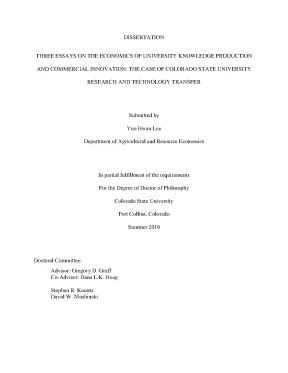
Tải xuống để đọc toàn bộDISSERTATION THREE ESSAYS ON THE ECONOMICS OF UNIVERSITY KNOWLEDGE PRODUCTION AND COMMERCIAL INNOVATION: THE CASE OF COLORADO STATE UNIVERSITY RESEARCH AND TECHNOLOGY TRANSFER Submitted by Yoo Hwan Lee Department of Agricultural and Resource Economics In partial fulfillment of the requirements For the Degree of Doctor of Philosophy Colorado State University Fort Collins, Colorado Summer 2016 Doctoral Committee: Advisor: Gregory D. Graff Co-Advisor: Dana L. Mushinski Copyright by Yoo Hwan Lee 2016 All Rights Reserved ABSTRACT THREE ESSAYS ON THE ECONOMICS OF UNIVERSITY KNOWLEDGE PRODUCTION AND COMMERCIAL INNOVATION: THE CASE OF COLORADO STATE UNIVERSITY RESEARCH AND TECHNOLOGY TRANSFER The central aim of this study is to analyze the research production and R&D activities of Colorado State University (CSU) across its different colleges, departments and other research units, and to evaluate how those activities impact the Colorado economy’s agriculturally-related sectors. The study consists of three main chapters, to introduce the dynamics of university knowledge transfer to local agricultural economies.
Chapter 1 explores CSU research production and technology-transfer activities, using a unique panel date set for each of 54 academic departments over the period of 1989-2012. In order to estimate the empirical knowledge-production function (KPF), this chapter attempts to build a negative binomial panel regression model with a polynomial distributed lags (PDL) of research expenditures. Three categories of research outputs are modelled, including (1) published journal articles, (2) industry collaboration, and (3) technology transfer mechanisms. In the regression results, publications are clearly the most common research outputs of the university, with a more systematic relationship between research inputs and publications than the other two types of research outputs.
Moreover, it appears to exhibit decreasing returns to scale, whereas the collaborative and tech transfer research outputs appear to show increasing returns to scale. In the results of a seemingly unrelated regressions (SUR) model among the three different types of research outputs, publications and the tech transfer mediated research outputs are the primary research outputs in the university and have the maximum impact from past research expenditures. ii Furthermore, results indicate that collaboration mediated outputs are substitutional relative to the more formal tech transfer outputs. Chapter 2 explores the agency of knowledge production, viewing scientific research teams as “quasi-firms” arising as independent knowledge-creating entities within the university context.
First, the findings from the ego-centric social network showed that the participation of outside members makes it possible to increase the size of the ego-centric teams and the growth patterns of the percent share are an obvious parallel to the patterns of team size. Particularly, the growth rate of team size is opposite of the percent share of ego’s home department co-authors with upward and downward tendencies, respectively. Second, the findings from the regression results showed that the number of CSU departments per team is statistically significant in the team’s assembly mechanism for both the article teams and patent teams. Thus, it seems reasonable to conclude that cross-functional team formation is more effective and common in the university research team formation and has a positive impact on the size of research teams.
Finally, the quality of research teams’ knowledge production tells us that the group with multiple departments per article has a higher research impact than a group using a single department per article. By the same token, larger-sized teams have higher impacts than relatively smaller-sized teams, as well as field variety. The group with multiple references per patent had a higher impact than the groups with a single or no reference per patent. This result tells us that the citation mapping from backward citations to forward citations is a significant factor for testing the research teams’ impacts on the economic and social benefits with respect to knowledge spillover.
Chapter 3 has focused on CSU’s knowledge spillovers within agriculturally related fields and technologies. The findings indicated that academic knowledge spillovers are geographically bounded, but they are not strictly limited to the regional scale. Crucially, the impact of university iii spillovers on agriculturally-related industries depends upon which type of knowledge dissemination channel is utilized by university researchers. Broadly speaking this chapter evaluates four types of channel—including the publication mechanism, the industry collaboration and extension mechanism, the technology patenting/licensing mechanism, and the venture creation mechanism—each of which are variously adapted to transmitting different degrees of sticky (tacit) versus slippery (codified) knowledge.
The results showed that in both aggregate level of technology and six different technological categories, the spillover impacts of journal publications, are rarely localized within Colorado; rather, the geographic scope of these impacts are national and even global. However, the extent to which the spillover impacts of patented knowledge is localized within Colorado is open to question because it is possible to control permissions for use, but at the same time it is impossible to limit everyone’s awareness and use of it, particularly in foreign jurisdictions where patents are not taken out by the university. However, the collaboration mechanism requires closer interaction and greater geographic proximity, which usually prevents global dissemination. Thus, we observe geographic proximity is significantly important for these channels.
However, there are even distinctions within these. For example, we find industry coauthorship on articles to be less likely to be localized than privately sponsored grant awards. Nevertheless, the stickiness of these channels might depend also on the different technological categories. As mention as above, the geographic proximity is important only in aggregate level of technology, but it can be varied across the different technological categories, especially the slippery form of knowledge in animal health and nutrition health technology.
Finally, university start-ups are highly geographically bounded near universities because in the early stages start-up companies need support from their host university. iv ACKNOWLEDGEMENTS I would like to sincerely thank my advisor, Professor. Graff, for supporting and advising me during my doctoral program years. Graff showed commitment to and put his heart into my dissertation and long-term career goals.
He always encouraged me to improve the most important skills to me as an economist and to grow as a creative and independent researcher. Particularly, I really love his academic leadership and economic intuitions, especially regarding technological innovation and the economics of entrepreneurship. Moreover, his mentorship is paramount in advising his students, especially his international students. Graff deeply and truly understands his students’ problems and concerns, and he always endeavors to solve their problems.
Whenever I suffered a hard time in my academic journey, he always cheered me up wholeheartedly and advised me how to resolve the problem. I would like to thank him again and to say that I could never have achieved my doctoral degree without his advice and encouragement. I would also like to thank my co-advisor, Professor. Dana Hoag, for his advice and insightful suggestions on my dissertation and for his letter of recommendation for my job applications.
He is the person I met first at Colorado State University, and he hooded me at the commencement ceremonies on behalf of Dr. Moreover, I am also grateful to my other dissertation committee members at Colorado State University, Professor. David Mushinski and Stephen Koontz, for their time and valuable feedback on a preliminary version of my dissertation, especially relating to their econometric knowledge. I would like to thank the members of the Department of Agricultural and Resource Economics at Colorado State University, including the professors (Dr.
Gregory Perry and Dr. Dawn Thilmany), the administrative staffs (Ms. Denise Davis and Donna Sosna), and my colleagues, especially v Ghulam Samad, Annabelle Berklund, Neama Lariel, Chuba Suntharlingam, and Jakrapun Suksawat (Ton), for their love and support. I would like to thank the members of CSU Ventures, Dr.
Todd Headley and Ms. Sarah Belford, for sharing their valuable dataset and our insightful discussions. I am also grateful to the members of the Office of the Vice President for Research at Colorado State University, Dr. Rudolph and Dr.
Pam Harrington, for sharing their valuable dataset, discussions, and suggestions. Finally, I thank my beloved family, my parents in Gumi, parents-in-law in Suji, my sister (Yoo Jin), my nephew (Jun Hyeok), my sister-in-law (Hye Won), for their endless love and commitment. I especially thank my lovely wife (Hye Jun) for her patience, love, and faith. I also thank my little princess: my daughter (Yerin_Manna).
In addition, I would like to thank my spiritual family: Pastor Paul J. Gim and Ms. Youngin Lee in the Korean Presbyterian Church of Lawrence for their prayer and love, and the other church family members: Pastor Gi Hyun Park and the other members of the First Korean Church of Fort Collins for also their prayer, love and support. vi DEDICATION I dedicate this dissertation to my Lord and Savior Jesus Christ for the unfailing love and eternal life.
“Surely God is my salvation; I will trust and not be afraid. The LORD, the LORD, is my strength and my song; he has become my salvation.", (Isaiah 12:2, NIV) vii TABLE OF CONTENTS Abstract. vii Overall Introduction. Empircal Evidence of the University Knowledge Production Function and Knowledge Dissemination Activities: The Case of Colorado State University.
The Knowledge Production Function: Theory and Empirical Analysis. Different Types of Knowledge Dissemination Channels. Empirical Model Framework. Functional Forms for Modelling Knowledge Production.
Count Data as Research Output. Polynomial Distributed Lags (PDL) Model. Effective Labor in Knowledge Production Function. Research Input Data.
Research Output Data. Outputs Disseminated via the Public Domain Mechanism. Outputs Disseminated via the Collaboration Mechanism. Outputs Disseminated via Technology Transfer Mechanism.
Identifying research inputs on the knowledge production function. Model specification on the lags of research expenditures. Research productivity and long-run effect. Independent Regression Model Results.
Estimating Output of Published Journal Articles. Estimating Output of Doctoral Degree Awards. Estimating Output captured in the Collaboration Index. Estimating Output of Combined Tech Transfer Metrics.
Returns to scale and long-run productivity. System of Equation Model Results. Knowledge Production Based on the Theory of Classical Production. Knowledge Production in a Single Institutional Data versus an Aggregation Data.
Scientific Teams as Quasi-firms: A New Framework for Understanding the Agency of Knowledge Production within the University Context. Social network analysis and research teams. Academic research teams operate like quasi-firms. Trend of Academic Research Teams within Colorado State University.
Conceptual Frameworks of Academic Research Teams. Empirical Approaches to Analyzing Academic Research Teams. Social network analysis. The structure of ego-centric research teams.
The dynamics of ego-centric research teams. Hypotheses for academic research teams and its formations. University research teams generating published journal articles. Relative proportion of non-CSU affiliations.
University research teams producing patented inventions. 127 2) Independent and control variables. Impacts of Team Research. Impact of published journal articles as research output.
The impact of participated private companies per article. The impact of the participation of CSU departments per article. The impact of team size per article. The impact of field categories per article.
Research impact of the patents. The impact of the corporate co-assignments per patent. The impact of the participation of researchers from multiple CSU departments. The impact of the cited references per patent.
The impact of the DWPI patent family per patent. The impact of team size on patent citations. The impact of time lag between application and publication per patent. University Knowledge Spillovers to the Agricultural Economy: The Impact of Agricultural Research at Colorado State University on the Colorado Economy, and Beyond.
Technology change and interaction between university and industry. Geographic proximity and localization. The Regional Agricultural Economy and Value Chains. Empirical Study of University Knowledge Spillovers in Agriculture.
Geographic footprint of university knowledge spillovers. Public domain mechanism of knowledge dissemination. Collaboration mechanism of knowledge dissemination. 163 1) Grants and contracts awarded from private sector sponsors.
164 2) Industry co-authorship on academic journal articles. Patenting/licensing mechanism of knowledge dissemination. Venture creation mechanism of knowledge dissemination .
Nội dung được bảo vệ bản quyền — Tải xuống đầy đủ
Trích dẫn luận án này
Yoo Hwan Lee (2016). Kinh tế sản xuất tri thức đại học & đổi mới thương mại CSU [Luận án tiến sĩ, Colorado State University]. LuanAn.net. https://luanan.net/kinh-te/kinh-te-phat-trien/kinh-te-san-xuat-tri-thuc-dai-hoc-doi-moi-thuong-mai-csu
Câu hỏi thường gặp
Luận án "Kinh tế sản xuất tri thức đại học & đổi mới thương mại CSU" nghiên cứu về vấn đề gì?
Khám phá kinh tế sản xuất tri thức đại học & đổi mới thương mại tại CSU. Nâng cao năng lực cạnh tranh và thúc đẩy tăng trưởng kinh tế.
Luận án "Kinh tế sản xuất tri thức đại học & đổi mới thương mại CSU" được bảo vệ tại trường nào?
Luận án này được bảo vệ tại Colorado State University. Năm bảo vệ: 2016.
Luận án "Kinh tế sản xuất tri thức đại học & đổi mới thương mại CSU" thuộc chuyên ngành gì?
Luận án "Kinh tế sản xuất tri thức đại học & đổi mới thương mại CSU" thuộc chuyên ngành Agricultural and Resource Economics. Danh mục: Kinh Tế Phát Triển.
Luận án "Kinh tế sản xuất tri thức đại học & đổi mới thương mại CSU" có bao nhiêu trang?
Luận án "Kinh tế sản xuất tri thức đại học & đổi mới thương mại CSU" có 230 trang. Bạn có thể xem trước một phần tài liệu ngay trên trang web trước khi tải về.
Cách tải luận án "Kinh tế sản xuất tri thức đại học & đổi mới thương mại CSU" về máy như thế nào?
Để tải luận án về máy, bạn nhấn nút "Tải xuống ngay" trên trang này, sau đó hoàn tất thanh toán phí lưu trữ. File sẽ được tải xuống ngay sau khi thanh toán thành công. Hỗ trợ qua Zalo: 0559 297 239.