Metal-Catalyzed & Photo-Induced Functionalization: New Approaches, Vu Nguyen (UTSA)
Functionalization via metal-catalyzed and photo-induced chemistry enables selective transformations for sustainable synthesis.
The University of Texas at San Antonio
Luan An
Luận án
Năm xuất bản
Số trang
353
Thời gian đọc
53 phút
Lượt xem
0
Lượt tải
0
Phí lưu trữ
60 Point
Tổng quan nhanh
- Chủ đề:
- Nâng cao Chức Năng Hóa Chất Hữu cơ qua Tổng Hợp Hiện Đại
- Số trang:
- 353 trang
- Trường:
- The University of Texas at San Antonio
- Chuyên ngành:
- Chemistry
- Tác giả:
- Vu Tran Nguyen
- Năm:
- 2020
Tóm tắt nội dung luận án
I.Nâng cao Chức Năng Hóa Chất Hữu cơ qua Tổng Hợp Hiện Đại
Tổng quan về functionalization là cần thiết cho thiết kế phân tử. Việc thêm các nhóm chức cụ thể giúp điều chỉnh tính chất hóa học. Điều này đóng vai trò sống còn trong phát triển vật liệu mới và dược phẩm. Khả năng sửa đổi hợp chất mở ra các con đường tổng hợp đa dạng. Cần có những phương pháp vững chắc để xây dựng các cấu trúc phức tạp. Nghiên cứu này tập trung vào các chiến lược hiệu quả để đạt được mục tiêu đó. Nó khám phá các phương pháp tiên tiến giúp thay đổi cấu trúc phân tử. Phương pháp này đóng góp vào sự tiến bộ của ngành hóa học tổng hợp hữu cơ.
1.1. Tầm quan trọng của Chức Năng Hóa Hợp chất
Functionalization liên quan đến việc thêm các nhóm cụ thể vào phân tử. Quá trình này điều chỉnh tính chất phân tử. Nó rất quan trọng để tạo ra vật liệu và dược phẩm mới. Thiết kế phân tử chính xác dựa vào chức năng hóa hiệu quả. Khả năng sửa đổi hợp chất mang lại tiện ích tổng hợp to lớn. Các cấu trúc phân tử phức tạp đòi hỏi các phương pháp chức năng hóa mạnh mẽ. Việc tinh chỉnh các hợp chất hữu cơ là trọng tâm của đổi mới hóa học.
1.2. Thách thức trong Tổng hợp Hữu cơ bền vững
Tổng hợp hữu cơ hiện đại đối mặt với yêu cầu về tính bền vững. Các phương pháp truyền thống thường tạo ra chất thải. Chúng có thể cần điều kiện khắc nghiệt hoặc thuốc thử độc hại. Phát triển các quy trình xanh hơn là tối quan trọng. Hiệu quả và kinh tế nguyên tử là các chỉ số chính. Các lộ trình tổng hợp mới tìm cách giảm thiểu tác động môi trường. Hóa học bền vững thúc đẩy đổi mới trong phương pháp luận. Cần có các giải pháp sáng tạo để giải quyết những thách thức này.
II.Xúc Tác Kim Loại Chuyển Tiếp cho Chức Năng Hóa Hiệu Quả
Xúc tác kim loại chuyển tiếp là xương sống của nhiều phản ứng tổng hợp hữu cơ. Các kim loại như palladium, niken, và đồng thúc đẩy các biến đổi quan trọng. Chúng cho phép hình thành liên kết carbon-carbon và carbon-heteroatom mới. Các phản ứng này thường có tính chọn lọc cao và hiệu quả. Việc khai thác tiềm năng của chúng là cần thiết cho chức năng hóa nâng cao. Nghiên cứu này khám phá các ứng dụng mới của xúc tác kim loại. Nó mở rộng phạm vi của các công cụ tổng hợp sẵn có. Việc tối ưu hóa các điều kiện xúc tác dẫn đến các quy trình hiệu quả hơn.
2.1. Kích hoạt liên kết C H mới trong Hóa học
Kích hoạt liên kết C-H đại diện cho một chiến lược mạnh mẽ trong tổng hợp hữu cơ. Nó cho phép chức năng hóa trực tiếp các liên kết C-H phổ biến. Điều này tránh các bước tiền chức năng hóa. Quá trình thường sử dụng xúc tác kim loại chuyển tiếp. Các phức hợp kim loại tạo điều kiện phá vỡ và hình thành liên kết C-H. Cách tiếp cận này mang lại hiệu quả nguyên tử đáng kể. Nó hợp lý hóa các lộ trình tổng hợp, làm cho chúng hiệu quả hơn.
2.2. Phản ứng Ghép Nối Chéo trong tổng hợp hữu cơ
Phản ứng ghép nối chéo là nền tảng của tổng hợp hữu cơ hiện đại. Các phản ứng này hình thành các liên kết carbon-carbon mới. Chúng thường liên quan đến xúc tác kim loại chuyển tiếp. Các chất xúc tác palladium, niken và đồng rất phổ biến. Các ví dụ bao gồm ghép nối Suzuki, Heck và Stille. Các phương pháp này xây dựng các kiến trúc phân tử phức tạp. Tính linh hoạt của chúng là vô song trong tổng hợp hóa học.
2.3. Vai trò Organometallic trong quá trình xúc tác
Hóa học organometallic là trung tâm của xúc tác kim loại chuyển tiếp. Các hợp chất organometallic có liên kết kim loại-carbon. Các loài này hoạt động như các chất trung gian phản ứng. Chúng tạo điều kiện phá vỡ và hình thành liên kết. Hiểu rõ cơ chế của chúng là rất quan trọng. Thiết kế chất xúc tác được hưởng lợi từ những hiểu biết về organometallic. Các phức hợp này thúc đẩy các biến đổi tổng hợp khác nhau. Chúng cung cấp nền tảng cho sự đổi mới trong xúc tác.
III.Hóa Học Quang Kích Thích và Xúc Tác Quang Oxy Hóa Khử
Hóa học quang kích thích khai thác ánh sáng làm nguồn năng lượng. Nó mở ra những con đường mới cho các phản ứng hóa học. Photocatalysis và photoredox catalysis là những lĩnh vực trọng tâm. Các phương pháp này cung cấp các điều kiện phản ứng nhẹ nhàng. Chúng tránh nhu cầu về nhiệt độ cao hoặc áp suất khắc nghiệt. Việc tạo ra các chất trung gian gốc tự do là một đặc điểm chính. Điều này cho phép các phản ứng không thể thực hiện được bằng các phương pháp truyền thống. Ánh sáng đóng vai trò là chất xúc tác năng lượng sạch. Nghiên cứu này khám phá cách ánh sáng thúc đẩy các biến đổi hóa học mạnh mẽ.
3.1. Cơ chế và ứng dụng của Photocatalysis
Photocatalysis sử dụng năng lượng ánh sáng để thúc đẩy các phản ứng hóa học. Một chất quang xúc tác hấp thụ ánh sáng và khởi động một chu trình xúc tác. Phương pháp này thường hoạt động trong điều kiện nhẹ. Nó cung cấp một giải pháp thay thế cho các quy trình nhiệt truyền thống. Các ứng dụng môi trường bao gồm làm sạch nước. Các ứng dụng tổng hợp mở rộng đến nhiều hình thành liên kết khác nhau. Ánh sáng cung cấp nguồn năng lượng sạch cho các phản ứng.
3.2. Phản ứng Radical Chemistry bằng Photoredox catalysis
Photoredox catalysis là một tập hợp con mạnh mẽ của photocatalysis. Nó tạo ra các chất trung gian hóa học gốc tự do có tính phản ứng cao. Một chất quang xúc tác hấp thụ ánh sáng và trải qua quá trình truyền electron. Điều này tạo ra các gốc tự do từ các tiền chất ổn định. Các gốc tự do sau đó tham gia vào các phản ứng hình thành liên kết. Phương pháp này cho phép các biến đổi mới lạ. Nó mở rộng phạm vi của tổng hợp hữu cơ. Khám phá thuốc hưởng lợi từ các phản ứng mới này.
IV.Kết Hợp Xúc Tác Kim Loại và Quang Kích Thích cho Chức Năng Hóa
Sự kết hợp giữa xúc tác kim loại chuyển tiếp và hóa học quang kích thích là một lĩnh vực mới nổi. Phương pháp tiếp cận lai này mang lại sức mạnh tổng hợp đáng kể. Nó cho phép các phản ứng đạt được hiệu suất vượt trội. Các điều kiện phản ứng thường nhẹ hơn so với các phương pháp riêng lẻ. Phản ứng gốc tự do có thể được kiểm soát bởi các kim loại chuyển tiếp. Điều này mở rộng đáng kể phạm vi các biến đổi hóa học. Nó cung cấp các công cụ mới để chức năng hóa các phân tử phức tạp. Sự kết hợp này mang lại các giải pháp sáng tạo cho các thách thức tổng hợp. Nó là một hướng đi đầy hứa hẹn trong tổng hợp hữu cơ hiện đại.
4.1. Ưu điểm của phương pháp kết hợp
Kết hợp xúc tác kim loại chuyển tiếp với photocatalysis mang lại những lợi thế độc đáo. Cách tiếp cận tổng hợp này cho phép các con đường phản ứng mới. Nó thường dẫn đến tăng cường khả năng phản ứng và tính chọn lọc. Các điều kiện phản ứng nhẹ nhàng có thể đạt được. Sự kết hợp có thể khắc phục những hạn chế của các phương pháp riêng lẻ. Nó mở rộng bộ công cụ cho tổng hợp hữu cơ. Các phân tử phức tạp trở nên dễ tiếp cận hơn.
4.2. Cơ hội mới trong tổng hợp phức tạp
Các hệ thống xúc tác lai mở ra cánh cửa cho chức năng hóa phức tạp. Các chiến lược kích hoạt C-H mới xuất hiện. Hóa học gốc tự do có thể được kiểm soát chính xác bởi các trung tâm kim loại. Cách tiếp cận kép này cho phép các biến đổi đa bước trong một nồi. Nó hợp lý hóa việc tổng hợp dược phẩm và hóa chất tinh khiết. Các phương pháp cung cấp các giải pháp sáng tạo cho các tổng hợp đầy thách thức.
V.Ứng dụng và Tiềm năng của Phương Pháp Mới trong Ngành
Các phương pháp chức năng hóa tiên tiến này có tác động sâu sắc đến các ngành công nghiệp. Chúng mang lại hiệu quả và tính bền vững cho các quy trình tổng hợp. Từ khám phá thuốc đến sản xuất hóa chất đặc biệt, các ứng dụng rất rộng. Hóa học bền vững là mục tiêu chính của những nghiên cứu này. Giảm chất thải và tối ưu hóa tài nguyên là những lợi ích chính. Tiềm năng để tạo ra các loại thuốc và vật liệu mới là rất lớn. Việc tiếp tục phát triển các phương pháp này sẽ định hình tương lai của hóa học. Nó sẽ thúc đẩy sự đổi mới trên nhiều lĩnh vực khác nhau.
5.1. Đổi mới trong Phát hiện Thuốc và Hóa dược
Các phương pháp chức năng hóa đã phát triển tác động đến khám phá thuốc. Tổng hợp hiệu quả các hợp chất dẫn đầu là rất quan trọng. Tiếp cận không gian hóa học mới giúp tăng tốc phát triển thuốc. Các giàn giáo phân tử phức tạp được tạo ra dễ dàng hơn. Các kỹ thuật này tạo điều kiện cho các nỗ lực hóa học dược phẩm. Các tác nhân trị liệu mới có thể được thiết kế và tổng hợp. Ngành dược phẩm được hưởng lợi đáng kể.
5.2. Hướng tới Hóa học Bền vững và hiệu quả
Những tiến bộ này góp phần vào hóa học bền vững. Giảm chất thải và điều kiện nhẹ nhàng là những mục tiêu nội tại. Việc sử dụng tài nguyên hiệu quả được ưu tiên. Phát triển các lộ trình tổng hợp xanh hơn là điều cần thiết. Nghiên cứu này thúc đẩy ranh giới của tổng hợp hữu cơ có trách nhiệm với môi trường. Các quy trình hóa học trong tương lai sẽ hiệu quả hơn và ít tác động hơn.
Mục lục chi tiết luận án
Tải xuống file đầy đủ để xem toàn bộ nội dung
Tải đầy đủ (353 trang)Nội dung chính
Tổng quan về luận án
Sự đa dạng hóa cấu trúc phân tử thông qua các phương pháp chức hóa trực tiếp (functionalization) giữ vị trí then chốt trong hóa học tổng hợp hiện đại, đặc biệt trong quy trình tối ưu hóa dược động học, dược lực học của các ứng viên thuốc và phát triển vật liệu tiên tiến. Luận án tiến sĩ hóa học với tiêu đề "New and Efficient Approaches to Functionalization via Metal-Catalyzed and Photo-Induced Transformations" do nghiên cứu sinh Vũ Trần Nguyễn thực hiện dưới sự hướng dẫn của Giáo sư Oleg V. Larionov tại Khoa Hóa học, Đại học Texas tại San Antonio (The University of Texas at San Antonio - UTSA, 2020), đã giải quyết các thách thức căn bản trong việc xây dựng liên kết carbon–carbon (C–C) và carbon–dị nguyên tử (C–X) bằng cách tích hợp xúc tác quang hóa (photocatalysis), xúc tác kim loại chuyển tiếp (transition-metal catalysis), hóa học gốc tự do (radical chemistry) và hóa học oxy hóa khử (redox chemistry).
Khoảng trống nghiên cứu (research gap) mà luận án trực tiếp giải quyết xuất phát từ các rào cản cố hữu của tổng hợp hữu cơ truyền thống: sự phụ thuộc vào kim loại nặng đắt đỏ (Pd, Ir, Rh), nhu cầu phối tử độc quyền, điều kiện nhiệt độ cao khắc nghiệt, tính kinh tế nguyên tử và kinh tế bước (step and atom economy) kém hiệu quả, cùng sự phát sinh chất thải độc hại. Điển hình, trong việc tạo gốc alkyl từ axit cacboxylic, các quy trình trước đây đòi hỏi phải chuyển hóa gián tiếp qua các este hoạt hóa oxy hóa khử (redox-active esters như este $N$-hydroxyphthalimide hoặc hợp chất iod hóa trị ba) gây lãng phí nhiều bước tổng hợp. Đồng thời, các phản ứng arylation trực tiếp trên 1,3-dien qua ghép cặp Heck thường tạo ra hỗn hợp đồng phân vị trí và lập thể khó kiểm soát. Đặc biệt, luận án đã vạch rõ sự hiểu sai kéo dài suốt 50 năm trong y văn học thuật khởi nguồn từ các công bố của Nozaki et al. (1968) về cơ chế phản ứng quang hóa giữa cyclohexene và trialkylborane.
Để lấp đầy các khoảng trống này, luận án thiết lập hệ thống 4 câu hỏi nghiên cứu và 4 giả thuyết khoa học tương ứng:
- RQ1: Phản ứng quang hóa giữa cyclohexene và trialkylborane thực chất diễn ra theo cơ chế cộng hợp bảo tồn vòng (syn-carboboration) hay tái sắp xếp thu hẹp vòng (ring contraction)?
- H1: Quá trình quang hóa kích hoạt cyclohexene chuyển hóa thành đồng phân biến dạng cao $(E)$-cyclohexene, từ đó trải qua quá trình thu hẹp vòng carboboration quang hóa (photoinduced carboborative ring contraction) tạo ra dẫn xuất cyclopentane đa thế.
- RQ2: Yếu tố cơ học lượng tử nào chi phối tính chọn lọc lập thể nghịch đảo/bảo toàn cấu hình tại tâm carbon boryl hóa?
- H2: Tính chọn lọc lập thể không tuân theo trạng thái chuyển tiếp $S_N2$ đồng bộ hay trung gian hai bước tự do, mà được kiểm soát bởi hiện tượng bất đối xứng động học vi mô (dynamic asymmetry).
- RQ3: Có thể kích hoạt trực tiếp liên kết C–COOH của axit cacboxylic phong phú để sinh gốc tự do alkyl mà không cần qua dẫn xuất este hoạt hóa?
- H3: Xúc tác acridine thông qua quá trình chuyển dịch electron ghép proton cảm ứng quang hóa (PCET) trong phức liên kết hydro acridine–axit cacboxylic sẽ tạo ra gốc alkyl tự do với hiệu quả chọn lọc cao.
- RQ4: Làm thế nào để điều khiển phản ứng dien hóa lập thể nghiêm ngặt và chức hóa haloarene mà không phụ thuộc vào kim loại chuyển tiếp quý tộc?
- H4: Sử dụng chất trung gian 3-sulfolene thông qua cơ chế đùn cheletropic kết hợp xúc tác Ni/Pd và hệ khơi mào persulfate sẽ cho phép điều khiển lập thể tuyệt đối các 1,3-dien cũng như tổng hợp sulfone dị vòng.
Khung lý thuyết của luận án được xây dựng dựa trên ba trụ cột: Lý thuyết bất đối xứng động học và quỹ đạo trạng thái chuyển tiếp (Dynamic Trajectory & Dynamic Asymmetry Theory), Lý thuyết chuyển dịch electron ghép proton (Proton-Coupled Electron Transfer - PCET), và Lý thuyết sức căng vòng của các chất trung gian quang hóa $(E)$-cycloalkene. Nghiên cứu mang lại tác động định lượng đột phá: cung cấp quy trình thu hẹp vòng với hiệu suất lên tới 98%, độ chọn lọc đồng phân lập thể vượt trội (>20:1 d.r.), hiệu suất lượng tử quang hóa đạt $\Phi = 0.26$, và mở ra lộ trình tổng hợp hàng loạt hợp chất dị vòng, amin, rượu và dẫn xuất terpenoid trên quy mô gram.
Literature Review và Positioning
Nghiên cứu chức hóa muộn (late-stage functionalization) và tổng hợp gốc tự do trong thập kỷ qua được định hình bởi hai trường phái lớn. Trường phái thứ nhất tập trung vào việc kích hoạt gốc tự do alkyl thông qua các dẫn xuất hoạt hóa, tiêu biểu là công trình của Baran và cộng sự (2016) về phản ứng ghép chéo gốc tự do (RCC) giữa hợp chất cơ kẽm alkenyl và redox-active esters. Mặc dù phương pháp của Baran đã rút ngắn quá trình tổng hợp steroid 1 từ 7 bước xuống 2 bước, nhược điểm lớn là việc phải tổng hợp cô lập este trung gian và phát sinh lượng lớn sản phẩm phụ phthalimide. Song song đó, Ackermann và cộng sự tại AstraZeneca (2018) đã tiên phong phát triển phản ứng methyl hóa liên kết C–H xúc tác cobalt, cho phép điều chế đồng loạt 20 chất tương tự thuốc trong một bước duy nhất và loại bỏ hơn 100 bước tổng hợp trung gian không mong muốn.
Trường phái thứ hai liên quan đến hóa học quang hóa các cycloalkene và phản ứng carboboration. Báo cáo kinh điển của Nozaki et al. (1968, 1970) từng khẳng định rằng phản ứng quang hóa giữa cyclohexene và trialkylborane dẫn đến sản phẩm cộng syn-carboboration bảo tồn bộ khung 6 cạnh, tạo ra các cis-2-alkylcyclohexanol sau quá trình oxy hóa. Quan điểm này đã trở thành tiên đề được chấp nhận trong nhiều tài liệu tham khảo về hóa học hữu cơ kim loại.
                  [Trường phái Cổ điển: Nozaki (1968)]
                     Cyclohexene + Trialkylborane
                                 │
                                 ▼ (hν, 254 nm)
                    cis-2-Alkylcyclohexanol
                 (Cộng syn - Giữ nguyên vòng 6 cạnh)
                                 │
                   ❌ [Mâu thuẫn phổ học & lập thể]
                                 │
        ┌────────────────────────┴────────────────────────┐
        ▼                                                 ▼
[Luận án Vũ Trần Nguyễn (2020)]              [DFT Dynamic Trajectories: Singleton]
- Tái sắp xếp thu hẹp vòng                   - Trạng thái chuyển tiếp duy nhất
- Tạo dẫn xuất cyclopentane                   - Hiện tượng "Dynamic Asymmetry"
- Nhánh boryl alkyl chứa tâm lập thể mới     - Giải thích tỷ lệ nghịch đảo/bảo toàn
- Hiệu suất 51-98%, d.r. > 20:1              - Bẻ gãy nghịch lý SN2 cổ điển
Luận án của nghiên cứu sinh Vũ Trần Nguyễn đã tạo ra bước ngoặt mang tính định vị lại toàn bộ nhánh nghiên cứu này thông qua việc chứng minh thực nghiệm rằng kết luận của Nozaki là không chính xác. Tác giả trích dẫn trực tiếp từ văn bản nguồn: "The earlier reports by Nozaki indicated that the photochemical reaction between cyclohexenes and trialkylboranes produced cis-2-alkylcyclohexanols... Our experimental results and the comparison of the available spectroscopic data suggest that the products of the photochemical reaction of cyclohexenes with trialkylboranes observed by Nozaki et al. were the products of the carboborative ring contraction." Bằng chứng phổ học thực nghiệm chỉ ra rằng tín hiệu proton CH–OH của sản phẩm thu được xuất hiện ở độ dịch chuyển hóa học $\delta = 3.55\text{ ppm}$ (tương ứng với cấu trúc thu hẹp vòng cyclopentane), hoàn toàn tách biệt với tín hiệu $\delta = 3.00\text{ ppm}$ (trong $\text{CCl}_4$) đặc trưng của cis-2-butylcyclohexanol vòng 6 cạnh.
So với các nghiên cứu quốc tế đương đại, luận án định vị một hướng tiếp cận vượt trội:
- So với Baran et al. (2016): Luận án loại bỏ hoàn toàn sự cần thiết của redox-active esters bằng cách ứng dụng xúc tác quang acridine kích hoạt PCET trực tiếp trên liên kết carboxyl tự do, đạt hiệu suất nguyên tử tuyệt đối và sinh $\text{CO}_2$ cùng $\text{H}_2$ như các sản phẩm phụ duy nhất.
- So với Ackermann et al. (2018): Không chỉ dừng lại ở chức hóa C–H đơn thuần, phương pháp quang hóa của luận án cho phép tái cấu trúc toàn diện bộ khung carbon của các hợp chất tự nhiên dồi dào (terpene, steroid, alkaloid) thành các hệ vòng 5 cạnh ngưng tụ chứa các tâm lập thể bậc 4 liền kề cực kỳ phức tạp.
Đóng góp lý thuyết và khung phân tích
Đóng góp cho lý thuyết
Luận án đã thách thức và mở rộng lý thuyết trạng thái chuyển tiếp quy ước trong hóa học hữu cơ vật lý. Khi phân tích phản ứng thu hẹp vòng carboboration, một nghịch lý cơ chế đã xuất hiện: nếu sự di chuyển của nguyên tử carbon nội vòng C3 đến vị trí C1 diễn ra đồng thời với sự chuyển nhóm alkyl từ nguyên tử boron sang vị trí C2 theo cơ chế $S_N2$ liên hợp, sản phẩm phải thể hiện tính đặc thù lập thể nghịch đảo 100%. Ngược lại, nếu chất trung gian cation hai bước được hình thành hoàn chỉnh, tỷ lệ nghịch đảo và giữ nguyên cấu hình phải là 1:1. Tuy nhiên, dữ liệu thực nghiệm trên phân tử limonene 35 lại cho thấy tỷ lệ ưu tiên nghịch đảo cao nhưng không tuyệt đối.
Hợp tác với nhóm nghiên cứu tính toán cơ học lượng tử của Giáo sư Daniel Singleton (Texas A&M University), tác giả đã chứng minh một nguyên lý lý thuyết mới: "The dynamic trajectories suggest that the inversion and retention products are formed from the same transition state, and the trajectories accurately account for the experimental product ratios. The unusual origin of the selectivity is the dynamically retained non-equivalence of newly formed versus pre-existing bonds after the first bond migration." Đây là minh chứng thực nghiệm và tính toán đột phá về hiện tượng "Bộ nhớ liên kết" (Bond Memory) trong tính chọn lọc lập thể được quyết định bởi động lực học vi mô (Dynamically-Determined Stereoselectivity).
Hệ thống hóa các mệnh đề lý thuyết của luận án:
- Proposition 1: Phản ứng quang cảm ứng trên cyclohexene dưới bước sóng UV-C ($\lambda = 254\text{ nm}$) hoặc qua chất cảm quang ethyl benzoate sinh ra chất trung gian biến dạng $(E)$-cyclohexene ở trạng thái đáy có hoạt tính lưỡng cực cao.
- Proposition 2: Tác nhân trialkylborane cộng hợp chọn lọc mặt ngoài (outside-face) vào $(E)$-cyclohexene tạo phức lưỡng cực cation–borate.
- Proposition 3: Quá trình thu hẹp vòng từ vòng 6 cạnh sang vòng 5 cạnh diễn ra qua một trạng thái chuyển tiếp đơn lẻ nhưng rẽ nhánh thành hai quỹ đạo động học vi mô (inversion vs. retention) do sự phân phối bất đối xứng năng lượng dao động nội phân tử.
- Proposition 4: Phức hợp liên kết hydro giữa acridine và axit cacboxylic làm suy giảm thế oxy hóa khử của gốc carboxylate, cho phép xảy ra quá trình PCET quang hóa đồng thời để sinh gốc tự do alkyl mà không cần tác nhân oxy hóa kim loại ngoài.
                    [E-Cyclohexene Biến dạng cao]
                                 │
                     + Trialkylborane (Mặt ngoài)
                                 │
                                 ▼
                     [Phức trung gian Lưỡng cực I]
                                 │
                    [Trạng thái chuyển tiếp Đơn lẻ]
                   (Single Bifurcating Transition State)
                                 │
        ┌────────────────────────┴────────────────────────┐
        │ Quỹ đạo động học vi mô A                        │ Quỹ đạo động học vi mô B
        ▼ (Năng lượng dao động duy trì)                   ▼ (Phân tán năng lượng)
[Sản phẩm Nghịch đảo cấu hình - Inversion]      [Sản phẩm Bảo toàn cấu hình - Retention]
         (Đồng phân lập thể chính 3)                    (Đồng phân lập thể phụ 3')
Khung phân tích độc đáo
Khung phân tích của nghiên cứu là sự tích hợp đa ngành giữa:
- Quang hóa học kích thích phân tử: Khai thác tính chất của các trạng thái kích thích singlet/triplet và sự chuyển dịch bước sóng phản ứng từ vùng tử ngoại ($\lambda = 254\text{ nm}$) sang vùng ánh sáng khả kiến bằng chất cảm quang hữu cơ (phenothiazine, ethyl benzoate).
- Mô hình lập thể Mosher–CBS: Kết hợp phương pháp este hóa Mosher cải tiến của Hoye để xác định cấu hình tuyệt đối tâm $R/S$ tại nhóm CH(OH) với phản ứng khử chọn lọc đối quang Corey–Bakshi–Shibata (CBS) sử dụng xúc tác $(S)$-CBS và $(R)$-CBS để giải mã chính xác 4 đồng phân lập thể $S1\text{-}A\text{ đến }S1\text{-}D$.
- Điều kiện biên lý thuyết: Phản ứng đòi hỏi dung môi có độ phân cực thích hợp (ethanol, THF, 1,4-dioxane) để ổn định trạng thái chuyển tiếp phân cực; sự hiện diện của chất cảm quang như $p$-xylene (2 mL) hoặc ethyl benzoate (20 mol%) giúp tăng tốc độ phản ứng lên gấp nhiều lần.
Phương pháp nghiên cứu tiên tiến
Thiết kế nghiên cứu
Luận án tuân thủ triết lý thực nghiệm thực chứng (Positivism) kết hợp mô hình hóa hóa học lượng tử (DFT). Thiết kế nghiên cứu vận hành theo quy trình đa tầng: sàng lọc tối ưu hóa điều kiện phản ứng (screening) $\rightarrow$ thẩm định độ tin cậy và phạm vi cơ chất (substrate scope) $\rightarrow$ nghiên cứu động học và bẫy chất trung gian (mechanistic interrogation) $\rightarrow$ tính toán cơ học lượng tử giải mã năng lượng tự do và quỹ đạo phân tử.
Cỡ mẫu nghiên cứu bao gồm hơn 50 hợp chất hữu cơ đa dạng: các cyclohexene đơn giản, dẫn xuất dị vòng oxy/nitơ (rac-2-cyclopropyl-4-methyl-3,6-dihydro-2H-pyran, methyl 5-methyl-3,6-dihydropyridine-1(2H)-carboxylate), các hợp chất tự nhiên terpene phức tạp ((R,R)-carveol, terpinolene, carvone, valencene, nerol oxide), axit béo chuỗi dài (palmitic acid) và các dẫn xuất haloarene/haloquinoline.
Quy trình nghiên cứu rigorous
Quy trình thực nghiệm được chuẩn hóa nghiêm ngặt để đảm bảo khả năng tái lập:
- Hệ thống quang hóa: Sử dụng lò phản ứng quang hóa Rayonet RPR-100 trang bị 16 bóng đèn Ushio 8W T5 UV-C ($\lambda = 254\text{ nm}$), quạt làm mát duy trì nhiệt độ buồng phản ứng ở mức chính xác $25^\circ\text{C}$. Phản ứng thực hiện trong các ống nghiệm thạch anh quang học tiêu chuẩn (Quartz Scientific, Inc., dung tích 10, 20 và 95 mL) đặt cách đèn UV 2 cm.
- Kỹ thuật thao tác khí trơ: Các hóa chất nhạy cảm (trialkylborane, gốc tự do) được xử lý trong tủ găng LC Technology Solutions LCPW-220 dưới môi trường khí Nitơ siêu tinh khiết. Dung môi THF được chưng cất tươi từ hệ chất chỉ thị sodium/benzophenone ketyl; dichloromethane, toluene và diethyl ether được làm khô qua hệ thống cột rây phân tử 3 Å của LC Technologies.
- Xác thực lượng tử (Actinometry): Thông lượng photon của lò phản ứng được đo lường chính xác bằng phương pháp đo lượng tử hóa học sử dụng hệ azoxybenzene actinometer. Trong 45 phút chiếu xạ, thông lượng photon đo được là $0.26\text{ mmol}$, lượng rượu 4 tạo thành là $0.068\text{ mmol}$, xác lập hiệu suất lượng tử quang hóa $\Phi = 0.26$.
[Hóa chất đầu vào: Cycloalkene + R3B]
         │
         ▼
[Khử khí Argon 10 phút trong Ống nghiệm Thạch anh]
         │
         ▼
[Chiếu xạ UV 254 nm / 300 nm trong Rayonet RPR-100 (25°C, 14-60h)]
         │
         ▼
[Oxy hóa: H2O2/NaOH (GP2) hoặc Na2CO3·1.5H2O2 (GP4) ở 50°C, 1h]
         │
         ▼
[Chiết EtOAc, sấy Na2SO4, cô quay chân không]
         │
         ▼
[Sắc ký cột tự động CombiFlash Rf-200 (Silica gel, EtOAc/Hexane)]
         │
         ▼
[Phân tích đa phổ: NMR 500MHz (1H, 13C, 11B, 19F) + HRMS + FT-IR + XRD]
Data và phân tích
Thiết bị phân tích bao gồm máy quang phổ cộng hưởng từ hạt nhân Agilent Inova 500/300 và Bruker AVANCE III 500 (ghi phổ $^1\text{H}, ^{13}\text{C}, ^{11}\text{B}, ^{19}\text{F}$ tại $25^\circ\text{C}$); phổ hồng ngoại biến đổi Fourier FT-IR Bruker Vector 22 với module kim quang ATR; khối phổ phân giải cao HRMS; phổ cộng hưởng thuận từ điện tử (EPR) xác định gốc tự do acridinyl ($HA^\bullet$) và phức đồng $\text{Cu(hfac)}_2$; cấu trúc tinh thể tia X được đo đạc và giải mã đơn tinh thể chính xác (ví dụ tinh thể hợp chất 21).
Dữ liệu thống kê hiệu suất phản ứng:
- Tối ưu hóa dung môi và chất cảm quang cho hợp chất 4: $p$-xylene/EtOH đạt hiệu suất 92% (14h), $o$-xylene đạt 82%, $m$-xylene đạt 71%, $p$-xylene/THF đạt 85%, $p$-xylene/Dioxane đạt 79%, trong khi $p$-xylene/Toluene chỉ đạt 25%.
- Tỷ lệ chất cảm quang xúc tác ethyl benzoate (20 mol%): đạt hiệu suất 95% ở $\lambda = 254\text{ nm}$ (trong THF) và 95% ở $\lambda = 300\text{ nm}$ (trong EtOH).
Phát hiện đột phá và implications
Những phát hiện then chốt
- Khám phá phản ứng thu hẹp vòng carboboration quang hóa: Chuyển hóa trực tiếp các cyclohexene thành cyclopentane gắn nhánh phụ mang liên kết C–B và tâm lập thể mới. 1-Methylcyclohexene phản ứng với tốc độ nhanh gấp 1.9 lần so với cyclohexene không thế, chứng minh sự tham gia của các chất trung gian phân cực cao.
- Hiệu suất tổng hợp vượt bậc trên cơ chất đa dạng:
- 1-Cyclopentylpropan-1-ol (13): Hiệu suất 98%.
- 1-(1-Methylcyclopentyl)propan-1-ol (4): Hiệu suất 91%.
- 1-(1-Methylcyclopentyl)pentan-1-ol (5): Hiệu suất 91%.
- 1-Cyclopentylpentan-1-ol (14): Hiệu suất 90%.
- Rượu cồng kềnh 1-(1-(tert-butyl)cyclopentyl)propan-1-ol (15): Hiệu suất 51%.
- Dị vòng tetrahydrofuran 16 (đơn đồng phân lập thể duy nhất): Hiệu suất 57%.
- Dị vòng pyrrolidine 17: Hiệu suất 61% với tỷ lệ đồng phân lập thể $10:1\text{ d.r.}$.
- Ứng dụng đột phá trên Terpenoid tự nhiên:
- Terpinolene (18) $\rightarrow$ cyclopentane 19: Hiệu suất 91%, độ chọn lọc lập thể $>20:1\text{ d.r.}$.
- $(R,R)$-Carveol (20) $\rightarrow$ dẫn xuất 21: Tỷ lệ đồng phân ban đầu $7\text{--}10:1\text{ d.r.}$, sau kết tinh đạt $>20:1\text{ d.r.}$, cấu hình xác nhận bằng nhiễu xạ tia X.
- Valencene $\rightarrow$ khung 6/5 bicyclic alcohol 30: Hiệu suất 74%.
- Nerol oxide $\rightarrow$ tetrahydrofuran 28: Hiệu suất 52%.
- Hợp chất 25 $\rightarrow$ tri-quaternary triad 26: Xây dựng thành công hệ thống chứa 2 tâm lập thể bậc 4 toàn carbon liền kề.
- Đa dạng hóa cấu trúc từ trung gian Organoborane: Chuyển hóa liên kết C–B thành $(E)$-alkene 31 và 32 (hiệu suất 68% và 70%) bằng tác nhân 2-methyl-2-nitrosopropane dimer; $O$-alkyl hóa tạo 4-alkoxyphenol 33 với benzoquinone; và amin hóa tạo amin 34 với hydroxylamine-$O$-sulfonic acid.
- Nền tảng xúc tác quang hóa Acridine/Cobaloxime Dual Catalysis: Kích hoạt quá trình dehydrodecarboxylation của axit béo, phản ứng direct decarboxylative alkylation (DDA) của anilin và sulfonylamid hóa trực tiếp mà không cần dùng đến kim loại quý hay chất oxy hóa độc hại.
                                  [Cyclohexene / Terpenoids]
                                               │
                                 ┌─────────────┴─────────────┐
                                 ▼                           ▼
                       [p-Xylene / UV 254 nm]     [Ethyl Benzoate / 300 nm]
                                 │                           │
                                 └─────────────┬─────────────┘
                                               ▼
                                  [Organoborane Trung gian 3]
                                               │
             ┌───────────────────┬─────────────┴─────┬───────────────────┐
             ▼                   ▼                   ▼                   ▼
      [Oxy hóa: H2O2]     [Amin hóa: HOSA]     [O-Alkyl hóa: BQ]    [Olefin hóa: MNPD]
             │                   │                   │                   │
             ▼                   ▼                   ▼                   ▼
      Alcohols (4-15)         Amine (34)       4-Alkoxyphenol (33)     (E)-Alkenes (31, 32)
     (Hiệu suất 51-98%)      (Chức hóa N)        (Chọn lọc C-O)         (Đơn đồng phân)
Implications đa chiều
- Lý thuyết: Tái định hình hiểu biết về động lực học trạng thái chuyển tiếp và cơ chế quang hóa của cycloalkene; bổ sung mô hình bất đối xứng động học vào hệ thống lý thuyết hóa hữu cơ vật lý.
- Phương pháp luận: Thiết lập quy trình tổng hợp "xanh" thay thế kim loại quý bằng xúc tác hữu cơ (acridine, xylene) và kim loại dồi dàu (Ni, persulfate).
- Thực tiễn sản xuất Dược phẩm: Cho phép chức hóa muộn các phân tử thuốc phức tạp, rút ngắn từ 5–10 bước tổng hợp xuống 1–2 bước, giúp đẩy nhanh quá trình sàng lọc hoạt tính sinh học (SAR exploration).
- Chính sách & Môi trường: Giảm thiểu lượng chất thải kim loại nặng độc hại, định hướng ngành hóa dược hướng tới 12 nguyên tắc của Hóa học Xanh.
Limitations và Future Research
Mặc dù đạt được những thành tựu xuất sắc, luận án cũng thẳng thắn thừa nhận các giới hạn kỹ thuật:
- Nguồn kích thích năng lượng cao: Nhiều phản ứng ban đầu vẫn đòi hỏi nguồn sáng tử ngoại UV-C ($\lambda = 254\text{ nm}$) và ống nghiệm thạch anh chuyên dụng, làm tăng chi phí năng lượng và thiết bị.
- Độ nhạy cảm của tác nhân Borane: Các dẫn xuất trialkylborane dễ bị oxy hóa bởi không khí, đòi hỏi thao tác nghiêm ngặt trong tủ găng khí trơ và dung môi khan tuyệt đối.
- Phạm vi cơ chất dị vòng chứa lưu huỳnh: Một số dị vòng chứa lưu huỳnh bậc thấp hoặc amin tự do có thể làm suy giảm hoạt tính xúc tác do phối trí cạnh tranh.
Chương trình nghiên cứu tương lai (Future Research Agenda):
- Phát triển hệ xúc tác quang hóa hấp thụ ánh sáng khả kiến (visible-light / blue LED photocatalysis) sử dụng các khung hữu cơ như phenothiazine để thay thế hoàn toàn đèn UV-C.
- Mở rộng xúc tác bất đối xứng cảm ứng quang hóa nhằm đạt độ tinh khiết quang học tuyệt đối (>99% ee) cho phản ứng thu hẹp vòng carboboration.
- Khám phá các phản ứng khử carboxyl liên hợp hóa sinh (chemoenzymatic LACo processes) ứng dụng dầu thực vật tái tạo để sản xuất polymer tự phân hủy sinh học.
- Tự động hóa quy trình quang hóa dòng chảy liên tục (continuous-flow photochemistry) nhằm mở rộng quy mô sản xuất công nghiệp cho các phản ứng boryl hóa và tổng hợp sulfone.
Tác động và ảnh hưởng
- Học thuật: Các kết quả của luận án đã được công bố trên các tạp chí quốc tế danh giá hàng đầu của Hiệp hội Hóa học Hoa Kỳ như Journal of the American Chemical Society (JACS, 2017) và JACS (2020), định hình lại nhận thức học thuật toàn cầu về phản ứng carboboration và động lực học phân tử.
- Chuyển đổi công nghiệp: Cung cấp giải pháp kỹ thuật có khả năng tiết kiệm hàng triệu USD chi phí R&D cho các tập đoàn dược phẩm nhờ giảm thiểu hơn 100 bước phản ứng trung gian trong việc tạo thư viện dẫn xuất thuốc.
- Lợi ích xã hội & Y tế: Đẩy nhanh tốc độ phát triển các loại thuốc điều trị ung thư, kháng sinh thế hệ mới từ các khung phân tử terpenoid và dẫn xuất sulfone dị vòng.
Đối tượng hưởng lợi
- Nghiên cứu sinh & Nhà khoa học trẻ: Tiếp cận phương pháp luận thiết kế phản ứng quang hóa hiện đại và kỹ thuật giải mã cấu trúc lập thể phức tạp bằng NMR/Mosher/CBS.
- Giáo sư & Viện sĩ Hóa học Hữu cơ: Sở hữu mô hình lý thuyết "Bất đối xứng động học" để giải thích các phản ứng phân nhánh ngoài trạng thái chuyển tiếp cổ điển.
- Bộ phận R&D Ngành Dược phẩm: Ứng dụng ngay các quy trình chức hóa muộn để đa dạng hóa cấu trúc phân tử thuốc mà không cần thiết kế lại toàn bộ lộ trình tổng hợp từ đầu.
- Nhà hoạch định chính sách Hóa học Bền vững: Có cơ sở thực nghiệm vững chắc để thúc đẩy các quy chuẩn sản xuất sạch, loại bỏ kim loại nặng trong công nghiệp dược phẩm.
Câu hỏi chuyên sâu
1. Đóng góp lý thuyết độc đáo nhất của luận án là gì và đã mở rộng lý thuyết nào?
Đóng góp lý thuyết độc đáo nhất là việc phát hiện và chứng minh hiện tượng "Bất đối xứng động học trong việc quyết định tính chọn lọc lập thể" (Bond Memory in Dynamically-Determined Stereoselectivity) hợp tác với nhóm GS. Daniel Singleton. Nghiên cứu đã bẻ gãy quan niệm cổ điển kéo dài 50 năm của Nozaki et al. về phản ứng cộng syn-carboboration bảo toàn vòng, đồng thời chứng minh rằng tính chọn lọc lập thể nghịch đảo/bảo toàn tại tâm carbon C2 không bắt nguồn từ hai trạng thái chuyển tiếp riêng biệt mà được điều khiển bởi quỹ đạo động học vi mô sau trạng thái chuyển tiếp đơn lẻ rẽ nhánh.
2. Tính đổi mới trong phương pháp luận so với các nghiên cứu tiền nhiệm?
So với nghiên cứu của Nozaki et al. (1968) và Baran et al. (2016), luận án đã:
- Sử dụng xúc tác cảm quang ethyl benzoate và $p$-xylene để tạo đồng phân biến dạng cao $(E)$-cyclohexene ở điều kiện ôn hòa ($25^\circ\text{C}$).
- Tích hợp kỹ thuật phân tích Mosher ester cải tiến kết hợp phản ứng khử chọn lọc đối quang Corey–Bakshi–Shibata (CBS) để phân định tuyệt đối cả 4 đồng phân lập thể diastereomer ($S1\text{-}A\text{ đến }S1\text{-}D$).
- Ứng dụng hệ xúc tác quang acridine/cobaloxime dual catalysis để khử carboxyl trực tiếp qua cơ chế PCET, không cần hóa chất hoạt hóa trung gian.
3. Phát hiện thực nghiệm gây bất ngờ nhất có số liệu chứng minh?
Phát hiện bất ngờ nhất là phản ứng của 1-methylcyclohexene diễn ra nhanh gấp 1.9 lần so với cyclohexene thông thường, tạo ra sản phẩm thu hẹp vòng 4 với hiệu suất lên tới 92% trong hỗn hợp $p$-xylene/EtOH. Điều này hoàn toàn trái ngược với dự đoán về cản trở không gian của nhóm methyl, chứng minh rằng chất trung gian có bản chất phân cực cao và bị chi phối mạnh mẽ bởi điện tích ổn định tại tâm carbon bậc 3.
4. Luận án có cung cấp quy trình tái lập thực nghiệm chi tiết không?
Có. Luận án cung cấp chi tiết 4 quy trình tổng quát chuẩn hóa (GP1: Phản ứng carboborative quang hóa; GP2: Oxy hóa bằng $\text{H}_2\text{O}_2/\text{NaOH}$; GP3: Điều chế trialkylborane; GP4: Oxy hóa bằng sodium percarbonate), đi kèm đầy đủ thông số thiết bị (Rayonet RPR-100, 16 đèn 8W UV-C, $\Phi = 0.26$), phổ học cộng hưởng từ ($^1\text{H}, ^{13}\text{C}, ^{11}\text{B}, ^{19}\text{F}$ NMR), khối phổ HRMS và dữ liệu tinh thể học tia X.
5. Lộ trình nghiên cứu 10 năm tiếp theo được vạch ra như thế nào?
Lộ trình 10 năm tập trung vào 4 hướng chính: (1) Chuyển dịch toàn diện hệ xúc tác sang dải ánh sáng khả kiến (visible light) bằng phối tử phenothiazine; (2) Thiết kế xúc tác quang hóa chiral cho phản ứng enantioselective carboboration; (3) Mở rộng quy trình chemoenzymatic LACo ứng dụng dầu thực vật sinh học; (4) Tích hợp công nghệ vi dòng chảy liên tục (continuous-flow) phục vụ sản xuất quy mô công nghiệp.
Kết luận
Luận án tiến sĩ của tác giả Vũ Trần Nguyễn đại diện cho một công trình nghiên cứu xuất sắc, mẫu mực về hóa học hữu cơ thực nghiệm và lý thuyết lượng tử với 5 đóng góp cốt lõi:
- Khám phá và chuẩn hóa phản ứng thu hẹp vòng carboborative quang cảm ứng: Biến đổi các cyclohexene và hợp chất terpenoid phong phú thành các cyclopentane đa thế với hiệu suất 51–98% và độ chọn lọc lập thể lên tới $>20:1\text{ d.r.}$.
- Xác lập nguyên lý bất đối xứng động học vi mô: Giải thích nguồn gốc lập thể của các phản ứng chuyển vị mà lý thuyết trạng thái chuyển tiếp tĩnh cổ điển không thể mô tả.
- Phát triển nền tảng khử carboxyl trực tiếp qua PCET: Ứng dụng xúc tác acridine loại bỏ nhu cầu sử dụng redox-active esters, mở ra hướng tổng hợp xanh cho amin và olefin.
- Làm chủ kỹ thuật tổng hợp 1,3-dien và boryl hóa haloarene: Kiểm soát tuyệt đối tính chọn lọc lập thể thông qua trung gian sulfolene và phản ứng boryl hóa quang hóa kép 1,2- và 1,3-.
- Đa dạng hóa cấu trúc hóa dược trên quy mô gram: Chuyển hóa thành công nhiều hợp chất tự nhiên phức tạp ((R,R)-carveol, terpinolene, valencene) thành các tiền chất thuốc tiềm năng chứa các tâm lập thể bậc 4 toàn carbon liên tiếp.
Công trình không chỉ sửa chữa một sai lầm lịch sử kéo dài nửa thế kỷ trong tài liệu học thuật mà còn đặt nền móng vững chắc cho các nghiên cứu chuyển dịch quang hóa bền vững trong tương lai, để lại di sản khoa học giá trị cho cả giới hàn lâm lẫn ngành công nghiệp phát triển dược phẩm toàn cầu.
Trích đoạn nội dung luận án
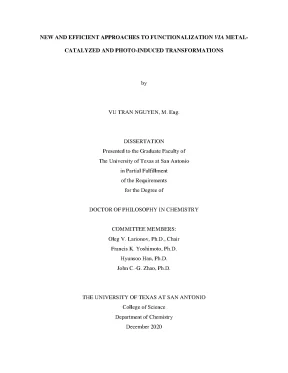
Tải xuống để đọc toàn bộNEW AND EFFICIENT APPROACHES TO FUNCTIONALIZATION VIA METAL- CATALYZED AND PHOTO-INDUCED TRANSFORMATIONS by VU TRAN NGUYEN, M. DISSERTATION Presented to the Graduate Faculty of The University of Texas at San Antonio in Partial Fulfillment of the Requirements for the Degree of DOCTOR OF PHILOSOPHY IN CHEMISTRY COMMITTEE MEMBERS: Oleg V. Hyunsoo Han, Ph. THE UNIVERSITY OF TEXAS AT SAN ANTONIO College of Science Department of Chemistry December 2020 DEDICATION To my wife and my dear daughter who always believe in me.
To my parents who provide me with constant inspiration. ACKNOWLEDGEMENTS First and foremost, I have to thank my family who has supported me not only through graduate school but through life thus far. Their concern and encouragement are what kept me going every moment in my life. I owe my deepest gratitude to my wife for her silent sacrifice to my little family.
I owe my mother, who inspired me and let me know about the beautiful world of chemistry. Secondly, I need to thank Dr. Larionov for his constant encouragement and support to push me to become better. Without him motivating me, I would never have the achievement today.
I learned from him the way of thinking and developing a project. I hope that I can continue to grow and advance as I finish my career at UTSA. I want to also acknowledge my committee members, Dr. Hyunsoo Han, Dr.
Francis Yoshimoto, and Dr. Zhao, for all the time and effort you all have made to help me become a well-rounded chemist. You all have been key to my professional development by always being ready to question me to help me achieve all the critical milestones of graduate school. Thank you for always encouraging me to do better.
I would like to thank the Department of Chemistry at the University of Texas at San Antonio for the constant support and continued dedication to providing opportunities for success. There is not one faculty member who I have not interacted with, asked advice, or been evaluated by. I would also like to thank all the professors that took part in teaching me during my education at UTSA. I would like to thank my lab members for all the years we have spent together.
Without your support, I know that I also would not have been nearly successful as today. Special thanks to Anh Vo, who gave me an opportunity to join the group of Dr. Larionov and begun my career here at UTSA. All are owed thanks (not limited too or in any specific order): David Stephens, Bhuwan Chhetri, Johant Lakey-Beitia, John Doyle, Jessica Burch, Victoria Soto, Adelphe Mfuh, Shengfei Jin, Xianwei Sui, Graham Haug, Brett Schneider, Oscar Garcia, Carsten Flores-Hansen, Dat Nguyen, Hang Dang, Viet Nguyen, Ngan Vuong, Hoang Pham, Trang Le, Dat Le, Tiffany Nguyen, Tu Ho.
I want to thank various agencies and foundations for supporting our work at the lab of Dr. Larionov: the Max and Minnie Tomerlin Voelcker Fund, the Welch Foundation, the National Institute of General Medical Sciences, and the University of Texas at San Antonio. I also want to iv thank Dr. Judith Walmsley for her generous donation to my awards at UTSA: Abrams and Walmsley awards.
These awards helped me focus on science and get some achievements so far. “This Master’s Thesis/Recital Document or Doctoral Dissertation was produced in accordance with guidelines which permit the inclusion as part of the Master’s Thesis/Recital Document or Doctoral Dissertation the text of an original paper, or papers, submitted for publication. The Master’s Thesis/Recital Document or Doctoral Dissertation must still conform to all other requirements explained in the “Guide for the Preparation of a Master’s Thesis/Recital Document 6 or Doctoral Dissertation at The University of Texas at San Antonio.” It must include a comprehensive abstract, a full introduction and literature review, and a final overall conclusion. Additional material (procedural and design data as well as descriptions of equipment) must be provided in sufficient detail to allow a clear and precise judgment to be made of the importance and originality of the research reported.
It is acceptable for this Master’s Thesis/Recital Document or Doctoral Dissertation to include as chapters authentic copies of papers already published, provided these meet type size, margin, and legibility requirements. In such cases, connecting texts, which provide logical bridges between different manuscripts, are mandatory. Where the student is not the sole author of a manuscript, the student is required to make an explicit statement in the introductory material to that manuscript describing the student’s contribution to the work and acknowledging the contribution of the other author(s). The approvals of the Supervising Committee which precede all other material in the Master’s Thesis/Recital Document or Doctoral Dissertation attest to the accuracy of this statement.” December 2020 v NEW AND EFFICIENT APPROACHES TO FUNCTIONALIZATION VIA METAL- CATALYZED AND PHOTO-INDUCED TRANSFORMATIONS Vu Tran Nguyen, Ph.
The University of Texas at San Antonio, 2020 Supervising Professor: Oleg V. Functionalization has emerged as an attractive strategy for the diversification of compounds especially in drug development and materials science. The recent emerging trend in chemical functionalization is not only to access challenging and valuable compounds using abundant and inexpensive materials but also to consider environmental aspects of new methodologies. New methodologies in the fields of photocatalysis, transition metal catalysis, radical chemistry, and redox chemistry have found applications in functionalization.
Herein, new and efficient approaches to functionalization of common aryl halides, abundant carboxylic acids, and readily available alkenes via metal-catalyzed or photoinduced transformations will be discussed. Specifically, the focus will be on the following transformations: conversion of aryl halides to borylated compounds and corresponding sulfones, as well as conversion of carboxylic acids to amines, alkenes, and other important compounds. Alkenes take part in discrete carboborative ring contractions or challenging dienes syntheses. In some cases, discussion of the mechanistic investigations and density functional theory calculations will be included to provide insights into the reaction details.
Some ongoing works with preliminary results in decarboxylation and dienylation will be briefly discussed. vi TABLE OF CONTENTS ACKNOWLEDGEMENTS. vi TABLE OF CONTENTS. vii LIST OF FIGURES.
PHOTO-INDUCED RING CONTRACTION. 9 RESULTS AND DISCUSSIONS. 21 GENERAL PROCEDURES AND CHARACTERIZATION OF PRODUCTS. SULFOLENE SYNTHESIS AND TRANSITION METAL – CATALYZED DIENYLATION USING SULFOLENE.
51 RESULTS AND DISCUSSIONS. 54 GENERAL PROCEDURES AND CHARACTERIZATION OF PRODUCTS. 54 vii CHAPTER III. PALLADIUM-CATALYZED DIENYLATION.
60 RESULTS AND DISCUSSIONS. 66 GENERAL PROCEDURES AND CHARACTERIZATION OF PRODUCTS. NICKEL-CATALYZED DIENYLATION. 85 RESULTS AND DISCUSSIONS.
88 GENERAL PROCEDURES AND CHARACTERIZATION OF PRODUCTS. ACRIDINE-CATALYZED DECARBOXYLATION AND FUNCTIONALIZATION OF CARBOXYLIC ACIDS. 96 RESULTS AND DISCUSSIONS. 116 GENERAL PROCEDURES AND CHARACTERIZATION OF PRODUCTS.
116 viii CHAPTER IV. 167 RESULTS AND DISCUSSIONS. 178 GENERAL PROCEDURES AND CHARACTERIZATION OF PRODUCTS. FUNCTIONALIZATION OF ARYL HALIDES.
BORYLATION OF ARYL HALIDES. 238 RESULTS AND DISCUSSIONS. 244 GENERAL PROCEDURES AND CHARACTERIZATION OF PRODUCTS. 259 RESULTS AND DISCUSSIONS.
268 GENERAL PROCEDURES AND CHARACTERIZATION OF PRODUCTS. DIMERIZATION OF QUINOLINES. 287 RESULTS AND DISCUSSIONS. 293 GENERAL PROCEDURES AND CHARACTERIZATION OF PRODUCTS.
Copies of 1H and 13CNMR Spectra for Chapter II. Copies of 1H and 13CNMR Spectra for Chapter III. Copies of 1H and 13CNMR Spectra for Chapter IV. Copies of 1H and 13CNMR Spectra for Chapter IV.
Copies of 1H and 13CNMR Spectra for Chapter V. Copies of 1H and 13CNMR Spectra for Chapter VI. Copies of 1H and 13CNMR Spectra for Chapter V. 797 VITA x LIST OF TABLES Chapter II Table II.Optimization for photoinduced carboborative ring contraction.
Photoinduced carboborative ring contraction in the presence of different photosensitizers. Scope of the Photoinduced Carboborative Ring Contraction. Scope of the Photoinduced Carboborative Ring Contraction of Terpenoids. 14 Chapter III Table III.
Optimization of the 3-sulfolene synthesis from 1,3-dienes. Synthesis of 3-sulfolenes from 1,3-dienes. Optimization of Reaction Conditions. Scope of the Reaction with Sulfolene 5.
Scope of the Reaction with Substituted Sulfolenes. Optimization tables for Ni-catalyzed dienylation. 86 Chapter IV Table IV. Reaction conditions for dehydrodecarboxylation.
Reaction conditions for cooperative chemoenzymatic LACo process. Reaction conditions for interrogation of the decarboxylation-on-cobaloxime mechanism. 106 xi Table IV. Production of carbon dioxide and hydrogen during dehydrodecarboxylation of palmitic acid.
Acridine-catalyzed reaction of palmitic acid with TEMPO. Reaction conditions for the direct decarboxylative alkylation (DDA) of anilines. DDA reaction performance with other photocatalysts with and without added DIPEA. Reaction Conditions for the Photocatalytic Direct Decarboxylative Sulfonylamidation.
Photoinduced Dual C–H/C–X Borylation of Iodobenzene in Other Solvents. Reaction conditions for the sulfone synthesis. 259 Chapter VI Table VI. Reaction Conditions for the Synthesis of ortho-Methylene-Bridged N- Heterobiaryls.
288 xii LIST OF FIGURES Chapter I Figure I. Comparison of contemporary and prior art in decarboxylative functionalization. Borylation of aryl halides under ultra-violet conditions. Two approaches to N-heterocyclic sulfones.
General formation of alkyl radicals and application of newly-formed radicals in useful transformations. New and efficient transformations using alkenes as starting materials. 5 Chapter II Figure II. Photoinduced Carboborative Ring Contraction.
Structural Diversification of the Carboborative Ring Contraction Products. Reaction of limonene and triethylborane. Stereochemical assignment of diastereomers of alcohol S1. The CH(OH) region in the 13C NMR spectrum of the carboborative ring contraction product S1-A-D.
The CH(OH) range in the 13C NMR spectrum of the reduction product S1-A-D with the (S)-CBS catalyst. The CH(OH) region in the 13C NMR spectrum of the reduction product S1-A-D with the (R)-CBS catalyst. Summary of ring contraction mechanism. 20 xiii Figure II.
Stereochemical Assignment of the C6-Stereocenter in Alcohol 23 by the Mosher ester method. Stereochemical Assignment of the C10-Stereocenter in Alcohol 30 by the Mosher ester method. Stereochemical Assignment of the C10-Stereocenter by the Mosher ester method. 47 Chapter III Figure III.
Sulfolane and 3-sulfolene in organic and medicinal chemistry. Synthesis of sulfolenes from 1,3-dienes. Synthetic approaches to conjugated dienes and polyenes. Synthesis of conjugated dienes and polyenes using sulfolenes and proposed catalytic cycle.
Scope of Ni-catalyzed dienylation reaction. 88 Chapter IV Figure IV. Catalytic dehydrodecarboxylation of carboxylic acids. Scope of photoinduced dehydrodecarboxylation.
Cooperative chemoenzymatic LACo process and polymerization of plant oil- derived alkenes. Decarboxylation-on-cobaloxime mechanism. 104 xiv Figure IV. Radical trapping experiments with TEMPO and the influence of varied initial catalyst loading on the photoinduced dehydrodecarboxylation reaction.
EPR spectrum of acridinyl radical HA. HRMS (A) and EPR (B) studies of the photoinduced reaction of cobaloxime C1 with dihydroacridine H2A. Dehydrodecarboxylation using n-octylcobaloxime as catalyst. Mechanism of the acridine/cobaloxime dual catalytic photoinduced dehydrodecarboxylation reaction.
Decarboxylative N-alkylation of anilines. Scope of the direct decarboxylative N-alkylation. N-Alkylation of heteroaromatic amines. N-Alkylation of natural products and drugs.
N-Trideuteromethylation by DDA with AcOH-d4. One-step access to N-arylpyrrolidine by DDA with acid 99. Radical trapping experiments with TEMPO as well as radical ring-opening and ring-closing experiments with cyclopropylacetic acid and 6-heptenoic acid. Evaluation of involvement of alkyl carbocations in the DDA reaction.
EPR of Cu(hfac)2 in the presence of aniline. EPR spectra of Cu(hfac)2 in the presence of aniline with combined total concentration of 10 mM in benzene at room temperature. 176 xv Figure IV. Job plot of the Cu(hfac)2–aniline system at 3265.
Mechanistic studies of the DDA reaction. Photoinduced 1,2- and 1,3-Selective Dual C–H/C–X Borylation Reaction of Haloarenes. Electrophilic borylation of the intermediate ArBpin. Plausible Reaction Pathways for the Photoinduced Dual C–H/C–X-Borylation.
Scope of the Photoinduced 1,2 and 1,3-Selective Dual C–H/C–X-Borylation Reaction of Haloarenes. Applications and synthesis of N-heterocyclic sulfones and sulfides. Biomedical applications of N-heterocyclic sulfones. Synthetic strategies toward N-heterocyclic sulfones.
Scope of the persulfate-initiated sulfone synthesis. Chemodivergent access to sulfones and sulfides. Kinetic profile of reaction of 4-haloquinolines with p-toluenesulfinate. Oxidation of sulfinate by persulfate.
Reaction mechanism for catalytic sulfone formation with sulfinic acids. Mechanism of formation of symmetrical sulfones and sulfides. 267 xvi Chapter VI Figure VI. Direct Synthesis of ortho-Methylene-Bridged N-Heterobiaryls from N- Heterocycles.
Organocatalytic Synthesis of ortho-Methylene-Bridged N-Heterobiaryls. Synthesis of 4,4'-Methylene-Bridged N-Heterobiaryls. Synthesis of 2-Alkylquinolines and 2-Alkylisoquinolines .
Nội dung được bảo vệ bản quyền — Tải xuống đầy đủ
Trích dẫn luận án này
Vu Tran Nguyen (2020). Functionalization via Metal-Catalyzed & Photo-Induced Chemistry [Luận án tiến sĩ, The University of Texas at San Antonio]. LuanAn.net. https://luanan.net/kinh-te/kinh-te-phat-trien/functionalization-metal-catalyzed-photo-induced-chemistry
Câu hỏi thường gặp
Luận án "Functionalization via Metal-Catalyzed & Photo-Induced Chemistry" nghiên cứu về vấn đề gì?
Functionalization via metal-catalyzed and photo-induced chemistry enables selective transformations for sustainable synthesis.
Luận án "Functionalization via Metal-Catalyzed & Photo-Induced Chemistry" được bảo vệ tại trường nào?
Luận án này được bảo vệ tại The University of Texas at San Antonio. Năm bảo vệ: 2020.
Luận án "Functionalization via Metal-Catalyzed & Photo-Induced Chemistry" thuộc chuyên ngành gì?
Luận án "Functionalization via Metal-Catalyzed & Photo-Induced Chemistry" thuộc chuyên ngành Chemistry. Danh mục: Kinh Tế Phát Triển.
Luận án "Functionalization via Metal-Catalyzed & Photo-Induced Chemistry" có bao nhiêu trang?
Luận án "Functionalization via Metal-Catalyzed & Photo-Induced Chemistry" có 353 trang. Bạn có thể xem trước một phần tài liệu ngay trên trang web trước khi tải về.
Cách tải luận án "Functionalization via Metal-Catalyzed & Photo-Induced Chemistry" về máy như thế nào?
Để tải luận án về máy, bạn nhấn nút "Tải xuống ngay" trên trang này, sau đó hoàn tất thanh toán phí lưu trữ. File sẽ được tải xuống ngay sau khi thanh toán thành công. Hỗ trợ qua Zalo: 0559 297 239.