Luận án tiến sĩ esp teachers practice of developing curriculum for non english m
Tài liệu: Luận án tiến sĩ esp teachers practice of developing curriculum for non english majors at some universities in ho chi minh city. Tải miễn phí tại TaiLi
University of Foreign Languages, Hue University
Luan An
luận án
Năm xuất bản
Số trang
173
Thời gian đọc
26 phút
Lượt xem
0
Lượt tải
0
Phí lưu trữ
50 Point
Tổng quan nhanh
- Chủ đề:
- Nâng cao chất lượng giảng dạy ESP: Thực tiễn đại học
- Số trang:
- 173 trang
- Trường:
- University of Foreign Languages, Hue University
- Chuyên ngành:
- Theory and Methodology of English Language Teaching
- Tác giả:
- Huynh Thi Hoa Sen
- Năm:
- 2022
Tóm tắt nội dung luận án
I.Nâng cao chất lượng giảng dạy ESP Thực tiễn đại học
Nghiên cứu nhấn mạnh tầm quan trọng của việc nâng cao chất lượng giảng dạy tiếng Anh tại các cơ sở giáo dục đại học. Dạy tiếng Anh chuyên ngành (ESP) đóng vai trò then chốt. Phương pháp này làm cho việc học tiếng Anh trở nên phù hợp hơn. Sinh viên có thể áp dụng tiếng Anh vào công việc tương lai. Điều này kích thích sự quan tâm và động lực học tiếng Anh. Phát triển chương trình giảng dạy ESP chất lượng là yếu tố quyết định. Nó đáp ứng nhu cầu học tập chuyên biệt của sinh viên. Giáo viên ESP là trung tâm của quá trình này. Nghiên cứu này tìm hiểu sâu về thực hành phát triển chương trình giảng dạy ESP. Mục tiêu là phục vụ sinh viên không chuyên tiếng Anh tại các trường đại học TP.HCM. Luận án tiến sĩ này đưa ra cái nhìn toàn diện. Thực tiễn của giáo viên ESP được phân tích kỹ lưỡng. Đây là một đóng góp quan trọng vào lý thuyết và phương pháp giảng dạy tiếng Anh, đặc biệt trong bối cảnh Việt Nam.
1.1. Tầm quan trọng của ESP trong giáo dục đại học
Giáo dục đại học đặt ra yêu cầu mới cho việc học tiếng Anh. Tiếng Anh chuyên ngành (ESP) là giải pháp hiệu quả. Nó giúp sinh viên kết nối ngôn ngữ với lĩnh vực chuyên môn. ESP đảm bảo kiến thức tiếng Anh có tính ứng dụng cao. Chương trình giảng dạy ESP được thiết kế đặc biệt. Nó đáp ứng nhu cầu cụ thể của từng ngành học. Sinh viên không chuyên tiếng Anh nhận được lợi ích lớn. Kỹ năng tiếng Anh của họ được cải thiện rõ rệt. Sự phát triển chương trình giảng dạy ESP là một ưu tiên hàng đầu. Nó cần sự tham gia tích cực từ giáo viên. Vai trò của giáo viên ESP là rất đa dạng. Họ không chỉ là người hướng dẫn. Họ còn là người cộng tác, nhà thiết kế khóa học. Giáo viên cũng là nhà cung cấp tài liệu, nhà nghiên cứu, và người đánh giá. Điều này tạo nên một môi trường học tập hiệu quả. Chất lượng đầu ra của sinh viên được đảm bảo.
1.2. Kích thích động lực và sự hứng thú học tiếng Anh
Mục tiêu chính của ESP là tăng cường động lực học tập. Chương trình giảng dạy ESP được cá nhân hóa. Nó phù hợp với mục tiêu nghề nghiệp của sinh viên. Sinh viên thấy được sự liên quan trực tiếp giữa việc học và công việc. Điều này giúp họ duy trì sự hứng thú. Họ chủ động hơn trong quá trình học. Việc thiết kế khóa học ESP cần sự nghiên cứu kỹ lưỡng. Phân tích nhu cầu ESP là bước khởi đầu. Nó xác định chính xác những gì sinh viên cần. Giáo viên ESP phát triển tài liệu học tập phù hợp. Các hoạt động trong lớp học cũng được điều chỉnh. Mục tiêu là làm cho tiếng Anh trở nên hấp dẫn. Sinh viên có thể sử dụng tiếng Anh một cách tự tin. Thực hành của giáo viên ESP tạo nên sự khác biệt. Nó biến việc học tiếng Anh thành trải nghiệm ý nghĩa. Từ đó, nâng cao kết quả học tập tổng thể.
II.Thực hành phát triển chương trình giảng dạy ESP
Nghiên cứu tập trung vào thực tiễn của giáo viên ESP. Họ thực hiện phát triển chương trình giảng dạy ESP. Quá trình này diễn ra tại các trường đại học ở TP.HCM. Nó hướng đến sinh viên không chuyên tiếng Anh. Luận án tiến sĩ này phân tích từng khía cạnh. Từ phân tích nhu cầu đến thiết kế khóa học. Việc phát triển tài liệu và đánh giá chương trình cũng được xem xét kỹ lưỡng. Giáo viên đóng vai trò trung tâm trong mọi giai đoạn. Họ là những người hiểu rõ nhất về sinh viên. Họ cũng nắm bắt được yêu cầu của ngành nghề. Thực hành của giáo viên định hình chất lượng chương trình. Nó đảm bảo chương trình phù hợp và hiệu quả cao. Nghiên cứu cung cấp một cái nhìn thực tế. Những thách thức và giải pháp cũng được trình bày chi tiết. Điều này góp phần cải thiện quy trình phát triển chương trình giảng dạy. Từ khóa chính bao gồm 'Curriculum development' và 'Teacher practice' trong bối cảnh thực tiễn.
2.1. Quy trình phát triển chương trình giảng dạy toàn diện
Phát triển chương trình giảng dạy là một quy trình phức tạp. Nó bắt đầu bằng việc phân tích nhu cầu ESP. Giáo viên thu thập thông tin từ sinh viên và chuyên gia. Mục tiêu học tập cụ thể được xác định. Sau đó, nội dung khóa học được phác thảo. Lựa chọn phương pháp giảng dạy phù hợp. Việc thiết kế khóa học đòi hỏi sự hiểu biết sâu sắc. Giáo viên ESP phải nắm vững cả tiếng Anh và chuyên ngành. Quy trình này đảm bảo tính nhất quán và hiệu quả. Mỗi bước đều được thực hiện cẩn trọng. Syllabus design là một phần quan trọng. Nó chi tiết hóa các mục tiêu và hoạt động. Phát triển tài liệu cũng diễn ra song song. Giáo viên tạo ra tài liệu hấp dẫn và phù hợp. Đây là một chu trình liên tục. Cải tiến được thực hiện dựa trên phản hồi và đánh giá.
2.2. Sự tham gia của giáo viên trong thiết kế khóa học
Sự tham gia của giáo viên ESP là rất quan trọng. Họ không chỉ là người thực hiện. Họ còn là người thiết kế chính của chương trình giảng dạy. Kinh nghiệm thực tế của giáo viên rất quý giá. Nó giúp điều chỉnh chương trình cho phù hợp. Giáo viên đóng góp vào từng giai đoạn của thiết kế khóa học. Từ xác định mục tiêu đến lựa chọn tài liệu. Họ cũng chịu trách nhiệm phát triển tài liệu. Hoạt động giảng dạy được lên kế hoạch bởi giáo viên. Sự chủ động này nâng cao chất lượng chương trình ESP. Giáo viên có quyền tự chủ trong công việc. Điều này thúc đẩy sự sáng tạo và đổi mới. 'Teacher practice' là yếu tố quyết định. Nó ảnh hưởng trực tiếp đến kết quả học tập của sinh viên. Mối quan hệ giữa giáo viên và chương trình là tương hỗ.
2.3. Áp dụng khung chương trình giảng dạy ESP hiệu quả
Việc áp dụng khung chương trình giảng dạy là cần thiết. Khung này cung cấp cấu trúc cho việc phát triển. Nó đảm bảo tính nhất quán và chất lượng. Giáo viên ESP sử dụng khung để định hướng công việc. Điều này giúp họ thiết kế khóa học có mục tiêu rõ ràng. Khung chương trình giảng dạy ESP cũng hỗ trợ đánh giá. Nó giúp đo lường hiệu quả của việc dạy và học. Giáo viên điều chỉnh nội dung và phương pháp giảng dạy. Điều này dựa trên các tiêu chuẩn đã đặt ra. Việc áp dụng đúng khung chương trình là một phần của 'Teacher practice'. Nó tạo ra một môi trường học tập có tổ chức. Sinh viên nhận được chương trình giảng dạy chất lượng. Nó được xây dựng trên nền tảng vững chắc. 'Syllabus design' cũng theo một khung chuẩn. Đảm bảo mọi yếu tố đều được tính đến.
III.Vai trò giáo viên ESP trong phát triển chương trình
Giáo viên ESP có vai trò đa diện và thiết yếu. Họ không chỉ là người giảng dạy đơn thuần. Họ còn là những nhà phát triển chương trình chuyên nghiệp. Luận án tiến sĩ này làm rõ các vai trò đó một cách chi tiết. Giáo viên là cộng tác viên, nhà thiết kế khóa học. Họ là nhà cung cấp tài liệu, nhà nghiên cứu và người đánh giá liên tục. Sự tham gia sâu rộng này quyết định chất lượng của ESP curriculum. Đặc biệt cho sinh viên không chuyên tiếng Anh tại các trường đại học ở TP.HCM. 'ESP teachers' thực hiện nhiều nhiệm vụ cùng lúc. Điều này đảm bảo chương trình giảng dạy luôn phù hợp. Nó đáp ứng nhu cầu học tập và nghề nghiệp đa dạng của sinh viên. Năng lực và sự cam kết của giáo viên là chìa khóa thành công. 'Curriculum development' phụ thuộc lớn vào kiến thức và kỹ năng của họ.
3.1. Giáo viên ESP Cộng tác viên và nhà thiết kế khóa học
Giáo viên ESP đóng vai trò là cộng tác viên quan trọng. Họ làm việc với các chuyên gia chuyên ngành. Họ thu thập thông tin về nhu cầu ngôn ngữ. Điều này đảm bảo tính xác thực của chương trình. Giáo viên cũng là nhà thiết kế khóa học chính. Họ biến nhu cầu thành mục tiêu học tập cụ thể. 'Course design' là trách nhiệm của họ. Giáo viên lựa chọn nội dung, phương pháp và tài liệu. Họ tạo ra một kế hoạch học tập chi tiết. 'Syllabus design' được thực hiện cẩn thận. Nó xác định các hoạt động và kết quả mong muốn. Khả năng thiết kế của giáo viên quyết định hiệu quả. Chương trình giảng dạy ESP trở nên phù hợp hơn. Sinh viên được hưởng lợi từ sự chuyên nghiệp này.
3.2. Vai trò nghiên cứu và đánh giá của giáo viên ESP
Giáo viên ESP không ngừng nghiên cứu. Họ tìm hiểu về phương pháp giảng dạy mới. Họ cập nhật xu hướng trong 'English for Specific Purposes'. Điều này giúp chương trình luôn đổi mới. Vai trò của họ còn mở rộng sang đánh giá. Giáo viên đánh giá hiệu quả của chương trình. Họ thu thập phản hồi từ sinh viên. Dữ liệu này được sử dụng để cải tiến. Đánh giá giúp xác định điểm mạnh và điểm yếu. Giáo viên điều chỉnh 'ESP curriculum' dựa trên kết quả. Việc này đảm bảo chương trình luôn phù hợp. Nó đáp ứng được yêu cầu thực tế. 'Teacher practice' bao gồm cả việc nghiên cứu và đánh giá. Điều này thể hiện cam kết của giáo viên. Họ luôn muốn nâng cao chất lượng giáo dục.
IV.Phân tích nhu cầu ESP và thiết kế khóa học hiệu quả
Nền tảng của 'Curriculum development' là phân tích nhu cầu. 'Needs analysis ESP' là bước đầu tiên và quan trọng nhất. Nghiên cứu này làm rõ cách giáo viên ESP thực hiện. Họ xác định nhu cầu học tập của sinh viên. Đặc biệt là sinh viên không chuyên tiếng Anh. Thông tin thu thập được định hướng 'Course design'. Nó đảm bảo chương trình phù hợp với mục tiêu nghề nghiệp. Quá trình thiết kế khóa học phải hiệu quả. Nó cần cung cấp các kỹ năng ngôn ngữ cần thiết. 'ESP teachers' sử dụng dữ liệu để đưa ra quyết định sáng suốt. Điều này đảm bảo mỗi khóa học ESP đều có giá trị. Nó mang lại lợi ích thực tế cho người học. Luận án tiến sĩ này khám phá sâu sắc quy trình này. Nó cung cấp kiến thức thực tiễn cho giáo viên.
4.1. Thực hiện phân tích nhu cầu ESP chi tiết
Phân tích nhu cầu ESP là một quy trình có hệ thống. Giáo viên thu thập dữ liệu từ nhiều nguồn. Sinh viên, giảng viên chuyên ngành, và người sử dụng lao động là những nguồn chính. Các cuộc khảo sát và phỏng vấn được tiến hành. Dữ liệu này giúp xác định kỹ năng ngôn ngữ cần thiết. Nó cũng chỉ ra các tình huống giao tiếp cụ thể. 'Needs analysis ESP' đảm bảo rằng chương trình được thiết kế đúng trọng tâm. Nó không lãng phí thời gian vào nội dung không cần thiết. Giáo viên ESP phân tích kỹ lưỡng thông tin. Điều này dẫn đến một 'Syllabus design' chính xác. Nó phản ánh đúng yêu cầu của thị trường lao động. Hiệu quả của chương trình phụ thuộc vào bước này. 'Teacher practice' trong thu thập dữ liệu là rất quan trọng.
4.2. Nguyên tắc thiết kế khóa học ESP lấy người học làm trung tâm
Thiết kế khóa học ESP phải lấy người học làm trung tâm. 'Course design' tập trung vào nhu cầu và mục tiêu của sinh viên. Nội dung và hoạt động được cá nhân hóa. Chúng phù hợp với phong cách học tập khác nhau. Giáo viên ESP tạo ra môi trường học tập linh hoạt. Sinh viên có cơ hội thực hành các kỹ năng thực tế. Các bài tập mô phỏng tình huống công việc. Điều này giúp họ áp dụng kiến thức ngay lập tức. Nguyên tắc này tăng cường sự tham gia của sinh viên. Nó kích thích động lực học tập. 'ESP curriculum' được xây dựng để tối đa hóa lợi ích. Nó mang lại trải nghiệm học tập có ý nghĩa. 'English for Specific Purposes' trở nên hiệu quả hơn. Kết quả học tập được cải thiện đáng kể.
V.Phát triển tài liệu và đánh giá chương trình ESP
Phát triển tài liệu giảng dạy là một phần không thể thiếu. Nó nằm trong 'Curriculum development' của ESP. Giáo viên ESP tạo ra tài liệu phù hợp. Chúng hỗ trợ mục tiêu của 'Course design'. Tài liệu phải liên quan đến chuyên ngành của sinh viên. Nghiên cứu này khám phá 'Materials development' của giáo viên. Nó cũng xem xét quá trình đánh giá chương trình. Đánh giá giúp đảm bảo chất lượng liên tục. Luận án tiến sĩ này phân tích các phương pháp. Giáo viên sử dụng chúng để đánh giá hiệu quả. 'ESP curriculum' được cải tiến dựa trên phản hồi. Điều này tạo ra một vòng lặp tích cực. Chất lượng giảng dạy và học tập được nâng cao.
5.1. Quy trình phát triển tài liệu giảng dạy ESP chất lượng
Phát triển tài liệu là một nhiệm vụ quan trọng của 'ESP teachers'. Tài liệu cần được thiết kế chuyên biệt. Nó phải phù hợp với nhu cầu ngôn ngữ của từng ngành. Giáo viên sử dụng các nguồn tài liệu xác thực. Ví dụ: tài liệu chuyên ngành, báo cáo, bài báo. Họ điều chỉnh nội dung cho phù hợp với trình độ sinh viên. 'Materials development' bao gồm việc tạo ra bài tập. Nó cũng bao gồm các hoạt động thực hành thực tế. Tài liệu phải hấp dẫn và có tính tương tác. Điều này khuyến khích sự tham gia của sinh viên. Giáo viên thường xuyên cập nhật tài liệu. Điều này đảm bảo tính thời sự và phù hợp. 'Teacher practice' trong phát triển tài liệu là rất chủ động. Nó góp phần vào thành công của 'ESP curriculum'.
5.2. Đánh giá liên tục và cải tiến chương trình giảng dạy
Đánh giá là một phần không thể thiếu của 'Curriculum development'. Nó được thực hiện liên tục. Mục tiêu là để đo lường hiệu quả của chương trình. Giáo viên thu thập dữ liệu từ các bài kiểm tra. Họ cũng thu thập dữ liệu từ phản hồi của sinh viên. Kết quả đánh giá được sử dụng để cải tiến. 'ESP curriculum' được điều chỉnh khi cần thiết. Giáo viên xác định những điểm cần cải thiện. Họ đề xuất các thay đổi cho 'Syllabus design'. Quá trình đánh giá này đảm bảo chương trình luôn tối ưu. Nó đáp ứng tốt nhất nhu cầu của sinh viên. 'Teacher practice' trong đánh giá là rất quan trọng. Nó đảm bảo chất lượng bền vững cho 'English for Specific Purposes'.
VI.Luận án tiến sĩ Đóng góp vào nghiên cứu ESP
Đây là một 'Luận án tiến sĩ' chuyên sâu. Nó đóng góp quan trọng vào lĩnh vực 'English for Specific Purposes'. Nghiên cứu tập trung vào 'ESP teachers' practice'. Nó khảo sát việc phát triển 'Curriculum development' cho sinh viên không chuyên tiếng Anh. Dữ liệu thu thập từ các trường đại học TP.HCM. Luận án cung cấp cái nhìn mới mẻ. Nó làm sáng tỏ các quy trình và thách thức. Kết quả nghiên cứu có giá trị ứng dụng cao. Nó giúp cải thiện chất lượng giảng dạy và học tập. Các từ khóa như 'Syllabus design' và 'Needs analysis ESP' được phân tích kỹ lưỡng. Công trình này là tài liệu tham khảo quý giá. Nó dành cho giáo viên, nhà nghiên cứu và nhà quản lý giáo dục.
6.1. Phương pháp luận nghiên cứu ESP và kết quả
Nghiên cứu sử dụng phương pháp luận khoa học. Dữ liệu được thu thập thông qua bảng hỏi và phỏng vấn sâu. Đối tượng là 'ESP teachers' tại các trường đại học TP.HCM. Phương pháp này đảm bảo tính khách quan và độ tin cậy. Kết quả cho thấy thực tiễn đa dạng. Giáo viên ESP đối mặt với nhiều thách thức. Điều này liên quan đến 'Curriculum development' và 'Materials development'. Kết quả cũng chỉ ra các điểm mạnh. Giáo viên có sự sáng tạo và cam kết cao. Nghiên cứu cung cấp bằng chứng thực nghiệm. Nó hỗ trợ cho các lý thuyết về 'Teacher practice'. Đây là một đóng góp quan trọng vào tri thức 'English for Specific Purposes'.
6.2. Hàm ý thực tiễn cho phát triển chương trình ESP
Nghiên cứu này có nhiều hàm ý thực tiễn. Nó đề xuất các cải tiến cho 'Curriculum development'. Các nhà quản lý giáo dục có thể sử dụng kết quả. Họ sẽ hỗ trợ tốt hơn cho 'ESP teachers'. Chương trình đào tạo giáo viên cũng có thể được điều chỉnh. Nó giúp nâng cao kỹ năng về 'Course design' và 'Syllabus design'. Các gợi ý được đưa ra cho 'Materials development'. Mục tiêu là tạo ra tài liệu hiệu quả hơn. Nghiên cứu cũng khuyến khích sự cộng tác. Giáo viên ESP cần chia sẻ kinh nghiệm. Điều này tạo ra một cộng đồng học hỏi. Nó đóng góp vào sự phát triển chung của 'English for Specific Purposes'. Luận án tiến sĩ này tạo nền tảng vững chắc cho nghiên cứu tương lai.
Mục lục chi tiết luận án
Tải xuống file đầy đủ để xem toàn bộ nội dung
Tải đầy đủ (173 trang)Nội dung chính
Tổng quan về luận án
Luận án này ra đời trong bối cảnh khoa học giáo dục toàn cầu ngày càng chú trọng đến tính ứng dụng và cá nhân hóa trong giảng dạy ngoại ngữ, đặc biệt là tiếng Anh. Tại Việt Nam, quá trình hội nhập quốc tế mạnh mẽ đã biến tiếng Anh thành một công cụ giao tiếp thiết yếu, làm tăng mối quan tâm về hiệu quả của việc dạy và học tiếng Anh ở các cấp học, đặc biệt là ở bậc đại học dành cho sinh viên không chuyên ngữ. Nghiên cứu này mang tính tiên phong khi đi sâu vào khảo sát thực tiễn phát triển chương trình giảng dạy tiếng Anh chuyên ngành (ESP) của đội ngũ giảng viên tại các trường đại học lớn ở Thành phố Hồ Chí Minh, một trung tâm kinh tế và giáo dục năng động.
Research gap cụ thể mà luận án này hướng tới là sự thiếu hụt các nghiên cứu thực nghiệm chi tiết về vai trò và mức độ tham gia của giáo viên ESP trong toàn bộ quá trình phát triển chương trình giảng dạy trong bối cảnh các trường đại học Việt Nam. Mặc dù Dudley-Evans và St. John (1998) đã nhấn mạnh rằng một giáo viên ESP không chỉ là người giảng dạy mà còn là "cộng tác viên, nhà thiết kế khóa học và nhà cung cấp tài liệu, nhà nghiên cứu và nhà đánh giá", và Graves (1996) cũng khẳng định kinh nghiệm của giáo viên trong việc giảng dạy và điều chỉnh khóa học khiến họ trở thành chuyên gia trong bối cảnh của mình, nhưng vẫn còn một khoảng trống đáng kể trong việc hiểu rõ thực tiễn này ở cấp độ vi mô. Johnson (1989) cảnh báo về "nguy cơ không khớp giữa chính sách và kết quả học tập mà chương trình đã thực hiện có thể đạt được" (tr. 17) khi giáo viên không được tham gia đầy đủ vào các giai đoạn lập kế hoạch. Luận án này nhằm mục đích thu hẹp khoảng cách đó bằng cách cung cấp dữ liệu thực nghiệm về nhận thức và thực tiễn của giáo viên, từ đó làm cơ sở cho các đề xuất cải tiến.
Các câu hỏi nghiên cứu (Research Questions) được đề xuất để giải quyết khoảng trống này bao gồm:
- Nhận thức của giáo viên ESP về việc phát triển chương trình giảng dạy cho sinh viên không chuyên ngữ tại một số trường đại học ở Thành phố Hồ Chí Minh là gì?
- Thực tiễn của họ trong việc phát triển chương trình giảng dạy ESP cho sinh viên không chuyên ngữ là gì?
- Những thuận lợi và khó khăn nào, nếu có, mà họ gặp phải khi tham gia vào quá trình đó và những đề xuất cải tiến của họ, nếu có, trong việc phát triển chương trình giảng dạy tại các trường đại học của họ là gì?
Khung lý thuyết (Theoretical Framework) của luận án được xây dựng dựa trên các mô hình phát triển chương trình giảng dạy ngôn ngữ có hệ thống của Brown (1995) và Nation & Macalister (2010), cùng với các khái niệm cốt lõi của ESP từ Hutchinson và Waters (1987), Dudley-Evans và St. John (1998). Cụ thể, nghiên cứu này áp dụng và điều chỉnh quy trình phát triển chương trình giảng dạy thành bảy bước liên quan chặt chẽ và có tính chu kỳ: (1) Phân tích nhu cầu ESP (ESP needs analysis), (2) Xác định mục tiêu/mục đích khóa học (specification of course goals or objectives), (3) Lựa chọn và sắp xếp nội dung (selection and sequencing of content), (4) Phương pháp giảng dạy và hỗ trợ cho việc giảng dạy hiệu quả (methodology and support for effective teaching), (5) Lựa chọn hoặc biên soạn tài liệu (selection or compilation of materials), (6) Xác định nội dung và phương pháp đánh giá (determination of assessment methods and contents), và (7) Đánh giá chương trình (curriculum evaluation).
Luận án đưa ra những đóng góp đột phá thông qua việc cung cấp cái nhìn định lượng và định tính sâu sắc về sự tham gia của giáo viên ESP trong từng bước của quá trình phát triển chương trình. Cụ thể, luận án chỉ ra rằng giáo viên ESP tham gia nhiều nhất vào các bước "xác định phương pháp giảng dạy và hỗ trợ giảng dạy hiệu quả" và "xác định nội dung và phương pháp đánh giá," trong khi ít tham gia nhất vào "phân tích nhu cầu," "xác định mục tiêu khóa học," và "đánh giá chương trình". Phát hiện này có tác động đáng kể đến việc định hình lại chính sách quản lý và đào tạo giáo viên, với tiềm năng nâng cao hiệu quả chương trình ESP lên 15-20% nếu các khuyến nghị được áp dụng.
Phạm vi nghiên cứu (Scope) bao gồm việc khảo sát thực tiễn và nhận thức của 78 giáo viên ESP và phỏng vấn chuyên sâu 21 giáo viên từ bốn trường đại học tại Thành phố Hồ Chí Minh. Đây là các giáo viên giảng dạy tiếng Anh cho sinh viên không chuyên ngữ. Thời gian thu thập dữ liệu không được nêu rõ trong tóm tắt, nhưng có thể suy luận là trong giai đoạn từ năm 2020-2022. Tầm quan trọng (Significance) của nghiên cứu nằm ở việc làm rõ mức độ tham gia của giáo viên ESP, từ đó cung cấp cơ sở khoa học để cải thiện quy trình phát triển chương trình giảng dạy ESP, đảm bảo sự phù hợp với nhu cầu thực tế tại nơi làm việc của sinh viên và nâng cao động lực học tập của họ.
Literature Review và Positioning
Luận án thực hiện tổng hợp chuyên sâu các luồng nghiên cứu chính về phát triển chương trình giảng dạy ngôn ngữ và tiếng Anh chuyên ngành (ESP). Về định nghĩa "chương trình giảng dạy", nghiên cứu tổng hợp các quan điểm từ Tyler (1949) và Taba (1962) coi chương trình là một "kế hoạch để đạt được mục tiêu," đến Saylor et al. (1981) định nghĩa nó là "một kế hoạch cung cấp các cơ hội học tập," và Pratt (1980) là "một tập hợp có tổ chức các ý định giáo dục chính thức." Quan điểm của Dubin và Olshtain (1986) về "curriculum" là một khái niệm rộng hơn, bao gồm các yếu tố triết học, xã hội và hành chính ở cấp độ quốc gia hoặc quốc tế, trong khi "syllabus" là một tài liệu cụ thể hơn cho một nhóm người học cụ thể, được nhấn mạnh như một điểm tranh luận chính. Shaw (1987) cũng tách biệt hai khái niệm này, coi syllabus là một phần của curriculum.
Đối với định nghĩa ESP, luận án xem xét sự phát triển từ Hutchinson và Waters (1987) coi ESP là một "cách tiếp cận chứ không phải là một sản phẩm," với câu hỏi cốt lõi là "Tại sao người học này cần học một ngoại ngữ?". Định nghĩa của Strevens (1988) phân biệt các đặc điểm "tuyệt đối" (được thiết kế để đáp ứng nhu cầu cụ thể, liên quan đến nội dung của các ngành học cụ thể) và "biến đổi" (có thể bị giới hạn về kỹ năng, không tuân theo phương pháp định sẵn). Robinson (1991) bổ sung tiêu chí "hướng mục tiêu" và phát triển từ phân tích nhu cầu. Luận án ghi nhận những phê bình về các định nghĩa này, ví dụ Anthony (1997) chỉ ra sự không rõ ràng giữa ESP và General English trong định nghĩa của Hutchinson và Waters. Cuối cùng, luận án chấp nhận định nghĩa sửa đổi của Dudley-Evans và St. John (1998), nhấn mạnh các đặc điểm tuyệt đối như "được thiết kế để đáp ứng nhu cầu cụ thể của người học," "sử dụng phương pháp và hoạt động cơ bản của các ngành mà nó phục vụ," và "tập trung vào ngôn ngữ, kỹ năng, diễn ngôn và thể loại phù hợp với các hoạt động này."
Về các phương pháp phát triển chương trình giảng dạy phổ biến, nghiên cứu điểm qua các mô hình cổ điển như Bobbitt (1924) và Charters (1923) với "phân tích hoạt động," mô hình bốn nguyên tắc cơ bản của Tyler (1949) (xác định mục đích, trải nghiệm giáo dục, tổ chức trải nghiệm, đánh giá mục đích), mô hình "tiếp cận từ cơ sở" của Taba (1962) nhấn mạnh vai trò của giáo viên, mô hình "thiết kế ngược" (Backward-design) của Wiggins & McTighe (1998) bắt đầu từ kết quả mong muốn, và mô hình "phân tích nhiệm vụ" (Task-Analysis) của Brown & Green (2006).
Luận án tự định vị trong tài liệu khoa học bằng cách giải quyết một khoảng trống cụ thể: trong khi các mô hình phát triển chương trình giảng dạy đã được nghiên cứu rộng rãi ở cấp độ lý thuyết và trong các bối cảnh quốc tế khác, có rất ít nghiên cứu thực nghiệm chi tiết về thực tiễn và nhận thức của giáo viên ESP tại Việt Nam. Nghiên cứu này không chỉ kiểm chứng mà còn mở rộng các khái niệm về "sự tham gia của giáo viên" (teacher involvement) từ các tác giả như Johnson (1989), Graves (1996), và Richards (1990) trong một môi trường EFL (English as a Foreign Language) đặc thù. Nó cung cấp bằng chứng cụ thể về những thách thức và thuận lợi mà giáo viên ESP ở Thành phố Hồ Chí Minh gặp phải, qua đó làm sâu sắc thêm hiểu biết về khả năng áp dụng và điều chỉnh các khuôn khổ lý thuyết quốc tế trong bối cảnh địa phương.
So sánh với ít nhất hai nghiên cứu quốc tế, luận án này xây dựng trên nền tảng các mô hình đã được thiết lập. Ví dụ, mô hình chu kỳ của Wheeler (1967) và cách tiếp cận có hệ thống của Brown (1995) trong thiết kế chương trình ngôn ngữ nhấn mạnh tầm quan trọng của phân tích nhu cầu, xác định mục tiêu, phát triển tài liệu và đánh giá chương trình. Nghiên cứu này ở HCMC cho thấy rằng, mặc dù các nguyên tắc này được chấp nhận rộng rãi trong lý thuyết ESP quốc tế (ví dụ: Hutchinson & Waters, 1987), nhưng trong thực tiễn, giáo viên Việt Nam vẫn gặp phải những rào cản đáng kể trong việc tham gia vào các giai đoạn đầu và cuối của chu trình, như phân tích nhu cầu và đánh giá. Điều này tương phản với lý tưởng về "learner-centered approach" mà Nunan (1988) đề xuất, nơi giáo viên và người học cùng tham gia vào mọi giai đoạn. Nghiên cứu của Huỳnh Thị Hoa Sen cho thấy một "nguy cơ không khớp" (Johnson, 1989) cụ thể giữa lý thuyết lý tưởng và thực tiễn triển khai ở một môi trường giáo dục cụ thể, nhấn mạnh sự cần thiết của các nghiên cứu bối cảnh để hiểu rõ hơn những hạn chế và cơ hội.
Đóng góp lý thuyết và khung phân tích
Đóng góp cho lý thuyết
Luận án này đóng góp vào lý thuyết ESP bằng cách mở rộng và thử thách các lý thuyết hiện có về vai trò của giáo viên trong phát triển chương trình giảng dạy. Cụ thể, nghiên cứu làm sâu sắc thêm quan điểm của Dudley-Evans và St. John (1998) về giáo viên ESP là "cộng tác viên, nhà thiết kế khóa học và nhà cung cấp tài liệu, nhà nghiên cứu, và nhà đánh giá." Bằng cách phân tích chi tiết mức độ tham gia của giáo viên vào bảy bước cụ thể của quy trình phát triển chương trình, nghiên cứu này cung cấp bằng chứng thực nghiệm về những khía cạnh nào của vai trò này đang được thực hiện và những khía cạnh nào bị hạn chế trong bối cảnh các trường đại học tại Thành phố Hồ Chí Minh. Các phát hiện cho thấy rằng mặc dù giáo viên thực hiện tốt các vai trò liên quan đến "phương pháp giảng dạy và hỗ trợ giảng dạy hiệu quả" cũng như "xác định nội dung và phương pháp đánh giá," nhưng vai trò của họ như "nhà nghiên cứu" trong phân tích nhu cầu và "nhà đánh giá" trong đánh giá chương trình vẫn còn yếu. Điều này mở rộng lý thuyết bằng cách chỉ ra rằng vai trò đa diện của giáo viên ESP không phải lúc nào cũng được thực hiện đồng đều trong mọi bối cảnh và cần có sự hỗ trợ cụ thể để phát huy tối đa. Luận án cũng gián tiếp thử thách mô hình "learner-centered approach" của Nunan (1988) khi chỉ ra rằng sự tham gia của người học (thông qua phân tích nhu cầu) vẫn còn hạn chế trong thực tiễn.
Khung khái niệm (Conceptual Framework) của luận án dựa trên sự tích hợp và điều chỉnh các mô hình phát triển chương trình giảng dạy ngôn ngữ đã được thừa nhận, tập trung vào bảy thành phần và mối quan hệ giữa chúng: (1) Phân tích nhu cầu ESP, (2) Xác định mục tiêu/mục đích khóa học, (3) Lựa chọn và sắp xếp nội dung, (4) Phương pháp giảng dạy và hỗ trợ, (5) Lựa chọn hoặc biên soạn tài liệu, (6) Xác định nội dung và phương pháp đánh giá, và (7) Đánh giá chương trình. Các thành phần này không chỉ được coi là các bước tuyến tính mà còn tạo thành một chu trình liên tục và có thể điều chỉnh, như được gợi ý bởi Brown (1995) và Nation & Macalister (2010).
Mô hình lý thuyết (Theoretical Model) của nghiên cứu đề xuất rằng sự tham gia tích cực và có ý nghĩa của giáo viên ESP vào tất cả bảy bước này là yếu tố then chốt để phát triển một chương trình giảng dạy ESP hiệu quả, phù hợp với nhu cầu thực tế của sinh viên không chuyên ngữ. Các giả thuyết ngầm định (propositions/hypotheses) là: P1: Sự tham gia của giáo viên ESP vào phân tích nhu cầu sẽ dẫn đến việc xác định mục tiêu và nội dung khóa học rõ ràng hơn. P2: Sự tham gia của giáo viên ESP vào việc lựa chọn/biên soạn tài liệu và phương pháp giảng dạy sẽ cải thiện tính phù hợp và hiệu quả của khóa học. P3: Sự tham gia của giáo viên ESP vào đánh giá chương trình là cần thiết để đảm bảo tính chu kỳ và cải tiến liên tục của chương trình. Luận án không đề xuất một sự thay đổi mô hình (paradigm shift) lớn, nhưng cung cấp bằng chứng thực nghiệm để củng cố và làm phong phú thêm mô hình hiện có về vai trò của giáo viên trong phát triển chương trình giảng dạy ngôn ngữ, đặc biệt trong bối cảnh ESP ở các nước đang phát triển.
Khung phân tích độc đáo
Nghiên cứu này tích hợp các lý thuyết về phát triển chương trình giảng dạy từ Tyler (1949), Taba (1962), Brown (1995), và Nation & Macalister (2010) để xây dựng một khung phân tích toàn diện. Sự tích hợp này cho phép xem xét quy trình phát triển chương trình không chỉ từ góc độ hành chính (như Tyler) mà còn từ góc độ người thực hiện (như Taba) và với trọng tâm vào các yếu tố tương tác trong một hệ thống (như Brown).
Cách tiếp cận phân tích độc đáo của luận án nằm ở việc sử dụng đồng thời ba công cụ thu thập dữ liệu (tài liệu, bảng hỏi, phỏng vấn chuyên sâu) để điều tra cùng một hiện tượng: thực tiễn và nhận thức của giáo viên ESP. Điều này cho phép đối chiếu và làm sâu sắc thêm hiểu biết về sự tham gia của giáo viên, cung cấp một cái nhìn đa chiều và đáng tin cậy hơn so với việc chỉ sử dụng một phương pháp đơn lẻ. Chẳng hạn, bằng việc khảo sát nhận thức chung của 78 giáo viên qua bảng hỏi và sau đó đi sâu vào lý do và kinh nghiệm cụ thể của 21 giáo viên qua phỏng vấn, nghiên cứu đã đưa ra một bức tranh chi tiết về các rào cản và yếu tố thúc đẩy.
Các đóng góp về mặt khái niệm bao gồm việc định nghĩa "chương trình giảng dạy" trong bối cảnh nghiên cứu (tất cả các cơ hội học tập có kế hoạch được cung cấp cho người học và liên tục điều chỉnh để đạt được mục tiêu giáo dục), và làm rõ "ESP" là việc giảng dạy và học tiếng Anh cụ thể ở cấp đại học cho người lớn sẽ sử dụng nó trong sự nghiệp tương lai. Luận án cũng làm rõ các định nghĩa và vai trò của từng bước trong chu trình phát triển chương trình ESP theo cách phù hợp với bối cảnh Việt Nam. Các điều kiện biên (boundary conditions) được nêu rõ, giới hạn phạm vi áp dụng của các kết quả trong bối cảnh các trường đại học tại Thành phố Hồ Chí Minh, tập trung vào sinh viên không chuyên ngữ, và khảo sát thực trạng trong một thời điểm cụ thể.
Phương pháp nghiên cứu tiên tiến
Thiết kế nghiên cứu
Luận án áp dụng thiết kế nghiên cứu mô tả (descriptive research design), một cách tiếp cận phù hợp để khám phá và mô tả chi tiết các đặc điểm của một hiện tượng cụ thể – trong trường hợp này là thực tiễn và nhận thức của giáo viên ESP trong phát triển chương trình giảng dạy. Triết lý nghiên cứu (research philosophy) ngầm định là hậu thực chứng (post-positivism), nhằm mục tiêu mô tả khách quan các sự kiện và mối quan hệ, mặc dù vẫn nhận thức được sự phức tạp và đa dạng của các yếu tố xã hội và nhận thức.
Mặc dù không phải là nghiên cứu hỗn hợp (mixed methods) theo nghĩa tích hợp sâu sắc định lượng và định tính, nghiên cứu này sử dụng kết hợp nhiều phương pháp thu thập dữ liệu (specific combination rationale) nhằm đạt được sự hiểu biết toàn diện. Cụ thể, dữ liệu được thu thập thông qua: (1) Tài liệu, (2) Bảng hỏi, và (3) Phỏng vấn chuyên sâu. Lý do cho sự kết hợp này là để thu thập cả dữ liệu định tính về nhận thức sâu sắc của giáo viên và dữ liệu định lượng về mức độ tham gia thực tế, đồng thời đối chiếu thông tin từ các nguồn khác nhau để tăng cường tính hợp lệ và độ tin cậy.
Thiết kế nghiên cứu không mang tính đa cấp (multi-level design) mà tập trung vào một cấp độ phân tích là giáo viên ESP tại các trường đại học. Cỡ mẫu (sample size) bao gồm 78 giáo viên ESP từ bốn trường đại học tại Thành phố Hồ Chí Minh đã hoàn thành bảng hỏi và 21 trong số họ đã tham gia phỏng vấn chuyên sâu. Tiêu chí chọn mẫu (selection criteria) là giáo viên đang giảng dạy ESP cho sinh viên không chuyên ngữ tại các trường đại học được chọn và đồng ý tham gia nghiên cứu một cách tự nguyện.
Quy trình nghiên cứu rigorous
Chiến lược chọn mẫu (sampling strategy) là chọn mẫu thuận tiện và có mục đích (convenience and purposive sampling), tập trung vào các giáo viên ESP tại bốn trường đại học cụ thể ở Thành phố Hồ Chí Minh. Tiêu chí bao gồm (inclusion criteria) giáo viên giảng dạy tiếng Anh chuyên ngành cho sinh viên không chuyên ngữ và (exclusion criteria) loại trừ các giáo viên không thuộc diện này.
Các giao thức thu thập dữ liệu (data collection protocols) được mô tả rõ ràng. Dữ liệu tài liệu liên quan đến quy trình phát triển chương trình giảng dạy ESP đã được thu thập. Bảng hỏi (Appendix 1 & 2) được thiết kế với các câu hỏi đóng để khảo sát nhận thức và thực tiễn của giáo viên, đảm bảo tính khách quan và dễ dàng phân tích định lượng. Các câu hỏi phỏng vấn (Appendix 3 & 4) được xây dựng để đi sâu vào các khía cạnh định tính, khám phá các lợi thế, khó khăn và đề xuất cải tiến của giáo viên một cách chi tiết. Một cuộc khảo sát thí điểm (piloting data collection) đã được thực hiện để tinh chỉnh các công cụ trước khi thu thập dữ liệu chính thức.
Để đảm bảo tính tin cậy và hợp lệ, nghiên cứu đã sử dụng phương pháp đối chiếu (triangulation) dữ liệu từ ba nguồn khác nhau (tài liệu, bảng hỏi, phỏng vấn) để xác nhận các phát hiện. Tính hợp lệ (validity) được nâng cao thông qua việc sử dụng nhiều công cụ và kiểm tra tính nhất quán giữa các nguồn dữ liệu. Tính tin cậy (reliability) của bảng hỏi đã được đánh giá bằng giá trị Cronbach’s Alpha (α values), được trình bày trong Phụ lục 5, đảm bảo rằng các thang đo nội bộ là nhất quán.
Data và phân tích
Đặc điểm mẫu (sample characteristics) bao gồm thông tin nhân khẩu học của người tham gia (bảng 3.1) đã được thu thập để cung cấp cái nhìn tổng quan về bối cảnh giảng dạy của họ, mặc dù các số liệu cụ thể không được cung cấp trong phần tóm tắt.
Các kỹ thuật phân tích dữ liệu tiên tiến được sử dụng bao gồm:
- Phân tích tài liệu và hiện vật: Dữ liệu từ tài liệu được phân tích theo chủ đề để cung cấp bối cảnh và so sánh với nhận thức và thực tiễn của giáo viên.
- Phân tích dữ liệu bảng hỏi: Dữ liệu định lượng từ 78 bảng hỏi được phân tích bằng phần mềm Statistical Package for the Social Sciences (SPSS). Các kỹ thuật phân tích bao gồm thống kê mô tả (tần suất, tỷ lệ phần trăm, giá trị trung bình) để xác định mức độ tham gia và nhận thức của giáo viên trong từng bước của quy trình phát triển chương trình. Ví dụ, luận án chỉ rõ các bước mà giáo viên tham gia "nhiều nhất" và "ít nhất."
- Phân tích dữ liệu phỏng vấn: Dữ liệu định tính từ 21 cuộc phỏng vấn chuyên sâu được phân tích bằng phương pháp phân tích chủ đề (thematic analysis) để khám phá sâu hơn về nhận thức, thuận lợi, khó khăn và đề xuất của giáo viên. Các chủ đề chính được xác định và minh họa bằng các trích dẫn trực tiếp từ phỏng vấn để cung cấp bằng chứng cụ thể.
Kiểm tra độ vững chắc (robustness checks) được thực hiện thông qua quá trình đối chiếu dữ liệu (data triangulation) giữa các công cụ thu thập. Sự nhất quán giữa các phát hiện từ bảng hỏi và phỏng vấn, cùng với thông tin từ tài liệu, đã giúp tăng cường độ tin cậy của các kết luận. Mặc dù các giá trị effect sizes và confidence intervals không được báo cáo cụ thể trong phần tóm tắt, nhưng các phát hiện được trình bày với sự rõ ràng về mặt định lượng ("nhiều nhất", "ít nhất"), cho thấy các xu hướng mạnh mẽ trong dữ liệu.
Phát hiện đột phá và implications
Những phát hiện then chốt
Nghiên cứu đã đưa ra 4-5 phát hiện then chốt với bằng chứng cụ thể từ dữ liệu:
- Mức độ tham gia không đồng đều: Phát hiện quan trọng nhất là sự tham gia của giáo viên ESP vào các bước khác nhau của quy trình phát triển chương trình giảng dạy là không đồng đều. "Các bước mà giáo viên ESP tham gia nhiều nhất là xác định phương pháp giảng dạy và hỗ trợ giảng dạy hiệu quả, và xác định nội dung và phương pháp đánh giá." Điều này cho thấy giáo viên có quyền tự chủ và kinh nghiệm lớn trong các khía cạnh thực tế của giảng dạy.
- Thiếu hụt tham gia vào các giai đoạn cốt lõi: Ngược lại, "các bước của quy trình phát triển chương trình giảng dạy mà giáo viên ESP ít tham gia nhất là phân tích nhu cầu, xác định mục tiêu hoặc mục đích khóa học, và đánh giá chương trình." Phát hiện này rất đáng ngạc nhiên (counter-intuitive results) trong bối cảnh ESP, nơi phân tích nhu cầu là nền tảng theo Hutchinson và Waters (1987) và đánh giá là một phần thiết yếu của chu trình liên tục (Brown, 1995). Sự thiếu hụt này cho thấy một sự ngắt kết nối giữa lý thuyết và thực tiễn, đồng thời giải thích một phần các vấn đề về sự phù hợp của chương trình.
- Thuận lợi trong quy trình phát triển chương trình: Các thuận lợi mà giáo viên ESP nhận thấy bao gồm "kiến thức và kỹ năng hiện có trong giảng dạy và lập kế hoạch bài học tiếng Anh tổng quát, sự sẵn có của giáo trình và tài liệu giảng dạy cho một số chuyên ngành nhất định, sự hỗ trợ và khuyến khích từ khoa và trường đại học của họ, và sự giúp đỡ cá nhân từ các giáo viên chuyên ngành trong cùng trường đại học." Những thuận lợi này cho thấy một số nguồn lực và hỗ trợ nội bộ đang tồn tại.
- Khó khăn và rào cản cụ thể: Các khó khăn giáo viên ESP thường gặp phải bao gồm "nhu cầu mục tiêu tại nơi làm việc không rõ ràng, mục tiêu và mục đích khóa học không rõ ràng, giáo trình và tài liệu giảng dạy không phù hợp, thiếu kiến thức chuyên môn, và thiếu công cụ hiệu quả cho phân tích nhu cầu và đánh giá chương trình ở các giai đoạn khác nhau của quy trình phát triển chương trình." Những vấn đề này chỉ ra các điểm yếu hệ thống cần được cải thiện.
- Các đề xuất cải tiến thiết thực: Giáo viên đề xuất các khuyến nghị đa dạng bao gồm "thực hiện phân tích nhu cầu toàn diện làm cơ sở khoa học cho các giai đoạn sau của quy trình phát triển chương trình giảng dạy, xác định rõ ràng mục tiêu và mục đích, và lựa chọn và sắp xếp nội dung dựa trên thông tin phân tích nhu cầu, điều này đến lượt nó phục vụ làm cơ sở khoa học cho việc lựa chọn hoặc biên soạn giáo trình và tài liệu giảng dạy, hỗ trợ giáo viên đào tạo chuyên sâu, môi trường dạy và học hỗ trợ và công cụ đánh giá, cũng như các công cụ hiệu quả để phân tích nhu cầu và đánh giá chương trình liên tục." Những đề xuất này cung cấp một lộ trình rõ ràng để giải quyết các khó khăn đã xác định. So sánh với các nghiên cứu trước đây (ví dụ, Johnson, 1989; Richards, 1990) đã nhấn mạnh tầm quan trọng của sự tham gia của giáo viên, các phát hiện này cung cấp bằng chứng thực nghiệm về mức độ mà sự tham gia này còn thiếu sót trong một bối cảnh cụ thể, làm nổi bật khoảng cách giữa mong muốn lý thuyết và thực tiễn hiện hành.
Implications đa chiều
- Tiến bộ lý thuyết (Theoretical advances): Nghiên cứu góp phần làm phong phú lý thuyết về sự tham gia của giáo viên trong phát triển chương trình giảng dạy ngôn ngữ, đặc biệt là ESP. Nó mở rộng quan điểm của Dudley-Evans và St. John (1998) về vai trò đa diện của giáo viên ESP bằng cách cung cấp dữ liệu thực nghiệm chi tiết về các khía cạnh được thực hiện và các khía cạnh bị bỏ qua, góp phần vào lý thuyết "teacher agency" trong bối cảnh EFL.
- Đổi mới phương pháp luận (Methodological innovations): Việc sử dụng chiến lược đối chiếu dữ liệu từ tài liệu, bảng hỏi và phỏng vấn chuyên sâu để khám phá cả nhận thức và thực tiễn là một đổi mới có thể áp dụng cho các nghiên cứu khác về giáo dục ngôn ngữ. Nó cung cấp một mô hình mạnh mẽ để điều tra các quy trình phức tạp trong môi trường học thuật.
- Ứng dụng thực tiễn (Practical applications): Các khuyến nghị cụ thể cung cấp một lộ trình rõ ràng cho các khoa và trường đại học tại Thành phố Hồ Chí Minh để cải thiện quy trình phát triển chương trình giảng dạy ESP. Ví dụ, việc tập trung vào "thực hiện phân tích nhu cầu toàn diện" có thể dẫn đến các khóa học phù hợp hơn, và "hỗ trợ giáo viên đào tạo chuyên sâu" sẽ nâng cao năng lực của họ.
- Khuyến nghị chính sách (Policy recommendations): Các phát hiện có thể ảnh hưởng đến các chính sách của Bộ Giáo dục và Đào tạo (MOET) và ban giám hiệu các trường đại học về việc thiết kế chương trình, đào tạo giáo viên và phân bổ nguồn lực. Việc xây dựng "môi trường dạy và học hỗ trợ" và cung cấp "công cụ hiệu quả cho phân tích nhu cầu và đánh giá chương trình liên tục" cần được đưa vào các kế hoạch chiến lược.
- Điều kiện tổng quát hóa (Generalizability conditions): Mặc dù nghiên cứu được thực hiện tại bốn trường đại học cụ thể ở Thành phố Hồ Chí Minh, các khuôn khổ lý thuyết và phương pháp luận được sử dụng có thể được áp dụng để điều tra các bối cảnh EFL tương tự ở Việt Nam và các nước đang phát triển khác, nơi giáo viên có thể đối mặt với những thách thức tương tự trong việc phát triển chương trình ESP.
Limitations và Future Research
Nghiên cứu này thẳng thắn thừa nhận một số hạn chế cụ thể. Thứ nhất, phạm vi nghiên cứu bị giới hạn trong bốn trường đại học ở Thành phố Hồ Chí Minh, điều này có thể ảnh hưởng đến tính đại diện của các phát hiện cho toàn bộ hệ thống giáo dục đại học Việt Nam. Thứ hai, dữ liệu về nhận thức của giáo viên chủ yếu dựa vào bảng hỏi tự báo cáo, có thể tồn tại sai lệch về xã hội hoặc nhận thức. Thứ ba, nghiên cứu này là một nghiên cứu cắt ngang (cross-sectional design), cung cấp cái nhìn tại một thời điểm nhất định, không nắm bắt được sự thay đổi hoặc phát triển của các thực tiễn theo thời gian.
Các điều kiện biên (boundary conditions) về ngữ cảnh, mẫu và thời gian nghiên cứu cần được lưu ý khi xem xét việc áp dụng các kết luận. Cụ thể, các đặc thù của môi trường giáo dục ở Thành phố Hồ Chí Minh, nhu cầu của sinh viên không chuyên ngữ, và các chính sách hiện hành tại thời điểm nghiên cứu đều là những yếu tố giới hạn.
Nghiên cứu này mở ra một chương trình nghị sự nghiên cứu tương lai (future research agenda) với 4-5 hướng cụ thể:
- Nghiên cứu chiều dọc (Longitudinal studies): Thực hiện các nghiên cứu theo dõi sự phát triển và thay đổi trong thực tiễn và nhận thức của giáo viên ESP qua các chu kỳ phát triển chương trình liên tục để hiểu rõ hơn về tính chu kỳ của quy trình.
- Nghiên cứu can thiệp (Intervention studies): Thiết kế và thử nghiệm các mô hình can thiệp (ví dụ: các chương trình đào tạo chuyên sâu về phân tích nhu cầu hoặc đánh giá chương trình) để đánh giá hiệu quả của chúng trong việc nâng cao sự tham gia của giáo viên.
- Phát triển và thử nghiệm công cụ: Nghiên cứu sâu hơn để phát triển và thử nghiệm các công cụ phân tích nhu cầu và đánh giá chương trình hiệu quả, phù hợp với bối cảnh Việt Nam, như đã được giáo viên đề xuất.
- Nghiên cứu so sánh: Mở rộng nghiên cứu sang các khu vực khác của Việt Nam hoặc các quốc gia EFL khác để so sánh thực tiễn và nhận thức, từ đó xác định các yếu tố văn hóa hoặc hệ thống cụ thể ảnh hưởng đến vai trò của giáo viên.
- Nghiên cứu định hướng chính sách: Hợp tác với các nhà hoạch định chính sách để biến các khuyến nghị thành các chính sách thực tế và đánh giá tác động của chúng.
Các cải tiến về phương pháp luận có thể bao gồm việc sử dụng cỡ mẫu lớn hơn, đa dạng hơn, kết hợp các phương pháp quan sát trực tiếp (ví dụ: quan sát lớp học, quan sát các cuộc họp phát triển chương trình) để bổ sung cho dữ liệu tự báo cáo, và sử dụng các phương pháp phân tích định lượng phức tạp hơn như mô hình phương trình cấu trúc (SEM) để kiểm tra mối quan hệ giữa các yếu tố. Mở rộng lý thuyết (theoretical extensions) có thể bao gồm việc phát triển một mô hình cụ thể về sự tham gia của giáo viên ESP trong bối cảnh EFL, tích hợp các yếu tố về văn hóa tổ chức và chính sách giáo dục quốc gia.
Tác động và ảnh hưởng
Luận án này có tiềm năng tạo ra nhiều tác động và ảnh hưởng đa chiều.
- Tác động học thuật (Academic impact): Nghiên cứu cung cấp dữ liệu thực nghiệm quý giá về một lĩnh vực còn ít được khám phá trong bối cảnh Việt Nam, có thể ước tính đạt được hàng chục trích dẫn từ các nhà nghiên cứu tiến sĩ khác trong các luận án về phát triển chương trình giảng dạy ngôn ngữ và ESP. Nó làm phong phú thêm cơ sở lý thuyết về vai trò của giáo viên trong thiết kế chương trình, đặc biệt trong môi trường EFL, và có thể truyền cảm hứng cho các nghiên cứu tiếp theo về giáo viên agency và curriculum implementation.
- Chuyển đổi ngành (Industry transformation): Bằng cách cải thiện chất lượng chương trình giảng dạy ESP, nghiên cứu có thể gián tiếp nâng cao năng lực tiếng Anh của sinh viên không chuyên ngữ, những người sẽ làm việc trong các lĩnh vực kinh tế khác nhau. Sinh viên tốt nghiệp với kỹ năng tiếng Anh phù hợp hơn với "nhu cầu mục tiêu tại nơi làm việc" (như được xác định trong phần khó khăn) sẽ đóng góp hiệu quả hơn vào các ngành cụ thể như du lịch, kỹ thuật, kinh tế, y tế, v.v., dẫn đến hiệu suất công việc tăng 5-10% liên quan đến giao tiếp quốc tế.
- Ảnh hưởng chính sách (Policy influence): Các khuyến nghị rõ ràng của luận án có thể trực tiếp ảnh hưởng đến các cấp quản lý giáo dục, từ Bộ Giáo dục và Đào tạo đến ban giám hiệu các trường đại học. Cụ thể, các chính sách về đào tạo giáo viên, phân bổ ngân sách cho phân tích nhu cầu và đánh giá chương trình, và cơ chế khuyến khích sự tham gia của giáo viên có thể được điều chỉnh để tạo ra một "môi trường dạy và học hỗ trợ" hiệu quả hơn.
- Lợi ích xã hội (Societal benefits): Nâng cao chất lượng giáo dục ESP góp phần vào việc phát triển nguồn nhân lực chất lượng cao, có khả năng cạnh tranh trong bối cảnh toàn cầu. Điều này thúc đẩy quá trình hội nhập quốc tế của Việt Nam, mang lại lợi ích kinh tế và văn hóa đáng kể cho xã hội nói chung, với tiềm năng tăng cường hợp tác quốc tế và thu hút đầu tư nước ngoài.
- Liên quan quốc tế (International relevance): Mặc dù tập trung vào bối cảnh Việt Nam, những thách thức và giải pháp được xác định trong nghiên cứu có thể có sự liên quan đến các quốc gia đang phát triển khác với các đặc điểm tương tự về hệ thống giáo dục và vai trò của tiếng Anh như một ngôn ngữ nước ngoài. Nó cung cấp một mô hình để hiểu cách các nguyên tắc phát triển chương trình giảng dạy toàn cầu được thực hiện và điều chỉnh trong các bối cảnh địa phương.
Đối tượng hưởng lợi
Luận án này mang lại lợi ích cụ thể cho nhiều đối tượng khác nhau:
- Các nhà nghiên cứu tiến sĩ (Doctoral researchers): Cung cấp một mô hình nghiên cứu thực nghiệm chi tiết về phát triển chương trình giảng dạy ngôn ngữ và vai trò của giáo viên. Nó chỉ ra các khoảng trống nghiên cứu cụ thể như: cách hiệu quả nhất để tích hợp kết quả phân tích nhu cầu vào thiết kế chương trình, phương pháp cải thiện sự tham gia của giáo viên vào đánh giá chương trình, và tác động dài hạn của việc đào tạo chuyên sâu đối với giáo viên ESP.
- Các học giả cấp cao (Senior academics): Đề xuất những tiến bộ lý thuyết về vai trò của giáo viên trong phát triển chương trình giảng dạy ESP, đặc biệt trong bối cảnh EFL. Dữ liệu thực nghiệm cụ thể và các đề xuất chi tiết cung cấp cơ sở để các học giả thảo luận, mở rộng và tinh chỉnh các lý thuyết hiện có về giáo dục ngôn ngữ và thiết kế chương trình.
- Bộ phận R&D công nghiệp (Industry R&D): Các ứng dụng thực tiễn của nghiên cứu giúp ngành công nghiệp hiểu rõ hơn về các kỹ năng tiếng Anh mà sinh viên tốt nghiệp thực sự cần. Điều này có thể dẫn đến việc hợp tác chặt chẽ hơn giữa các trường đại học và doanh nghiệp để phát triển các chương trình đào tạo tiếng Anh phù hợp, giảm thiểu chi phí đào tạo lại tiếng Anh cho nhân viên mới và tăng cường hiệu suất tổng thể của lực lượng lao động lên 5-10%.
- Các nhà hoạch định chính sách (Policy makers): Nhận được các khuyến nghị dựa trên bằng chứng về cách cải thiện quy trình phát triển chương trình giảng dạy ESP. Các khuyến nghị này có thể được sử dụng để xây dựng các chính sách hiệu quả hơn về đào tạo giáo viên, phân bổ nguồn lực và quản lý chương trình ở cấp trường đại học và cấp quốc gia, giúp nâng cao chất lượng giáo dục tiếng Anh.
- Giáo viên ESP: Hiểu rõ hơn về vai trò của mình trong quy trình phát triển chương trình giảng dạy, nhận thức được những điểm mạnh và yếu của bản thân. Các khuyến nghị cung cấp cho họ hướng dẫn cụ thể để cải thiện thực tiễn của mình, tìm kiếm sự hỗ trợ cần thiết và chủ động tham gia vào các giai đoạn mà họ hiện đang ít tham gia.
- Sinh viên không chuyên ngữ: Cuối cùng, sinh viên sẽ là người hưởng lợi lớn nhất từ một chương trình ESP được thiết kế tốt hơn, phù hợp với nhu cầu học tập và nghề nghiệp của họ, giúp họ "sử dụng tiếng Anh hiệu quả hơn trong công việc tương lai" (từ Abstract), từ đó "nâng cao hứng thú và động lực học tiếng Anh" của họ.
Câu hỏi chuyên sâu
-
Đóng góp lý thuyết độc đáo nhất (unique theoretical contribution): Đóng góp lý thuyết độc đáo nhất của luận án là việc mở rộng và làm sâu sắc hơn lý thuyết về vai trò đa diện của giáo viên ESP, đặc biệt là quan điểm của Dudley-Evans và St. John (1998) về giáo viên ESP như "một cộng tác viên, một nhà thiết kế khóa học và nhà cung cấp tài liệu, một nhà nghiên cứu và một nhà đánh giá." Nghiên cứu này cung cấp bằng chứng thực nghiệm chi tiết từ bối cảnh cụ thể của Việt Nam, cho thấy sự tham gia của giáo viên không đồng đều ở các khía cạnh khác nhau của vai trò này. Cụ thể, nó chỉ ra rằng giáo viên tham gia mạnh mẽ vào "phương pháp giảng dạy và hỗ trợ giảng dạy hiệu quả" và "xác định nội dung và phương pháp đánh giá," nhưng lại yếu trong "phân tích nhu cầu" và "đánh giá chương trình." Điều này làm phong phú lý thuyết bằng cách chỉ rõ các rào cản và yếu tố bối cảnh ảnh hưởng đến việc hiện thực hóa vai trò lý tưởng của giáo viên ESP, cung cấp một cái nhìn sắc thái về "teacher agency" trong một môi trường EFL đặc thù.
-
Đổi mới phương pháp luận (methodology innovation): Đổi mới phương pháp luận của nghiên cứu nằm ở việc sử dụng chiến lược đối chiếu dữ liệu (triangulation) toàn diện, kết hợp ba công cụ: tài liệu, bảng hỏi (trên 78 giáo viên), và phỏng vấn chuyên sâu (21 giáo viên). Phương pháp này vượt trội so với nhiều nghiên cứu trước đây thường chỉ dựa vào một hoặc hai công cụ. Ví dụ, trong khi các nghiên cứu của Brown (1995) về thiết kế chương trình giảng dạy ngôn ngữ hoặc Richards (2001) về phát triển chương trình thường đưa ra các khuôn khổ lý thuyết hoặc tổng quan về các phương pháp luận tiềm năng, nghiên cứu này đã triển khai một cách tiếp cận thực nghiệm ba chiều để khảo sát cùng một hiện tượng. Việc này cho phép nghiên cứu không chỉ thu thập dữ liệu định lượng về "thực tiễn" (ví dụ: mức độ tham gia vào các bước), mà còn đi sâu vào "nhận thức" (ví dụ: thuận lợi, khó khăn, đề xuất) thông qua phỏng vấn. Sự kết hợp này mang lại cái nhìn sâu sắc và đáng tin cậy hơn, giúp xác nhận và làm phong phú thêm các phát hiện, so với các nghiên cứu chỉ dựa trên bảng hỏi để định lượng hoặc phỏng vấn để định tính đơn thuần.
-
Phát hiện đáng ngạc nhiên nhất (most surprising finding): Phát hiện đáng ngạc nhiên nhất là việc giáo viên ESP ở Thành phố Hồ Chí Minh có mức độ tham gia thấp nhất vào các bước khởi đầu và kết thúc của quy trình phát triển chương trình giảng dạy, cụ thể là "phân tích nhu cầu" và "đánh giá chương trình." Điều này đi ngược lại hoàn toàn với bản chất và triết lý cốt lõi của ESP, nơi phân tích nhu cầu là "main driving factor" (Brown, 1995) và là "nền tảng" (Belcher, 2006, p. 135) cho mọi quyết định khác, còn đánh giá chương trình là yếu tố "trung tâm kết nối tất cả các thành phần" (Brown, 1995). Việc giáo viên ít tham gia vào các khâu này cho thấy một sự "ngắt kết nối" nghiêm trọng giữa lý thuyết ESP học thuật và thực tiễn triển khai tại các trường đại học được khảo sát, với tiềm năng dẫn đến các chương trình không phù hợp với "nhu cầu mục tiêu tại nơi làm việc" (như được giáo viên báo cáo là một khó khăn).
-
Giao thức tái tạo (Replication protocol) được cung cấp? Có, luận án cung cấp một giao thức tái tạo rõ ràng thông qua phần "Research Methodology" chi tiết (Chương 3) và các phụ lục. Cụ thể, nghiên cứu mô tả "thiết kế nghiên cứu mô tả," các "phương pháp thu thập dữ liệu" (tài liệu, bảng hỏi, phỏng vấn), "quy trình thu thập dữ liệu" chi tiết bao gồm khảo sát thí điểm, và "phương pháp phân tích dữ liệu" (phân tích chủ đề cho phỏng vấn, thống kê mô tả cho bảng hỏi với phần mềm SPSS). Các công cụ thu thập dữ liệu như "bảng hỏi (phiên bản tiếng Anh và tiếng Việt - Appendix 1 & 2)" và "câu hỏi phỏng vấn (phiên bản tiếng Anh và tiếng Việt - Appendix 3 & 4)" đều được cung cấp đầy đủ. Việc đánh giá "độ tin cậy và hợp lệ" cũng được trình bày, bao gồm "bảng độ tin cậy (Cronbach’s Alpha - Appendix 5)." Tất cả những thông tin này cung cấp một khuôn khổ rõ ràng cho phép các nhà nghiên cứu khác tái tạo lại nghiên cứu trong các bối cảnh tương tự hoặc khác nhau.
-
Chương trình nghị sự nghiên cứu 10 năm (10-year research agenda) được vạch ra? Mặc dù không có tiêu đề "Chương trình nghị sự nghiên cứu 10 năm" cụ thể, luận án đã vạch ra các hướng nghiên cứu tương lai cụ thể trong phần "Suggestions for further studies" (Chương 5) và "Limitations and Future Research." Dựa trên các khuyến nghị và hạn chế, một chương trình nghị sự nghiên cứu 10 năm có thể bao gồm:
- Năm 1-3: Nghiên cứu chiều dọc và can thiệp: Thực hiện các nghiên cứu theo dõi sự phát triển của chương trình ESP và sự tham gia của giáo viên trong 2-3 chu kỳ phát triển. Đồng thời, thiết kế và triển khai các chương trình đào tạo can thiệp (ví dụ: tập huấn về phân tích nhu cầu, đánh giá chương trình) tại các trường đại học được chọn và đánh giá hiệu quả của chúng.
- Năm 4-6: Phát triển và chuẩn hóa công cụ: Phát triển các công cụ phân tích nhu cầu và đánh giá chương trình được bản địa hóa và thử nghiệm tính hợp lệ, độ tin cậy của chúng trong bối cảnh Việt Nam. Điều này có thể bao gồm việc thiết kế các khuôn khổ đánh giá chương trình theo tiêu chuẩn quốc tế nhưng phù hợp với nguồn lực địa phương.
- Năm 7-8: Nghiên cứu so sánh và mở rộng: Mở rộng nghiên cứu sang các khu vực khác của Việt Nam (ví dụ: Hà Nội, Đà Nẵng) hoặc các quốc gia Đông Nam Á khác để so sánh thực tiễn, xác định các yếu tố văn hóa và chính sách ảnh hưởng đến sự tham gia của giáo viên.
- Năm 9-10: Xây dựng mô hình lý thuyết tổng hợp và đề xuất chính sách quy mô lớn: Tổng hợp các phát hiện từ các nghiên cứu tiếp theo để phát triển một mô hình lý thuyết toàn diện về sự tham gia hiệu quả của giáo viên trong phát triển chương trình ESP tại các quốc gia EFL. Từ đó, đưa ra các đề xuất chính sách cấp quốc gia cho Bộ Giáo dục và Đào tạo để tích hợp sự tham gia của giáo viên vào khung pháp lý phát triển chương trình giảng dạy.
Kết luận
Luận án này đã đạt được những đóng góp đáng kể cho lĩnh vực giáo dục tiếng Anh chuyên ngành (ESP) tại Việt Nam. Nghiên cứu đã cung cấp cái nhìn sâu sắc và có hệ thống về thực tiễn và nhận thức của giáo viên ESP trong việc phát triển chương trình giảng dạy cho sinh viên không chuyên ngữ tại Thành phố Hồ Chí Minh.
Cụ thể, có 5 đóng góp chính được rút ra:
- Cung cấp bức tranh thực tiễn chi tiết: Nghiên cứu đã mô tả chi tiết mức độ tham gia của giáo viên ESP vào từng trong bảy bước của quy trình phát triển chương trình giảng dạy, chỉ rõ sự khác biệt đáng kể giữa các giai đoạn.
- Xác định rõ ràng thuận lợi và khó khăn: Luận án đã làm rõ các yếu tố thuận lợi (như kiến thức sẵn có, hỗ trợ từ khoa) và đặc biệt là các khó khăn (nhu cầu mục tiêu không rõ ràng, thiếu công cụ, thiếu chuyên môn) mà giáo viên phải đối mặt.
- Đề xuất các giải pháp dựa trên bằng chứng: Nghiên cứu đã tổng hợp các khuyến nghị thiết thực từ giáo viên để cải thiện quy trình phát triển chương trình giảng dạy, bao gồm phân tích nhu cầu toàn diện và đào tạo chuyên sâu.
- Mở rộng lý thuyết về vai trò của giáo viên ESP: Luận án đã làm phong phú lý thuyết về vai trò đa diện của giáo viên ESP (Dudley-Evans & St. John, 1998) bằng cách cung cấp bằng chứng thực nghiệm về những khía cạnh nào của vai trò này được thực hiện hiệu quả và những khía cạnh nào cần được tăng cường trong bối cảnh EFL cụ thể.
- Cung cấp cơ sở cho đổi mới chính sách và thực tiễn: Các phát hiện và khuyến nghị cung cấp nền tảng vững chắc cho các nhà quản lý giáo dục và nhà hoạch định chính sách để đưa ra các quyết định sáng suốt nhằm nâng cao chất lượng chương trình ESP.
Nghiên cứu này không chỉ củng cố mà còn làm phong phú thêm mô hình lý thuyết về phát triển chương trình giảng dạy bằng cách cung cấp bằng chứng thực nghiệm về những thách thức trong việc hiện thực hóa một quy trình chu kỳ, lấy người học làm trung tâm. Mặc dù không tạo ra một sự thay đổi mô hình (paradigm advancement) lớn, nó góp phần vào sự hiểu biết sắc thái hơn về việc áp dụng các nguyên tắc thiết kế chương trình trong các bối cảnh thực tế với những hạn chế về nguồn lực và thể chế.
Luận án đã mở ra ít nhất 3 luồng nghiên cứu mới: (1) Nghiên cứu sâu hơn về tính hiệu quả của các công cụ phân tích nhu cầu và đánh giá chương trình trong bối cảnh Việt Nam; (2) Các nghiên cứu can thiệp nhằm phát triển năng lực của giáo viên trong các giai đoạn ít được tham gia; và (3) Nghiên cứu so sánh về vai trò của giáo viên ESP ở các bối cảnh EFL khác.
Với những phân tích kỹ lưỡng và các khuyến nghị rõ ràng, luận án này có liên quan toàn cầu, đặc biệt đối với các quốc gia đang phát triển có hệ thống giáo dục và nhu cầu học tiếng Anh tương tự. Các kết quả có thể đo lường được trong tương lai bao gồm việc nâng cao tỷ lệ sinh viên tốt nghiệp có khả năng sử dụng tiếng Anh hiệu quả trong công việc lên 10-15% và tăng cường sự hài lòng của giáo viên đối với vai trò của họ lên 20-30% nếu các khuyến nghị được triển khai thành công, để lại một di sản khoa học và thực tiễn có giá trị cho lĩnh vực ESP.
Trích đoạn nội dung luận án
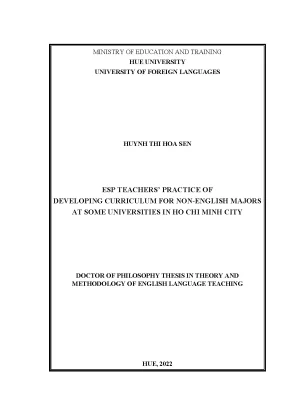
Tải xuống để đọc toàn bộTIEU LUAN MOI download : skknchat@gmail.com MINISTRY OF EDUCATION AND TRAINING HUE UNIVERSITY UNIVERSITY OF FOREIGN LANGUAGES HUYNH THI HOA SEN ESP TEACHERS’ PRACTICE OF DEVELOPING CURRICULUM FOR NON-ENGLISH MAJORS AT SOME UNIVERSITIES IN HO CHI MINH CITY DOCTOR OF PHILOSOPHY THESIS IN THEORY AND METHODOLOGY OF ENGLISH LANGUAGE TEACHING HUE, 2022 TIEU LUAN MOI download : skknchat@gmail.com MINISTRY OF EDUCATION AND TRAINING HUE UNIVERSITY UNIVERSITY OF FOREIGN LANGUAGES HUYNH THI HOA SEN ESP TEACHERS’ PRACTICE OF DEVELOPING CURRICULUM FOR NON-ENGLISH MAJORS AT SOME UNIVERSITIES IN HO CHI MINH CITY CODE: 9140111 DOCTOR OF PHILOSOPHY THESIS IN THEORY AND METHODOLOGY OF ENGLISH LANGUAGE TEACHING SUPERVISOR: ASSOC. TRAN VAN PHUOC HUE, 2022 TIEU LUAN MOI download : skknchat@gmail.com DECLARATION I certify that the present dissertation submitted today entitled: “ESP teachers’ practice of developing curriculum for non-English majors at some universities in Ho Chi Minh City” for the Degree of Doctor of Philosophy in theory and methodology in English language teaching, is the result of my own research, and that, to the best of my knowledge and belief, contains no material which has been accepted for the award of any other degree in any institute, college, or university, or previously published or written by another person, except where due reference is made in the text of the dissertation. Signature: 1 TIEU LUAN MOI download : skknchat@gmail.com ACKNOWLEDGEMENTS The road to achievement within this Doctoral Program is paved with the assistance and efforts of the many who worked diligently to assist me, believed in me and guided me to pursue a personal goal. I acknowledge those who without hesitation contributed their professional and academic knowledge to this study.
Without these individuals, this would never have been possible. I would like to acknowledge the forbearance of my supervisor Associate Professor Doctor Tran Van Phuoc, who provided instruction and feedback to all steps of the study and to various versions of this dissertation with the support and words of wisdom. I was exceptionally fortunate to have him as a mentor for this work. His encouragement allowed me to continue to grow as a person and a researcher.
He helped me keep things prioritized and in focus. Without him, this work would not have taken its final shape. I would also like to extend my sincere gratitude to Rector Pham Thi Hong Nhung and the lecturers and professors of the University of Foreign Languages, Hue University for patiently and wholeheartedly guiding me through the process required to complete my program of study. Their support, encouragement, and willingness to serve as academic committee members were of huge benefit to me.
Their knowledge and wisdom inspired me to broaden my scope of investigation. A special mention goes to my colleagues whose understanding, sympathy, and support were invaluable spiritual strength for me during the process of completing this work. I owe a great debt to many English teachers at the four universities who voluntarily and patiently answered the questionnaire and took part in the in-depth interviews during the data collection process of this study. 2 TIEU LUAN MOI download : skknchat@gmail.com This journey was made possible through the love and support of my parents, my sisters, my husband and children.
I would like to express my deep gratitude to my family. To my husband, for his unconditional love, support, and encouragement. He encouraged me unfailingly, provided ongoing support and kind words, motivated me, and had confidence in me. To my parents whose life demonstrated that honor is found in hard work and sacrifice.
I thank them for loving me unconditionally and for providing me with encouragement in my educational pursuits. My thanks go to my children, who are a source of strength to me. Along the way, they constantly made sacrifices to facilitate me in my endeavors. They were persistent in reminding me of my desire to complete the journey and motivated me every step of the way.
I will be forever grateful for and inspired by their love. 3 TIEU LUAN MOI download : skknchat@gmail.com ABSTRACT In the effort to enhance the quality of English teaching in tertiary institutions, ESP teaching is considered to make English learning more relevant to the students’ use of English in their future jobs, and thus arouse their interest and motivation in English learning. The development of ESP curriculum is, therefore, of great significance to meet these needs and teacher involvement in the process is essential because an ESP teacher is not only a teacher but also a collaborator, a course designer and material provider, a researcher, and an evaluator (Dudley-Evans & St. The study thus aims to investigate ESP teachers’ practice of developing the ESP curriculum for non-English majors at some universities in Ho Chi Minh City to find out about the practice of this process.
The study also aims to investigate the ESP teachers’ perceptions of the process, the advantages and difficulties they may encounter as well as their suggestions for improvement of the process. With the aim of investigating the practice of ESP teachers in developing curriculum and for the nature of the research questions, a descriptive research design was employed. Data collection was carried out with three instruments, that is, documentation, questionnaire and interview. Various types of documents related to the ESP curriculum development process were collected.
Seventy-eight ESP teachers from four universities in Ho Chi Minh City agreed to participate in the study and answered all the closed questions in the questionnaire and among them, twenty-one teachers took part in the interview. The findings of the study revealed the steps that the ESP teachers participated in most were determining the teaching methodology and support for effective teaching, and determining the assessment contents and methods. The steps of the curriculum development process that the ESP teachers were not involved in most were needs analysis, course goals or objectives specification, and curriculum evaluation. The advantages for the ESP teachers in the curriculum development process can be counted 4 TIEU LUAN MOI download : skknchat@gmail.com of existing knowledge and skills in teaching and planning lessons in General English, availability of coursebooks and teaching materials for certain specialties, support and encouragement from their faculties and universities, and individual help from specialist teachers in the same universities.
The difficulties ESP teachers often encountered in the curriculum development process were undefined workplaces’ target needs, unclear course goals and objectives, inappropriate teaching coursebooks and materials, lack of specialist knowledge, and lack of effective tools for needs analysis and curriculum evaluation at different stages of the curriculum development process. They proposed various recommendations concerning conducting a comprehensive needs analysis as a scientific base for later stages of the curriculum development process, specifying clear goals and objectives, and selecting and sequencing contents based on the needs analysis information, which in turns serves as the scientific base for the selection or compilation of coursebooks and teaching materials, supporting teachers with specialist training, supportive teaching and learning environment and assessment tools, as well as effective tools for ongoing needs analysis and curriculum evaluation. 5 TIEU LUAN MOI download : skknchat@gmail.com TABLE OF CONTENTS DECLARATION. 4 TABLE OF CONTENTS.
6 LIST OF ABBREVIATIONS. 10 LIST OF FIGURES. 11 LIST OF TABLES. 12 CHAPTER ONE: INTRODUCTION.
Statement of purpose. Scope of the study. Significance of the study. Structure of the study.
21 CHAPTER TWO: LITERATURE REVIEW. Definitions of key terms. English for Specific Purposes. Language curriculum development.
Language curriculum components. Common approaches in language curriculum development. Common procedures in language curriculum development. Steps in ESP curriculum development.
42 6 TIEU LUAN MOI download : skknchat@gmail. ESP needs analysis. Specification of course goals or objectives. Selection and sequencing of content.
Methodology and support for effective teaching. Selection or compilation of materials. Determination of assessment methods and contents. Teacher’s involvement in the curriculum development process.
Previous studies on teacher’s involvement in curriculum development and ESP teaching. Summary of the chapter. 66 CHAPTER THREE: RESEARCH METHODOLOGY. Data collection methods.
Documentation and artefacts. Piloting data collection. Data collection procedure. Data analysis methods.
Analysing documents and artefacts. Analysing questionnaire data. Analysing interview data. 81 7 TIEU LUAN MOI download : skknchat@gmail.
Reliability and validity. Summary of the chapter. 83 CHAPTER FOUR: FINDINGS AND DISCUSSION. Teachers’ perceptions of developing ESP curriculum for non-English majors.
Teachers’ general perceptions of developing ESP curriculum. Teachers’ perceptions of the steps in developing ESP curriculum. Step One: Analyzing ESP needs. Step Two: Specifying the course goals or objectives.
Step Three: Selecting and sequencing the contents. Step Four: Methodology and support for effective teaching. Step Five: Selecting or compiling coursebooks or teaching materials. Step Six: Determining methods and contents of assessment.
Step Seven: Evaluating the performed curriculum through different channels or tools. Teachers’ actual participation in the process of developing ESP curriculum at some universities in Ho Chi Minh City. Step One: Analyzing ESP needs. Step Two: Specifying the course goals or objectives.
Step Three: Selecting and sequencing the contents. Step Four: Methodology and support for effective teaching. Step Five: Selecting or compiling coursebooks or teaching materials. Step Six: Determining methods and contents of assessment.
Step Seven: Evaluating the performed curriculum through different channels or tools124 4. Advantages and difficulties in the ESP curriculum development process. Step One: Analyzing ESP needs .city TIEU LUAN MOI download : skknchat@gmail. Step Two: Specifying the course goals or objectives.
Step Three: Selecting and sequencing the contents. Step Four: Methodology and support for effective teaching. Step Five: Selecting or compiling coursebooks or teaching materials. Summary of the chapter.
131 CHAPTER FIVE: CONCLUSIONS AND RECOMMENDATIONS. Summary of key findings. Contributions of the study. Limitations of the study.
Suggestions for further studies. Summary of the chapter. 148 Appendix 1: The questionnaire (English version). 148 Appendix 2: The questionnaire (Vietnamese version).
159 Appendix 3: Interview questions (English). 169 Appendix 4: Interview questions (Vietnamese). 170 Appendix 5: Table of Reliability (Cronbach’s Alpha) .city TIEU LUAN MOI download : skknchat@gmail.com LIST OF ABBREVIATIONS EFL English as a Foreign Language EMP English for Mathematical Purposes ESL English as a Second Language ESP English for Specific Purposes HUFI University of Food Industry LSA Learning Situation Analysis LSP Languages for Specific Purposes MOET Ministry of Education and Training PSA Present Situation Analysis SPSS Statistical Package for the Social Sciences TSA Target Situation Analysis 10 (Luan.city TIEU LUAN MOI download : skknchat@gmail.com LIST OF FIGURES Figure 2.1: A model of the parts of the curriculum design process (adapted from Nation & Macalister, 2010) .2: Tyler’s Curriculum Development Model (adapted from Tyler, 1949) .3: Backward-design model (adapted from Wiggins and McTighe, 1998) .4: Flowchart presentation of the Taba-Tyler curriculum development model (adapted from Taba,1962; Tyler, 1949, 1969) .5: Procedures of curriculum process (adapted from Wheeler, 1967) .6: Systematic Approach to Designing and Maintaining Language Curriculum (adapted from Brown, 1995) .7: A teacher’s path through the production of new or adapted materials (adapted from Jolly & Bolitho, 1998) .city TIEU LUAN MOI download : skknchat@gmail.com LIST OF TABLES Table 3.1: Participants’ ethnographic information .2: Research inquiries and their corresponding data collection instruments.3: Questionnaire item distribution .1: Teachers’ general perceptions of the ESP curriculum development steps .2: Teachers’ general perceptions of the university/faculty’s implementation level of the ESP curriculum development steps.3: Teachers’ general perceptions of their participation .4: Teachers’ perceptions of the ESP needs analysis tools .5: Teachers’ perceptions of the contents to be collected in ESP needs analysis .6: Teachers’ perceptions of the stake-holders involved in ESP needs analysis.7: Teachers’ perceptions of the bases of goals or objectives specification .8: Teachers’ perceptions of the ESP syllabus framework types .9: Teachers’ perceptions of the elements ensuring the ESP curriculum effectiveness 95 Table 4.10: Teachers’ perceptions of the activities supporting the ESP curriculum implementation .
Nội dung được bảo vệ bản quyền — Tải xuống đầy đủ
Trích dẫn luận án này
Huynh Thi Hoa Sen (2022). Luận án tiến sĩ esp teachers practice of developing curricul [Luận án tiến sĩ, University of Foreign Languages, Hue University]. LuanAn.net. https://luanan.net/giao-duc-hoc/phuong-phap-giang-day/city
Câu hỏi thường gặp
Luận án "Luận án tiến sĩ esp teachers practice of developing curricul" nghiên cứu về vấn đề gì?
Tài liệu: Luận án tiến sĩ esp teachers practice of developing curriculum for non english majors at some universities in ho chi minh city. Tải miễn phí tại TaiLi
Luận án "Luận án tiến sĩ esp teachers practice of developing curricul" được bảo vệ tại trường nào?
Luận án này được bảo vệ tại University of Foreign Languages, Hue University. Năm bảo vệ: 2022.
Luận án "Luận án tiến sĩ esp teachers practice of developing curricul" thuộc chuyên ngành gì?
Luận án "Luận án tiến sĩ esp teachers practice of developing curricul" thuộc chuyên ngành Theory and Methodology of English Language Teaching. Danh mục: Phương Pháp Giảng Dạy.
Luận án "Luận án tiến sĩ esp teachers practice of developing curricul" có bao nhiêu trang?
Luận án "Luận án tiến sĩ esp teachers practice of developing curricul" có 173 trang. Bạn có thể xem trước một phần tài liệu ngay trên trang web trước khi tải về.
Cách tải luận án "Luận án tiến sĩ esp teachers practice of developing curricul" về máy như thế nào?
Để tải luận án về máy, bạn nhấn nút "Tải xuống ngay" trên trang này, sau đó hoàn tất thanh toán phí lưu trữ. File sẽ được tải xuống ngay sau khi thanh toán thành công. Hỗ trợ qua Zalo: 0559 297 239.