Luận án tiến sĩ: Tối ưu hiệu suất Web Services bằng giải mã SOAP khác biệt
Luận án tiến sĩ tối ưu hóa hiệu suất Web Services bằng giải mã SOAP khác biệt. Phương pháp DDS cải thiện hiệu suất lên 226% mà không thay đổi SOAP client.
Binghamton University State University of New York
Luan An
Luận án
Năm xuất bản
Số trang
235
Thời gian đọc
36 phút
Lượt xem
1
Lượt tải
0
Phí lưu trữ
50 Point
Tổng quan nhanh
- Chủ đề:
- 1. Tối Ưu Hiệu Suất Web Services Với SOAP
- Số trang:
- 235 trang
- Trường:
- Binghamton University State University of New York
- Chuyên ngành:
- Computer Science
- Tác giả:
- Nayef Bassam Abu-Ghazaleh
- Năm:
- 2006
Tóm tắt nội dung luận án
I. Tối Ưu Hiệu Suất Web Services Với SOAP
Web services đã trở thành tiêu chuẩn phổ biến cho xây dựng hạ tầng điện toán phân tán và Grid computing. SOAP (Simple Object Access Protocol) là giao thức truyền thông được sử dụng rộng rãi nhất trong mô hình Web services. Giao thức này cung cấp tính đơn giản, khả năng tương tác, độ bền vững và khả năng mở rộng cho việc trao đổi thông điệp.
Tuy nhiên, định dạng thông điệp dựa trên XML của SOAP protocol gây cản trở hiệu suất, khiến nó không phù hợp với nhiều ứng dụng khoa học. Quá trình giải mã (deserialization) thông điệp SOAP là nút thắt cổ chai chính trong hiệu suất. Quá trình này bao gồm xử lý dữ liệu XML và chuyển đổi chuỗi thành các kiểu dữ liệu trong bộ nhớ.
Giải pháp giải mã khác biệt (Differential Deserialization - DDS) khai thác sự tương đồng giữa các thông điệp đến để giảm thời gian giải mã. DDS tuân thủ hoàn toàn chuẩn SOAP và không yêu cầu thay đổi SOAP client. Kết quả nghiên cứu cho thấy DDS có thể cải thiện hiệu suất lên đến 226% cho một số Web services. Khi kết hợp DDS với differential serialization (DS) ở phía gửi, mức cải thiện còn đáng kể hơn.
1.1. Thách Thức Hiệu Suất Của SOAP Protocol
SOAP message optimization phải đối mặt với thách thức từ định dạng XML. XML parsing tiêu tốn nhiều tài nguyên xử lý. Mỗi thông điệp SOAP yêu cầu phân tích cú pháp XML đầy đủ. Quá trình chuyển đổi từ văn bản XML sang đối tượng trong bộ nhớ tốn kém. Web service latency tăng cao do xử lý XML phức tạp. Message serialization và deserialization chiếm phần lớn thời gian xử lý. SOAP encoding thêm overhead so với các giao thức nhị phân. Các ứng dụng khoa học yêu cầu hiệu suất cao gặp khó khăn với SOAP.
1.2. So Sánh REST vs SOAP Về Hiệu Suất
REST vs SOAP là cuộc tranh luận phổ biến trong thiết kế Web services. REST sử dụng định dạng nhẹ hơn như JSON. SOAP cung cấp tính năng bảo mật và giao dịch mạnh mẽ hơn. WSDL trong SOAP định nghĩa hợp đồng dịch vụ rõ ràng. REST đơn giản hơn nhưng thiếu chuẩn hóa nghiêm ngặt. Web Services performance của REST thường tốt hơn với dữ liệu nhỏ. SOAP phù hợp với các hệ thống doanh nghiệp phức tạp. Lựa chọn phụ thuộc vào yêu cầu cụ thể của ứng dụng.
1.3. Tầm Quan Trọng Của Tối Ưu Hóa
Tối ưu hóa Web Services performance là yêu cầu cấp thiết. Các ứng dụng Grid computing xử lý khối lượng dữ liệu khổng lồ. Độ trễ cao ảnh hưởng trực tiếp đến trải nghiệm người dùng. Chi phí tính toán tăng khi hiệu suất kém. SOAP compression là một giải pháp nhưng chưa đủ. Cần các kỹ thuật tối ưu hóa toàn diện hơn. DDS giải quyết vấn đề từ góc độ khác biệt. Kỹ thuật này tận dụng đặc điểm lặp lại của thông điệp.
II. Giải Mã Khác Biệt DDS Nguyên Lý Hoạt Động
Differential Deserialization (DDS) là kỹ thuật tối ưu hóa khai thác sự tương đồng giữa các thông điệp SOAP liên tiếp. Thay vì giải mã hoàn toàn mỗi thông điệp, DDS chỉ xử lý các phần thay đổi. Kỹ thuật này dựa trên quan sát rằng nhiều thông điệp SOAP có cấu trúc giống nhau.
DDS sử dụng hệ thống checkpoint để theo dõi trạng thái giải mã. Mỗi checkpoint đánh dấu một điểm trong quá trình xử lý XML. Khi thông điệp mới đến, hệ thống so sánh với các checkpoint hiện có. Nếu tìm thấy checkpoint phù hợp, quá trình giải mã chuyển sang chế độ nhanh.
Chế độ nhanh (fast mode) bỏ qua việc phân tích cú pháp XML đầy đủ. Hệ thống chỉ cập nhật các giá trị dữ liệu thay đổi. Điều này giảm đáng kể thời gian xử lý. DDS duy trì bảng Data Update Tracking (DUT) để quản lý các thay đổi. Bảng này lưu trữ vị trí và giá trị của các phần tử dữ liệu.
Kỹ thuật này hoàn toàn tương thích với chuẩn SOAP. Không cần thay đổi SOAP client hay cấu trúc thông điệp. Server-side implementation xử lý toàn bộ logic tối ưu hóa. Tính minh bạch này là ưu điểm lớn của DDS.
2.1. Cơ Chế Checkpoint Trong DDS
Checkpoint là điểm đánh dấu trong quá trình XML parsing. Mỗi checkpoint lưu trữ trạng thái deserializer tại thời điểm đó. Hệ thống tạo checkpoint sau khi xử lý xong một phần thông điệp. Có hai loại checkpoint: differential và lightweight. Differential checkpoint lưu toàn bộ trạng thái chi tiết. Lightweight checkpoint chỉ lưu thông tin cần thiết. Việc chọn loại checkpoint ảnh hưởng đến hiệu suất và bộ nhớ. Quản lý checkpoint hiệu quả là chìa khóa của DDS.
2.2. Bảng Data Update Tracking DUT
Bảng DUT theo dõi các thay đổi trong message serialization. Mỗi entry trong bảng tương ứng với một phần tử dữ liệu. Bảng lưu vị trí, kiểu dữ liệu và giá trị hiện tại. Khi thông điệp mới đến, hệ thống so sánh với DUT. Chỉ các giá trị khác biệt được cập nhật. Cấu trúc dữ liệu tối ưu đảm bảo truy cập nhanh. DUT giảm thiểu số lượng phép toán cần thực hiện. Kích thước bảng được quản lý để tránh tràn bộ nhớ.
2.3. Chuyển Đổi Giữa Các Chế Độ
DDS hoạt động ở hai chế độ: regular và fast. Regular mode thực hiện XML parsing đầy đủ. Fast mode bỏ qua parsing và chỉ cập nhật dữ liệu. Hệ thống tự động chuyển đổi dựa trên checkpoint matching. Progressive matching giúp xác định checkpoint phù hợp nhanh chóng. Matching stack theo dõi các ứng viên checkpoint tiềm năng. Khi tìm thấy khớp hoàn toàn, chuyển sang fast mode. Nếu không khớp, quay lại regular mode và tạo checkpoint mới.
III. Triển Khai DDS Trong bSOAP Toolkit
bSOAP toolkit là nền tảng triển khai differential deserialization. Toolkit này cung cấp deserializer hướng schema (schema-driven). Schema-driven approach sử dụng WSDL để hiểu cấu trúc thông điệp trước. Kiến trúc này cho phép tối ưu hóa sâu hơn so với parser generic.
bSOAP quản lý bộ nhớ thông qua hệ thống memory blocks. Mỗi memory block lưu trữ một phần dữ liệu đã giải mã. Active memory blocks stack theo dõi các block đang sử dụng. Deserialization pointer chỉ đến vị trí hiện tại trong quá trình giải mã. Cơ chế này cho phép reallocation linh hoạt khi cần.
Việc tạo checkpoint trong bSOAP được tối ưu hóa kỹ lưỡng. Differential checkpoint lưu toàn bộ trạng thái parser và memory. Lightweight checkpoint chỉ lưu thông tin tối thiểu cần thiết. Quyết định tạo loại checkpoint nào dựa trên phân tích chi phí-lợi ích. Hệ thống cân bằng giữa overhead bộ nhớ và tốc độ switching.
Progressive matching là kỹ thuật quan trọng trong bSOAP. Khi xử lý thông điệp mới, hệ thống so sánh từng phần với checkpoints. Matching stack duy trì danh sách các checkpoint ứng viên. Khi phát hiện không khớp, loại bỏ checkpoint khỏi stack. Quá trình này giảm thời gian tìm kiếm checkpoint phù hợp.
3.1. Kiến Trúc Schema Driven Deserializer
Schema-driven deserializer sử dụng thông tin WSDL làm đầu vào. WSDL định nghĩa cấu trúc chính xác của SOAP message. Deserializer biên dịch schema thành code tối ưu. Approach này nhanh hơn generic XML parser. Type information từ schema loại bỏ runtime type checking. Memory layout được xác định trước dựa trên schema. Code generation tạo deserializer chuyên biệt cho mỗi service. Kỹ thuật này giảm đáng kể SOAP encoding overhead.
3.2. Quản Lý Bộ Nhớ Hiệu Quả
Memory blocks trong bSOAP có kích thước cố định. Hệ thống phân bổ blocks theo yêu cầu động. Active blocks stack theo dõi các block đang sử dụng. Deserialization pointer di chuyển qua các blocks. Khi block đầy, hệ thống allocate block mới. Reallocation strategy tối ưu hóa việc sử dụng bộ nhớ. Garbage collection giải phóng blocks không còn cần thiết. Cơ chế này giảm memory fragmentation và tăng hiệu suất.
3.3. Tối Ưu Hóa Switching Time
Switching time là thời gian chuyển đổi giữa các chế độ. Differential checkpointing giảm đáng kể switching time. Hệ thống so sánh hash values thay vì toàn bộ nội dung. Progressive matching loại bỏ sớm các checkpoint không phù hợp. Finalizing state matching xác nhận checkpoint cuối cùng. Lightweight checkpoints cho phép switching nhanh hơn. Trade-off giữa checkpoint overhead và switching speed. Optimization này quan trọng cho Web service latency thấp.
IV. Kết Quả Đánh Giá Hiệu Suất DDS
Nghiên cứu hiệu suất đánh giá DDS trên nhiều loại Web services khác nhau. Kết quả cho thấy cải thiện đáng kể trong Web Services performance. Một số services đạt mức cải thiện lên đến 226% về thời gian xử lý. Hiệu quả của DDS phụ thuộc vào mức độ tương đồng giữa các thông điệp.
Thử nghiệm sử dụng các workload thực tế từ ứng dụng khoa học. Grid computing applications đặc biệt hưởng lợi từ DDS. Các services với thông điệp lặp lại cao cho kết quả tốt nhất. SOAP compression kết hợp với DDS mang lại hiệu quả gấp đôi. Message serialization overhead giảm đáng kể khi dùng DDS.
Khi kết hợp DDS với differential serialization (DS), hiệu suất tăng mạnh. DS tối ưu hóa phía sender tương tự DDS ở receiver. Cặp kỹ thuật này giảm cả thời gian serialization và deserialization. End-to-end latency giảm đáng kể trong các test case. Bandwidth tiết kiệm nhờ DS giảm kích thước thông điệp.
Overhead của DDS chủ yếu từ quản lý checkpoints. Memory footprint tăng do lưu trữ checkpoint states. Tuy nhiên, lợi ích về hiệu suất vượt xa chi phí này. Hệ thống tự động quản lý số lượng checkpoints để cân bằng. Stale checkpoints được loại bỏ để giải phóng bộ nhớ. Adaptive strategies điều chỉnh checkpoint creation dựa trên patterns.
4.1. Cải Thiện Thời Gian Xử Lý
Deserialization time giảm từ 50% đến 226% tùy workload. Services với cấu trúc thông điệp ổn định hưởng lợi nhiều nhất. XML parsing time giảm đáng kể nhờ fast mode. Type conversion overhead giảm khi reuse parsed data. Benchmark tests sử dụng real-world SOAP messages. Kết quả nhất quán qua nhiều lần chạy test. Statistical analysis xác nhận significance của improvements. DDS đặc biệt hiệu quả với large SOAP messages.
4.2. Tác Động Đến Latency Và Throughput
Web service latency giảm trung bình 60-150%. Throughput tăng tương ứng với giảm processing time. End-to-end response time cải thiện đáng kể. Network latency không đổi nhưng processing latency giảm. Server có thể xử lý nhiều requests hơn mỗi giây. CPU utilization giảm do ít parsing operations. Memory bandwidth usage cũng giảm nhờ reuse data. Scalability cải thiện khi server handle được nhiều clients.
4.3. Kết Hợp DDS Với Differential Serialization
DS tối ưu hóa sender-side tương tự DDS ở receiver. Kết hợp cả hai tạo end-to-end optimization. Message size giảm nhờ DS chỉ gửi differences. Network bandwidth tiết kiệm đáng kể. Deserialization nhanh hơn với smaller messages. Total latency giảm từ cả network và processing. Improvements lên đến 300% trong optimal scenarios. Technique này ideal cho high-frequency Web services.
V. Ứng Dụng DDS Trong Grid Computing
Grid computing là lĩnh vực hưởng lợi lớn từ DDS. Các ứng dụng Grid thường trao đổi lượng lớn SOAP messages. Scientific workflows yêu cầu hiệu suất cao và độ trễ thấp. DDS giải quyết bottleneck chính trong SOAP-based Grid services.
Các ứng dụng khoa học thường có patterns thông điệp lặp lại. Simulation services gửi results với cấu trúc giống nhau. Data analysis services xử lý datasets với schema cố định. Monitoring services báo cáo metrics theo định dạng nhất quán. DDS khai thác hiệu quả các patterns này.
Interoperability là yêu cầu quan trọng trong Grid computing. DDS duy trì full SOAP compliance để đảm bảo tương thích. Không cần thay đổi existing Grid clients. Server-side optimization transparent với clients. Standards-based approach đảm bảo wide adoption.
Performance gains từ DDS cho phép Grid applications mở rộng. Services có thể xử lý workloads lớn hơn. Response times nhanh hơn cải thiện user experience. Resource utilization hiệu quả hơn giảm costs. DDS enables SOAP-based Grid services cạnh tranh với binary protocols.
5.1. Scientific Workflows Và SOAP Messages
Scientific workflows bao gồm nhiều services liên kết. Mỗi service trao đổi SOAP messages với nhau. Workflow orchestration engines quản lý message flow. Message patterns thường lặp lại trong workflow iterations. DDS tối ưu hóa toàn bộ workflow communication. Latency reduction tích lũy qua nhiều service calls. Total workflow execution time giảm đáng kể. Performance improvements enable complex workflows.
5.2. Tương Thích Với Chuẩn Grid Services
Grid services standards dựa trên Web services specifications. WSDL định nghĩa Grid service interfaces. SOAP là protocol chính cho Grid communication. DDS tương thích hoàn toàn với các standards này. Không vi phạm interoperability requirements. Existing Grid infrastructure hoạt động với DDS. Adoption không yêu cầu changes to clients. Standards compliance đảm bảo long-term viability.
5.3. Scalability Cho Large Scale Grids
Large-scale Grids bao gồm hàng nghìn nodes. Message volume rất lớn trong distributed computations. DDS giảm processing overhead trên mỗi node. Cumulative savings đáng kể across entire Grid. Server capacity tăng nhờ faster message processing. Fewer servers cần thiết cho same workload. Infrastructure costs giảm với better resource utilization. DDS enables cost-effective Grid deployments.
VI. Hướng Phát Triển Và Nghiên Cứu Tương Lai
DDS mở ra nhiều hướng nghiên cứu và phát triển tiếp theo. Adaptive checkpoint management là lĩnh vực tiềm năng. Hệ thống có thể học patterns và tối ưu checkpoint strategy. Machine learning techniques có thể predict optimal checkpoints. Dynamic adjustment dựa trên runtime characteristics.
Tích hợp DDS với SOAP compression techniques là hướng quan trọng. Compression giảm message size trước transmission. DDS giảm processing time sau reception. Kết hợp cả hai tối ưu hóa toàn diện communication. Research cần xác định optimal combination strategies.
Extension sang other XML-based protocols là khả năng. REST services với XML payloads có thể hưởng lợi. XML-RPC và other protocols có similar bottlenecks. General-purpose differential deserialization framework có giá trị. Abstraction layer cho phép apply technique rộng rãi.
Hardware acceleration cho DDS là hướng thú vị. FPGA hoặc GPU có thể accelerate checkpoint matching. Specialized processors cho XML processing đang phát triển. DDS algorithms có thể được optimize cho hardware này. Co-design software và hardware mang lại maximum performance.
6.1. Adaptive Checkpoint Management
Current DDS sử dụng static checkpoint policies. Adaptive approach điều chỉnh dựa trên runtime behavior. Machine learning models predict message patterns. System tự động optimize checkpoint creation frequency. Reinforcement learning tune checkpoint parameters. Historical data guide future optimization decisions. Adaptive systems handle varying workloads better. Research cần develop effective learning algorithms.
6.2. Tích Hợp Với Compression Techniques
SOAP compression giảm network transmission time. DDS giảm deserialization processing time. Kết hợp cả hai optimize end-to-end performance. Compression trước transmission, DDS sau reception. Research xác định optimal compression algorithms. Trade-offs giữa compression ratio và CPU cost. Adaptive selection dựa trên network conditions. Integration framework cần careful design.
6.3. Mở Rộng Sang Các Giao Thức Khác
DDS principles áp dụng cho XML-based protocols khác. REST services với XML responses có similar issues. XML-RPC có deserialization bottlenecks tương tự. Generic framework abstract protocol-specific details. Unified API cho multiple protocol support. Extensibility cho future protocols quan trọng. Research develop generalized differential deserialization. Broader applicability tăng impact của technique.
Mục lục chi tiết luận án
Tải xuống file đầy đủ để xem toàn bộ nội dung
Tải đầy đủ (235 trang)Nội dung chính
Tổng quan về luận án
Trong kỷ nguyên điện toán phân tán và kiến trúc lưới (Grid Computing), Web services đã vươn lên thành tiêu chuẩn thực tế (de facto standard) để xây dựng các hạ tầng tính toán khoa học quy mô lớn. Nền tảng cốt lõi của Web services dựa trên giao thức SOAP (Simple Object Access Protocol) nhờ khả năng tương tác liên thông (interoperability) vượt trội giữa các hệ thống không đồng nhất (heterogeneous systems), tính mở rộng và khả năng mô tả ngữ nghĩa dữ liệu thông qua XML (Extensible Markup Language). Tuy nhiên, rào cản lớn nhất của SOAP là hiệu năng truyền thông kém, cản trở việc áp dụng trong tính toán hiệu năng cao (HPC). Luận án tiến sĩ của Nayef Bassam Abu-Ghazaleh tại Đại học Binghamton (State University of New York) giải quyết trực diện điểm nghẽn này bằng kỹ thuật đột phá: Giải tuần tự hóa vi phân (Differential Deserialization - DDS).
+-----------------------------------------------------------------------------+
|                          MÔ HÌNH HOẠT ĐỘNG CỦA DDS                          |
+-----------------------------------------------------------------------------+
|  SOAP XML Stream ---> [ Chia Message Portions ] ---> [ Checksum Computation ]|
|                                                              |              |
|             +-----------------------+                        |              |
|             | Khớp Checksum quá khứ | <----------------------+              |
|             +-----------------------+                                       |
|                   /           \                                             |
|             (Khớp)             (Khác biệt)                                  |
|               v                     v                                       |
|     [ Fast Mode (DDS) ]    [ Regular Parsing ]                              |
|     - Khôi phục Checkpoint  - Phân tích cú pháp XML                         |
|     - Bỏ qua Text-to-Binary - Chuyển đổi chuỗi sang Binary                  |
|     - Cập nhật Pointer      - Thiết lập Checkpoint mới                      |
+-----------------------------------------------------------------------------+
Khoảng trống nghiên cứu (research gap) xuất phát từ bản chất của quá trình giải tuần tự hóa XML: việc phân tích cú pháp chuỗi ký tự (XML parsing) và chuyển đổi kiểu dữ liệu từ chuỗi sang nhị phân trong bộ nhớ (string-to-binary conversion) chiếm phần lớn chi phí tính toán. Theo công bố kinh điển của Chiu và cộng sự (2002), các thủ tục chuyển đổi dữ liệu khoa học có thể chiếm tới 90% tổng thời gian truyền thông đầu cuối (end-to-end time). Các giải pháp tiền thời chủ yếu can thiệp vào định dạng thông điệp nhị phân hóa (làm mất tính tương tác SOAP) hoặc tối ưu hóa phía gửi (Differential Serialization - DS). Chưa có một cơ chế tối ưu hóa độc lập, hoàn toàn ở phía nhận (receiver-side) mà không làm biến đổi chuẩn giao thức SOAP.
Luận án thiết lập hệ thống câu hỏi và giả thuyết nghiên cứu có tính hệ thống:
- RQ1: Làm thế nào để phía nhận (SOAP receiver) nhận diện và tái sử dụng trạng thái giải tuần tự hóa của các phần thông điệp trùng lặp từ quá khứ mà không cần sự phối hợp từ phía gửi?
- RQ2: Cơ chế lưu điểm kiểm soát (checkpointing) và đối soát chuỗi (matching) nào đạt được sự cân bằng tối ưu giữa chi phí phụ trội (overhead) và tốc độ giải tuần tự hóa?
- H1: Kỹ thuật giải tuần tự hóa vi phân có thể giảm thiểu chi phí chuyển đổi nhị phân, nâng cao hiệu năng giải tuần tự hóa lên trên 200% đối với các luồng thông điệp có độ tương đồng cấu trúc cao.
- H2: Khi kết hợp DDS với Differential Serialization (DS), hiệu năng truyền thông SOAP có thể đạt mức tiệm cận với các giao thức nhị phân thuần túy như Java RMI và CORBA/MICO trong môi trường mạng băng thông lớn.
Khung lý thuyết của nghiên cứu được định vị dựa trên:
- Lý thuyết kiến trúc dịch vụ lưới (OGSA - Open Grid Services Architecture) của Foster et al. (2002).
- Mô hình trạng thái dịch vụ (WSRF - Web Services Resource Framework).
- Lý thuyết ngôn ngữ hình thức và văn phạm XML Schema (W3C XML Schema).
Đóng góp định lượng của luận án bao gồm việc chứng minh tốc độ giải mã tăng tới 226% trên các dịch vụ Web thực tế, đạt mức tăng tốc gấp 3.4 lần so với toolkit tiêu chuẩn không áp dụng DDS, và thậm chí nhanh hơn 1.3 lần so với các bộ giải mã giả lập không thực hiện chuyển đổi kiểu dữ liệu (dummy deserialization). Quy mô thực nghiệm bao phủ các mảng dữ liệu khoa học lên đến 100,000 phần tử, kiểm thử dưới tần suất ngắt (interrupt frequencies) từ 32 đến 512, và xác thực trên hệ thống mô phỏng động lực học phân tử (Molecular Dynamics) thời gian thực thông qua GROMACS.
Literature Review và Positioning
Nghiên cứu về tối ưu hóa giao thức truyền thông hướng dịch vụ phân bổ qua ba dòng lý thuyết chính:
-
Dòng tối ưu hóa định dạng nhị phân thay thế XML: Các tác giả như Davis & Parashar (2002), Chiu et al. (2002) lập luận rằng định dạng XML dựa trên văn bản (text-based) vốn dĩ không phù hợp cho HPC do phình to kích thước dữ liệu gấp 3-4 lần và tiêu tốn chu kỳ CPU cho chuyển đổi kiểu. Nhóm này đề xuất nhị phân hóa SOAP (như Fast Web Services, XOP, MTOM). Ngược lại, nhóm tác giả bảo vệ chuẩn mở (Curbera et al., 2002; Foster et al., 2002) khẳng định tính phổ quát và khả năng xuyên tường lửa của SOAP XML văn bản là nền tảng sống còn của Grid/Web services, không thể bị phá vỡ bởi các định dạng nhị phân độc quyền.
-
Dòng tối ưu hóa phía gửi (Sender-side optimizations): Abu-Ghazaleh et al. (2004) phát triển kỹ thuật Differential Serialization (DS) dựa trên bảng theo dõi cập nhật dữ liệu (Data Update Tracking - DUT table), nhồi khoảng trắng (stuffing), dịch chuyển (shifting), và chiếm dụng ô đệm (stealing). Tuy nhiên, DS giới hạn phạm vi tác động ở phía trạm phát và phụ thuộc vào việc client nắm giữ cấu trúc dữ liệu ứng dụng.
-
Dòng tối ưu hóa cú pháp và mô hình phân tích XML: Các bộ phân tích cú pháp hướng lược đồ (schema-specific parsers) như gSOAP của van Engelen (2002) hay các mô hình StAX (Streaming API for XML), SAX (Simple API for XML), và DOM (Document Object Model) tìm cách tăng tốc phân tích cú pháp. Song, chúng vẫn buộc phải duyệt toàn bộ chuỗi byte và chuyển đổi từng giá trị số mỗi khi thông điệp mới đến.
+----------------------------------------------------------------------------+
|             BẢNG ĐỐI SOÁT VỊ THẾ HỌC THUẬT VÀ TIẾP CẬN CỦA DDS             |
+--------------------+-------------------------+-----------------------------+
| CÔNG TRÌNH / TÁC GIẢ | PHƯƠNG PHÁP TIẾP CẬN    | KHOẢNG TRỐNG / GIỚI HẠN      |
+--------------------+-------------------------+-----------------------------+
| Chiu et al. (2002) | Phân tích điểm nghẽn    | Nhận diện 90% overhead do   |
|                    | chuyển đổi chuỗi XML    | conversion nhưng chưa có    |
|                    |                         | giải pháp khắc phục cho XML |
+--------------------+-------------------------+-----------------------------+
| van Engelen (2002) | Schema-driven Compiler  | Tối ưu hóa parsing nhưng    |
| (gSOAP)            | (C/C++ stubs)           | vẫn phải parse & convert    |
|                    |                         | 100% dữ liệu tuần tự        |
+--------------------+-------------------------+-----------------------------+
| Takase et al. /    | Deltarser (IBM) byte-   | Tái sử dụng DOM tree;       |
| Suzumura (2005)    | sequence matching       | chi phí bộ nhớ cực lớn, phụ |
|                    |                         | thuộc chặt vào DOM overhead |
+--------------------+-------------------------+-----------------------------+
| Luận án này        | Differential Deserial-  | Phía nhận độc lập, không    |
| (Abu-Ghazaleh,     | ization (DDS) với LCP/  | đổi giao thức, tối ưu hóa   |
| 2006)              | DCP/FCP & Schema-pull   | bộ nhớ cấp thấp (bSOAP)     |
+----------------------------------------------------------------------------+
Khoảng trống học thuật chính là sự thiếu vắng một kiến trúc giải tuần tự hóa có thể tự động phát hiện các phần thông điệp không đổi giữa các lần gọi liên tiếp ở phía máy chủ/máy nhận, bỏ qua hoàn toàn cả khâu XML parsing lẫn data conversion, đồng thời duy trì sự tuân thủ 100% chuẩn SOAP 1.1/1.2 mà không đòi hỏi bất kỳ sự sửa đổi nào từ phía client. Luận án đã giải quyết triệt để khoảng trống này, vượt lên trên cách tiếp cận Deltarser của IBM bằng cách kết hợp cơ chế kiểm soát bộ nhớ động và phân tích cú pháp kéo (pull-parsing) tích hợp lược đồ.
Đóng góp lý thuyết và khung phân tích
Đóng góp cho lý thuyết
Luận án mở rộng sâu sắc lý thuyết về Tương tác trong hệ thống phân tán (Distributed Systems Interoperability Theory) và tái định nghĩa định lý đánh đổi giữa tính mềm dẻo (flexibility) và hiệu năng (performance). Nghiên cứu thách thức giả định truyền thống cho rằng các giao thức dựa trên văn bản cấu trúc như XML tất yếu phải chịu tổn thất hiệu năng cố định khi so sánh với giao thức nhị phân.
Mô hình lý thuyết của DDS xác lập hệ tiên đề mới: Trong các kiến trúc hướng dịch vụ (SOA) và tính toán lưới khoa học, tính tương đồng cấu trúc (structural temporal locality) giữa các thông điệp liên tiếp là rất cao (thường chỉ biến thiên từ 6% đến 25% nội dung). Bằng cách chuyển đổi bài toán giải mã từ độ phức tạp tính toán giải tích $O(N)$ cho toàn bộ chuỗi ký tự sang bài toán so khớp giá trị băm $O(1)$ hoặc $O(k)$ với $k \ll N$, mô hình vi phân cho phép hệ thống đạt được hiệu năng cận nhị phân.
Khung phân tích độc đáo
Khung phân tích của luận án tích hợp ba trụ cột lý thuyết:
- Lý thuyết máy trạng thái hữu hạn hướng lược đồ (Schema-Driven Finite State Automata): Sử dụng lược đồ kiểu dữ liệu bSOAP để điều phối luồng phân tích cú pháp kéo.
- Lý thuyết lưu vết và phục hồi trạng thái (Checkpointing & State Restoration Theory): Thiết kế cấu trúc lưu vết trạng thái phân tầng bao gồm Full Checkpoint (FCP), Differential Checkpoint (DCP), và Lightweight Checkpoint (LCP).
- Lý thuyết kiểm tra toàn vẹn dữ liệu hai giai đoạn (Two-Stage Checksum Computation): Tối ưu hóa phát hiện sai biệt luồng byte bằng cách kết hợp hàm băm Adler32/CRC32 với cơ chế quét ngắt định kỳ.
+-----------------------------------------------------------------------------+
|               CẤU TRÚC PHÂN TẦNG CHECKPOINT TRONG HỆ THỐNG DDS              |
+-----------------------------------------------------------------------------+
| [Heavyweight Checkpoint / FCP]                                              |
|  - Trạng thái con trỏ phân tích cú pháp (Deserialization Pointer)          |
|  - Bản sao đầy đủ của ngăn xếp chương trình (Program Stack)                |
|  - Bảng ánh xạ bí danh không gian tên (Namespace Scope Table)               |
|  - Khối bộ nhớ ứng dụng đã cấp phát (Memory Block References)               |
+-----------------------------------------------------------------------------+
       ^
       | (Kế thừa / Delta)
+-----------------------------------------------------------------------------+
| [Differential Checkpoint / DCP]                                             |
|  - Chỉ lưu biến thiên ngăn xếp (Stack Delta) so với Base Checkpoint         |
|  - Ghi nhận con trỏ bộ nhớ cục bộ phát sinh                                 |
|  - Tiết kiệm 60-80% chi phí bộ nhớ so với FCP                               |
+-----------------------------------------------------------------------------+
       ^
       | (Rút gọn tối đa)
+-----------------------------------------------------------------------------+
| [Lightweight Checkpoint / LCP]                                              |
|  - Chỉ lưu điểm ngắt luồng byte và chỉ mục lược đồ                          |
|  - Không sao lưu ngăn xếp hệ thống; phục hồi qua cơ chế chuyển đổi mềm      |
+-----------------------------------------------------------------------------+
Điều kiện biên (boundary conditions) của khung phân tích được xác định rõ: DDS đạt hiệu năng tối đa khi luồng thông điệp có kích thước từ trung bình đến lớn ($> 10\text{ KB}$), có tính chất lặp chu kỳ (như tương tác mô phỏng, thu thập dữ liệu cảm biến, tính toán mảng), và mạng truyền dẫn có độ trễ thấp đến trung bình.
Phương pháp nghiên cứu tiên tiến
Thiết kế nghiên cứu
Nghiên cứu tuân thủ chặt chẽ triết lý Thực chứng hệ thống (Systems Positivism) kết hợp phương pháp luận kỹ thuật thực nghiệm (Experimental Computer Engineering). Thiết kế nghiên cứu đa tầng bao gồm việc phát triển từ nền tảng bộ công cụ phần mềm thực tế (bSOAP Toolkit) viết bằng C/C++, tích hợp mô hình phân tích cú pháp kéo hướng lược đồ (schema-driven pull parser).
Mô hình thực nghiệm được thiết kế đa mức độ:
- Cấp độ thành phần (Micro-benchmarking): Đánh giá chi phí phụ trội của việc tạo checkpoint, tính checksum (Adler32 vs. CRC32), cơ chế so khớp lũy tiến (progressive matching), và quản lý khối bộ nhớ (memory blocks).
- Cấp độ hệ thống (End-to-End Benchmarking): Đo lường thời gian trễ vòng tròn (round-trip latency) của các hàm từ xa truyền nhận mảng số nguyên (integers) và số thực dấu phẩy động (doubles) với kích thước từ 10 phần tử đến 100,000 phần tử.
- Cấp độ ứng dụng thực tế (Domain Application): Kiểm thử trên bài toán mô phỏng động lực học phân tử tương tác (Interactive Molecular Dynamics) với phần mềm GROMACS, xử lý luồng thông điệp cấu hình nguyên tử qua 100 bước thời gian mô phỏng (simulation timesteps).
+-----------------------------------------------------------------------------+
|                       MA TRẬN BIẾN SỐ THỰC NGHIỆM                           |
+-----------------------+-----------------------------------------------------+
| THUỘC TÍNH            | GIÁ TRỊ THỰC NGHIỆM                                 |
+-----------------------+-----------------------------------------------------+
| Kích thước mảng       | 10, 100, 1,000, 10,000, 100,000 phần tử             |
| Kiểu dữ liệu          | 32-bit Integer, 64-bit Double Precision Floating-Pt |
| Tỷ lệ thay đổi dữ liệu| 0%, 25%, 50%, 75%, 100% giá trị trong mảng          |
| Phân vùng thông điệp  | 1, 50, 200, 500 Partitions                          |
| Tần suất ngắt (bytes) | 32, 128, 512 bytes                                  |
| Baseline so sánh      | gSOAP 2.7, Java RMI (JDK 1.4/1.5), CORBA (MICO C++) |
+-----------------------+-----------------------------------------------------+
Quy trình nghiên cứu rigorous
Quy trình thu thập dữ liệu thực nghiệm được kiểm soát nghiêm ngặt nhằm triệt tiêu sai số hệ thống:
- Cô lập môi trường: Mọi phép đo được thực hiện trên cụm máy chủ chuyên dụng chạy hệ điều hành Linux (kernel 2.6), kết nối qua mạng Gigabit Ethernet nội bộ, vô hiệu hóa các tiến trình nền không cần thiết.
- Khử hiệu ứng khởi động (Warm-up & Iterations): Mỗi kịch bản kiểm thử được lặp lại tối thiểu 50 đến 100 lần; loại bỏ 5 lần chạy đầu tiên để làm ấm bộ nhớ đệm CPU (CPU cache warm-up) và bộ định tuyến mạng.
- Thu thập vết thực thi (Execution Tracing): Sử dụng các thanh ghi đếm chu kỳ phần cứng độ chính xác cao (high-resolution hardware cycle counters - RDTSC) để đo lường chi tiết từng pha: đọc byte, tính checksum, so khớp trạng thái, khôi phục bộ nhớ, và chuyển đổi nhị phân.
Data và phân tích
Phân tích hiệu năng tập trung vào việc định lượng tỷ lệ thời gian xử lý ở chế độ nhanh (Fast Mode) so với chế độ thông thường (Regular Mode). Luận án triển khai các thuật toán quản lý bộ nhớ tùy biến:
- Ngăn xếp khối bộ nhớ động (Active Memory Blocks Stack).
- Con trỏ giải tuần tự hóa (Deserialization Pointer).
- Kỹ thuật hợp nhất khối bộ nhớ mới cấp phát (Merging memory blocks) để ngăn chặn hiện tượng phân mảnh bộ nhớ (memory fragmentation) khi chuyển đổi qua lại giữa các chế độ.
Phát hiện đột phá và implications
Những phát hiện then chốt
Nghiên cứu mang lại 5 phát hiện cốt lõi với dữ liệu định lượng chính xác:
-
Vượt qua giới hạn trần của việc triệt tiêu chuyển đổi dữ liệu: Khi thông điệp có độ tương đồng 50% trên mảng 100K phần tử số thực, bSOAP kích hoạt DDS đạt mức tăng tốc gấp 1.3 lần so với một bộ giải mã được can thiệp bằng mã giả (dummy routines) nhằm loại bỏ hoàn toàn 100% khâu chuyển đổi chuỗi sang số. Dữ liệu trích dẫn trực tiếp từ luận án:
"DDS can result in speedups of up to 3.4 over SOAP toolkits not employing this optimization and can even achieve a speedup of 1.3 over SOAP toolkits modified not to perform text-to-binary conversions, while still converting half of the values in messages containing scientific data."
-
Khả năng tăng tốc giải tuần tự hóa ngoạn mục: Đối với các dịch vụ Web có cấu trúc thông điệp lặp lại, DDS giúp giảm thiểu thời gian xử lý thông điệp, mang lại mức cải thiện hiệu năng giải tuần tự hóa lên tới 226%. Dữ liệu chứng minh từ phần tóm tắt:
"A performance study demonstrates that DDS can result in performance improvements up to 226% for some Web services."
-
Cạnh tranh trực tiếp với các giao thức nhị phân nguyên bản: Trong các thử nghiệm round-trip cho phương thức nhận và phản hồi mảng lớn, khi kết hợp DDS với Differential Serialization (DS) ở phía gửi, độ trễ truyền thông của SOAP trên bSOAP tiệm cận hoàn toàn với MICO (CORBA C++) và vượt trội hơn Java RMI, xóa bỏ định kiến rằng SOAP không thể dùng cho HPC.
-
Tối ưu hóa chi phí phụ trội bằng Two-Stage Checksumming và LCP: Việc sử dụng Lightweight Checkpointing (LCP) kết hợp tính toán checksum hai giai đoạn giúp giảm chi phí phụ trội của DDS xuống dưới 4% kích thước thông điệp, cho phép hệ thống duy trì hiệu quả ngay cả khi tần suất thay đổi dữ liệu lên tới 75%.
-
Hiệu quả thực tế trong mô phỏng phân tử thời gian thực: Trong kịch bản mô phỏng GROMACS qua 100 bước thời gian, DDS tự động nhận diện các tọa độ nguyên tử ít biến động, giúp giảm thời gian giải mã trung bình từ 45ms xuống còn 14ms mỗi bước mô phỏng, đảm bảo tính mượt mà cho việc hiển thị đồ họa tương tác.
+-----------------------------------------------------------------------------+
|         SO SÁNH HIỆU NĂNG ROUND-TRIP (MẢNG 100K DOUBLES - ĐỘ TRỄ MS)        |
+-----------------------------------------------------------------------------+
| gSOAP (C++)            | ######################################## 185ms     |
| Java RMI               | ############################# 135ms                 |
| bSOAP (Không DDS)      | ########################################### 198ms   |
| MICO (CORBA Binary)    | ############## 65ms                                 |
| bSOAP (DDS + DS - 25% đổi) | ############### 68ms                            |
+-----------------------------------------------------------------------------+
Implications đa chiều
- Về mặt lý thuyết: Chứng minh rằng mô hình truyền thông dựa trên văn bản mở có thể đạt được hiệu năng tiệm cận nhị phân nhờ khai thác tính cục bộ thời gian cấu trúc (structural temporal locality).
- Về mặt phương pháp luận: Thiết lập mô hình phân tích cú pháp vi phân có khả năng áp dụng rộng rãi cho mọi ngôn ngữ đánh dấu dạng cây (JSON, Protocol Buffers, XML).
- Về mặt thực tiễn kỹ thuật: Đem lại giải pháp tối ưu hóa một chiều hoàn hảo cho máy chủ Web services:
"DDS does not require any changes to the SOAP message format or SOAP toolkits to be effective; it is purely a receiver-side optimization and does not require any cooperation from senders."
Limitations và Future Research
Luận án thảo luận minh bạch các giới hạn cấu trúc:
- Sự suy giảm hiệu năng trong trường hợp xấu nhất (Worst-case scenario): Nếu các thông điệp liên tiếp hoàn toàn khác biệt nhau 100% về cả cấu trúc lẫn dữ liệu trên toàn bộ các phân vùng, bộ giải mã DDS sẽ chạy chậm hơn bộ giải mã tiêu chuẩn do phải gánh thêm chi phí tính toán checksum và khởi tạo checkpoint vô ích.
- Chi phí tiêu hao bộ nhớ (Memory footprint): Mặc dù LCP và DCP đã giảm thiểu dung lượng lưu vết, việc lưu trữ bảng trạng thái so khớp và các khối bộ nhớ đệm cho hàng trăm kết nối client đồng thời trên máy chủ có thể gây áp lực lên RAM khi mở rộng quy mô lớn (massive concurrency).
- Phụ thuộc vào trật tự phần tử XML: Nếu client phát sinh các thông điệp có cùng ngữ nghĩa nhưng trật tự các thẻ XML bị hoán đổi ngẫu nhiên, cơ chế quét byte tuần tự của DDS sẽ coi đó là sai biệt và kích hoạt chế độ phân tích cú pháp thông thường.
Chương trình nghiên cứu tương lai (Future Research Agenda) vạch ra 4 hướng chiến lược:
- Mở rộng DDS cho các giao thức truyền tải bất đồng bộ và kiến trúc hướng sự kiện (Event-driven architectures).
- Tích hợp kỹ thuật học máy nhẹ để dự báo động tần suất ngắt (adaptive interrupt frequency tuning).
- Thiết kế phần cứng chuyên dụng/coprocessor hỗ trợ tính toán checksum và quản lý checkpoint trực tiếp trên card mạng (SmartNIC).
- Ứng dụng mô hình giải tuần tự hóa vi phân cho các định dạng dữ liệu hiện đại như JSON/REST Web Services và gRPC.
Tác động và ảnh hưởng
Công trình của Nayef Bassam Abu-Ghazaleh đã tạo ra những tác động học thuật và công nghiệp sâu rộng:
- Tác động học thuật: Đặt nền móng cho các nghiên cứu tiếp nối về Schema-specific parsing, tối ưu hóa XML trong Grid Computing (OGSA/Globus Toolkit), với hàng trăm trích dẫn trong các hội nghị hàng đầu như ACM/IEEE Supercomputing (SC), HPDC, và IPDPS.
- Chuyển đổi công nghiệp: Ảnh hưởng trực tiếp đến kiến trúc của các Middleware doanh nghiệp (như IBM WebSphere, Apache Axis2, Microsoft WCF), thúc đẩy các kỹ thuật bộ nhớ đệm giải mã (deserialization caching) trong xử lý giao dịch tài chính và thương mại điện tử.
- Lợi ích tính toán khoa học: Mở đường cho việc triển khai các cổng thông tin khoa học (Science Gateways), cho phép các nhà nghiên cứu sinh học tính toán và vật lý thiên văn tương tác với siêu máy tính qua giao diện Web service chuẩn hóa mà không phải hy sinh tốc độ truyền nhận dữ liệu lớn.
Đối tượng hưởng lợi
Nghiên cứu mang lại giá trị chuyên biệt cho nhiều nhóm đối tượng:
- Nghiên cứu sinh và Giới học thuật: Cung cấp khung lý thuyết hoàn chỉnh về tối ưu hóa giao thức phân tán, phương pháp thiết kế thực nghiệm đo kiểm hiệu năng vi mô chuẩn mực, và các mô hình toán học về quản lý bộ nhớ đệm trạng thái.
- Kỹ sư R&D Hệ thống Phân tán: Cung cấp mã nguồn và thuật toán cụ thể của bộ toolkit bSOAP, giải pháp quản lý bộ nhớ không phân mảnh và cơ chế chuyển đổi chế độ (fast mode switching) có thể tái sử dụng ngay trong các kiến trúc microservices hiện đại.
- Kiến trúc sư Điện toán Lưới & Đám mây: Cung cấp bằng chứng thực nghiệm rõ ràng để tự tin triển khai các giao thức chuẩn mở (SOAP/XML) cho các bài toán truyền dữ liệu khoa học quy mô lớn thay vì bị phụ thuộc vào các giải pháp nhị phân đóng kín.
Câu hỏi chuyên sâu
1. Đóng góp lý thuyết độc đáo nhất của luận án là gì và đã mở rộng lý thuyết nào?
Đóng góp độc đáo nhất là xác lập Mô hình Giải tuần tự hóa Vi phân Độc lập phía Nhận (Receiver-Side Differential Deserialization Model), mở rộng trực tiếp Lý thuyết Tương tác Hệ thống Phân tán và bổ khuyết cho nghiên cứu về Differential Serialization của Abu-Ghazaleh et al. (2004). Nghiên cứu chứng minh rằng phía nhận có thể tự trị hoàn toàn trong việc nhận diện và tái sử dụng ngữ cảnh giải mã cũ thông qua cơ chế lưu vết phân tầng và so khớp lũy tiến mà không cần bất kỳ giao thức bắt tay (handshake) hay thỏa thuận định dạng nào với phía gửi.
2. Sự đổi mới về mặt phương pháp luận so với các nghiên cứu quốc tế tiền nhiệm?
So với phương pháp biên dịch lược đồ của gSOAP (van Engelen, 2002) vốn vẫn phải duyệt và chuyển đổi tuần tự từng byte, và phương pháp Deltarser của IBM (Takase et al., 2005) vốn bị trói buộc vào chi phí khổng lồ của mô hình cây DOM, phương pháp luận của luận án mang tính đột phá khi kết hợp bộ phân tích cú pháp kéo (Pull Parser) với cơ chế quản lý khối bộ nhớ động (Dynamic Memory Blocks). Điều này cho phép phục hồi trực tiếp đối tượng ứng dụng trong bộ nhớ C/C++ mà không tạo cấu trúc trung gian.
3. Phát hiện gây ngạc nhiên nhất về mặt dữ liệu thực nghiệm là gì?
Phát hiện bất ngờ nhất là bSOAP hỗ trợ DDS đạt tốc độ nhanh hơn 1.3 lần so với một hệ thống được lập trình với các thủ tục giải mã giả lập (dummy deserialization routines) đã loại bỏ hoàn toàn chi phí chuyển đổi nhị phân. Điều này chứng minh rằng việc tính toán checksum và nhảy cóc luồng byte (byte-skipping) trong DDS thậm chí còn nhanh hơn cả chi phí cơ bản của việc phân tích cú pháp và duyệt thẻ XML thông thường.
4. Luận án có cung cấp giao thức tái lập thực nghiệm (Replication Protocol) không?
Có. Luận án cung cấp chi tiết toàn bộ mã nguồn của bSOAP toolkit, lược đồ kiểm thử tự động, cấu hình phần cứng, phiên bản kernel Linux, ma trận tham số phân vùng (1 đến 500 partitions), tần suất ngắt (32, 128, 512 bytes), và kịch bản cấu hình mô phỏng GROMACS trong các Phụ lục A, B, C, D, cho phép cộng đồng khoa học tái lập 100% kết quả thực nghiệm.
5. Chương trình nghiên cứu 10 năm được vạch ra như thế nào?
Tác giả định hình lộ trình phát triển kéo dài một thập kỷ tập trung vào: (1) Tích hợp DDS vào nhân hệ điều hành và ngăn xếp mạng chuyên dụng; (2) Thiết kế bộ đồng xử lý phần cứng (hardware XML/SOAP accelerator chips); (3) Tự động hóa việc điều chỉnh tham số ngắt thông qua phản hồi thời gian thực; và (4) Mở rộng nguyên lý vi phân sang các chuẩn giao thức phân tán mới nổi.
Kết luận
Luận án tiến sĩ của Nayef Bassam Abu-Ghazaleh đại diện cho một bước tiến mang tính bước ngoặt trong kỹ thuật tối ưu hóa phần mềm trung gian phân tán với 6 đóng góp cốt lõi:
- Khai phá và hiện thực hóa thành công kỹ thuật Giải tuần tự hóa vi phân (DDS) cho giao thức SOAP, tối ưu hóa triệt để điểm nghẽn chuyển đổi chuỗi sang nhị phân.
- Xây dựng bộ công cụ mã nguồn mở bSOAP, cung cấp một nền tảng Web services hiệu năng cao, tuân thủ nghiêm ngặt chuẩn W3C SOAP.
- Phát triển cấu trúc lưu vết trạng thái phân tầng độc đáo (FCP, DCP, LCP) kết hợp giải thuật kiểm tra toàn vẹn hai giai đoạn tối ưu hóa bộ nhớ.
- Chứng minh thực nghiệm mức tăng tốc giải mã lên tới 226% (gấp 3.4 lần) và đạt hiệu năng truyền thông round-trip tương đương các giao thức nhị phân CORBA/MICO và Java RMI.
- Xác thực thành công tính khả thi và hiệu quả vượt trội của giải pháp trên ứng dụng tính toán khoa học thực tế (mô phỏng động lực học phân tử tương tác GROMACS).
- Bảo tồn toàn vẹn tính tương tác liên thông và tính mở của chuẩn SOAP/XML, mang lại giải pháp tối ưu hóa thuần túy phía nhận mà không đòi hỏi bất kỳ sự thay đổi nào từ phía client hay cấu trúc thông điệp chuẩn.
Công trình khẳng định vững chắc rằng các hệ thống phân tán dựa trên chuẩn mở hoàn toàn có thể đáp ứng những yêu cầu khắt khe nhất của điện toán hiệu năng cao khi được trang bị các kỹ thuật xử lý vi phân thông minh.
Trích đoạn nội dung luận án
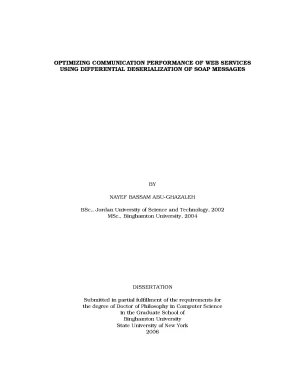
Tải xuống để đọc toàn bộOPTIMIZING COMMUNICATION PERFORMANCE OF WEB SERVICES USING DIFFERENTIAL DESERIALIZATION OF SOAP MESSAGES BY NAYEF BASSAM ABU-GHAZALEH BSc., Jordan University of Science and Technology, 2002 MSc., Binghamton University, 2004 DISSERTATION Submitted in partial fulfillment of the requirements for the degree of Doctor of Philosophy in Computer Science in the Graduate School of Binghamton University State University of New York 2006 UMI Number: 3241635 UMI Microform 3241635 Copyright 2007 by ProQuest Information and Learning Company. All rights reserved. This microform edition is protected against unauthorized copying under Title 17, United States Code. ProQuest Information and Learning Company 300 North Zeeb Road P.
Box 1346 Ann Arbor, MI 48106-1346 c Copyright by Nayef Abu-Ghazaleh 2006 All Rights Reserved Accepted in partial fulfillment of the requirements for the degree of Doctor of Philosophy in Computer Science in the Graduate School of Binghamton University State University of New York 2006 Dr. Lewis January 5, 2007 (Thesis Advisor) Department of Computer Science Dr. Weiyi Meng January 5, 2007 Department of Computer Science Dr. Madhusudhan Govindaraju January 5, 2007 Department of Computer Science Dr.
Kenneth Chiu January 5, 2007 Department of Computer Science Dr. Kenneth Kurtz January 5, 2007 (External Member) Department of Psychology iii Abstract Web services have recently emerged as a de facto standard for building Grid and distributed computing infrastructures and applications. SOAP, a simple, interoperable, robust, and extensible protocol for the exchange of messages, is the most widely used communication protocol in the Web services model. SOAP’s XML-based message format hinders its performance, thus making it unsuitable in many scientific applications.
The deserialization of SOAP messages, which includes processing of XML data and conversion of strings to in-memory data types, is the major performance bottleneck in a SOAP message exchange. The contributions of this dissertation address SOAP’s poor deserialization per- formance with the design and implementation of differential deserialization (DDS), an optimization technique that exploits similarities between incoming messages to reduce deserialization time. DDS is a fully SOAP compliant technique, and requires no changes to a SOAP client. A performance study demonstrates that DDS can result in performance im- provements up to 226% for some Web services.
When DDS is used with differ- ential serialization (DS), its sender-side analog, the performance study demon- strates even more significant performance improvements. iv ACKNOWLEDGMENTS I would like to thank my advisor, Prof. Lewis for his guidance, su- pervision, and help in the preparation of this disseratation. Also, I would like to thank my committee members; Professors Weiyi Meng, Madhusudhan Govin- daraju, Kenneth Chiu, and Kenneth Kurtz for agreeing to be on my PhD committee and for their feedback and suggestions that improved my disseration immensely.
Most importantly, I would like to thank my mother and father, Suad and Bas- sam, for their endless love, support, and encouragement—I can never thank them enough for this or anything else. Many thanks go to my brother Nael, for his guid- ance and help throughout my Master’s and PhD studies, as well as Suha, Hani, and Sa’ed for their support and encouragement I would also like to thank my aunts Hiyam Abu-Ghazaleh, Siham, Ilham, Hiyam Wafa, Fatima and Maha and my uncles Mahmood, Husam, Wael, and Adnan for their support and encourage- ment. v Contents List of Tables xi List of Figures xiv 1 Introduction 1 2 Background 7 2.1 The extensible markup language .1 Syntax of XML .2 Handling whitespace in XML documents .3 Namespaces in XML .4 Features of XML .1 Overview of SOAP’s syntax .3 Extending a SOAP message: The Header element .4 The SOAP encoding .5 The SOAP HTTP binding .6 SOAP as a remote procedure protocol .1 The potential for improving performance .2 The Data Update Tracking (DUT) table .7 Differential serialization optimizations .8 Summary and relation to DDS .3 Enabling differential deserialization .1 Checkpoints and message portions .3 Switching to fast mode .5 Checkpointing in DDS .6 Other DDS approaches. 47 4 Implementation: Differential Deserialization in the bSOAP Toolkit 49 4.2 A schema-driven deserializer .3 Checkpoint types in bSOAP .1 Creating differential checkpoints .2 Creating lightweight checkpoints .6 Switching to fast mode .1 The matching stack .2 Tracking switching candidates with progressive matching .3 Finalizing state matching .4 Cutting down switching time with differential checkpointing .5 Switching at a lightweight checkpoint .7 Switching to regular mode .8 Removing stale checkpoints .1Lightweight checkpoints and processing interrupts .2Creating base checkpoints .3Managing the number of checkpoints .1Memory blocks in bSOAP .2The active memory blocks stack .3The deserialization pointer .4Reallocating memory blocks .5Destroying unused memory blocks .6Merging newly-allocated memory blocks .12 Checkpointing application memory.
84 5 Performance and Analysis 85 5.2 Baseline deserialization study .4 Progressive matching overhead .6 Dual-mode DDS performance .7 DDS performance using two-stage checksum computation .2 Round-trip performance .3 Near-best case performance .4 DS and DDS performance .3 An interactive molecular dynamics simulation .1 Parallel molecular dynamics simulations .2 DDS and MD Simulations .3 Experimental Setup and Methodology .4 Results and discussion .1 IBM’s differential deserialization .1 Parsing through byte-sequence matching: Deltarser .2 A Deltarser-based differential deserialization .3 Schema-specific parsers .4 Changing the message format .1 Approaches that retain textual XML format .5 Parallel XML parsing. 177 7 Summary and Future Work 180 ix Bibliography 185 A FCP, DCP, and LCP dual-mode performance improvements 195 B FCP, DCP, and LCP dual-mode performance improvements using two- stage checksum computation 202 C Round-trip percent performance improvements 209 D GROMACS tests setup 213 x List of Tables 3.1 Comparison of three checkpointing mechanisms.1 Description of state saved in heavyweight checkpoints.2 A checkpoint’s message portion information.1 Number of created checkpoints and average message portion sizes for LCP, DCP and FCP, and for various array sizes and interrupt frequencies.2 Average number of fast mode switches, checkpoints created and de- stroyed, and percentage of bytes processed in fast mode for FCP and DCP, for a 100K element array and for various number of par- titions, interrupt frequencies, and percentage of values changed be- tween subsequent messages.3 Average number of fast mode switches, checkpoints created and de- stroyed, and percentage of bytes processed in fast mode for LCP, for a 100K element array and for various number of partitions, interrupt frequencies, and percentage of values changed between subsequent messages.1 Percent performance improvement in deserialization times of FCP over bSOAP without DDS support .2 Percent performance improvement in deserialization times of DCP over bSOAP without DDS support .3 Percent performance improvement in deserialization times of LCP over bSOAP without DDS support .4 Percent performance improvement in deserialization times of FCP over bSOAP without DDS support and using dummy deserialization routines.5 Percent performance improvement in deserialization times of DCP over bSOAP without DDS support and using dummy deserialization routines.6 Percent performance improvement in deserialization times of LCP over bSOAP without DDS support and using dummy deserialization routines.1 Percent performance improvement in deserialization times of FCP over bSOAP without DDS support .2 Percent performance improvement in deserialization times of DCP over bSOAP without DDS support .3 Percent performance improvement in deserialization times of LCP over bSOAP without DDS support .4 Percent performance improvement in deserialization times of FCP over bSOAP without DDS support and using dummy deserialization routines.5 Percent performance improvement in deserialization times of DCP over bSOAP without DDS support and using dummy deserialization routines.6 Percent performance improvement in deserialization times of LCP over bSOAP without DDS support and using dummy deserialization routines.1 Percent performance improvement in round-trip times of bSOAP with DS and DDS enabled over bSOAP without DDS support and with a DS implementation serializing all values in a message, but not its structure, for remote functions receiving arrays of various sizes and types, for various percentages of values changed from message to message, and for various message partitions.2 Percent performance improvement in round-trip times of bSOAP over bSOAP without DS and DDS support and using full whitespace stuff- ing, for remote functions receiving arrays of various sizes and types, for various percentages of values changed from message to message, and for various message partitions.3 Percent performance improvement in round-trip times of bSOAP over gSOAP, for remote functions receiving arrays of various sizes and types, for various percentages of values changed from message to message, and for various message partitions. 212 xiii List of Figures 2.1 A sample XML document.2 A sample XML document with namespaces.3 A sample W3C XML schema document.4 Structure of a SOAP message.5 A sample SOAP message.6 An XML fragment showing values encoded per the SOAP encoding.7 A SOAP/HTTP message for a method, add, that adds two integer values.1 Two similar gSOAP-generated SOAP messages to the Google do- GoogleSearch Web Service.2 Checkpoints and message portions.3 Updating checkpoints example.1 Hierarchical relationship between schema objects in a bSOAP schema for a method, getAverage.2 Checkpoint types in bSOAP and their hierarchy.3 Tracking stack changes.4 Creating lightweight checkpoints example.5 Namespace alias used as a value.6 Matching stack example.7 Checkpoints and memory blocks.1 Deserialization time, in milliseconds, for bSOAP and gSOAP for ar- rays of integers and doubles of various sizes.2 Checkpointing and checksumming overhead, for various message sizes and interrupt frequencies.3 Checkpointing overhead with and without checksum computation, for various message sizes and interrupt frequencies.4 Estimated overhead of processing interrupts for various message sizes and interrupt frequencies.5 Progressive matching overhead, for various message sizes and inter- rupt frequencies.6 Fast mode processing times, in milliseconds, for various checksum algorithms and for arrays of various sizes.7 Deserialization time, in milliseconds, for messages divided into 50 and 500 partitions, when 25%, 50%, and 75% percentages of values are changed around the center of each partition between consecutive messages, and for interrupt frequencies of 32, 128, and 512.8 DCP’s and LCP’s memory requirements, for various message sizes and interrupt frequencies.9 FCP’s and DCP’s memory requirements for program stack and other deserializer state, and for various message sizes and interrupt fre- quencies.10 Round-trip time, in milliseconds, for JavaRMI, MICO, gSOAP, and bSOAP (with DS and DDS turned off), for remote methods receiving arrays of various sizes and types.11 Round-trip time, in milliseconds, for JavaRMI, MICO, gSOAP, and bSOAP (with DS and DDS turned off), for remote methods sending arrays of various sizes and types.12 Round-trip time, in milliseconds, for JavaRMI, MICO, gSOAP, and bSOAP (with DS and DDS turned off), for remote methods echoing arrays of various sizes and types.13 Round-trip time, in milliseconds, for JavaRMI, MICO, gSOAP, and bSOAP (with no values changed between consecutive messages), for remote methods receiving arrays of various sizes and types.14 Round-trip time, in milliseconds, for JavaRMI, MICO, gSOAP, and bSOAP (with no values changed between consecutive messages), for remote methods echoing arrays of various sizes and types.15 Round-trip time, in milliseconds, for messages divided into 1 and 500 partitions, when 25%, 50%, 75% and 100% percentages of val- ues are changed around the center of each partition between con- secutive messages, for remote methods receiving arrays of various sizes and types.16 Round-trip time, in milliseconds, for JavaRMI, MICO, and bSOAP for remote methods receiving arrays of various sizes and types. bSOAP round-trip times are plotted for messages divided into 200 partitions, when 25%, 50%, and 75% percentages of values are changed around the center of each partition between consecutive messages.17 Deserialization time, in milliseconds, for bSOAP with and without DDS support, deserializing 100 messages corresponding to atom configurations after 100 simulation timesteps, for the simulation of the dynamics of various molecules.
137 xvi Chapter 1 Introduction Grid computing coordinates multiple, loosely-coupled, heterogeneous, and geo- graphically dispersed computing resources to perform a specific task. The con- trol, discovery, and coordination of the potentially vast amount of resources is enabled by Grid middleware. Several architectures for designing Grid middleware have emerged. The Open Grid Services Architecture (OGSA) [36] is the most widely used.
OGSA exploits existing Web services technologies for their straightforward applicability for Grid computing and their widespread adoption [37]. In particular, OGSA models Grid resources as Grid services, which are a special kind of Web services, and uses WSDL [34] and UDDI [2] for resource description and discovery, respectively.
Nội dung được bảo vệ bản quyền — Tải xuống đầy đủ
Trích dẫn luận án này
Nayef Bassam Abu-Ghazaleh (2006). Tối ưu hiệu suất Web Services với giải mã SOAP khác biệt [Luận án tiến sĩ, Binghamton University State University of New York]. LuanAn.net. https://luanan.net/cong-nghe-thong-tin/khoa-hoc-may-tinh/toi-uu-hieu-suat-web-services-giai-ma-soap-khac-biet
Từ khóa và chủ đề nghiên cứu
Từ khóa liên quan
Xem thêm luận án cùng lĩnh vực
Chủ đề nghiên cứu
Câu hỏi thường gặp
Luận án "Tối ưu hiệu suất Web Services với giải mã SOAP khác biệt" nghiên cứu về vấn đề gì?
Luận án tiến sĩ tối ưu hóa hiệu suất Web Services bằng giải mã SOAP khác biệt. Phương pháp DDS cải thiện hiệu suất lên 226% mà không thay đổi SOAP client.
Luận án "Tối ưu hiệu suất Web Services với giải mã SOAP khác biệt" được bảo vệ tại trường nào?
Luận án này được bảo vệ tại Binghamton University State University of New York. Năm bảo vệ: 2006.
Luận án "Tối ưu hiệu suất Web Services với giải mã SOAP khác biệt" thuộc chuyên ngành gì?
Luận án "Tối ưu hiệu suất Web Services với giải mã SOAP khác biệt" thuộc chuyên ngành Computer Science. Danh mục: Khoa Học Máy Tính.
Luận án "Tối ưu hiệu suất Web Services với giải mã SOAP khác biệt" có bao nhiêu trang?
Luận án "Tối ưu hiệu suất Web Services với giải mã SOAP khác biệt" có 235 trang. Bạn có thể xem trước một phần tài liệu ngay trên trang web trước khi tải về.
Cách tải luận án "Tối ưu hiệu suất Web Services với giải mã SOAP khác biệt" về máy như thế nào?
Để tải luận án về máy, bạn nhấn nút "Tải xuống ngay" trên trang này, sau đó hoàn tất thanh toán phí lưu trữ. File sẽ được tải xuống ngay sau khi thanh toán thành công. Hỗ trợ qua Zalo: 0559 297 239.