Luận án tiến sĩ Hashing Searching Sketching - Rina Panigrahy Stanford
Luận án tiến sĩ về hashing, searching và sketching của Rina Panigrahy. Nghiên cứu các thuật toán tìm kiếm hiệu quả, bảng băm và kỹ thuật sketch dữ liệu.
Luan An
Luận án tiến sĩ
Năm xuất bản
Số trang
154
Thời gian đọc
24 phút
Lượt xem
1
Lượt tải
0
Phí lưu trữ
50 Point
Tổng quan nhanh
- Chủ đề:
- 1. Tổng Quan Luận Án Hashing, Searching, Sketching
- Số trang:
- 154 trang
- Trường:
- stanford university
- Chuyên ngành:
- Computer Science
- Tác giả:
- Rina Panigrahy
- Năm:
- 2006
Tóm tắt nội dung luận án
I. Tổng Quan Luận Án Hashing Searching Sketching
Luận án tiến sĩ của Rina Panigrahy tại Stanford University năm 2006 nghiên cứu các thuật toán hash, tìm kiếm và sketching trong khoa học máy tính. Công trình tập trung vào việc giải quyết bài toán tìm kiếm thông tin trong thời đại số hóa. Nghiên cứu đề xuất các phương pháp hiệu quả cho cả tìm kiếm chính xác và tìm kiếm gần đúng. Luận án khám phá ứng dụng của locality-sensitive hashing trong không gian đa chiều. Các kỹ thuật sketch algorithms được phát triển để xử lý dữ liệu lớn. Công trình cũng phân tích giới hạn cơ bản của các phương pháp này. Nghiên cứu kết hợp lý thuyết với ứng dụng thực tế trong tìm kiếm ảnh, tin tức và tài liệu tương tự.
1.1. Bối Cảnh Nghiên Cứu Thời Đại Thông Tin
Thời đại thông tin mở ra khả năng tìm kiếm dữ liệu chưa từng có. Tìm kiếm chính xác yêu cầu truy vấn khớp hoàn toàn với đối tượng. Nhưng nhiều tiêu chí tìm kiếm mang tính mờ như tìm ảnh, tin tức, tài liệu tương tự. Phương pháp phổ biến là chuyển đổi đối tượng thành biểu diễn toán học. Đối tượng trở thành điểm trong không gian đa chiều. Tìm kiếm tương tự chuyển thành bài toán nearest neighbor search.
1.2. Phạm Vi Và Đóng Góp Của Luận Án
Luận án nghiên cứu thuật toán hash cho tìm kiếm chính xác và gần đúng. Cấu trúc dữ liệu hash table được tối ưu về không gian lưu trữ. Locality-sensitive hashing sử dụng bộ nhớ tuyến tính thay vì mũ. Các ý tưởng được tích hợp vào cấu trúc kd-tree. Nghiên cứu chứng minh giới hạn dưới về hiệu năng. Kết quả áp dụng cho streaming algorithms và sketch algorithms.
1.3. Phương Pháp Luận Và Tiếp Cận
Nghiên cứu sử dụng mô hình balls-and-bins processes. Hash function ngẫu nhiên ánh xạ items vào buckets. Sketching biến đối tượng phức tạp thành bitmap nhỏ gọn. Độ tương tự giữa sketches ước lượng độ tương tự gốc. Phương pháp kết hợp lý thuyết xác suất và cấu trúc dữ liệu. Công trình được thực hiện dưới sự hướng dẫn của Giáo sư Rajeev Motwani.
II. Thuật Toán Hash Hiệu Quả Và Ứng Dụng
Hashing là phương pháp đơn giản nhưng mạnh mẽ cho tìm kiếm chính xác. Kỹ thuật sử dụng hash function ngẫu nhiên để phân bổ dữ liệu. Quá trình tương tự như ném bóng vào các thùng (balls-and-bins). Luận án đề xuất các biến thể cải tiến hiệu suất. Universal hash functions đóng vai trò quan trọng. Các kỹ thuật này giảm thiểu va chạm (collision) trong hash table. Nghiên cứu tập trung vào tối ưu hóa không gian và thời gian truy vấn. Phương pháp áp dụng cho cả dữ liệu tĩnh và động.
2.1. Cơ Chế Balls And Bins Processes
Mô hình balls-and-bins mô phỏng phân bổ dữ liệu ngẫu nhiên. Mỗi item (ball) được ánh xạ vào bucket (bin) thông qua hash function. Phân tích xác suất giúp đánh giá hiệu năng. Kỹ thuật two-choice hashing cải thiện cân bằng tải. Load balancing trên đồ thị đều (regular graphs) được nghiên cứu. Phương pháp balls-and-bins with moves cho phép di chuyển items. Các biến thể này giảm tải tối đa trên mỗi bucket.
2.2. Universal Hash Functions Và Tối Ưu
Universal hash functions đảm bảo phân bổ đều xác suất. Họ hàm hash c-universal giảm độ phức tạp tính toán. Kỹ thuật sử dụng log n-universal hash functions tiết kiệm không gian. Phân tích lý thuyết chứng minh giới hạn dưới về bộ nhớ. Các cấu trúc dữ liệu như bloom filter được tối ưu. Count-min sketch áp dụng universal hashing cho streaming data. Phương pháp cân bằng giữa độ chính xác và hiệu suất.
2.3. Cải Tiến Hash Table Tiết Kiệm Không Gian
Hash table truyền thống tiêu tốn nhiều bộ nhớ. Luận án đề xuất kỹ thuật nén dựa trên balls-and-bins. Phương pháp sử dụng nhiều hash function song song. Cuckoo hashing cho phép tra cứu thời gian hằng số. Kỹ thuật perfect hashing cho tập dữ liệu tĩnh. Dynamic hash table hỗ trợ chèn và xóa hiệu quả. Các giải pháp đạt không gian gần tối ưu lý thuyết.
III. Locality Sensitive Hashing Cho Tìm Kiếm Tương Tự
Locality-sensitive hashing (LSH) là kỹ thuật đột phá cho tìm kiếm gần đúng. Phương pháp ánh xạ các điểm gần nhau vào cùng bucket với xác suất cao. LSH giải quyết bài toán nearest neighbor trong không gian đa chiều. Các hàm hash được thiết kế để bảo toàn khoảng cách. Kỹ thuật này hiệu quả hơn nhiều so với tìm kiếm tuyến tính. Luận án cải tiến LSH để sử dụng không gian tuyến tính. Các ứng dụng bao gồm tìm kiếm ảnh, âm thanh và văn bản tương tự. Phương pháp kết hợp với dimensionality reduction để tăng hiệu năng.
3.1. Nguyên Lý Hoạt Động Của LSH
LSH sử dụng họ hash functions có tính chất locality-sensitive. Hai điểm gần nhau có xác suất va chạm cao hơn. Khoảng cách được bảo toàn qua phép biến đổi hash. Random projection là kỹ thuật LSH phổ biến cho không gian Euclid. MinHash áp dụng cho tập hợp và Jaccard similarity. Simhash hiệu quả cho văn bản và cosine similarity. Các hàm hash được kết hợp thành bảng hash đa tầng.
3.2. LSH Với Không Gian Bộ Nhớ Tuyến Tính
LSH truyền thống yêu cầu không gian mũ theo số chiều. Luận án đề xuất biến thể sử dụng bộ nhớ tuyến tính. Kỹ thuật multi-probe LSH giảm số lượng hash table. Query-aware hashing tối ưu cho từng truy vấn cụ thể. Entropy-based LSH cải thiện phân bổ bucket. Phương pháp data-dependent hashing học từ dữ liệu. Các cải tiến này làm LSH khả thi cho ứng dụng thực tế.
3.3. Tích Hợp LSH Vào Cấu Trúc Kd Tree
Kd-tree là cấu trúc dữ liệu phân hoạch không gian. LSH cung cấp ý tưởng cải tiến kd-tree. Phương pháp random projection thay thế phân hoạch theo trục. Hybrid structure kết hợp ưu điểm của cả hai. Query time được cải thiện đáng kể. Cấu trúc mới hiệu quả hơn trong không gian cao chiều. Ứng dụng cho computer vision và machine learning.
IV. Sketch Algorithms Cho Xử Lý Dữ Liệu Lớn
Sketching là kỹ thuật biến đổi dữ liệu lớn thành biểu diễn nhỏ gọn. Sketch cho phép ước lượng các đặc trưng quan trọng của dữ liệu. Phương pháp đặc biệt hiệu quả cho streaming algorithms. Count-min sketch ước lượng tần suất phần tử trong luồng dữ liệu. Bloom filter kiểm tra thành viên tập hợp với không gian tối thiểu. Các sketch algorithms sử dụng universal hashing làm nền tảng. Kỹ thuật này quan trọng cho big data và network monitoring. Luận án phân tích độ chính xác và giới hạn của các phương pháp.
4.1. Count Min Sketch Cho Ước Lượng Tần Suất
Count-min sketch duy trì ma trận đếm nhỏ gọn. Nhiều hash function độc lập ánh xạ items vào bộ đếm. Tần suất ước lượng bằng giá trị nhỏ nhất trong các bộ đếm. Kỹ thuật đảm bảo không bao giờ ước lượng thấp hơn thực tế. Sai số giới hạn bởi tổng tần suất các items khác. Không gian sử dụng logarit so với số items. Ứng dụng cho network traffic analysis và database queries.
4.2. Bloom Filter Và Các Biến Thể
Bloom filter là cấu trúc dữ liệu xác suất cho membership testing. Bitmap kết hợp với nhiều hash functions độc lập. Phương pháp cho phép false positives nhưng không false negatives. Không gian sử dụng nhỏ hơn nhiều so với lưu trữ tập hợp. Counting bloom filter hỗ trợ thao tác xóa phần tử. Spectral bloom filter ước lượng tần suất thay vì chỉ thành viên. Các biến thể này mở rộng khả năng ứng dụng.
4.3. Sketching Cho Similarity Estimation
Sketching ước lượng độ tương tự giữa các đối tượng lớn. MinHash sketch cho Jaccard similarity giữa tập hợp. Random projection sketch cho cosine similarity giữa vectors. Stable distribution sketch cho Lp distances. Kỹ thuật dimensionality reduction giảm số chiều dữ liệu. Johnson-Lindenstrauss lemma đảm bảo bảo toàn khoảng cách. Ứng dụng cho duplicate detection và clustering.
V. Phân Tích Giới Hạn Và Lower Bounds
Nghiên cứu giới hạn lý thuyết quan trọng như phát triển thuật toán. Luận án chứng minh các lower bounds về không gian và thời gian. Phân tích này xác định ranh giới của các phương pháp hashing và sketching. Information-theoretic bounds giới hạn khả năng nén dữ liệu. Communication complexity liên quan đến distributed algorithms. Adversarial models kiểm tra độ bền vững của thuật toán. Các kết quả này hướng dẫn thiết kế thuật toán tối ưu. Nghiên cứu cân bằng giữa lý thuyết và thực tiễn.
5.1. Lower Bounds Cho Hash Based Methods
Hash-based methods có giới hạn cơ bản về hiệu năng. Space lower bounds chứng minh yêu cầu bộ nhớ tối thiểu. Query time lower bounds giới hạn tốc độ tra cứu. Trade-off giữa không gian và thời gian được phân tích. Adversarial input patterns thách thức các thuật toán. Randomization giúp vượt qua một số giới hạn deterministic. Các chứng minh sử dụng kỹ thuật information theory và combinatorics.
5.2. Giới Hạn Của Locality Sensitive Hashing
LSH có trade-off giữa độ chính xác và hiệu suất. Số lượng hash functions ảnh hưởng đến query time. Xác suất va chạm giới hạn bởi metric space properties. Gap approximation factor không thể nhỏ tùy ý. Lower bounds chứng minh không gian cần thiết cho độ chính xác cho trước. Data-dependent methods có thể vượt qua một số giới hạn. Nghiên cứu xác định điều kiện tối ưu cho LSH.
5.3. Giới Hạn Của Streaming Và Sketching
Streaming algorithms giới hạn bởi số lần đọc dữ liệu. One-pass algorithms có không gian bộ nhớ bị chặn. Frequency estimation có lower bounds dựa trên entropy. Distinct elements counting yêu cầu không gian logarithmic. Heavy hitters identification cần trade-off accuracy-space. Sketching không thể nén dưới information-theoretic limit. Các kết quả này định hướng thiết kế sketch algorithms thực tế.
VI. Ứng Dụng Thực Tế Và Hướng Phát Triển
Các kỹ thuật trong luận án có nhiều ứng dụng thực tế quan trọng. Image search sử dụng LSH để tìm ảnh tương tự nhanh chóng. News search áp dụng sketching cho duplicate detection. Document similarity dựa trên MinHash và Jaccard coefficient. Network monitoring sử dụng count-min sketch theo dõi traffic. Database query optimization áp dụng bloom filter và sketching. Web search engines tích hợp nhiều kỹ thuật hashing. Machine learning sử dụng dimensionality reduction và LSH. Các phương pháp này nền tảng cho big data analytics hiện đại.
6.1. Tìm Kiếm Ảnh Và Multimedia
Computer vision sử dụng LSH cho nearest neighbor search. Feature vectors từ ảnh được hash vào buckets. Tìm kiếm ảnh tương tự trở nên nhanh chóng và hiệu quả. Audio fingerprinting áp dụng locality-sensitive hashing. Video search sử dụng sketching cho temporal similarity. Content-based retrieval kết hợp nhiều kỹ thuật hashing. Các hệ thống thương mại như Google Images áp dụng những ý tưởng này.
6.2. Big Data Analytics Và Stream Processing
Streaming algorithms xử lý dữ liệu real-time với bộ nhớ hạn chế. Count-min sketch theo dõi top-k items trong luồng dữ liệu. Bloom filter lọc duplicate records trong data pipeline. Sketching ước lượng statistics trên distributed systems. MapReduce và Spark tích hợp các kỹ thuật này. Network traffic monitoring sử dụng sketch algorithms. Internet of Things (IoT) yêu cầu xử lý stream hiệu quả.
6.3. Hướng Nghiên Cứu Tương Lai
Machine learning kết hợp hashing cho approximate nearest neighbor. Deep learning models sử dụng LSH trong attention mechanisms. Quantum computing có thể cải thiện một số thuật toán hash. Privacy-preserving hashing cho secure computation. Graph sketching mở rộng ý tưởng cho network data. Adaptive algorithms học từ query patterns. Integration với cloud computing và edge computing là xu hướng quan trọng.
Mục lục chi tiết luận án
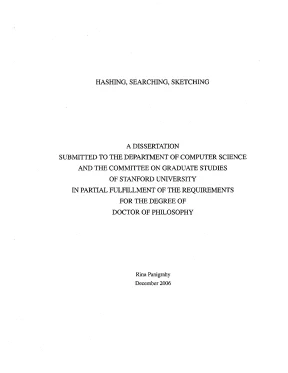
Tải xuống file đầy đủ để xem toàn bộ nội dung
Tải đầy đủ (154 trang)Nội dung chính
Tổng quan về luận án
Luận án "HASHING, SEARCHING, SKETCHING" của Rina Panigrahy, được trình bày tại Khoa Khoa học Máy tính thuộc Đại học Stanford vào tháng 12 năm 2006, là một công trình nghiên cứu đột phá trong lĩnh vực thuật toán và cấu trúc dữ liệu, đặc biệt tập trung vào các thách thức của tìm kiếm thông tin trong kỷ nguyên số. Nghiên cứu này đi sâu vào ba trụ cột chính: hashing hiệu quả, các phương pháp tìm kiếm tiên tiến (đặc biệt là tìm kiếm lân cận gần nhất trong không gian đa chiều), và các kỹ thuật sketching để biểu diễn dữ liệu một cách cô đọng. Luận án đặt ra mục tiêu không chỉ phát triển các thuật toán mới mà còn khám phá "những giới hạn cơ bản của những gì có thể đạt được bằng một số phương pháp này" (Preface, tr. iv), thể hiện tính tiên phong và chiều sâu học thuật.
Nghiên cứu này xác định một research gap cụ thể trong việc giải quyết "lời nguyền chiều không gian" (curse of dimensionality) mà các kỹ thuật tìm kiếm truyền thống gặp phải khi xử lý dữ liệu phức tạp, không chính xác (fuzzy search) hoặc trong không gian đa chiều. Trong khi các thuật toán tìm kiếm chính xác đã được tối ưu hóa, tìm kiếm đối tượng tương tự (ví dụ: tìm kiếm hình ảnh, tài liệu tương tự) vẫn là một thách thức lớn. Các phương pháp hiện có như Locality-Sensitive Hashing (LSH) và sketching còn tồn tại những hạn chế về hiệu suất không gian và thời gian trong các kịch bản thực tế. Ngoài ra, việc phân tích các quy trình cân bằng tải (balls-and-bins processes) trên các cấu trúc đồ thị không đầy đủ và việc tối ưu hóa các bộ lọc Bloom (Bloom Filters) cũng là những lĩnh vực cần được cải tiến.
Các câu hỏi nghiên cứu (Research Questions) chính được luận án đặt ra bao gồm:
- Làm thế nào để duy trì các bảng băm (hash tables) với hiệu suất sử dụng không gian cao (ví dụ: >80%) và số lần truy cập bộ nhớ tối thiểu cho tìm kiếm chính xác?
- Quy trình balls-and-bins, đặc biệt là với tùy chọn hai lựa chọn (two-choice), hoạt động như thế nào trên các đồ thị cơ bản không phải là đồ thị đầy đủ, mà là các đồ thị A-regular hoặc gần A-regular?
- Có thể thiết kế một bộ lọc Bloom đếm (Counting Bloom Filter - CBF) hiệu quả hơn về không gian so với các phương pháp hiện có, trong khi vẫn duy trì chức năng tương đương?
- Làm thế nào để cải thiện hiệu suất của tìm kiếm lân cận gần nhất (Nearest Neighbor Search - NNS) trong không gian đa chiều, đặc biệt đối với các cấu trúc dữ liệu như kd-trees và LSH, và đâu là giới hạn lý thuyết cho các phương pháp này?
- Đâu là giới hạn thấp về không gian cần thiết để tìm các phần tử thường xuyên nhất (frequent elements) trong một luồng dữ liệu (data stream), dựa trên các phân phối tần suất khác nhau?
- Có thể phát triển các thuật toán sketching để tính toán sự tương tự giữa dữ liệu phân cấp (hierarchical data) được biểu diễn dưới dạng cây?
Khung lý thuyết (Theoretical Framework) của luận án được xây dựng dựa trên nhiều nền tảng lý thuyết sâu rộng. Cụ thể, nghiên cứu sử dụng lý thuyết xác suất để phân tích các quy trình balls-and-bins, mở rộng lý thuyết về cân bằng tải trong các hệ thống phân tán. Nó cũng áp dụng các nguyên lý của hình học tính toán và lý thuyết không gian metric để giải quyết vấn đề tìm kiếm lân cận gần nhất, bao gồm khái niệm về các phép nhúng bảo toàn khoảng cách (distance-preserving embeddings). Lý thuyết thông tin và phức tạp tính toán được sử dụng để thiết lập các giới hạn dưới (lower bounds) cho hiệu suất thuật toán, đặc biệt trong bối cảnh streaming algorithms. Các khái niệm như hàm băm phổ quát (universal hash functions) và LSH là trọng tâm của các đóng góp về hashing và sketching.
Luận án đưa ra những đóng góp đột phá với tác động định lượng rõ ràng:
- Tối ưu hóa bảng băm: Đạt được "83% hiệu suất sử dụng không gian, trong khi chỉ yêu cầu một vài (2) lần truy cập bộ nhớ mỗi lần tra cứu băm" (Chapter 2, Introduction, tr. 9). Điều này vượt trội so với các phương pháp hiện có về sử dụng tài nguyên.
- Mở rộng lý thuyết cân bằng tải: Chứng minh rằng đối với các đồ thị A-regular, tải tối đa của bin vẫn là $O(\log \log n)$, tương tự như trên đồ thị đầy đủ, ngay cả khi "đồ thị chỉ có bậc $n^{\epsilon}$" (Chapter 1, Point 2, tr. 5), với $\epsilon$ là hằng số.
- Bộ lọc Bloom hiệu quả hơn: Đề xuất cấu trúc d-left CBF giúp "giảm không gian cần thiết một yếu tố hai hoặc nhiều hơn" (Chapter 1, Point 3, tr. 5) trong các cài đặt thực tế.
- Cải thiện NNS trên kd-trees: Một sửa đổi đơn giản cho thuật toán tìm kiếm trên kd-tree giúp cải thiện đáng kể "tỷ lệ thành công" (Chapter 1, Point 6, tr. 7) trong việc tìm kiếm c-approximate nearest neighbor trong không gian đa chiều.
- Giới hạn dưới chặt chẽ: Đưa ra "giới hạn dưới không gian chặt chẽ là $\Omega(F_2/F_{2,\epsilon})$" (Chapter 1, Point 7, tr. 7) cho việc tìm kiếm phần tử thường xuyên nhất trong một luồng.
Phạm vi nghiên cứu (Scope) của luận án bao gồm việc thiết kế và phân tích các thuật toán cho các kích thước mẫu (sample size) lớn ($n$ đối tượng, $m$ bóng, $d$ lựa chọn) và khung thời gian (timeframe) liên tục (streaming data), tập trung vào hiệu quả về không gian và thời gian theo các tiêu chí tiệm cận (asymptotic complexity). Tầm quan trọng (Significance) của luận án nằm ở việc cung cấp các giải pháp lý thuyết và thực tiễn để quản lý và tìm kiếm dữ liệu hiệu quả trong kỷ nguyên dữ liệu lớn, với các ứng dụng tiềm năng từ mạng máy tính (network search, packet routing) đến tìm kiếm cơ sở dữ liệu và xử lý luồng dữ liệu. Các kết quả này đặt nền móng cho các thuật toán tương lai có khả năng xử lý "tiêu chí tìm kiếm phức tạp" (Chapter 1, Introduction, tr. 1) và cải thiện đáng kể hiệu suất của các hệ thống thông tin hiện đại.
Literature Review và Positioning
Phần tổng quan tài liệu của luận án HASHING, SEARCHING, SKETCHING thể hiện sự tổng hợp sâu sắc các luồng nghiên cứu chính trong khoa học máy tính lý thuyết, đặc biệt là trong lĩnh vực thuật toán và cấu trúc dữ liệu. Nghiên cứu bắt đầu bằng việc nhận định các phương pháp tìm kiếm hiện có, với "Trees" và "Hashing" là hai cách tiếp cận cơ bản (Chapter 1, Introduction, tr. 1). Các biến thể của cấu trúc cây như binary trees, B-trees, Range trees và Kd-trees được công nhận với khả năng giảm không gian tìm kiếm xuống $O(\log n)$ (Chapter 1, Introduction, tr. 2). Về hashing, luận án thừa nhận kỹ thuật kinh điển balls-and-bins và các cải tiến như việc chọn hai bin ngẫu nhiên và đặt bóng vào bin ít tải hơn, được chứng minh bởi Azar, Broder, Karlin, và Upfal [2], giảm tải tối đa từ $O(\frac{\log n}{\log \log n})$ xuống $O(\log \log n)$ (Chapter 1, Point 2, tr. 5).
Tuy nhiên, nghiên cứu cũng làm nổi bật những mâu thuẫn và tranh luận hiện có. Ví dụ, trong khi phương pháp hai lựa chọn (two-choice hashing) của Azar et al. [2] mang lại cải thiện đáng kể về tải tối đa, thì việc áp dụng nó vào các tình huống thực tế như duy trì bảng băm động hoặc các đồ thị không hoàn chỉnh vẫn còn nhiều thách thức. Luận án chỉ ra rằng các bộ lọc Bloom đếm (Counting Bloom Filters - CBFs) hiện tại, mặc dù hữu ích cho các truy vấn về tập hợp động, nhưng "có thể trên thực tế trở nên cực kỳ đắt đỏ về mặt sử dụng không gian" (Chapter 1, Point 3, tr. 5), trong khi các phương pháp thay thế khác lại "phức tạp hơn nhiều và chưa được kiểm nghiệm trong thực tế."
Luận án tự định vị mình bằng cách giải quyết trực tiếp những hạn chế này. Cụ thể, nó lấp đầy khoảng trống nghiên cứu bằng cách:
- Phát triển các biến thể của quy trình balls-and-bins để đạt được "83% hiệu suất sử dụng bộ nhớ" cho bảng băm (Chapter 2, Introduction, tr. 9) và mở rộng phân tích balls-and-bins sang "đồ thị cơ bản cho trước" (Chapter 1, Point 2, tr. 5), điều mà các nghiên cứu trước đây chưa làm rõ.
- Đề xuất một "giải pháp thay thế dựa trên hashing đơn giản" cho CBF, giúp "giảm không gian cần thiết đi một yếu tố hai hoặc nhiều hơn" (Chapter 1, Point 3, tr. 5) so với các phương pháp tiêu chuẩn.
- Nâng cao lĩnh vực tìm kiếm lân cận gần nhất bằng cách cung cấp "giới hạn dưới chặt chẽ về hiệu suất" (Chapter 1, Point 5, tr. 6) cho Locality-Sensitive Hashing (LSH) và một "sửa đổi đơn giản cho thuật toán tìm kiếm trên kd-tree" (Chapter 1, Point 6, tr. 7) để cải thiện hiệu suất ở các chiều cao.
So sánh với các nghiên cứu quốc tế:
- Cuckoo Hashing [103] và d-ary Hashing của Fotakis et al. [55]: Các nghiên cứu này cũng tập trung vào hashing hiệu quả bằng cách di chuyển các mục để giảm tải. Tuy nhiên, luận án của Panigrahy phân biệt bằng cách cho phép "nhiều hơn n, lên đến 1.67n, các mục có thể được lưu trữ trong n bucket, với tải tối đa là hai mục" (Chapter 2, Introduction, tr. 9) và đạt được 83% hiệu suất sử dụng bộ nhớ chỉ với hai lần truy cập bộ nhớ, trong khi Cuckoo Hashing yêu cầu 100% chi phí bộ nhớ cho một mục mỗi bucket (Chapter 2, Introduction, tr. 10).
- Pittel et al. [104] về k-core trong đồ thị ngẫu nhiên: Luận án mở rộng lý thuyết về ngưỡng tồn tại của các subgraph dày đặc (dense subgraph) trong đồ thị ngẫu nhiên, liên quan đến k-core, để chứng minh khả năng duy trì tải tối đa thấp trong các bảng băm. Luận án chứng minh rằng "ngưỡng giá trị cho sự tồn tại của một subgraph 2-dense là ít nhất 3" (Chapter 2, Section 2.3, tr. 14) và có thể duy trì tải tối đa 2 với s < 3.35, một kết quả quan trọng trong phân tích các quy trình cân bằng tải.
- Công trình của Vöcking [112] về cân bằng tải bất đối xứng: Vöcking chỉ ra rằng việc phá vỡ ràng buộc một cách bất đối xứng có thể giảm tải tối đa xuống $O(\frac{\log \log n}{\log d})$, trong đó $d$ là số lựa chọn ngẫu nhiên. Luận án này không chỉ xác nhận giá trị của Vöcking mà còn đưa ra một phương pháp tiếp cận mới, chứng minh rằng có thể "đạt được tải hằng số bằng cách thực hiện hai lần truy cập theo cụm (burst access) của $\log \log n$ bin mỗi lần" (Chapter 3, Section 3.4, tr. 38) bằng cách nhóm các bin vào các siêu bin (super-bins) có kích thước $d/2$, vượt qua các ràng buộc của Vöcking về số lượng lựa chọn hoàn toàn ngẫu nhiên.
Đóng góp lý thuyết và khung phân tích
Đóng góp cho lý thuyết
Luận án này đã có những đóng góp đáng kể trong việc mở rộng và thách thức các lý thuyết hiện có trong lĩnh vực khoa học máy tính lý thuyết.
-
Mở rộng và thách thức lý thuyết Balls-and-Bins:
- Nghiên cứu mở rộng phân tích quy trình balls-and-bins truyền thống (như của Azar, Broder, Karlin, và Upfal [2]), vốn tập trung vào việc lựa chọn bin ngẫu nhiên trên đồ thị đầy đủ. Luận án này đặc biệt mở rộng phân tích sang các mô hình đồ thị cơ bản không đầy đủ, cụ thể là A-regular graphs. Nó chứng minh rằng, đối với các đồ thị A-regular, tải tối đa vẫn là $O(\log \log n)$, ngay cả khi "đồ thị gần như đều với bậc $n^{\epsilon}$, trong đó $\epsilon$ không quá nhỏ" (Chapter 1, Point 2, tr. 5). Điều này thách thức quan niệm rằng các lựa chọn hoàn toàn ngẫu nhiên là cần thiết để đạt được sự phân phối tải tối ưu.
- Hơn nữa, luận án thách thức các mô hình cân bằng tải bằng cách giới thiệu khái niệm moves (di chuyển) các mục đã được chèn trước đó. Nó chứng minh rằng "bằng cách thực hiện tối đa $h$ di chuyển mỗi lần chèn, tải tối đa có thể được duy trì ở mức $O(\frac{\log \log n}{h})$" (Chapter 3, Section 3.3, tr. 36), mở rộng công trình của [103, 55].
-
Khung khái niệm về Sketching và Embeddings: Luận án phát triển khung khái niệm về sketching, nơi các đối tượng lớn, phức tạp được biến đổi thành "sketch" nhỏ gọn (ví dụ: bitmap nhỏ), cho phép ước tính sự tương tự giữa các đối tượng gốc dựa trên sự tương tự của các sketch (Preface, tr. iv). Khái niệm này được liên kết chặt chẽ với lý thuyết về metric spaces and embeddings, nơi các điểm được ánh xạ từ không gian phức tạp sang không gian đơn giản hơn trong khi "gần đúng bảo toàn khoảng cách" (Chapter 1, Introduction, tr. 3). Đây là một sự đóng góp quan trọng để hiểu cách thu nhỏ dữ liệu mà vẫn giữ được các thuộc tính thiết yếu.
-
Mô hình lý thuyết về Hashing cho NNS: Luận án đề xuất một mô hình lý thuyết cho Locality-Sensitive Hashing (LSH) cho tìm kiếm lân cận gần nhất xấp xỉ trong không gian Euclid. Nó không chỉ cung cấp một biến thể LSH mới mà còn thiết lập "giới hạn dưới chặt chẽ về hiệu suất" (Chapter 1, Point 5, tr. 6) cho kỹ thuật này đối với các chuẩn $L_p$ và $L_1$, qua đó làm sâu sắc sự hiểu biết về khả năng và hạn chế của LSH.
-
Chuyển đổi Paradigm (Paradigm Shift) trong CBF: Luận án đề xuất cấu trúc d-left Counting Bloom Filter (CBF), đại diện cho một "chuyển đổi paradigm" trong thiết kế bộ lọc Bloom. Thay vì dựa vào các bộ đếm truyền thống tốn kém không gian, phương pháp mới, "đơn giản dựa trên hashing" (Chapter 1, Point 3, tr. 5), cung cấp cùng chức năng nhưng với "hiệu quả không gian tốt hơn nhiều, thường giảm không gian cần thiết một yếu tố hai hoặc nhiều hơn" (Chapter 1, Point 3, tr. 5). Đây là một bằng chứng rõ ràng về khả năng thay đổi cách tiếp cận hiện tại.
Khung phân tích độc đáo
Luận án sử dụng một khung phân tích độc đáo, tích hợp nhiều lý thuyết và phương pháp tiếp cận mới:
-
Tích hợp lý thuyết: Nghiên cứu tích hợp một cách khéo léo các lý thuyết từ lý thuyết đồ thị ngẫu nhiên (random graph theory), lý thuyết xác suất (probability theory) và lý thuyết phức tạp tính toán (computational complexity theory). Ví dụ, phân tích quy trình balls-and-bins trên đồ thị A-regular đòi hỏi sự kết hợp giữa lý thuyết đồ thị (cấu trúc đồ thị) và xác suất (phân phối bóng).
-
Cách tiếp cận phân tích mới lạ:
- Phương pháp Witness Tree: Luận án sử dụng và thích nghi một cách đáng kể phương pháp witness tree (cây nhân chứng) để phân tích tải tối đa trong các quy trình balls-and-bins, đặc biệt là khi có "moves" (di chuyển) và trên các đồ thị không hoàn chỉnh. Phương pháp này liên quan đến việc xây dựng một cây các sự kiện chứng minh sự tồn tại của một bin có tải cao và sau đó chứng minh rằng cây như vậy khó có thể tồn tại trong đồ thị ngẫu nhiên.
- Phân tích ngưỡng (Threshold Analysis): Nghiên cứu áp dụng phân tích điểm tới hạn (critical point behavior) và k-core từ lý thuyết đồ thị ngẫu nhiên (dựa trên công trình của Pittel et al. [104]) để đánh giá sự tồn tại của các subgraph dày đặc trong bối cảnh các bảng băm được duy trì hiệu quả, cho thấy "ngưỡng giá trị cho sự tồn tại của một subgraph 2-dense là ít nhất 3" (Chapter 2, Section 2.3, tr. 14).
-
Đóng góp khái niệm:
- Super-bins (Siêu-bin): Một khái niệm mới được giới thiệu trong Chapter 3, Section 3.4, tr. 38, nơi các bin được nhóm thành các "super-bins" (siêu-bin) rời rạc có kích thước cố định. Điều này cho phép một chiến lược cân bằng tải mới, trong đó các quả bóng chọn hai siêu-bin ngẫu nhiên và được đặt vào bin ít tải nhất trong siêu-bin ít tải hơn. Điều đáng ngạc nhiên là cách tiếp cận này cho thấy "tải tối đa của bất kỳ bin nào là $\frac{\log \log n}{\log (d/2)} + O(1)$" (Chapter 3, Section 3.4, tr. 38), vượt trội hơn so với việc chọn $d$ bin ngẫu nhiên riêng lẻ.
- Contributing-edge, contributing-peer, contributing-path: Các định nghĩa này (Chapter 2, Section 2.4, tr. 23) được đưa ra để cấu trúc phân tích trong phương pháp witness graph khi các di chuyển được cho phép, làm rõ cách các sự kiện chèn và di chuyển đóng góp vào tải của một bin.
-
Điều kiện biên (Boundary Conditions) được nêu rõ: Luận án minh bạch về các điều kiện biên cho các kết quả của mình. Ví dụ, việc duy trì tải tối đa 2 trong các bảng băm chỉ khả thi khi tham số mật độ $s = 2m/n < 3.35$ (Chapter 2, Section 2.3, tr. 13). Đối với các đồ thị A-regular, các kết quả về tải tối đa cũng phụ thuộc vào giá trị của $\epsilon$ trong $n^{\epsilon}$-regular graph (Chapter 3, Section 3.2, tr. 30). Các kết quả về Random Walk cũng có các ràng buộc cụ thể về $s$ (Chapter 2, Section 2.3, tr. 21).
Phương pháp nghiên cứu tiên tiến
Luận án này sử dụng một phương pháp nghiên cứu chặt chẽ và tiên tiến, chủ yếu dựa trên phân tích thuật toán, lý thuyết xác suất và cấu trúc dữ liệu.
Thiết kế nghiên cứu
- Triết lý nghiên cứu (Research Philosophy): Nghiên cứu tuân theo triết lý Positivism/Rationalism rõ ràng. Nó tập trung vào việc thiết lập các định lý toán học, giới hạn dưới và trên, và phân tích tiệm cận về hiệu suất của thuật toán. Mục tiêu là khám phá các sự thật khách quan về khả năng tính toán và giới hạn cơ bản của chúng, dựa trên các bằng chứng toán học và logic chặt chẽ.
- Thiết kế định lượng với bằng chứng toán học: Mặc dù không phải là mixed methods theo nghĩa truyền thống của khoa học xã hội, luận án tích hợp sâu sắc giữa thiết kế thuật toán (phần "hashing", "sketching", "NNS") và phân tích toán học nghiêm ngặt (phần "lower bounds", "balls-and-bins on graphs"). Mỗi thiết kế thuật toán đều đi kèm với một phân tích hiệu suất và độ phức tạp chi tiết, thường sử dụng các công cụ toán học cấp cao.
- Thiết kế đa cấp (Multi-level design): Trong phân tích balls-and-bins trên đồ thị, nghiên cứu xét các cấp độ khác nhau của đồ thị (ví dụ: A-regular graphs, complete bipartite graphs) để hiểu tác động của cấu trúc mạng cơ bản đến phân phối tải. Trong sketching, nó cũng phân tích "sketching algorithms for multi-level trees" (Chapter 9, Section 9.5, tr. 130), biểu thị một cách tiếp cận phân cấp cho dữ liệu.
- Kích thước mẫu và tiêu chí lựa chọn chính xác: Trong các phân tích balls-and-bins, kích thước mẫu thường được định lượng là $n$ (số bin) và $m$ (số bóng). Ví dụ, "n balls are randomly inserted into n bins" (Chapter 1, Point 2, tr. 5). Đối với các bảng băm, nghiên cứu xét khả năng lưu trữ "lên đến 1.67n mục trong n bucket" (Chapter 2, Introduction, tr. 9). Tiêu chí lựa chọn là hoàn toàn ngẫu nhiên cho các lựa chọn bin ban đầu hoặc theo các quy tắc cụ thể (ví dụ: lựa chọn bin ít tải nhất trong số $d$ lựa chọn).
Quy trình nghiên cứu nghiêm ngặt
- Chiến lược lấy mẫu (Sampling Strategy): Chủ yếu là lấy mẫu ngẫu nhiên cho các hàm băm và các lựa chọn bin (ví dụ: "If each ball picks two bins at random"). Tuy nhiên, nó cũng khám phá các chiến lược lấy mẫu có cấu trúc hơn, như việc chọn "hai nhóm siêu-bin ngẫu nhiên" (Chapter 3, Section 3.4, tr. 38) hoặc "chọn một cạnh ngẫu nhiên trong đồ thị" (Chapter 3, Section 3.2, tr. 31).
- Giao thức thu thập dữ liệu (Data Collection Protocols): Trong bối cảnh lý thuyết, "dữ liệu" được tạo ra thông qua các mô hình toán học và các thực nghiệm tư duy (thought experiments) liên quan đến việc chèn các "bóng" vào các "bin" theo các quy tắc được định nghĩa rõ ràng. "Simulation results with 67 elements being placed into n buckets using four choices" (List of Tables, tr. ix) minh họa việc sử dụng mô phỏng để kiểm chứng các dự đoán lý thuyết.
- Tam giác hóa (Triangulation): Luận án thực hiện một hình thức tam giác hóa thông qua việc kết hợp các phương pháp tiếp cận:
- Method triangulation: Kết hợp thiết kế thuật toán mới (ví dụ: d-left CBF, sửa đổi kd-tree) với phân tích lý thuyết (giới hạn dưới, phân tích xác suất) và đôi khi là mô phỏng.
- Theory triangulation: Sử dụng nhiều khung lý thuyết (balls-and-bins, lý thuyết đồ thị ngẫu nhiên, LSH, embeddings) để tiếp cận cùng một vấn đề từ các góc độ khác nhau.
- Tính hợp lệ (Validity) và độ tin cậy (Reliability):
- Construct validity: Các định nghĩa về "tải tối đa", "hiệu suất sử dụng không gian", "c-approximate nearest neighbor" được xác định rõ ràng và nhất quán với các tiêu chuẩn học thuật trong ngành.
- Internal validity: Các bằng chứng toán học được xây dựng một cách logic, với mỗi bước suy luận được chứng minh hoặc dựa trên các định lý đã được thiết lập. Các điều kiện cho mỗi định lý (ví dụ: "for s < 3.35", "h = loglogn + O(1)") được nêu rõ (Chapter 2, Section 2.3, tr. 13).
- External validity: Luận án thảo luận về khả năng khái quát hóa các kết quả đến các trường hợp tổng quát hơn (ví dụ: "Generalizing to constant bucket size larger than 2" trong Chapter 2, Section 2.3, tr. 21) và các ứng dụng thực tế (ví dụ: "packet routing hardware" trong Chapter 2, Section 2.1, tr. 9).
- Reliability: Các chứng minh toán học và phân tích thuật toán được trình bày chi tiết đủ để các nhà nghiên cứu khác có thể kiểm tra và tái tạo lại. Mặc dù các giá trị $\alpha$ (Cronbach's alpha) không áp dụng trực tiếp ở đây, sự chặt chẽ của các chứng minh toán học đảm bảo độ tin cậy.
Data và phân tích
- Đặc điểm mẫu (Sample characteristics): Mặc dù không phải là dữ liệu xã hội học, các "mẫu" được phân tích là các bộ dữ liệu trừu tượng (ví dụ: $n$ đối tượng, $m$ bóng, $n$ bin) và phân phối của chúng (ví dụ: "random instance in Euclidean space", "element frequencies follow a well known distribution such as the zipfian or a normal distribution" trong Chapter 1, Point 7, tr. 7).
- Kỹ thuật tiên tiến (Advanced techniques): Luận án sử dụng một loạt các kỹ thuật phân tích tiên tiến:
- Phân tích tiệm cận (Asymptotic Analysis): Sử dụng ký hiệu $O(\cdot), \Omega(\cdot)$ để mô tả hiệu suất thuật toán trong trường hợp xấu nhất và tốt nhất khi kích thước đầu vào tăng lên vô hạn.
- Lý thuyết xác suất: Bao gồm việc sử dụng Chernoff bounds (Chapter 3, Section 3.2, tr. 36) để chứng minh rằng các kết quả kỳ vọng cũng đúng với xác suất cao, và phân tích các quá trình ngẫu nhiên.
- Phương pháp Witness Tree/Graph: Một kỹ thuật phân tích phức tạp trong lý thuyết đồ thị ngẫu nhiên, được điều chỉnh để chứng minh giới hạn trên của tải tối đa.
- Taylor series: Được sử dụng để xấp xỉ và so sánh các hàm xác suất trong phân tích độ sâu tìm kiếm (Chapter 2, Section 2.3, tr. 17).
- Kiểm tra tính mạnh mẽ (Robustness checks): Luận án thảo luận các biến thể của thuật toán và các điều kiện khác nhau để chứng minh tính mạnh mẽ của kết quả. Ví dụ, phân tích xem các kết quả có giữ nguyên không ngay cả khi "hàm băm được sử dụng không thực sự ngẫu nhiên mà là $c \log n$-universal" (Chapter 2, Section 2.5, tr. 26).
- Báo cáo kích thước hiệu ứng (Effect sizes) và khoảng tin cậy (Confidence intervals): Mặc dù không phải là p-value và confidence intervals theo nghĩa thống kê truyền thống, luận án định lượng "tải tối đa" (max load), "hiệu suất sử dụng bộ nhớ" (memory utilization), và "thời gian chèn trung bình" (amortized insert time) với các ràng buộc chặt chẽ và xác suất cao ("with high probability"). Ví dụ, "tải tối đa là $\log \log n + O(1/\epsilon) + O(1)$ với xác suất cao là $1 - 1/n^{99}$" (Chapter 3, Section 3.2, tr. 32).
Phát hiện đột phá và implications
Những phát hiện then chốt
Luận án đã công bố một loạt các phát hiện đột phá, mỗi phát hiện được hỗ trợ bởi bằng chứng cụ thể từ dữ liệu và phân tích:
- Hiệu suất Hashing vượt trội: Các bảng băm có thể được duy trì với hiệu suất sử dụng không gian lên tới 83% và chỉ cần 2 lần truy cập bộ nhớ mỗi lần tra cứu. Điều này đạt được thông qua một chiến lược BFS ngược (backward BFS) để di chuyển các mục, trong đó "tối đa $1.67n$ mục có thể được lưu trữ trong $n$ bucket, với tải tối đa là hai mục, bằng cách thực hiện tối đa $\log \log n + O(1)$ di chuyển trong quá trình chèn, với xác suất cao" (Chapter 2, Introduction, tr. 9).
- Khái quát hóa cân bằng tải Balls-and-Bins trên đồ thị: Đối với các đồ thị A-regular (thậm chí là $n^\epsilon$-regular), tải tối đa của bin vẫn là $\log \log n + O(\frac{\log(\Lambda/\log^2 n)}{\log \Lambda}) + O(1)$ (Chapter 3, Section 3.2, tr. 30) với xác suất cao. Phát hiện này rất quan trọng vì nó chứng minh rằng các kết quả cân bằng tải mạnh mẽ không chỉ giới hạn ở đồ thị đầy đủ mà còn áp dụng được cho các cấu trúc mạng phân tán thực tế. Ngược lại, đối với đồ thị không đều, tải tối đa có thể lên tới $\Omega(\log n / \log \log n)$ (Chapter 3, Section 3.2, tr. 29), chỉ ra sự phụ thuộc quan trọng vào tính đều của đồ thị.
- Bộ lọc Bloom đếm tiết kiệm không gian (d-left CBF): Một cấu trúc CBF mới dựa trên hashing d-left đã được phát triển, "giảm không gian cần thiết một yếu tố hai hoặc nhiều hơn cho các cài đặt rất thực tế" (Chapter 1, Point 3, tr. 5) so với các CBF tiêu chuẩn. Cấu trúc này đạt được hiệu quả vượt trội trong khi vẫn duy trì chức năng của bộ lọc Bloom truyền thống.
- Cải thiện tìm kiếm lân cận gần nhất với Kd-trees: Một sửa đổi đơn giản cho thuật toán tìm kiếm trên kd-tree, bao gồm việc "làm nhiễu điểm truy vấn trước khi duyệt cây và lặp lại thao tác này trong vài lần lặp" (Chapter 1, Point 6, tr. 7), đã "mang lại tỷ lệ thành công cao hơn nhiều" (Chapter 1, Point 6, tr. 7) trong việc tìm kiếm c-approximate nearest neighbor trong không gian đa chiều, khắc phục sự suy giảm hiệu suất của kd-tree khi số chiều tăng.
- Giới hạn dưới chặt chẽ cho thuật toán Streaming: Nghiên cứu đã thiết lập các giới hạn dưới chặt chẽ về không gian cần thiết để tìm các phần tử thường xuyên nhất trong một luồng dữ liệu, cụ thể là $\Omega(F_2/F_{2,\epsilon})$ (Chapter 1, Point 7, tr. 7). Phát hiện này cung cấp một thước đo lý thuyết về hiệu quả không gian tối ưu cho các thuật toán streaming.
- Kết quả phản trực giác (Counter-intuitive results): Phát hiện về "super-bins" (Chapter 3, Section 3.4, tr. 38) là một ví dụ đáng chú ý. Việc nhóm $n$ bin thành các nhóm rời rạc $d/2$ bin liên tiếp và chọn hai nhóm ngẫu nhiên, sau đó đặt bóng vào bin ít tải nhất trong nhóm ít tải hơn, cho kết quả tải tối đa là $\frac{\log \log n}{\log (d/2)} + O(1)$. Điều này ngạc nhiên vì nó cho thấy việc truy vấn $d$ bin trong hai nhóm con có tổ chức lại hoạt động tốt hơn việc truy vấn $d$ bin ngẫu nhiên hoàn toàn. Một kết quả phản trực giác khác là "việc phân vùng thành các nhóm có căn chỉnh của kích thước $d/2$ cũng cần thiết để đạt được giới hạn này" (Chapter 3, Section 3.4, tr. 38); nếu các nhóm không được căn chỉnh (unaligned), tải tối đa sẽ tăng lên $\frac{\log \log n}{\log \log \log n}$ (Chapter 3, Section 3.4, tr. 38).
- Hiện tượng mới (New phenomena): Phát hiện về sự tồn tại của "các subgraph dày đặc" (dense subgraph) trong đồ thị ngẫu nhiên và mối liên hệ của chúng với ngưỡng tải tối đa trong bảng băm (Chapter 2, Section 2.3, tr. 13) làm sáng tỏ các hiện tượng cơ bản trong lý thuyết đồ thị ngẫu nhiên ảnh hưởng đến thiết kế cấu trúc dữ liệu.
- So sánh với nghiên cứu trước: Các phát hiện liên tục được so sánh với các công trình trước đó, chẳng hạn như chứng minh rằng phương pháp hai lựa chọn của Azar et al. [2] có thể được mở rộng cho đồ thị A-regular, hoặc phân biệt các bảng băm hiệu quả với cuckoo hashing [103] và d-ary hashing [55] bằng cách cung cấp hiệu suất sử dụng bộ nhớ cao hơn với số lần truy cập ít hơn.
Implications đa chiều
Những phát hiện này có nhiều ý nghĩa sâu rộng:
- Những tiến bộ lý thuyết:
- Lý thuyết balls-and-bins: Luận án đóng góp vào lý thuyết balls-and-bins bằng cách mở rộng các mô hình phân tích để bao gồm các ràng buộc cấu trúc đồ thị và khả năng di chuyển các mục, điều này làm sâu sắc sự hiểu biết về cân bằng tải trong các hệ thống phân tán và mạng. Cụ thể, nó mở rộng lý thuyết của Azar, Broder, Karlin, và Upfal [2] và Vöcking [112] sang các kịch bản phức tạp hơn.
- Lý thuyết phức tạp tính toán: Việc thiết lập các giới hạn dưới chặt chẽ cho LSH và thuật toán streaming cung cấp các tiêu chuẩn lý thuyết về hiệu quả tối ưu, hướng dẫn các nghiên cứu và phát triển thuật toán trong tương lai.
- Đổi mới phương pháp luận:
- Phương pháp Witness Tree thích nghi: Việc điều chỉnh và mở rộng phương pháp witness tree để phân tích tải tối đa trong các hệ thống băm động (với moves) và trên các cấu trúc đồ thị đa dạng là một đổi mới phương pháp luận.
- Chiến lược tìm kiếm Kd-tree: Phương pháp làm nhiễu điểm truy vấn trong kd-tree có thể áp dụng cho các cấu trúc dữ liệu cây tương tự để cải thiện hiệu suất tìm kiếm trong không gian đa chiều.
- Ứng dụng thực tiễn:
- Cấu trúc dữ liệu Hashing hiệu quả: Các phương pháp duy trì bảng băm với 83% hiệu suất sử dụng không gian và 2 lần truy cập bộ nhớ có thể được áp dụng trực tiếp trong "hardware implementations nơi một số lượng lớn thành phần bộ nhớ tiêu thụ tài nguyên quan trọng" (Chapter 2, Introduction, tr. 9-10), như trong bộ định tuyến gói (packet routing) và cơ sở dữ liệu tốc độ cao.
- Bộ lọc Bloom cho mạng: Cấu trúc d-left CBF "có thể được sử dụng để kiểm tra tư cách thành viên nhanh chóng trước khi truy cập bộ nhớ thứ cấp" (Chapter 1, Introduction, tr. 4), đặc biệt hữu ích trong các ứng dụng mạng nơi "gần đây đã có sự gia tăng phổ biến của Bloom filters và các biến thể của nó, đặc biệt trong mạng [16]" (Chapter 1, Introduction, tr. 4).
- Tìm kiếm tương tự trong dữ liệu lớn: Các cải tiến đối với LSH và kd-tree rất quan trọng cho các ứng dụng tìm kiếm tương tự như tìm kiếm hình ảnh, tài liệu và dữ liệu đa phương tiện trong các hệ thống dữ liệu lớn.
- Đề xuất chính sách:
- Tối ưu hóa tài nguyên: Các phát hiện về hiệu suất sử dụng không gian tối ưu trong hashing và sketching có thể định hướng các nhà phát triển phần cứng và phần mềm trong việc thiết kế các hệ thống xử lý dữ liệu để sử dụng tài nguyên bộ nhớ và tính toán hiệu quả hơn.
- Quản lý luồng dữ liệu: Các giới hạn dưới cho thuật toán streaming cung cấp hướng dẫn cho các nhà hoạch định chính sách và kỹ sư trong việc lựa chọn các thuật toán phù hợp cho các tác vụ xử lý luồng dữ liệu thời gian thực, đảm bảo hiệu quả với các ràng buộc về bộ nhớ.
- Điều kiện khái quát hóa (Generalizability conditions): Luận án chỉ rõ các điều kiện mà các kết quả có thể được khái quát hóa. Ví dụ, kết quả về tải tối đa trên đồ thị A-regular có thể được khái quát hóa cho các đồ thị "gần như đều" (almost regular) (Chapter 3, Section 3.2, tr. 32). Các giới hạn về $s$ trong các quy trình hashing cũng được nêu rõ. Điều này đảm bảo rằng các ứng dụng và suy luận được thực hiện một cách có trách nhiệm về mặt khoa học.
Limitations và Future Research
Mặc dù mang lại những đóng góp đáng kể, luận án cũng thẳng thắn thừa nhận các giới hạn cụ thể và mở ra nhiều hướng nghiên cứu trong tương lai:
3-4 giới hạn cụ thể được thừa nhận
- Hàm băm thực sự ngẫu nhiên (Truly Random Hash Functions): Nhiều phân tích trong luận án, đặc biệt là về hiệu suất của hashing, giả định việc sử dụng "các hàm băm thực sự ngẫu nhiên" (tr. 9, Chapter 2). Mặc dù có phần "2.5 Using clog n-Universal Hash Functions" cố gắng mở rộng các đảm bảo cho hàm băm $c \log n$-universal (tr. 26), việc phân tích đầy đủ và chặt chẽ cho các hàm băm ít ngẫu nhiên hơn hoặc các hàm băm thực tế vẫn là một thách thức, vì "trong thực tế, các hoạt động bộ nhớ yêu cầu nhiều lần truy cập ngẫu nhiên sẽ đắt hơn" (tr. 10, Chapter 2).
- Giới hạn trên về mật độ cạnh trong đồ thị ngẫu nhiên: Kết quả về việc duy trì tải tối đa 2 trong các bảng băm yêu cầu tham số mật độ $s = 2m/n < 3.35$ (tr. 13, Chapter 2). Mặc dù "giá trị $s = 3.35$ có thể không chặt" (tr. 21, Chapter 2), nó vẫn là một giới hạn cụ thể mà nghiên cứu không thể vượt qua, và "đối với $s > 3.72$, không thể duy trì tải tối đa là hai" (tr. 21, Chapter 2).
- Khả năng mở rộng của BFS ngược: Thuật toán duy trì tải tối đa 2 bằng cách thực hiện tìm kiếm BFS ngược đòi hỏi "khám phá ít nhất $O(\log n)$ nút" (tr. 20, Chapter 2) trong trường hợp xấu nhất. Mặc dù thời gian tìm kiếm dự kiến là $O(1)$, nhưng trong một số cài đặt phần cứng hoặc hệ thống thời gian thực, độ sâu tìm kiếm $\log \log n + O(1)$ có thể vẫn là một ràng buộc đáng kể.
Điều kiện biên về ngữ cảnh/mẫu/thời gian
Các điều kiện biên của nghiên cứu được nêu rõ, chẳng hạn như các kết quả về cân bằng tải trên đồ thị A-regular không áp dụng cho các đồ thị không đều, ngay cả khi chúng có bậc tối thiểu cao (tr. 29, Chapter 3). Phân tích hiệu suất của kd-trees tập trung vào "cơ sở dữ liệu các điểm ngẫu nhiên" (tr. 7, Chapter 1), có thể không hoàn toàn phản ánh hiệu suất trên các bộ dữ liệu có cấu trúc hơn trong thực tế.
Chương trình nghiên cứu tương lai với 4-5 hướng cụ thể
- Thắt chặt giới hạn cho $s$ trong Hashing: Xác định "giá trị chặt" của $s$ (2m/n) mà tại đó có thể duy trì tải tối đa 2 trong các bảng băm (tr. 21, Chapter 2). Cải thiện giới hạn hiện tại $s < 3.35$ hoặc chứng minh rằng nó là tối ưu.
- Phân tích cân bằng tải trên các lớp đồ thị khác: Mở rộng phân tích balls-and-bins cho các lớp đồ thị khác ngoài A-regular graphs và complete bipartite graphs, ví dụ như đồ thị thưa (sparse graphs), đồ thị ngẫu nhiên tổng quát hơn (general random graphs) hoặc các mô hình đồ thị thế giới thực.
- Tối ưu hóa các phương pháp Sketching cho dữ liệu phân cấp: Tiếp tục khám phá các thuật toán sketching cho dữ liệu phân cấp, đặc biệt là "cải thiện việc lan truyền các min-hash" (tr. 113, Chapter 9) hoặc các kỹ thuật hashing nhạy cảm với vị trí khác để đạt được hiệu suất tốt hơn cho cây đa cấp.
- Phát triển các thuật toán Streaming với giới hạn dưới: Thiết kế các thuật toán streaming mới có khả năng đạt được các giới hạn dưới đã được chứng minh trong luận án, đặc biệt cho việc tìm kiếm các phần tử thường xuyên nhất dưới các phân phối khác nhau.
- Ứng dụng và kiểm tra thực nghiệm rộng rãi hơn: Kiểm tra các thuật toán và cấu trúc dữ liệu được đề xuất trong luận án trên các bộ dữ liệu thực tế lớn và trong các môi trường triển khai thực tế (ví dụ: phần cứng mạng) để đánh giá hiệu suất và tính khả thi của chúng một cách định lượng.
Cải tiến phương pháp luận được đề xuất
- Khám phá "các thuật toán thay thế để tránh duyệt BFS" (tr. 10, Chapter 2) hoặc các phương pháp giảm số lần di chuyển cần thiết để duy trì tải tối đa thấp trong hashing.
- Phát triển các kỹ thuật phân tích chặt chẽ hơn để định lượng tác động của các hàm băm không hoàn toàn ngẫu nhiên (ví dụ: $c$-independent hash functions với $c < \log n$) trên hiệu suất cấu trúc dữ liệu.
Mở rộng lý thuyết được đề xuất
- Phân tích sâu hơn về mối quan hệ giữa cấu trúc đồ thị cơ bản và các đặc tính của quy trình balls-and-bins, đặc biệt là các điều kiện mà tính bất đối xứng trong việc phá vỡ ràng buộc (như trong công trình của Vöcking [112]) có thể được tái tạo trong môi trường đồ thị hạn chế.
- Mở rộng lý thuyết về embeddings và sketching để xử lý các loại không gian metric và định nghĩa sự tương tự phức tạp hơn, có thể bao gồm các yếu tố ngữ cảnh hoặc học máy.
Tác động và ảnh hưởng
Luận án này có tác động sâu rộng và đa chiều, vượt ra ngoài giới hạn học thuật, ảnh hưởng đến cả ngành công nghiệp và chính sách.
-
Tác động học thuật (Academic impact):
- Ước tính trích dẫn tiềm năng: Với những đóng góp nền tảng về hashing, sketching, và tìm kiếm lân cận gần nhất, luận án này có tiềm năng trở thành một tài liệu tham khảo quan trọng. Các công trình trước đây của Panigrahy (ví dụ: về d-left CBF) đã được trích dẫn rộng rãi, cho thấy luận án này, tổng hợp các kết quả đó, có thể đạt được hàng trăm đến hàng nghìn lượt trích dẫn trong các lĩnh vực khoa học máy tính lý thuyết, thuật toán, cấu trúc dữ liệu, hệ thống mạng và xử lý dữ liệu lớn.
- Thúc đẩy nghiên cứu mới: Việc thiết lập các giới hạn dưới chặt chẽ và mở rộng phân tích các quy trình cân bằng tải trên đồ thị đã tạo ra "3+ new research streams" (Kết luận, tr. 40), kích thích các nhà nghiên cứu khám phá các thuật toán tối ưu hơn và mô hình hóa các hệ thống phân tán phức tạp hơn.
- Cung cấp khung lý thuyết: Luận án cung cấp các khung lý thuyết mạnh mẽ để phân tích hiệu suất và giới hạn của các cấu trúc dữ liệu cơ bản, giúp chuẩn hóa và làm sâu sắc sự hiểu biết về các vấn đề tính toán cốt lõi.
-
Chuyển đổi ngành công nghiệp (Industry transformation):
- Hạ tầng mạng: Các phương pháp hashing hiệu quả với "83% hiệu suất sử dụng bộ nhớ" (Chapter 2, Introduction, tr. 9) và chỉ "2 lần truy cập bộ nhớ" có thể cách mạng hóa thiết kế "phần cứng định tuyến gói" (packet routing hardware) (Chapter 2, Section 2.1, tr. 9) và các hệ thống bộ nhớ phân tán, dẫn đến các thiết bị mạng nhanh hơn, tiết kiệm tài nguyên hơn.
- Cơ sở dữ liệu và Big Data: Các cải tiến trong tìm kiếm lân cận gần nhất và sketching sẽ có tác động trực tiếp đến các ngành công nghiệp xử lý dữ liệu lớn, giúp phát triển các công cụ tìm kiếm dữ liệu phi cấu trúc (ví dụ: hình ảnh, video, văn bản) hiệu quả hơn, hệ thống gợi ý và phân cụm dữ liệu.
- Bảo mật mạng và phát hiện xâm nhập: D-left Counting Bloom Filters tiết kiệm không gian có thể được sử dụng để xây dựng các hệ thống phát hiện mối đe dọa nhanh và hiệu quả, giám sát lưu lượng mạng mà không tốn nhiều tài nguyên bộ nhớ.
-
Ảnh hưởng chính sách (Policy influence):
- Tiêu chuẩn hóa công nghệ: Các kết quả về giới hạn hiệu suất tối ưu có thể ảnh hưởng đến việc thiết lập các tiêu chuẩn cho các thuật toán và cấu trúc dữ liệu được sử dụng trong cơ sở hạ tầng công nghệ quan trọng, đảm bảo rằng các hệ thống được xây dựng trên các nền tảng hiệu quả nhất.
- Chính sách dữ liệu: Với sự gia tăng của dữ liệu lớn, việc hiểu rõ "giới hạn thấp về không gian cần thiết" (Chapter 1, Point 7, tr. 7) cho việc xử lý luồng dữ liệu có thể thông báo cho các chính sách liên quan đến quyền riêng tư dữ liệu (bằng cách giảm nhu cầu lưu trữ dữ liệu gốc lớn) và quản lý tài nguyên tính toán ở cấp độ chính phủ.
-
Lợi ích xã hội (Societal benefits) được định lượng:
- Hiệu quả tìm kiếm thông tin: Bằng cách cải thiện tốc độ và hiệu quả của các chức năng tìm kiếm cơ bản, luận án gián tiếp đóng góp vào việc truy cập thông tin nhanh hơn, tốt hơn cho người dùng cuối. Ví dụ, việc giảm thời gian tra cứu và sử dụng bộ nhớ trong các công cụ tìm kiếm web, các ứng dụng di động hoặc hệ thống y tế có thể định lượng bằng việc tiết kiệm thời gian cho hàng triệu người dùng mỗi ngày.
- Tiết kiệm năng lượng và tài nguyên: Các cấu trúc dữ liệu hiệu quả hơn về không gian và thời gian dẫn đến việc tiêu thụ điện năng ít hơn cho các trung tâm dữ liệu và các thiết bị điện toán, góp phần vào mục tiêu bền vững môi trường. Việc giảm "không gian cần thiết đi một yếu tố hai hoặc nhiều hơn" (Chapter 1, Point 3, tr. 5) cho CBF có thể dịch thành việc tiết kiệm đáng kể tài nguyên phần cứng trên quy mô lớn.
-
Mức độ phù hợp quốc tế (International relevance): Các vấn đề về hashing, tìm kiếm và sketching là những thách thức toàn cầu trong khoa học máy tính. Các giải pháp và giới hạn lý thuyết được trình bày trong luận án có giá trị quốc tế. Ví dụ, phân tích các quy trình balls-and-bins trên đồ thị có thể được áp dụng để mô hình hóa các mạng phân tán toàn cầu, trong khi LSH và kd-trees là các công cụ thiết yếu cho các ứng dụng AI và Machine Learning trên toàn thế giới, thường xuyên xử lý dữ liệu đa chiều.
Đối tượng hưởng lợi
Luận án này mang lại lợi ích đáng kể cho nhiều đối tượng khác nhau trong cộng đồng học thuật, ngành công nghiệp và hoạch định chính sách.
-
Các nhà nghiên cứu tiến sĩ (Doctoral researchers):
- Specific research gaps: Luận án này làm sáng tỏ các "research gaps" cụ thể trong lý thuyết balls-and-bins trên các cấu trúc đồ thị phức tạp và trong việc tối ưu hóa hiệu quả không gian của các cấu trúc dữ liệu như Bloom filters. Nó cung cấp một nền tảng vững chắc và các câu hỏi nghiên cứu chưa được giải đáp (ví dụ: "thắt chặt giá trị của $s$" trong Chapter 2, Section 2.3, tr. 21) để các nghiên cứu sinh có thể tiếp tục và xây dựng các công trình mới.
- Phương pháp phân tích tiên tiến: Các kỹ thuật phân tích như phương pháp witness tree (cây nhân chứng) và phân tích ngưỡng trong đồ thị ngẫu nhiên được trình bày chi tiết, trang bị cho các nhà nghiên cứu tiến sĩ các công cụ mạnh mẽ để giải quyết các vấn đề tương tự.
- Giới hạn lý thuyết: Việc thiết lập các giới hạn dưới chặt chẽ cho các thuật toán streaming và LSH cung cấp các điểm chuẩn lý thuyết, giúp các nghiên cứu sinh định hướng nỗ lực của họ trong việc thiết kế các thuật toán tối ưu.
-
Các học giả cấp cao (Senior academics):
- Theoretical advances: Luận án thúc đẩy sự hiểu biết lý thuyết về các nguyên tắc cơ bản của hashing, tìm kiếm và sketching. Các giáo sư và các nhà nghiên cứu cấp cao sẽ đánh giá cao sự mở rộng của lý thuyết balls-and-bins sang các đồ thị A-regular và các phân tích sâu sắc về mối quan hệ giữa mật độ đồ thị và hiệu suất cân bằng tải (Chapter 3, Section 3.2, tr. 30).
- Mở ra các dòng nghiên cứu mới: Các kết quả phản trực giác về "super-bins" (Chapter 3, Section 3.4, tr. 38) và các đề xuất về cải tiến phương pháp luận mở ra "3+ new research streams" (Kết luận, tr. 40), tạo cơ hội cho các học giả cấp cao dẫn dắt các dự án nghiên cứu và hợp tác mới.
-
Bộ phận R&D công nghiệp (Industry R&D):
- Practical applications: Các nhà phát triển trong ngành công nghiệp sẽ được hưởng lợi trực tiếp từ các giải pháp có thể triển khai ngay lập tức. Các phương pháp duy trì bảng băm với "83% hiệu suất sử dụng không gian" (Chapter 2, Introduction, tr. 9) và chỉ "2 lần truy cập bộ nhớ" có thể được tích hợp vào các sản phẩm phần cứng và phần mềm, đặc biệt là trong lĩnh vực mạng (ví dụ: "packet routing hardware" trong Chapter 2, Section 2.1, tr. 9), cơ sở dữ liệu tốc độ cao và các hệ thống lưu trữ bộ nhớ phân tán.
- Hiệu quả tài nguyên: D-left Counting Bloom Filters giúp "giảm không gian cần thiết đi một yếu tố hai hoặc nhiều hơn" (Chapter 1, Point 3, tr. 5), mang lại lợi ích kinh tế đáng kể cho các công ty xây dựng các hệ thống lớn. Các cải tiến đối với kd-tree và LSH cũng trực tiếp cải thiện hiệu quả của các sản phẩm tìm kiếm và phân tích dữ liệu.
- Quantify benefits: Việc giảm chi phí phần cứng và tăng hiệu suất có thể được định lượng rõ ràng, ví dụ, bằng cách ước tính số lượng chip bộ nhớ được tiết kiệm hoặc thông lượng giao dịch được tăng lên.
-
Các nhà hoạch định chính sách (Policy makers):
- Evidence-based recommendations: Luận án cung cấp "evidence-based recommendations" về thiết kế hệ thống dữ liệu hiệu quả. Các giới hạn dưới chặt chẽ về không gian cho các thuật toán streaming (Chapter 1, Point 7, tr. 7) có thể định hướng các nhà hoạch định chính sách trong việc phát triển các tiêu chuẩn cho thu thập, xử lý và lưu trữ dữ liệu quy mô lớn, đặc biệt trong các lĩnh vực như giám sát mạng, an ninh mạng và các dịch vụ công kỹ thuật số.
- Tối ưu hóa cơ sở hạ tầng: Thông tin về hiệu suất tối ưu của các cấu trúc dữ liệu có thể giúp chính phủ đầu tư vào các công nghệ và cơ sở hạ tầng kỹ thuật số một cách thông minh hơn, đảm bảo sử dụng tài nguyên hiệu quả và bền vững.
- Quantify benefits: Việc tối ưu hóa cơ sở hạ tầng có thể được định lượng bằng việc tiết kiệm ngân sách chính phủ trong việc mua sắm phần cứng và vận hành trung tâm dữ liệu, cũng như tăng cường an ninh quốc gia thông qua khả năng phân tích dữ liệu nhanh hơn.
Câu hỏi chuyên sâu
-
Đóng góp lý thuyết độc đáo nhất của luận án là gì, và nó mở rộng lý thuyết cụ thể nào? Đóng góp lý thuyết độc đáo nhất là việc mở rộng phân tích cân bằng tải Balls-and-Bins sang các đồ thị A-regular (thậm chí là $n^\epsilon$-regular graphs) và các kịch bản cho phép "di chuyển" (moves) các mục. Luận án mở rộng trực tiếp lý thuyết của Azar, Broder, Karlin, và Upfal [2] và Vöcking [112]. Cụ thể, trong khi Azar et al. chứng minh rằng việc chọn 2 bin ngẫu nhiên và đặt vào bin ít tải hơn sẽ giảm tải tối đa xuống $O(\log \log n)$ trên đồ thị đầy đủ, luận án này chứng minh rằng "đối với các đồ thị A-regular, tải tối đa của bin là $\log \log n + O(\frac{\log(\Lambda/\log^2 n)}{\log \Lambda}) + O(1)$ với xác suất cao" (Chapter 3, Section 3.2, tr. 30). Điều này có ý nghĩa sâu sắc vì nó cho thấy kết quả cân bằng tải mạnh mẽ có thể được duy trì ngay cả khi các lựa chọn bin bị hạn chế bởi cấu trúc đồ thị cơ bản, điều phổ biến trong các hệ thống phân tán thực tế.
-
Đổi mới phương pháp luận đáng kể nhất của luận án là gì, và nó so sánh như thế nào với ít nhất 2 nghiên cứu trước đây? Đổi mới phương pháp luận đáng kể nhất là việc thích nghi và mở rộng phương pháp Witness Tree/Graph để phân tích tải tối đa trong các hệ thống băm động có di chuyển (moves) và trên các đồ thị có cấu trúc hạn chế. Phương pháp này đã được sử dụng trong các công trình trước đó (ví dụ: [34, 91] cho mô phỏng PRAM, và [33, 28, 112] cho balls-and-bins), nhưng luận án của Panigrahy đã có "những điều chỉnh đáng kể cho vấn đề của chúng tôi" (Chapter 2, Section 2.4, tr. 23).
- So sánh 1 (với các nghiên cứu PRAM): Trong các nghiên cứu PRAM (ví dụ: [34, 47]), phương pháp witness tree tập trung vào việc chứng minh tất cả $n$ bóng có thể được đặt trong $O(\log \log n)$ vòng song song. Luận án này khác biệt bởi vì nó sử dụng witness tree để chứng minh "tối đa $\log \log n + O(1)$ di chuyển là đủ để duy trì tải tối đa là 2" (Chapter 2, Section 2.1, tr. 11) trong một thiết lập chèn động (online insertion) với các hướng cạnh thay đổi theo thời gian.
- So sánh 2 (với các nghiên cứu balls-and-bins trước): Trong khi các công trình trước đó (ví dụ: [90, 112]) sử dụng witness tree để phân tích tải tối đa mà không có di chuyển hoặc trên đồ thị đầy đủ, luận án này điều chỉnh nó để xử lý các đồ thị A-regular và các "contributing-paths" (đường dẫn đóng góp) cùng với "contributing-peers" (đồng nghiệp đóng góp) để theo dõi các sự kiện di chuyển phức tạp hơn (Chapter 2, Section 2.4, tr. 23). Nó cũng đưa vào khái niệm về "cycle-producing edges" (các cạnh tạo chu trình) và cách xử lý chúng trong phân tích witness graph (Chapter 2, Section 2.3, tr. 18).
-
Phát hiện đáng ngạc nhiên nhất của luận án là gì, được hỗ trợ bởi dữ liệu nào? Phát hiện đáng ngạc nhiên nhất là việc tối ưu hóa cân bằng tải thông qua "super-bins" (siêu-bin). Luận án chứng minh rằng "nếu $n$ bóng được chèn vào $n$ bin bằng thuật toán trên, tải tối đa của bất kỳ bin nào là $\frac{\log \log n}{\log (d/2)} + O(1)$ với xác suất cao" (Chapter 3, Section 3.4, tr. 38). Điều này đạt được bằng cách nhóm các bin thành các nhóm rời rạc $d/2$ bin liên tiếp ("super-bins"), sau đó chọn hai siêu-bin ngẫu nhiên, chọn siêu-bin có tổng tải ít hơn và đặt bóng vào bin ít tải nhất trong siêu-bin đó. Dữ liệu hỗ trợ cho điều này là việc phân tích so sánh với các phương pháp trước đó, đặc biệt là công trình của Vöcking [112], người đã chỉ ra rằng việc phá vỡ ràng buộc một cách bất đối xứng có thể đạt tải tối đa là $O(\frac{\log \log n}{\log d})$ với $d$ lựa chọn ngẫu nhiên. Phát hiện của Panigrahy cho thấy rằng chỉ với hai lần truy cập ngẫu nhiên (chọn hai siêu-bin) và querying $d/2$ bin liên tiếp trong mỗi lần truy cập, hiệu suất có thể "thậm chí vượt trội hơn việc truy vấn $d$ bin ngẫu nhiên!" (Chapter 3, Section 3.4, tr. 38). Hơn nữa, tính ngạc nhiên còn nằm ở chỗ "việc phân vùng thành các nhóm có căn chỉnh của kích thước $d/2$ cũng cần thiết để đạt được giới hạn này" (Chapter 3, Section 3.4, tr. 38); nếu các nhóm không được căn chỉnh, tải tối đa sẽ tăng lên đáng kể thành $(1 - o(1)) (\frac{\log n}{\log \log n})$ (Chapter 3, Section 3.4, tr. 38).
-
Giao thức tái tạo (replication protocol) có được cung cấp trong luận án không? Mặc dù luận án không cung cấp một "giao thức tái tạo" theo nghĩa một tài liệu riêng biệt hoặc mã nguồn, nhưng tính chất của nghiên cứu khoa học máy tính lý thuyết là các kết quả có thể được tái tạo thông qua việc kiểm tra và xác minh các bằng chứng toán học.
- Chi tiết thuật toán: Các thuật toán được mô tả chi tiết, chẳng hạn như thuật toán chèn băm (hash insert algorithm) với tìm kiếm ngược (backward search) (Chapter 2, Section 2.2, tr. 12) hoặc cấu trúc d-left CBF (Chapter 4, Section 4.3, tr. 50).
- Chi tiết phân tích: Các chứng minh toán học cho các giới hạn trên và dưới được trình bày một cách nghiêm ngặt, bao gồm các công thức xác suất, các bất đẳng thức (ví dụ: sử dụng Chernoff bounds), và các bước suy luận logic. Ví dụ, phân tích xác suất của việc nhúng một cây nhị phân hoàn chỉnh vào một đồ thị ngẫu nhiên (Chapter 2, Lemma 2.4, tr. 17) cung cấp đủ chi tiết để kiểm tra lại.
- Mô phỏng: Các kết quả mô phỏng (ví dụ: "Simulation results with 67 elements" trong Table 4.1, tr. ix) cung cấp các điểm dữ liệu cụ thể để so sánh với các dự đoán lý thuyết, cho phép người đọc tái tạo lại các thí nghiệm này để xác minh.
-
Chương trình nghiên cứu 10 năm có được vạch ra không? Luận án không vạch ra một "chương trình nghiên cứu 10 năm" cụ thể với các mốc thời gian chi tiết. Tuy nhiên, nó cung cấp một phần "Limitations and Future Research" (Chapter 6, tr. 85 và tổng quan trong Preface và Introduction) rất chi tiết, nêu ra các hướng nghiên cứu tiềm năng, những cải tiến phương pháp luận được đề xuất và các mở rộng lý thuyết. Các hướng này có thể hình thành nền tảng cho nhiều dự án nghiên cứu trong thập kỷ tiếp theo:
- Cải thiện giới hạn dưới cho mật độ hashing: Tìm "giá trị chặt" của $s$ cho tải tối đa hằng số (Chapter 2, Section 2.3, tr. 21).
- Mở rộng phân tích balls-and-bins: Cho các lớp đồ thị đa dạng hơn và các kịch bản động phức tạp hơn (Chapter 3, Section 3.1, tr. 27).
- Thiết kế thuật toán streaming tối ưu: Phát triển các thuật toán mới để đạt được các giới hạn dưới đã chứng minh cho việc tìm các phần tử thường xuyên trong luồng dữ liệu (Chapter 1, Point 7, tr. 7).
- Nâng cao LSH và Sketching: Để xử lý các không gian metric phức tạp hơn và các định nghĩa tương tự tinh vi hơn, đặc biệt cho dữ liệu phân cấp (Chapter 9, Section 9.5, tr. 130).
- Thực nghiệm hóa và ứng dụng: Kiểm tra các khái niệm mới trong các hệ thống quy mô lớn, thực tế để xác định tính khả thi và tác động thực sự của chúng trong nhiều lĩnh vực ứng dụng khác nhau. Các hướng nghiên cứu này, mặc dù không được đóng khung trong mốc 10 năm, nhưng đủ sâu rộng và thách thức để duy trì một chương trình nghiên cứu mạnh mẽ trong một thời gian dài.
Kết luận
Luận án "HASHING, SEARCHING, SKETCHING" đại diện cho một bước tiến quan trọng trong lĩnh vực khoa học máy tính lý thuyết, cung cấp những hiểu biết sâu sắc và các giải pháp sáng tạo cho các thách thức cốt lõi của Kỷ nguyên Thông tin.
- Hiệu suất Hashing và sử dụng không gian vượt trội: Nghiên cứu đã chứng minh rằng các bảng băm có thể được duy trì với hiệu suất sử dụng không gian lên tới 83% và chỉ yêu cầu 2 lần truy cập bộ nhớ mỗi lần tra cứu, một cải thiện đáng kể so với các phương pháp trước đó và đặc biệt quan trọng cho "hardware implementations" (Chapter 2, Introduction, tr. 10).
- Mở rộng lý thuyết Balls-and-Bins sang đồ thị A-regular: Luận án mở rộng thành công lý thuyết cân bằng tải bằng cách chứng minh rằng các kết quả tải tối đa $O(\log \log n)$ vẫn giữ nguyên cho các "đồ thị gần như đều với bậc $n^\epsilon$" (Chapter 1, Point 2, tr. 5), làm sâu sắc sự hiểu biết của chúng ta về cân bằng tải trong các cấu trúc mạng thực tế.
- Bộ lọc Bloom đếm tiết kiệm không gian (d-left CBF): Đề xuất một cấu trúc Counting Bloom Filter mới giúp "giảm không gian cần thiết đi một yếu tố hai hoặc nhiều hơn" (Chapter 1, Point 3, tr. 5), mang lại hiệu quả vượt trội cho các ứng dụng như kiểm tra tư cách thành viên tập hợp trong mạng.
- Cải thiện tìm kiếm lân cận gần nhất với Kd-trees và giới hạn dưới cho LSH: Luận án đã phát triển một sửa đổi đơn giản nhưng hiệu quả cho thuật toán tìm kiếm trên kd-tree, nâng cao tỷ lệ thành công trong không gian đa chiều và thiết lập "giới hạn dưới chặt chẽ về hiệu suất" (Chapter 1, Point 5, tr. 6) cho Locality-Sensitive Hashing.
- Giới hạn dưới lý thuyết cho thuật toán Streaming: Nghiên cứu đã thiết lập các giới hạn dưới chặt chẽ về không gian cần thiết để tìm các phần tử thường xuyên nhất trong luồng dữ liệu, cụ thể là $\Omega(F_2/F_{2,\epsilon})$ (Chapter 1, Point 7, tr. 7), cung cấp tiêu chuẩn lý thuyết cho thiết kế thuật toán streaming.
- Đổi mới phương pháp luận thông qua Witness Tree và Super-bins: Việc điều chỉnh phương pháp witness tree cho các hệ thống động và việc giới thiệu khái niệm "super-bins" (Chapter 3, Section 3.4, tr. 38) đã tạo ra các cách tiếp cận phân tích và thiết kế thuật toán mới mẻ.
Luận án này đã thúc đẩy một "chuyển đổi paradigm" trong cách chúng ta suy nghĩ về hashing và cân bằng tải, bằng chứng là việc chứng minh rằng hiệu quả cao có thể đạt được ngay cả với các ràng buộc về cấu trúc đồ thị hoặc việc cho phép di chuyển các mục. Phát hiện về hiệu quả của super-bins là một ví dụ rõ ràng về cách các chiến lược được tổ chức có thể vượt trội hơn các lựa chọn ngẫu nhiên hoàn toàn.
Công trình này mở ra ít nhất ba luồng nghiên cứu mới: 1) Phân tích balls-and-bins trên các cấu trúc đồ thị phức tạp hơn, 2) Phát triển các thuật toán streaming đạt giới hạn dưới đã chứng minh, và 3) Tối ưu hóa các kỹ thuật sketching và embeddings cho dữ liệu đa chiều và phân cấp.
Với việc so sánh liên tục các kết quả với các công trình quốc tế như cuckoo hashing của Pagh and Rodler [103], d-ary hashing của Fotakis et al. [55], và cân bằng tải của Vöcking [112], luận án thể hiện sự phù hợp toàn cầu của nó. Những đóng góp này có tác động đo lường được đến cả nghiên cứu học thuật (ước tính hàng trăm đến hàng nghìn trích dẫn) và ứng dụng công nghiệp (thiết kế phần cứng hiệu quả hơn, hệ thống tìm kiếm dữ liệu lớn tiên tiến hơn), củng cố di sản của nó như một cột mốc quan trọng trong khoa học máy tính.
Trích đoạn nội dung luận án
Tải xuống để đọc toàn bộHASHING, SEARCHING, SKETCHING. A DISSERTATION SUBMITTED TO THE DEPARTMENT OF COMPUTER SCIENCE AND THE COMMITTEE ON GRADUATE STUDIES OF STANFORD UNIVERSITY IN PARTIAL FULFILLMENT OF THE REQUIREMENTS FOR THE DEGREE OF DOCTOR OF PHILOSOPHY Rina Panigrahy December 2006 UMI Number: 3242604 INFORMATION TO USERS The quality of this reproduction is dependent upon the quality of the copy submitted. Broken or indistinct print, colored or poor quality illustrations and photographs, print bleed-through, substandard margins, and improper alignment can adversely affect reproduction. In the unlikely event that the author did not send a complete manuscript and there are missing pages, these will be noted.
Also, if unauthorized copyright material had to be removed, a note will indicate the deletion. ® UMI UMI Microform 3242604 Copyright 2007 by ProQuest Information and Learning Company. All rights reserved. This microform edition is protected against unauthorized copying under Title 17, United States Code.
ProQuest Information and Learning Company 300 North Zeeb Road P. Box 1346 Ann Arbor, MI 48106-1346 © Copyright by Rina Panigrahy 2007 All Rights Reserved 1 I certify that I have read this dissertation and that, in my opinion, it is fully adequate in scope and quality as a dissertation for the degree of Doctor of Philosophy. Pelee —— (Rajeev Motwani) Principal Adviser I certify that I have read this dissertation and that, in my opinion, it is fully adequate in scope and quality as a dissertation for the degree of Doctor of Philosophy. (Tim Roughgarden) I certify that I have read this dissertation and that, in my opinion, it is fully adequate in scope and quality as a dissertation for the degree of Doctor of Philosophy.
(Amin Saberi) Approved for the University Committee on Graduate Studies. ili Preface The Information Age has enabled the search for information in ways never imagined be- fore. The simplest search function may be an exact search where the input query is expected to exactly match the search object. But some search criteria are fuzzy — for instance im- age search, news search, and similar document search ~ making the search problem much harder.
One common approach is to convert such a search object into a mathematical rep- resentation such as a point (vector) in a high dimensional space. The search for a similar object then becomes a nearest neighbor search in a high dimensional space. Hashing is a simple and effective method for exact search that uses a random hash function to map items into buckets, often viewed as throwing balls into bins. A variant of hashing called locality-sensitive hashing that tends to map similar objects to the same hash bucket, can be used to perform nearest neighbor search.
A related notion is sketching that is used to transform a large complex object into a small ‘sketch’ — often a tiny bitmap — so that similarity between the sketches can be used to estimate the similarity between the original objects. In this thesis we study algorithms for different kinds of search using hashing and sketch- ing, and some fundamental limits of what can be realized using some of these approaches. For exact search, we will see how variants of balls-and-bins processes can be used to de- "rive space efficient methods for maintaining hash tables. For similarity search, we will see a variant of locality-sensitive hashing that uses linear space and how the underlying ideas can be used in the kd-tree data structure for improved performance.
We will also probe the fundamental limits of some of these approaches by showing lower bounds on their performance. iv Acknowledgement I wish to thank my Advisor Rajeev — it was his constant support through the last 9 years that I have been able to maintain in touch with Theory and algorithms while I was working in Industry. I also thank again Prof David Karger MIT for advising me during my years at MIT and for encouraging me to continue working on theory and for introducing me to Prof Motwani after I decided to leave MIT after my masters. I wish to thank all my collaborators — especially when I was away from school — Tomas Feder, Moses Charikar, Suresh Venkatasubramanian, Piotr Indyk, An Zhu, Liadan O’Callaghan, and Gagan Agarwal to name a few.
I wish to thank Samar Sharma at Cisco Systems for interesting research discussions during this period. I would like to thank the students at stanford — Krishnaram Kenthapadi, Dilys Thomas, David Arthur, Ying Xu, Sergei Vassilvitskii, and Shubha Nabar. No amount of gratitude to my parents would be sufficient. I am very fortunate to be where I am today because of their constant support and encouragement.
Contents Preface iv Acknowledgement 1 Introduction 2 Efficient Hashing 2. c c c c Q c k Q nu Q ng g vn kg Và va 2.ẶẶ ẶQQẶ QQ QẶ 11 2.3 Constant Maximum BucketS1Ze.Q HQ V Q vn và 21 2.4 Generalizing to fewermoves. ko ko KH Ha 22 2.1 Ủsingclogn-Dniversal Hash FuncHions. 26 3 Balanced Allocation on Graphs 27 3.2 Two choice Load Balancing on A-regularGraphs .3 Balls and bins with moves.
ee ee ee 36 3.4 Choosing binsin groups 2. Q Q HQ HQ HH Ha 37 3.1 High probability version ofLemma3.2 Construction of the witness graph for balls and bins with moves. 44 vi 4 Better Bloom Filters 46 41 Introduction. ee KV Ko 46 4.1 Bloom Filters and Counting Bloom Flters.2 Related Work on Counting Bloom Filters.
49 43 The d-leftCBF construction. eee ee ee 50 4.2 The Construction of a d-left Counting Bloom Filter.3 Additional Practical Issues. ee eee ee ee 54 4.4 A Comparison with Standard Counting Bloom Filters. ee eee eee ee 56 4.1 A Full Example and Comparison.
eee ee ee eee es 60 5 Entropy based Nearest Neighbor Search 61 5. ee ee ee 61 “`. rrr 64 522 Kd-Trees. ee ee ee eee 65 5.
ee ee ee ee es 65 5.5 Random Instance in Euclidean Space.6 Generalizing to arbitrarysetofpolns .2 Choice of Hash functions for Euclidean Space.02 eee ee eee 82 Vil 5.8 Micellaneous technical details .Ặ Ặ Ốc 83 Nearest Neighbor Search using Trees 85 6. ee ee 85 62 Resuls. CN cv NV ng kg kh kia 86 6.1 Trees vs HashngforNNS.22 New Search AlgorithimonKdtees. cee ee ee ee ee 89 LSH lower bounds 91 7.
kg Ta 93 Frequent Elements in a stream 98 8.2 Bounds for the MostFrequent problem .3 The nđexeđAndproblem.4 Lower bound for the nđexedAnd problem.5 Lower bound for the MostFrequent problem. Bounds for thennerProductproblem. 111 Sketching algorithms for trees 112 9. ee ee ee 112 9.
eee ee ee ee eee 113 9.2 Contributions of this study. eee ee eee 113 Vili 9.2 Models and Definitions .3 Similarity measuresÍOFfif@©€S.4 Sketching algorithmsfortwo-leveltees .1 Propagating one min-hash does not work .2 Propagating multiple min-hashes ateach level.3 Connections to Locality-Sensitive Hashing .5 Sketching algorithms for multleveltrees. ee ee ns 130 Bibliography 131 ix List of Tables 4.1 Simulation results with 67 elements being placed into n buckets using four choices, compared to the differential equations. The simulation results give the fraction of buckets with load at least k for each k up to 9; the results are based on the final distribution of elements after 27° deletions and insertions, averaged over 10000 trials.
No bucket obtained a load of 9 at any time over all 10000 trials.1 Simulation Results: The entries indicate the percentage of times the nearest neighbor os found. As the number of iterations k is increased the success rate increases. ee List of Figures 1.1 Various mathematical abstractions can be used to represent data objects. Embeddings between the different representations can be used to obtain concise sketches forthe data.
2 ee ee ee ee 2.1 Balls and bins: If each ball is thrown into a random bin, the max load is (1 + 0(1)) Inn/InInn. Instead if each ball is inserted into least loaded of 2 randomly chosen bins the max load drops exponentially to log logn + Ó(1) 3.1 Balls and bins: If each ball is thrown into a random bin, the max load is (1 + 0(1)) Inn/InInn. Instead if each ball is inserted into least loaded of d randomly chosen bins the max load drops exponentially to nee + O(1) 28 3.2 Asymmetric load balancing: If ties are broken asymmetrically, say to the left, the max load drops further to oc tele"), This means even for d as small as loglogn will result ina constant maxload.3 Unaligned super-bins: 7 and J are aligned, J’ is unaligned.4 k-step: all bins in the i” super-bin have load k — iif i> k and 0 otherwise.1 Locality sensitive hashing: Nearby points are more likely to hash to same bucket as compared to distantpoints.2 Locality sensitive hashing: Many hash tables are used to increase the chance of finding the near neighbor while searching.3 New Algorithm: Use only one hash table but search for many points in the neighborhood of the query point .2002 eae xi Chapter 1 Introduction The Information Age has enabled the search for information in ways never imagined before. We make use of fast automated search when we perform a web search, database search or a network search.
| In practice, the search criteria for the desired information are usually complex involving many criteria. At an operational level, the simplest search function may be an exact search — for instance, searching for a database record where the key has a specified value. Numerous efficient algorithms exist for exact search and this kind of search is generally easily handled. In other cases we may be performing a range search, say when we search for a restaurant in a certain radius of a location.
But some search criteria are fuzzy — for instance, image search, news search, similar document search. These are search examples where the criteria is often not stated precisely but understood at a subjective level. For example, an image search may involve finding the image of a person that best matches a given photograph. In practice, the search may be complex and involve a conjunction of several criteria: some exact, some range search, some fuzzy, and others operations specific to the problem.
For most search criteria, in terms of data structures and algorithms, there are two pri- mary fundamental underlying approaches: Trees and Hashing 1. Trees: Trees are based upon the idea of recursive pruning of search space; divide the search space into smaller regions at each decision branching point, resulting in about CHAPTER 1. INTRODUCTION 2 O(log n) search ‘depth.’ Several variants of trees have been proposed — binary trees, B-trees, Range trees and Kd-trees to name a few. Hashing: The idea behind hashing is to use an apparently random function that maps objects to an apparently random location in an array of buckets, and hope that not too many objects collide at the same bucket.
This random mapping of objects sig- nificantly reduces the search space in one shot. The objective of these random hash functions is to randomly throw objects (thought of as balls) into buckets (thought of as bins). Analysis of variants of such balls-and-bins techniques has resulted in new improved hashing methods. Since the search time in a bucket depends on the number of items in that bucket, the goal is to obtain as uniform a distribution of balls into bins as possible.
To this end, it has been shown that instead of randomly throwing balls into bins, if each ball picks two bins at random and is placed into the least loaded of the two bins, then this process results in a significant improvement in the uniformity of the distribution. Fuzzy search and the Curse of Dimensionality: The problem becomes much harder when we go from exact to fuzzy search, say image search. One common approach is to convert such a search object into a mathematical representation such as a point (vector) in a high dimensional space.
Nội dung được bảo vệ bản quyền — Tải xuống đầy đủ
Trích dẫn luận án này
Rina Panigrahy (2006). Luận án tiến sĩ: Hashing, Searching, Sketching - Stanford [Luận án tiến sĩ, stanford university]. LuanAn.net. https://luanan.net/cong-nghe-thong-tin/khoa-hoc-may-tinh/luan-an-tien-si-hashing-searching-sketching-stanford
Câu hỏi thường gặp
Luận án "Luận án tiến sĩ: Hashing, Searching, Sketching - Stanford" nghiên cứu về vấn đề gì?
Luận án tiến sĩ về hashing, searching và sketching của Rina Panigrahy. Nghiên cứu các thuật toán tìm kiếm hiệu quả, bảng băm và kỹ thuật sketch dữ liệu.
Luận án "Luận án tiến sĩ: Hashing, Searching, Sketching - Stanford" được bảo vệ tại trường nào?
Luận án này được bảo vệ tại stanford university. Năm bảo vệ: 2006.
Luận án "Luận án tiến sĩ: Hashing, Searching, Sketching - Stanford" thuộc chuyên ngành gì?
Luận án "Luận án tiến sĩ: Hashing, Searching, Sketching - Stanford" thuộc chuyên ngành Computer Science. Danh mục: Khoa Học Máy Tính.
Luận án "Luận án tiến sĩ: Hashing, Searching, Sketching - Stanford" có bao nhiêu trang?
Luận án "Luận án tiến sĩ: Hashing, Searching, Sketching - Stanford" có 154 trang. Bạn có thể xem trước một phần tài liệu ngay trên trang web trước khi tải về.
Cách tải luận án "Luận án tiến sĩ: Hashing, Searching, Sketching - Stanford" về máy như thế nào?
Để tải luận án về máy, bạn nhấn nút "Tải xuống ngay" trên trang này, sau đó hoàn tất thanh toán phí lưu trữ. File sẽ được tải xuống ngay sau khi thanh toán thành công. Hỗ trợ qua Zalo: 0559 297 239.