Luận án tiến sĩ: Phát triển hệ thống định vị và lập kế hoạch chuyển động cho robot bánh tại Học viện Kỹ thuật Quân sự
Luận án tiến sĩ nghiên cứu hệ thống định vị robot bánh trong môi trường động, ứng dụng thuật toán SLAM và học máy.
Control Engineering and Automation
Luan An
Luận án tiến sĩ
Năm xuất bản
Số trang
152
Thời gian đọc
23 phút
Lượt xem
1
Lượt tải
0
Phí lưu trữ
50 Point
Tổng quan nhanh
- Chủ đề:
- 1. Tổng quan hệ thống định vị robot bánh xe thông minh
- Số trang:
- 152 trang
- Trường:
- Military Technical Academy
- Chuyên ngành:
- Control Engineering and Automation
- Tác giả:
- Nguyen Thi Lan Anh
- Năm:
- 2021
Tóm tắt nội dung luận án
I. Tổng quan hệ thống định vị robot bánh xe thông minh
Hệ thống định vị robot bánh xe đóng vai trò nền tảng trong bài toán tự hành. Robot di động cần ước lượng chính xác tọa độ và hướng di chuyển trong không gian làm việc. Môi trường động chứa nhiều vật cản di chuyển với tốc độ bất định. Người đi bộ, phương tiện và máy móc tạo ra các biến đổi không gian liên tục. Hệ thống điều khiển đòi hỏi dữ liệu vị trí phản hồi nhanh và chính xác. Các thuật toán định vị hiện đại triệt tiêu sai số tích lũy từ cơ cấu chấp hành. Độ chính xác vị trí quyết định trực tiếp đến mức độ an toàn vận hành. Nghiên cứu tập trung giải pháp định vị ổn định cho robot vi sai. Mô hình toán học phản ánh tương tác vật lý giữa bánh xe và mặt sàn. Khả năng thích ứng cao là yêu cầu cốt lõi cho mọi môi trường phức tạp.
1.1. Mô hình động học robot bánh xe vi sai
Mô hình động học vi sai mô tả chuyển động của robot bánh xe thông qua vận tốc hai bánh độc lập. Tọa độ toàn cục và hệ quy chiếu cục bộ liên kết qua ma trận biến đổi tọa độ. Hệ thống tính toán vận tốc dài và vận tốc góc tại tâm trục bánh xe. Hiện tượng trượt bánh cơ học gây ra hiện tượng trôi dạt tích lũy theo thời gian. Việc phân tích sai số động học giúp thiết lập ma trận hiệp phương sai nhiễu chuẩn xác. Bộ điều khiển bám quỹ đạo sử dụng các thông số này để bù trừ sai lệch vị trí. Phân tích hình học chuyển động cung cấp tiền đề vững chắc cho việc ước lượng trạng thái. Độ tin cậy của mô hình động học quyết định chất lượng điều hướng cuối cùng.
1.2. Thách thức định vị trong môi trường động
Môi trường động đặt ra nhiều bài toán phức tạp cho hệ thống định vị robot bánh xe. Các vật cản di chuyển làm che khuất các mốc chuẩn tĩnh đã biết trước. Bản đồ tĩnh bị nhiễu do sự xuất hiện liên tục của chướng ngại vật nhất thời. Sai số cảm biến tăng cao khi các đối tượng thay đổi vận tốc đột ngột. Hiện tượng trượt bánh cơ học làm sai lệch thông tin đo đạc quán tính. Thuật toán định vị truyền thống dễ mất dấu vị trí thực tế của robot. Việc phân loại vật thể động và tĩnh đòi hỏi năng lực tính toán thời gian thực cao. Nghiên cứu tập trung giải quyết các bất định này bằng các mô hình xác suất hiện đại.
II. Hợp nhất đa cảm biến định vị robot trong môi trường động
Kỹ thuật hợp nhất đa cảm biến là giải pháp then chốt nâng cao độ chính xác vị trí. Một cảm biến đơn lẻ không thể đáp ứng toàn bộ yêu cầu trong không gian động. Dữ liệu từ encoder, IMU và hệ thống quang học được kết hợp đồng bộ. Quá trình xử lý tín hiệu loại bỏ nhiễu trắng và sai số hệ thống. Các bộ lọc Bayes cập nhật liên tục phân bố xác suất trạng thái robot. Cấu trúc hợp nhất dữ liệu phân cấp tăng cường độ bền vững của hệ thống định vị robot bánh xe. Tốc độ lấy mẫu cao đảm bảo đáp ứng tức thì với các biến đổi bất ngờ. Thuật toán duy trì ước lượng vị trí tin cậy ngay cả khi mất tín hiệu tạm thời.
2.1. Bộ lọc Kalman mở rộng EKF kết hợp IMU và Odometry
Bộ lọc Kalman mở rộng EKF tuyến tính hóa các mô hình động học phi tuyến quanh điểm làm việc. Thuật toán thực hiện hai bước chính: dự đoán trạng thái và cập nhật đo lường. Dữ liệu vận tốc từ bánh xe kết hợp với gia tốc góc từ cảm biến IMU. Ma trận hiệp phương sai lỗi ước lượng được tối ưu hóa liên tục. Bộ lọc Kalman mở rộng EKF triệt tiêu hiệu quả hiện tượng trôi dạt của cảm biến đo quán tính. Thuật toán duy trì tần số cập nhật cao trên phần cứng nhúng. Kết quả ước lượng vị trí đạt độ mượt mà và sai số dịch chuyển cực thấp trong điều kiện thực tế.
2.2. Bộ lọc hạt Monte Carlo Localization MCL nâng cao
Bộ lọc hạt Monte Carlo Localization MCL ước lượng phân bố xác suất phi tuyến và phi Gauss. Tập hạt đại diện cho các giả thuyết vị trí khả dĩ của robot bánh xe. Trọng số của mỗi hạt được cập nhật dựa trên mức độ tương đồng giữa quan sát thực tế và bản đồ. Quá trình tái lấy mẫu tập trung hạt vào các vùng có mật độ xác suất cao. Bộ lọc hạt Monte Carlo Localization MCL xử lý hiệu quả bài toán mất vị trí toàn cục trong không gian rộng. Phiên bản cải tiến loại bỏ các hạt rơi vào vùng vật cản di động. Độ chính xác hội tụ của bộ lọc hạt đáp ứng tốt yêu cầu định vị thời gian thực.
III. Ứng dụng thuật toán SLAM định vị robot bánh xe hiệu quả
Nghiên cứu ứng dụng thuật toán SLAM để xây dựng bản đồ không gian đồng thời với ước lượng vị trí. Quá trình lập bản đồ và định vị đồng thời tạo nền tảng cho khả năng tự chủ di chuyển. Robot liên tục quét môi trường và so khớp các đặc trưng không gian xung quanh. Thuật toán tối ưu hóa đồ thị tư thế nhằm loại bỏ sai số tích lũy trên diện rộng. Kỹ thuật đóng vòng lặp giúp hiệu chỉnh toàn bộ quỹ đạo đã đi qua. Hệ thống hoạt động tin cậy trong các khu vực thiếu tín hiệu định vị toàn cầu GPS. Khả năng phát hiện và cập nhật bản đồ thời gian thực duy trì tính chính xác dài hạn.
3.1. Kỹ thuật lập bản đồ và định vị đồng thời với LiDAR
Quá trình lập bản đồ và định vị đồng thời phụ thuộc lớn vào cảm biến LiDAR hai chiều hoặc ba chiều. Cảm biến LiDAR cung cấp đám mây điểm có độ chính xác khoảng cách cao. Thuật toán so khớp quét tia trích xuất các đường biên và góc tường đặc trưng. Bản đồ lưới chiếm chỗ biểu diễn không gian tĩnh rõ ràng và chuẩn xác. Các chướng ngại vật chuyển động được phân tách để tránh làm hỏng cấu trúc bản đồ tĩnh. Tốc độ quét nhanh của cảm biến LiDAR hỗ trợ phát hiện vật cản từ cự ly an toàn. Dữ liệu đám mây điểm được xử lý nhanh chóng nhằm giảm thiểu tối đa độ trễ tính toán.
3.2. Đo quãng đường quang học Visual Odometry và Visual SLAM
Phương pháp đo quãng đường quang học Visual Odometry theo dõi các điểm đặc trưng giữa các khung hình liên tiếp. Kỹ thuật này trích xuất chuyển động không gian ba chiều từ camera góc rộng. Thuật toán Visual SLAM kết hợp dữ liệu hình ảnh với bản đồ đặc trưng điểm mây để tối ưu tư thế robot. Kỹ thuật tái định vị bằng nhận dạng địa điểm giúp khắc phục hiện tượng mất dấu quang học. Khi ánh sáng biến đổi hoặc camera bị che khuất, hệ thống tự động chuyển đổi nguồn dữ liệu. Sự bổ trợ giữa Visual SLAM và đo quãng đường quang học Visual Odometry tạo nên độ tin cậy vượt trội cho hệ thống định vị robot bánh xe.
IV. Lập quỹ đạo di chuyển cho robot trong môi trường động
Lập kế hoạch chuyển động an toàn là mục tiêu then chốt trong môi trường động phức tạp. Robot phải vừa bám sát lộ trình toàn cục vừa tránh va chạm tức thời. Các thuật toán lập kế hoạch cục bộ tính toán vận tốc khả thi trong từng chu kỳ điều khiển. Không gian vận tốc được giới hạn bởi gia tốc động cơ và khoảng cách an toàn. Hệ thống dự đoán hướng di chuyển của các đối tượng xung quanh để đưa ra quyết định né tránh sớm. Phản ứng điều khiển phải mượt mà, hạn chế rung lắc cơ khí. Nghiên cứu đề xuất các cải tiến thuật toán nhằm tối ưu thời gian di chuyển và tiêu hao năng lượng.
4.1. Cải tiến thuật toán Dynamic Window Approach EDWA
Thuật toán Dynamic Window Approach truyền thống được nâng cấp thành phiên bản mở rộng EDWA. Phương pháp EDWA tích hợp mô hình vận tốc tương hỗ để dự đoán chuyển động của vật cản. Không gian vận tốc động được lọc bỏ các vector có nguy cơ va chạm trong tương lai gần. Hàm mục tiêu đánh giá đồng thời khoảng cách mục tiêu, góc hướng và vận tốc an toàn. Thuật toán giảm thiểu hiện tượng mắc kẹt tại các điểm cực trị địa phương. Robot duy trì tốc độ tối ưu ngay cả khi đi qua các hành lang hẹp có người qua lại. Thời gian tính toán được tối ưu hóa cho vi xử lý nhúng.
4.2. Kỹ thuật Proactive Timed Elastic Band tránh va chạm
Kỹ thuật Proactive Timed Elastic Band chủ động biến dạng quỹ đạo theo thời gian thực. Phương pháp PTEB mô hình hóa quỹ đạo thành chuỗi các điểm tư thế kèm khoảng thời gian chuyển tiếp. Thuật toán tối ưu hóa đa mục tiêu phi tuyến giải quyết ràng buộc động học và khoảng cách vật cản. Hệ thống chủ động điều chỉnh hướng rẽ trước khi vật cản cắt ngang đường đi. Quỹ đạo tạo ra đạt độ mượt mà cao và tuân thủ giới hạn gia tốc góc. Thuật toán ETEB mở rộng bổ sung khả năng thích ứng với nhiều loại chướng ngại vật đa dạng trong không gian thực tế.
V. Đánh giá thực nghiệm hệ thống định vị robot bánh xe ROS
Hệ thống định vị và điều hướng được kiểm chứng qua mô phỏng và thực nghiệm trên robot vật lý. Nền tảng Robot Operating System đóng vai trò khung phần mềm tích hợp chuẩn mực. Các nút xử lý dữ liệu giao tiếp thông suốt qua cơ chế xuất bản và đăng ký tin nhắn. Môi trường thử nghiệm bao gồm phòng thí nghiệm tĩnh và hành lang có người di chuyển liên tục. Các cảm biến LiDAR, IMU và camera đo quãng đường quang học được đồng bộ thời gian chính xác. Dữ liệu thực nghiệm chứng minh thuật toán hoạt động ổn định với tải tính toán vừa phải. Độ chính xác định vị đáp ứng hoàn hảo tiêu chuẩn công nghiệp.
5.1. Kiến trúc điều hướng tích hợp trên nền tảng ROS
Kiến trúc điều hướng hoàn chỉnh kết hợp chặt chẽ giữa tầng ước lượng trạng thái và tầng điều khiển chuyển động. Nền tảng ROS chuẩn hóa giao diện trao đổi dữ liệu giữa các khối thuật toán EKF, MCL và PTEB. Thư viện PCL lọc bỏ nhiễu đám mây điểm trước khi chuyển vào bản đồ chi phí costmap. Hệ thống quản lý trạng thái chuyển đổi linh hoạt giữa chế độ bám mục tiêu và chế độ tránh vật cản khẩn cấp. Cấu trúc module hóa cao giúp việc triển khai và bảo trì hệ thống diễn ra thuận lợi. Độ trễ đáp ứng tổng thể của hệ thống luôn duy trì dưới ngưỡng cho phép.
5.2. Kết quả thử nghiệm định vị và bám quỹ đạo thực tế
Thực nghiệm trên xe robot di động bánh xe vi sai cho thấy sai số định vị trung bình dưới hai centimet. Khi di chuyển qua khu vực có người đi bộ cắt ngang, robot tự động giảm tốc và né tránh mượt mà. Hệ thống duy trì bám quỹ đạo ổn định mà không bị mất dấu vị trí. Thời gian hoàn thành lộ trình giảm rõ rệt so với các phương pháp điều hướng kinh điển. Dữ liệu ghi nhận từ encoder và cảm biến quán tính xác nhận độ trôi dạt đã bị triệt tiêu hoàn toàn. Toàn bộ kết quả khẳng định tính khả thi và độ tin cậy của khung điều hướng đề xuất.
Mục lục chi tiết luận án
Tải xuống file đầy đủ để xem toàn bộ nội dung
Tải đầy đủ (152 trang)Trích đoạn nội dung luận án
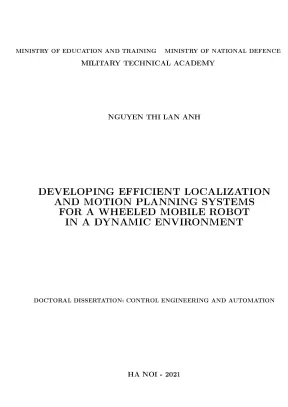
Tải xuống để đọc toàn bộMINISTRY OF EDUCATION AND TRAINING MINISTRY OF NATIONAL DEFENCE MILITARY TECHNICAL ACADEMY NGUYEN THI LAN ANH DEVELOPING EFFICIENT LOCALIZATION AND MOTION PLANNING SYSTEMS FOR A WHEELED MOBILE ROBOT IN A DYNAMIC ENVIRONMENT DOCTORAL DISSERTATION: CONTROL ENGINEERING AND AUTOMATION HA NOI - 2021 luan an MINISTRY OF EDUCATION AND TRAINING MINISTRY OF NATIONAL DEFENCE MILITARY TECHNICAL ACADEMY NGUYEN THI LAN ANH DEVELOPING EFFICIENT LOCALIZATION AND MOTION PLANNING SYSTEMS FOR A WHEELED MOBILE ROBOT IN A DYNAMIC ENVIRONMENT DOCTORAL DISSERTATION Major: CONTROL ENGINEERING AND AUTOMATION Code: 092520216 SUPERVISOR: Assoc. Pham Trung Dung HA NOI - 2021 luan an ASSURANCE I certify that this dissertation is a research work done by the author under the guidance of the research supervisors. The dissertation has used citation information from many different references, and the ci- tation information is clearly stated. Experimental results presented in the dissertation are completely honest and not published by any other author or work.
Author Nguyen Thi Lan Anh luan an ACKNOWLEDGEMENTS First of all, I would like to express my sincere gratitude to my advisor, Assistant Professor Pham Trung Dung, who has been directly guiding me through the PhD progress. His passionate enthusiasm, unwavering dedication to research, and insightful advice have motivated me to carry out this research. I do appreciate all support and opportunities that he has provided to me. Then, I wish to thank my co-supervisor my co-supervisor, Dr.
Truong Xuan Tung, for his valuable advices on my research. He has given and discussed a lot of new issues with me. Working with Dr. Tung, I have learnt how to do research systematically.
His support have motivated me to overcome all challenges in during my PhD journey. Next, I also would like to thank the leaders and all lecturers of the Fac- ulty of Control Engineering, Military Technical Academy for supporting me with favorable conditions and cheerfully helping me in the study and research process. Finally, I must express my very profound gratitude to my parents, to my husband for unfailing support me and always encouraging, to my daughter, Tran Nguyen Khanh An, and my son, Tran Duc Anh for trying to grow up by themselves. This accomplishment would not have been possible without them.
Author Nguyen Thi Lan Anh luan an CONTENTS Contents. iv List of figures. v List of tables. Mobile robot models.
Mobile robot platforms. Kinematic model of differential-drive robot. Bayesian filters for localization systems. Extended Kalman filter algorithm.
The particle filter algorithm. Typical obstacle avoidance algorithms. The dynamic window approach algorithm. Hybrid reciprocal velocity obstacle model.
Timed elastic band technique. Conclusions of the chapter. SENSOR DATA FUSION-BASED LO- CALIZATION ALGORITHMS. Extended Kalman filter-based localization algorithm.
Construction of EKF-based localization algorithm. Results and discussions. Particle filter-based localization algorithm. Construction of PF-based localization algorithm.
Results and discussions. Remarks and discussions. DEVELOPING EFFICIENT MOTION PLANNING SYSTEMS. Proposed enhanced dynamic window approach algorithm.
Construction of the EDWA algorithm. The EDWA algorithm-based navigation framework. Algorithm validation by simulations and experiments. Proposed proactive timed elastic band algorithm.
Construction of the PTEB algorithm. The PTEB algorithm-based navigation framework. 98 ii luan an 4. Remarks and discussion.
Proposed extended timed elastic band algorithm. Construction of the ETEB algorithm. Proposed integrated navigation system. Completed navigation framework.
Experimental setup and results. Conclusions and discussion. CONCLUSIONS AND FUTURE WORKS 125 5. 131 iii luan an ABBREVIATIONS No.
Abbreviation Meaning 1 IMU Inertial Measurement Unit 2 GPS Global Position System 3 KF Kalman Filter 4 EKF External Kalman Filter 5 PF Particle Filter 6 VO Velocity Obstacle 7 RVO Reciprocal Velocity Obstacle 8 HRVO Hybrid Reciprocal Velocity Obstacle 9 DWA Dynamic Window Approach 10 EDWA Enhance Dynamic Window Approach 11 EB Elastic Band 12 TEB Time Elastic Band 13 PTEB Proactive Time Elastic Band 14 ETEB Extended Time Elastic Band 15 ROS Robot Operating System 16 PCL Point Cloud Library iv luan an LIST OF FIGURES 1.1 A general control scheme for autonomous mobile robots.1 Two mobile robot platforms under the study.2 The global reference frame and the robot reference frame.3 The velocity space of the dynamic window approach model. Vs , Va , Vd are the possible velocities, admissible velocities, and dynamic window, respectively.4 Procedure of the hybrid reciprocal velocity obstacles of a robot and an obstacle.5 TEB trajectory representation with n=3 poses .6 The example of exploration graph (a). The block diagram of parallel trajectory planning of time elastic bands (b).1 The block diagram of the proposed autonomous mobile robot localization systems based on the multiple sensor fusion methods.2 The data flow from sensors into the EKF for robot localization.3 The extended Kalman filter-based mobile robot localiza- tion system.4 The proposed approaches .5 The sinusoidal trajectories of the mobile robot in three approaches.6 The circular trajectories of the mobile robot in three ap- proaches.7 The mean error and mean square error of the robot’s po- sition of three approaches in two simulations.8 The simulation results using PF localization .1 The navigation framework for autonomous mobile robot.2 The example scenario of the dynamic environments in- cluding a mobile robot and two dynamic obstacles.3 The efficient navigation system based on the EDWA algorithm78 4.4 The trajectory of the mobile robot and obstacles in Sce- nario 1 and 2.5 The trajectory of the mobile robot and obstacles in Sce- nario 3 and 4.6 The minimum passing distance along the robot’s trajectory.7 The robot’s velocity along the trajectory of mobile robot.8 (a) The Eddie mobile robot platform equipped with a laser rangefinder and a NVIDIA Xavier Developer Kit; (b) The data flow diagram of the proposed framework.9 The experimental results of four experiments.10 The example scenario of the dynamic social environments including a mobile robot and three dynamic obstacles. The robot is requested to navigate to the given goal while avoiding two crossing obstacles o1 and o2 , and a moving forward obstacle o3.
The curved dashed line is the in- tended optimal trajectory of the mobile robot.11 The flowchart of the proposed proactive TEB algorithm.12 The navigation framework based on the PTEB algorithm.13 Four snapshots at four timestamps of the two experiments in the simulation environment.14 A hallway-like scenario with walls, objects, humans, and goals.15 The simulation results of the two experiments. The first row shows the collision index of the conventional TEB al- gorithm. Whereas, the second row illustrates the collision index of the PTEB technique. 102 vi luan an 4.16 The example scenario including a mobile robot and two dynamic obstacles.
The curved dashed line is the intended optimal trajectory of the mobile robot.17 The proposed extended TEB algorithm .18 Four snapshots at four timestamps of the two experiments in the simulation environment.19 The navigation framework based on the ETEB algorithm .20 The simulation results of the two experiments. The first row shows the collision index of the conventional PTEB algorithm. Whereas, the second row illustrates the colli- sion index of the ETEB technique.21 The block diagram of the mobile robot navigation sys- tem utilize the EKF-based localization algorithm and the ETEB-based obstacle avoidance algorithm.22 The example of the human detection and tracking algorithm.23 The comparison result of localization systems.24 The example result of the A*-based path planing algo- rithm (the green curve).25 The QBot-2e mobile robot platforms and the data flow diagram of the proposed framework.26 Three snapshots at three timestamps of the experiment in the sparse environment. 122 vii luan an LIST OF TABLES 3.1 Mean error for the three approaches .2 Mean square error for the three approaches .3 The mean error of the proposed localization system and existing localization system.1 Parameters set in experiments .2 The average passing velocity of the robot .3 Parameters of the Eddie mobile robot platform .4 Parameters set in experiments .5 Parameters of the QBot 2e mobile robot platform.
121 viii luan an Chapter 1 INTRODUCTION 1. Motivation Mobility is an essential navigation issue for autonomous mobile robots. To allow the mobile robots to navigate safely in a real-world environment, the mobile robots must deal with four typical functional blocks of the navigation system [1], as shown in Fig.1, including: (i) perception – the mobile robots must interpret its sensors to extract meaningful infor- mation; (ii) localization – the mobile robots must determine their posi- tion and orientation in the environment. In other words, it answers the question “Where am I?”; (iii) motion planning – includes path planning techniques and obstacle avoidance methods.
The mobile robots utilize it to decide how to act to achieve its goals; and (iv) motor control – the mobile robots must modulate their motor outputs to achieve the desired trajectory, i. Motion Motor Perception Localization planning control Real – world environment Figure 1.1: A general control scheme for autonomous mobile robots. It has been known that, the success in robot navigation requires the 1 luan an success of the four aforementioned fundamental processes, and to im- prove the performance of the robot’s navigation system, the performance of all processes need to be improved. In recent years, several domestic researches in the field of robotics have been published in recent years, such as the publications of Viet- nam Academy of Science and Technology, Institute of Information Tech- nology, Hanoi University of Science and Technology, Vietnam National University, Le Quy Don Technical University and Ho Chi Minh City Uni- versity of Technology.
The domestic works mainly focus on trajectory tracking systems [2], [3], [4] and [5]. Specifically, the authors propose control laws which enable the mobile robots to follow predefined trajec- tories. In this research, the authors also stated that, using these control laws the systems can overcome uncertainties caused by dynamic param- eter variations and external disturbances. In other research direction, some studies [6] and [7] propose algorithms based on extended Kalman filter (EKF) to improve the localization system for mobile robots in un- known environments.
And a few works [8], [9] develop adaptive control algorithms for tracking moving targets by using image features of the target which get from a camera system. Finally, a little researches intro- duce a trajectory planning method in a static environment with known start point and target point [10]. As a result, the mobile robot navi- gation system, especially localization and motion planning systems has not been focused and adequately researched. Therefore, in this research we only focuses on two interesting systems including localization and motion planning systems, which are the scope 2 luan an of the thesis.
Localization is the problem of estimating a robot’s pose relative to its environment from sensor observations. It has been referred as the most fundamental problem to provide the mobile robot with autonomous competences. The challenges of localization are from the inaccuracy and inadequacies of sensors and effects of noise. Firstly, the errors of the mea- surement model, or sensor noise, due to the structural characteristics, resolution and error tolerance of different types of sensors or dynamic environments, such as light conditions, obstacles.
Clearly, the solution here is to take multiple readings into account or multi-sensor fusion to increase the overall information from inputs. Secondly, the errors also can be caused by systematic errors (deterministic) such as the size of uneven wheels, the distance between two unbalance wheels, and they can be eliminated by proper calibration of the system. However, there are still a number of non-systematic (random) errors that remain, such as slipping on the surface, changes in the contact points of the wheel are uneven [1], leading to uncertainties in position estimation over time. In addition, when the mobile robot navigates in the harsh environmental conditions, the information can be interrupted in a short or long interval of time.
Therefore, the mobile robot might have insufficient information for estimating the pose during its navigation.
Nội dung được bảo vệ bản quyền — Tải xuống đầy đủ
Trích dẫn luận án này
Nguyen Thi Lan Anh (2021). Luận án tiến sĩ hệ thống định vị robot bánh trong môi trường động [Luận án tiến sĩ, Military Technical Academy]. LuanAn.net. https://luanan.net/cong-nghe-thong-tin/he-thong-thong-tin/luan-an-tien-si-he-thong-dinh-vi-robot-banh-moi-truong-dong
Câu hỏi thường gặp
Luận án "Luận án tiến sĩ hệ thống định vị robot bánh trong môi trường động" nghiên cứu về vấn đề gì?
Luận án tiến sĩ nghiên cứu hệ thống định vị robot bánh trong môi trường động, ứng dụng thuật toán SLAM và học máy.
Luận án "Luận án tiến sĩ hệ thống định vị robot bánh trong môi trường động" được bảo vệ tại trường nào?
Luận án này được bảo vệ tại Military Technical Academy. Năm bảo vệ: 2021.
Luận án "Luận án tiến sĩ hệ thống định vị robot bánh trong môi trường động" thuộc chuyên ngành gì?
Luận án "Luận án tiến sĩ hệ thống định vị robot bánh trong môi trường động" thuộc chuyên ngành Control Engineering and Automation. Danh mục: Hệ Thống Thông Tin.
Luận án "Luận án tiến sĩ hệ thống định vị robot bánh trong môi trường động" có bao nhiêu trang?
Luận án "Luận án tiến sĩ hệ thống định vị robot bánh trong môi trường động" có 152 trang. Bạn có thể xem trước một phần tài liệu ngay trên trang web trước khi tải về.
Cách tải luận án "Luận án tiến sĩ hệ thống định vị robot bánh trong môi trường động" về máy như thế nào?
Để tải luận án về máy, bạn nhấn nút "Tải xuống ngay" trên trang này, sau đó hoàn tất thanh toán phí lưu trữ. File sẽ được tải xuống ngay sau khi thanh toán thành công. Hỗ trợ qua Zalo: 0559 297 239.