ELiPS-based CP-ABE: Mã hóa dựa trên thuộc tính - Luận án tiến sĩ
Luận án tiến sĩ về mã hóa CP-ABE sử dụng thư viện ELiPS. Nghiên cứu cải thiện bảo mật dữ liệu trong lưu trữ đám mây, IoT và blockchain với hiệu suất cao hơn.
Okayama University
Engineering
Luan An
Doctoral Thesis
Năm xuất bản
Số trang
105
Thời gian đọc
16 phút
Lượt xem
1
Lượt tải
0
Phí lưu trữ
40 Point
Mục lục chi tiết
Tóm tắt nội dung
I. CP ABE Encryption Advanced Access Control Method
Ciphertext-Policy Attribute-Based Encryption (CP-ABE) represents a breakthrough in cryptographic protocols. Traditional encryption relies on single-key possession. CP-ABE transforms this paradigm. Access depends on user attributes instead. This creates fine-grained access control mechanisms. Data owners specify access policies during encryption. Only users with matching attributes can decrypt. The system integrates encryption with access control seamlessly. Cloud storage benefits significantly from this approach. Internet of Things applications gain enhanced security. Personal health records remain protected yet accessible. Blockchain systems implement CP-ABE for privacy. The technology addresses modern security challenges. Third-party data storage raises privacy concerns. CP-ABE solves these issues through attribute verification. Organizations control who accesses sensitive information. The method proves essential for distributed systems. Security levels must meet contemporary standards. Implementation efficiency determines practical adoption. Understanding CP-ABE fundamentals enables better deployment.
1.1. Core Components of Attribute Based Encryption
CP-ABE operates through four essential functions. Setup generates master and public keys initially. The master key remains confidential always. Public keys distribute to all users freely. Key generation creates user-specific secret keys. These keys derive from user attributes. Attributes define access permissions precisely. Encryption embeds access policies in ciphertext. Data owners specify these policies explicitly. Decryption requires attribute satisfaction completely. The process verifies user credentials automatically. Bilinear pairing enables cryptographic operations. Elliptic curve cryptography provides mathematical foundation. Each component serves critical security purposes. Integration ensures robust protection mechanisms.
1.2. Access Policy Implementation Mechanisms
Access policies determine decryption eligibility strictly. Data owners define policy structures flexibly. Attributes combine using logical operators effectively. Policies embed directly into ciphertext. Users cannot decrypt without matching attributes. The system enforces policies cryptographically. No central authority monitors access continuously. Verification happens during decryption automatically. Complex policies support organizational hierarchies. Fine-grained control exceeds traditional methods. Boolean formulas express policy requirements. Threshold schemes enable flexible configurations. Policy updates require careful management. Revocation mechanisms complement access control.
1.3. Applications in Modern Computing Systems
Cloud computing demands secure data sharing. CP-ABE addresses third-party storage concerns. IoT devices generate massive data volumes. Privacy requirements increase with scale. Personal health records need selective access. Regulatory compliance mandates strict controls. Blockchain systems require encrypted transactions. Distributed networks benefit from decentralized access. Each application presents unique challenges. CP-ABE adapts to diverse requirements. Implementation must balance security and performance. Real-world deployments demonstrate practical viability. Adoption grows across multiple sectors. Future applications continue emerging constantly.
II. ELiPS Library High Performance Pairing Systems
The Efficient Library for Pairing Systems (ELiPS) delivers superior performance for pairing-based cryptography. Traditional libraries face security limitations. The PBC library provides only 80-bit security. Modern threats require stronger protection levels. ELiPS addresses these critical gaps. The library implements efficient elliptic curve operations. Point arithmetic achieves optimal speed. Exponentiation functions maintain high performance. Bilinear pairing calculations execute rapidly. Security standards meet contemporary requirements. The library supports various curve types. Implementation flexibility enables diverse applications. Developers gain powerful cryptographic tools. Code optimization ensures minimal overhead. Resource constraints matter for embedded systems. ELiPS balances security with efficiency. Mathematical operations remain mathematically sound. Cryptographic protocols depend on reliable foundations. Library design prioritizes both speed and safety. Integration simplifies complex implementations. Open architecture supports community contributions.
2.1. Elliptic Curve Cryptography Foundations
Elliptic curve cryptography provides mathematical basis. Curves offer equivalent security with smaller keys. Point operations define group structures. Addition and multiplication follow specific rules. Scalar multiplication enables key generation. Discrete logarithm problem ensures security. Curve selection impacts performance significantly. Pairing-friendly curves support advanced protocols. ELiPS implements optimized curve arithmetic. Coordinate systems affect computation speed. Projective coordinates reduce inversion operations. Mixed coordinate systems balance efficiency. Field arithmetic underlies all operations. Prime fields offer implementation simplicity.
2.2. Bilinear Pairing Operations and Efficiency
Bilinear pairings map curve points to finite fields. These mappings enable advanced cryptographic schemes. Pairing computation remains computationally intensive. ELiPS optimizes pairing algorithms extensively. Miller's algorithm forms the core procedure. Final exponentiation completes the process. Ate pairing variants improve efficiency. Optimal ate pairing reduces iteration counts. Precomputation strategies accelerate repeated operations. Memory trade-offs affect implementation choices. Hardware acceleration possibilities exist. Software optimization techniques apply broadly. Benchmark results demonstrate performance gains. Security analysis validates implementation correctness.
2.3. Security Levels and Performance Benchmarks
Security levels correspond to key lengths. 80-bit security proves insufficient currently. 128-bit security represents minimum standards. 192-bit and 256-bit levels provide future-proofing. ELiPS supports multiple security parameters. Performance varies with security choices. Benchmarks compare different configurations. Execution time measurements guide optimization. Memory consumption impacts embedded deployment. Energy efficiency matters for mobile devices. Trade-offs exist between security and speed. ELiPS documentation provides detailed metrics. Comparison with PBC shows improvements. Real-world testing validates theoretical analysis.
III. Ciphertext Policy ABE Implementation Challenges
Implementing CP-ABE presents significant technical challenges. Computational overhead affects practical deployment. Encryption complexity grows with policy size. Decryption requires intensive pairing operations. Key generation must remain efficient. Storage requirements increase with attributes. Network transmission impacts user experience. Legacy systems lack pairing support. Integration requires careful architectural planning. Security proofs demand rigorous analysis. Side-channel attacks threaten implementations. Timing attacks exploit execution variations. Power analysis reveals secret information. Constant-time operations prevent leakage. Random number generation needs cryptographic quality. Parameter selection affects security guarantees. Attribute management requires robust infrastructure. Revocation mechanisms add complexity. Forward secrecy considerations arise. Backward compatibility constraints limit options. Testing validates security properties. Performance optimization remains ongoing. Real-world constraints shape design decisions. Deployment success depends on careful engineering.
3.1. Computational Complexity in Encryption Processes
Encryption computational cost depends on policy complexity. Each attribute increases processing time. Pairing operations dominate execution duration. Exponentiation requires significant resources. Policy tree depth affects performance. Leaf node count determines operation quantity. Linear secret sharing schemes distribute values. Polynomial evaluation happens during encryption. Randomness generation impacts security critically. Optimization reduces redundant calculations. Precomputation strategies improve responsiveness. Batch operations amortize overhead. Hardware acceleration provides speedup. Algorithm selection matters significantly. Implementation quality determines efficiency.
3.2. Key Management and Distribution Systems
Key generation creates user-specific credentials. Attribute authorities issue secret keys. Distributed systems complicate key management. Secure channels protect key transmission. Storage security prevents unauthorized access. Key updates handle attribute changes. Revocation invalidates compromised keys. Re-encryption enables access changes. Proxy re-encryption delegates authority. Key escrow raises privacy concerns. Multi-authority schemes distribute trust. Threshold cryptography enhances robustness. Backup strategies prevent data loss. Recovery mechanisms restore access. Lifecycle management spans key lifetime.
3.3. Security Analysis and Vulnerability Assessment
Security proofs validate cryptographic schemes. Reduction arguments establish hardness assumptions. Decisional bilinear Diffie-Hellman problem underlies security. Chosen-plaintext attacks test resistance. Chosen-ciphertext attacks probe weaknesses. Collusion resistance prevents attribute pooling. Formal verification ensures correctness. Cryptanalysis identifies potential vulnerabilities. Implementation flaws undermine theoretical security. Side-channel resistance requires careful coding. Fault injection attacks exploit errors. Security parameters determine attack costs. Regular audits maintain security posture. Threat modeling guides defensive measures.
IV. Public Key Encryption with Fine Grained Control
Public key encryption traditionally offers coarse-grained access. A single private key decrypts all ciphertexts. CP-ABE introduces fine-grained access control. Multiple attributes determine decryption capability. This granularity enables precise authorization. Organizations define complex access structures. Hierarchical policies reflect organizational structure. Role-based access translates to attributes. Time-based restrictions limit access periods. Location attributes enforce geographic constraints. Clearance levels map to security attributes. Department membership controls data access. Project participation determines visibility. Combination requirements strengthen security. Expressive policies support business logic. Cryptographic enforcement prevents circumvention. No trusted server mediates access. Decentralized control reduces single points of failure. Scalability challenges emerge with growth. Attribute universe size impacts performance. Policy expressiveness balances complexity. User experience affects adoption rates. Management overhead requires consideration.
4.1. Attribute Based Access Control Mechanisms
Attributes represent user characteristics formally. Boolean attributes indicate presence or absence. Numerical attributes express quantitative properties. String attributes capture categorical information. Composite attributes combine multiple values. Attribute certification ensures authenticity. Trusted authorities issue attribute credentials. Verification protocols confirm attribute validity. Attribute revocation removes privileges. Temporal attributes expire automatically. Contextual attributes depend on environment. Dynamic attributes change over time. Static attributes remain constant. Attribute hierarchies express relationships. Inheritance simplifies policy specification.
4.2. Policy Expression and Enforcement Techniques
Access policies use Boolean formulas. AND gates require all attributes. OR gates accept any attribute. Threshold gates specify minimum counts. Monotonic policies simplify implementation. Non-monotonic policies add negation. Policy size affects ciphertext length. Compact representations reduce overhead. Tree structures organize policy elements. Linear secret sharing implements policies. Shamir secret sharing enables thresholds. Benaloh-Leichter construction handles general formulas. Policy hiding enhances privacy. Predicate encryption generalizes further. Functional encryption extends capabilities.
4.3. Decentralized Trust and Multi Authority Schemes
Single authority creates centralization risks. Multi-authority schemes distribute trust. Different authorities manage different attributes. Users collect keys from multiple sources. Decryption combines keys cryptographically. Collusion resistance prevents authority cooperation. Disjoint attribute spaces simplify design. Overlapping spaces require coordination. Global identifiers link user keys. Anonymous credentials enhance privacy. Threshold authorities prevent single compromise. Byzantine fault tolerance increases robustness. Coordination protocols synchronize authorities. Scalability improves with distribution.
V. Cryptographic Protocols for Data Protection
Cryptographic protocols define security procedures systematically. CP-ABE protocols specify precise interaction sequences. Setup phase initializes system parameters. Authority generates public parameters. Master secret remains confidential. Key generation protocol issues user credentials. Users prove attribute possession. Authorities verify claims cryptographically. Encryption protocol creates ciphertext. Data owner specifies access policy. Symmetric encryption protects actual data. Asymmetric encryption protects symmetric key. Decryption protocol recovers plaintext. User presents secret key. System verifies attribute satisfaction. Pairing operations compute intermediate values. Final computation yields plaintext. Protocol security depends on mathematical assumptions. Implementation security requires careful coding. Formal analysis proves protocol properties. Simulation paradigm establishes security. Game-based proofs analyze attack scenarios. Composability ensures modular security. Real-world deployment faces additional challenges.
5.1. Setup and Initialization Procedures
System initialization establishes global parameters. Security parameter determines key sizes. Elliptic curve selection affects performance. Pairing type influences efficiency. Hash functions provide randomness. Attribute universe definition sets scope. Master key generation uses randomness. Public parameter publication enables encryption. Secure storage protects master secrets. Backup procedures prevent loss. Parameter validation ensures correctness. Compatibility checks verify interoperability. Documentation guides implementation. Testing validates setup correctness. Audit trails track parameter generation.
5.2. Encryption and Decryption Workflows
Encryption begins with policy specification. Access structure defines requirements. Random values ensure semantic security. Policy embedding into ciphertext happens. Pairing-based operations create components. Symmetric key encrypts actual data. Ciphertext combines all elements. Decryption starts with attribute verification. Secret key components correspond to attributes. Pairing computations proceed systematically. Intermediate results combine appropriately. Final computation recovers symmetric key. Symmetric decryption yields plaintext. Verification confirms integrity. Error handling manages failures.
5.3. Security Proofs and Formal Verification
Security proofs establish cryptographic guarantees. Reduction arguments link to hard problems. Adversary models define attack capabilities. Indistinguishability games test security. Chosen-plaintext security represents baseline. Chosen-ciphertext security provides stronger guarantee. Selective security simplifies proofs. Adaptive security handles dynamic attacks. Formal methods verify protocol correctness. Automated tools check implementations. Symbolic analysis finds logical flaws. Computational analysis assesses complexity. Provable security guides design. Security parameters determine resistance.
VI. Future Developments in Attribute Based Encryption
Attribute-based encryption continues evolving rapidly. Research addresses current limitations actively. Efficiency improvements reduce computational costs. New pairing types offer better performance. Lattice-based alternatives provide post-quantum security. Quantum computers threaten current schemes. Post-quantum CP-ABE protects against future threats. Functional encryption extends expressiveness further. Inner-product predicates enable new applications. Searchable encryption combines with CP-ABE. Homomorphic properties allow computation on encrypted data. Privacy-preserving protocols enhance anonymity. Zero-knowledge proofs add verification capabilities. Blockchain integration creates decentralized systems. Smart contracts automate policy enforcement. Machine learning on encrypted data emerges. Federated learning preserves privacy. Standardization efforts promote interoperability. Industry adoption drives practical improvements. Regulatory compliance shapes requirements. Privacy regulations mandate protection. Security standards define baselines. Open-source implementations democratize access. Community collaboration accelerates progress.
6.1. Post Quantum Cryptography Integration
Quantum computers threaten pairing-based schemes. Shor's algorithm breaks discrete logarithms. Post-quantum alternatives resist quantum attacks. Lattice-based cryptography offers promising direction. Learning with errors problem provides hardness. Ring-LWE variants improve efficiency. NTRU schemes offer compact keys. Code-based cryptography presents another option. Multivariate cryptography explores polynomial systems. Hash-based signatures provide quantum resistance. Hybrid schemes combine classical and post-quantum. Transition strategies manage migration. Performance comparisons guide selection. Standardization efforts coordinate adoption.
6.2. Enhanced Privacy and Anonymity Features
Privacy preservation grows increasingly important. Policy hiding conceals access requirements. Attribute hiding protects user information. Anonymous credentials prevent tracking. Unlinkability prevents correlation attacks. Pseudonymous systems balance accountability and privacy. Differential privacy adds statistical guarantees. Secure multi-party computation enables collaboration. Private information retrieval protects queries. Oblivious transfer hides selections. Mix networks anonymize communications. Onion routing provides network privacy. Privacy-preserving authentication verifies without revealing. Selective disclosure minimizes information leakage.
6.3. Practical Applications and Industry Adoption
Healthcare systems protect patient records. Financial services secure transaction data. Government agencies classify information. Cloud providers offer encrypted storage. IoT platforms control device access. Supply chains track sensitive shipments. Digital rights management restricts content. Secure messaging encrypts communications. Collaborative platforms share selectively. Academic institutions protect research data. Legal systems maintain confidentiality. Military applications secure classified information. Industry standards emerge gradually. Best practices guide implementations. Success stories demonstrate viability.
Tải xuống file đầy đủ để xem toàn bộ nội dung
Tải đầy đủ (105 trang)Trích đoạn nội dung luận án
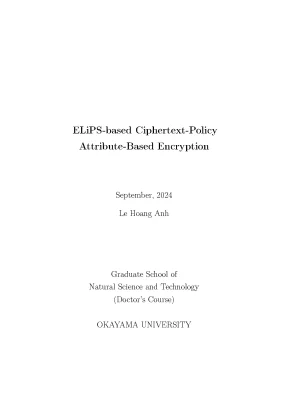
Tải xuống để đọc toàn bộELiPS-based Ciphertext-Policy Attribute-Based Encryption September, 2024 Le Hoang Anh Graduate School of Natural Science and Technology (Doctor’s Course) OKAYAMA UNIVERSITY DOCTORAL THESIS ELiPS-based Ciphertext-Policy Attribute-Based Encryption Author : Le Hoang ANH Supervisor : Yasuyuki NOGAMI Co-supervisors: Yoshitaka TOYOTA Yukinobu FUKUSHIMA A dissertation submitted to OKAYAMA UNIVERSITY in fulfillment of the requirements for the degree of Doctor of Philosophy in Engineering in the Graduate School of Natural Science and Technology September, 2024 Declaration Authorship This dissertation and the work presented here for doctoral studies were conducted under the supervision of Professor Yasuyuki Nogami. I, Le Hoang Anh, declare that this thesis titled, “ELiPS-based Ciphertext-Policy Att- ribute-Based Encryption” and the work presented in it are my own. I confirm that: • The work presented in this thesis is the result of original research carried out by myself, in collaboration with others, while enrolled in the Gradu- ate School of Natural Science and Technology at Okayama University as a candidate for the degree of Doctor of Philosophy in Engineering. • This work has not been submitted for a degree or any other qualification at this University or any other institution.
• The published work of others cited in this thesis is clearly attributed. Where I have quoted from the work of others, the source is always given. With the exception of such quotations, this thesis is entirely my own work. • I have acknowledged all main sources of help to pursue this work.
• The experiments and results presented in this thesis and in the articles where I am the first author were conducted by myself. Signed: Date: i Abstract Ciphertext-Policy Attribute-Based Encryption (CP-ABE) is an advanced cryptographic technique that enhances the flexibility and security of access control in data encryption. Unlike traditional encryption methods where access is determined by the possession of a single key, CP-ABE enables access based on a user’s attributes, providing a more fine-grained and expressive approach to data security. The CP-ABE scheme operates through four main functions such as setup, key generation, encryption, and decryption.
In the setup function, the algo- rithm generates a master key and a public key. The public key is distributed to users, while the master key is kept secret. The master key and public key are then used to create secret keys for users based on their attributes. These secret keys enable authorized users to decrypt ciphertexts that adhere to specified access policies, ensuring fine-grained access control over encrypted data.
In CP-ABE, data is encrypted under an access policy specified by the data owner. Access to the encrypted data is granted only if the user’s attributes satisfy the access policy embedded in the ciphertext. This approach integrates the encryption and access control processes, ensuring that only authorized users can decrypt the data. Therefore, CP-ABE is not only to encrypt data but also to provide fine- grained access control over encrypted data.
CP-ABE is a powerful crypto- graphic tool for keeping data safe in places like cloud storage, the Internet of Things (IoT), personal health records, and blockchain, using pairing-based cryptography. Cloud computing enables the storage and remote access of data via the internet. However, issues with access control and privacy arise when data is stored by a third party. On the other hand, IoT is a rapidly developing technology in the modern digital era.
The large amounts of data generated by the expanding IoT have led to a greater focus on privacy and data access control in security. To meet these requirements, CP-ABE is utilized to provide privacy and fine-grained access control in both cloud storage and IoT applications. Despite CP-ABE has various important applications, the original CP- ABE scheme relies on the pairing-based cryptography (PBC) library. The PBC library is an open-source library carrying out the essential mathematical ii operations in pairing-based cryptosystems.
Speed and portability are crucial considerations as the PBC library is intended to serve as the foundation for pairing-based cryptosystem implementations. It offers functions like elliptic curve arithmetic, hash-to-curve, and pairing. The PBC utilizes symmetric pairing, which offers a security level limited to 80 bits. This level of security is now considered outdated and vulnerable to various attacks, failing to meet the current demands for high-level security.
The Efficient Library for Pairing Systems (ELiPS), on the other hand, of- fers efficient operations related to pairing-based cryptography, delivering high performance while upholding a substantial security standard. Such cryptogra- phy involves mathematical pairings between points on an elliptic curve. The ELiPS library offers a range of functionalities, including point arithmetic op- erations, exponentiation, hash-to-curve, and pairing. ELiPS is specifically de- signed to support bilinear pairing using the BLS-12 curve, providing a 128-bit security level.
In our first study, to deal with the shortcomings of the original CP-ABE, we adopt and implement the ELiPS as an efficient library for pairing systems into the CP-ABE framework, namely ELiPS-based CP-ABE. However, the in- tegration process is not straightforward due to differences between PBC and ELiPS libraries, including function parameters, data types, and the type of pairing. Notably, ELiPS supports asymmetric pairing, while the original CP- ABE relies on symmetric pairing. To bridge this gap and ensure compatibility, we designed three procedures to adapt ELiPS for CP-ABE.
Our approach be- gins with the generation of a generator g. Then, we utilize Shirase’s method to transform asymmetric pairing to symmetric pairing, establishing compatibility between ELiPS and CP-ABE. Subsequently, we make several modifications to the CP-ABE framework and choose the appropriate ELiPS functions for inte- gration. Afterward, we validate our proposal through several experiments involv- ing data access authorization scenarios.
Firstly, we evaluate the efficacy of setup, key generation, encryption, and decryption in PBC-based CP-ABE, MCL-based CP-ABE, and ELiPS-based CP-ABE with a two-attribute sce- nario. The results show that the setup time in ELiPS-based CP-ABE reduces by 26.8% and in MCL-based CP-ABE decreases by 28.6% compared to PBC- iii based CP-ABE. In addition, the key generation time in MCL-based CP-ABE is lower than that in PBC-based CP-ABE by 74.8%, while in ELiPS-based CP- ABE, it is lower than other schemes by 2.6% compared to MCL-based CP-ABE and by 75.5% compared to PBC-based CP-ABE. Moreover, the results con- firm that the encryption time in ELiPS-based CP-ABE is the lowest among the three versions, namely PBC-based CP-ABE, MCL-based CP-ABE, and ELiPS-based CP-ABE.
Whereas encryption time in MCL-based CP-ABE de- creases by 74.0%, encryption time in ELiPS-based CP-ABE reduces by 75.3% compared to that in PBC-based CP-ABE. On the other hand, the decryption time for MCL-based CP-ABE and ELiPS-based CP-ABE increases by 31.7%, respectively, compared to the decryption time for PBC-based CP- ABE. Hence, further evaluation with increasing the number of attributes is necessary. Secondly, since the setup part is not affected by the number of attributes, we do not need to evaluate it further.
Instead, we focus on experi- ments and evaluations of key generation, encryption, and decryption with the numbers of attributes ranging from 2 to 20. The experimental results depict the key generation time in MCL-based CP-ABE is lower than that in PBC- based CP-ABE by 74.7%, while in ELiPS-based CP-ABE, it is lower than other schemes by 3.7% compared to MCL-based CP-ABE and by 75.6% com- pared to PBC-based CP-ABE. Encryption time in ELiPS-based CP-ABE is the lowest among the three versions. Encryption time in ELiPS-based CP-ABE decreases by 75.0% compared to that in PBC-based CP-ABE and reduces by 4.9% compared to that in MCL-based CP-ABE.
The decryption time of both MCL-based CP-ABE and ELiPS-based CP-ABE is higher than that of the PBC-based CP-ABE across scenarios. Overall, the experimental results confirm that our ELiPS-based CP-ABE performs comparably to the competitive MCL library, showcasing its efficiency and effectiveness in modern cryptographic applications. Additionally, com- pared to PBC-based CP-ABE, our ELiPS-based solution demonstrates reduced computational costs across most functions, except for decryption. Therefore, in the next study, we aim to reduce the decryption process time in ELiPS-based CP-ABE.
In ELiPS-based CP-ABE, the decryption part primarily utilizes in- version in the Lagrange coefficient part and pairing, which includes the Miller loop and final exponentiation. Both the final exponentiation and inversion are iv equivalent to the number of attributes. Performing these operations can be very expensive, especially when the number of attributes is large. In our second study, we further explore reducing the decryption process time in the initial version of ELiPS-based CP-ABE by proposing two optimiza- tion methods, such as minimizing the number of final exponentiations and in- versions.
The decryption cost comparison shows that our methods reduce the number of final exponentiations from 2n + 1 to 2 and the number of inversions from n + 1 to 2. The experimental results show that the equation with mini- mizing the number of final exponentiations reduces the execution time by an average of 43.6% compared to the original equation, and our proposed equation with minimizing the number of inversions decreases the execution time by an average of 74.4% compared to the equation without minimizing the number of inversions. In addition, we already successfully integrated these minimization methods into the ELiPS-based CP-ABE and implemented several scenarios, which increase the number of attributes from 5 to 100, to measure the decryp- tion time. The effectiveness of the proposal is confirmed through experimental analyses where the decryption time in the ELiPS-based with these optimiza- tions decreased by an average of 45.5% compared to the initial version of ELiPS-based CP-ABE.
In our third study, we further evaluate and analyze the impact of these optimizations on decryption efficiency. Moreover, we compare the ELiPS-based CP-ABE with these improvements to the initial version of ELiPS-based CP- ABE and the original PBC-based CP-ABE. As a result, the combination of both optimization techniques resulted in an average 43.1% overall reduction in decryption time compared to the initial version of the ELiPS-based CP-ABE scheme, while in total execution, it led to a 25. Furthermore, our optimized construction also outperformed the original PBC-based CP-ABE by an average of 53.8%, while providing a higher 128-bit security level.
Our research demonstrates that integrating the ELiPS library into the CP-ABE framework significantly enhances the efficiency and security of the CP-ABE scheme. By implementing optimization techniques, we further re- duced computational costs, particularly during the decryption process. This makes ELiPS-based CP-ABE a highly viable option for modern cryptographic applications, providing robust security and efficient performance. v Acknowledgments I would like to express my sincere gratitude to my supervisor, Professor Yasuyuki Nogami, for his support throughout my doctoral courses at Okayama University.
Without his extraordinary understanding and cooperation, I would not have been able to complete my doctoral research. I also appreciate my co- supervisors, Professor Yoshitaka Toyota, and Associate Professor Yukinobu Fukushima, who gave me a lot of effort to improve this thesis. They also gave me knowledge of electronics and networks through the classes in my courses. I would like to express my gratitude to Specially Appointed Assistant Professor Samsul Huda at the Green Innovation Center, Okayama University, for the in-depth discussion of scientific topics.
His strong work ethic and passion for research helped us publish some remarkable collaborative works. He was always there to help while any difficulty arose from attending conferences to publishing papers. I sincerely thank Assistant Professor Yuta Kodera who is my respected senior and gave me a lot of influence from his great attitude for research. I also appreciate other teachers who have imparted a lot of knowledge to me through the classes in my courses.
Special thanks also to student members of the Information Security Labo- ratory (Nogami Lab.) for creating a great work atmosphere and their generous support. My special thanks to Mr. Yuta Kawada for his kind support in dis- cussions, cooperation, and publishing papers. Thanks to MEXT, Japan for the scholarship that fulfilled my dream to pursue doctoral study in Japan.
I sincerely acknowledge all the funds that afforded me to join several conferences and conduct research activities. I am also grateful to all administrative officers of the Faculty of Engineer- ing who directly or indirectly made an impact on my doctoral course studies.
Nội dung được bảo vệ bản quyền — Tải xuống đầy đủ
Từ khóa và chủ đề nghiên cứu
Câu hỏi thường gặp
Luận án "ELiPS-based Ciphertext-Policy Attribute-Based Encryption" nghiên cứu về vấn đề gì?
Luận án tiến sĩ về mã hóa CP-ABE sử dụng thư viện ELiPS. Nghiên cứu cải thiện bảo mật dữ liệu trong lưu trữ đám mây, IoT và blockchain với hiệu suất cao hơn.
Luận án "ELiPS-based Ciphertext-Policy Attribute-Based Encryption" được bảo vệ tại trường nào?
Luận án này được bảo vệ tại Okayama University. Năm bảo vệ: 2024.
Luận án "ELiPS-based Ciphertext-Policy Attribute-Based Encryption" thuộc chuyên ngành gì?
Luận án "ELiPS-based Ciphertext-Policy Attribute-Based Encryption" thuộc chuyên ngành Engineering. Danh mục: An Toàn Thông Tin.
Luận án "ELiPS-based Ciphertext-Policy Attribute-Based Encryption" có bao nhiêu trang?
Luận án "ELiPS-based Ciphertext-Policy Attribute-Based Encryption" có 105 trang. Bạn có thể xem trước một phần tài liệu ngay trên trang web trước khi tải về.
Cách tải luận án "ELiPS-based Ciphertext-Policy Attribute-Based Encryption" về máy như thế nào?
Để tải luận án về máy, bạn nhấn nút "Tải xuống ngay" trên trang này, sau đó hoàn tất thanh toán phí lưu trữ. File sẽ được tải xuống ngay sau khi thanh toán thành công. Hỗ trợ qua Zalo: 0559 297 239.