Luận án tiến sĩ mô hình đặc tính kênh truyền cho thông tin thủy âm vùng nước nôn
Luận án: Luận án tiến sĩ mô hình đặc tính kênh truyền cho thông tin thủy âm vùng nước nông. Xem tóm tắt và tải về tại LuanAn.net
Luan An
Luận án tiến sĩ
Năm xuất bản
Số trang
128
Thời gian đọc
20 phút
Lượt xem
1
Lượt tải
0
Phí lưu trữ
40 Point
Tổng quan nhanh
- Chủ đề:
- Phát triển Mô Hình Kênh Truyền cho Thông Tin Thủy Âm
- Số trang:
- 128 trang
- Trường:
- Đại học Bách khoa Hà Nội
- Chuyên ngành:
- Telecommunications Engineering
- Tác giả:
- Do Viet Ha
- Năm:
- 2017
Tóm tắt nội dung luận án
I.Phát triển Mô Hình Kênh Truyền cho Thông Tin Thủy Âm
Luận án này tập trung vào việc mô hình hóa đặc tính kênh truyền cho thông tin thủy âm vùng nước nông. Môi trường thủy âm đặt ra nhiều thách thức độc đáo do sự phức tạp của đường truyền sóng. Nghiên cứu phát triển các mô hình kênh mạnh mẽ, chính xác nhằm dự đoán hành vi tín hiệu. Những mô hình này rất quan trọng để thiết kế các hệ thống truyền thông dưới nước đáng tin cậy. Chúng cung cấp hiểu biết cơ bản về đặc tính truyền dẫn trong các điều kiện khắc nghiệt. Việc tối ưu hóa các mô hình này giúp cải thiện hiệu suất truyền dữ liệu.
1.1. Tổng quan Mô Hình Kênh Thủy Âm Hiện Có
Các mô hình kênh truyền hiện có cho thông tin thủy âm được đánh giá kỹ lưỡng. Các kênh Rayleigh và Rice cung cấp nền tảng lý thuyết cơ bản. Các mô hình kênh xác định dựa trên Bộ tán xạ đồng bộ (SOS) và Bộ tán xạ đồng bộ điều kiện (SOC) cũng được xem xét. Việc phân tích này thiết lập bối cảnh cho các phát triển mô hình mới. Hiểu rõ ưu nhược điểm của chúng là bước đầu tiên quan trọng.
1.2. Mô Hình Kênh Dựa Trên Hình Học và Đo Lường
Hai phương pháp mô hình kênh chính được phát triển và nghiên cứu sâu. Mô hình dựa trên hình học xây dựng từ cấu trúc vật lý của môi trường kênh. Mô hình dựa trên đo lường sử dụng dữ liệu thu thập được từ thực tế để tạo ra các mô phỏng kênh truyền. Việc so sánh chi tiết giữa hai phương pháp này cung cấp cái nhìn sâu sắc về độ chính xác và khả năng ứng dụng của mỗi loại. Mỗi mô hình có ưu điểm riêng trong việc nắm bắt đặc tính truyền dẫn.
1.3. Thiết kế Bộ Mô Phỏng Kênh Truyền Thủy Âm
Việc thiết kế bộ mô phỏng kênh truyền thủy âm vùng nước nông được trình bày cụ thể. Bộ mô phỏng này đóng vai trò thiết yếu trong việc đánh giá hiệu suất của hệ thống trước khi triển khai thực tế. Nó cho phép thử nghiệm các kịch bản khác nhau của đặc tính truyền dẫn. Các tham số kênh được ước lượng kênh truyền cẩn thận để đảm bảo tính chính xác và độ tin cậy của mô phỏng. Đây là công cụ hữu ích cho nghiên cứu và phát triển.
II.Đặc Tính Truyền Dẫn Kênh Thủy Âm Nông và Mô Phỏng
Nghiên cứu đi sâu vào việc làm rõ đặc tính truyền dẫn của kênh thủy âm vùng nước nông. Môi trường này đặc trưng bởi hiện tượng phản xạ và tán xạ phức tạp từ đáy biển, bề mặt nước và các vật thể. Các yếu tố như độ sâu, địa hình và sự biến động của nước tạo ra hiện tượng kênh fading nghiêm trọng. Việc mô phỏng chính xác các đặc tính này là tối quan trọng cho việc thiết kế hiệu quả hệ thống truyền thông dưới nước. Công việc này liên quan đến việc xác định các tham số chính ảnh hưởng đến chất lượng tín hiệu. Hiểu rõ các tham số này hỗ trợ quá trình xử lý tín hiệu cho truyền thông.
2.1. Phát triển Mô Hình Tham Chiếu từ Dữ Liệu Thực Tế
Dữ liệu đo lường thực tế đóng vai trò nền tảng trong việc xây dựng mô hình kênh. Một mô hình tham chiếu được phát triển trực tiếp từ các phép đo thực địa. Điều này đảm bảo mô hình phản ánh chân thực đặc tính truyền dẫn của kênh thủy âm. Các tham số kênh quan trọng được ước lượng kênh truyền một cách chính xác từ dữ liệu này. Cách tiếp cận này giúp mô hình hóa gần gũi với thực tế.
2.2. Ước Lượng Tham Số Kênh và So Sánh Mô Phỏng
Các tham số của mô hình mô phỏng được ước lượng kênh truyền kỹ lưỡng. Sự so sánh chi tiết giữa mô hình kênh dựa trên hình học và mô hình dựa trên đo lường được tiến hành. Phân tích này giúp đánh giá độ phù hợp của mỗi mô hình với dữ liệu thực tế. Mục tiêu là xác định mô hình tối ưu cho các ứng dụng truyền thông di động dưới nước cụ thể. Việc này cung cấp cơ sở vững chắc cho các quyết định thiết kế.
2.3. Ứng Dụng Mô Hình cho Kênh Thủy Âm Tĩnh và Di Động
Các phương pháp mô hình hóa được đề xuất được ứng dụng cho cả kênh thủy âm tĩnh và trường hợp có hiệu ứng Doppler. Kênh tĩnh cung cấp cơ sở để hiểu các đặc tính truyền dẫn cơ bản. Hiệu ứng Doppler đòi hỏi các mô hình động để xử lý tín hiệu cho truyền thông di động dưới nước. Việc xử lý hiệu quả Doppler là một thách thức đáng kể trong truyền thông di động thủy âm. Các mô hình mới giúp đối phó tốt hơn với sự phức tạp này.
III.Tác Động Doppler trong Kênh Truyền Thủy Âm Nước Nông
Hiệu ứng Doppler là một yếu tố thách thức lớn trong kênh truyền thông vô tuyến thủy âm, đặc biệt là trong môi trường nước nông. Sự di chuyển tương đối giữa thiết bị phát và thu, cùng với sự biến động của môi trường, gây ra sự dịch tần số và trải phổ tín hiệu. Điều này ảnh hưởng nghiêm trọng đến hiệu suất xử lý tín hiệu cho truyền thông. Nghiên cứu này đề xuất một mô hình kênh truyền mới để mô tả phổ Doppler. Mô hình này giúp dự đoán và bù trừ hiệu ứng Doppler, tăng cường độ tin cậy của thông tin thủy âm.
3.1. Mô Hình Phổ Doppler Đề Xuất cho Kênh Thủy Âm
Một mô hình phổ Doppler mới được phát triển. Mô hình này được thiết kế để nắm bắt các đặc điểm phức tạp của hiệu ứng Doppler trong kênh thủy âm vùng nước nông. Nó tính đến nhiều yếu tố môi trường ảnh hưởng đến sự biến đổi tần số. Mô hình này là một đóng góp quan trọng cho lý thuyết kênh truyền. Nó cung cấp một công cụ phân tích mạnh mẽ.
3.2. Mô Tả Đo Đạc và Tối Ưu Hóa Tham Số Doppler
Các phép đo phổ Doppler thực tế được mô tả chi tiết trong luận án. Dữ liệu đo lường được sử dụng để phát triển một mô hình tham chiếu chính xác. Các tham số của mô hình Doppler đề xuất được tối ưu hóa dựa trên dữ liệu thực tế này. Quy trình tối ưu hóa đảm bảo tính chính xác và khả năng ứng dụng của mô hình. Việc này là cần thiết để mô hình hóa kênh fading hiệu quả.
3.3. Kết Quả Đo Đạc và Mô Hình Hóa Phổ Doppler
Các kết quả từ đo đạc và mô hình hóa phổ Doppler được trình bày rõ ràng. Sự so sánh giữa mô hình đề xuất và dữ liệu thực tế chứng minh hiệu quả và độ chính xác của nó. Mô hình này cung cấp công cụ mạnh mẽ để dự đoán và giảm thiểu tác động của hiệu ứng Doppler. Điều này cải thiện đáng kể khả năng của truyền thông di động dưới nước trong môi trường phức tạp.
IV.Phân Tích Hiệu Suất Hệ Thống với Mô Hình Kênh Mới
Việc phát triển các mô hình kênh truyền mới là một thành phần thiết yếu. Tuy nhiên, điều quan trọng không kém là đánh giá tác động của chúng đối với hiệu suất của hệ thống truyền thông di động thủy âm. Luận án này phân tích hiệu suất của hệ thống UWA-OFDM (Orthogonal Frequency Division Multiplexing) sử dụng mô hình kênh dựa trên đo lường. Phân tích này mang lại cái nhìn thực tế về cách các đặc tính kênh ảnh hưởng đến khả năng truyền dữ liệu. Các kết quả có giá trị cho việc tối ưu hóa hệ thống.
4.1. Phân Tích Nhiễu Liên Tín Hiệu ICI trong UWA OFDM
Một khía cạnh quan trọng của hệ thống OFDM là phân tích nhiễu liên tín hiệu (ICI). Trong môi trường kênh thủy âm có hiệu ứng Doppler, ICI có thể trở nên nghiêm trọng, làm giảm chất lượng tín hiệu. Nghiên cứu này phân tích cơ chế phát sinh và mức độ ảnh hưởng của ICI. Việc hiểu rõ ICI giúp phát triển các kỹ thuật xử lý tín hiệu cho truyền thông hiệu quả hơn. Điều này rất cần thiết cho các hệ thống kênh fading.
4.2. Ảnh Hưởng của Công Suất Nhiễu Môi Trường đến OFDM
Công suất nhiễu môi trường là một yếu tố then chốt ảnh hưởng đến hiệu suất hệ thống truyền thông. Đặc biệt trong thông tin thủy âm, tiếng ồn xung quanh có thể rất lớn và biến động. Nghiên cứu đánh giá tác động của công suất nhiễu này đến hệ thống UWA-OFDM. Kết quả cung cấp thông tin quý giá cho việc thiết kế các bộ thu và chiến lược mã hóa nhằm đối phó với nhiễu. Việc này hỗ trợ mô phỏng kênh truyền chân thực hơn.
4.3. Đánh Giá Hiệu Suất Hệ Thống với Mô Hình Kênh Thực Tế
Hiệu suất tổng thể của hệ thống UWA-OFDM được đánh giá một cách toàn diện. Việc sử dụng mô hình kênh truyền dựa trên đo lường đảm bảo tính thực tế của kết quả phân tích. Phân tích này xác định giới hạn và tiềm năng của công nghệ OFDM trong điều kiện thủy âm thực tế. Nó đóng góp vào việc cải thiện độ tin cậy và hiệu quả của truyền thông di động dưới nước, đặc biệt trong các kênh fading phức tạp.
Tải xuống file đầy đủ để xem toàn bộ nội dung
Tải đầy đủ (128 trang)Trích đoạn nội dung luận án
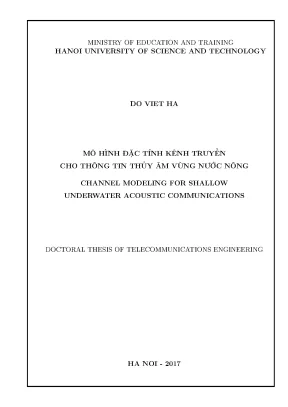
Tải xuống để đọc toàn bộMINISTRY OF EDUCATION AND TRAINING HANOI UNIVERSITY OF SCIENCE AND TECHNOLOGY DO VIET HA MÔ HÌNH ĐẶC TÍNH KÊNH TRUYỀN CHO THÔNG TIN THỦY ÂM VÙNG NƯỚC NÔNG CHANNEL MODELING FOR SHALLOW UNDERWATER ACOUSTIC COMMUNICATIONS DOCTORAL THESIS OF TELECOMMUNICATIONS ENGINEERING HA NOI - 2017 MINISTRY OF EDUCATION AND TRAINING HANOI UNIVERSITY OF SCIENCE AND TECHNOLOGY DO VIET HA MÔ HÌNH ĐẶC TÍNH KÊNH TRUYỀN CHO THÔNG TIN THỦY ÂM VÙNG NƯỚC NÔNG CHANNEL MODELING FOR SHALLOW UNDERWATER ACOUSTIC COMMUNICATIONS Specialization: Telecommunications Engineering Code No: 62520208 DOCTORAL THESIS OF TELECOMMUNICATIONS ENGINEERING SUPERVISORS: 1. Van Duc Nguyen 2. Van Tien Pham Hanoi - 2017 DECLARATION OF AUTHORSHIP I hereby declare that this dissertation titled, "Channel Modeling for Shal- low Underwater Acoustic Communications”, and the work presented in it are entirely my own original work under the guidance of my supervi- sors. I confirm that: • This work was done wholly or mainly while in candidature for a PhD research degree at Hanoi University of Science and Technology.
• Where any part of this dissertation has previously been submitted for a degree of any other qualification at Hanoi University of Science and Technology or any other institution, this has been clearly stated. • Where I have consult the published work or others, this is always given. With the exception of such quotations, this dissertation is entirely my own work. • I have acknowledged all main source of help.
• Where the thesis is based on work done by myself jointly with oth- ers, I have made exactly what was done by others and what I have contributed myself. Hanoi, August 27, 2017 SUPERVISORS PhD STUDENT 1. Van Duc Nguyen 2. Van Tien Pham Do Viet Ha ACKNOWLEDGEMENTS First and foremost, I would like to thank my advisor Associate Prof.
Nguyen Van Duc for for providing an excellent atmosphere for doing research, for his valuable comments, constant support and motivation. His guidance helped me in all the time of research and writing of this dissertation. I could not have imagined having a better advisor and mentor for my PhD. I would also like to thank Dr.
Pham Van Tien for their advice and feedback, also for many educational and inspiring discussions. My sincere gratitude goes to the members in the Wireless Communica- tion Lab, School of Electronics and Telecommunications, Hanoi Univer- sity of Science and Technology, Hanoi, Vietnam. Without their support and friendship it would have been difficult to complete my PhD studies. I am also thankful to Dr.
Nguyen Tien Hoa for his invaluable instruc- tions in presenting my dissertation. I would also like to express my deepest gratitude to my parents, my husband, my son, and my daughter. They were always supporting me and encouraging me with their best wishes, they were standing by me throughout my life. Hanoi, August 27, 2017 PhD STUDENT Do Viet Ha Contents TABLE OF CONTENTS.
iv LIST OF FIGURES. vi LIST OF TABLES. DESIGN OF SHALLOW UWA CHANNEL SIMU- LATORS. Overview of Simulation Models for UWA Channels.
Rayleigh and Rice channels. Deterministic SOS Channel Models. Deterministic SOC Channel Models. The Geometry-based UWA Channel Simulator.
Developing the Reference Model from the Geometrical Channel Model. The Simulation Model. The Estimated Parameters of the Simulation Model. The Measurement-based UWA Channel Simulator.
The Reference Model from the Measurement Data. The Simulation Model. Estimated Channel Parameters of the Simulation Model 33 1. Comparison of the Two Channel Simulators.
The Proposed Approach for the Static UWA Channel. Results and Discussions. The Proposed Approach for the Case of Doppler Effects. The Measurement Data.
The Conventional Measurement-based Simulators. The Proposed Channel Simulator. MODELING OF DOPPLER POWER SPECTRUM FOR SHALLOW UWA CHANNELS. The Proposed Doppler Spectrum Model.
The Doppler Effects in Shallow UWA Channels. The Proposed Doppler Model for UWA Channels. The Description of Doppler Spectrum Measurements. Reference Model from the Measurement Data.
Parameter Optimizations of the Proposed Model. Measurement and Doppler Modeling Results. UWA-OFDM SYSTEM PERFORMANCE ANAL- YSIS USING THE MEASUREMENT-BASED UWA CHAN- NEL MODEL. ICI Analysis of UWA-OFDM Systems.
Ambient Noise Power. 103 LIST OF PUBLICATIONS. 105 ABBREVIATIONS ACF Autocorrelation Function AOA Angles of Arrival AOD Angles of Departure AWGN Additive White Gaussian Noise BPSK Binary Phase Shift Keying CIR Channel Impulse Response FCF Frequency Correlation Function ICI Inter-Channel Interference INLSA Iterative Nonlinear Least Square Approximation ISI Inter-Symbol Interference LNA Low Noise Amplifier LOS Line of Sight LPNM Lp-Norm Method MESS Method of Equally Spaced Scatterers MSE Mean Square Error OFDM Orthogonal Frequency Division Multiplexing PDF Probability Density Function PDP Power Delay Profile PN Pseudo-Noise PSD Power Spectra Density Rx Receiver SINR Signal to Interference plus Noise Ratio SIR Signal-to-Interference Ratio SNR Signal to Noise Ratio SOC Sum-of-Cisoids SOS Sum-of-Sinusoids TCF Time Correlation Function iv v T-FCF Time-Frequency Correlation Function TVCIR Time Variant Channel Impulse Response TVCTF Time-Variant Channel Transfer Function Tx Transmitter UWA Underwater Acoustic WLAN Wireless Local Area Network WSSUS Wide-Sense Stationary Uncorrelated Scattering List of Figures 1 Multipath interference in UWA communication systems.1 The methodology behind the geometry-based channel modelling [17, 55].2 The methodology behind the measurement-based channel modelling [31, 56].3 The scheme of designing the geometry-based channel simulator [17, 55].4 The geometrical model for shallow UWA channels with randomly dis- tributed scatterers Si,n (•) on the surface (i = 1) and the bottom (i = 2) [55].5 The comparison between the normalized FCF of the reference model and that obtained by the geometry-based simulator.6 Illustration of the measurement setup in Halong bay.7 The measured |ĥ(τ, t)|2 for the transmission distance of 150 m.8 The measured and normalized PDP ρ(τ ) obtained for the transmission distance of 150 m.9 The comparison of the normalized FCF obtained by the two simulators to that of the reference model.10 The flowchart of proposed approach to design the static UWA channel simulator.11 The comparison between the normalized FCF of the reference model and that obtained by the measurement-based, the geometry-based, and the proposed simulators.12 The normalized Doppler power spectrum.13 a) The reference T-FCF derived from the measurement results. b) The T-FCF of the channel simulation model designed by the conventional simulator.14 The comparison between the normalized T-FCF of the reference model and that obtained by the conventional measurement-based simulator.15 The flowchart of the proposed approach for the case of moving Rx.16 a) The reference T-FCF derived from the measurement results.
b) The T-FCF of the channel simulation model designed by the proposed simulator.17 The comparison between the normalized T-FCF of the reference model and that obtained by the proposed simulator.18 a) The error of the simulation T-FCF designed by the conventional measurement-based simulator. b)The error of the simulation T-FCF designed by the proposed simulator.1 The 3-D geometry model for shallow environments with randomly dis- tributed scatterers Si,n (•) on the surface (i = 1) and the bottom (i = 2).2 The Spike-shape Doppler spectrum.3 Effect of the two Doppler components on the overall Doppler spectrum.4 Illustration of the measurement setup in Halong bay.5 The Doppler measurement scenario 1.6 The Doppler measurement scenario 2.7 The Doppler measurement scenario 3.8 The steps of parameter computations.9 The reference model S˜n (f ) compared with the proposed Doppler model S (f ) for four observed cases in scenario 1.10 The reference model S˜n (f ) compared with the proposed Doppler model S (f ) for six typical cases in scenario 2.11 The reference model S˜n (f ) compared with the proposed Doppler model S (f ) for six cases in scenario 3.12 The estimated trajectory movement of the Rx for scenario 3.1 Average SIR versus signal bandwidth for different numbers of sub-carriers.2 Average SINR versus signal bandwidth for different numbers of sub-carriers.3 Capacity of UWA-OFDM system versus signal bandwidth for different numbers of sub-carriers.4 Average spectra efficiency versus signal bandwidth for the number of sub-carriers N = 256, and SNR = 20 dB at the receiver.5 Required transmit power PT versus signal bandwidth to achieve an SNR of 20 dB at the receiver.6 Average spectra efficiency versus SNR at the receiver for the number of sub-carriers N = 256, and signal bandwidth B = 10 kHz.7 Average SIR, SINR versus SNR at the receiver for the number of sub- carriers N = 256, and signal bandwidth B = 10 kHz.8 Average spectra efficiency versus SNR at the receiver for the number of sub-carriers N = 256, and signal bandwidth B = 10 kHz.9 Average SIR, SINR, SNR versus transmit power for the number of sub- carriers N = 256, and signal bandwidth B = 10 kHz.10 Noise power, average ICI power, and average desired signal power versus transmit power for the number of sub-carriers N = 256, and signal bandwidth B = 10 kHz.11 Cumulative distribution function of the SNR, SIR, and SINR of sub- carriers for N = 256, and signal bandwidth B = 10 kHz.12 Results of Doppler spectrum measurement and modeling while the Rx moves with the consistent speed of VR = 0. 104 List of Tables 1.1 Parameters of the geometrical channel model .2 The performance comparisons .3 The performance comparison of the simulation approaches.1 Environmental conditions and system configurations of experiment .2 The optimal and derivative parameters of the proposed model.3 The optimal parameters for Doppler spectrum modeling derived from the measurement data in scenario 1 (as plotted in Fig.4 The optimal parameters for Doppler spectrum modeling derived from the measurement data in scenario 2 (as plotted in Fig.5 The optimal parameters for Doppler spectrum modeling derived from the measurement data in scenario 3 (as plotted in Fig. Overview of the Dissertation Underwater acoustic (UWA) communication systems have been devel- oped for the past three decades [25].
They can be used in potential appli- cations such as environmental monitoring, offshore oil exploration, and military missions. Nevertheless, UWA communications have a plethora of difficulties, so they display many challenges for further developments. The reason can be explained by a large demand on high frequency uti- lization as well as high data rate access under very complexity shallow underwater environments. All these requirements, without doubt, call for intensive research efforts on how to cope with problems faced by current UWA communications, e., limited availability of acoustic fre- quency spectrum, complex time variations in UWA fading channels, and urgent needs for good quality of service.
Therefore, this dissertation is devoted to investigate UWA communication systems by considering all these challenges. In particular, two goals are aimed at, which are known as: i) UWA channel modeling and ii) performance analysis of UWA communication systems The design, development, performance analysis, and test of such com- munication systems, however, call for a deep insight of the most impor- tant characteristics of real-world propagation environments. Similar to the other communication fashions, channel modeling is an initial inves- tigation because it provides hints to predict performance of communica- tion systems before doing further high cost implementations as hardware designs [75, 96]. The task of channel modeling is to reproduce the real channel conditions.
In other words, the statistical properties of the real channel such as path loss, multipath fading and Doppler effect should be represented by channel modeling. For this reason, this dissertation presents the analysis and modeling UWA channels in shallow water en- 1 2 vironments, which have strong multipath and Doppler effects on signal propagations [97]. Without discussing the performance of UWA communication systems under different propagation environments, this study seems to be unfin- ished. In this view point, Orthogonal Frequency Division Multiplexing (OFDM) has been widely applied to acoustic transmission [10, 22, 42, 68, 86] since it can mitigate inter-symbol interference as well as has higher spectral efficiency than single carrier systems.
Thus, for the sake of completeness, we utilize analyses such as the signal-to-interference ratio (SIR), the signal-to-interference-plus-noise ratio (SINR), and the chan- nel capacity to determine the performance of the UWA-OFDM systems.
Nội dung được bảo vệ bản quyền — Tải xuống đầy đủ
Trích dẫn luận án này
Do Viet Ha (2017). Luận án tiến sĩ mô hình đặc tính kênh truyền cho thông tin t [Luận án tiến sĩ, Hanoi University of Science and Technology]. LuanAn.net. https://luanan.net/chan-nuoi-thu-y/luan-an-tien-si-mo-hinh-dac-tinh-kenh-truyen-cho-thong-tin-thuy-am-vung-nuoc-nong
Câu hỏi thường gặp
Luận án "Luận án tiến sĩ mô hình đặc tính kênh truyền cho thông tin t" nghiên cứu về vấn đề gì?
Luận án: Luận án tiến sĩ mô hình đặc tính kênh truyền cho thông tin thủy âm vùng nước nông. Xem tóm tắt và tải về tại LuanAn.net
Luận án "Luận án tiến sĩ mô hình đặc tính kênh truyền cho thông tin t" được bảo vệ tại trường nào?
Luận án này được bảo vệ tại Hanoi University of Science and Technology. Năm bảo vệ: 2017.
Luận án "Luận án tiến sĩ mô hình đặc tính kênh truyền cho thông tin t" thuộc chuyên ngành gì?
Luận án "Luận án tiến sĩ mô hình đặc tính kênh truyền cho thông tin t" thuộc chuyên ngành Telecommunications Engineering. Danh mục: Chăn Nuôi - Thú Y.
Luận án "Luận án tiến sĩ mô hình đặc tính kênh truyền cho thông tin t" có bao nhiêu trang?
Luận án "Luận án tiến sĩ mô hình đặc tính kênh truyền cho thông tin t" có 128 trang. Bạn có thể xem trước một phần tài liệu ngay trên trang web trước khi tải về.
Cách tải luận án "Luận án tiến sĩ mô hình đặc tính kênh truyền cho thông tin t" về máy như thế nào?
Để tải luận án về máy, bạn nhấn nút "Tải xuống ngay" trên trang này, sau đó hoàn tất thanh toán phí lưu trữ. File sẽ được tải xuống ngay sau khi thanh toán thành công. Hỗ trợ qua Zalo: 0559 297 239.