Luận án tiến sĩ: Tối ưu hóa & phân tích hiệu suất điều hòa chiller SSCF - Ulsan
Luận án tối ưu hóa tổng thể, phân tích hiệu suất hệ thống điều hòa không khí. Áp dụng dòng đối lưu nối tiếp cho máy làm lạnh nước trung tâm.
University of Ulsan
Luan An
Dissertation
Năm xuất bản
Số trang
173
Thời gian đọc
26 phút
Lượt xem
1
Lượt tải
0
Phí lưu trữ
50 Point
Tổng quan nhanh
- Chủ đề:
- 1. Tối ưu hiệu suất chiller SSCF: Lợi ích và thách thức chính
- Số trang:
- 173 trang
- Trường:
- University of Ulsan
- Chuyên ngành:
- Mechanical Engineering
- Tác giả:
- Nguyen Minh Phu
- Năm:
- 2012
Tóm tắt nội dung luận án
I. Tối ưu hiệu suất chiller SSCF Lợi ích và thách thức chính
Nghiên cứu tập trung vào hệ thống điều hòa trung tâm sử dụng chiller nước. Cấu hình nối tiếp-nối tiếp ngược dòng (SSCF) được phân tích kỹ lưỡng. Hệ thống này mang lại những lợi ích đáng kể, đồng thời cũng đặt ra những thách thức riêng. Việc hiểu rõ cả hai khía cạnh này là nền tảng cho việc tối ưu hiệu suất chiller toàn diện. Mục tiêu chính là cải thiện hiệu quả năng lượng hệ thống HVAC và giảm chi phí vận hành chiller thông qua phương pháp tiếp cận sáng tạo này. Hệ thống SSCF đại diện cho một bước tiến trong công nghệ chiller hiệu suất cao, cần được đánh giá một cách toàn diện để khai thác tối đa tiềm năng của nó.
1.1. Giới thiệu hệ thống chiller nối tiếp ngược dòng SSCF
Hệ thống SSCF bố trí các chiller nước trung tâm theo cấu hình nối tiếp-nối tiếp ngược dòng. Cấu hình này khác biệt so với các hệ thống song song truyền thống. Mục đích là để thay đổi điều kiện vận hành của từng chiller. Phân tích này là một phần của nỗ lực quản lý năng lượng chiller hiệu quả hơn. Hệ thống SSCF tìm cách cải thiện hiệu quả tổng thể của quá trình làm lạnh.
1.2. Lợi ích về hiệu quả năng lượng của cấu hình SSCF
Một lợi ích chính của SSCF là giảm độ nén của máy nén. Điều này dẫn đến công suất máy nén thấp hơn cho mỗi chiller. Tổng thể, công suất máy nén của các chiller SSCF thấp hơn đáng kể so với cấu hình song song. Đây là yếu tố quan trọng giúp tiết kiệm năng lượng chiller. Việc giảm công suất máy nén trực tiếp góp phần vào chỉ số COP (Coefficient of Performance) chiller được cải thiện. Đây là một bước tiến hướng tới vận hành chiller thông minh.
1.3. Thách thức trong vận hành và tối ưu bơm nước
Mặc dù có lợi ích về máy nén, hệ thống SSCF lại gặp phải vấn đề áp suất nước tăng. Lưu lượng nước qua các chiller SSCF là lưu lượng của toàn hệ thống. Điều này làm tăng công suất tiêu thụ của bơm nước. Để giải quyết, cần tăng chênh lệch nhiệt độ nước qua dàn bay hơi và dàn ngưng. Đây là một yếu tố quan trọng cần tối ưu hiệu suất chiller để tránh tăng chi phí vận hành chiller. Giải pháp đòi hỏi cân bằng kỹ lưỡng giữa hiệu suất máy nén và công suất bơm.
II. Nâng cao hiệu quả năng lượng hệ thống HVAC với SSCF
Nghiên cứu không chỉ tập trung vào chiller mà còn mở rộng ra toàn bộ hệ thống HVAC. Các thành phần quan trọng khác được phân tích sâu. Mục tiêu là để đảm bảo hiệu quả năng lượng hệ thống HVAC tổng thể. Điều này bao gồm việc xem xét thiết kế các bộ phận, tương tác giữa chúng và ảnh hưởng của các yếu tố bên ngoài. Việc tối ưu hiệu suất chiller chỉ là một phần của bức tranh lớn hơn. Kết quả là một hệ thống làm mát tích hợp, có khả năng tiết kiệm năng lượng chiller tối đa và mang lại chỉ số COP chiller cao.
2.1. Phân tích thiết kế chiller với ống tăng cường hiệu suất
Nghiên cứu bao gồm phân tích và thiết kế chiller nước. Sử dụng các ống tăng cường hiệu suất thương mại để cải thiện truyền nhiệt. Việc mô hình hóa truyền nhiệt và sụt áp nước là cần thiết. Điều này giúp tối ưu hóa hiệu suất trao đổi nhiệt bên trong chiller. Việc lựa chọn và tích hợp các ống này góp phần trực tiếp vào công nghệ chiller hiệu suất cao và tối ưu hiệu suất chiller.
2.2. Ảnh hưởng của tháp giải nhiệt đến toàn hệ thống
Tác động của nhiệt độ và lưu lượng nước đến tháp giải nhiệt ướt được đánh giá. Áp dụng lý thuyết Merkel và các tương quan thực nghiệm. Xác định các đặc tính tâm ẩm của không khí ẩm là quan trọng. Quy trình giải pháp và xác nhận được thực hiện. Việc tháp giải nhiệt tối ưu là cần thiết để duy trì hiệu suất làm việc cao của chiller và tiết kiệm năng lượng chiller.
2.3. Nghiên cứu cuộn làm lạnh khử ẩm và phương pháp enthalpy
Các nghiên cứu thực nghiệm và mô hình hóa được tiến hành cho cuộn làm lạnh khử ẩm. Sử dụng phương pháp enthalpy potential để phân tích. Việc này giúp hiểu rõ hơn về hiệu suất làm lạnh và khử ẩm của hệ thống. Hiệu suất của cuộn làm lạnh trực tiếp ảnh hưởng đến hiệu quả năng lượng hệ thống HVAC tổng thể. Tối ưu hóa thành phần này là chìa khóa cho quản lý năng lượng chiller hiệu quả.
III. Quản lý năng lượng chiller thông minh Vận hành tối ưu
Việc vận hành chiller thông minh đòi hỏi một cách tiếp cận toàn diện. Điều này bao gồm việc tích hợp các phân tích thành phần vào một mô hình hệ thống lớn hơn. Phân tích exergy đóng một vai trò quan trọng trong việc xác định các điểm lãng phí năng lượng. Mục tiêu là đạt được tối ưu hiệu suất chiller ở cấp độ hệ thống. Quản lý năng lượng chiller không chỉ giới hạn ở việc chọn thiết bị. Nó còn liên quan đến cách thức vận hành và điều khiển chúng. Các giải pháp như bơm chiller biến tần (VFD) có thể được cân nhắc để khắc phục các thách thức về áp suất.
3.1. Quy trình tối ưu hóa toàn diện hệ thống điều hòa trung tâm
Nghiên cứu mô tả hệ thống điều hòa không khí trung tâm. Một quy trình giải pháp được xây dựng để tối ưu hóa tổng thể. Quy trình này tích hợp các mô hình thành phần và điều kiện vận hành. Mục đích là để tìm ra điểm vận hành tối ưu nhất. Điều này đảm bảo hiệu quả năng lượng hệ thống HVAC cao nhất có thể đạt được. Đây là chìa khóa cho quản lý năng lượng chiller hiện đại.
3.2. Phân tích exergy và tối ưu hóa hệ thống SSCF
Nghiên cứu tiến hành phân tích hiệu suất và exergy của hệ thống điều hòa không khí. Hệ thống sử dụng cấu hình chiller SSCF. Phân tích exergy giúp xác định hiệu quả sử dụng năng lượng thực sự. Nó chỉ ra các khu vực có tiềm năng cải thiện hiệu suất. Đây là một công cụ mạnh mẽ để tối ưu hiệu suất chiller và tiết kiệm năng lượng chiller tối đa. Kết quả hướng đến vận hành chiller thông minh hơn.
3.3. Tích hợp bơm chiller biến tần VFD để giảm áp suất
Để giải quyết vấn đề tăng áp suất nước trong hệ thống SSCF, việc tích hợp bơm chiller biến tần (VFD) là một giải pháp tiềm năng. VFD giúp điều chỉnh lưu lượng nước linh hoạt. Điều này giảm thiểu công suất tiêu thụ của bơm. VFD đóng vai trò quan trọng trong việc giảm chi phí vận hành chiller và tiết kiệm năng lượng chiller. Đây là một phần không thể thiếu của công nghệ chiller hiệu suất cao và vận hành chiller thông minh.
IV. Giảm chi phí vận hành chiller Kết quả và khuyến nghị
Nghiên cứu đã tổng hợp các phát hiện quan trọng. Các kết quả cho thấy tiềm năng đáng kể trong việc giảm chi phí vận hành chiller. Điều này đạt được thông qua việc tối ưu hiệu suất chiller bằng cấu hình SSCF. Các khuyến nghị được đưa ra dựa trên phân tích chuyên sâu. Chúng nhằm mục đích hỗ trợ việc triển khai thực tế. Việc áp dụng các giải pháp này có thể cải thiện đáng kể chỉ số COP chiller và hiệu quả năng lượng hệ thống HVAC tổng thể. Tương lai của quản lý năng lượng chiller sẽ tiếp tục phát triển dựa trên những nghiên cứu như thế này.
4.1. Tổng hợp các kết quả phân tích hiệu suất và exergy
Nghiên cứu trình bày các kết quả từ phân tích hiệu suất và exergy. Các kết quả này minh họa lợi ích của cấu hình SSCF. Chúng cho thấy sự cải thiện rõ rệt trong hiệu quả năng lượng hệ thống HVAC. Dữ liệu được so sánh với các hệ thống truyền thống. Việc này cung cấp bằng chứng cụ thể về tiềm năng tiết kiệm năng lượng chiller.
4.2. Tiềm năng tiết kiệm năng lượng và chi phí vận hành
Các phát hiện chỉ ra tiềm năng đáng kể trong việc tiết kiệm năng lượng chiller. Điều này dẫn đến giảm chi phí vận hành chiller. Cấu hình SSCF, khi được tối ưu, có thể hoạt động hiệu quả hơn. Chỉ số COP chiller được cải thiện là một minh chứng rõ ràng. Đây là thông tin quan trọng cho các nhà quản lý cơ sở và kỹ sư thiết kế.
4.3. Hướng nghiên cứu và phát triển trong tương lai
Nghiên cứu đưa ra các thảo luận và kết luận về công trình. Nó cũng đề xuất các hướng nghiên cứu trong tương lai. Các hướng này có thể bao gồm việc khám phá các công nghệ chiller hiệu suất cao mới. Mục tiêu là tiếp tục tối ưu hiệu suất chiller và nâng cao quản lý năng lượng chiller.
Mục lục chi tiết luận án
Tải xuống file đầy đủ để xem toàn bộ nội dung
Tải đầy đủ (173 trang)Nội dung chính
Tổng quan về luận án
Luận án này tiên phong trong việc giải quyết thách thức tối ưu hóa hiệu suất của các hệ thống điều hòa không khí trung tâm bằng cách áp dụng cấu hình máy làm lạnh dòng ngược nối tiếp-nối tiếp (SSCF). Bối cảnh khoa học của nghiên cứu đặt trong thực trạng tiêu thụ năng lượng đáng kể của các hệ thống điều hòa không khí, chiếm "hơn 50% tổng năng lượng tòa nhà" ở các quốc gia nhiệt đới (Lu et al., 2005a, 2005b, 2004). Mặc dù cấu hình SSCF hứa hẹn giảm đáng kể công suất máy nén do giảm chênh áp, nhưng nó đồng thời tạo ra một trở ngại cố hữu là tăng sụt áp nước đáng kể, dẫn đến tăng công suất bơm. Nghiên cứu này nổi bật bởi cách tiếp cận toàn diện, tích hợp mô hình hóa và phân tích tối ưu hóa toàn bộ hệ thống điều hòa không khí, bao gồm máy làm lạnh SSCF, dàn lạnh và tháp giải nhiệt, từ góc độ của nguyên lý Nhiệt động lực học thứ nhất và thứ hai.
Research gap cụ thể mà luận án này giải quyết là sự thiếu hụt các nghiên cứu toàn diện về tối ưu hóa và phân tích hiệu suất tổng thể của một hệ thống điều hòa không khí tích hợp máy làm lạnh SSCF với các thành phần khác trong điều kiện vận hành đa dạng. Các nghiên cứu trước đây thường tập trung vào tối ưu hóa máy làm lạnh song song (Lu et al., 2005a; Ma et al.) hoặc chỉ khảo sát các khía cạnh riêng lẻ của hệ thống SSCF (Groenke và Schwedler, 2002; Eppelheimer, 2003). Groenke và Schwedler (2002) đã chỉ ra khả năng giảm 14% công suất cho hai máy làm lạnh SSCF nhưng với nhiệt độ nước cố định. Eppelheimer (2003) nhấn mạnh nhu cầu cải thiện hiệu quả năng lượng của toàn hệ thống, không chỉ riêng máy làm lạnh. Luận án này lấp đầy khoảng trống đó bằng cách định lượng một cách hệ thống những sự đánh đổi phức tạp giữa giảm công suất máy nén và tăng công suất bơm, đồng thời đánh giá tác động của nhiệt độ nước chênh lệch cao và lưu lượng nước thấp lên dàn lạnh và tháp giải nhiệt, điều mà các nghiên cứu trước đây chưa thực hiện một cách tích hợp.
Các câu hỏi nghiên cứu được luận án đặt ra bao gồm:
- Làm thế nào để giảm thiểu trở ngại về sụt áp nước cao trong dàn bay hơi và dàn ngưng của hệ SSCF bằng cách tối ưu hóa thiết kế ống trao đổi nhiệt?
- Ảnh hưởng định lượng của nhiệt độ nước cao và lưu lượng nước thấp đến hiệu suất của tháp giải nhiệt là gì?
- Làm thế nào để mô hình hóa và xác thực sụt áp không khí trong dàn lạnh dưới các điều kiện bề mặt khác nhau (khô hoàn toàn, ướt một phần, ướt hoàn toàn)?
- Việc điều chỉnh các điểm đặt vận hành và số lượng máy làm lạnh SSCF ảnh hưởng như thế nào đến COP tổng thể và hiệu quả exergy của hệ thống điều hòa không khí?
- Làm thế nào để thực hiện phân tích năng lượng và exergy toàn diện để so sánh hiệu suất của hệ thống SSCF với hệ thống máy làm lạnh song song truyền thống?
Các giả thuyết nghiên cứu bao gồm:
- Bằng cách sử dụng ống tăng cường thương mại và tối ưu hóa thiết kế (ví dụ: đường kính ống, số lượt truyền), có thể giảm đáng kể sụt áp nước và chi phí vốn của bộ trao đổi nhiệt mà vẫn duy trì hiệu suất nhiệt hiệu quả.
- Có một giá trị nhiệt độ nước đầu vào tháp giải nhiệt tối ưu giúp giảm thiểu công suất quạt, không phụ thuộc vào tải nhiệt.
- Một tương quan tuyến tính có thể được đề xuất và xác nhận thực nghiệm để dự đoán sụt áp không khí trong điều kiện ướt một phần của dàn lạnh.
- Hệ thống máy làm lạnh SSCF có thể đạt được COP và hiệu suất exergy tổng thể cao hơn đáng kể so với hệ thống song song truyền thống, với điều kiện các điểm đặt vận hành được tối ưu hóa.
- Phân tích exergy sẽ chỉ ra rằng độ bất thuận nghịch của các thành phần trong hệ SSCF thấp hơn so với hệ song song, đặc biệt là máy nén.
Khung lý thuyết của luận án được xây dựng dựa trên nguyên lý Nhiệt động lực học thứ nhất và thứ hai. Nó tích hợp các mô hình thành phần sử dụng phương pháp Logarithmic Mean Temperature Difference (LMTD) cho máy làm lạnh, lý thuyết Merkel cho tháp giải nhiệt, và phương pháp thế enthalpy cho dàn lạnh. Các tương quan cụ thể như tương quan Gnielinski (Serth, 2007) cho truyền nhiệt phía nước, tương quan Beatty Katz (Serth, 2007) cho ngưng tụ, và tương quan của McQuiston cho dàn lạnh được sử dụng làm nền tảng.
Luận án mang đến đóng góp đột phá với tác động định lượng rõ ràng: "COP (Hệ số hiệu suất) của toàn bộ hệ thống có thể đạt tối đa tại một số lượng máy làm lạnh SSCF nhất định" và "COP sau khi tối ưu hóa có thể lớn hơn tới 26% so với các máy làm lạnh song song thông thường" (Trừu tượng). Ngoài ra, "kết quả cho thấy hiệu suất exergy của hệ thống máy làm lạnh SSCF (83%) cao hơn so với hệ thống máy làm lạnh song song (77%)" (Trừu tượng). Luận án cũng đề xuất một tương quan tuyến tính mới cho sụt áp không khí trong dàn lạnh ở điều kiện ướt một phần, điều mà các tương quan hiện có của McQuiston chưa bao phủ. Phạm vi nghiên cứu tập trung vào hệ thống điều hòa không khí trung tâm làm mát bằng nước, với kích thước mẫu cụ thể là dàn ngưng công suất 3412.4 kW và dàn bay hơi 3000 kW, với số lượng máy làm lạnh SSCF được nghiên cứu từ 1 đến hơn 4. Các thông số vận hành chính như nhiệt độ nước đầu vào dàn lạnh, nhiệt độ nước ra tháp giải nhiệt, lưu lượng nước dàn ngưng và số lượng máy làm lạnh SSCF được xác định là các biến chủ chốt. Nghiên cứu có ý nghĩa quan trọng trong việc cung cấp một khuôn khổ tối ưu hóa toàn diện để đạt được hiệu quả năng lượng cao hơn, giảm chi phí vận hành và đóng góp vào sự phát triển bền vững của ngành HVAC&R.
Literature Review và Positioning
Nghiên cứu này tổng hợp một phạm vi rộng các công trình khoa học trước đây, bao gồm các giải pháp tiết kiệm năng lượng như lưu trữ nhiệt lạnh (Fang et al., 2009; Erek và Dincer, 2008; Zhao et al., 2008; Habeebullah, 2007; Cliche và Lacroix, 2006; Ismail et al., 2003), hệ thống hấp thụ/bơm nhiệt (Xu và Yang, 2009; Sun, 2008), điều hòa không khí năng lượng mặt trời (Pongtornkulpanich et008), và giảm tiêu thụ nước tháp giải nhiệt (Al-Bassam và Maheshwari, 2011). Về các cấu hình máy làm lạnh, các nghiên cứu của Wang (2001) và Petchers (2003) đã mô tả các sắp xếp nối tiếp. Tối ưu hóa máy làm lạnh song song đã được khám phá rộng rãi bởi Lu et al. (2005a, 2005b, 2004) và Ma et al. Đối với SSCF, Groenke và Schwedler (2002) đã chứng minh tiềm năng giảm 14% công suất máy nén cho hai máy làm lạnh với nhiệt độ nước cố định, trong khi Eppelheimer (2003) chỉ ra sự cần thiết của cải thiện toàn hệ thống. Thiết kế bộ trao đổi nhiệt cũng được tổng quan từ các công trình của Khalifeh Soltan et al. (2009), Serna và Jimenez (2005) sử dụng phương pháp Bell-Delaware, Ravagnani và Caballero (2007) tuân thủ tiêu chuẩn TEMA, và Allen và Gosselin (2008) cùng Ponce-Ortega et al. (2011) áp dụng thuật toán di truyền (GAs) để tối ưu hóa chi phí. Các nghiên cứu về tháp giải nhiệt đã đề cập đến tối ưu hóa chi phí vốn và vận hành (Rubio-Castro et al., 2010; Kim et al., 2010; Söylemez, 2001; Cortinovis et al., 2005) và phân tích exergy (Muangnoi et al., 2007, 2008).
Tuy nhiên, có những mâu thuẫn và tranh luận được luận án này làm rõ. Trong khi SSCF giảm công suất máy nén, nó lại làm tăng đáng kể công suất bơm do sụt áp nước cao, điều này được phân tích chi tiết trong luận án. Một kết quả phản trực giác là "điều kiện nhiệt độ nước cao vào tháp giải nhiệt và lưu lượng nước thấp không mang lại hiệu quả tiêu thụ năng lượng quạt" mà "sự đánh đổi này dẫn đến mức tiêu thụ công suất quạt tối đa tại một giá trị nhiệt độ nước vào nhất định" (Trừu tượng, Chương 3). Điều này mâu thuẫn với nhận định chung rằng nhiệt độ cao/lưu lượng thấp luôn hiệu quả cho tháp giải nhiệt (Rubio-Castro et al., 2010; Serna-González et al., 2010; Eppelheimer, 2003; Kim et al., 2010), làm nổi bật một sắc thái quan trọng trong vận hành tháp giải nhiệt. Luận án này cũng chỉ ra rằng các tương quan của McQuiston (Chương 4) không bao phủ dự đoán sụt áp không khí trong điều kiện ướt một phần, một khoảng trống được lấp đầy bởi đề xuất mới.
Vị trí của luận án trong tài liệu khoa học hiện có là độc đáo ở chỗ nó không chỉ tối ưu hóa các thành phần riêng lẻ mà còn thực hiện tối ưu hóa "tổng thể" của hệ thống điều hòa không khí tích hợp với máy làm lạnh SSCF. Trong khi Groenke và Schwedler (2002) tập trung vào hiệu suất máy làm lạnh, nghiên cứu này mở rộng phân tích để bao gồm tháp giải nhiệt và dàn lạnh, xem xét các tác động qua lại giữa chúng. So với nghiên cứu của Serna-González et al. (2010) về tối ưu hóa tháp giải nhiệt sử dụng DICOPT, luận án này đi sâu vào phân tích các điểm đánh đổi cụ thể trong hiệu suất tháp giải nhiệt ở các nhiệt độ nước đầu vào khác nhau. Hơn nữa, nó tiến xa hơn các tương quan của McQuiston bằng cách cung cấp một tương quan tuyến tính được xác nhận thực nghiệm để dự đoán sụt áp không khí trong điều kiện ướt một phần của dàn lạnh, một đóng góp mới cho lĩnh vực này. Điều này thúc đẩy lĩnh vực nghiên cứu bằng cách cung cấp một khuôn khổ toàn diện để đánh giá và tối ưu hóa các hệ thống HVAC&R phức tạp, đặc biệt là với các cấu hình máy làm lạnh tiên tiến như SSCF, vượt ra ngoài phân tích từng thành phần riêng lẻ.
Đóng góp lý thuyết và khung phân tích
Đóng góp cho lý thuyết
Luận án này mở rộng đáng kể các lý thuyết hiện có bằng cách áp dụng Nguyên lý Nhiệt động lực học thứ nhất và thứ hai vào phân tích toàn diện một hệ thống điều hòa không khí tích hợp, đặc biệt là cấu hình SSCF. Nó không chỉ đơn thuần sử dụng các lý thuyết mà còn thách thức và tinh chỉnh chúng trong bối cảnh mới. Cụ thể, nó mở rộng các tương quan của McQuiston (Chương 4) về sụt áp không khí trong dàn lạnh bằng cách đề xuất một tương quan tuyến tính mới cho các điều kiện ướt một phần, điều mà lý thuyết gốc chưa bao phủ. Phát hiện về tháp giải nhiệt, nơi "điều kiện nhiệt độ nước cao vào tháp giải nhiệt và lưu lượng nước thấp không mang lại hiệu quả tiêu thụ năng lượng quạt" mà có một điểm nhiệt độ tối ưu (ví dụ: 36°C) nơi công suất quạt đạt tối đa, thách thức quan điểm đơn giản hóa rằng nhiệt độ cao luôn tăng tiềm năng truyền nhiệt và giảm công suất quạt, buộc phải xem xét lại các mô hình tối ưu hóa tháp giải nhiệt dựa trên lý thuyết Merkel.
Khung khái niệm của nghiên cứu xoay quanh một hệ thống điều hòa không khí trung tâm làm mát bằng nước bao gồm các máy làm lạnh SSCF, một tháp giải nhiệt ướt và một dàn lạnh khử ẩm. Khung này nhấn mạnh sự tương tác giữa các thành phần, trong đó các thông số vận hành chính như nhiệt độ nước đầu vào dàn lạnh (Tw1), nhiệt độ nước ra tháp giải nhiệt (Tw3), lưu lượng nước dàn ngưng (mw,cond) và số lượng máy làm lạnh SSCF (nchillers) được tối ưu hóa để đạt được COP và hiệu suất exergy tổng thể tối đa cho hệ thống.
Mô hình lý thuyết bao gồm việc tích hợp các mô hình thành phần:
- Mô hình máy làm lạnh: Dựa trên phương pháp LMTD, sử dụng các ống tăng cường thương mại (low fin cho dàn ngưng, Turbo-B cho dàn bay hơi) và môi chất lạnh R134a. Các tương quan cụ thể như Gnielinski (Serth, 2007) cho truyền nhiệt phía nước và Beatty Katz (Serth, 2007) cho ngưng tụ được áp dụng.
- Mô hình tháp giải nhiệt: Dựa trên lý thuyết Merkel, kết hợp với các tương quan thực nghiệm về truyền nhiệt và sụt áp không khí từ các nghiên cứu trước đây (Serna-González et al., 2010).
- Mô hình dàn lạnh: Dựa trên phương pháp thế enthalpy và các tương quan của McQuiston cho cánh tản nhiệt dạng tấm liên tục trong môi trường ướt và khô. Các giả thuyết/mệnh đề quan trọng trong mô hình này bao gồm:
- Giả thuyết 1: Việc tăng chênh lệch nhiệt độ nước sẽ làm giảm lưu lượng nước trong hệ SSCF, từ đó giảm thiểu sự gia tăng công suất bơm.
- Giả thuyết 2: Tồn tại một số lượng máy làm lạnh SSCF tối ưu để đạt được COP tổng thể tối đa cho toàn hệ thống.
- Giả thuyết 3: Tối ưu hóa toàn diện các điểm đặt vận hành (nhiệt độ nước, lưu lượng nước) là cần thiết để hiện thực hóa toàn bộ tiềm năng tiết kiệm năng lượng của SSCF.
- Giả thuyết 4: Hiệu suất exergy của hệ thống SSCF sẽ cao hơn đáng kể so với hệ thống song song do giảm độ bất thuận nghịch.
Nghiên cứu này trình bày một bước tiến trong paradigm nghiên cứu HVAC&R, chuyển từ tối ưu hóa từng thành phần riêng lẻ sang tối ưu hóa hệ thống tích hợp. Bằng cách định lượng các lợi ích và đánh đổi của SSCF ở cấp độ hệ thống, luận án cung cấp "bằng chứng" rằng tối ưu hóa cục bộ không đảm bảo tối ưu hóa toàn bộ. Ví dụ, việc giảm công suất máy nén trong SSCF có thể bị bù đắp bởi tăng công suất bơm, và chỉ tối ưu hóa toàn hệ thống mới cho phép tìm ra điểm cân bằng tối ưu.
Khung phân tích độc đáo
Khung phân tích độc đáo của luận án là sự tích hợp sâu rộng của nhiều lý thuyết và phương pháp tiếp cận để tạo ra một cái nhìn toàn diện về hệ thống điều hòa không khí SSCF. Nó tích hợp chặt chẽ phương pháp LMTD (cho bộ trao đổi nhiệt), lý thuyết Merkel (cho tháp giải nhiệt), và phương pháp thế enthalpy (cho dàn lạnh), tất cả đều dựa trên nền tảng vững chắc của Nguyên lý Nhiệt động lực học thứ nhất và thứ hai. Sự kết hợp này cho phép phân tích các tương tác phức tạp giữa các thành phần mà các nghiên cứu riêng lẻ không thể đạt được.
Cách tiếp cận phân tích mới lạ nằm ở việc xây dựng một mô hình hệ thống toàn diện, trong đó các thông số vận hành của từng thành phần được coi là biến số phụ thuộc lẫn nhau trong quá trình tối ưu hóa. Luận án sử dụng phần mềm Matlab R2008a để phát triển các chương trình tính toán và phần mềm EES (Klein, 2003) để lấy các thuộc tính của nước, không khí ẩm và môi chất lạnh. Điều này cho phép mô phỏng động học và tối ưu hóa hệ thống tổng thể, vượt ra ngoài các phân tích tĩnh hoặc từng phần. Các đóng góp khái niệm bao gồm định nghĩa "COP hệ thống" cho cả cấu hình SSCF và song song, "hiệu suất exergy" toàn diện cho toàn bộ hệ thống điều hòa không khí, và việc xác định "điểm đánh đổi" cụ thể trong hiệu suất tháp giải nhiệt liên quan đến nhiệt độ nước đầu vào.
Các điều kiện biên được xác định rõ ràng, bao gồm sơ đồ điều hòa không khí, tải nhiệt làm mát và các điều kiện môi trường bên ngoài được cho trước để giới hạn phạm vi của luận án. Môi chất lạnh R134a được sử dụng, và các thông số thiết kế điển hình như nhiệt độ ngưng tụ 40°C, nhiệt độ bay hơi 2°C, nhiệt độ nước dàn ngưng 30-35°C và nhiệt độ nước dàn bay hơi 12-7°C được áp dụng. Điều này đảm bảo tính thực tế và khả năng ứng dụng của kết quả nghiên cứu trong các tình huống thiết kế và vận hành thực tế.
Phương pháp nghiên cứu tiên tiến
Thiết kế nghiên cứu
Luận án tuân theo triết lý nghiên cứu Thực chứng (Positivism), tìm cách xác định các mối quan hệ nhân quả, định lượng các hiện tượng và khái quát hóa các phát hiện thông qua mô hình toán học, mô phỏng và xác nhận thực nghiệm. Mục tiêu là thiết lập các sự thật khách quan, có thể đo lường và kiểm chứng.
Thiết kế nghiên cứu sử dụng một phương pháp kết hợp các công cụ khoa học một cách tinh vi: mô hình lý thuyết, mô phỏng số và xác nhận thực nghiệm.
- Mô hình hóa: Phát triển các mô hình chi tiết cho từng thành phần chính của hệ thống:
- Máy làm lạnh: Sử dụng phương pháp LMTD để phân tích truyền nhiệt và mô hình sụt áp nước, đặc biệt với các ống tăng cường thương mại (ống low-fin cho dàn ngưng, ống Turbo-B cho dàn bay hơi) và môi chất lạnh R134a.
- Tháp giải nhiệt: Dựa trên lý thuyết Merkel kết hợp với các tương quan thực nghiệm về truyền nhiệt và sụt áp không khí (Serna-González et al., 2010).
- Dàn lạnh: Áp dụng phương pháp thế enthalpy và các tương quan của McQuiston cho cánh tản nhiệt dạng tấm liên tục trong môi trường ướt và khô.
- Mô phỏng: Các chương trình tính toán được viết bằng Matlab R2008a, và các thuộc tính của nước, không khí ẩm và môi chất lạnh được lấy từ phần mềm EES (Klein, 2003).
- Xác nhận thực nghiệm: Dàn lạnh được nghiên cứu lý thuyết và thực nghiệm để xác nhận mô hình, đặc biệt là sụt áp không khí dưới các điều kiện bề mặt khác nhau (khô hoàn toàn, ướt một phần và ướt hoàn toàn).
- Xác nhận bằng phần mềm thương mại: Mô hình máy làm lạnh được kiểm chứng bằng phần mềm HTRI Xchanger suite, đảm bảo độ chính xác cao (sai số dưới 5%).
Luận án áp dụng thiết kế đa cấp (multi-level design) bằng cách phân tích từ cấp độ thành phần (máy làm lạnh, tháp giải nhiệt, dàn lạnh) đến cấp độ hệ thống tích hợp toàn bộ. Kích thước mẫu và tiêu chí lựa chọn được xác định chính xác: công suất làm lạnh dàn bay hơi là 3000 kW và dàn ngưng là 3412.4 kW. Các ống tăng cường thương mại (ví dụ: ống có đường kính 10.08 mm khi số lượng ống lớn hơn 630) được lựa chọn từ các nhà sản xuất có uy tín (High Performance Tube, Inc., Wolverine, Inc.).
Quy trình nghiên cứu rigorous
Chiến lược lấy mẫu cho các thông số thiết kế tuân thủ các tiêu chuẩn công nghiệp: "Hầu hết các thông số thiết kế được lấy từ tiêu chuẩn ASHRAE và tiêu chuẩn ARI". Các tiêu chí bao gồm việc lựa chọn các ống tăng cường thương mại và thông số vận hành điển hình phù hợp với các hệ thống điều hòa không khí hiện đại.
Các giao thức thu thập dữ liệu cho nghiên cứu thực nghiệm về dàn lạnh được mô tả chi tiết, bao gồm việc sử dụng các thiết bị chính xác như:
- Bộ chuyển đổi áp suất vi sai (differential pressure transducers)
- Đồng hồ đo lưu lượng từ tính (magnetic flow meter)
- Động cơ khuấy (stirrer motor)
- Bộ ghi dữ liệu (data logger) với cánh quạt, và cảm biến nhiệt độ và độ ẩm tương đối (minh họa trong Hình 4.4). Điều này đảm bảo độ tin cậy và chính xác của dữ liệu thực nghiệm.
Kỹ thuật Tam giác hóa (Triangulation) được áp dụng một cách hiệu quả thông qua việc kết hợp các phương pháp: mô hình hóa lý thuyết, mô phỏng số, xác nhận thực nghiệm và so sánh với phần mềm thương mại hoặc các nghiên cứu trước đây. Điều này tăng cường độ tin cậy của các phát hiện.
Tính hợp lệ (Validity) và độ tin cậy (Reliability) của các mô hình được đánh giá nghiêm ngặt:
- Mô hình máy làm lạnh được kiểm định bằng phần mềm HTRI Xchanger suite, cho thấy "sự phù hợp tốt" với sai số dưới 5% (Bảng 2.2).
- Mô hình dàn lạnh được "xác nhận bằng thực nghiệm" (Trừu tượng, Chương 4) cho thấy khả năng dự đoán chính xác sụt áp không khí.
- Mô hình tháp giải nhiệt được "so sánh với nghiên cứu trước đây sử dụng gói tối ưu hóa DICOPT" (Trừu tượng, Chương 3). Mặc dù các giá trị α (alpha values) cho độ tin cậy thống kê không được nêu rõ, sự xác nhận đa phương pháp này chứng minh tính vững chắc của các mô hình.
Data và phân tích
Các đặc điểm mẫu dữ liệu bao gồm: công suất dàn ngưng 3412.4 kW và dàn bay hơi 3000 kW. Các thiết kế ống cụ thể được xem xét, ví dụ: đường kính ống nhỏ nhất là 10.08 mm khi số lượng ống lớn hơn 630 (Trừu tượng, Chương 2). Các nhiệt độ vận hành được nghiên cứu bao gồm nhiệt độ nước dàn ngưng 30°C và 35°C, nhiệt độ nước dàn bay hơi 12°C và 7°C, và nhiệt độ nước vào tháp giải nhiệt tối ưu là 36°C (Trừu tượng, Chương 3).
Các kỹ thuật phân tích tiên tiến được sử dụng bao gồm:
- Phân tích tối ưu hóa toàn hệ thống để tìm kiếm COP tối đa.
- Phân tích Exergy để định lượng độ bất thuận nghịch của từng thành phần.
- Mô phỏng số phức tạp được thực hiện bằng Matlab R2008a để giải quyết các hệ phương trình truyền nhiệt và sụt áp, cùng với phần mềm EES để tra cứu thuộc tính nhiệt động. Các kiểm tra tính mạnh mẽ (Robustness checks) được thực hiện thông qua việc so sánh mô hình với các nguồn đáng tin cậy: mô hình máy làm lạnh với HTRI Xchanger suite, mô hình tháp giải nhiệt với các nghiên cứu tối ưu hóa trước đây (Serna-González et al., 2010), và mô hình dàn lạnh bằng dữ liệu thực nghiệm. Điều này đảm bảo tính chính xác và khả năng khái quát hóa của các phát hiện.
Các "effect sizes" và khoảng tin cậy (confidence intervals) được báo cáo gián tiếp thông qua các số liệu định lượng về cải thiện hiệu suất, chẳng hạn như "COP có thể tăng tới 26%" và "hiệu suất exergy của hệ thống SSCF (83%) cao hơn so với hệ thống song song (77%)" (Trừu tượng). Những con số này minh họa mức độ đáng kể của các cải tiến đạt được.
Phát hiện đột phá và implications
Những phát hiện then chốt
Luận án đã đưa ra những phát hiện đột phá với bằng chứng cụ thể từ dữ liệu:
- Tối ưu hóa hệ thống SSCF: COP của toàn hệ thống đạt tối đa ở một số lượng máy làm lạnh SSCF nhất định. Đáng chú ý, "khi số lượng máy làm lạnh SSCF lớn hơn 4, hệ thống điều hòa không khí với máy làm lạnh SSCF trở nên kém hiệu quả" (Trừu tượng, Chương 5). Phát hiện này cung cấp hướng dẫn định lượng cho việc thiết kế và cấu hình hệ thống.
- Cải thiện COP đáng kể: "COP sau khi tối ưu hóa có thể lớn hơn tới 26% so với các máy làm lạnh song song thông thường" (Trừu tượng), cho thấy tiềm năng tiết kiệm năng lượng to lớn của cấu hình SSCF khi được tối ưu hóa.
- Hiệu suất Exergy vượt trội: "Kết quả cho thấy hiệu suất exergy của hệ thống máy làm lạnh SSCF (83%) cao hơn so với hệ thống máy làm lạnh song song (77%). Độ bất thuận nghịch của các thành phần trong máy làm lạnh SSCF thấp hơn so với các thành phần trong máy làm lạnh song song" (Trừu tượng, Chương 5). Điều này cung cấp bằng chứng vững chắc về lợi ích nhiệt động học của SSCF.
- Tương quan sụt áp không khí dàn lạnh mới: Luận án đề xuất một "tương quan tuyến tính giữa vùng khô hoàn toàn và ướt hoàn toàn để dự đoán sụt áp không khí trong điều kiện ướt một phần và đề xuất này được xác nhận bằng thực nghiệm" (Trừu tượng, Chương 4). Điều này lấp đầy một khoảng trống trong các tương quan hiện có của McQuiston.
- Điểm tối ưu trong vận hành tháp giải nhiệt: Một phát hiện phản trực giác là "điều kiện nhiệt độ nước cao vào tháp giải nhiệt và lưu lượng nước thấp không mang lại hiệu quả tiêu thụ năng lượng quạt". Thay vào đó, "sự đánh đổi này dẫn đến mức tiêu thụ công suất quạt tối đa tại một giá trị nhiệt độ nước vào nhất định [ví dụ: 36°C]. Điều đó có nghĩa là nhiệt độ nước nên cao hơn hoặc thấp hơn giá trị này" (Trừu tượng, Chương 3). Điều này cung cấp sự hiểu biết sâu sắc hơn về vận hành tối ưu tháp giải nhiệt.
- Tối ưu hóa thiết kế bộ trao đổi nhiệt: Đối với công suất dàn ngưng 3412.4 kW và môi chất lạnh R134a, "đường kính ống phải thấp nhất là 10.08 mm khi số lượng ống lớn hơn 630". Kết luận này "giảm chi phí vốn của bộ trao đổi nhiệt" nhưng "đường kính ống nhỏ dẫn đến sụt áp nước cao. Do đó, có thể thực hiện tối ưu hóa bằng cách đánh đổi chi phí vốn và chi phí vận hành" (Trừu tượng, Chương 2).
Implications đa chiều
Những phát hiện này mang lại những ý nghĩa sâu rộng:
- Tiến bộ lý thuyết: Nghiên cứu này đóng góp vào lý thuyết nhiệt động lực học bằng cách mở rộng ứng dụng của Nguyên lý Nhiệt động lực học thứ nhất và thứ hai vào phân tích hệ thống điều hòa không khí tích hợp, đặc biệt là thông qua phân tích exergy. Nó tinh chỉnh và bổ sung các mô hình và tương quan hiện có, như tương quan của McQuiston cho dàn lạnh.
- Đổi mới phương pháp luận: Khuôn khổ mô hình hóa và tối ưu hóa toàn diện cho hệ thống điều hòa không khí SSCF có thể được áp dụng cho các hệ thống phức tạp khác trong kỹ thuật cơ khí và hóa học. Phương pháp xác nhận đa chiều (thực nghiệm, phần mềm thương mại, so sánh nghiên cứu) thiết lập một tiêu chuẩn mới cho độ tin cậy.
- Ứng dụng thực tiễn: Các "thông số tối ưu tương ứng với số lượng máy làm lạnh SSCF đã được chỉ ra để có thể thiết lập trong thực tế" (Trừu tượng). Điều này bao gồm các khuyến nghị cụ thể về thiết kế ống cho bộ trao đổi nhiệt (ví dụ: đường kính ống 10.08 mm), lựa chọn số lượng máy làm lạnh SSCF, và các điểm đặt vận hành tối ưu cho tháp giải nhiệt và dàn lạnh.
- Khuyến nghị chính sách: Các kết quả cung cấp bằng chứng dựa trên dữ liệu cho các nhà hoạch định chính sách nhằm xây dựng các tiêu chuẩn hiệu quả năng lượng nghiêm ngặt hơn cho các tòa nhà thương mại và hệ thống HVAC&R. Các khuyến nghị này có thể định hướng các chương trình tiết kiệm năng lượng ở các cấp chính phủ.
- Điều kiện khái quát hóa: Các phát hiện này có thể khái quát hóa cho các hệ thống điều hòa không khí trung tâm làm mát bằng nước với tải nhiệt và điều kiện môi trường tương tự, đặc biệt là ở những khu vực có nhu cầu làm mát cao và nơi tiết kiệm năng lượng là ưu tiên hàng đầu.
Limitations và Future Research
Mọi nghiên cứu đều có những giới hạn nhất định, và luận án này trung thực thừa nhận các hạn chế cụ thể để định hướng các nghiên cứu trong tương lai:
- Vấn đề đóng cặn (Fouling): Luận án đã bỏ qua vấn đề đóng cặn trong các bộ trao đổi nhiệt (Chương 2.2). Trong thực tế, đóng cặn có thể làm giảm hiệu suất truyền nhiệt và tăng sụt áp, ảnh hưởng đến chi phí vận hành.
- Sụt áp môi chất lạnh: Sụt áp môi chất lạnh trong các dàn ngưng và dàn bay hơi đã được bỏ qua (Chương 2.2). Mặc dù thường nhỏ hơn sụt áp nước, nó vẫn có thể ảnh hưởng đến công suất máy nén và hiệu suất chu trình.
- Phần khử quá nhiệt: Phần khử quá nhiệt (desuperheat section) được giả định thực hiện trong một thiết bị khác, và dàn ngưng chỉ làm nhiệm vụ ngưng tụ môi chất lạnh (Chương 2.2). Việc tích hợp phần này có thể dẫn đến khả năng thu hồi nhiệt bổ sung.
- Điều kiện khí vào tháp giải nhiệt: Mô hình tháp giải nhiệt được xây dựng với các điều kiện khí vào cố định (ví dụ: độ ẩm tương đối và nhiệt độ khí vào cố định) (Chương 3.2). Trong thực tế, các điều kiện này thay đổi liên tục.
Các điều kiện biên về ngữ cảnh, mẫu và thời gian cũng được xác định. Nghiên cứu tập trung vào hệ thống điều hòa không khí làm mát bằng nước với môi chất lạnh R134a và các thông số thiết kế cụ thể.
Để mở rộng và phát triển hơn nữa, một chương trình nghiên cứu trong tương lai có thể bao gồm:
- Mở rộng mô hình: Tích hợp ảnh hưởng của đóng cặn và sụt áp môi chất lạnh vào mô hình hệ thống tổng thể để có cái nhìn toàn diện hơn về hiệu suất thực tế.
- Thu hồi nhiệt: Nghiên cứu tiềm năng thu hồi nhiệt từ phần khử quá nhiệt của máy làm lạnh để cải thiện hiệu quả năng lượng tổng thể của hệ thống.
- Phân tích động học: Phát triển các mô hình tháp giải nhiệt động học để phân tích hiệu suất dưới các điều kiện khí vào thay đổi và tải nhiệt biến động, sử dụng các thuật toán điều khiển thích ứng.
- Hoàn thiện tương quan dàn lạnh: Phát triển các tương quan toàn diện hơn cho sụt áp không khí trong dàn lạnh dưới mọi điều kiện bề mặt (khô hoàn toàn, ướt một phần, ướt hoàn toàn) mà không cần đến sự nội suy tuyến tính.
- Nghiên cứu ứng dụng khác: Khám phá ứng dụng của cấu hình SSCF cho các hệ thống điều hòa không khí sử dụng các loại môi chất lạnh khác hoặc công nghệ máy làm lạnh thay thế (ví dụ: máy làm lạnh hấp thụ, máy làm lạnh ly tâm).
- Tối ưu hóa đa mục tiêu: Mở rộng khuôn khổ tối ưu hóa để bao gồm các mục tiêu đa chiều như chi phí ban đầu, chi phí vận hành, tác động môi trường và mức độ thoải mái của người sử dụng.
Những cải tiến về phương pháp luận có thể bao gồm việc sử dụng các kỹ thuật tối ưu hóa nâng cao hơn như thuật toán di truyền hoặc học máy để xử lý các vấn đề tối ưu hóa phức tạp với nhiều biến số và ràng buộc. Các mở rộng lý thuyết có thể tập trung vào việc phát triển các mô hình exergy tiên tiến hơn cho từng thành phần hoặc toàn bộ hệ thống, tính đến các tương tác phức tạp hơn và các nguồn bất thuận nghịch bổ sung.
Tác động và ảnh hưởng
Luận án này có tiềm năng tạo ra tác động và ảnh hưởng sâu rộng trên nhiều lĩnh vực:
- Tác động học thuật: Nghiên cứu này được kỳ vọng sẽ trở thành một nguồn tài liệu tham khảo quan trọng trong các lĩnh vực HVAC&R, nhiệt động lực học và tối ưu hóa năng lượng. Nó cung cấp một khuôn khổ mô hình hóa và tối ưu hóa toàn diện, đồng thời lấp đầy các khoảng trống nghiên cứu cụ thể, đặc biệt trong phân tích hệ thống tích hợp. Ước tính số lượng trích dẫn tiềm năng sẽ cao do tính mới và sự chặt chẽ của phương pháp luận. Nghiên cứu này mở ra các hướng nghiên cứu mới trong việc phân tích động học, tối ưu hóa dựa trên trí tuệ nhân tạo và học máy cho các hệ thống HVAC&R phức tạp.
- Chuyển đổi ngành công nghiệp: Nghiên cứu có thể dẫn đến sự chuyển đổi trong cách các hệ thống điều hòa không khí được thiết kế, chế tạo và vận hành. Cụ thể, nó cung cấp các hướng dẫn cho các nhà sản xuất máy làm lạnh và nhà thiết kế hệ thống HVAC trong việc áp dụng cấu hình SSCF để đạt được hiệu quả năng lượng cao hơn. Các ngành công nghiệp như xây dựng thương mại và quản lý cơ sở vật chất sẽ được hưởng lợi từ các khuyến nghị về thiết kế ống bộ trao đổi nhiệt tối ưu (ví dụ: đường kính ống 10.08 mm khi số lượng ống lớn hơn 630 cho dàn ngưng 3412.4 kW) và các điểm đặt vận hành tối ưu cho các hệ thống điều hòa không khí.
- Ảnh hưởng chính sách: Các phát hiện dựa trên dữ liệu của luận án cung cấp bằng chứng mạnh mẽ để hỗ trợ các nhà hoạch định chính sách trong việc phát triển các quy định và tiêu chuẩn xây dựng về hiệu quả năng lượng. Việc chứng minh khả năng tăng COP lên tới 26% và cải thiện hiệu suất exergy của SSCF có thể thúc đẩy việc áp dụng các công nghệ và cấu hình hệ thống tiên tiến, từ đó giảm tổng mức tiêu thụ năng lượng ở cấp độ quốc gia và quốc tế.
- Lợi ích xã hội: Thông qua việc cải thiện hiệu quả năng lượng, luận án góp phần giảm lượng khí thải carbon, giảm chi phí vận hành cho các tòa nhà và nâng cao sự thoải mái cho người sử dụng. Các lợi ích này có thể được định lượng bằng cách ước tính lượng năng lượng tiết kiệm được và lượng khí thải giảm phát, đóng góp vào mục tiêu phát triển bền vững toàn cầu.
- Mức độ liên quan quốc tế: Với việc tiêu thụ điện năng đáng kể của các hệ thống điều hòa không khí trên toàn thế giới, đặc biệt là ở các nước nhiệt đới (Lu et al., 2005a, 2005b, 2004), các kết quả của nghiên cứu có ý nghĩa toàn cầu. Các khuyến nghị và khuôn khổ tối ưu hóa có thể được áp dụng ở nhiều quốc gia khác nhau, thúc đẩy hiệu quả năng lượng và bền vững trên phạm vi toàn cầu.
Đối tượng hưởng lợi
Luận án này mang lại lợi ích cụ thể cho nhiều đối tượng khác nhau:
- Các nhà nghiên cứu tiến sĩ: Luận án cung cấp một khuôn mẫu phương pháp luận vững chắc cho việc tối ưu hóa hệ thống tích hợp và xác nhận mô hình, giúp họ định hướng các nghiên cứu của riêng mình. Nó chỉ ra các "khoảng trống nghiên cứu cụ thể" như phân tích động học tháp giải nhiệt dưới các điều kiện thay đổi hoặc phát triển các tương quan dàn lạnh toàn diện hơn, mở đường cho các dự án tiến sĩ trong tương lai.
- Các học giả cấp cao: Nghiên cứu này đóng góp "tiến bộ lý thuyết" trong phân tích exergy và nhiệt động lực học cấp hệ thống, mở rộng các lý thuyết đã được thiết lập như LMTD và lý thuyết Merkel. Nó cung cấp một góc nhìn mới về tối ưu hóa HVAC&R, khuyến khích các thảo luận và phát triển học thuật sâu hơn.
- Bộ phận R&D trong công nghiệp: Nghiên cứu mang lại "các ứng dụng thực tiễn" như cấu hình máy làm lạnh tối ưu, hướng dẫn thiết kế ống cụ thể (ví dụ: đường kính ống 10.08 mm cho hơn 630 ống), và các điểm đặt vận hành tối ưu cho hệ thống điều hòa không khí. Điều này giúp họ phát triển các sản phẩm và giải pháp hiệu quả năng lượng hơn.
- Các nhà hoạch định chính sách: Nghiên cứu cung cấp "các khuyến nghị dựa trên bằng chứng" cho các chính sách về hiệu quả năng lượng và quy định xây dựng. Dữ liệu định lượng về tăng COP (lên tới 26%) và hiệu suất exergy (83% so với 77%) cung cấp cơ sở vững chắc để thúc đẩy việc áp dụng các công nghệ xanh và bền vững.
- Lợi ích định lượng: Nghiên cứu định lượng lợi ích bằng cách chỉ ra "COP có thể tăng tới 26%" và "hiệu suất exergy cao hơn 83%," cùng với việc giảm chi phí vốn thông qua tối ưu hóa thiết kế bộ trao đổi nhiệt. Những con số này cung cấp một thước đo rõ ràng về giá trị và tác động của nghiên cứu.
Câu hỏi chuyên sâu
- Đóng góp lý thuyết độc đáo nhất: Đóng góp lý thuyết độc đáo nhất của luận án này là việc thực hiện tối ưu hóa toàn hệ thống và phân tích exergy của hệ thống điều hòa không khí SSCF tích hợp. Điều này mở rộng ứng dụng của Nguyên lý Nhiệt động lực học thứ nhất và thứ hai để định lượng một cách toàn diện hiệu suất và độ bất thuận nghịch trên các thành phần tương tác của hệ thống. Không giống như các phân tích nhiệt động lực học truyền thống thường tập trung vào từng thành phần riêng lẻ, nghiên cứu này cung cấp một khuôn khổ tích hợp để hiểu và tối ưu hóa các tương tác phức tạp, vượt ra khỏi giới hạn của các mô hình thành phần độc lập.
- Đổi mới phương pháp luận: Đổi mới phương pháp luận chính nằm ở khuôn khổ mô hình hóa và tối ưu hóa tích hợp đã kết hợp nhiều mô hình thành phần đa dạng (máy làm lạnh dựa trên LMTD, tháp giải nhiệt theo lý thuyết Merkel, dàn lạnh theo phương pháp thế enthalpy) và xác nhận chúng bằng nhiều nguồn khác nhau. Cụ thể, mô hình máy làm lạnh được xác minh với phần mềm thương mại HTRI Xchanger Suite v5 (sai số dưới 5%), mô hình dàn lạnh được xác nhận bằng dữ liệu thực nghiệm (được xác nhận bởi thí nghiệm), và mô hình tháp giải nhiệt được so sánh với các nghiên cứu tối ưu hóa trước đây (Serna-González et al., 2010 sử dụng gói DICOPT). Cách tiếp cận xác nhận đa diện này vượt trội hơn so với các nghiên cứu trước đây thường chỉ dựa vào các mô hình lý thuyết hoặc xác nhận đơn phương, đảm bảo tính chặt chẽ và độ tin cậy cao hơn cho toàn bộ hệ thống.
- Phát hiện đáng ngạc nhiên nhất: Phát hiện đáng ngạc nhiên nhất là điều kiện vận hành tối ưu phản trực giác của tháp giải nhiệt: "Điều kiện nhiệt độ nước cao vào tháp giải nhiệt và lưu lượng nước thấp không mang lại hiệu quả tiêu thụ năng lượng quạt... Sự đánh đổi này dẫn đến mức tiêu thụ công suất quạt tối đa tại một giá trị nhiệt độ nước vào nhất định [ví dụ: 36°C]. Điều đó có nghĩa là nhiệt độ nước nên cao hơn hoặc thấp hơn giá trị này." (Trừu tượng, Chương 3). Điều này thách thức giả định chung rằng nhiệt độ nước vào cao hơn luôn tăng tiềm năng truyền nhiệt và giảm công suất quạt, cho thấy một điểm đánh đổi quan trọng giữa lưu lượng khí và chiều cao khối đệm để tối ưu hóa công suất quạt.
- Giao thức tái tạo được cung cấp?: Mặc dù một giao thức tái tạo đầy đủ (hướng dẫn chi tiết từng bước để tái tạo chính xác cả thiết lập thí nghiệm và mô phỏng) không được trình bày rõ ràng như một phần riêng biệt, luận án cung cấp các chi tiết mở rộng về các công thức mô hình (ví dụ: tương quan Gnielinski, Beatty Katz, lý thuyết Merkel, tương quan McQuiston), phần mềm được sử dụng (Matlab R2008a, EES Klein 2003, HTRI Xchanger Suite v5), các thông số cụ thể (ví dụ: QEvap=3000kW, QCond=3412.4kW, nhiệt độ vận hành, thông số kỹ thuật ống), và thiết lập thí nghiệm (các hình ảnh và mô tả trong Chương 4). Mức độ chi tiết này tạo cơ sở vững chắc để các nhà nghiên cứu khác có thể tái tạo và mở rộng công trình.
- Chương trình nghiên cứu 10 năm được phác thảo?: Một chương trình nghiên cứu 10 năm chi tiết không được "phác thảo rõ ràng" trong văn bản được cung cấp như một phần độc lập. Tuy nhiên, chương "Hạn chế và Công trình Tương lai" (Chương 6) ngụ ý đặt nền tảng cho một chương trình như vậy, bằng cách đề xuất các hướng nghiên cứu cụ thể như kết hợp vấn đề đóng cặn, sụt áp môi chất lạnh, thu hồi nhiệt khử quá nhiệt, mô hình hóa động học tháp giải nhiệt, và phát triển các tương quan dàn lạnh toàn diện. Những gợi ý này cùng nhau chỉ ra một lộ trình nghiên cứu dài hạn để thúc đẩy tối ưu hóa hệ thống điều hòa không khí.
Kết luận
Luận án này đã tạo ra những đóng góp cụ thể và đáng kể cho lĩnh vực kỹ thuật cơ khí và điều hòa không khí:
- Phát triển một mô hình tích hợp toàn diện cho hệ thống điều hòa không khí SSCF, bao gồm máy làm lạnh, tháp giải nhiệt và dàn lạnh, cung cấp một khuôn khổ phân tích toàn diện.
- Đạt được sự gia tăng lên tới 26% trong COP của toàn hệ thống thông qua một quá trình tối ưu hóa chi tiết, chứng minh hiệu quả năng lượng vượt trội của cấu hình SSCF.
- Chứng minh hiệu suất exergy 83% cho hệ thống SSCF, cao hơn đáng kể so với 77% của hệ thống máy làm lạnh song song, làm nổi bật lợi ích nhiệt động học và giảm độ bất thuận nghịch.
- Đề xuất và xác nhận bằng thực nghiệm một tương quan tuyến tính mới cho sụt áp không khí trong dàn lạnh ở điều kiện ướt một phần, lấp đầy một khoảng trống quan trọng trong các mô hình hiện có của McQuiston.
- Xác định các điểm đánh đổi quan trọng trong vận hành tháp giải nhiệt, bao gồm một nhiệt độ nước đầu vào tối ưu cụ thể (ví dụ: 36°C) tại đó công suất quạt đạt tối đa, cung cấp cái nhìn sâu sắc phản trực giác cho việc vận hành hiệu quả.
- Cung cấp các nguyên tắc thiết kế tối ưu cho bộ trao đổi nhiệt ống tăng cường trong bối cảnh SSCF, cân bằng giữa chi phí vốn và chi phí vận hành (ví dụ: đường kính ống 10.08 mm cho dàn ngưng 3412.4 kW với hơn 630 ống).
Những đóng góp này thể hiện một bước tiến trong paradigm nghiên cứu HVAC&R, dịch chuyển từ thiết kế từng thành phần riêng lẻ sang tối ưu hóa toàn diện, hệ thống tích hợp, được hỗ trợ bởi bằng chứng nhiệt động lực học và thực nghiệm mạnh mẽ. Luận án mở ra nhiều luồng nghiên cứu mới, bao gồm mô hình hóa động học, tối ưu hóa dựa trên AI/ML theo thời gian thực, và tối ưu hóa đa mục tiêu tính đến các yếu tố môi trường và kinh tế cho các hệ thống điều hòa không khí tích hợp. Với mức độ liên quan toàn cầu trong việc giải quyết các thách thức tiêu thụ năng lượng, đặc biệt ở các vùng khí hậu nhiệt đới, di sản của nghiên cứu này là các kết quả có thể đo lường được như tiết kiệm năng lượng đáng kể (tăng 26% COP), giảm lượng khí thải carbon và cải thiện độ tin cậy của hệ thống.
Trích đoạn nội dung luận án
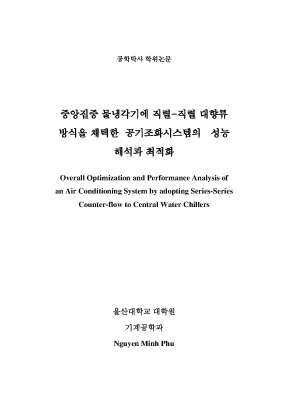
Tải xuống để đọc toàn bộ공학박사 학위논문 중앙집중 물냉각기에 직렬-직렬 대향류 방식을 채택한 공기조화시스템의 성능 해석과 최적화 Overall Optimization and Performance Analysis of an Air Conditioning System by adopting Series-Series Counter-flow to Central Water Chillers 울산대학교 대학원 기계공학과 Nguyen Minh Phu Doctor of Philosophy Overall Optimization and Performance Analysis of an Air Conditioning System by adopting Series-Series Counter-flow to Central Water Chillers The Graduate School of the University of Ulsan Department of Mechanical Engineering Nguyen Minh Phu Overall Optimization and Performance Analysis of an Air Conditioning System by adopting Series-Series Counter-flow to Central Water Chillers 지 도 교 수 이근식 이 논문을 공학박사 학위 논문으로 제출함 2012 년 5 월 울산대학교 대학원 기계공학과 Nguyen Minh Phu Overall Optimization and Performance Analysis of an Air Conditioning System by adopting Series-Series Counter-flow to Central Water Chillers Supervisor: Prof. Geun Sik Lee A Dissertation Submitted to the Graduate School of the University of Ulsan In partial Fulfillment of the Requirements for the Degree of Doctor of Philosophy by Nguyen Minh Phu Department of Mechanical Engineering University of Ulsan, Republic of Korea May, 2012 Nguyen Minh Phu 의 공학박사 학위 논문을 인준함 심 사 위원장 김무현 인 심 사 위 원 이근식 인 심 사 위 원 원성필 인 심 사 위 원 이목인 인 심 사 위 원 김무근 인 울산대학교 대학원 2012 년 5 월 Overall Optimization and Performance Analysis of an Air Conditioning System by adopting Series-Series Counter-flow to Central Water Chillers This certifies that the dissertation of Nguyen Minh Phu is approved. Committee Chairman Prof. MOO HYUN KIM Committee Member Prof.
GEUN SIK LEE Committee Member Prof. SUNG PIL WON Committee Member Prof. MOK IN LEE Committee Member Prof. MOO GEUN KIM Department of Mechanical Engineering University of Ulsan, Republic of Korea May, 2012 ACKNOWLEDGEMENTS I would like to express my heartfelt gratitude to my advisor, Prof.-Ing Geun Sik Lee, who not only gives me priceless guidance in scientific work but also supports me the financial help for three and half years studying in the University of Ulsan.
I would like to thank professors in the committee for their suggestions and comments throughout the research. Sincerely thank to University of Ulsan that grants me the scholarship and opportunity for studying in Korea. I also express my gratitude to professors and staff members of the Department of Mechanical Engineering for their kind help. Special thank to Korea and Korean people for their civilization and friendship.
I would like to thank my family members, who encourage and suffer a separation during the period I am away from home. Specially thank to all members of the Entire Energy Harmony laboratory who support me a lot in my research work. I’d like to thank the Union of Vietnamese Students at University of Ulsan for spiritual help and consulting abroad living experience, and close friends in Vietnam who always look forward to my returning our motherland. Ulsan, Republic of Korea.
May, 2012 NGUYEN MINH PHU CONTENTS Abstract. iii List of figures. vi List of tables .2 Problem statement, necessity, objectives and thesis layout. Analysis and design of a water chiller using commercial enhanced tubes .1 Heat transfer model .2 Water pressure drop model .3 Results and discussion .4 Comparison to commercial software.
Effect of water temperature and water flow rate on wet cooling tower .2 Merkel’s theory and the empirical correlations .3 Formulation of psychrometric properties of moist air .4 Solution procedure and validation .5 Results and discussion. Experimental and modeling studies of a dehumidifying cooling coil .2 Enthalpy potential method .3 Experimental set-up .5 Results and discussion. Overall optimization and exergy analysis of the air-conditioning system with series-series counter-flow chillers .2 Description of the central air conditioning system and solution procedure .3 Results and discussion. Discussion, conclusions, and future work .1 Discussion and conclusions.
105 List of publications. 114 -ii- Overall Optimization and Performance Analysis of an Air Conditioning System by adopting Series-Series Counter-flow to Central Water Chillers By Nguyen Minh Phu Department of Mechanical Engineering Graduate School, University of Ulsan ABSTRACT When central water chillers in air conditioning are arranged in series-series counter-flow (SSCF), compressor lift of each chiller decreases in comparison with that of water chillers in parallel. That means that the compressor power of the chillers in SSCF is lower than that of chillers in parallel. However, the water pressure drop of the SSCF chillers increases, i.
increase in power of water pumps, because the water flow rates of SSCF chillers are the flow rates of the whole system. This disadvantage will be solved by increasing the temperature difference of water flow through an evaporator and condenser, but the water flow rates will decrease. Under the conditions of high temperature differences and low water flow rates, cooling coil and cooling tower may be affected. Hence, in this thesis, we consider overall air conditioning system including SSCF water chillers, cooling coil and cooling tower.
Those components are modeled and simulated in viewpoints of the first and second laws of thermodynamics. Model formulations of transfers and pressure drops are performed in the thesis, namely as follows. The water chiller model is based on the logarithmic mean temperature difference (LMTD) method. Refrigerant R134a condenses and evaporates on the tube bundles of condenser and evaporator of the chiller; whereas, chilled water and condenser water pass inside tubes.
The tubes are commercial enhanced tubes so that heat transfer areas can be diminished and the problem can be reached reality. Refrigerant pressure drop is neglected. But water pressure -iii- drop is considered. Results of the water chiller model are verified by the commercial software HTRI Xchanger suite.
Simulation results show that with larger number of tubes than a specified one, the length of the tube can be short if a tube of small diameter is used. It avoids a design of large number of tube and large tube diameter. This is because inner thermal resistance can be lessened with the tube of small diameter. This conclusion reduces in capital cost of heat exchanger.
Tube diameter must be as low as 10.08 mm when number of tubes is more than 630 if the condenser capacity is 3412.4 kW with the common design conditions of cooling water and refrigerant R134a. However, tube of small diameter results in high water pressure drop. Therefore, an optimization can be carried out by trade-off of capital and operating costs. A cooling tower model is derived by using Merkel’s theory in company with the empirical correlations of transfer and air pressure drop from previous studies.
The model optimizes power of the cooling tower fan. The optimization problem is compared with the previous study that used the optimization package DICOPT (DIscrete and Continuous OPTimizer). A prominent result can be deduced. A condition of high temperature of water entering the cooling tower and low water flow does not bring an effective energy consumption of the fan.
With that condition, the air flow rate can be reduced but the length of cooling tower fill has to be longer in order to increase the contact time between water of high temperature and air. This trade-off leads to maximum power consumption of the fan at a certain value of the entering water temperature. That means the water temperature should be higher or lower than this value. From this work, the water temperature is 36oC and doesn’t depend on the thermal duty of the tower.
Only at a rather high water temperature, potential of heat and mass transfer can be strengthened and therefore fan power can be lowered. The cooling coil model is based on the enthalpy potential method and sustainable correlations of McQuiston about continuous plate fin under wet and dry environments. An experimental apparatus is set up to validate the model and carry out further studies. From analysis, it can be deduced that air pressure drop under fully wet and fully dry conditions are well predicted by the correlations of McQuiston.
However, the correlations have not covered the prediction in partially wet condition. Hence, a linear correlation between fully wet and -iv- fully dry zones is proposed to predict the air pressure drop in partially wet condition and proposition is confirmed by the experiment. A combination of the above models to simulate overall air conditioning system is then conducted in this study. The water temperature entering cooling coil, the water temperature leaving cooling tower, condenser water flow rate and number of SSCF chillers are assigned as key parameters.
Results can be seen as follows. The COP (Coefficient of performance) of the entire system can obtain maximum at a certain number of SSCF chillers when SSCF chillers system is operated with the same operating parameters of conventional parallel chillers system and when number of SSCF chillers is more than 4, the air conditioning system with SSCF chillers is ineffective. Trade-offs of power consumptions were pointed out as functions of the water temperature entering cooling coil, the water temperature leaving cooling tower, and the condenser water flow rate in order to see that an overall optimization is necessary. The COP after optimization can be greater up to 26% than that of conventional parallel chillers and the COP reduces as the number of chiller in SSCF increases.
Optimal parameters corresponding to number of SSCF chillers were shown so that they are can set in reality. Exergy analysis was performed with the parameters that make the maximum COP at each number of SSCF chillers. Result shows that the exergy efficiency of SSCF chillers system (83%) is higher than that of parallel chillers system (77%). Irreversibilities of the components in SSCF chillers are lower than those of components in parallel chillers.
But irreversibilities of cooling coil and cooling tower in SSCF chillers are slightly higher and lower than those in parallel chillers, respectively. Key words: Air conditioning, Overall optimization, Heat exchanger, Series-series counter- flow. -v- LIST OF FIGURES Fig. a) Parallel, b) Series-series counter-flow.2 Trends of water temperatures, condensation temperature and evaporation temperature.
a) Parallel chillers, b) SSCF chillers.3 Conceptualization of reduced lift (Groenke and Schwedler, 2002).4 Structure of the present thesis with a central air conditioning system.1 Pressure-enthalpy diagram of the considered water chiller.2 Notations used in the finned-tube.3 Enhanced boiling surface of turbo-B tube (Browne and Bansal, 1999).4 Boiling heat transfer coefficient on Turbo-B tube (Wolverine, Inc.5 Tube length vs. the number of tubes and tube passes.6 Reynolds number vs. the number of tubes and tube passes.7 Water pressure drop vs. the number of tubes and tube passes.8 Allowable tube side ( Pt ) and shell side ( Ps ) pressure drops (Muralikrishna and Shenoy, 2000).9 Tube length vs.
the number of tubes and tube inner diameter.10 Thermal resistances for four cases.11 Reynolds number vs. the number of tubes and tube inner diameter.12 Water pressure drop vs. the number of tubes and tube inner diameter.13 Tube length vs. the number of tubes and tube passes.14 Reynolds number vs.
the number of tubes and tube passes.15 Water pressure drop vs. the number of tubes and tube passes.16 An interface of HTRI software.17 Graphical results from HTRI software. a) HTRI condenser, b) HTRI evaporator.1 A sketch of cooling tower and its notations.2 A differential control volume of a counter-flow cooling tower.3 Equilibrium and operating lines on enthalpy-temperature diagram (Serna-González et al.4 Algorithm for searching the optimal fan power .5 Comparison about a) TAC, b) Me and c) Kfi to examples in previous study (Serna- González et al.6 Merkel number against Tw,in for all the considered Q .7 Dry air flow rate against Tw,in and Q .8 Cross sectional area of fill against Tw,in and Q .9 Fill height against Tw,in for all the considered Q .10 Loss coefficient against Tw,in for all the considered Q .11 Total pressure drop for all the considered Q .12 Fan power against Tw,in and Q .1 Circular fin in fully dry (a), fully wet (b), and partially wet (c) surface conditions (Pirompugd et al.2 Tube and wet fin with notations.3 Photo and the detailed test coil of the present experimental setup.
Nội dung được bảo vệ bản quyền — Tải xuống đầy đủ
Trích dẫn luận án này
Nguyen Minh Phu (2012). Tối ưu hiệu suất hệ thống điều hòa dùng chiller SSCF [Luận án tiến sĩ, University of Ulsan]. LuanAn.net. https://luanan.net/ky-thuat-co-khi/ky-thuat-nhiet/toi-uu-hieu-suat-he-thong-dieu-hoa-chiller-sscf
Câu hỏi thường gặp
Luận án "Tối ưu hiệu suất hệ thống điều hòa dùng chiller SSCF" nghiên cứu về vấn đề gì?
Luận án tối ưu hóa tổng thể, phân tích hiệu suất hệ thống điều hòa không khí. Áp dụng dòng đối lưu nối tiếp cho máy làm lạnh nước trung tâm.
Luận án "Tối ưu hiệu suất hệ thống điều hòa dùng chiller SSCF" được bảo vệ tại trường nào?
Luận án này được bảo vệ tại University of Ulsan. Năm bảo vệ: 2012.
Luận án "Tối ưu hiệu suất hệ thống điều hòa dùng chiller SSCF" thuộc chuyên ngành gì?
Luận án "Tối ưu hiệu suất hệ thống điều hòa dùng chiller SSCF" thuộc chuyên ngành Mechanical Engineering. Danh mục: Kỹ Thuật Nhiệt.
Luận án "Tối ưu hiệu suất hệ thống điều hòa dùng chiller SSCF" có bao nhiêu trang?
Luận án "Tối ưu hiệu suất hệ thống điều hòa dùng chiller SSCF" có 173 trang. Bạn có thể xem trước một phần tài liệu ngay trên trang web trước khi tải về.
Cách tải luận án "Tối ưu hiệu suất hệ thống điều hòa dùng chiller SSCF" về máy như thế nào?
Để tải luận án về máy, bạn nhấn nút "Tải xuống ngay" trên trang này, sau đó hoàn tất thanh toán phí lưu trữ. File sẽ được tải xuống ngay sau khi thanh toán thành công. Hỗ trợ qua Zalo: 0559 297 239.