Luận án: Kinh tế ngầm, FDI, chất lượng thể chế và bất bình đẳng thu nhập tại châu Á
Luận án phân tích kinh tế ngầm, FDI chất lượng thể chế, bất bình đẳng thu nhập tại Châu Á. Nghiên cứu dựa trên bằng chứng thực nghiệm.
Năm xuất bản
Số trang
189
Thời gian đọc
29 phút
Lượt xem
0
Lượt tải
0
Phí lưu trữ
50 Point
Tổng quan nhanh
- Chủ đề:
- Kinh tế ngầm châu Á: Bối cảnh và mối liên hệ chính
- Số trang:
- 189 trang
- Trường:
- Trường Đại học Kinh tế Thành phố Hồ Chí Minh
- Chuyên ngành:
- Development Economics
- Tác giả:
- Huynh Cong Minh
- Năm:
- 2018
Tóm tắt nội dung luận án
I.Kinh tế ngầm châu Á Bối cảnh và mối liên hệ chính
Kinh tế ngầm đại diện cho các hoạt động kinh tế không được chính phủ ghi nhận. Hiện tượng này phổ biến ở nhiều quốc gia, đặc biệt là tại châu Á. Nghiên cứu này tập trung vào mối quan hệ phức tạp giữa kinh tế ngầm, đầu tư trực tiếp nước ngoài (FDI), chất lượng thể chế và bất bình đẳng thu nhập. Phân tích thực nghiệm từ các quốc gia châu Á cung cấp cái nhìn sâu sắc. Các phát hiện giúp xây dựng chính sách hiệu quả. Mục tiêu là kiểm soát kinh tế phi chính thức châu Á. Đồng thời, cải thiện môi trường đầu tư và xã hội. Kinh tế bóng tối khu vực ảnh hưởng lớn đến tăng trưởng kinh tế và phân phối tài sản. Việc hiểu rõ các động lực này là cần thiết. Chính phủ có thể thiết kế các giải pháp phù hợp. Các giải pháp này nhằm thúc đẩy phát triển bền vững và công bằng.
1.1. Định nghĩa và phạm vi kinh tế phi chính thức
Kinh tế phi chính thức bao gồm các hoạt động sản xuất hàng hóa và dịch vụ bị che giấu. Hoạt động này tránh né thuế, quy định hoặc thống kê của chính phủ. Nó tồn tại ở mọi nền kinh tế, với quy mô và đặc điểm khác nhau. Ở châu Á, kinh tế ngầm có thể chiếm một phần đáng kể GDP. Điều này gây khó khăn cho việc hoạch định chính sách. Việc đo lường chính xác kinh tế bóng tối khu vực là thách thức lớn. Các phương pháp khác nhau được sử dụng để ước tính quy mô. Kết quả mang lại cái nhìn tổng quan về mức độ phổ biến của nó. Sự hiện diện của kinh tế phi chính thức châu Á phản ánh nhiều vấn đề cấu trúc. Điều này bao gồm chất lượng thể chế yếu kém và gánh nặng thuế cao.
1.2. Các yếu tố hình thành kinh tế bóng tối khu vực
Nhiều yếu tố thúc đẩy sự phát triển của kinh tế ngầm. Gánh nặng thuế và quy định hành chính phức tạp là nguyên nhân chính. Tham nhũng và chất lượng thể chế yếu kém cũng góp phần. Mức độ thất nghiệp cao có thể đẩy người lao động vào khu vực phi chính thức. Các doanh nghiệp tìm cách giảm chi phí sản xuất. Họ né tránh các chi phí tuân thủ pháp luật. Mức độ phát triển kinh tế và cấu trúc ngành cũng ảnh hưởng. Tỷ lệ kinh tế ngầm thường cao hơn ở các nước đang phát triển. Năng lực quản lý nhà nước còn hạn chế. Điều này tạo điều kiện cho các hoạt động không chính thức gia tăng. Mối quan hệ giữa tham nhũng và kinh tế ngầm ở châu Á là rõ ràng.
II.FDI và Chất lượng thể chế tác động kinh tế ngầm
FDI mang lại nhiều lợi ích cho các nền kinh tế. FDI có thể thúc đẩy tăng trưởng, chuyển giao công nghệ và tạo việc làm. Tuy nhiên, tác động của FDI đến kinh tế ngầm không phải lúc nào cũng tích cực. Sự có mặt của các công ty đa quốc gia có thể làm giảm kinh tế ngầm. Các công ty này thường tuân thủ quy định chặt chẽ hơn. Ngược lại, FDI cũng có thể gián tiếp nuôi dưỡng một số hoạt động ngầm. Điều này xảy ra khi các công ty địa phương tìm cách cạnh tranh. Chất lượng thể chế đóng vai trò quan trọng. Thể chế mạnh mẽ có khả năng giảm quy mô kinh tế ngầm. Chúng đảm bảo thực thi pháp luật và giảm tham nhũng. Đầu tư trực tiếp nước ngoài và phát triển bền vững phụ thuộc vào chất lượng thể chế. Một hệ thống pháp luật minh bạch và công bằng là nền tảng vững chắc.
2.1. Ả̉nh hưởng của FDI đến quy mô kinh tế ngầm
FDI có thể tác động hai chiều đến kinh tế ngầm. Một mặt, các doanh nghiệp FDI thường hoạt động trong môi trường chính thức. Họ tuân thủ luật pháp và trả thuế đầy đủ. Điều này có thể giúp thu hẹp quy mô kinh tế ngầm bằng cách tăng tính minh bạch. FDI cũng có thể cải thiện năng lực quản lý của các chính phủ. Mặt khác, FDI có thể tạo ra các liên kết với khu vực phi chính thức. Các nhà cung cấp địa phương hoạt động không chính thức có thể tham gia chuỗi cung ứng. FDI cũng có thể làm tăng cạnh tranh. Điều này buộc các doanh nghiệp trong nước phải tìm cách giảm chi phí. Họ có thể chuyển sang hoạt động ngầm để tồn tại. Mối quan hệ FDI và kinh tế ngầm phức tạp, cần được xem xét cẩn thận.
2.2. Chất lượng thể chế và vai trò trong kiểm soát kinh tế ngầm
Chất lượng thể chế là yếu tố then chốt. Thể chế tốt bao gồm pháp quyền mạnh, kiểm soát tham nhũng và hiệu quả quản lý hành chính. Một thể chế mạnh mẽ tạo ra môi trường kinh doanh minh bạch. Điều này khuyến khích các doanh nghiệp hoạt động chính thức. Ngược lại, thể chế yếu kém sẽ làm gia tăng kinh tế ngầm. Nó tạo cơ hội cho tham nhũng và trốn tránh thuế. Chất lượng thể chế kinh tế châu Á còn nhiều khác biệt. Các nước có thể chế tốt hơn thường có quy mô kinh tế ngầm nhỏ hơn. Việc củng cố thể chế là giải pháp dài hạn. Nó giúp kiểm soát hiệu quả kinh tế phi chính thức. Các chính sách chống tham nhũng có ý nghĩa quan trọng.
2.3. Mối quan hệ tương tác FDI và thể chế
Mối quan hệ giữa FDI và thể chế là tương hỗ. FDI có xu hướng chảy vào các quốc gia có thể chế ổn định và minh bạch. Thể chế tốt giúp giảm rủi ro cho nhà đầu tư. Ngược lại, sự hiện diện của FDI có thể thúc đẩy cải cách thể chế. Các nhà đầu tư nước ngoài thường yêu cầu môi trường kinh doanh công bằng. Điều này gây áp lực lên chính phủ để cải thiện pháp quyền. Tuy nhiên, trong một số trường hợp, FDI có thể khai thác điểm yếu của thể chế. Điều này đặc biệt đúng ở các nước có tham nhũng cao. Việc hiểu rõ tác động của FDI đến phân phối thu nhập đòi hỏi xem xét bối cảnh thể chế. Thể chế yếu có thể làm trầm trọng thêm sự bất bình đẳng.
III.Kinh tế ngầm ảnh hưởng bất bình đẳng thu nhập khu vực
Kinh tế ngầm có thể tác động đến bất bình đẳng thu nhập theo nhiều cách. Một số lập luận cho rằng nó cung cấp cơ hội việc làm cho người nghèo. Đặc biệt là những người không tìm được việc làm trong khu vực chính thức. Điều này có thể giúp giảm nhẹ bất bình đẳng. Tuy nhiên, các hoạt động ngầm thường có mức lương thấp. Người lao động ít được bảo vệ và không có phúc lợi xã hội. Điều này có thể làm trầm trọng thêm sự bất bình đẳng thu nhập khu vực. Các nghiên cứu cần phân tích kỹ lưỡng các kênh tác động này. Hệ số Gini các nước châu Á thường được sử dụng để đo lường bất bình đẳng. Dữ liệu này giúp đánh giá tác động thực tế của kinh tế ngầm.
3.1. Tác động của kinh tế ngầm đến phân phối thu nhập
Kinh tế ngầm có thể vừa giảm vừa tăng bất bình đẳng. Nó cung cấp nguồn thu nhập cho những người bị loại khỏi khu vực chính thức. Điều này có thể làm giảm chênh lệch thu nhập giữa các nhóm. Tuy nhiên, người lao động trong khu vực ngầm thường nhận lương thấp. Họ thiếu các quyền lợi lao động cơ bản. Họ dễ bị bóc lột và không có khả năng thăng tiến. Điều này có thể làm gia tăng bất bình đẳng. Hơn nữa, những người có khả năng tiếp cận các hoạt động ngầm sinh lời cao lại kiếm được nhiều. Những người ít có khả năng thì không. Điều này tạo ra một sự phân hóa mới. Tác động của FDI đến phân phối thu nhập cũng cần được xem xét cùng với kinh tế ngầm. FDI có thể tạo ra việc làm tốt nhưng cũng làm tăng khoảng cách lương.
3.2. Đo lường bất bình đẳng thu nhập ở châu Á Hệ số Gini
Hệ số Gini là thước đo phổ biến về bất bình đẳng thu nhập. Giá trị của nó dao động từ 0 (bình đẳng hoàn toàn) đến 1 (bất bình đẳng hoàn toàn). Các nước châu Á thể hiện sự đa dạng về hệ số Gini. Một số quốc gia có mức độ bất bình đẳng tương đối thấp. Một số khác lại đối mặt với thách thức lớn. Việc phân tích hệ số Gini cùng với quy mô kinh tế ngầm là cần thiết. Điều này giúp hiểu rõ hơn mối liên hệ giữa hai yếu tố. Các yếu tố thể chế và bất bình đẳng thu nhập cũng có mối quan hệ chặt chẽ. Thể chế yếu kém có thể dẫn đến phân phối tài nguyên không công bằng. Điều này làm gia tăng khoảng cách giàu nghèo.
IV.Kết quả nghiên cứu thực nghiệm Phân tích châu Á
Nghiên cứu sử dụng dữ liệu từ 19 quốc gia châu Á. Các mô hình kinh tế lượng được áp dụng để phân tích các mối quan hệ. Kết quả cung cấp bằng chứng thực nghiệm mạnh mẽ. Kinh tế ngầm, FDI, chất lượng thể chế và bất bình đẳng thu nhập có mối liên hệ chặt chẽ. Phương pháp tiếp cận cẩn thận giúp kiểm soát các yếu tố nhiễu. Dữ liệu bảng (panel data) cho phép theo dõi các thay đổi qua thời gian. Các phát hiện cho thấy vai trò quan trọng của từng yếu tố. Đồng thời chỉ ra sự tương tác phức tạp giữa chúng. Các phát hiện này có giá trị cho các nhà hoạch định chính sách. Họ có thể đưa ra quyết định dựa trên bằng chứng. Từ đó thúc đẩy phát triển kinh tế bao trùm ở châu Á.
4.1. Phương pháp luận và dữ liệu từ các nước châu Á
Nghiên cứu áp dụng phương pháp định lượng. Các mô hình kinh tế lượng tiên tiến được sử dụng. Chúng bao gồm các mô hình cho dữ liệu bảng (panel data). Mẫu nghiên cứu bao gồm 19 quốc gia châu Á trong giai đoạn từ năm 1990 đến 2014. Dữ liệu về kinh tế ngầm được ước tính bằng phương pháp MIMIC. Dữ liệu về FDI, chất lượng thể chế và bất bình đẳng thu nhập được thu thập từ các nguồn quốc tế uy tín. Việc chọn mẫu và phương pháp đảm bảo tính vững chắc của kết quả. Điều này giúp đưa ra bằng chứng đáng tin cậy về kinh tế phi chính thức châu Á. Phân tích này cũng xem xét các biến kiểm soát khác. Các biến này ảnh hưởng đến các mối quan hệ được nghiên cứu.
4.2. Phát hiện chính về FDI thể chế và kinh tế ngầm
Kết quả nghiên cứu chỉ ra một số phát hiện quan trọng. Chất lượng thể chế có tác động tiêu cực đáng kể đến quy mô kinh tế ngầm. Thể chế tốt hơn giúp giảm bớt các hoạt động ngầm. FDI cũng có tác động phức tạp. Trong một số điều kiện, FDI có thể giúp giảm kinh tế ngầm. Đặc biệt là khi chất lượng thể chế đủ mạnh. Tuy nhiên, FDI không phải lúc nào cũng là giải pháp. FDI không tự động giải quyết được vấn đề kinh tế bóng tối khu vực. Tác động của FDI đến phân phối thu nhập cần được xem xét. Chất lượng thể chế kinh tế châu Á là yếu tố quyết định. Nó ảnh hưởng đến hiệu quả của đầu tư trực tiếp nước ngoài và phát triển.
4.3. Phát hiện về kinh tế ngầm và bất bình đẳng thu nhập
Nghiên cứu cũng phát hiện ra mối quan hệ giữa kinh tế ngầm và bất bình đẳng thu nhập. Quy mô kinh tế ngầm lớn hơn có thể làm gia tăng bất bình đẳng thu nhập. Điều này mâu thuẫn với một số quan điểm cho rằng nó giúp người nghèo. Những người tham gia vào kinh tế ngầm thường thiếu bảo vệ xã hội. Họ đối mặt với điều kiện làm việc kém. Thu nhập không ổn định. Điều này làm trầm trọng thêm tình trạng bất bình đẳng thu nhập khu vực. Cần có các chính sách để hỗ trợ người lao động trong khu vực này. Các chính sách này giúp họ chuyển đổi sang khu vực chính thức. Giảm tham nhũng và kinh tế ngầm ở châu Á là bước đi cần thiết để đạt được sự công bằng hơn.
V.Hàm ý chính sách Đối phó kinh tế ngầm và bất bình đẳng
Kết quả nghiên cứu cung cấp cơ sở cho các hàm ý chính sách. Các chính phủ cần ưu tiên cải thiện chất lượng thể chế. Điều này là để kiểm soát kinh tế ngầm và giảm bất bình đẳng. Các biện pháp bao gồm tăng cường pháp quyền, giảm tham nhũng và minh bạch hóa hành chính. Ngoài ra, cần có các chính sách quản lý FDI hiệu quả. Các chính sách này nhằm tối đa hóa lợi ích của FDI. Đồng thời, hạn chế các tác động tiêu cực đến kinh tế ngầm và phân phối thu nhập. Việc giảm bất bình đẳng thu nhập khu vực là mục tiêu quan trọng. Điều này đòi hỏi một cách tiếp cận đa chiều. Phối hợp giữa các chính sách kinh tế và xã hội là cần thiết. Khuyến nghị chính sách này nhằm thúc đẩy phát triển bền vững và công bằng hơn ở châu Á.
5.1. Khuyến nghị chính sách nâng cao chất lượng thể chế
Chính phủ cần tập trung vào cải cách thể chế. Tăng cường pháp quyền là ưu tiên hàng đầu. Thực thi công bằng và minh bạch các quy định pháp luật. Giảm thiểu tham nhũng trong bộ máy nhà nước. Nâng cao hiệu quả của các cơ quan quản lý. Đơn giản hóa thủ tục hành chính. Điều này giúp giảm gánh nặng tuân thủ cho doanh nghiệp. Thúc đẩy công khai, minh bạch trong quản lý công. Đầu tư vào xây dựng năng lực thể chế. Các biện pháp này sẽ làm giảm động cơ hoạt động phi chính thức. Đồng thời, củng cố lòng tin vào hệ thống. Chất lượng thể chế kinh tế châu Á cần được cải thiện liên tục.
5.2. Giải pháp quản lý FDI và giảm kinh tế ngầm
Chính phủ cần thu hút FDI có chất lượng cao. Các dự án FDI cần tạo ra giá trị gia tăng. FDI nên tạo ra việc làm chính thức. Thúc đẩy liên kết giữa doanh nghiệp FDI và doanh nghiệp địa phương. Cần có các chính sách hỗ trợ chuyển đổi từ khu vực ngầm sang chính thức. Đặt ra các tiêu chuẩn lao động rõ ràng. Đảm bảo tuân thủ các quy định về môi trường và xã hội. Điều này giúp FDI đóng góp tích cực vào phát triển. Đồng thời, ngăn chặn FDI khai thác các điểm yếu của thể chế. Mối quan hệ FDI và kinh tế ngầm cần được quản lý chặt chẽ. Đầu tư trực tiếp nước ngoài và phát triển bền vững là mục tiêu cuối cùng.
5.3. Chiến lược giảm bất bình đẳng thu nhập hiệu quả
Các chính sách xã hội và kinh tế cần được điều chỉnh. Mục tiêu là giảm bất bình đẳng thu nhập. Cần cải thiện hệ thống an sinh xã hội. Mở rộng tiếp cận giáo dục và y tế chất lượng cao. Đầu tư vào đào tạo nghề. Giúp người lao động nâng cao kỹ năng. Tạo điều kiện cho họ tham gia vào khu vực chính thức. Thực hiện chính sách thuế lũy tiến công bằng. Chống thất thu thuế từ kinh tế ngầm. Các chính sách này sẽ giúp tái phân phối thu nhập hiệu quả hơn. Chúng giảm thiểu sự chênh lệch giàu nghèo. Thể chế và bất bình đẳng thu nhập có mối liên hệ sâu sắc. Cải cách thể chế là nền tảng cho sự công bằng xã hội.
Mục lục chi tiết luận án
Tải xuống file đầy đủ để xem toàn bộ nội dung
Tải đầy đủ (189 trang)Trích đoạn nội dung luận án
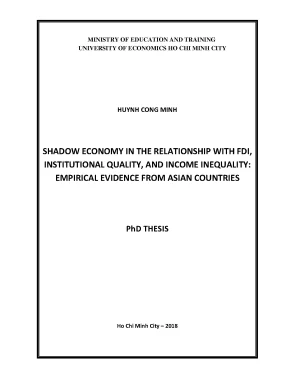
Tải xuống để đọc toàn bộMINISTRY OF EDUCATION AND TRAINING UNIVERSITY OF ECONOMICS HO CHI MINH CITY HUYNH CONG MINH SHADOW ECONOMY IN THE RELATIONSHIP WITH FDI, INSTITUTIONAL QUALITY, AND INCOME INEQUALITY: EMPIRICAL EVIDENCE FROM ASIAN COUNTRIES PhD THESIS Ho Chi Minh City – 2018 MINISTRY OF EDUCATION AND TRAINING UNIVERSITY OF ECONOMICS HO CHI MINH CITY HUYNH CONG MINH SHADOW ECONOMY IN THE RELATIONSHIP WITH FDI, INSTITUTIONAL QUALITY, AND INCOME INEQUALITY: EMPIRICAL EVIDENCE FROM ASIAN COUNTRIES Major: Development Economics Code: 9310105 PhD THESIS Advisors: 1. Nguyen Hoang Bao 2. Nguyen Vu Hong Thai Ho Chi Minh City – 2018 i This thesis submitted to the School of Economics, University of Economics Ho Chi Minh City, in partial fulfillment of the requirements for the degree of Doctor of Philosophy in development economics. ii DECLARATION I hereby declare that this thesis is my own research.
Data and results are reliable, clearly originated, and have never been published in any other study. The author iii ACKNOWLEDGEMENTS First of all, I would like to express my great gratitude to Dr. Nguyen Hoang Bao and Dr. Nguyen Vu Hong Thai for their invaluable supervision and inspirations.
Thank you so much for keeping me on track throughout the research process, giving wise comments, advices and encouragement during such a long academic journey. Then I am honestly grateful to Dr. Pham Khanh Nam, Dr. Truong Dang Thuy, Dr.
Le Van Chon, Dr. Vo Tat Thang, Dr. Vo Hong Duc, Associate Pro. Nguyen Huu Dung, Dr.
Nguyen Luu Bao Doan, Dr. Pham Thi Thu Tra, Dr. Pham Thi Bich Ngoc, Associate Pro. Vuong Duc Hoang Quan and the two independent Reviewers for their valuable comments and encouragements so that I can improve the quality of my thesis.
I cannot forget showing my special thanks to lecturers at school of economics as well as those at University of Economics HCMC such as Professor Dr. Nguyen Trong Hoai, Dr. Pham Khanh Nam, Dr. Truong Dang Thuy, Associate Pro.Nguyen Manh Hung, Dr.
Tran Thi Tuan Anh, Associate Pro. Tran Tien Khai… for their academic and practical instructions during my time of study and research at the university. Last but not least, I am deeply grateful to my beloved family, including my deceased father, my 83-year-old mother as well as my sisters and brothers who always support and encourage me in time for completing the thesis. iv TABLE OF CONTENTS Declaration Acknowledgements Table of contents List of Abbreviations List of Tables List of Figures Pages Chapter 1: Introduction.
Research context and gaps. Research subjects and scope. Research methodology and data …………………………………. 18 Chapter 2: Literature review and hypotheses.
Theories on shadow economy. Schools of thought. Empirical studies on shadow economy. Methods to estimate the size of the shadow economy.
The impacts of shadow economy (effects). Shadow economy, FDI and Institutional quality. FDI and institutional quality. Theories on FDI (Definition, Theories, Determinants).
Theories of institutional quality (Definition, Theories, Determinants) 47 2. The relationship between institutional quality and FDI. Institutional quality and shadow economy .1 The effect of institutional quality on shadow economy .2 The effect of shadow economy on institutional quality. Shadow economy and FDI .1 The effects of FDI and FDI-institutional quality interaction on shadow economy .2 The effects of shadow economy on FDI.
Shadow economy and income inequality. The impact of shadow economy on income inequality. 67 Chapter 3: Methodology, model specifications, and data. Empirical models and data.
The sample selection of 19 Asian countries and their backgrounds on research problems. 93 vi Chapter 4: Shadow economy, FDI and Institutional quality: empirical evidence from Asian countries. Data descriptive statistics. Unit-root test.
Estimation results and discussions. 102 Chapter 5: The impacts of shadow economy on income inequality in developing Asia. Data descriptive statistics. Empirical results and discussions.
119 Chapter 6: Conclusions and policy implications. Limitations and further research implications. 129 List of publications. 158 vii LIST OF ABBREVIATIONS 2SLS: Two-stage Least Squares 3SLS: Three-stage Least Squares ARDL: Autoregressive-distributed lag model AR1: First-order Autocorrelation AR2: Second-order Autocorrelation ECM: Error correction model EFR: Economic Freedom Report FDI: Foreign direct investment FE: Fixed Effects FH: The Freedom House GCI: Global Competitiveness Index GDP: Gross Domestic Products GLS: Generalized Least Squares GNI: Gross National Income MENA: Middle East and North Africa MIMIC: Multiple Indicators Multiple Causes MNCs: Multinational Corporations HDR: Human Development Report HF: The Heritage Foundation ICRG: The International Country Risk Guide IEF: Index of Economic Freedom viii ILO: International Labor Organization IMF: International Monetary Fund IQ: Institutional quality JGLS: Joint Generalized Least Squares OLI: Ownership, Location, and Internalization OLS: Ordinary Least Squares POLS: Pooled Ordinary Least Squares PRS: Political Risk Services Group RE: Random Effects SEM: Simultaneous equation model SGMM: Two Steps System Generalized Method of Moments SURE: Seemingly Unrelated Regression UNESCO: United Nations Educational Scientific and Cultural Organization UNCTAD: United Nations Conference on Trade and Development UNDP: United Nations Development Programme WB: World Bank WDI: World Development Indicators WEF: World Economic Forum WGIs: Worldwide Governance Indicators ix LIST OF TABLES Table 2.
Labor market classification. Structure of informal work typology. Unit root tests for all variables. The estimation results of the SEM by 3SLS and Two Steps System GMM.
The effect of FDI on shadow economy. Definition and summary statistics. Final estimation results for the impact of shadow economy on income inequality by FE and RE. Estimation results for the impact of shadow economy on income inequality by 2 Steps SGMM.
121 x LIST OF FIGURES Figure 1. Institutional quality by 5 components in Asian countries on average from 2002-2015. The size of shadow economy as a share of official GDP and FDI as the percentage of GDP in Asian countries on average from 1999-2015. Recent trends of income inequality in Asian developing countries.
The place of institutions in the FDI determinants pattern. The theoretical framework for the link between shadow economy and income inequality. The analytical framework for the relationship among FDI, institutional quality, shadow economy and income inequality. The shadow economy and income inequality in Asian countries (1990-2015) ……………………………………………………………………………….
115 1 CHAPTER 1 INTRODUCTION Chapter Outline 1. Research context and gap 1. Research subjects and scope 1. Research methodology and data 1.1 Research context and gaps 1.1 Practical background For recent decades, shadow economy, investment from abroad, institutional quality and income inequality have attracted a great deal of attention in development economics because all of them relate to economic growth.
Both of foreign direct investment (FDI) and institutional quality (IQ) are considered important determinants of economic growth and development (Borensztein, Gregorio, & Lee, 1998; Nair- Reichert & Weinhold, 2001; Rodrik, Subramanian, & Trebbi, 2004; Acemoglu, 2 Johnson, & Robinson, 2005; Hansen & Rand, 2006; Varsakelis, 2006; and Kandil, 2009). While the official economy is closely related to the shadow economy (Schneider & Bajada, 2003; Vo & Pham, 2014). Moreover, economic growth is associated with income inequality (Kuznets, 1955; Barro, 2000). Especially, these variables and their relationships become worth studying in the context of Asia for its rising thorny features, such as high flow of FDI but low institutional quality, large shadow economy and rising income inequality.
First, global foreign direct investment has significantly grown since the 1970s, reached $1.76 trillion in 2015, fell 13% in 2016 ($1.52 trillion) and recovered in 2017; especially, developing Asia is now the largest recipient and accounts for almost one- third of total FDI inflows (UNCTAD, 2017). It is seen as the result of Asian countries in effort to attract FDI for economic development by adopting an open door policy, governance changes & institutional innovation (Haggard, 2004; Lee, 2002). However, the positive impact of FDI on economic growth depends on the institutional quality in the host countries (Brahim & Rachdi, 2014; Jude & Levieuge, 2017). It is also Asia‘s specific concern, especially when there are many countries might be stuck in middle income trap in the region and deficient institutional quality is one of the main causes (Dollar, 2015).1 describes the institutional quality by 5 components (including Voice and Accountability, Political Stability and Absence of Violence, Government Effectiveness, Regulatory Quality, and Rule of Law) in 19 Asian countries1 on average from 2002-2015.
The scale of measurement ranks from -2. In general, the institutional quality in Asian countries is low. The improvement has been seen but it is a slow progress. FDI has flowed into Asian countries in great amounts, but institutional quality is still 1 Including Bangladesh, Bhutan, Cambodia, China, India, Indonesia, Kazakhstan, Kyrgyzstan, Laos, Malaysia, Maldives, Mongolia, Myanmar, Nepal, Pakistan, Philippines, Sri Lanka, Thailand, and Vietnam.
Luận án đủ ở file: Luận án full
Nội dung được bảo vệ bản quyền — Tải xuống đầy đủ
Trích dẫn luận án này
Huynh Cong Minh (2018). Kinh tế ngầm, FDI, thể chế và bất bình đẳng thu nhập châu Á [Luận án tiến sĩ, University of Economics Ho Chi Minh City]. LuanAn.net. https://luanan.net/kinh-te/kinh-te-phat-trien/kinh-te-ngam-fdi-chat-luong-the-che-bat-binh-dang-thu-nhap-chau-a
Câu hỏi thường gặp
Luận án "Kinh tế ngầm, FDI, thể chế và bất bình đẳng thu nhập châu Á" nghiên cứu về vấn đề gì?
Luận án phân tích kinh tế ngầm, FDI chất lượng thể chế, bất bình đẳng thu nhập tại Châu Á. Nghiên cứu dựa trên bằng chứng thực nghiệm.
Luận án "Kinh tế ngầm, FDI, thể chế và bất bình đẳng thu nhập châu Á" được bảo vệ tại trường nào?
Luận án này được bảo vệ tại University of Economics Ho Chi Minh City. Năm bảo vệ: 2018.
Luận án "Kinh tế ngầm, FDI, thể chế và bất bình đẳng thu nhập châu Á" thuộc chuyên ngành gì?
Luận án "Kinh tế ngầm, FDI, thể chế và bất bình đẳng thu nhập châu Á" thuộc chuyên ngành Development Economics. Danh mục: Kinh Tế Phát Triển.
Luận án "Kinh tế ngầm, FDI, thể chế và bất bình đẳng thu nhập châu Á" có bao nhiêu trang?
Luận án "Kinh tế ngầm, FDI, thể chế và bất bình đẳng thu nhập châu Á" có 189 trang. Bạn có thể xem trước một phần tài liệu ngay trên trang web trước khi tải về.
Cách tải luận án "Kinh tế ngầm, FDI, thể chế và bất bình đẳng thu nhập châu Á" về máy như thế nào?
Để tải luận án về máy, bạn nhấn nút "Tải xuống ngay" trên trang này, sau đó hoàn tất thanh toán phí lưu trữ. File sẽ được tải xuống ngay sau khi thanh toán thành công. Hỗ trợ qua Zalo: 0559 297 239.