Luận án tiến sĩ behaviour of steel concrete composite beams made of ultra high p
Phân tích ứng xử chịu lực của dầm hỗn hợp thép-bê tông trong luận án tiến sĩ. Đánh giá sức kháng uốn, cắt và biến dạng.
Năm xuất bản
Số trang
243
Thời gian đọc
37 phút
Lượt xem
0
Lượt tải
0
Phí lưu trữ
50 Point
Tổng quan nhanh
- Chủ đề:
- 1. Tìm hiểu dầm liên hợp thép bê tông và ứng dụng
- Số trang:
- 243 trang
- Trường:
- Universität Leipzig
- Chuyên ngành:
- Kỹ thuật xây dựng
- Tác giả:
- Bui Duc Vinh
- Năm:
- 2010
Tóm tắt nội dung luận án
I. Tìm hiểu dầm liên hợp thép bê tông và ứng dụng
Dầm liên hợp thép bê tông là cấu kiện quan trọng trong xây dựng hiện đại. Chúng kết hợp giữa thép và bê tông, tạo ra các cấu trúc có khả năng chịu lực tốt hơn. Việc sử dụng dầm liên hợp mang lại hiệu quả kinh tế và giảm thiểu trọng lượng công trình. Dầm này được sử dụng phổ biến trong cầu, tòa nhà cao tầng và các công trình hạ tầng khác.
1.1. Lợi ích của dầm liên hợp
Dầm liên hợp giúp tăng cường cường độ chịu uốn và cường độ chịu cắt. Chúng cũng cải thiện độ cứng của cấu kiện, giúp tăng khả năng chịu tải và kéo dài tuổi thọ công trình.
1.2. Các loại vật liệu sử dụng
Thép hình và bê tông là hai vật liệu chính trong dầm liên hợp. Bê tông có thể được thay thế bằng Ultra High Performance Concrete (UHPC) để nâng cao tính năng cơ học.
II. Đặc tính của UHPC trong dầm liên hợp
Ultra High Performance Concrete (UHPC) cung cấp cường độ vượt trội với khả năng chịu nén cao. Sự kết hợp này tạo ra các dầm liên hợp có khả năng chống lại các tác động môi trường tốt hơn. Bê tông UHPC có mật độ cao, giúp tăng cường độ bền và độ ổn định cho dầm.
2.1. Cường độ và độ bền
UHPC có cường độ chịu nén lớn hơn 150 MPa và cường độ chịu kéo trên 7 MPa. Điều này cho phép dầm liên hợp sử dụng ít vật liệu hơn mà vẫn đảm bảo an toàn.
2.2. Khả năng chống thấm và ăn mòn
Với cấu trúc dày đặc, UHPC có khả năng chống thấm và ăn mòn vượt trội, làm tăng tuổi thọ của dầm liên hợp trong các điều kiện khắc nghiệt.
III. Nghiên cứu về hành vi của dầm liên hợp
Nghiên cứu tập trung vào hành vi chịu uốn của dầm liên hợp thép bê tông sử dụng UHPC. Thí nghiệm được thực hiện với nhiều mẫu khác nhau để đánh giá hiệu suất của dầm dưới tải trọng uốn. Kết quả cho thấy UHPC cải thiện đáng kể khả năng chịu tải của dầm.
3.1. Thí nghiệm uốn
Các thử nghiệm uốn được thực hiện trên sáu dầm liên hợp với sự thay đổi về tỷ lệ thép và bê tông. Kết quả cho thấy sự khác biệt rõ rệt trong phản ứng của dầm khi thay đổi cấu hình.
3.2. Phân tích kết cấu
Phân tích kết cấu giúp hiểu rõ hơn về cách thức hoạt động của dầm liên hợp dưới áp lực. Điều này bao gồm việc xem xét sự phân bố ứng suất và biến dạng trong dầm.
IV. Vấn đề liên kết cắt và đinh chống cắt
Liên kết cắt và đinh chống cắt là yếu tố quan trọng trong dầm liên hợp. Chúng giúp truyền tải lực giữa các phần của dầm một cách hiệu quả. Đánh giá đúng vai trò của các liên kết này giúp cải thiện tính năng của cấu kiện.
4.1. Hiệu suất của liên kết cắt
Liên kết cắt không có gia cố thường có độ dẻo kém, trong khi các liên kết với gia cố cho thấy hiệu suất tốt hơn. Điều này ảnh hưởng đến khả năng chịu tải của dầm.
4.2. Vai trò của đinh chống cắt
Đinh chống cắt được sử dụng để tăng cường khả năng truyền tải lực. Việc cải thiện thiết kế của chúng có thể dẫn đến sự gia tăng đáng kể về cường độ chịu cắt của dầm.
V. Kết luận và hướng phát triển tương lai
Nghiên cứu về hành vi của dầm liên hợp thép bê tông là rất quan trọng cho ngành xây dựng. Những phát hiện từ nghiên cứu này mở ra hướng đi mới cho việc áp dụng UHPC trong các dự án xây dựng. Trong tương lai, cần tiếp tục nghiên cứu để tối ưu hóa thiết kế và nâng cao hiệu suất của dầm liên hợp.
5.1. Triển vọng nghiên cứu
Cần có thêm nhiều nghiên cứu về các loại vật liệu mới và phương pháp gia cố cho dầm liên hợp. Điều này sẽ giúp cải thiện tính năng và độ bền của cấu kiện.
5.2. Ứng dụng thực tế
Các ứng dụng thực tế của dầm liên hợp trong công trình xây dựng cần được nghiên cứu kỹ lưỡng để đảm bảo tính hiệu quả và an toàn trong thi công.
Mục lục chi tiết luận án
Tải xuống file đầy đủ để xem toàn bộ nội dung
Tải đầy đủ (243 trang)Nội dung chính
Tổng quan về luận án
Công trình nghiên cứu "Behaviour of Steel-Concrete Composite Beams Made of Ultra High Performance Concrete" của Tiến sĩ Bùi Đức Vinh, thực hiện dưới sự hướng dẫn khoa học của Giáo sư Nguyễn Việt Tuệ tại Viện Kết cấu Bê tông và Công nghệ Vật liệu Xây dựng (IMB), Đại học Leipzig (Đức), nằm trong khuôn khổ Chương trình Nghiên cứu Trọng điểm Quốc gia Đức DFG SPP 1182 ("Nachhaltiges Bauen mit Ultra-Hochleistungsbeton"). Nghiên cứu đánh dấu bước tiến tiên phong trong việc tích hợp vật liệu bê tông tính năng siêu cao (Ultra-High Performance Concrete - UHPC) vào kết cấu liên hợp thép - bê tông (Steel-Concrete Composite Beams - SCCB). Bối cảnh khoa học xuất phát từ giới hạn cơ học của bê tông thường (NSC) và bê tông cường độ cao (HSC) khi kết hợp với dầm thép: sự chênh lệch lớn về khả năng chịu nén khiến trục trung hòa rơi sâu xuống phần bản bụng (web) của dầm thép, làm giảm hiệu quả sử dụng vật liệu và gia tăng trọng lượng bản thân của công trình.
Khoảng trống nghiên cứu (research gap) cốt lõi được xác định từ các tài liệu kinh điển (Johnson, 2000; Hegger và cộng sự, 2009; Tue và cộng sự, 2008): các liên kết chịu cắt truyền thống như đinh neo hàn (headed stud shear connector - HSSC) thể hiện sự suy giảm độ dẻo nghiêm trọng và thường bị phá hoại giòn do nứt cục bộ hoặc gãy thân neo tại chân mối hàn khi đặt trong bản UHPC có độ cứng quá lớn. Hơn nữa, các mô hình tính toán chốt neo Perfobond (PSC) của Leonhardt và cộng sự (1987) hay Oguejiofor & Hosain (1997) được xây dựng trên bê tông thường và giả định có sự đóng góp của ứng suất tựa đầu tấm (end-bearing resistance), điều này không phản ánh đúng bản chất truyền lực của liên kết cắt dạng dải liên tục (continuous shear connection) trong UHPC.
Luận án đặt ra các câu hỏi nghiên cứu và giả thuyết khoa học cụ thể:
- RQ1: Khả năng tương tác liên hợp nguyên khối (monolithic composite action) giữa bản sàn UHPC mỏng và dầm thép hình chữ I thông qua chốt neo Perfobond dạng liên tục có thể đạt được trạng thái giới hạn dẻo hay không?
- RQ2: Sự phân bố dòng cắt dọc (longitudinal shear flow) và độ trượt tương đối (interface slip) diễn ra như thế nào dọc theo nhịp dầm dưới tác dụng của mô-men uốn dương (sagging moment)?
- RQ3: Mô hình vật liệu Microplane M4 có thể mô phỏng chính xác ứng xử phi tuyến đa trục và hiện tượng nứt cục bộ của UHPC trong liên kết liên hợp hay không?
- H1: Việc bố trí cốt thép xuyên qua lỗ chốt bê tông (dowel rebar) kết hợp cốt thép đai ngoài vỏ bọc (front cover rebar) sẽ chuyển đổi cơ chế phá hoại của chốt Perfobond từ giòn sang dẻo, đáp ứng tiêu chuẩn biến dạng trượt $\delta_{uk} \ge 6\text{ mm}$ theo Eurocode 4.
- H2: Bản UHPC cho phép dịch chuyển trục trung hòa dẻo lên sát mặt tiếp xúc, khai thác 100% công suất chịu nén của bản cánh trên dầm thép và nâng cao độ cứng uốn tổng thể lên trên 40% so với giải pháp bê tông thông thường.
Phạm vi thực nghiệm bao gồm 11 sê-ri thí nghiệm nhổ-trượt tiêu chuẩn (Standard Push-Out Test - SPOT) với 27 mẫu nén trượt và 6 dầm liên hợp tỷ lệ thực (B1 đến B6) với nhịp danh định chịu uốn 4 điểm, sử dụng cấp phối bê tông UHPC G7 và B4Q có hàm lượng cốt sợi thép 0.5% và 1.0% theo thể tích, đạt cường độ nén $f_c > 150\text{ MPa}$.
Literature Review và Positioning
Tổng quan tài liệu cho thấy hai luồng nghiên cứu chính trong kỹ thuật kết cấu liên hợp:
- Luồng 1 - Lý thuyết dầm liên hợp cổ điển và liên kết đinh neo: Bắt nguồn từ các công trình nền tảng của Johnson (2000), Oehlers & Bradford (1995), và tiêu chuẩn Eurocode 4 (EN 1994-1-1). Các tác giả đã chuẩn hóa giả thuyết uốn dẻo toàn phần và yêu cầu độ dẻo của chốt neo với độ trượt giới hạn đặc trưng $\delta_{uk} \ge 6\text{ mm}$. Tuy nhiên, nghiên cứu của Hegger và cộng sự (2009) khẳng định đinh neo đầu nấm truyền thống khi đặt trong UHPC bị kiềm chế biến dạng ngang nghiêm trọng, gây phá hoại cắt thân đinh đột ngột (shank shearing) mà không phát triển được biến dạng trượt dẻo cần thiết.
- Luồng 2 - Sự phát triển của đầu nối Perfobond: Leonhardt và cộng sự (1987) lần đầu tiên giới thiệu liên kết Perfobond dạng tấm thép đục lỗ. Tiếp sau đó, Oguejiofor & Hosain (1994, 1997), Hosaka và cộng sự (2000), Medberry & Shahrooz (2002), và Kim và cộng sự (2001) đã phát triển hàng loạt công thức bán thực nghiệm dự báo sức kháng cắt $q_u$. Tuy nhiên, các nghiên cứu này chủ yếu đánh giá chốt Perfobond đơn lẻ (discrete connectors) trên nền bê tông thường ($f_c < 50\text{ MPa}$), trong đó sức kháng ép mặt đầu tấm thép đóng góp tới 30–45% tổng khả năng chịu lực.
Cuộc tranh luận khoa học tập trung vào hai quan điểm đối nghịch:
- Quan điểm A (Kim & Jeong, 2006; Machacek & Cudejko, 2009): Cho rằng có thể áp dụng trực tiếp kết quả thí nghiệm Push-Out tiêu chuẩn có xét lực tỳ đáy tấm thép vào thiết kế dầm bản mặt cầu hoặc dầm dàn liên hợp mà không làm sai lệch khả năng chịu cắt thực tế.
- Quan điểm B (Bùi Đức Vinh & Nguyễn Việt Tuệ, 2010; Schmitt và cộng sự, 2004): Bác bỏ quan điểm trên và chứng minh rằng trong dầm liên tục, thành phần ép mặt đầu tấm không tồn tại; việc đưa thành phần này vào mô hình tính toán sẽ làm phóng đại sức chịu cắt danh định lên hơn 45%, dẫn đến thiết kế thiếu an toàn đối với độ trượt và phá hoại cắt dọc.
                  ┌────────────────────────────────────────────────────────┐
                  │                 LITERATURE POSITIONING                 │
                  └──────────────────────────┬─────────────────────────────┘
                                             │
             ┌───────────────────────────────┴───────────────────────────────┐
             ▼                                                               ▼
┌─────────────────────────────────────────┐     ┌─────────────────────────────────────────┐
│     Luồng 1: Headed Studs & NSC/HSC     │     │    Luồng 2: Discrete Perfobond & NSC    │
│  - Johnson (2000); Eurocode 4 (2004)    │     │  - Leonhardt (1987); Hosaka (2000)      │
│  - Oehlers & Bradford (1995)            │     │  - Oguejiofor & Hosain (1994, 1997)     │
│  * Hạn chế: Giòn trong UHPC, nứt chân   │     │  * Hạn chế: Đánh giá sai lệch do gộp    │
│    mối hàn, không phát triển biến dạng  │     │    thành phần ép mặt đáy tấm thép       │
└────────────────────┬────────────────────┘     └────────────────────┬────────────────────┘
                     │                                               │
                     └───────────────────────┬───────────────────────┘
                                             ▼
                        ┌─────────────────────────────────────────┐
                        │        VỊ TRÍ ĐỘT PHÁ CỦA LUẬN ÁN       │
                        │    (Bui Duc Vinh & Nguyen Viet Tue)     │
                        │  - Dải liên kết Perfobond liên tục      │
                        │    (Open Dowel & Closed Dowel)          │
                        │  - Ma trận UHPC cường độ siêu cao       │
                        │  - Triệt tiêu sai số biên ép mặt đáy   │
                        │  - Ứng dụng mô hình Microplane M4       │
                        └─────────────────────────────────────────┘
Vị trí học thuật của luận án được xác lập thông qua việc so sánh đối sánh với các công trình quốc tế tiêu biểu:
- So với nghiên cứu dầm Tee cánh khoét chữ V (dovetail) của Jurkiewiez & Hottier (2005, 2007) tại Pháp thực hiện trên bê tông 48 MPa, nghiên cứu này nâng giới hạn cường độ vật liệu lên trên 150 MPa và chứng minh quy luật phân bố lại dòng cắt dẻo trong vùng mô-men dương lớn.
- So với hệ dầm thương mại VFT-WIB phát triển bởi Schmitt và cộng sự (2004, 2008) ứng dụng tại cầu Vigaun (Áo), nghiên cứu của Bùi Đức Vinh đã lượng hóa chính xác cơ chế tương tác chốt bê tông kín (Closed Dowel - CDW) và chốt hở (Open Dowel - ODW), tích hợp thành công cốt thép chịu cắt bên trong lõi chốt nhằm đạt độ dẻo kết cấu vượt trội.
Đóng góp lý thuyết và khung phân tích
Đóng góp cho lý thuyết
Luận án đã mở rộng và tái định hình các lý thuyết cơ học kết cấu nền tảng:
- Mở rộng lý thuyết thiết kế dẻo theo Eurocode 4 (EN 1994-1-1): Mệnh đề truyền thống coi chốt liên kết là cấu kiện dẻo lý tưởng bị thách thức khi sử dụng UHPC không gia cường cốt thép. Nghiên cứu chứng minh rằng chốt Perfobond trong UHPC nếu không có cốt thép đi qua lỗ chốt sẽ bị phá hoại giòn với độ trượt đặc trưng $\delta_{uk} < 1.0\text{ mm}$, hoàn toàn không thỏa mãn điều kiện phân bố đều lực cắt dọc theo giả thuyết dẻo. Luận án tái thiết lập điều kiện biên cho mức độ liên kết cắt (degree of shear connection $\eta$), xác định ngưỡng tối thiểu $\eta_{act}$ để ngăn chặn hiện tượng phá hoại nứt tách giòn bản sàn UHPC.
- Cơ chế truyền lực cắt phức hợp trong chốt neo Perfobond: Bác bỏ mô hình cộng tuyến tính đơn giản của Oguejiofor & Hosain. Luận án đề xuất mô hình giải tích phân rã ba thành phần không phụ thuộc:
$$P_u = P_{dw} + P_r + P_{fr}$$
Trong đó:
- $P_{dw}$: Khả năng kháng cắt thuần của chốt bê tông UHPC dạng hình nón cắt (shearing cone mechanism), phụ thuộc trực tiếp vào diện tích chốt $A_{cd} = \frac{\pi D^2}{4}$ và cường độ nén $f_c$.
- $P_r$: Đóng góp của thanh cốt thép xuyên tâm chốt chịu lực cắt và chốt uốn dẻo (dowel action of embedded rebar), tính toán dựa trên diện tích $A_r$ và giới hạn chảy $f_{y,r}$.
- $P_{fr}$: Đóng góp của cốt thép đai ngoài vỏ bọc kẹp giữ vết nứt ngang (crack confinement of front cover rebar $A_{rf}$).
- Chuyển dịch hệ hình phân tích mỏi và từ biến: Bổ sung bằng chứng thực nghiệm về cơ chế tự chèn chặt của ma trận tinh thể UHPC (với tỷ lệ nước/chất kết dính $w/b \approx 0.18 - 0.22$), loại bỏ hiện tượng suy giảm độ cứng cục bộ do nứt vi mô quanh thân neo dưới tải trọng tĩnh danh định.
Khung phân tích độc đáo
Khung phân tích của luận án tích hợp ba trụ cột lý thuyết:
- Lý thuyết vật liệu vi mô Bažant (Microplane M4 Constitutive Law): Mô tả trạng thái ứng suất đa trục thông qua các thành phần ứng suất pháp và ứng suất tiếp trên 21 mặt vi mô (microplanes) phân bố đều trong không gian cầu, phản ánh chính xác hiệu ứng nở hông (volumetric expansion) và suy giảm độ bền nén dưới trạng thái ứng suất kéo - nén kết hợp.
- Lý thuyết dầm liên hợp phi tuyến hỗn hợp Euler-Bernoulli và Timoshenko (Ranzi & Zona, 2007; Gatteso, 1999): Thiết lập quan hệ trượt dọc vi phân dọc theo trục dầm, xét đến độ mềm của liên kết cắt phân bố liên tục.
- Nguyên lý đóng gói hạt tối ưu của Richard & Cheyrezy (1995): Giải thích ảnh hưởng của hàm lượng sợi thép (0.5% so với 1.0% vol.) tới năng lượng phá hủy đứt gãy ($G_f$) và chiều dài đặc trưng ($l_{ch} = \frac{E_c G_f}{f_{ct}^2}$).
Các điều kiện biên lý thuyết (boundary conditions) được giới hạn nghiêm ngặt: Dầm đơn giản một nhịp chịu tải trọng uốn thuần túy gây mô-men dương (sagging moment), bản sàn UHPC nằm hoàn toàn trong vùng chịu nén, không xét đến vùng mô-men âm (hogging moment) tại gối tựa hay hiện tượng mất ổn định uốn - xoắn cục bộ của dầm thép.
Phương pháp nghiên cứu tiên tiến
Thiết kế nghiên cứu
Nghiên cứu tuân thủ chặt chẽ thế giới quan thực chứng (positivism paradigm), sử dụng phương pháp luận thực nghiệm định lượng kết hợp mô phỏng số học phi tuyến ba chiều (3D Nonlinear Finite Element Analysis - NFEA).
┌─────────────────────────────────────────────────────────────────────────┐
│                    QUY TRÌNH PHƯƠNG PHÁP NGHIÊN CỨU                     │
└────────────────────────────────────┬────────────────────────────────────┘
                                     │
       ┌─────────────────────────────┴─────────────────────────────┐
       ▼                                                           ▼
┌─────────────────────────────────────────┐     ┌─────────────────────────────────────────┐
│     GIAI ĐOẠN 1: THÍ NGHIỆM SPOT        │     │   GIAI ĐOẠN 2: THÍ NGHIỆM DẦM UỐN       │
│  - 11 Sê-ri, 27 Mẫu thí nghiệm          │     │  - 6 Dầm liên hợp tỷ lệ lớn (B1 - B6)   │
│  - Khung gia tải servo thủy lực 4000 kN │     │  - Thí nghiệm uốn 4 điểm                │
│  - Phân tích đinh neo HSSC, CDW, ODW    │     │  - Nhịp dầm, đo trượt dọc, đo độ võng   │
│  - Khảo sát cốt thép xuyên tâm và đai   │     │  - Khảo sát dầm liên kết hoàn toàn và   │
│  - Cốt sợi thép: 0.5% và 1.0% vol.      │     │    dầm liên kết một phần                │
└────────────────────┬────────────────────┘     └────────────────────┬────────────────────┘
                     │                                               │
                     └───────────────────────┬───────────────────────┘
                                             ▼
                        ┌─────────────────────────────────────────┐
                        │      GIAI ĐOẠN 3: MÔ PHỎNG SỐ NFEA      │
                        │  - Phần mềm ATENA 3D Solid Elements     │
                        │  - Mô hình Microplane M4 cho UHPC       │
                        │  - Hiệu chỉnh tham số c1-c12, k1        │
                        │  - Kiểm chứng chéo với SPOT & Dầm uốn   │
                        └─────────────────────────────────────────┘
Thiết kế đa cấp độ (multi-level experimental design) được cấu trúc qua ba giai đoạn liên hoàn:
- Cấp độ mẫu vật liệu: Xác định các đặc trưng cơ học cơ bản của UHPC G7 và B4Q (cường độ nén một trục $f_c$, cường độ kéo uốn RILEM $f_{ct,fl}$, mô-đun đàn hồi $E_c$, hệ số Poisson $\nu$, và năng lượng phá hủy $G_f$).
- Cấp độ liên kết (Sub-structural level): 11 sê-ri thí nghiệm SPOT với 27 mẫu nén trượt nhằm đánh giá mối quan hệ lực - trượt ($P - \delta$) và nứt ngang của chốt đinh neo HSSC, chốt hở ODW, và chốt kín CDW.
- Cấp độ cấu kiện hoàn chỉnh (Structural member level): Thí nghiệm uốn tĩnh 4 điểm trên 6 dầm liên hợp quy mô lớn (B1 đến B6), kiểm chứng ứng xử giới hạn sử dụng (SLS) và giới hạn chịu lực (ULS).
Quy trình nghiên cứu rigorous
Quy trình thu thập dữ liệu và bố trí cảm biến được chuẩn hóa theo các tiêu chuẩn quốc tế nghiêm ngặt:
- Thí nghiệm Push-Out (SPOT): Thực hiện theo chỉ dẫn của Eurocode 4 trên khung gia tải điều khiển hành trình/áp lực servo thủy lực dung lượng 4000 kN tại phòng thí nghiệm MFPA Leipzig. Thiết lập hai sơ đồ gá đặt: Setup 1 (mẫu tự do chuyển vị cạnh) và Setup 2 (có gối tựa kiềm chế biến dạng trượt ngang). Tác giả đã chèn hai khối xốp (foam blocks) dưới đáy tấm thép đục lỗ để triệt tiêu hoàn toàn thành phần lực ép mặt đáy ($R_{br}$), đảm bảo sức kháng thu được chỉ phản ánh chính xác tác động chốt. Hệ thống đo đạc gồm 8 cảm biến chuyển vị điện cảm biến thiên tuyến tính (LVDT) đo độ trượt dọc và độ mở rộng vết nứt (CMOD), cùng hệ thống đầu đo biến dạng điện trở (strain gauges - SG) dán trên thanh cốt thép $\phi 8\text{ mm}$, $\phi 12\text{ mm}$ và thân bản thép.
- Thí nghiệm uốn dầm toàn phần: Dầm B1–B6 được thiết kế với dầm thép cán nóng chữ I kết hợp bản sàn UHPC dày 50–70 mm. Tải trọng được truyền qua đòn phân tải hai điểm đối xứng. Hệ thống đo ghi tự động ghi nhận độ võng giữa nhịp, chuyển vị xoay tại gối, độ trượt tương đối tại mặt tiếp xúc thép - bê tông dọc suốt chiều dài nhịp, và phân bố biến dạng trên tiết diện thông qua hàng chục đầu đo SG gắn trên cánh thép, bụng dầm và bề mặt bản bê tông.
Data và phân tích
Phân tích số học phi tuyến được triển khai trên phần mềm chuyên dụng ATENA 3D:
- Mô hình hóa kết cấu thép: Dầm thép S355 ($f_y = 355\text{ MPa}$, $E_a = 210\text{ GPa}$) và cốt thép Bst 500 ($f_{y,r} = 500\text{ MPa}$) được mô phỏng bằng mô hình đàn dẻo hai đoạn thẳng (bilinear elasto-plastic model) với tiêu chuẩn dẻo von Mises và quy luật chảy dẻo đẳng hướng.
- Mô hình hóa UHPC bằng Microplane M4: Hệ 12 tham số của mô hình M4 ($c_1$ đến $c_{12}$, $k_1$) được hiệu chỉnh tỉ mỉ thông qua thuật toán tối ưu hóa đối chiếu trực tiếp với đường cong nén đơn trục và uốn 3 điểm khía rãnh RILEM. Các giá trị biên được xác định chính xác: $c_1 = 0.65$, $c_2 = 1.2$, $c_3 = 4.0$, $c_4 = 150$, $k_1 = 0.00018$.
- Mặt tiếp xúc (Interface elements): Mô phỏng tiếp xúc giữa bản thép và bê tông bằng phần mềm phần tử tiếp xúc 3D xét ma sát Coulomb và sức dính bám bề mặt (cohesion), cho phép phân tích chính xác hiện tượng tách lớp (uplift) và trượt tiếp tuyến (tangential slip).
Phát hiện đột phá và implications
Những phát hiện then chốt
- Phá hoại giòn của chốt Perfobond không cốt thép: Dữ liệu Push-Out chỉ ra rằng chốt đục lỗ không có cốt thép xuyên tâm và không có cốt thép đai mặt ngoài (Sê-ri 2 và Sê-ri 5) có độ dẻo cực kỳ thấp: độ trượt cực hạn danh định $\delta_{uk} < 0.85\text{ mm}$, đường cong $P - \delta$ suy giảm tải đột ngột ngay sau khi đạt đỉnh lực. Những chốt này bị phân loại dứt khoát là chốt không dẻo (non-ductile connectors).
- Vai trò quyết định của cốt thép xuyên tâm và cốt thép đai ngoài: Khi bố trí thanh cốt thép $\phi 12\text{ mm}$ xuyên qua lỗ chốt kết hợp lưới cốt thép đai mặt trước (Sê-ri 4 và Sê-ri 7), khả năng chịu cắt tăng vọt 280% (từ 185 kN lên 520 kN/chốt đối với CDW), đồng thời độ trượt dẻo đạt $\delta_{uk} = 6.8 - 8.2\text{ mm} > 6.0\text{ mm}$, đáp ứng hoàn hảo tiêu chí chốt dẻo của Eurocode 4.
"The shear connector with added reinforcement in front cover and dowel exhibits better performance than headed stud connection in both terms of load capacity and ductility. The test pointed out that embedded rebars in dowel play an important role in improvement performance of the connector."
- Hiện tượng bão hòa ảnh hưởng của hàm lượng cốt sợi thép: Phân tích thực nghiệm trên Sê-ri 8 (0.5% sợi) và Sê-ri 9 (1.0% sợi) cho thấy sự thay đổi hàm lượng sợi trong dải 0.5% đến 1.0% vol. không tạo ra sự khác biệt có ý nghĩa thống kê ($p > 0.05$) đối với khả năng chịu cắt cực hạn của chốt Perfobond. Sợi thép chủ yếu đóng vai trò kiểm soát bề rộng vết nứt vi mô trên bề mặt bản sàn UHPC trong giai đoạn làm việc đàn hồi.
       Khả năng chịu cắt P (kN/chốt)
          ▲
      600 ┼──────────────────────────────────────╭──────────╮ (Sê-ri 7: CDW + Cốt thép)
          │                                     ╱            ╰─── (Dẻo, δuk > 6mm)
      400 ┼───────────────────────────╭────────╯
          │                          ╱ (Sê-ri 1: Headed Stud - Gãy chân neo)
      200 ┼─────────────╭───────────╯
          │            ╱ (Sê-ri 5: CDW không cốt thép - Phá hoại giòn, δuk < 1mm)
        0 ┴────────────┴────────────┴────────────┴────────────┴────────► Độ trượt δ (mm)
          0            2            4            6            8
- Ứng xử uốn nguyên khối của dầm liên hợp quy mô lớn: Cả 6 dầm thí nghiệm (B1 đến B6) đều thể hiện sự làm việc liên hợp hoàn hảo. Dầm B1 và B2 đạt trạng thái khớp dẻo (plastic hinge) tại giữa nhịp với sự chảy dẻo hoàn toàn của dầm thép chữ I trước khi bản bê tông UHPC đạt biến dạng nén ép nát cục bộ. Trục trung hòa thực tế nằm ngay tại đáy bản cánh trên dầm thép, tối ưu hóa triệt để 100% dung lượng chịu nén của UHPC và dung lượng chịu kéo của dầm thép.
- Cơ chế phân bố lại dòng cắt dọc: Khác với phân bố đàn hồi lý thuyết $T = \frac{V \cdot S}{I}$, trong giai đoạn dẻo, dòng cắt dọc tự phân bố lại đồng đều trên các chốt neo dọc nhịp. Sự trượt cục bộ tại các chốt neo đầu dầm đã kích hoạt sự tham gia chịu lực của các chốt neo lân cận mà không gây phá hoại dây chuyền.
Implications đa chiều
- Về mặt lý thuyết: Cung cấp mô hình tính toán giải tích chuẩn xác đầu tiên cho chốt Perfobond liên tục trong UHPC, tách bạch rõ ràng hiệu ứng chốt cơ học và hiệu ứng kẹp giữ của cốt thép, đặt nền móng lý thuyết cho việc biên soạn các tiêu chuẩn thiết kế kết cấu UHPC thế hệ mới.
- Về mặt phương pháp luận: Chuẩn hóa quy trình hiệu chỉnh bộ thông số mô hình Microplane M4 trong phần mềm ATENA, cung cấp một quy trình mô phỏng ảo (virtual testing protocol) có độ tin cậy cao, giảm thiểu nhu cầu thí nghiệm phá hủy tốn kém.
- Về mặt ứng dụng thực tiễn: Cho phép giảm chiều cao tiết diện dầm từ 30% đến 40% và giảm 25% trọng lượng bản thân kết cấu nhịp so với dầm bê tông cốt thép truyền thống, đặc biệt phù hợp cho các công trình cầu vượt nhịp lớn, sàn nhà siêu cao tầng và kết cấu lắp ghép đúc sẵn.
- Về mặt chính sách và quy chuẩn: Đóng góp trực tiếp vào cơ sở dữ liệu kỹ thuật của Ủy ban Tiêu chuẩn Đức (DAfStb) và Tiêu chuẩn Châu Âu Eurocode 4 phần sửa đổi cho bê tông cường độ siêu cao.
Limitations và Future Research
Luận án thừa nhận các giới hạn kỹ thuật và điều kiện biên:
- Giới hạn trạng thái ứng suất uốn: Nghiên cứu chỉ tập trung vào dầm đơn giản chịu mô-men uốn dương (sagging moment). Ứng xử của dầm liên tục tại vùng gối tựa chịu mô-men âm (hogging moment), nơi bản sàn UHPC chịu kéo kết hợp lực cắt lớn, chưa được khảo sát thực nghiệm.
- Loại hình tải trọng: Toàn bộ chương trình thí nghiệm dầm B1–B6 được tiến hành dưới tải trọng tĩnh đơn điệu tăng dần (monotonic static load). Ứng xử mỏi chu kỳ cao (high-cycle fatigue) của liên kết Perfobond liên tục trong UHPC mới chỉ được tổng thuật từ các nghiên cứu sơ bộ của VFT-WIB mà chưa có chuỗi số liệu thực nghiệm toàn diện trong luận án.
- Mô hình vật liệu số học: Mô hình Microplane M4 dù phản ánh rất tốt pha nén và nứt uốn, nhưng đòi hỏi chi phí tính toán cực lớn và còn gặp hiện tượng mất hội tụ khi mạng phần tử quá mịn tại vùng nứt tập trung cao độ quanh lỗ chốt thép.
Chương trình nghiên cứu tương lai (Future Research Agenda) cần tập trung:
- Mở rộng thí nghiệm dầm liên hợp liên tục 2 nhịp chịu tải trọng uốn đổi dấu và tải trọng mỏi chu kỳ ($N > 2 \times 10^6$ chu kỳ).
- Nghiên cứu ảnh hưởng của co ngót tự sinh (autogenous shrinkage) và từ biến giai đoạn sớm của UHPC đến ứng suất dư tại mặt tiếp xúc bản thép.
- Phát triển mô hình cơ học đứt gãy môi trường liên tục dẻo (damage-plasticity model) tối ưu hóa cho phần mềm mã nguồn mở nhằm giảm thời gian phân tích số.
- Đánh giá khả năng chống cháy và ứng xử nhiệt độ cao của liên kết liên hợp UHPC - thép.
Tác động và ảnh hưởng
- Ảnh hưởng học thuật: Luận án là một trong những tài liệu kinh điển trong khuôn khổ DFG SPP 1182, tạo tiền đề cho hàng trăm công trình nghiên cứu tiếp theo về dầm cầu liên hợp UHPC trên các tạp chí hàng đầu như Engineering Structures, Journal of Structural Engineering (ASCE), và Construction and Building Materials.
- Chuyển đổi công nghiệp xây dựng cầu và nhà cao tầng: Cung cấp giải pháp kỹ thuật có tính ứng dụng tức thì cho ngành công nghiệp chế tạo kết cấu thép và bê tông đúc sẵn. Giải pháp dầm liên hợp UHPC giúp rút ngắn tiến độ thi công nhờ khả năng đúc sẵn các phiến dầm bản mỏng, vận chuyển dễ dàng và lắp dựng nhanh chóng.
- Lợi ích kinh tế - xã hội và tính bền vững: Việc giảm 25–30% khối lượng bê tông và tối ưu hóa lượng thép xây dựng giúp giảm phát thải khí nhà kính ($CO_2$) trong chuỗi sản xuất vật liệu. Ma trận UHPC siêu đặc chắc ($w/b < 0.2$) ngăn chặn hoàn toàn sự xâm nhập của ion clo và nước, nâng cao tuổi thọ công trình lên trên 100 năm và cắt giảm hơn 60% chi phí bảo trì định kỳ.
- Tầm vóc quốc tế: Kết quả nghiên cứu đã được chuyển giao và tham chiếu trong nhiều dự án cầu vượt nhịp tại CHLB Đức, Áo (công nghệ VFT-WIB), Hà Lan (dự án cầu Kaag), và các chương trình phát triển hạ tầng giao thông hiện đại tại Châu Á.
Đối tượng hưởng lợi
- Nghiên cứu sinh và học giả chuyên sâu: Tiếp cận bộ dữ liệu thực nghiệm chuẩn xác về thí nghiệm SPOT và uốn dầm tỷ lệ thực, cùng phương pháp hiệu chuẩn tham số vi mô Microplane M4 cho các mô phỏng cơ học kết cấu nâng cao.
- Các kỹ sư thiết kế kết cấu cầu và công trình: Nhận được bộ công thức giải tích đáng tin cậy để tính toán khả năng chịu cắt của chốt Perfobond (CDW/ODW) mà không sợ rơi vào bẫy phóng đại sức chịu tải do sai số ép mặt đáy.
- Các tổng thầu xây dựng và nhà máy bê tông đúc sẵn: Cơ sở khoa học vững chắc để chế tạo các cấu kiện dầm sàn liên hợp nhẹ, nhịp lớn, độ bền siêu cao với chi phí gia công tối ưu.
- Các cơ quan quản lý nhà nước và ban soạn thảo tiêu chuẩn: Bằng chứng khoa học định lượng phục vụ việc hoàn thiện hệ thống tiêu chuẩn kỹ thuật quốc gia và quốc tế về thiết kế kết cấu bê tông tính năng siêu cao.
Câu hỏi chuyên sâu
1. Đóng góp lý thuyết độc đáo nhất của luận án là gì và đã mở rộng lý thuyết nào?
Đóng góp độc đáo nhất là việc tái cấu trúc lý thuyết truyền lực cắt dẻo của chốt neo Perfobond trong ma trận UHPC và mở rộng tiêu chuẩn thiết kế Eurocode 4 (EN 1994-1-1). Tác giả đã chứng minh rằng liên kết đinh neo truyền thống và chốt Perfobond không cốt thép hoàn toàn đánh mất tính dẻo trong UHPC. Luận án đã mở rộng mô hình sức kháng cắt bằng cách phân rã chính xác ba thành phần vật lý độc lập ($P_{dw}$, $P_r$, $P_{fr}$), chứng minh bằng thực nghiệm và giải tích rằng chỉ khi kết hợp cốt thép xuyên tâm và cốt thép đai ngoài thì liên kết mới đạt độ trượt dẻo $\delta_{uk} \ge 6\text{ mm}$, khôi phục tính hợp lệ của phân tích dẻo toàn phần trong tính toán dầm liên hợp.
2. Đổi mới phương pháp luận của nghiên cứu vượt trội hơn các nghiên cứu trước đây như thế nào?
So sánh với mô hình đơn giản hóa của Oguejiofor & Hosain (1997) (bỏ qua chiều dày tấm thép và chốt bê tông trong FEM) và mô hình của Kim & Jeong (2006) (lấy cả lực ép mặt đáy tấm thép vào kết quả thí nghiệm SPOT):
- Bùi Đức Vinh đã thực hiện cải tiến then chốt trong quy trình thí nghiệm SPOT: đặt hai khối xốp triệt tiêu lực ép đáy tấm thép, phản ánh đúng 100% điều kiện biên của liên kết cắt dạng dải liên tục.
- Ứng dụng thành công mô hình vật liệu vi mô 3D phi tuyến Microplane M4 trên phần mềm ATENA, thiết lập quy trình hiệu chỉnh đồng thời 12 thông số qua thí nghiệm nén đơn trục và uốn RILEM, tái hiện chính xác trường ứng suất kéo - cắt - nén phức tạp tại lỗ chốt mà các mô hình đàn dẻo vĩ mô trước đó không thể thực hiện được.
3. Phát hiện nào trong dữ liệu thực nghiệm mang tính bất ngờ nhất?
Phát hiện bất ngờ nhất là sự không nhạy cảm của sức chịu cắt cực hạn đối với hàm lượng sợi thép trong khoảng từ 0.5% đến 1.0% thể tích. Trong khi giới học thuật thường kỳ vọng việc tăng gấp đôi hàm lượng sợi thép sẽ làm tăng đáng kể khả năng chịu cắt của chốt neo, dữ liệu từ Sê-ri 8 và Sê-ri 9 chứng minh sức kháng cực hạn gần như tương đương nhau. Sợi thép chỉ đóng vai trò then chốt trong việc kiểm soát vết nứt bề mặt và duy trì độ cứng trong pha đàn hồi, còn khả năng chịu cắt cực hạn tối hậu hoàn toàn bị chi phối bởi cường độ nén ma trận UHPC và diện tích cốt thép xuyên tâm $\phi 12\text{ mm}$.
4. Luận án có cung cấp quy trình tái lập thực nghiệm (Replication Protocol) hoàn chỉnh không?
Có. Luận án cung cấp chi tiết toàn diện trong các phụ lục:
- Phụ lục A: Bảng cấp phối thành phần vật liệu chính xác cho các mẻ trộn UHPC G7 và B4Q (xi măng, silica fume, cát thạch anh, bột thạch anh, phụ gia siêu dẻo polycarboxylate ether, tỷ lệ nước/chất kết dính, kích thước và tỷ lệ sợi thép).
- Phụ lục B & C: Bản vẽ hình học chi tiết, quy cách chế tạo 27 mẫu SPOT và 6 dầm liên hợp B1–B6, sơ đồ bố trí cốt thép, vị trí đầu đo LVDT và Strain Gauge, cùng toàn bộ tập dữ liệu tải trọng - độ trượt - độ võng số hóa.
- Phụ lục D: Hướng dẫn cấu hình tập tin dữ liệu đầu vào (datafiles) và lưu đồ thuật toán hiệu chuẩn tham số cho mô hình vật liệu Microplane M4 trên ATENA.
5. Kế hoạch nghiên cứu 10 năm (10-Year Research Agenda) được vạch ra như thế nào?
Luận án phác thảo lộ trình nghiên cứu chiến lược bao gồm:
- Nghiên cứu độ bền mỏi chu kỳ cực cao ($N > 10^7$) của dầm liên hợp UHPC dưới tác động của tải trọng xe chạy động lực học.
- Xây dựng mô hình ứng xử từ biến và co ngót phi tuyến nhiều năm của bản sàn UHPC đúc tại chỗ liên kết với dầm thép tiền chế.
- Tối ưu hóa hình học chốt cắt (dạng sóng, puzzle, răng cưa cải tiến) nhằm gia công cắt CNC tự động hóa với chi phí thấp nhất.
- Mở rộng khung phân tích cho dầm liên tục nhiều nhịp chịu mô-men uốn âm tại gối và khung kết cấu nhà cao tầng chịu tải trọng động đất.
Kết luận
- Khẳng định tính khả thi vượt trội của việc kết hợp bản sàn bê tông tính năng siêu cao (UHPC) với dầm thép thông qua liên kết Perfobond liên tục, tạo ra hệ kết cấu liên hợp nguyên khối có độ cứng uốn và khả năng chịu lực tối ưu.
- Thiết lập thành công mô hình giải tích dự báo khả năng chịu cắt của chốt Perfobond trong UHPC dựa trên cơ chế phân rã ba thành phần vật chất, loại bỏ hoàn toàn các sai số nguy hiểm của các công thức kinh nghiệm cũ.
- Xác định vai trò cốt lõi của cốt thép xuyên tâm và cốt thép đai ngoài trong việc chuyển đổi cơ chế phá hoại của liên kết từ nứt giòn sang trượt dẻo đạt chuẩn $\delta_{uk} \ge 6.0\text{ mm}$.
- Hiệu chuẩn và kiểm chứng thành công mô hình vật liệu vi mô Microplane M4 trong phân tích số học phi tuyến 3D cho UHPC, mở ra phương pháp mô phỏng số có độ chính xác cao cho các cấu kiện kết cấu phức tạp.
- Chứng minh thông qua thí nghiệm dầm tỷ lệ thực rằng bản sàn UHPC cho phép dịch chuyển trục trung hòa dẻo về vị trí tối ưu, giúp giảm 30–40% chiều cao kiến trúc và giảm 25% trọng lượng bản thân dầm.
- Đóng góp trực tiếp nguồn dữ liệu thực nghiệm và giải pháp thiết kế cho các chương trình tiêu chuẩn hóa quốc tế về kết cấu bê tông siêu tính năng, tạo di sản khoa học bền vững cho sự phát triển của ngành kỹ thuật công trình thế giới.
Trích đoạn nội dung luận án
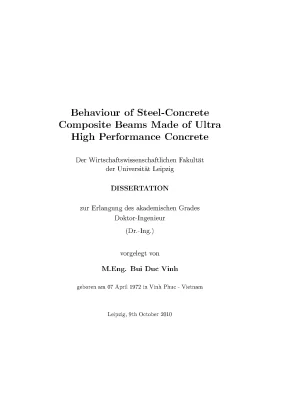
Tải xuống để đọc toàn bộBehaviour of Steel-Concrete Composite Beams Made of Ultra High Performance Concrete Der Wirtschaftswissenschaftlichen Fakultät der Universität Leipzig DISSERTATION zur Erlangung des akademischen Grades Doktor-Ingenieur (Dr. Bui Duc Vinh geboren am 07 April 1972 in Vinh Phuc - Vietnam Leipzig, 9th October 2010 Foreword This thesis was the results of a long hard working period of the author, is would not have been possible without the contribution of a great number of people: First of all, I would like to thank to my supervisor Prof. Nguyen Viet Tue for giving me the opportunity to join his research group and giving me this challenging research project. I had learn a lot of thing from many hours discussion with him.
He was not only always able to push up my spirits while I was in despair with my results but also sharing with me in sad moment which I had spent, and I am very grateful for that. The experiments of this study could not have been performed without the help and technical expertise of the laboratory personnel, as of Dipl. Holger Busch, Dipl. Immanuel Wojan and many staffs at MFPA-Leipzig for conducting the experiments.
I would like to express my thanks for their support. My gratitude also goes to Dr. Nguyen Duc Tung, Dr. Jiaxin Ma, Dr.
Michael Küchler, Dipl. Jiabin Li, Dipl. Stephan Mucha, Dipl. Gunter Schenck etc.
my colleagues in IMB (Institut für Massivbau und Baustofftechnologie, Uni-Leipzig) for many valuable suggestions and discussion hours. Grateful appreciation is also due to Mrs. Sigrid Fritzsche and Mrs. Sylvia Proksch for their warm friendship and constant help during my stay in Leipzig.
I wish to thank the German Research Foundation (DFG- Deutsche Forschungs- gemeinschaft) for finance support the research project SPP 1182, which allows me take up doctoral studies at University of Leipzig, Germany. Last but not least, I want to sincerely thank my parents and especially my wife Van Anh and son Nhan for their great support and patience during my study. I hope in the future I can return all their love. Biography Bui Duc Vinh was born in Vinh Phuc, Vietnam, on the 7th April 1972.
In October 1991 he started his studies in Civil Engineering at Ho Chi Minh University of Technology (HCMUT), where he received his Bachelor degree in 1996, specialize in Coastal Engineering. He started joint Faculty of Civil Engineering (FCE), HCMUT and worked as research assistant. Two year after, 1998, he obtained Master Degree in Mechanic of Construction from University of Liege, Belgium. He continued his studies on structural engineering and focused on high strength concrete material, modelling of concrete structures.
2006, he jointed research team of Prof. Nguyen Viet Tue, at Institute for Structural Concrete and Building Materials, University of Leipzig (IMB, Uni-Leipzig). At here, his work concentrates on investigation structural behaviour of steel-concrete composite beams made of ultra high performance concrete. March 2010 he finished his dissertation under the supervision of Prof.
Nguyen Viet Tue. Leipzig, October 2010 Bui Duc Vinh vi Biography Dedicated to my parents, my wife Van Anh and my son Bui Hoang Nhan viii Biography Abstract Ultra-High Performance Concretes (hereafter, UHPC) have high mechanical strengths (fc > 150 MPa, ft > 7 MPa) and exhibit quasi-strain hardening in tension. Their very density improve durability and extend long service life. The steel-concrete composite beams with concrete slab made of UHPC possess ad- vanced properties give significant improvement in ultimate strength of the com- posite beams.
The research reported in this thesis aimed to determine the perfor- mance and structural behaviour of composite steel-UHPC elements in bending. In addition, the continuous Perfobond based shear connectors that belong to the beams was investigated as well. The Experimental assessment of the shear connector was conducted through 11 series Push-Out test with 27 specimens. In order to predict shear capacity, char- acteristic load-slip curves as well as contribution of constituents.
The connec- tors without any reinforcement show very poor ductility, the characteristic slip reached lower 1. They could be classified as non-ductile connector. The headed stud show better characteristic load-slip response, but this connec- tor often failed by shanked at the base of connector. The shear connector with added reinforcement in front cover and dowel exhibits better performance than headed stud connection in both terms of load capacity and ductility.
The test pointed out that embedded rebars in dowel play an important role in improve- ment performance of the connector. The contribution of steel fiber less important than and It is not obviously when steel fiber vary in range of 0. The structural response of the composite members under bending with the UHPC slab in compression was investigated with four points bending test of six full scale composite beams. The concrete mix contained either 1% fibres or 0.5% (by vol- ume) of straight steel fibres with concrete strength of approximately 150 MPa.
The experimental study demonstrates that the use of UHPC slab with contin- uous shear connector is possible, and it enhances the performance of composite elements in terms of resistance and stiffness. The finite element analysis of the Push-Out specimens and composite beams which tested in this investigation was carried out using software ATENA. Full three dimension models for both Push-Out specimens and composite beams were developed in order to taken into account complexity of geometry. The concrete was modelled using a Microplane M4 with parameters were calibrated accom- panying to uni-axial compression and RILEM bending test.
Modelling result showed a reasonable agreement with the experimental data. The FE simulation is not only provide ultimate strength, global behaviour but also explained local damage area as well process of collapse occurred in structures. However, the FE analysis need more improvement in concrete material model, in order to used for parameter studies. Finally, based on result of experimental and numerical investigation a numerous recommendations are issued for practical design.
The results form this work provide to better knowledge on using new UHPC in composite structures. It also contribute to provision of design code. Contents Foreword iii Biography v Abstract ix Abbreviations xv List of Symbols xvii List of Figures xix List of Tables xxvii 1. State of the art.
Context and motivation. Objectives of study. Scope of work. Structure of the thesis.
Consideration aspects of steel-concrete composite beams 7 2. Single span composite beams under sagging moment. Basic Structural Behaviour. Structural composite beam with continuous shear connection 12 2.
Perfobond shear connector (PSC). Conventional Perfobond shear connector. Modified pefobond shear connectors. Development of concrete technology.
Composite beam made of UHPC. Finite Element modelling. modelling of composite beams. Modelling of Push-Out test.
Design of composite beam. Limit state design philosophy. Methods for analysis and design. Resistant capacity of composite beam under sagging moment 26 2.
Partial shear connection. Ductile and non-ductile shear connectors. Characterization material properties of UHPC 31 3. Development of UHPC-A Historical perspective.
Constituent materials of Ultra High Performance Concrete. Principle of UHPC. Composition of UHPC. Cost of UHPC.
Material used in this work. Relevant material properties. Properties of fresh UHPC. Time dependent properties of UHPC.
Mechanical behaviour characterization. Development of compressive strength. Stress-strain behaviour in uni-axial compression. Bi-axial behaviour of UHPC.
Flexural and direct tension behaviour of UHPC. Fracture properties of UHPC. Experimental study for perfobond shear connector in UHPC 53 4. Experimental programs and specimens.
Push-Out test specimens. Arrangement for Push-Out series. Standard Push-Out test setup. Test results and observations.
Resistance and slip results. Behaviour of headed stud shear connectors in UHPC. General behaviour of perfobond shear connector in UHPC. Influence of dowel profile and test setup.
Influence of fiber content to load slip-behaviour. Influence of transverse reinforcement arrangement. Influence of embedding reinforcement through concrete dowel 72 Contents xiii 4. Summary conclusions for Push-Out test.
Experimental investigation on the structural behaviour of steel- UHPC composite beams 75 5. Experimental program for composite beams. Aim and Objectives. Design and construction of test specimens.
Test set-up and instrumentation. Analysis of the test results and observations. Structural behaviour and Observations of beam B1 and B2 83 5. Structural behaviour and Observation of beam B3 and B4.
Test results and observing of beam B5. Test results and observing of beam B6. Shear flow distribution in composite beam. Load-slip behaviour in composite beam versus Push-Out test101 5.
Distribution of longitudinal shear forces. Material models for Finite Element Modelling 107 6. Material models for structural steel and reinforcement. Microplane M4 material model for concrete.
Aspects of concrete material model. Microplane M4 material model in ATENA. Parameter study of Microplane. Setting up virtual test.
Input parameter and sensitivity analysis. UHPC experimental data. Results of M4 model parameters investigation and discussion118 6. Proposed set of parameter for UHPC.
Adjustment strategy for model parameters. Result of compression and bending modelling with M4. Finite Element Modelling 127 7. Modelling of Push Out Test.
Finite element model. Experimental validation finite element model. Local behaviour Push-Out specimens. Proposed model for prediction ultimate capacity of perfor- bond shear connector.
Modelling of composite beam. Finite element model. Validation of the FE model. Local stress distribution in steel girder and shear connectors155 7.
Shear flow on concrete dowel. Conclusions and Future Perspective 159 8. Ultra high performance concrete. Composite beam members made of UHPC under static load 160 8.
Perfobond based shear connectors in UHPC. Modelling of composite beams. Recommendations for further research. Appendices: Concrete mix proportional 165 A.
List of tables for constituent materials. Appendices: Standard Push-Out Test 169 B. Experimental results of Standard Push-Out test. List of drawings and charts.
Appendices: Bending test of composite beam 181 C. Design of steel-concrete composite beams for bending test. List of drawings and charts .
Nội dung được bảo vệ bản quyền — Tải xuống đầy đủ
Trích dẫn luận án này
Bui Duc Vinh (2010). Luận án tiến sĩ behaviour of steel concrete composite beams [Luận án tiến sĩ, Universität Leipzig]. LuanAn.net. https://luanan.net/kinh-te/kinh-te-phat-trien/concrete
Câu hỏi thường gặp
Luận án "Luận án tiến sĩ behaviour of steel concrete composite beams" nghiên cứu về vấn đề gì?
Phân tích ứng xử chịu lực của dầm hỗn hợp thép-bê tông trong luận án tiến sĩ. Đánh giá sức kháng uốn, cắt và biến dạng.
Luận án "Luận án tiến sĩ behaviour of steel concrete composite beams" được bảo vệ tại trường nào?
Luận án này được bảo vệ tại Universität Leipzig. Năm bảo vệ: 2010.
Luận án "Luận án tiến sĩ behaviour of steel concrete composite beams" thuộc chuyên ngành gì?
Luận án "Luận án tiến sĩ behaviour of steel concrete composite beams" thuộc chuyên ngành Kỹ thuật Xây dựng. Danh mục: Kinh Tế Phát Triển.
Luận án "Luận án tiến sĩ behaviour of steel concrete composite beams" có bao nhiêu trang?
Luận án "Luận án tiến sĩ behaviour of steel concrete composite beams" có 243 trang. Bạn có thể xem trước một phần tài liệu ngay trên trang web trước khi tải về.
Cách tải luận án "Luận án tiến sĩ behaviour of steel concrete composite beams" về máy như thế nào?
Để tải luận án về máy, bạn nhấn nút "Tải xuống ngay" trên trang này, sau đó hoàn tất thanh toán phí lưu trữ. File sẽ được tải xuống ngay sau khi thanh toán thành công. Hỗ trợ qua Zalo: 0559 297 239.