Luận án: Áp lực nuôi dạy con - So sánh cha mẹ trẻ khuyết tật và bình thường
Nghiên cứu so sánh căng thẳng của cha mẹ nuôi con khuyết tật/không khuyết tật. Phân tích theo giới tính cha mẹ và tình trạng con.
university of north texas
Clinical Psychology
Luan An
Doctor of Philosophy
Năm xuất bản
Số trang
179
Thời gian đọc
27 phút
Lượt xem
0
Lượt tải
0
Phí lưu trữ
50 Point
Mục lục chi tiết
Tóm tắt nội dung
I. Đánh giá áp lực nuôi dạy con Trẻ khuyết tật và bình thường
Nghiên cứu này so sánh mức độ căng thẳng trong nuôi dạy con cái giữa các nhóm cha mẹ. Ba nhóm được khảo sát bao gồm cha mẹ có con mắc Rối loạn tăng động giảm chú ý (ADHD), cha mẹ có con khuyết tật phát triển, và cha mẹ có con phát triển bình thường. Kết quả nghiên cứu khẳng định các phân tích trước đây. Cha mẹ của trẻ ADHD và trẻ khuyết tật phát triển trải nghiệm áp lực làm cha mẹ lớn hơn đáng kể. Đặc biệt, căng thẳng này xuất phát từ đặc điểm của trẻ. Việc xác định các yếu tố liên quan đến stress nuôi dạy con cái là rất quan trọng. Mức độ căng thẳng cao có mối liên hệ với phúc lợi tâm lý. Căng thẳng cũng liên quan đến tiềm năng lạm dụng trẻ. Khả năng điều chỉnh kém cho cả cha mẹ và con cũng là một hệ quả.
1.1. So sánh mức độ căng thẳng
Cha mẹ trẻ mắc ADHD và trẻ khuyết tật phát triển báo cáo mức độ stress nuôi dạy con cái cao hơn rõ rệt. Sự khác biệt này có ý nghĩa thống kê. Áp lực làm cha mẹ chủ yếu liên quan đến các đặc điểm cụ thể của con cái. Các đặc điểm này bao gồm hành vi, nhu cầu chăm sóc đặc biệt. Cha mẹ trẻ phát triển bình thường có mức độ căng thẳng thấp hơn.
1.2. Nhóm trẻ được nghiên cứu
Nghiên cứu tập trung vào ba nhóm trẻ chính. Nhóm đầu tiên là trẻ mắc Rối loạn tăng động giảm chú ý (ADHD). Nhóm thứ hai là trẻ có các khuyết tật phát triển. Ví dụ như trẻ tự kỷ hoặc các dạng khuyết tật khác. Nhóm thứ ba là trẻ phát triển bình thường. So sánh đa chiều giúp đánh giá sâu sắc áp lực làm cha mẹ trong các bối cảnh khác nhau.
1.3. Liên hệ với sức khỏe tâm thần
Căng thẳng khi nuôi dạy con cái có ảnh hưởng đáng kể đến sức khỏe tâm thần cha mẹ. Mức độ stress cao có thể dẫn đến suy giảm phúc lợi tâm lý. Ngoài ra, nó làm tăng khả năng xảy ra lạm dụng. Cả cha mẹ và con cái đều có nguy cơ điều chỉnh kém. Việc giảm áp lực làm cha mẹ là cần thiết cho sự phát triển lành mạnh của gia đình.
II. Sự khác biệt về giới trong kiệt sức khi nuôi con
Nghiên cứu phát hiện sự khác biệt đáng kể về giới tính trong các đặc điểm liên quan đến stress nuôi dạy con cái. Điều này áp dụng cho cả cha mẹ nam và nữ. Cha nam và mẹ nữ có những trải nghiệm áp lực làm cha mẹ không giống nhau. Việc nhận diện những khác biệt này rất quan trọng. Nó giúp phát triển các chiến lược hỗ trợ hiệu quả hơn. Hiện tượng hội chứng kiệt sức parenting burnout có thể biểu hiện khác nhau. Sự hiểu biết sâu sắc về vai trò giới tính là cần thiết. Điều này góp phần giảm gánh nặng tinh thần cho cả hai giới.
2.1. Căng thẳng theo giới tính
Có sự khác biệt đáng kể giữa cha mẹ nam và nữ về các đặc điểm liên quan đến stress. Các yếu tố gây ra áp lực làm cha mẹ có thể khác nhau. Ví dụ, kỳ vọng xã hội hoặc vai trò truyền thống ảnh hưởng đến mức độ căng thẳng. Việc phân tích riêng biệt giúp làm rõ bức tranh tổng thể về kiệt sức khi nuôi con.
2.2. Áp lực của người cha
Cha nam báo cáo mức độ căng thẳng cao hơn trong lĩnh vực gắn bó. Gắn bó ở đây bao gồm mối quan hệ với con và vai trò kết nối. Những áp lực này thường bị bỏ qua trong nghiên cứu trước đây. Việc tập trung vào cha nam giúp hiểu rõ hơn sức khỏe tâm thần cha mẹ. Đặc biệt là cha mẹ có con khuyết tật phát triển.
2.3. Áp lực của người mẹ
Mẹ nữ báo cáo nhiều hạn chế hơn trong vai trò làm cha mẹ. Các hạn chế này có thể liên quan đến thời gian, công việc, hoặc các hoạt động cá nhân. Nuôi dạy trẻ phát triển bình thường hay trẻ khuyết tật đều mang lại những thách thức riêng. Sự hạn chế vai trò góp phần vào hội chứng kiệt sức parenting burnout của người mẹ.
III. Tác động của hỗ trợ xã hội đến sức khỏe tâm thần cha mẹ
Nghiên cứu đã tìm thấy mối quan hệ tiêu cực đáng kể giữa sự hữu ích của hỗ trợ xã hội phi chính thức và điểm số stress nuôi dạy con cái. Điều này đúng với cả cha mẹ nam và nữ. Sự hữu ích của hỗ trợ xã hội có thể dự đoán mức độ căng thẳng. Nó khẳng định những tác động tích cực của hỗ trợ xã hội đối với áp lực làm cha mẹ. Hỗ trợ này đặc biệt quan trọng trong việc giảm gánh nặng cho cha mẹ có con khuyết tật. Sự hỗ trợ có ý nghĩa lớn đối với sức khỏe tâm thần cha mẹ. Nó giúp ngăn ngừa kiệt sức khi nuôi con. Việc xây dựng mạng lưới hỗ trợ vững chắc là cần thiết.
3.1. Hỗ trợ xã hội và stress
Mối quan hệ tiêu cực giữa sự hữu ích của hỗ trợ xã hội phi chính thức và stress nuôi dạy con cái là rõ ràng. Khi cha mẹ cảm thấy nhận được sự hỗ trợ hữu ích, mức độ căng thẳng của họ giảm. Điều này cho thấy vai trò quan trọng của cộng đồng và các mối quan hệ cá nhân trong việc giảm áp lực làm cha mẹ. Hỗ trợ hiệu quả giúp cải thiện sức khỏe tâm thần cha mẹ.
3.2. Hiệu quả của hỗ trợ phi chính thức
Sự hữu ích của hỗ trợ xã hội phi chính thức là yếu tố dự đoán đáng kể stress nuôi dạy con cái. Điều này áp dụng cho cả cha mẹ nam và nữ. Hỗ trợ này có sức mạnh dự đoán đối với các yếu tố liên quan đến cả con và cha mẹ. Đối với cha mẹ có con khuyết tật, hỗ trợ phi chính thức trở nên càng quan trọng. Nó giúp họ đối phó với những thách thức đặc biệt.
3.3. Vai trò của hỗ trợ trong giảm kiệt sức
Hỗ trợ xã hội có sức mạnh dự đoán lớn hơn đối với các yếu tố đóng góp liên quan đến cha mẹ. Điều này có nghĩa là hỗ trợ giúp cha mẹ quản lý cảm xúc và vai trò của mình. Nó góp phần ngăn chặn hội chứng kiệt sức parenting burnout. Đối với cha mẹ trẻ có khuyết tật ở trẻ em, hỗ trợ này là một nguồn lực quý giá.
IV. Các yếu tố nhân khẩu học và stress nuôi dạy con cái
Nghiên cứu cũng xem xét mối quan hệ giữa một số biến số nhân khẩu học và stress nuôi dạy con cái. Các yếu tố như tình trạng kinh tế xã hội (SES), số con, số năm kết hôn, tuổi cha mẹ và tuổi con đã được kiểm tra. Một số yếu tố nhân khẩu học cho thấy khả năng dự đoán áp lực làm cha mẹ. Điều này đặc biệt đúng với các bà mẹ. Việc hiểu rõ những yếu tố này giúp định hướng các chương trình hỗ trợ. Chương trình có thể nhắm mục tiêu đến các nhóm cha mẹ có nguy cơ cao. Điều này giúp giảm stress nuôi dạy con cái và cải thiện sức khỏe tâm thần cha mẹ.
4.1. Ảnh hưởng của tuổi con
Mẹ có con nhỏ tuổi hơn có xu hướng báo cáo mức độ stress nuôi dạy con cái lớn hơn. Tuổi của con là một yếu tố dự đoán có ý nghĩa đối với áp lực làm cha mẹ ở các bà mẹ. Việc chăm sóc trẻ nhỏ đòi hỏi nhiều thời gian và năng lượng hơn. Đặc biệt khi nuôi dạy trẻ khuyết tật phát triển, thách thức càng lớn.
4.2. Tầm quan trọng của SES
Mẹ có tình trạng kinh tế xã hội (SES) thấp hơn cũng có nhiều khả năng báo cáo stress cao hơn. SES thấp có thể liên quan đến nguồn lực hạn chế và áp lực tài chính. Điều này là yếu tố dự đoán quan trọng đối với stress nuôi dạy con cái ở người mẹ. Cha mẹ trẻ tự kỷ hoặc trẻ có khuyết tật thường phải đối mặt với gánh nặng tài chính lớn.
4.3. Các yếu tố khác
Các yếu tố như số con, số năm kết hôn, và tuổi cha mẹ cũng được xem xét. Tuy nhiên, khả năng dự đoán của chúng đối với stress nuôi dạy con cái không mạnh mẽ bằng tuổi con và SES. Cần có thêm nghiên cứu để làm rõ vai trò của những biến số này. Điều này giúp hiểu toàn diện về áp lực làm cha mẹ.
V. Vai trò của cha mẹ trong nghiên cứu áp lực làm cha mẹ
Nghiên cứu này đặc biệt chú trọng việc xác định các yếu tố liên quan đến stress nuôi dạy con cái ở cha nam. Cha nam thường là nhóm ít được đại diện trong các nghiên cứu về nuôi dạy con cái. Việc bỏ qua vai trò của họ có thể dẫn đến một bức tranh thiếu sót về áp lực làm cha mẹ. Sự bao gồm cha nam trong nghiên cứu này cung cấp cái nhìn toàn diện hơn. Nó giúp hiểu rõ hơn về cách cha nam trải nghiệm và đối phó với thách thức. Đặc biệt khi nuôi dạy trẻ phát triển bình thường hoặc trẻ khuyết tật. Việc xác định phương pháp hiệu quả để dự đoán stress cao ở cha nam là rất quan trọng.
5.1. Thiếu đại diện của người cha
Cha nam thường là nhóm ít được đại diện trong nghiên cứu về nuôi dạy con cái. Điều này làm hạn chế hiểu biết về trải nghiệm của họ. Nghiên cứu nhấn mạnh tầm quan trọng của việc đưa cha nam vào các phân tích. Điều này giúp có cái nhìn đầy đủ hơn về stress nuôi dạy con cái, đặc biệt là khi con có khuyết tật ở trẻ em.
5.2. Chức năng riêng của người cha
Cha nam có chức năng riêng biệt trong cặp đôi nuôi dạy con cái. Vai trò của họ không chỉ là người hỗ trợ. Họ cũng đóng góp trực tiếp vào sự phát triển của trẻ và năng động của gia đình. Áp lực làm cha mẹ của họ cần được nghiên cứu và thấu hiểu rõ ràng hơn.
5.3. Định hướng nghiên cứu tương lai
Nghiên cứu trong tương lai cần tiếp tục khám phá các yếu tố liên quan đến stress nuôi dạy con cái ở cha nam. Việc xác định các phương pháp hiệu quả để dự đoán mức độ căng thẳng cao là rất quan trọng. Điều này giúp phát triển các biện pháp can thiệp hỗ trợ cho cả cha và mẹ. Từ đó giảm thiểu hội chứng kiệt sức parenting burnout.
Tải xuống file đầy đủ để xem toàn bộ nội dung
Tải đầy đủ (179 trang)Trích đoạn nội dung luận án
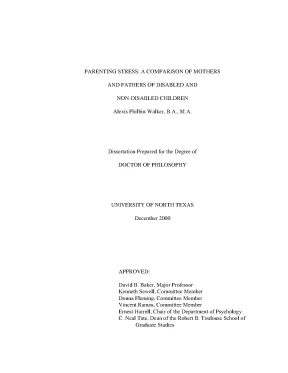
Tải xuống để đọc toàn bộPARENTING STRESS: A COMPARISON OF MOTHERS AND FATHERS OF DISABLED AND NON-DISABLED CHILDREN Alexis Philbin Walker, B. Dissertation Prepared for the Degree of DOCTOR OF PHILOSOPHY UNIVERSITY OF NORTH TEXAS December 2000 APPROVED: David B. Baker, Major Professor Kenneth Sewell, Committee Member Donna Fleming, Committee Member Vincent Ramos, Committee Member Ernest Harrell, Chair of the Department of Psychology C. Neal Tate, Dean of the Robert B.
Toulouse School of Graduate Studies Walker, Alexis Philbin, Parenting Stress: A comparison of mothers and fathers of Disabled and Non-Disabled children. Doctor of Philosophy (Clinical Psychology), December 2000, 168 pp., 27 tables, 76 reference titles. This study compared perceived levels of parenting stress between mothers and fathers of children with Attention-Deficit Hyperactivity Disorder (ADHD), children with developmental disabilities, and normally developing children. The relationship of certain demographic variables, such as Socio-economic Status (SES), number of children, years married, parent age, and child age, as well as social support with parenting stress was also examined for mothers and fathers of these three groups.
Identification of factors related to parenting stress in fathers was of particular importance for this study, as fathers are often an underrepresented group within parenting research. Identifying effective methods for predicting high levels of parenting stress is important, as stress has been linked to psychological well-being, potential for abuse, and a greater likelihood of poor adjustment for both parent and child. Results from the present study comparing reported stress levels between groups of parents were supportive of previous studies indicating that parents of children with ADHD and developmentally disabilities experience significantly greater parenting stress, specifically with respect to child characteristics. Significant gender differences were also found between mothers and fathers in terms of parent characteristics related to stress.
Fathers reported greater stress in the areas of attachment, while mothers reported more parent role restrictions. Additionally, significant negative relationships were found between parents’ perceived helpfulness of informal social support and parenting stress scores in both mothers and fathers, affirming positive effects of social support on stress. Helpfulness of informal social support was also significantly predictive of parenting stress in both mothers and fathers across both the child and parent domains of the PSI, although, it had more predictive power with regard to parent related contributors to parenting stress. Family demographic factors, including age of the child and SES demonstrated some predictive power of parenting stress in mothers.
Mothers with younger children and lower SES were more likely to report greater parenting stress. Implications of these results and future directions for research are also discussed. Copyright 2000 By Alexis Philbin Walker ii ACKNOWLEDGEMENTS I would like to offer my sincerest appreciation to several people who made important contributions toward the completion of this project. I would especially like to thank my mother and father, Paul and Sandra Philbin to whom I am indebted for all their support and caring.
I would like to extend thanks to my husband, Bill, who helped keep me focused and enthusiastic throughout this process. Also, Bill and Judy, thanks so much for your time and help in gathering many of the crucial resources for this endeavor. In addition to family members, I would like to thank Dr. Steven Bailley for his persistent encouragement, unfaltering guidance, and life’s important little instructions.
Most importantly, I would like to thank Dr. Bailley for his unselfishness and willingness to take significant time out to support a colleague. Karen, thanks for listening and offering wonderful insight and a healthy perspective. Finally, I would also like to thank my major professor, Dave Baker, for his support, direction, and pragmatic sense, as well as my other committee members, who helped facilitate this process and make this a positive experience.
iii TABLE OF CONTENTS Page ACKNOWLEDGEMENTS …………………………………………………… iii LIST OF TABLES……………………………………………………………… v Chapter 1. INTRODUCTION AND LITERATURE REVIEW……………………… 1 General Overview The Concept of Stress The Concept of Parenting Stress Parenting Stress and its Influence on Family Functioning Parenting Stress and Child Disability Parenting Stress in Families of Children with Disabilities Parenting Stress and ADHD Parenting Stress and Developmental Disabilities Parenting Stress and Normal Child Development Parenting Stress and Parent Gender Reasons to Include Fathers in Parenting Research Fathers’ Role in Society Fathers’ Unique Functioning in the Parenting Dyad Parenting Stress and Fathers Parenting Stress Comparisons Between Mothers and Fathers Other Factors Associated with Parenting Stress Parenting Stress and Social Support Parenting Stress and Demographic Factors Parenting Role Identity Summary and Conclusions Statement of Rationale Research Questions and Related Hypotheses 2. METHOD……………………………………………………………………… 37 Participants Measures Procedure Overview of Data Analysis Preliminary Analyses Primary Analyses iv 3. RESULTS………………………………………………………………………52 Preliminary Data Screening Accuracy of Data Input, Missing Data and Distributions Replacing Missing Data: Standardized Measures Replacing Missing Data: Variables from non-standardized measures (CPSS, PRQ, (FIF) Skewness and Kurtosis Outliers Preliminary Analyses Primary Analyses Research Question 1 Research Question 2 Research Question 3 Research Question 4 Research Question 5 4.
DISCUSSION……………………………………………………………… 68 Summary of Findings Theoretical Implications Applied Implications Social Policy Implications Limitations of this Study Measurement Issues and Research Implications Future Directions APPENDICES…………………………………………………………………… 95 Appendix A: Instruments ……………………………………………………….95 Appendix B: Consent Forms ………………………………………………… 107 Appendix C: Flyers/Parent Letters …………………………………………… 112 Appendix D: Tables ……………………………………………………………117 REFERENCE LIST……………………………………………………………. 161 v LIST OF TABLES Table Page 1. Frequency Distribution of Geographic Location of families……………………. Frequency Distributions for Children with ADHD………………… ………… 119 3.
Frequency Distributions for Children with Developmental Disabilities… ……. Frequency Distributions for Normally Developing Control children……………125 5. Descriptive Statistics for DSM-IV Checklist and CBCL Scales… …………. Frequency Distributions of Family Demographic Variables by Group ……….
Skewness and Kurtosis Scores for Parents of ADHD Children on Dependent Variables (PSI) and Independent Variables (CPSS, Demographics) Before and After Transformations…………………………………………………………. Skewness and Kurtosis Scores for Parents Children with Developmental Disabilities on Dependent Variables (PSI) and Independent Variables (CPSS, Demographics) Before and After Transformations………………………………………………131 9. Skewness and Kurtosis Scores for Parents of Non-Disabled Control Children on Dependent Variables (PSI) and Independent Variables (CPSS, Demographics) Before and After Transformations…………………………………… ………. Skewness and Kurtosis Scores for Total Sample of Parents (ADHD, DD, and ND Control) on Dependent Variables (PSI) and Independent Variables (CPSS, Demographics) Before and After Transformations…………………….
Group Comparisons of Continuous Demographic Variables. Group Comparisons of Categorical Demographic Variables……………. PSI Domain Scores (Means, Standard Deviations, and F Ratios) by Disability Group and Gender of Parent………………………………. PSI Child Domain Subscale scores (Means, Standard Deviations, and F Ratios) by Disability Group and Gender of Parent………………….
PSI Parent Domain Subscale scores (Means, Standard Deviations, F Ratios) by Disability Group and Gender of Parent…………………………………………142 16. Correlations Between Independent Variables and Parenting Stress Scores for Mothers and Fathers……………………………………………………………… 144 17. Social Support Scores by Disability Group and Parent Gender…………………. Summary of Hierarchical Multiple Regression Predicting Mothers’ PSI Child Domain Scores from Diagnostic Category, Demographic Variables, and Perceived Helpfulness of Social Support ………………………………………….
Summary of Hierarchical Multiple Regression Predicting Mothers’ PSI Parent Domain Scores from Diagnostic Category, Demographic Variables, and Perceived Helpfulness of Social Support…………………………………………………… 148 20. Summary of Hierarchical Multiple Regression Predicting Fathers’ PSI Child Domain Scores from Diagnostic Category, Demographic Variables, and Perceived Helpfulness of Social Support………………………………………149 21. Summary of Hierarchical Multiple Regression Predicting Fathers’ PSI Parent Domain Scores from Diagnostic Category, Demographic Variables, and Perceived Helpfulness of Social Support……………………………………………150 22. Descriptive Statistics for Mothers’ Parental Role Items for Each Age Group……151 23.
Descriptive Statistics for Fathers’ Parental Role Items for Each Age Group……. Descriptive Statistics for Mothers’ and Fathers’ View of Overall Importance of Parental Role Characteristics…………………………………………………. Comparison of Mothers and Fathers across Groups on PRQ……………………. Frequency Distribution of Responses to Importance of Parental Role Characteristics for Mothers by Group…………………………………………… 157 27.
Frequency Distribution of Responses to Importance of Parental Role Characteristics for Fathers by Group …………………………………………… 159 vii CHAPTER I INTRODUCTION AND LITERATURE REVIEW “Becoming a parent is one of the most significant family life cycle transitions.” (Pittman, Wright, & Lloyd, 1989, p. 267) “Parenting any child can at times be a stressful experience.” (Cameron, Dobson, & Day, 1991, p. 14) General Overview The purpose of this study was to investigate several factors reported to be related to or predictive of parenting stress. Such factors included aspects of the child’s functioning and/or presence of a disability, gender of the parent, characteristics of the family (i.
Socio-economic Status (SES), number of children, years married, age of the parents and age of the child), as well as aspects of the parents’ social support network. This study investigated the relationship of such variables to parent stress reports of mothers and fathers of children with ADHD, developmental disabilities, and normally developing children. Many researchers of parenting stress have discussed or alluded to the importance of some of these variables with respect to parenting stress (Baker, 1994; Barkely, 1990; Beckman, 1991; Dumas, Wolf, Fisman & Culligan, 1991). However, simultaneous investigation of the aforementioned variables and characteristics is sparse.
The following can be expected in the review that follows. First, given the multitude of measurements of parenting stress, the concept of stress and more specifically, parenting stress will be discussed. The possible negative effects of parenting stress on children and families will then be explored. Next, child related variables to 1 parenting stress, such as disability status of the child will be reviewed.
A significant portion of parent related variables will discuss the importance of including fathers in parenting research and their role in society and the family. Movements toward inclusion of fathers in parenting research will be presented, as will a review of the comparison of mothers and fathers in the parenting stress literature. Investigation of other family and environmental factors influencing parenting stress, including SES and social support will then be discussed. Furthermore, the relationship between parental role identity and parenting stress will also be explored, and will be followed by a summary and rationale for this study.
The introduction will close with research questions and related hypotheses for the present investigation. The Concept of Stress Lazarus and Folkman (1984) define psychological stress as “a relationship between the person and the environment that is appraised by the person as taxing or exceeding his or her resources and endangering his or her well-being. Folkman (1984) describes this relationship between the person and environment as dynamic, bi- directional, and mutually reciprocal. Furthermore, one’s cognitive appraisal of the situation and coping methods utilized influence the degree of stress experienced by the person.
Lazarus and Folkman (1984) also describe a complex process of evaluating or appraising a stressful situation and the available coping options and resources to determine whether the resources will be adequate for coping with the demands of the stressor. Other researchers including Noppe, Noppe, and Hughes (1990) note that stress itself can be seen as a component of personality (i. trait variable), related to situational 2 factors (i. state variable), or as related to attitudinal variables such as interpersonal attributions and locus of control.
Lazarus and Folkman (1984) note that personal characteristics and environmental factors influence the appraisal of the person-environment relationship. Examples of personal characteristics are one’s type of motivation (i. goals and values), beliefs about the individual and the world, and recognition of one’s personal resources for coping (i. problem-solving skills, finances, social skills and level of health and energy).
Differences in these personal characteristics can help to explain why individuals evaluate similar stressful encounters differently. Environmental factors include the proximity and nature of the danger, its ambiguity and duration, as well as the availability and quality of social support resources. The Concept of Parenting Stress Given this general conceptual model of stress, researchers have sought to provide a useful conceptualization for a particular type of stress, parenting stress. One of the more widely used indices of parenting stress is the Parenting Stress Index (PSI), (Abidin, 1995), which provides a useful conceptualization for parenting stress.
Abidin acknowledges the assumption that stressors are multi-dimensional both in source and kind. He notes that this assumption led to the identification of three major source domains of stressors for parents: 1) Child Characteristics; 2) Parent Characteristics, and 3) Situational/Demographic-Life Stress. Child characteristics include factors such as the child’s adaptability, demandingness, and level of hyperactivity.
Nội dung được bảo vệ bản quyền — Tải xuống đầy đủ
Câu hỏi thường gặp
Luận án "Áp lực nuôi dạy con: So sánh cha mẹ trẻ khuyết tật và bình thường" nghiên cứu về vấn đề gì?
Nghiên cứu so sánh căng thẳng của cha mẹ nuôi con khuyết tật/không khuyết tật. Phân tích theo giới tính cha mẹ và tình trạng con.
Luận án "Áp lực nuôi dạy con: So sánh cha mẹ trẻ khuyết tật và bình thường" được bảo vệ tại trường nào?
Luận án này được bảo vệ tại university of north texas. Năm bảo vệ: 2000.
Luận án "Áp lực nuôi dạy con: So sánh cha mẹ trẻ khuyết tật và bình thường" thuộc chuyên ngành gì?
Luận án "Áp lực nuôi dạy con: So sánh cha mẹ trẻ khuyết tật và bình thường" thuộc chuyên ngành Clinical Psychology. Danh mục: Tâm Lý Học Phát Triển.
Luận án "Áp lực nuôi dạy con: So sánh cha mẹ trẻ khuyết tật và bình thường" có bao nhiêu trang?
Luận án "Áp lực nuôi dạy con: So sánh cha mẹ trẻ khuyết tật và bình thường" có 179 trang. Bạn có thể xem trước một phần tài liệu ngay trên trang web trước khi tải về.
Cách tải luận án "Áp lực nuôi dạy con: So sánh cha mẹ trẻ khuyết tật và bình thường" về máy như thế nào?
Để tải luận án về máy, bạn nhấn nút "Tải xuống ngay" trên trang này, sau đó hoàn tất thanh toán phí lưu trữ. File sẽ được tải xuống ngay sau khi thanh toán thành công. Hỗ trợ qua Zalo: 0559 297 239.