Methane Multiple Reforming Modeling in Biogas SOFC: Operation Analysis
Nghiên cứu mô hình reforming methane đa cấp trong SOFC chạy biogas. Luận án ứng dụng phân tích vận hành, tối ưu hiệu suất và độ bền.
Kyushu University
Hydrogen Energy Systems
Luan An
Luận án
Năm xuất bản
Số trang
174
Thời gian đọc
27 phút
Lượt xem
0
Lượt tải
0
Phí lưu trữ
50 Point
Mục lục chi tiết
Tóm tắt nội dung
I. Tối ưu Mô hình Hóa Khí Reforming Methane SOFC Biogas
Nghiên cứu tập trung vào pin nhiên liệu oxit rắn (SOFC) hoạt động ở nhiệt độ cao (700-800°C). SOFC được cấp trực tiếp biogas, hỗn hợp khí CH4 (55-70%) và CO2 (30-45%). Quá trình này được gọi là Direct Internal Reforming (DIR). CH4 và CO2 đồng thời phản ứng trong vật liệu anode gốc Ni. Phản ứng tạo ra syngas thông qua quá trình cải cách methane đa hợp (MMR). Biogas-fuelled DIR-SOFC là công nghệ đầy hứa hẹn. Nó hướng tới phát triển bền vững các vùng nông thôn giàu tài nguyên sinh khối. Để hiện thực hóa công nghệ này, cần hiểu rõ hành vi vận hành. Tuy nhiên, việc mô hình hóa động học phức tạp của quá trình MMR là một thách thức lớn. Nghiên cứu này giải quyết vấn đề đó bằng cách phát triển một mô hình MMR mới.
1.1. Khái quát hoạt động SOFC Biogas Trực tiếp
Pin nhiên liệu oxit rắn (SOFC) hoạt động ở nhiệt độ cao (700-800°C). Biogas, hỗn hợp khí CH4 (55-70%) và CO2 (30-45%), cấp trực tiếp. Quá trình này được gọi là Direct Internal Reforming (DIR). CH4 và CO2 phản ứng trên vật liệu anode Ni-based. Sản phẩm là syngas thông qua quá trình cải cách methane đa hợp (MMR). Biogas-fuelled DIR-SOFC là công nghệ hứa hẹn. Phát triển bền vững các vùng nông thôn dồi dào sinh khối. Cần hiểu rõ hành vi vận hành trước khi phát triển hệ thống.
1.2. Phát triển mô hình cải cách methane đa hợp
Thách thức lớn là mô hình hóa động học phức tạp của quá trình MMR. Nghiên cứu này tập trung vào giải quyết vấn đề đó. Dữ liệu cải cách thu được từ thực nghiệm hệ thống. Các thí nghiệm sử dụng tế bào anode-supported (ASC) gốc Ni. Mô hình MMR được tạo ra bằng mạng thần kinh nhân tạo (ANN). Phương pháp ANN cho phép tạo ra các tham số mô hình. Mô hình MMR mới cung cấp tốc độ tiêu thụ và sản xuất ròng. Bao gồm các loại khí (CH4, CO2, H2O, H2, CO) trong quá trình MMR. Mô hình hoạt động ở nhiệt độ và thành phần khí bất kỳ.
1.3. Xác thực tính hiệu quả của mô hình MMR mới
Mô hình MMR áp dụng cho các loại xúc tác Ni-based khác nhau. Điều chỉnh một hệ số hiệu chỉnh bù đắp sự khác biệt. Hệ số này tính đến diện tích bề mặt xúc tác hoạt động. Tính toán động lực học chất lỏng tính toán (CFD) được thực hiện. Các tính toán này tích hợp vận chuyển khối lượng, nhiệt. Đồng thời bao gồm quá trình MMR và điện hóa trong tế bào. Tính nhất quán của CFD với mô hình MMR được xác nhận. So sánh với hiệu suất đo được của SOFC cấp CH4-CO2. Quá trình xác thực mô hình ba bước đã được thực hiện.
II. Phân tích Vận hành SOFC Biogas bằng Mô hình CFD
Mô hình cải cách methane đa hợp (MMR) được phát triển đã được tích hợp vào các tính toán động lực học chất lỏng tính toán (CFD). Phương pháp tích hợp này cho phép phân tích toàn diện. Nó xem xét vận chuyển khối lượng, nhiệt, quá trình MMR và các quá trình điện hóa bên trong tế bào SOFC. Sự nhất quán của mô hình CFD kết hợp MMR (MMR model-incorporated CFD) đã được xác nhận. Điều này được thực hiện bằng cách so sánh với hiệu suất đo được của SOFC được cấp bằng hỗn hợp CH4-CO2. Quá trình xác thực mô hình ba bước đã được thực hiện. Cách tiếp cận này hiệu quả hơn các phương pháp thông thường. Các phương pháp truyền thống thường bỏ qua hiệu ứng đồng thời của CO2 và H2O đối với quá trình cải cách xúc tác CH4. Mô hình MMR mới cung cấp các ước tính thực tế hơn nhiều cho DIR-SOFC.
2.1. Tích hợp mô hình MMR vào tính toán CFD
Mô hình MMR phát triển được tích hợp vào tính toán CFD. CFD tính toán các quá trình xảy ra bên trong tế bào. Bao gồm vận chuyển khối lượng và nhiệt. Quá trình MMR và điện hóa cũng được đưa vào xem xét. Mô hình CFD kết hợp MMR (MMR model-incorporated CFD) cung cấp cái nhìn toàn diện. Nó mô tả hành vi của DIR-SOFC được cấp biogas. Phương pháp này cho phép phân tích chi tiết. Hiểu rõ sự tương tác giữa các hiện tượng vật lý.
2.2. Kiểm tra tính đồng nhất hiệu suất SOFC thực tế
Tính nhất quán của mô hình CFD kết hợp MMR được xác nhận. So sánh với hiệu suất đo được của SOFC cấp bằng hỗn hợp CH4-CO2. Quá trình xác thực mô hình ba bước. Bước đầu là hai bước điều chỉnh tham số mô hình. Dữ liệu thực nghiệm thu được từ hoạt động non-DIR và DIR được sử dụng. Bước cuối là kiểm tra tính hợp lệ. Đánh giá khả năng tái tạo hiệu suất của DIR-SOFC. Điều này được thực hiện dưới điều kiện vận hành tùy ý.
2.3. Ưu điểm mô hình cải cách mới so với phương pháp truyền thống
Cách tiếp cận thông thường bỏ qua hiệu ứng đồng thời của CO2 và H2O. Nó xem MMR là tổng của cải cách khô và hơi nước. Phương pháp này không đạt được tính nhất quán. Mô hình MMR phát triển trong nghiên cứu này đã chứng minh điều ngược lại. Nó cung cấp ước tính thực tế và có ý nghĩa hơn. Đặc biệt đối với các SOFC DIR. Mô hình mới cho phép hiểu sâu sắc hơn về động học phản ứng. Từ đó cải thiện thiết kế và vận hành.
III. Nâng cao Ổn định Hiệu suất Pin Nhiên liệu SOFC Biogas
Để tăng cường ổn định cơ nhiệt và công suất đầu ra của DIR-SOFC được cấp biogas, việc kiểm soát tỷ lệ cải cách nội bộ là rất quan trọng. Nghiên cứu đã điều tra hai khái niệm DIR tiên tiến sử dụng tính toán CFD kết hợp mô hình MMR. Khái niệm-I sử dụng mặt nạ chắn khí anode, trong khi Khái niệm-II sử dụng bộ cải cách trong tế bào với xúc tác cấu trúc giấy (PSC). Các nghiên cứu được thực hiện trên hai loại tế bào anode-supported cells (ASC) với độ dày chất nền anode khác nhau. Mục tiêu là cung cấp hướng dẫn thiết kế tế bào phù hợp, đảm bảo hoạt động ổn định cơ học với mật độ công suất cao khi cấp hỗn hợp biogas mô phỏng ở 800°C.
3.1. Mục tiêu cải thiện SOFC biogas DIR
Để tăng cường ổn định cơ nhiệt và công suất đầu ra. Tỷ lệ cải cách nội bộ phải được kiểm soát đúng cách. Điều này rất quan trọng đối với DIR-SOFC được cấp biogas. Kiểm soát tốc độ phản ứng ngăn chặn các điểm nóng cục bộ. Nó cũng giảm thiểu ứng suất cơ học. Mục tiêu cuối cùng là hoạt động an toàn và hiệu quả hơn. Nghiên cứu tập trung vào các giải pháp cải tiến này.
3.2. Khái niệm điều khiển reforming tiên tiến được nghiên cứu
Hai khái niệm DIR tiên tiến đã được điều tra. Cả hai đều sử dụng tính toán CFD kết hợp mô hình MMR. Khái niệm-I sử dụng mặt nạ chắn khí anode. Khái niệm-II sử dụng bộ cải cách trong tế bào. Bộ này dùng xúc tác cấu trúc giấy (PSC). Các khái niệm này nhằm mục đích kiểm soát quá trình cải cách. Từ đó tối ưu hóa hiệu suất và độ bền của SOFC.
3.3. Các loại tế bào anode supported cells ASC được phân tích
Hai loại ASC có kích thước 20 x 50 mm2 đã được xem xét. ASC-A có chất nền anode dày 950 µm. ASC-B có chất nền anode dày 200 µm. Chất nền anode là zirconia ổn định bằng Ni. Việc xem xét các độ dày khác nhau cung cấp hướng dẫn. Điều này giúp lựa chọn thiết kế tế bào phù hợp. Tùy thuộc vào lượng Ni kim loại có trong chất nền anode. Mục tiêu là hoạt động ổn định cơ học và mật độ công suất cao. Điều kiện thử nghiệm là cấp hỗn hợp biogas mô phỏng (CH4/CO2 = 1) ở 800°C.
IV. Giải pháp Cải tiến Thiết kế SOFC Biogas DIR Hoạt động
Nghiên cứu đã chứng minh hiệu quả của việc áp dụng mặt nạ chắn khí anode (Khái niệm-I). Giải pháp này nhằm kiểm soát dòng khối lượng nhiên liệu đi vào anode xốp dọc theo hướng dòng chảy. Bằng cách đó, nó ngăn chặn việc sản xuất syngas quá nhanh ở vùng đầu vào nhiên liệu. Điều này dẫn đến phân bố nhiệt độ đồng nhất hơn trên toàn tế bào. So với các ASC thông thường, Khái niệm-I ước tính giảm khoảng 20% ứng suất tối đa do nhiệt. Mật độ công suất tối đa chỉ giảm khoảng 8% cho cả ASC-A và ASC-B. Điều này chỉ ra rằng việc sử dụng mặt nạ chắn khí anode rất hiệu quả. Nó giúp giảm nguy cơ đứt gãy điện phân. Khái niệm-I đã được xác nhận là một lựa chọn tốt cho hoạt động ổn định của DIR-SOFC.
4.1. Ứng dụng mặt nạ chắn khí anode Khái niệm I
Khái niệm-I áp dụng cho cả ASC-A và ASC-B. Nó kiểm soát dòng khối lượng nhiên liệu đi vào anode xốp. Dòng chảy được kiểm soát dọc theo hướng dòng nhiên liệu. Điều này giúp ngăn chặn sản xuất syngas nhanh chóng. Đặc biệt ở vùng đầu vào nhiên liệu. Kiểm soát này dẫn đến phân bố nhiệt độ đồng nhất hơn. Nhiệt độ được phân bố đều khắp tế bào.
4.2. Giảm căng thẳng nhiệt tối ưu phân phối nhiệt độ
So với các ASC thông thường, Concept-I mang lại lợi ích. Ước tính giảm khoảng 20% ứng suất tối đa do nhiệt. Điều này có ý nghĩa lớn đối với độ bền cơ học. Mật độ công suất tối đa chỉ giảm khoảng 8%. Mức giảm này xảy ra cho cả ASC-A và ASC-B. Điều này cho thấy mặt nạ chắn khí anode rất hiệu quả. Nó giảm nguy cơ đứt gãy điện phân.
4.3. Hướng dẫn thiết kế tế bào SOFC cho hoạt động ổn định
Khái niệm-I được xác nhận là lựa chọn tốt. Nó mang lại hoạt động ổn định cho các SOFC DIR. Kết quả nghiên cứu cung cấp hướng dẫn quý giá. Chúng hỗ trợ lựa chọn thiết kế tế bào phù hợp. Đặc biệt, việc sử dụng mặt nạ chắn khí cải thiện đáng kể sự ổn định. Điều này cho phép hoạt động liên tục với hiệu suất cao hơn. Sự cân bằng giữa ổn định và công suất được tối ưu hóa.
Tải xuống file đầy đủ để xem toàn bộ nội dung
Tải đầy đủ (174 trang)Trích đoạn nội dung luận án
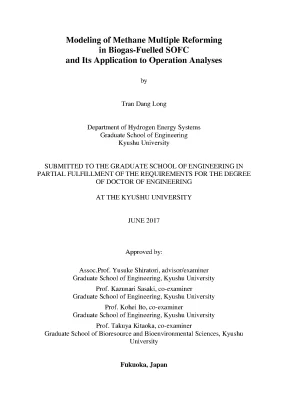
Tải xuống để đọc toàn bộModeling of Methane Multiple Reforming in Biogas-Fuelled SOFC and Its Application to Operation Analyses by Tran Dang Long Department of Hydrogen Energy Systems Graduate School of Engineering Kyushu University SUBMITTED TO THE GRADUATE SCHOOL OF ENGINEERING IN PARTIAL FULFILLMENT OF THE REQUIREMENTS FOR THE DEGREE OF DOCTOR OF ENGINEERING AT THE KYUSHU UNIVERSITY JUNE 2017 Approved by: Assoc. Yusuke Shiratori, advisor/examiner Graduate School of Engineering, Kyushu University Prof. Kazunari Sasaki, co-examiner Graduate School of Engineering, Kyushu University Prof. Kohei Ito, co-examiner Graduate School of Engineering, Kyushu University Prof.
Takuya Kitaoka, co-examiner Graduate School of Bioresource and Bioenvironmental Sciences, Kyushu University Fukuoka, Japan ABSTRACT This research focuses on solid oxide fuel cell (SOFC) operated at high temperature (700±800 oC) with the direct feed of biogas, a gaseous mixture of 55±70 vol% CH4 and 30±45 vol% CO2 obtained from the anaerobic fermentation of organic matters such as garbage, livestock manure and agricultural residues. When the biogas is supplied directly to SOFC, CH4 dry and steam reforming simultaneously occur in a porous Ni- based anode material to produce syngas (Methane multiple-reforming (MMR) process). This type of operation is called direct internal reforming (DIR) operation. Biogas- fuelled DIR-SOFC is a promising technology for sustainable development of a rural area abundant in biomass resources.
For the realization of this technology, prior to system development, operating behavior of it has to be fully understood. However, how to model the complex kinetics of MMR process was a big challenge. In this study, from the reforming data obtained in the series of systematic experiments using Ni-based anode-supported cells (ASCs), a MMR model (model parameters) was inductively generated using the approach of artificial neural network (ANN). The developed MMR model can provide the net consumption and production rates of gaseous species (CH4, CO2, H2O, H2 and CO) involved in the MMR process at arbitrary temperatures and gas compositions.
And, it can be applied for different types of Ni-based catalysts by adjusting a correction factor to compensate the differences in catalytically-active surface area. Computational fluid-dynamics (CFD) calculations, in which mass and heat transports, MMR and electrochemical processes occurring inside the cell were taken into consideration, were conducted for the DIR-SOFC fuelled by biogas. Consistency of the CFD calculation incorporating the MMR model developed in this study (MMR model-incorporated CFD) with the measured performance of SOFC fuelled by CH4-CO2 mixture was confirmed through a three-step model validation process consisting of two model-parameter-tuning steps (model fitting steps with the data experimentally obtained under non-DIR and DIR operations) followed by a validity check whether the established-model can reproduce a performance of DIR-SOFC under an arbitrary i operating condition. The consistency was not achieved by the conventional approach in literature considering MMR as a sum of CH4 dry and steam reforming (ignoring the concurrent effect of CO2 and H2O on the catalytic CH4 conversion).
The MMR model developed in this study was proved to be able to provide more realistic and meaningful estimations for the DIR-SOFCs. In order to enhance thermomechanical stability and output power of DIR-SOFC fuelled by biogas, internal reforming rates have to be properly controlled. For this purpose, two advanced DIR concepts, with the anode gas-barrier mask (Concept-I) and with the in-cell reformer using paper-structured catalyst (PSC) (Concept-II), were investigated by the MMR model-incorporated CFD calculation. Two types of 20 ൈ 50 mm2 ASC, ASC-A and ASC-B, with different thicknesses of anode substrate (Ni- stabilized zirconia) of 950 and 200 ߤ m, respectively, were considered, providing guidelines for selecting a proper cell design depending on the thickness of the anode substrate (in other words the amount of metallic Ni) to obtain a mechanically stable operation with higher power density in the direct feed of simulated biogas mixture (CH4/CO2 = 1) at 800 oC.
For both ASC-A and ASC-B, by adopting Concept-I which can control mass flux of fuel getting into the porous volume of the anode along fuel flow direction, rapid syngas production at the fuel inlet region was suppressed to have homogeneous temperature distribution over the cell. In comparison to the normal ASCs (Normal), about 20% decrease in the maximum thermally-induced stress was estimated with a slight loss (about 8%) of maximum power density for both ASC-A and ASC-B, indicating that the use of anode gas-barrier mask is effective to reduce the risk of electrolyte fracture. Concept-I was confirmed to be a good choice for getting stable operation of DIR- SOFCs. For the feed of 200 mL min±1 simulated biogas, in the cases of Normal and Concept- I, maximum power densities (ܲ௫ ) with thinner anode substrate (ASC-B) were 1.95 W cm±2, respectively, lower than those with thicker one (ASC-A), 1.08 W cm±2, respectively, reflecting that the degree of catalytic CH4 conversion is a predominant factor of the performance.
In fact, by the application of Concept-II, ܲ௫ of ASC-A and ASC-B were boosted up to 1.45 W cm±2, respectively, although ii the risk of electrolyte fracture was increased. The effect of Concept-II was more pronounced for ASC-B with thinner anode substrate, from which H2O (product of the anodic reaction) was easily drained. As a result, buildup of partial pressure of H2O within the anode functional layer under high current densities, leading to the decrease in electromotive force, could be suppressed. This study provided a powerful numerical tool for creating highly efficient and robust DIR-SOFCs operating with biogas.
This dissertation is mainly divided in six parts: overviews of SOFC and conventional modeling approaches for DIR-SOFCs are summarized in General Introduction. Investigation on electrochemical behavior of DIR-SOFC operating with biogas is presented in Chapter 2. In Chapter 3, detailed description of the ANN/FIS- based MMR model is given. CFD model of DIR-SOFC considering MMR and strategy of model validation are described in Chapter 4.
The effectiveness of advanced DIR concepts is discussed in Chapter 5. Finally, important findings and outlook for future work are summarized in Chapter 6. iii ACKNOWLEDGEMENTS The study was conducted under the excellent supervision of Assoc. Yusuke Shiratori whom I gratefully acknowledge for his enthusiasm and many hours of helpful discussion throughout the progress of my thesis.
I wish to express my deep gratitude to Prof. Kazunari Sasaki for giving me the opportunity to realize this thesis in his laboratory. In particular, I greatly appreciate his valuable scientific comments and suggestions in my research. It is an honor for me that he is one of examiners of my thesis.
I am also deeply grateful to Prof. Kohei Ito and Prof. Takuya Kitaoka for being committee members of my thesis. I would also like to thank Assoc.
Hironori Nakajima and Assist. Yuya Tachikawa for their helpful supports in using COMSOL Multiphysics software and valuable discussions on SOFC calculations. I wish to thank to Prof. Akari Hayashi and Assoc.
Masamichi Nishihara for their helpful comments and suggestions in my research. I would like to express my appreciation to Dr. Tran Quang Tuyen for teaching me fundamentals on SOFCs and skills on conducting experiments, as well as accompanying me during my stay in Japan. I especially thank Ms.
Mio Sakamoto, Mr. Atsushi Kubota and Mr. Go Matsumoto, who assisted me to collect experimental results; Ms. Nguyen Thi Giang Huong and Dr.
Pham Hung Cuong who encouraged me all the time; Ms. Tomomi Uchida, who supported me in many things; and all other officemates and students for their support. I also appreciate Saga Ceramic Research Laboratory (Japan) for their supporting the anode-supported half-cells. I gratefully acknowledge to Japan International Cooperation Agency (JICA) and ASEAN University Network/Southeast Asia Engineering Education Development Network (AUN/SEED-Net) for awarding me a scholarship to study in Kyushu iv University; and Japan Science and Technology Agency (JST) and Science and Technology Research Partnership for Sustainable Development (SATREPS) program for financial support on my research.
I greatly appreciate Ms. Akiko Sakono in JICA Kyushu International Center (JICA Kyushu) for helpful supports during my PhD period. Finally, my highest appreciation is addressed to my family: my parents, my sisters and brothers who believe in me and give me any supports without hesitation; my wife, Thuy Ha, who always makes me proud and has never complained for my absence at home; and my beloved children, Vinh Khang and Khanh An, who are my motivation in all circumstances. v TABLE OF CONTENTS Abstract.
iv Table of contents. vi List of figures. ix List of tables. xvii List of symbols.
xviii List of abbreviations. xx Chapter 1: General introduction .2 Solid Oxide Fuel Cells (SOFCs) .4 Direct internal reforming (DIR) operation .3 Overview of modeling approaches for DIR-SOFCs. 21 Chapter 2: Electrochemical behavior of DIR-SOFCs operating with biogas .1 Electrochemical characteristics of Ni-based anodes with H2 and CO .3 Results and discussion .1 Internal reforming behavior under open-circuit condition .2 Electrochemical impedance for simulated biogas mixtures. 39 Chapter 3: Modeling of methane multiple-reforming within the Ni-based anode of an SOFC .2 Determination of model parameters .2 Data post-processing.
62 Chapter 4: Modeling and simulation of a DIR-SOFC operating with biogas .1 A comprehensive CFD model for DIR-SOFCs considering methane multiple-reforming (MMR) .2 Sub-model of mass transport .3 Sub-model of chemical reactions .4 Sub-model of electrochemical reactions.5 Sub-model of heat transport .1 Strategy of model validation.3 Results and discussion .2 Behavior of a DIR-SOFC fuelled by biogas .1 Distribution of gaseous species .3 Distributions of temperature and thermal stress .4 Imperfection of conventional modeling approaches of MMR. 97 Chapter 5: Advanced DIR concepts for SOFCs operating with biogas .2 Results and discussion .1 Case study for the thick anode substrate (ASC-A, ݀ = 950 Pm) .2 Case study for the thin anode substrate (ASC-B, ݀ = 200 Pm) .3 Effect of anode thickness .2 Outlook for future work. 124 Appendix A: Effects of H2O and CO2 on the electrochemical oxidation of Ni- based SOFC anodes with H2 and CO as a fuel. 127 Appendix B: Overview of Artificial Neural Network (ANN).
134 Appendix C: Overview of Fuzzy Inference System (FIS). 140 viii LIST OF FIGURES Fig.1 Biogas-fuelled SOFC as a sustainable power generator.2 Operating mechanism of a SOFC with H2 as a fuel.3 Typical ݅-ܸ characteristics of an SOFC.4 Schematic illustrations of (a) tubular and (b) planar SOFCs [28].5 Schematic illustrations of SOFC single cell configurations [14].6 Carbon formation boundary for humidified biogas mixtures 11 (CH4:CO2:H2O = 0.15)) calculated by HSC Chemistry 9.0 (Outotec, Finland), showing the effect of the degree of humidification on coking prevention within the operating temperature range of SOFCs.7 Calculated electromotive force under open-circuit condition in 12 DIR-SOFC operating with humidified biogas mixtures (CH4:CO2:H2O = 0.15)) without carbon deposition, showing the effect of the degree of humidification on power generation.8 Physical and chemical phenomena in the DIR-SOFC operating with 14 CH4-based fuels.1 Button-type ESC prepared in this study to investigate the 30 electrochemical behaviour of DIR-SOFC operating with the direct feed of simulated biogas mixtures; (a) illustration of cell configuration and (b) photograph of the cell unit. WE ± working electrode (anode); CE ± counter electrode (cathode); and RE ± reference electrode.2 Electrochemical measurement setup for DIR-SOFC fuelled by a 31 simulated biogas mixture; (a) schematic drawing and (b) photograph.3 Internal reforming behavior of ESC with Ni-10ScSZ anode (total 33 anode thickness of about 38 Pm, surface area of 8 ൈ 8 mm2) with 80 mL min±1 of simulated biogas mixtures (CH4:CO2:N2 = 20:݂ைమ :(60 ± ݂ைమ )) measured at 800 oC; (a) total CH4 conversion, (b) net production rates of H2, CO and H2O and (c) H2/CO molar ratio of reformate gas with respect to CO2 inlet flow rate (݂ைమ ).4 Thermodynamically-calculated partial pressure of oxygen in anode 34 side (ைమ ǡ ) with respect to CO2 inlet flow rate (݂ைమ ) at 800 oC for 80 mL min±1 of simulated biogas mixtures (CH4:CO2:N2 = 20:݂ைమ :(60 ± ݂ைమ )).5 Anode-side impedance spectra at 800 oC for the ESC with Ni- 35 10ScSZ measured under open-circuit condition with 80 mL min±1 of different CH4-CO2-N2 mixtures. Spectra for dry and humidified H2 were also plotted for the comparison.
Nội dung được bảo vệ bản quyền — Tải xuống đầy đủ
Câu hỏi thường gặp
Luận án "Modeling Methane Reforming in Biogas SOFC: Operation Analysis" nghiên cứu về vấn đề gì?
Nghiên cứu mô hình reforming methane đa cấp trong SOFC chạy biogas. Luận án ứng dụng phân tích vận hành, tối ưu hiệu suất và độ bền.
Luận án "Modeling Methane Reforming in Biogas SOFC: Operation Analysis" được bảo vệ tại trường nào?
Luận án này được bảo vệ tại Kyushu University. Năm bảo vệ: 2017.
Luận án "Modeling Methane Reforming in Biogas SOFC: Operation Analysis" thuộc chuyên ngành gì?
Luận án "Modeling Methane Reforming in Biogas SOFC: Operation Analysis" thuộc chuyên ngành Hydrogen Energy Systems. Danh mục: Năng Lượng Tái Tạo.
Luận án "Modeling Methane Reforming in Biogas SOFC: Operation Analysis" có bao nhiêu trang?
Luận án "Modeling Methane Reforming in Biogas SOFC: Operation Analysis" có 174 trang. Bạn có thể xem trước một phần tài liệu ngay trên trang web trước khi tải về.
Cách tải luận án "Modeling Methane Reforming in Biogas SOFC: Operation Analysis" về máy như thế nào?
Để tải luận án về máy, bạn nhấn nút "Tải xuống ngay" trên trang này, sau đó hoàn tất thanh toán phí lưu trữ. File sẽ được tải xuống ngay sau khi thanh toán thành công. Hỗ trợ qua Zalo: 0559 297 239.